Showing posts with label social wasps. Show all posts

Wednesday, May 25, 2022

Wasp Wednesday: Southern Yellowjacket

Upon returning home last Thursday, I noticed the silhouette of what I thought was a paper wasp on the inside of one of the garage windows. It turned out to be something more exciting than that. Here in eastern Kansas, it is the time when female social wasps of all sorts are founding new colonies, or at least seeking a place to set up housekeeping. This individual is no exception, but she also has a devious alternative strategy she can use.

I gently captured the wasp in a plastic vial. In better light she was instantly recognizable as a queen of the Southern Yellowjacket, Vespula squamosa. This species is not quite as common as other species in eastern North America, so it was nice to have a chance to see one up close and finally get some respectable images of those muted ochre and yellow colors. As beautiful as these wasps are, their biology is even more fascinating and somewhat frightening.

Southern Yellowjacket is sometimes an "inquiline," a facultative social parasite of other yellowjacket species, namely the Eastern Yellowjacket, Vespula maculifrons, but also the Widow Yellowjacket, Vespula vidua. That is to say that while Southern Yellowjacket can exist like any normal, free-living yellowjacket species with a queen, worker caste, and males and new queens at the end of the colony life cycle, it can also hijack the colony of another species for its own benefit of free labor. Conversely, an obligate social parasite cannot exist on its own. It must successfully usurp a host nest. Obligate social parasites have no worker caste, only queens and males (in the case of yellowjackets).
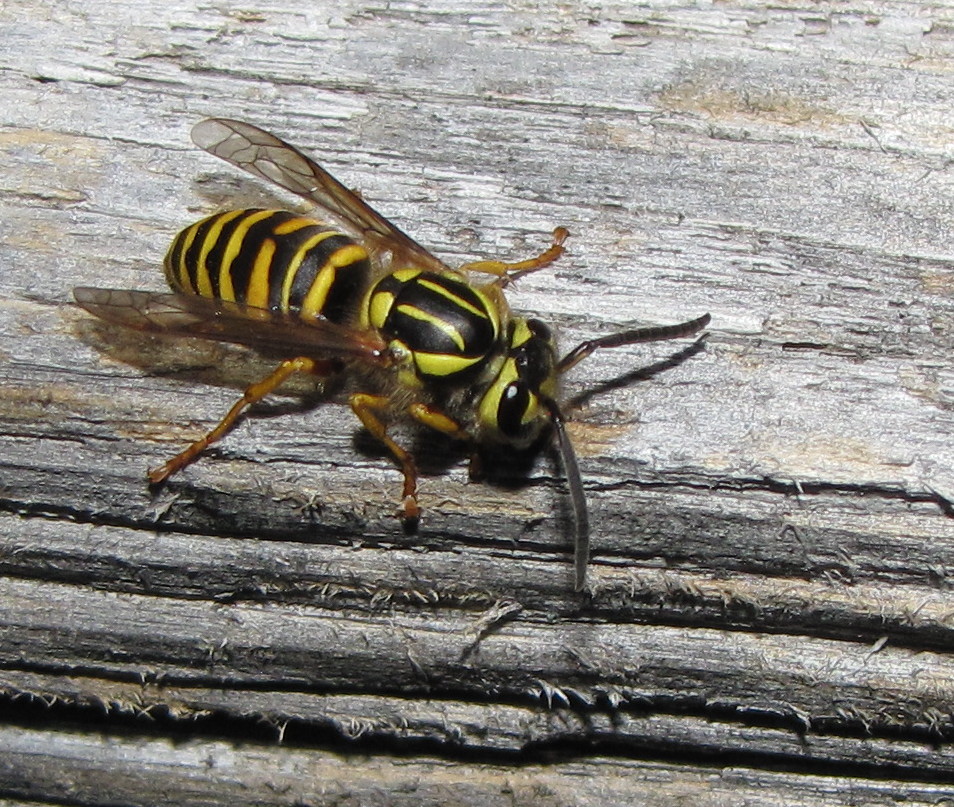
Southern Yellowjacket worker from Ohio, USA

Competition for optimal, concealed nesting sites can be keen, so social parasitism may have evolved as one way to solve this problem. Eastern Yellowjackets typically nest in abandoned rodent burrows and similar cavities, but they can also nest in wall voids of human structures. It is telling that colonies of this species in disturbed habitats and urban and suburban locations appear to be the most vulnerable to being taken over by Southern Yellowjacket.

The Southern queen typically invades an embryonic nest of its host, dominating, evicting, or killing the resident queen. There may or may not be any host workers at the outset, but eventually the nest is converted entirely to Southern Yellowjacket workers. Evidence of the host remains in the differing architecture of the nest. Southern Yellowjacket is a significantly larger insect than Eastern Yellowjacket, so the cells in the paper combs of the nest differ accordingly.
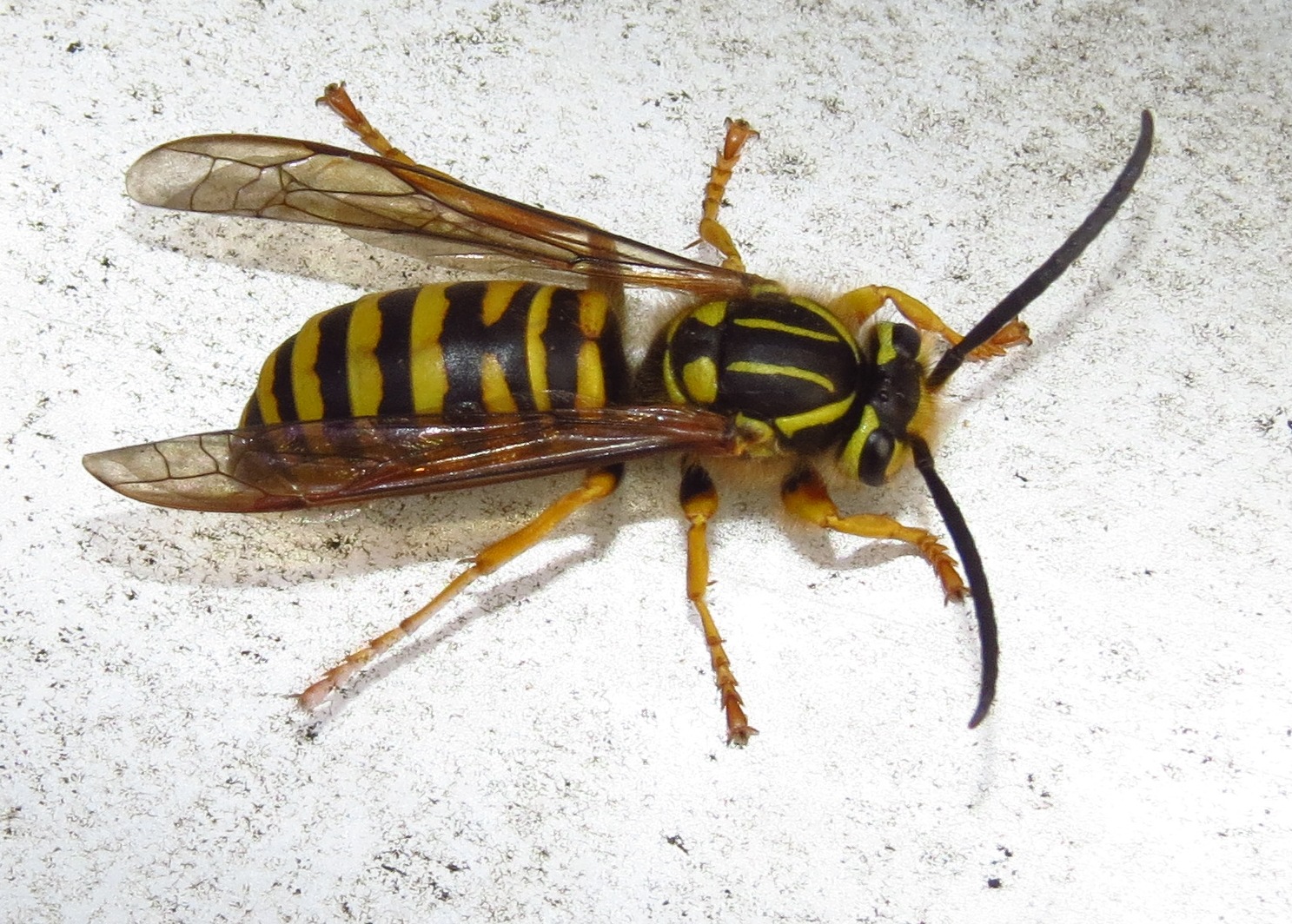
Southern Yellowjacket male from Tennessee, USA

A mature nest of Southern Yellowjacket, persisting into late autumn, may contain an average of 5,000 cells. That is a lot of wasps! Southern Yellowjacket is not inherently more aggressive than most other yellowjacket species in defense of their nest, but more workers means a greater response to disturbance. You may want to inspect your yard carefully before using any powered tools that could cause vibrations and spark a yellowjacket offensive.

Southern Yellowjacket ranges from the Great Lakes to the Atlantic coast south of New England, to Florida, and west to Iowa, Kansas, and most of eastern Texas. It also occurs in southern Mexico and Guatemala, making it quite literally our southernmost species of yellowjacket.

Sources: Akre, R.D., A. Greene, J.F. MacDonald, P.J. Landolt, and H.G. Davis. 1980. Yellowjackets of America North of Mexico. U.S. Department of Agriculture, Agricultural Handbook No. 552, 102 pp.
Kratzer, Chris Alice. 2022. The Social Wasps of North America. Frenchtown, New Jersey: Owlfly Publishing, LLC. 417 pp.

Thursday, March 24, 2022

Book Review: The Social Wasps of North America

Chris Alice Kratzer’s new guide to The Social Wasps of North America stands to revolutionize the future of field guides. It certainly sets a new standard in many ways, through methodology, organization, and sheer honesty. It is my pleasure to recommend this wonderful reference without reservation.

This is a self-published book from Owlfly Publishing, one arm of Kratzer’s company, Owlfly, LLC. The other branch is an engineering firm. Kratzer has not only avoided all the usual pitfalls of self-publishing, she has taken great pains to make every aspect of that enterprise respectful and sustainable, right down to her choice in the packaging vendor she uses.

Why is this book so unique and important? Perhaps the most obvious feature is the geographic coverage. Kratzer rightly defines North America as everything north of South America. Most natural history publishers, and authors, would consider that to be overly ambitious, confusing, and impossible to execute given the increased biodiversity south of the Mexican border. It helps to choose a taxon that has relatively limited diversity, and social wasps in the family Vespidae do fit the bill nicely. However, one should not overlook the statement this book makes about inclusiveness. This book is useful to indigenous peoples in those other nations, as well as people traveling from other places. A Spanish translation, in digital format, will be available by the end of 2021, but if a publishing house is interested in producing a hard copy, please contact Kratzer at Owlfly Publishing.

This book also marks a return to illustrations, rather than photographs, as the best means to visually communicate each species. Kratzer is a master of digital renderings. Social wasps are maddeningly variable in color pattern, so she ingeniously fused the most common xanthic (mostly yellow) and melanic (mostly black/dark) forms of each species into a single drawing, capitalizing on the bilateral symmetry of her subjects to do so. Brilliant. Kratzer essentially crowdsourced her references by utilizing pinned specimens from many curated collections, and images of living specimens from the iNaturalist web portal. She gives credit to every single individual who furnished the material. Unheard of. Each species account includes female and male examples, plus queens, where relevant. Range maps are included. Photos of living specimens, and their nests, are featured under descriptions of the genera.

© Owlfly LLC

The first seventy or so pages of the book serve as an introduction and overview of social wasps, their biology, role within ecosystems, and how they impact humanity. This alone is worth the price of the book. The writing is outstanding in accuracy and honesty:

“All of the information in this book is wrong. All of it. Wasps are an appallingly understudied group of organisms, to the point that even this book – the most complete visual guide of social wasp to date – is built precariously upon the edge of a vast, unsolved jigsaw puzzle.”
The grammar is impeccable, and the tone is exceptionally friendly and empathetic, even to those readers who want nothing to do with wasps. It is easy for someone with an affinity for maligned animals to be unintentionally hostile towards those who do not share the same perspective and opinions. Kratzer is going to make many more “friends of wasps” with this book. Did I mention that there is also a glossary and extensive bibliography with links to online versions of actual scientific papers?

Overall, Kratzer’s embrace and navigation of the scientific ecosystem, inclusive of both academic professionals and well-informed non-professionals, is admirable and even ground-breaking. Rarely does one find a reference or author/illustrator so worthy of emulating. Maybe David Sibley and Kenn Kaufman, but add Chris Alice Kratzer to the list.

Are wasps not your thing at all? Stay tuned for Kratzer’s next effort, a guide to North American cicadas, in the works as I write this. Meanwhile, order The Social Wasps of North America for a friend, directly from Owlfly Publishing.

Saturday, July 29, 2017

One of These is Not Like the Others....

Sometimes, even with your book-learned knowledge, it takes you a moment to recognize something when you see it firsthand. Such was the case when my wife and I encountered a softball-sized nest of the Aerial Yellowjacket, Dolichovespula arenaria, under the eave of a small building in Green Mountain Falls, Colorado, on July 10. Worker wasps were coming and going as they should, but another wasp was periodically emerging, too, and it was not like the others.

The other wasp was larger than the workers, and instead of being black and yellow, it was black and white. It eventually dawned on me that I was witnessing a social parasite in action. The black and white wasp was a female Dolichovespula arctica (aka Dolichovespula adulterina). Her species has no worker caste like the Aerial Yellowjacket, only reproductive females, and males.

The Aerial Yellowjacket is the primary host species for this social parasite. The D. arctica female infiltrates an existing colony of the host, when it is underway but before worker wasps have emerged from the pupa stage. The parasite does not usually kill the host queen immediately, but waits until she has produced a fair number of workers. She may also evict the queen, or follow her around and eat the eggs she lays in the cells of the paper comb. By the time workers of the host species have matured, they serve as a workforce to raise the offspring of the social parasite. It is a subtle form of slavery of which the host species seems unaware.

Why the female D. arctica repeatedly emerged from the interior of the nest to wander around on the exterior paper envelope is a mystery to me. Perhaps the workers tolerate her only for short periods, and her foreign scent would overwhelm the normal colony odor if she lingered longer inside?

The parasite is probably fairly common, but seldom seen. The species ranges from Alaska and throughout Canada save for the Nunavut Province, south to the northern U.S. and along major mountain ranges to Kentucky, Georgia, Arizona, and California. It appears to be limited to high elevation coniferous forest habitats here in Colorado; and that is probably the case over much of the United States.

Lest you feel saddened about the fate of the host colony, remember that worker yellowjackets are still capable of laying unfertilized eggs that ultimately give rise to males of the species. So, the host colony can still reproduce, but is limited to liberating only males during the late summer reproductive season.

Take a moment when you encounter insect activity, what it reveals over even a short period of time may surprise you. Even nests of social wasps can be approached quite closely, as long as you do not jar the nest or otherwise create hostile vibrations. I had to get very close with my camera because my flash was not working. Not once was I even harassed by a worker wasp.

Sources: Akre, Roger D. et al. 1980. Yellowjackets of America North of Mexico. U.S. Department of Agriculture, Agriculture Handbook No. 552, 102 pp.
Buck, M., Marshall, S.A. and Cheung D.K.B. 2008. Identification Atlas of the Vespidae (Hymenoptera, Aculeata) of the northeastern Nearctic region. Canadian Journal of Arthropod Identification No. 5: 492 pp. (PDF version). Published on 19 February 2008.
Evans, Howard E. and Mary Jane West Eberhard. 1970. The Wasps. Ann Arbor: University of Michigan Press. 265 pp.