Showing posts with label grasshoppers. Show all posts

Tuesday, September 26, 2017

Grasshopper or Locust?

A person on a Facebook insect identification group recently asked a very good question about the difference between a grasshopper and a locust. You would think it is pretty straightforward, but not so fast.

The American Bird Grasshopper, Schistocerca americana, is related to some grasshopper species in Europe and Africa that can become locusts; and it sometimes migrates beyond its usual geographic range in the U.S.

Most of us think of locusts in the context of Biblical plagues in Africa and parts of Europe, in ancient times. Such plagues still happen, and they are almost apocalyptic in their destructiveness. They even occur in North America on occasion, as well as other parts of the world, so there must be more than one species of locust, right? Yes, and no.

Two-striped Grasshopper, Melanoplus bivittatus, has been overwhelmingly abundant in recent years along the Colorado Front Range

Locusts are not a species of grasshopper, they are the result of overcrowding in the nymph stage of many kinds of grasshoppers. Under favorable conditions, there is an extraordinary survival rate of young grasshoppers, which are called nymphs. When they are literally so abundant and concentrated that they are rubbing elbows (well, "knees" is probably a more appropriate term), this friction causes them to detour from their normal route of metamorphosis.

Instead of maturing into the usual grasshopper, the adult stage features longer wings and other body modifications that permit them to fly greater distances, remain airborne for longer periods, and to undertake these migrations from one food source to the next over long distances. They also may be aided by winds ahead of storm fronts.

The Clear-winged Grasshopper, Camnula pellucida, is prone to population outbreaks in the American West

This is something of a simplification of the physiology of locusts versus normal grasshoppers, but a surprising number of species have the potential to morph into locusts when conditions are right. Then they overwhelm the landscape, defoliating every plant in their path.

Locust swarms will devour plants they would not normally eat. I recall a presentation about a locust epidemic in Oregon where the scientist showed slides of juniper trees (yes, juniper trees) that had been reduced to skeletons by grasshopper swarms. The locusts have even been known to eat garments on clotheslines. Grasshoppers are also omnivores, and will not hesitate to eat dead members of their own species, or gnaw on injured or even healthy ones. It is late in grasshopper season here now in Colorado, and I regularly see grasshoppers with wings reduced to stubs thanks to hungry comrades.

A victim of the grasshopper-killing fungus Entomophaga grylli

Fortunately, for us at least, grasshoppers face many mortality factors. While it has been a banner year for grasshoppers this year along the Colorado Front Range, huge numbers have succumbed to the entomopathic fungus Entomophaga grylli. The insidious fungus grows inside the insect, eventually commandeering its brain and forcing it to behave abnormally. The grasshopper, through no will of its own, climbs to the top of a tall weed, assumes a death grip embracing the stem, and dies. The fungal spores then erupt and rain down on healthy grasshoppers below to begin the cycle again. The spores may even decapitate the dead grasshopper as they exit.

Grasshoppers are the chief grazers of the prairie, even more impactful than livestock, deer, pronghorn, elk, and bison. Natural rangeland can usually withstand their feeding, but ranchers obviously see them as competition and exercise chemical controls when necessary. Since grasshoppers are mostly generalist feeders (a few specialize on only certain broadleaved plants), they pose a threat to agricultural crops, too.

A specimen of the extinct Rocky Mountain Locust
© Bugguide.net

Ironically, the Rocky Mountain Locust, Melanoplus spretus, once the most abundant and devastaging insect pests ever to occur in North America, is now extinct. The book Locust, by Jeffrey A. Lockwood, chronicles the rise and dramatic fall of the species, which ultimately vanished from the U.S. landscape by the early 1900s. I will not spoil the solving of the mystery, as Lockwood's account is far more riveting than anything I could craft if I was even prone to writing historical fiction. Let us just say it is a cautionary tale.

Historical range of the Rocky Mountain Locust

We can certainly be grateful that we seldom experience such traumatic explosions of grasshoppers here on American soil, but we should be empathetic to other nations that do. Entire economies can be on the verge of collapse in the wake of such devastation.

Source: Lockwood, Jeffrey A. 2004. Locust. New York: Basic Books (A member of the Perseus Books Group). 294 pp.

Friday, October 7, 2016

The Great Grasshopper Hunt II

I am terribly behind in chronicling field experiences I have participated in this summer, including the second annual(?) "grasshopper hunt" co-sponsored by Mile High Bug Club and the Aiken Audubon Society. Our first one was held last year at Homestead Ranch Regional Park near Peyton, Colorado. This time we opted to head farther south and a little farther east to Chico Basin Ranch; and we were led by grasshopper expert Bill Maynard.

Our intrepid participants © Bell Mead

The ranch is a sprawling 87,000 acres that straddles the El Paso and Pueblo County line. Its wide array of habitats, from sandhills to artificial wetlands, makes for high biodiversity, especially among insects and grasshoppers in particular. In only a few hours our party of roughly ten people observed forty (40) species of grasshoppers, plus many other insects and arachnids.

Pink form of the Broad-banded Grasshopper, Trimerotropis latifasciata

Bill is rather new to the study of grasshoppers, but he quickly masters many aspects of natural history. He is already recognized as a leading authority on birds and dragonflies, with many state and county records to his credit. It is only a matter of time before the same can be said of his expertise in the order Orthoptera to which grasshoppers belong.

Rather than overwhelming you with images here, I will direct you to the Mile High Bug Club Flickr Group where you can peruse the image collection at your leisure.

Snakeweed Grasshopper, Hesperotettix viridis

We would be remiss if we did not also acknowledge the hospitality of the Chico Basin Ranch staff, especially Tess Leach and her family. Her two children were especially curious, and remarkably patient and gentle in their approach to the many grasshoppers we saw.

Three-banded Grasshopper, Hadrotettix triafasciatus (foreground), signaling to a Broad-banded Grasshopper (background) to get out of its territory

The intense heat of that August 6 day sent some members of our party packing by about noon, but who could blame them? The Plains Harvestfly, a type of cicada, made it seem hotter still with its loud, oppressive buzz. All in all, the "expedition" was a resounding success, and no vehicles or people were injured during the odyssey.

Plains Harvestfly, Neotibicen dealbatus

While plains and deserts are prime habitats for grasshoppers, you can find them nearly everywhere. You will be surprised by the number of species you can discover in your own backyard, neighborhood park, vacant lot, or any other patch of wildness. Even now, with the first frosts approaching, grasshoppers are among the few insects left in any abundance. Go take a look for them.

Saturday, December 5, 2015

New Mexico Dragonfly Blitz - Day 4

The plan for Sunday, August 30, was to visit The Nature Conservancy's Mimbres River Preserve, appropriately located on a former ranch along the Mimbres River. The morning dawned bright and warm, but a violent thunderstorm had run over City of Rocks State Park the night before, and many of those camped there were literally swamped by water gushing through their campsites. So, we had fewer party members as a result.

The preserve is located off highway 35, but the entrance is not terribly conspicuous. A wonderful old barn marks the trailhead, and it is a short walk to the edge of the Mimbres River.

We did not see any new dragonflies or damselflies, but there were plenty of other insects to catch our attention. A Questionmark butterfly was basking on the trunk of a cottonwood, for example.

Questionmark butterfly

Caterpillars of the American Dagger Moth, Acronicta americana, were abundant in the vicinity of box elder trees.

American Dagger Moth caterpillar

Largid bugs, Stenomacra marginella, were in extreme abundance on the foliage, stems, and flowers of Seep Willow, Baccharis salicifolia, along with aphids and insects attracted to aphid honeydew (the sweet, sticky liquid waste product of aphids).

Largid bugs mating

I also found a specimen of Yarrow's Grasshopper, Melanoplus yarrowii, a species I had not seen before.

Yarrow's Grasshopper (male)

Would you believe there was a mushroom sprouting in the riparian zone? The contrast between the moist, shady riverbank and the arid grassland adjacent to it was quite stark.

"Shaggy Mane" mushroom

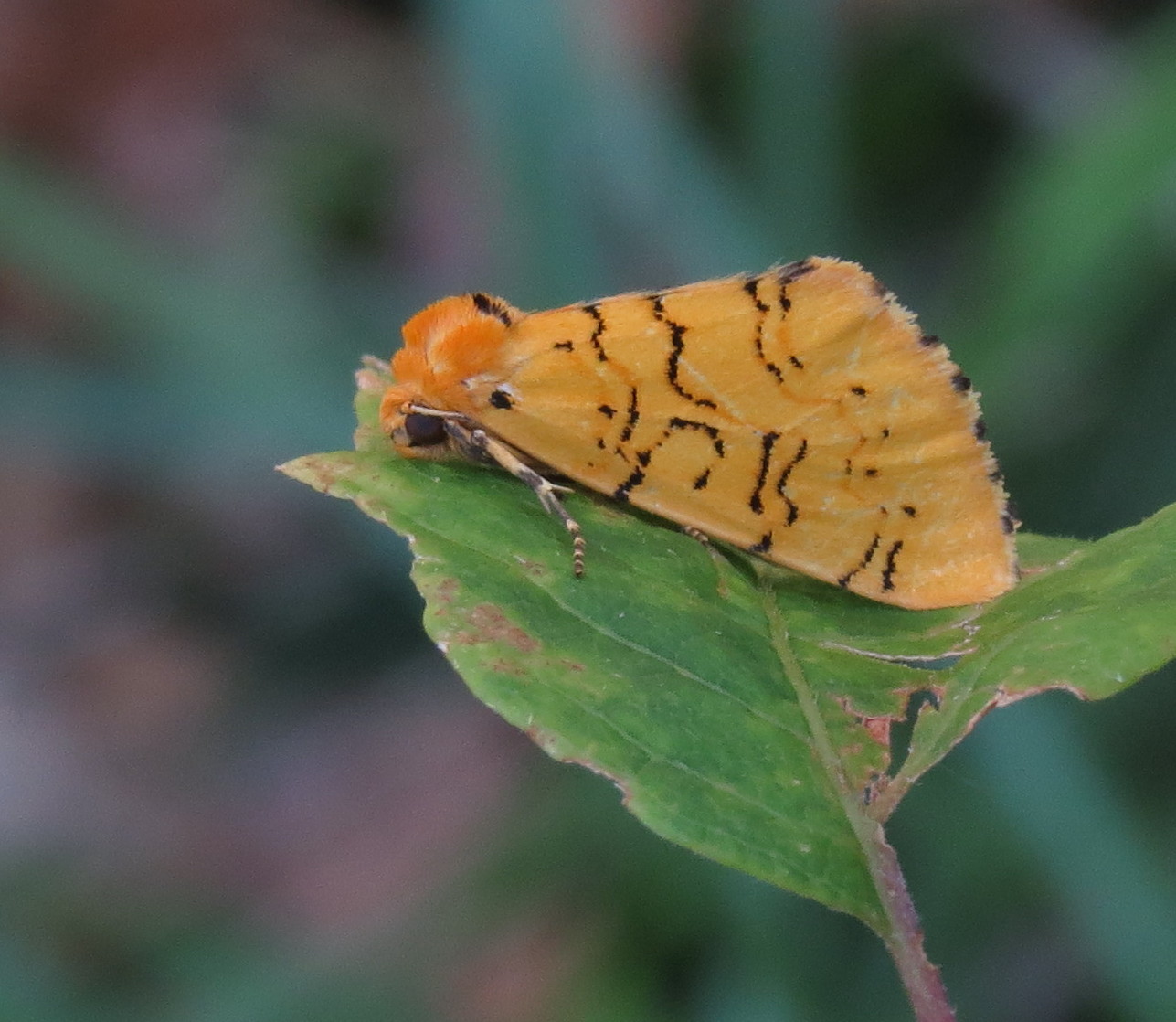
One of the more colorful finds of the morning was this lovely orange owlet moth,Chrysoecia atrolinea.

Owlet moth, Chrysoecia atrolinea

From the Mimbres River Preserve we progressed up the road to Bear Canyon Reservoir. There, we picked up some of the more common and widespread dragonfly species that had eluded us until then. That included a Widow Skimmer and two Eastern Amberwing dragonflies.

Some of our best photo opportunities for Flame Skimmers came here, too.

male Flame Skimmer

Meanwhile, I found the Ridged Grasshopper, Conozoa carinata, occupying the parking area.

Ridged Grasshopper

Also conspicuous were a couple of Plains Lubber grasshoppers, Brachystola magna, the largest grasshoppers in that area of New Mexico.

Plains Lubber grasshopper

Did I mention that Heidi also fished a Wheel Bug, Arilus cristatus, out of the lake? These large assassin bugs are always a treat to find, especially here in the west where they are less common than in the plains and canyons of the southern Midwest.

Wheel Bug

Bear Canyon Reservoir was our last "official" destination, and from there we all went our separate ways, concluding a most successful event in every sense of the word. We found lots of interesting species, some of them county records, and made many new friends. This could well become an annual event.

Heidi and I decided to go back to City of Rocks State Park to explore some more, and find some geocaches. We were rewarded with some spectacular wildlife. Heidi has very sharp eyes, and she spotted a pair of Great Horned Owls in one of the few trees scattered between the rock formations.

One of two Great Horned Owls

We also saw a couple of Northern Mockingbirds, Canyon Towhee, and Blue Grosbeak.

Another stand of blooming Seep Willow near the park's campgrounds was humming with insect activity, including Queen and Bordered Patch butterflies, tarantula hawks and other spider wasps, scoliid wasps, and various flies.

Queen butterfly

Thomas' Two-striped Grasshopper, Melanoplus thomasi, caught my eye due to its rather large size, and the fact that it is blue!

Thomas' Two-striped Grasshopper

We decided to drive up the Observation Road to get a scenic view, but I was quickly distracted by the variety of grasshoppers living on the top of the hill. Heidi managed to spy something even more cryptic: a Texas Horned Lizard. Make that two Texas Horned Lizards. These remarkable reptiles are specialist predators on harvester ants.

One of two Texas Horned Lizards

I could do an entire blog post on the grasshoppers I found in about an hour on that hill, but here is some eye candy to give you an indication of the diversity.

Regal Grasshopper,Melanoplus regalis
Rainbow Grasshopper, Dactylotum bicolor
Wheeler's Blue-winged Grasshopper, Leprus wheeleri
Great Crested Grasshopper

Our entire experience in southeast New Mexico was highly enjoyable, and we still had the evening to come and the drive back home to look forward to. Stay tuned, there is more excitement to come.

Thursday, October 1, 2015

The Grasshopper Hunt

The Aiken Audubon Society here in Colorado Springs asked me to speak at their September monthly meeting, and to lead a field trip beforehand. I chose the topic of grasshoppers since there is so much diversity here. The field trip was to Homestead Ranch Regional Park near Peyton, Colorado (El Paso County). I was surprised and delighted by the turnout, and the interesting animals we encountered.

Carolina Grasshopper basking

We were fortunate to have two young men, Seth and Zach Vogel, and their father, Tim, along for the trip. The boys helped find many more animals than we would have were we left to my own devices. They have a keen eye, endless stamina, and great enthusiasm. Tim employed a GoPro® camera to record parts of the expedition in this video.

© Tim Vogel

The Mile High Bug Club was represented by Bell Mead and myself; and Aiken Audubon by Jeannie Mitchell, Leslie Holzmann, and Bill Maynard. Alison Kondler even came down from the Denver area. Thankfully, the weather was sunny, but not too hot.

Plains Lubber grasshopper

We had not even made it beyond the playground and picnic shelter before we saw Carolina Grasshoppers basking on the pavement, and the boys had found an enormous Plains Lubber Grasshopper, Brachystola magna. The latter brought out the "'hopper-razzi," cameras clicking away.

Plains Lubber grasshopper draws a crowd

Further along the trail through grassy habitat on a gentle slope, we encountered several species of spur-throated grasshoppers in the genus Melanoplus, plus Pallid-winged Grasshoppers (Trimerotropis pallidipennis), and the Northwestern Red-winged Grasshopper, Arphia pseudonietana.

While I was explaining how to identify a particular species, the boys brought over a really nice find: a male Mormon "Cricket." The Mormon Cricket, Anabrus simplex, is not a true cricket, nor a grasshopper, but a kind of shield-backed katydid.

Mormon "Cricket" male

Seth and Zach located these large insects by homing in on their "song," a kind of buzzing sound produced by the males rapidly rubbing their short wings together.

We entered a narrow zone of pine trees near the summit of the slope we were traversing, and that brought us another species of grasshopper, apparently confined to that wooded habitat. The Kiowa Grasshopper, Trachyrhachys kiowa, is another of the "band-winged grasshoppers" named for the dark band on the colored hind wing. The hind wings are only visible when the insect flies, and most grasshoppers fly only short distances before landing and once again becoming nearly invisible owing to their superb camouflage.

Kiowa Grasshopper with hind wing spread

Band-winged grasshoppers can make noise in flight. This is called "crepitation," and is a rattling or crackling sound, presumably as front and hind wing rub together....but the sound can be produced at will, so it is something of a mystery how it is produced.

The hill terminates in a rolling plateau, and the grassland changes a bit in composition. Here we heard slant-faced grasshoppers, hidden from view. Slant-faced grasshoppers cling to vegetation in the vertical plane rather than crawling on the ground like band-winged grasshoppers usually do. They produce sound not by crepitation but by "stridulation." The male grasshopper rubs the inside surface of his hind femur ("thigh") against veins of the folded front wing. The result is a "zip-zip-zip" kind of song.

We ended our hike at a circular water trough for horses and cattle, fed by a well with a windmill pump. The water looked awful, but was full of life. It took no time at all for Zach to spy a Barred Tiger Salamander (Ambystoma mavortium), one of at least two inhabiting the pool.

Barred Tiger Salamander

There were also water striders (insect family Gerridae), backswimmers (Notonectidae), diving beetles (Dytiscidae), and a Giant Water Scavenger Beetle, Hydrophilus triangularis (family Hydrophilidae). Various dragonflies circled as well.

Giant Water Scavenger Beetle

Everyone appeared delighted by the whole adventure, and I am very happy to see what is apparently a growing demand for field outings geared to organisms other than birds, or at least in addition to birds. I would very much like to do more of this kind of thing, all over the U.S., so keep those invitations coming!

Sunday, September 27, 2015

The Tarantula Hunt

Heidi and I had the pleasure of going on a hunt for tarantulas on Labor Day, September 7, with Megan Miller, Jordan Spalding, and Bell Mead. Thanks to Ryan Nefcy, we learned of a location in Pueblo County, Colorado where one can reliably find tarantulas, genus Aphonopelma. Not only did we have success, but we found some other spiders, too, as well as some spectacular grasshoppers.

There are at least four species of tarantulas found in Colorado, and although we suspect the ones at the Pueblo County location are Aphonopelma hentzi, we would need to perform invasive procedures on a spider's genitalia to know for certain. The single specimen Megan collected is alive and well as we speak.

Occupied tarantula burrow

Bell has a keen eye for detecting tarantula burrows, which are surprisingly small and cryptic, hidden among tangles of desert grassland vegetation. Occupied burrows are covered with a thin film of silk by day. Sometimes, the remains of insect prey are scattered around the burrow entrance, too. Still, it takes skill to spot the holes.

Bell "fishing" for a tarantula while Heidi looks on

It takes even *more* skill to "fish" the occupant from her lair. Bell is highly skilled at this, and Jordan was able to capture the procedure in a video. Everyone was shocked to see such a large arachnid erupting from such a small tunnel. Whether a given spider is mature or not is difficult to assess. Male specimens change drastically in appearance upon their final molt into maturity, but females do not; and tarantulas are among the very few spiders that continue to molt after they reach adulthood.

Megan admiring the spider that Bell fished out
Megan's tarantula up close (© Megan Miller)

Upon returning home, Megan set up a spacious terrarium to house her new friend. Since tarantulas are in high demand in the pet trade, we agreed that we would not disclose the exact location that we visited. We thank Ryan for sharing his "spot" even with us. Thank you for trusting!

Megan's tarantula (© Megan Miller)

We found three occupied burrows altogether, but could only lure the one spider out. We did find other kinds of spiders, though. Before we had even ventured from the vicinity of our parked cars, we came across a lovely orange jumping spider, Phidippus apacheanus. It is thought that this species might mimic velvet ants, wingless female wasps that pack a very painful sting. They certainly share the wasp's bright "warning colors" of black and orange.

There were also Western Black Widows, and two kinds of orbweavers. This Banded Garden Spider, Argiope trifasciata was a highlight of the trip. Despite her size she was difficult to spot in her web in dense, tall grass.

Banded Garden Spider

Heidi had an easier time noticing another giant, a female Black and Yellow Garden Spider, Argiope aurantia. This species seems to prefer slightly more "open" situations, but still build their webs relatively close to the ground. Both species of Argiope can easily handle grasshoppers and other large, strong prey that become entangled in their snares.

Black & Yellow Garden Spider

Grasshoppers certainly were plentiful, and diverse. They scattered at every step: Carolina Grasshopper (Dissosteira carolina), Two-striped Grasshopper (Melanoplus bivittatus), and Two-striped Mermiria (Mermiria bivittata) being among the most conspicuous. I also finally got images of the Ebony Grasshopper, Boopedon nubilum, and Saussure's Blue-winged Grasshopper, Leprus intermedius. Black-winged Grasshoppers, Trimerotropis melanoptera,also made an appearance.

Leprus intermedius with hind wing spread

As we were leaving, Jordan suddenly jumped and exclaimed that a very large insect had collided with him after it leapt from the ground beneath his feet. Upon investigating we found a spectacular female specimen of the Green Bird Grasshopper, Schistocerca shoshone. This was the first one I have seen in Colorado.

Green Bird Grasshopper

We concluded our expedition with a well-earned visit to the Dairy Queen back along the interstate at Pueblo. As we sat down I noticed a small spider on the outside of the window. Tired and hungry, I nearly dismissed it as "just another orbweaver." I am glad I took time to double check. It was a mature pirate spider, family Mimetidae, perhaps Reo eutypus, though I can't be positive. You just never know *what* you will find, or where you will find it! Many thanks to my partners in crime. You all rock.

Pirate Spider from Dairy Queen

Friday, April 17, 2015

How Insects Sing

Observing the insect world requires one to use not just their vision, but their hearing, too. Many insects use sound to communicate with each other, or to ward-off enemies by startling them with a sudden, audible noise. How do insects make such a racket, anyway?

Male field cricket, Gryllus sp., Arizona
Stridulation

Most insects produce sound by rubbing one body part against another, a phenomenon known as "stridulation." The most accomplished stridulators are, of course, the members of the order Orthoptera. Most male grasshoppers, katydids, and crickets have modifications of the body that allow them to create, amplify, and broadcast auditory signals to attract mates and/or ward-off competing males.

Male larger meadow katydid, Orchelimum sp., singing in Nebraska

Short-horned grasshoppers in the family Acrididae rub special pegs on the inside surface of the hind femur ("thigh") against raised veins on the front wings while the insects are at rest. Slant-faced grasshoppers (subfamily Gomphicerinae) are especially accomplished at this and their soft zip-zip-zip songs are easily heard during daylight hours. Below is a video of a male Psoloessa grasshopper stridulating vigorously. Unfortunately, the incessant prairie winds on the eastern Colorado plains overwhelm the 'hopper's song.

Male Psoloessa sp. grasshopper stridulating

Band-winged grasshoppers (subfamily Oedipodinae) also stridulate, but not as loudly. You are more apt to see two males sizing each other up instead of a male courting a female. In the video below, two male Carolina Grasshoppers stridulate aggressively, side-by-side, until the loser leaves the stage.

Male Carolina Grasshoppers, Dissosteira carolina, stridulating aggressively

Katydids and crickets are the most accomplished of all stridulating insects, in part because the wings of the male insect are highly modified to produce sound; and the insect often stations itself in a circumstance that enhances the projection of sound, such as the mouth of a burrow, or between leaves.

Male tree cricket, Oecanthus sp., singing, Colorado
Male tree cricket at rest

Most male katydids are "left-handed," meaning that the left forewing overlaps the right forewingwing. Contrastingly, most male crickets are "right-handed." In both cases, the edge of one wing is equipped with a "file" of fine teeth, while the other wing has a bladelike "scraper" that is drawn rapidly over the file to create the song.

Singing male field cricket, Gryllus sp., Colorado

The songs we hear most often are "calling songs" designed to attract females; but, crickets in particular produce two other types of songs: a "rivalry song" that is directed at another male during and/or after a confrontation, and a soft "courtship song" to entice a female into mating.

Male Drumming Katydid, Meconema thalassinum, Ohio
Percussion

A surprising variety of insects, from treehoppers to stoneflies, to beetles actually smack body parts against a substrate such as a leaf or twig to generate vibrations that are received by potential mates. Sometimes these body-slamming signals are also audible. The Drumming Katydid, Meconema thalassinum, and "wing-tapper" cicadas in the genus Platypedia do not produce sound the way most other members of their clan do. Instead, they strike a blow against a branch, leaf, or twig to call to the opposite sex. This is still audible to us, too.

Wing-tapper cicada, Platypedia putnami, Colorado

Males of most cicada species have a pair of built-in percussion instruments. Large pits take up most of the volume of the abdomen and are covered by "lids" called opercula (singular: operculum). Inside each chamber, a strong muscle pulls and releases another organ called a tymbal. The tymbal buckles under the muscle's tug, generating a noise, then snaps back when the muscle relaxes, making another noise. The muscle twitches at such a high rate that we hear one continuous sound, and a very loud one at that.

Underside of male Tibicen sp. cicada showing operculum
Hearing

How do the insects hear each other? Insects do not have ears, per se, but they do have auditory receptors called typmana located in peculiar places. Short-horned grasshoppers have an opening on each side of the abdomen, near the base. Cidadas likewise have their typana located in the front section of the abdomen. Katydids and crickets have a slit located on the front surface of the tibia ("shin") on each front leg. The tympana is usually represented as a thin, oval membrane located inside the "ear" opening.

Greater Anglewing Katydid, Microcentrum rhombifolium, showing "ear"
Resources

Many singing insects can be identified reliably only by differences in their songs, so it helps to familiarize yourself with their calls. Thankfully, a variety of resources are available to do just that. The "Singing Insects of North America" website is particularly useful. Examples of songs are available as audio files for most species.

Male conehead katydid, Neoconocephalus ensiger, singing, Massachusetts

Lisa Rainsong's superb scientific blog "Listening in Nature" covers bird songs, frog choruses, and other sounds of nature as well as insect songs.

Several books exist that address insect songs, but my two favorites are The Songs of Insects by Lang Elliott and Wil Hershberger (2007, Houghton Mifflin Company), and Crickets and Katydids, Concerts and Solos, by Vincent G. Dethier (1992, Harvard University Press).

You should be hearing field crickets any time now, if you aren't already, along with the daytime calls of some acridid grasshoppers. Enjoy the symphony.