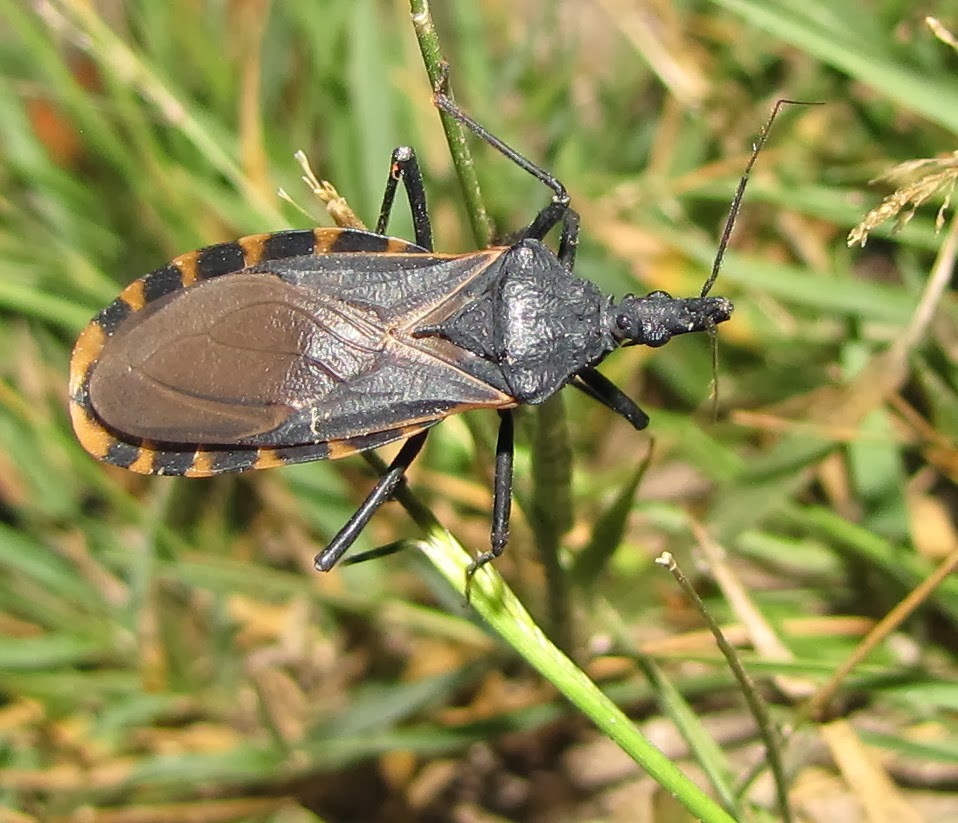
Showing posts with label biting. Show all posts

Friday, February 19, 2016

Bite of the Black Fly

It happened at the zoo. I was parked innocently opposite the African Elephant yard, with the window rolled down on this nice late afternoon of September 19, 2015, waiting for Heidi to get off work. I noticed a tiny fly had flown into the car, but was truly shocked to see it was a female black fly, likely a species of Simulium....and she wanted my blood.

She got it, too, because I so rarely see members of the family Simuliidae, let alone adult females. I was able to get some respectable images of the 3-4 millimeter vampire precisely because she was occupied pumping blood out of my knuckle. What was she doing here, though?

I was under the mistaken impression that black flies, also known as "buffalo gnats" and, here in Colorado at least, "turkey gnats," seldom venture far from fast-flowing streams and rivers. That is because they spend the egg, larva, and pupa stage of their lives in aquatic torrents. It occurred to me that the elephant yard does have a waterfall, and I would bet that black fly larvae live on the very edge of that artificial cataract.

Well, I have since learned that female black flies are perfectly capable of flying miles in search of a blood meal. There are some records in Canada of black flies migrating over ninety (90) miles from where they grew up as larvae.

Only the female black fly bites. Like mosquitoes, she needs the protein for the proper development of her eggs; and she can lay several hundred eggs in her two- or three-week adult lifespan. Unlike mosquitoes, black flies do not have beak-like mouthparts to extract blood from our capillaries. Black flies slice you open with knife-like mouthparts, then lap up what spills out.

Depending on the species, the black flies lay their eggs on vegetation or other objects in the water, under the water, or scatter them on the water's surface. Interestingly, freshly-laid eggs apparently produce a pheromone (scent) that attracts other adult female flies of the same species, and stimulates them to lay their eggs in the vicinity.

The larvae that hatch spin silken pads on the surface of stones or vegetation in the middle of flowing water. They then anchor themselves to the silk pads with special hooks on the rear of the abdomen. The larvae feed in a unique manner, by deploying a pair of "cephalic fans" that intercept organic particulates from the current. Larvae molt 7-11 times.

Black fly larvae in Arizona

At the end of its larval life, the creature spins a silken bag in which it will pupate. The tapered rear of the bag points upstream into the current, while the wider, open portion projects downstream. The larva molts one final time to reveal a resting stage with branching gills that may reach beyond the lip of the silken bag.

Black fly pupae in Arizona © Tony Palmer

The adult fly emerges in a few days or so, rising to the water surface in an air bubble and floating to an emergent object it can climb onto and finish expanding its wings and hard its exoskeleton. The total time from egg to adult takes roughly 3-4 weeks and is heavily influenced by water temperature. The colder the water, the longer the life cycle. There can be three or four generations per year; winter is typically spent in a dormant larva stage.

Male black fly (note huge eyes meeting at top of head)

There are about forty species of black flies in Colorado, in three genera: Simulium, Prosimulium, and Metacnephia. Different species live at different elevations, and on different sides of the Continental Divide. Surprisingly, the majority are not pests of people or livestock, preferring to feed on birds and other wildlife.

The species that do afflict horses, cattle, poultry, and people can cause severe distress, and may carry diseases. I will spare you the agonizing details of suffering incurred by victims of black fly attacks, as there is no end to the resources where you can learn such information if you are so inclined.

Suffice it to say that it pays to be prepared with an excellent insect repellent if you plan to be in black fly territory. Prevention is always the best tactic for battling *any* bloodsuckers. Take care.

Female black fly on Feb. 24, 2014

Sources: Bechinski, Edward John, and Marc J. Klowden. 2005. Black Flies - Biology and Control. Division of Entomology, University of Idaho (available online as a PDF).
Cranshaw, W.S., F.B. Pearis, and B. Kondratieff. 2013. Biting Flies. Colorado State University Extension. Fact Sheet 5.582.
Kuhn, Dwight. "Black Flies - Life Cycle," Kuhn Photo.

Friday, January 29, 2016

The Stable Fly

Of all the biting flies we have in North America, one of the most annoying has to be the Stable Fly, Stomoxys calcitrans. They are especially abundant around farms, ranches, zoos, and other places where large mammals are kept. Unfortunately, they will also bite people when livestock is not close at hand.

Like any notorious villain worth their salt, the Stable Fly has it aliases: "beach fly," "dog fly," and "lawn-mower fly" among them. The insect has also fled local jurisdiction. It is apparently native to Eurasia and Africa, with speculation that it probably came to the New World in colonial times, maybe in ship's ballast.

The Stable Fly is easily dismissed as a House Fly under cursory examination. Both flies are in the family Muscidae; and both are about the same size, the Stable Fly measuring 5-7 millimeters. Each species is mostly gray, with black "pinstripes" down the back of the thorax. The Stable Fly differs mostly in having a slender, black, slightly curved beak tucked under its "chin."

Proboscis (painfully) deployed!

While it is only the female mosquito, black fly, deer fly, and horse fly that sucks blood, both genders of the Stable Fly can bite. This is not a painless event, either. An immediate, sharp sensation occurs when the fly plunges its piercing mouthparts into your skin. Shoo it away and it returns instantly, and repeatedly. This persistence is perhaps the main source of our aggravation.

Commencing feeding
Almost full!

The adult fly is only one quarter of the life history of the species of course, with eggs, larvae, and pupae making up the other three stages in its metamorphosis. The female fly deposits her eggs singly, or in clusters of 25-30, in wet, decaying fibrous organic matter. Typical breeding material includes horse manure, silage, rotting hay, grass clippings, and partially composted livestock bedding.

Female full of eggs

The eggs hatch in one to fourteen days. The maggots that emerge take anywhere from 11-30 days on average to mature. The interval is largely determined by temperature, humidity, and food quality and quantity. The hotter and more humid the substrate, the faster the maggots develop. The maggot molts twice after hatching, and may be up to twelve millimeters in length by the time it enters the pupal stage.

The pupa represents the larva's third molt, the shed exoskeleton of which forms a hard, oval, dark brown "capsule" around the pupa itself. The pupal stage typically lasts six to twenty days. The adult fly then bursts out of its capsule by more or less inflating the front of its head.

Stable Flies will also sip flower nectar

The determination of Stable Flies in their feeding behavior naturally induces stress in its victims, and this can take a toll on livestock. A mere twenty flies on a cow can result in decreased milk production. Mild anemia and weight loss can also be a result of high numbers of feeding Stable Flies.

Were it such that general malaise was the only negative effect of Stable Fly populations, it would possibly be tolerable. Unfortunately, Stomoxys calictrans can also carry a variety of diseases. Most of these are of limited effect in the U.S., thankfully, but they cannot be dismissed entirely. Here, the fly can transmit anthrax, which affects livestock, pets, and people. Anthrax exhibits a variety of symptoms, the worst of which include lesions of the lungs or brain.

The next time you visit a local farm, ranch, or zoo, you might want to consider applying that DEET-based insect repellent to help fend-off attacks of Stable Flies. It will make your experience much more enjoyable if it is bite-free.

Sources: Cumming, Jeffrey M. 2006. "Diptera Associated With Livestock Dung," North American Dipterists Society.
Newberry, J. 2003. "Stomoxys calcitrans" (online), Animal Diversity Web.

Wednesday, November 25, 2015

New Report on Chagas Disease Causes Storm of Concern

There has been a great increase in concern, and spread of misinformation recently in response to a press release and policy paper earlier this month. The publication advocates for more research into Chagas disease, caused by a parasitic organism, Trypanosoma cruzi, carried by assassin bugs in the subfamily Triatominae. The result in social media especially has been the misidentification of nearly every indoor "bug" or assassin bug as a "kissing bug" carrying Chagas.

Our most common U.S. "kissing bug," Triatoma sanguisuga

I wrote about our U.S. species of Triatoma in an earlier blog post, and that information remains largely correct. The post also includes information about species regularly confused with Triatoma species.

There is no question that it is in the best interest of governments and scientific institutions to devote more resources to treating and preventing tropical parasitic diseases as the climate continues to warm and new disease vectors spread northward; and as parasitic organisms develop resistance to conventional medicines. The elephant in the room, however, is the increasing population of human immigrants to the northern hemisphere in response to economic suffering and political violence or unrest.

Rural poverty continues to be the reason that many parasitic diseases proliferate, and the driving force behind immigration to nations experiencing relative prosperity and economic opportunities not found in the countries from which immigrants originate.

Victims often carry Chagas disease without showing obvious symptoms, serving as a reservoir for the parasite. Pets, especially dogs, and livestock can also carry the parasites responsible for Chagas. This should not make immigrants, legal or otherwise, enemies of native U.S. citizens, but I fear it is only a matter of time before it becomes a political football, just another excuse to "reform" our immigration policy.

Furthermore, our native species of Triatoma are poor vectors of the disease, which is transmitted when the insect defecates while feeding. The victim of the bite then scratches the parasite-infected feces into the bite wound, or may absent-mindedly rub their eye or other mucous membrane. Our kissing bug species are "potty trained" and nearly always poop after they have left their host.

My friend Richard Fagerlund gave a succinct and accurate assessment of the status of kissing bugs in New Mexico for a television news report, but his advice applies to the rest of the southern U.S. as well: There is simply nothing to be concerned about in urban areas, and simple preventive measures in rural areas, such as keeping your property free of wood rats, almost completely eliminates the prospect of encountering them.

Please help me spread the message that there is no need to panic, especially at this time of year. Kissing bugs are late spring and summer insects, only rarely showing up in autumn. If you are finding an insect in your home right now, it is almost certainly not a Triatoma.

Tuesday, November 11, 2014

Little Bugs with a Big Bite: Minute Pirate Bugs

Sometimes it seems the tiniest of insects is the biggest nuisance. Mosquitoes come to mind, as well as black flies, and "no-see-ums" or "punkies" (biting midges in the family Ceratopogonidae). One other insect often responsible for surprisingly painful bites is the aptly-named "minute pirate bug." There are about 90 species in the family Anthocoridae found in North America, in 22 genera, but only a few cause us grief.

Insidious Flower Bug biting me in Colorado

The Insidious Flower Bug, Orius insidiosus is, appropriately, the species most likely to get under your skin. Well, on your arm, hand, or neck, where it will likely probe you painfully. At only 2-2.5 millimeters, it is possible to overlook it entirely when trying to pinpoint the source of your irritation. In the right light, however, the little bug appears bright white and black.

Despite dispensing unprovoked bites, Orius insidiosus is actually a highly beneficial bug. It is a predator of many crop pests like very young caterpillars of the corn earworm, plus insect eggs, aphids, whiteflies, thrips, and mites. Consequently, this minute pirate bug is reared commercially and sold to farmers as a biocontrol agent.

It takes only twenty days, on average, for O. insidiosus to go from egg to adult. Females lay two eggs per day, and about thirty during their lifetime. Each ovum is deposited in foliage such that the top of the capsule protrudes above the leaf surface. In about four or five days, the first instar nymph emerges from the egg. During the next two or three weeks, the nymph goes through a total of four more instars before transforming into a fully-winged adult bug. The adults live an additional three or four weeks.

Insidious Flower Bug biting me in Kansas

Adult Insidious Flower Bugs overwinter in leaf litter and probably other debris on the ground. Several generations can be produced annually over the insect's wide geographic range. It occurs east of the Rocky Mountains, plus parts of California, and has been introduced to British Columbia. Because it is available commercially, it has likely spread elsewhere, too.

Adult Anthocoris musculus, Colorado

Another species I have found commonly here in Colorado Springs is Anthocoris musculus. It is a real giant by pirate bug standards, measuring 3.4-4.0 millimeters as an adult. I have found it associated with cottonwood trees, and it is well-known from willows and other deciduous trees and shrubs as well as herbaceous plants.

Nymph of Anthocoris musculus, Colorado

It is potentially an important predator in orchards, and has been observed eating red mites and "eye spotted bud moth" in Nova Scotia (Kelton, 1978). This species ranges throughout most of North America including Alaska and northern Canada.

The next time the pirate bug bites, simply utter "Ar-r-r-r!" and remember their beneficial qualities. After all, they are probably keeping your garden free of other tiny pests.

Adult A. musculus feeding on unknown object, Colorado

Sources: "Minute Pirate Bug aka. Orious insidiosus," Evergreen Growers Supply.
Gibb, Tim. 2006. "Have a thick skin when it comes to Insidious Flower Bugs," Purdue Plant & Pest Diagnostic Laboratory, Purdue University Extension
Hull, L.A. and R.L. Horsburgh. "Minute Pirate Bug, Orius insidiosus (Say)," Mid-Atlantic Orchard Monitoring Guide.
Kelton, Leonard K. 1978. The Anthocoridae of Canada and Alaska. Ottawa: Canada Department of Agriculture. Publication 1639. 106 pp. (PDF).
Slater, J.A. and R.M. Baranowski. 1978. How to Know the True Bugs. Dubuque, Iowa: Wm. C. Brown Company Publishers. 256 pp.

Tuesday, May 13, 2014

The Black Corsair

Turn on an outdoor light anywhere in the eastern U.S. at night at this time of year and you are likely to attract one, if not several, individual males of the assassin bug known as the “Black Corsair,” Melanolestes picipes. Why only males? More on that in a moment. What are they doing there? They are likely looking for other insects to prey upon.

This species exhibits what is called sexual dimorphism. Adult males are fully winged and are strong fliers. Females usually lack hind wings and have the front wings reduced to mere pads, though there are exceptions. They are nocturnal, like the males, hiding under stones, boards, and other objects by day.

Female M. picipes, Taney County, Missouri

This is among one of the most abundant assassin bugs in the United States, found from New England to Florida, and west to Colorado, Utah, and California. It is often confused with the Masked Hunter, but the Black Corsair averages smaller, at 15-20 millimeters in body length.

Most specimens from the northern part of its range are wholly jet black, but southern specimens may have a red or orange edge to the abdomen, or even have the abdomen entirely red. Those specimens are sometimes confused with the bordered plant bugs I wrote about last week. The red-bordered forms of Melanolestes picipes were formerly considered a separate species, M. abdominalis. The two are now recognized as a single species.

Male M. picipes, Taney County, Missouri

A highly distinctive feature of these agile assassin bugs are the “ankle weights” or “leg-warmers” they seem to be wearing on the first and second pair of legs, at the distal end of the tibial (“shin”) segment. The inflated attribute is called the fossula spongiosa, a pad composed of a dense mat of hairs, with pores beneath them that exude a thin film of oil to the flared tips of the hairs. The whole affair allows the bug to chase prey over slick substrates, cling to struggling victims, and grip a mate in the case of males.

M. picipes from Cape May, New Jersey, after a bad molt

Be careful that you don’t ever mindlessly swat one of these insects if it lands on you. The defensive bites of assassin bugs in general are excruciating, and the odds of being bitten go up when the Black Corsair comes to town. Because they are attracted to lights, and run and fly with great speed and agility, the males may find their way indoors.

It is just this scenario that played out in the notorious “kissing bug scare” in the summer of 1899 in the eastern United States. Accounts vary, some stating the panic began with a single incident of a woman being bitten in Washington, DC (Freiberg, et al, 1984); others claiming there really was a higher incidence of bites from bugs that year. That sensationalized newspaper reporting helped fan the flames of paranoia is a subject of unanimous agreement. Whether the assassin bug responsible was the Black Corsair, or the Masked Hunter, neither species would have been lusting after human victims, simply looking for insect prey in the wrong places.

Male M. picipes, Manhattan, Kansas

Sources: Berenbaum, May. 2009. “Kiss and telmophage,” Am. Entomol.. 55(2): 68-69, 112
Freiberg, Marcos and Jerry G. Walls. 1984. The World of Venomous Animals. London: T. F. H. Publication, Inc. Ltd. 191 pp.
McPherson, J.E., S.L. Keffer, and S.J. Taylor. 1991. “Taxonomic Status of Melanolestes picipes and M. abdominalis (Heteroptera: Reduviidae),” Fla. Entomol. 74(3): 396-403
Slater, J.A. and R.M. Baranowski. 1978. How to Know the True Bugs. Dubuque, Iowa: Wm. C. Brown Company Publishers. 256 pp.

Tuesday, April 1, 2014

A Bed Bug Primer

”Sleep tight, don’t let the bed bugs bite.” That rhyme had no relevance for decades, but not any longer. After vanishing from the scene after World War II, bed bugs are back in our nightmares and, more importantly, our reality. Thankfully, bed bugs pose no threat from the transmission of blood-borne pathogens, but what they lack in virulence is more than made up for in litigations. Here is what you need to know about these insidious pests.

What is a Bed Bug?

Cimex lectularius is a member of the family Cimicidae in the order of true bugs (Hemiptera). Like all true bugs they have piercing-sucking mouthparts. Bed bugs use their beaks to drink the blood of human beings. Yes, we are the preferred host of this parasitic insect. Pets, other mammals, and birds suffice in a pinch for starving bed bugs, but people are the real target.

These are small, wingless insects, dorso-ventrally flattened (top to bottom) to the point of being paper thin. Adults measure only 4-6 millimeters, 7-8 millimeters immediately after feeding. First instar nymphs (those just emerged from the egg) are only one millimeter, and so pale as to be nearly invisible on the typical mattress or sheet.

First instar bed bug nymph
Life Cycle

Bed bugs go through five instars before becoming adults. An instar is the interval between molts. Each bed bug must have one blood meal in order to graduate from one instar to the next.

Bed bugs of various instars

Eggs usually hatch 6-10 days after being laid, though it can take up to 21 days. Each nymph stage lasts about one week under ideal conditions, longer if blood meals are irregular. Adult bed bugs typically live ten months to a year, feeding about every ten days. Since the average female can lay 500 eggs in her lifetime, you can imagine how quickly a population of bed bugs can build.

Second or third instar nymph
Do I Have Bed Bugs?

Obviously, inexplicable bite wounds can be a clue that you might have bed bugs. Bites are typically in a linear arrangement of three, evidenced as red, slightly-raised welts. However, some people do not react at all to bites, while others experience worse symptoms. If your bedmate complains, take them seriously.

A fair-sized population of bed bugs gives off a sweet, distinctive odor, so use your sense of smell. The French word for bed bug is punaise, a reference to this stinky aspect of bed bug biology.

If you suspect bed bugs, strip the bed and look for the insects and their signs, especially along mattress seams, under mattress buttons, the slots where the bed frame attaches to headboard and footboard, and other tight spaces. Bed bugs have to poop, and reddish or dark brownish stains are another sign of their presence.

Avoiding Bed Bugs

Inspect, inspect, inspect! You cannot be too careful in avoiding infestations. When traveling, inspect your lodging thoroughly, and elevate your luggage off the floor. Maybe put the suitcase in the bathtub. Look behind headboards that are flush against the wall. Take drawers out of the nightstand and examine them carefully. Look under carpet where it goes up the wall like a baseboard. Look in mattress seams and under mattress buttons.

Any place where there is serial occupancy is prone to infestations, from five star hotels to rental cabins, dorms, prisons, hospitals, movie theaters, planes, trains, buses, taxicabs….

Beware of secondhand furniture and avoid used mattresses. The rise in popularity of thrift stores is credited in part with expanding the bed bug empire, so again, inspect items thoroughly before purchasing.

Treating for Bed Bugs

Don’t panic, but do seek professional help. Bed bugs are extremely difficult to eradicate, so find a reputable, recommended company that has a successful track record. Understand that the extermination process is highly invasive. Furniture will have to be taken apart, perhaps even discarded. Your best bet may be heat treatment. Unfortunately, this is usually the most expensive option, but it is highly effective.

Complications may arise if you are in a multi-family dwelling, rental, or are the proprietor of a hotel, motel, campground, or other lodging enterprise. This is when legal representation is often sought to determine (or avoid) liability. Do make sure your interests are protected, but try to refrain from making any situation more adversarial than it already is.

Sources: Berenbaum, May R. 1989. Ninety-nine Gnats, Nits, and Nibblers. Urbana: University of Illinois Press. 263 pp.
Centers for Disease Control and Prevention. 2013. Parasites – Bed Bugs
Maestre, Ralph H. 2011. The Bed Bug Book. NY: Skyhorse Publishing. 181 pp.
National Institutes of Health. 2014. “Bedbugs,” Medline Plus.

Tuesday, January 7, 2014

Kissing Bugs

The holidays may be over, but the last thing you would want to cuddle up to under the mistletoe would be the subject of today’s “True Bug Tuesday.” Assassin bugs in the subfamily Triatominae are known as “kissing bugs.” There is nothing romantic about these vampires, especially considering that they can carry a lethal disease. Eleven species of Triatoma occur north of Mexico, most of them found in the southwest U.S.

Triatoma rubida from Arizona

Villains by Many Names

Like any notorious outlaw, the triatomines have their share of aliases: conenose, blood-sucking conenose, big bedbug, Mexican bedbug, Hualupai tigers (Arizona), vinchuca (in several South American nations), chipo or pito (in Colombia and Venezuela), chirimacho (in Peru), bush chinch (in Belize), and barbeiro or bicudo (Portugese, in Brazil). The name “kissing bug” derives from the fact that triatomines do not like to be confined under blankets and sheets while feeding on human victims, preferring to tap blood from the uncovered face, especially around the mouth.

Life Cycle

Kissing bugs begin life as eggs, dropped singly by an adult female. The nymph that hatches may take its first blood meal only two or three days after emerging from its egg. Blood meals are required for the insect to grow, each nymph passing through five instars (an instar is the interval between molts) before reaching adulthood. The adult insect is sexually mature, and has functional wings in most species. Mature triatomines range from 12-36 millimeters depending on the species.

Triatoma gerstaeckeri from Texas

Host of Last Resort

People are not the normal hosts of triatomine assassin bugs. Here in the U.S., Triatoma is mostly associated with woodrats (aka “packrats,” genus Neotoma), but several species accept blood meals from other vertebrates including opossum and raccoon, and sometimes livestock and pets. The nymphs of kissing bugs dwell mostly in the middens of woodrat nests, in the burrows of other rodents, or sheltered situations where hosts may be encountered regularly. People encounter kissing bugs when the adult insects disperse to find new rodent host populations during late spring, summer, and early fall. At that time, the bugs may be attracted to outdoor lights, and then sneak indoors. Their extremely flat bodies allow them to slip into the thinnest crevices.

Triatoma sanguisuga from Ohio

How to Stalk a Sleeping Human

The process by which a triatomine finds a host is akin to how a shark approaches a victim: with caution, and by relying on a series of different senses. Most pestiferous triatomines live in Mexico, Central, and South America. They dwell in the thatched roofs of rural homes, or in cracks in walls or beams. Hiding by day, they stir at night, usually simply dropping to the floor to begin the hunt. The bug uses its antennae to first detect gases in the breath of a potential target. Homing in on carbon dioxide, it begins its assault. As the insect gets closer, it switches to thermal detection, much like pit vipers. It is suspected that special pits in the antennae not only detect heat, but can determine whether the temperature is appropriate (too hot, too cold, or just right). The bug may even be able to calculate the size of the heat-emitting animal by “triangulating” with its antennae. A warm-blooded creature with the right attributes elicits the feeding response, and when the bug is within a few inches its proboscis extends like a divining rod for blood vessels.

Triatoma gerstaeckeri from Texas

Chagas’ Disease

As if blood loss is not enough of an insult, the victim of a kissing bug bite may contract a deadly disease. In Latin America, several species of triatomines can transmit Chagas’ disease, also known as American trypanosomiasis. The ailment is caused by a parasitic organism called a trypanosome, related to the one responsible for African sleeping sickness. Unlike the tsetse fly vector of sleeping sickness, triatomines do not inject the microbes in the course of biting. Instead, the trypanosomes proliferate in the digestive tract of the bug, and are excreted in the feces. Due to the unrefined bathroom habits of these bugs, they may defecate while feeding, liberating the disease organisms. Victims inoculate themselves by scratching the microbes into the itchy bite wound, or contacting mucous membranes of the eyes or nose. Species of Triatoma in the U.S. are certainly capable of harboring trypanosomes, but they are “potty trained,” going to the bathroom about twenty to thirty minutes after feeding, usually having left their victim by then. Still, isolated cases of Chagas’ disease have been recorded in Texas, California, and Tennessee.

Our smallest species, Triatoma neotomae of south Texas

Aftermath

Bites from kissing bugs are painless while the insect is feeding, but the victim typically experiences itching and swelling the next morning. Most human victims wake up with a fat lip, but some may have an allergic reaction, going into anaphylactic shock with low blood pressure, swollen airways, and rashes being symptoms. This situation requires emergency medical treatment. Repeated bite episodes may make one more vulnerable to anaphylaxis, and also have the potential to become disfiguring. Many rural citizens in Latin America are horribly scarred from constant victimization by triatomines.

Mistaken Identity

Several other true bugs enter homes in North America, and may be misidentified as kissing bugs. Those species include other assassin bugs that are not blood feeders, like the Black Corsair, Melanolestes picipes, and the Masked Hunter, Reduvius personatus. The Western Conifer Seed Bug, Leptoglossus occidentalis, is a completely harmless insect that seeks shelter indoors during late fall and winter. All of these insects can be mostly excluded by sealing cracks and crevices, repairing worn weatherstripping around doors, mending holes in window screens, and taking care to inspect firewood and other material and objects brought indoors from outside.

The big Triatoma recurva of Arizona

Sources: Flores, Graciela. 2005. “In the heat of the night,” Natural History 114(6), July/August, 2005: 32-37.
Schmidt, Justin O., et al. 2011. “Kissing Bugs in the United States,” The Kansas School Naturalist 57(2): 1-16.

Friday, October 11, 2013

"Is it poisonous?"

Hardly a day goes by when I am not asked some version of this question. Maybe it is phrased “Is it dangerous?” or “Is it venomous?” This illustrates just how paranoid we have become of other life forms on this planet. Let’s clarify the definition of each of these terms, and the relative risks involved with each.

Most of the time, people use the terms “poisonous” and “venomous” interchangeably. What they usually want to know whether a given spider, scorpion, or insect is venomous. Venomous animals possess toxins that they deliver to a victim by biting or stinging. Nearly all spiders are venomous, as that is how they kill their prey. Only a handful of spiders are dangerously venomous to the average, healthy human being. Here in North America, the only spiders confirmed to be potentially dangerous are widows (genus Latrodectus), and brown spiders (genus Loxosceles). This is not to say that the bite from *any* spider cannot spark an allergic reaction in someone hypersensitive to venoms.


Western Black Widow (female)

What is generally exaggerated is the risk of being bitten by a spider. The likelihood of being envenomated by a spider is quite miniscule, especially if you take simple precautions like those suggested in this article at Spiders.us.

Some venomous insects can come as a surprise to the uninformed or uninitiated. Several caterpillar species, for example, have stinging spines or hairs that can cause excruciating pain, at least in some people. Be careful not to touch hairy or spiny caterpillars.


Flannel Moth caterpillar

Ironically, tarantulas in the genus Aphonopelma will kick tiny, barbed hairs off of their abdomen instead of biting in self-defense. The hairs become airborne and, if inhaled or otherwise contact mucous membranes, cause severe irritation or even allergic reactions. Some people who handle tarantulas, or even the molted exoskeleton, may pay for the experience with contact dermatitis.


Wheel Bug adult

Many species of ants other than fire ants are capable of stinging, as can “velvet ants,” wasps in which the female gender is wingless and may resemble a large, hairy, brightly-colored ant. Assassin bugs like the Wheel Bug, and aquatic bugs like giant water bugs (aka “toe-biters”), backswimmers, and water scorpions, have a venomous bite to immobilize prey, but they can bite in self-defense, too. I can speak from experience that it is not pleasant.


Giant Centipede

Centipedes, fast-moving, snake-like arthropods with “too many legs,” are venomous, their first pair of legs modified into fangs they use to subdue their prey or defend themselves. Scorpions, arachnids related to spiders have a venomous stinger at the end of their telson (“tail”), but only the “bark scorpion,” Centruroides sculpturatus, is dangerously venomous. It occurs only in Arizona, western New Mexico, southern Nevada and Utah, and extreme southeast California.

The term poisonous means that an organism is toxic if ingested (swallowed). A startling number of insect species actually are poisonous and it pays to learn which ones, especially if you have curious toddlers prone to putting things in their mouths. Fireflies are very poisonous, as their bodies contain lucibufagins, toxins closely related to the toxins in toads.


Blister Beetle, one of many species

Blister beetles (image above) are aptly-named, for when molested they ooze a liquid substance containing cantharidin, an irritant that can raise blisters on sensitive skin. Even worse, if eaten, they can be lethal. Ranchers must be careful that blister beetles are not accidentally baled in hay. Horses that swallow beetles along with hay can die.

Millipedes, slow-moving, worm-like arthropods with lots of legs, are vegetarians, but most can defend themselves with harsh chemical secretions. Some species, like the one shown below, ooze cyanide compounds to repel potential predators. Others produce substances that can stain, or even burn, the skin.


Flat-backed Millipede

Luckily, many venomous and poisonous insects and spiders are aposematic. That is, they are marked with bright, contrasting “warning colors” such as black and yellow, orange, or white. There are many completely harmless insects that mimic those dangerous species, but when in doubt it pays to avoid handling brightly-colored animals.

While I do want people to find fascination in insects, spiders, and other invertebrates, I also want the public to stay safe and healthy. Be careful out there.

Friday, May 24, 2013

Mosquitoes

It’s “Fly Day Friday,” and while not everyone thinks of mosquitoes as flies, that is exactly what they are. Mosquitoes make up the family Culicidae. The majority are aquatic in the egg, larva, and pupa stage of their life cycle. They do not require a great deal of water, or time, to complete their development, and this makes them very difficult to control.


Female Culiseta incidens, the "Cool Weather Mosquito"

The adult female insect, in most species, needs a meal of blood in order to nourish her eggs. Human beings are not usually the host of choice, but we will do in a pinch. Mosquitoes are often cited as the most dangerous of all animals because of their efficiency in delivering disease pathogens to human populations. West Nile Virus may make headlines, but other dangerous mosquito-borne illnesses fly under the radar. Our pets and livestock are also at risk.

The Mosquito Life Cycle


Many mosquitoes breed in treeholes

Female mosquitoes deposit eggs in “rafts,” or singly, on the surface of still water. Larvae, called “wrigglers,” emerge from the eggs and begin their aquatic lives. They breathe through a spiracle at the end of an elongated tube called a “siphon,” at the tip of the abdomen. Most species are filter-feeders that use their mouthparts to strain food particles and/or microorganisms from the water. A few species are predators of other mosquito larvae.

Larvae grow by molting, shedding their flexible yet constraining exoskeleton periodically. Eventually, they molt into the pupa stage, known as a “tumbler.” The pupa is not inert, but quite active, able to dive when danger threatens by thrashing its abdomen. Tumblers breathe through paired siphons (“trumpets”) on its “shoulders.”


Mosquito Life Cycle, © Eric R. Eaton

The adult mosquito pops out of the top of the pupa, and sits on the water surface while its new, winged body hardens and pigments become evident. Adult mosquitoes are covered in scales that may serve to attract mates, but also allow the insects to skip off spider webs, shedding scales instead of becoming entangled.

Mosquito Diversity
There are 176 species of mosquitoes currently recognized in North America. This includes species introduced from other parts of the world through commerce. A new species, Anopheles grabhamii, was described from the Florida Keys in 2002, so there is certainly potential for future additions to our mosquito fauna through several avenues. Only female mosquitoes bite, and not all species bite mammals. Many feed only on birds, a few on amphibians. Some species don’t bite at all.


Male Culex mosquito

Male Mosquitoes
Male mosquitoes are often easily identified by their plumose (feathery) antennae, which they use in part to find females of the same species. They also frequently have enlarged, brush-like palps, paired appendages that are part of their mouthparts. The palps might be mistaken for antennae themselves. Both male and female mosquitoes fuel their flight muscles with flower nectar which they sip through that needle-like proboscis.

Asian Tiger Mosquito


Asian Tiger Mosquito

One prominent example of an exotic species is the Asian Tiger Mosquito, Aedes albopictus. It was first documented in Texas in 1985. One year later it turned up in Florida, among tires imported from overseas for re-treading. This is probably how it spread, as this is one of the “container-breeding” mosquitoes that needs little water to complete its life cycle. Rainwater collects in discarded tires exposed to the elements, and mosquitoes in general are adept at finding such resources. The Asian Tiger Mosquito is now found over much of the eastern U.S. An outbreak in Los Angeles, California in 2001 was traced to a shipment of “lucky bamboo” from China. The insects were eradicated, but subsequent introductions may not have been so successfully suppressed.

Mosquito vs. Mosquito
Aedes albopictus has largely replaced the Yellow Fever Mosquito, Aedes aegypti here in the U.S. Larvae of the Asian Tiger Mosquito compete better for food, and parasites brought with the Asian Tiger Mosquito have had an adverse impact on A. aegypti. Sterility of offspring from interspecific matings has also affected the Yellow Fever mosquito disproportionally. Today, Aedes aegypti is limited to the southeast U.S., a few isolated areas in New York state, and Arizona.


Yellow Fever Mosquito

Disease Transmission
The success of the Asian Tiger Mosquito is ironically somewhat helpful to us. While A. albopictus is known to be able to transmit over thirty viruses, it is not a very efficient vector. Western and Eastern Equine Encephalitis, St. Louis Encephalitis, LaCrosse Encephalitis, and dengue fever are all serious diseases potentially vectored by the Asian Tiger Mosquito.

Malaria is, thankfully, not currently a problem in North America. This was not always the case. Anopheles quadrimaculatus was the vector of this disease in the U.S. and Canada. Malaria affected most of the United States by 1850. One century later, thanks to improvements in sanitation that reduced breeding spots for mosquitoes, and the widespread use of DDT and other potent pesticides, the disease was largely eradicated.


Female Anopheles mosquito

West Nile Virus is transmitted almost exclusively by mosquitoes in the genus Culex. Birds and horses suffer much more frequently from this disease than people; and there is a vaccination available for equines. The elderly, and those people with compromised immune systems, are most at risk.

Dog Heartworm is also a mosquito-borne disease that occasionally afflicts cats as well. The illness itself is caused by a roundworm that is transmitted by at least sixteen species of mosquito. Risk for Dog Heartworm is greatest along the southern Atlantic and Gulf coasts, and the Mississippi River Valley (Nayar & Rutledge-Connelly, 2012).


The "Gallinipper," Psorophora ciliata, a real giant whose larvae eat other mosquito larvae

Mosquito Control and Prevention
You can do a great deal to reduce your risk of exposure to mosquitoes and the diseases they may carry. Consider taking the following measures and precautions:

  • Eliminate standing water on your property by cleaning gutters regularly, storing toys, flowerpots, and other potential rainwater collectors indoors, and draining water wherever else it accumulates.
  • Apply insect repellents with DEET as the active ingredient, paying careful attention to the directions on the product.
  • Comply with local city and county vector control regulations.
  • Maintain swimming pools properly
  • Change the water in the birdbath frequently, remembering mosquitoes can complete their life cycle in about a week.
  • Sleep under mosquito netting when traveling overseas to locations where malaria, dengue, and yellow fever are still problematic.
  • Get your pet checked for, and immunized against, Dog Heartworm.

Mosquitoes have their own pests: this one has mites (red spots)

What good are mosquitoes?
When asked this question, I am sometimes tempted to answer “Ask a Plasmodium (the malaria parasite).” We are naturally anthropocentric in our view of other organisms, especially when we see no direct benefit to us. We do know that mosquito-borne diseases have driven our own evolution. Sickle-cell Disease was an evolutionary response to malaria, the misshapen blood cells being inhospitable to the malaria parasite. What else do we owe to mosquitoes, positive or negative? We have much yet to learn, no doubt. Meanwhile, mosquitoes are a fundamental building block in the food chain, responsible for supporting the enormous diversity of fish, birds, bats, and predatory insects found around the globe. We also don’t know what we might lose with the microbes dependent on mosquitoes for transportation from host to host. The next medical breakthrough might come from studying one of those organisms. Lastly, mosquitoes can be important pollinators of flowers. Both male and female mosquitoes visit blossoms for nectar. Still want to wipe them off the face of the Earth?


Yellow Fever Mosquito sipping nectar

Sources: “Asian Tiger Mosquitoes,” Greater Los Angeles County Vector Control District, 2012.
Rios, Leslie, and James E. Maruniak. 2004. “Asian Tiger Mosquito (EENY-319),” Featured Creatures. University of Florida.
Nayar, Jai K., and C. Roxanne Rutledge-Connelly. 2012. “Mosquito-borne Dog Heartworm Disease,” EDIS. University of Florida.
”Mosquito-borne Diseases,” American Mosquito Control Association, 2011.