There will be no posts in the immediate future, due to a family emergency. Heidi and I appreciate your prayers for the Geske and Genter families in the meantime. Thank you.
Sunday, January 29, 2012


Wednesday, January 25, 2012
Wasp Wednesday: Diapriids
Few insects, unfortunately, have common names in the English language. That creates an obstacle for the general public to realize just how diverse and amazing the animal kingdom truly is. Among these overlooked organisms are tiny wasps in the family Diapriidae. I was not even familiar with them myself until I ran across numerous specimens while sorting pitfall and emergence trap samples for the University of Massachusetts back in 2009.

Were I to name them, I would call them “shelf-faced wasps.” Well, it fits! The most prominent feature of these insects is a ledge-like extension of the face just above the clypeus (“upper lip,” if you will), from which the antennae originate. Not all diapriids have this feature, but most of our more than 300 North American species do.
Averaging only 2-4 millimeters in length (they range from one to eight millimeters), it helps to put them under a microscope to see the details of their external anatomy. Besides the face, note that there is minimal wing venation, if any at all. The abdomen is petiolate, and the body is generally smooth and polished.

Little is known about these parasitic wasps in part because they do not impact important agricultural pests. Instead, most known species have a life cycle involving parasitism of the larvae and/or pupae of various flies (order Diptera). Fungus gnats (families Mycetophilidae and Sciaridae) are among common hosts. The larva of the diapriid feeds internally on the maggot. While most are probably solitary parasites, at least a few species are gregarious, several larvae feeding inside one host.
Diapriids are most common in moist woodland habitats where they stalk their hosts around fungi, leaf litter, and damp soil. Some genera in occupy extreme habitats such as intertidal zones. There are at least two records from the Old World tropics suggesting that some specialized genera in the subfamily Diapriinae are parasitic on the larvae of certain ants.

The great majority of diapriid species are awaiting formal description by scientists. Worldwide, there are 2,300 described species in 150 genera. Entomologists estimate there are at least 4,500 species. There are few resources for identifying species outside of Europe.
I urge my fellow naturalists to try various trapping techniques to see what wonders they might find in their own yard, garden, or nearby park. Invest in a good microscope, too. You will be surprised at the animals you will find.

Sources: Goulet, Henri and John T. Huber (eds.). 1993. Hymenoptera of the World: An identification guide to families. Ottawa: Agriculture Canada. 668 pp.
The Diapriidae
Sunday, January 22, 2012
Spider Sunday: Giant Crab Spider
When one thinks of giant spiders in the southwest U.S., tarantulas come immediately to mind. There is one other spider, however, in an unrelated family, that rivals tarantulas in size. Olios giganteus is a member of the family Sparassidae, collectively known as “giant crab spiders,” or “huntsman” spiders. These are tropical and subtropical spiders, but some species occasionally turn up in temperate climates, imported with bananas or other tropical fruits.
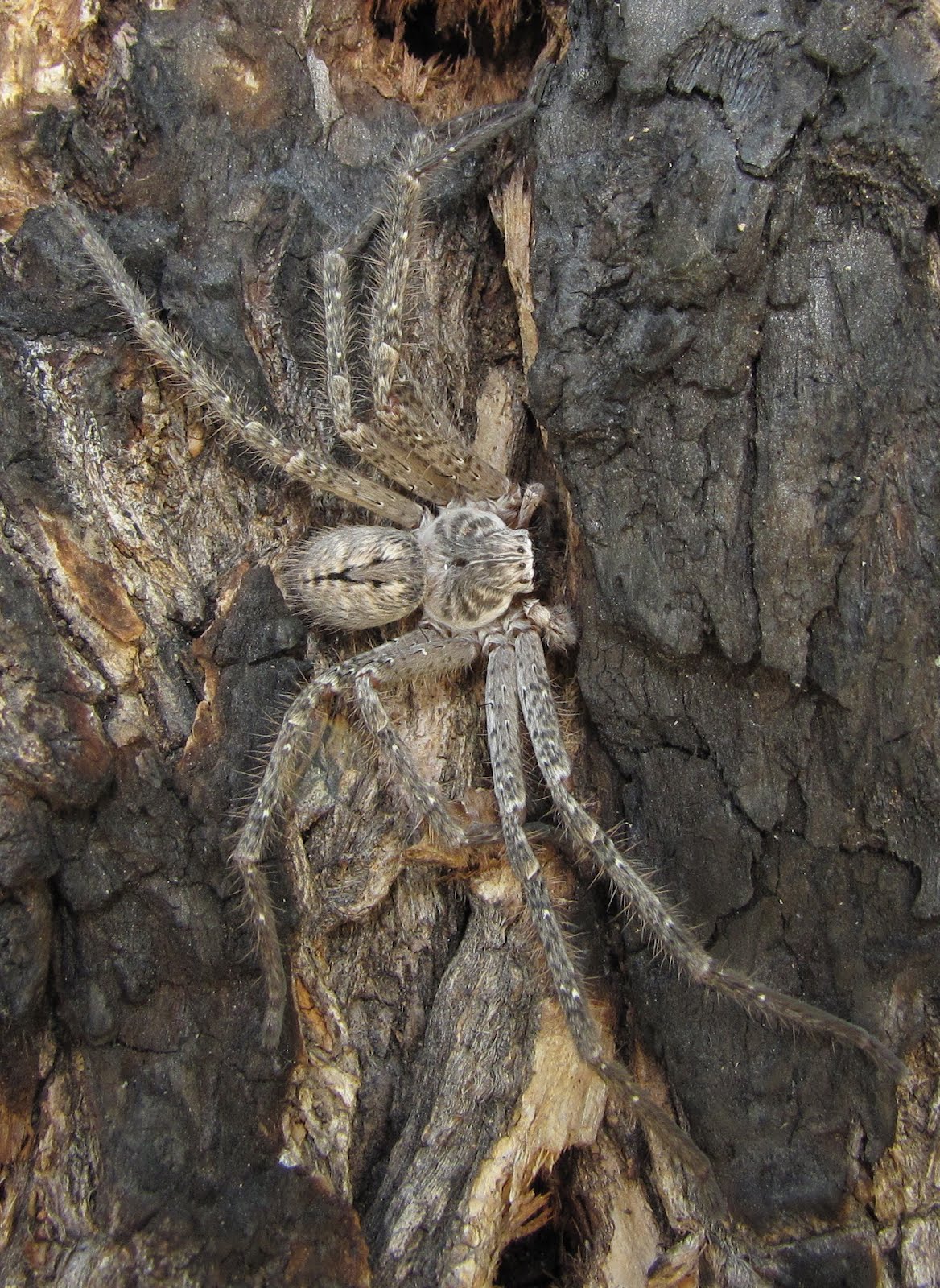
Giant crab spiders, like spiders in the families Thomisidae, Philodromidae (see Ebo from last week’s “Spider Sunday”), and Selenopidae, have laterigrade legs. This means the legs are “twisted” at the base such that they are oriented in the horizontal plane, rather than the vertical axis. This allows these flat-bodied spiders to scuttle into very narrow cracks or crevices. Giant crab spiders take full advantage of this to slip underneath loose bark, or into an opening in the siding on your home. Indeed, you are most often apt to encounter these spiders on vertical surfaces.

Paired claws at the tip of each leg, with a tuft of special hairs between them, allow the spider to easily navigate surfaces with the least bit of texture, or scramble effortlessly over slender twigs in pursuit of prey. Hiding by day they emerge at night to hunt. I was surprised to find them on a night hike in Florida Canyon in the Santa Rita Mountains of Arizona, so accustomed had I become to seeing them on the exterior walls of buildings.

They do sometimes stray indoors, and apparently such incidents once inspired newspaper publicity for the “barking spider” in some small towns in west Texas (Gertsch, 1979).
There are five species in the genus Olios found in North America north of Mexico, collectively found from southern California to western Texas. O. giganteus is recorded from California, Nevada, Utah, Arizona, New Mexico, extreme west Texas (Big Bend), and Sonora, Mexico. U.S. specimens formerly classified as O. fasciculatus, an African species, are now known to be O. giganteus.
Olios giganteus is just that: a giant. Mature males measure 11.3-29.4 mm (average 25), but females can be 14.6 to a whopping 48 millimeters (average 31.6) in body length. The eight sprawling legs make these arachnids look larger still. In reality, their legspan is “only” 50-64 millimeters.
Little is known about the life cycle of Olios huntsman spiders. Normally nomadic, females do settle down when it comes time to lay eggs. They weave a large bag-like retreat within which they spin an egg sac. They guard the precious pouch and the spiderlings that eventually emerge, not feeding themselves during the incubation period, about one month in mid-late summer (Jennings, 1981).

Sources: Rheims, Cristina A. 2010. “On the native Nearctic species of the huntsman spider family Sparassidae Bertkau (Araneae),” J. Arachnol. 38: 530-537
Lizotte, Rene. 2000. “Spiders” in Phillips, Steven J. and Patricia Wentworth Comus (eds.). A Natural History of the Sonoran Desert. Tucson: Arizona-Sonora Desert Museum Press. pp. 294-303.
Jennings, Daniel T. 1981. “Observations on Olios fasciculatus, a giant crab spider (Araneae: Sparassidae),” The Southwest Naturalist 26(4): 437-439.
Richman, David B., et al. 2008. The Spiders of the Arid Southwest. New Mexico State University.
Gertsch, Willis J. 1979. American Spiders (2nd ed.). New York: Van Nostrand Reinhold Company, Inc. 274 pp.
Wednesday, January 18, 2012
Wasp Wednesday: Not Wasp VI
Many bees are easily mistaken for small wasps, especially the “masked bees” of the genus Hylaeus in the family Colletidae. There are not many characters that can be used to separate these bees from wasps that are easily visible in the field. Mostly it just takes a practiced eye to tell them apart.

Masked bees, also known as yellow-faced bees, are nearly hairless, accentuating their resemblance to wasps. While wasps have hairs, too, those hairs are simple and unbranched. The hairs of bees, in contrast, are plumose and almost feather-like. Unfortunately, this character requires a minimum magnification of sixty power to observe. Live bees and wasps don’t usually cooperate for microscopic examination.
Hylaeus are not parasitic on other bees, so a logical question would be how does a hairless bee transport pollen and nectar back to its nest? The answer is that the female bee ingests mostly nectar, and stores it in a special internal organ called the “crop.” Once the bee arrives back at the nest, she regurgitates her load and stores it in a cell. Several such loads will provide enough nourishment for the single larval offspring in each cell.
Masked bees are solitary, meaning each female makes her own nest. Without strong jaws, or a rake of spines on the front legs, Hylaeus bees are pretty much forced to use pre-existing burrows of other insects in the soil, cavities in the pith of twigs, or in abandoned galls. Indeed, most species of Hylaeus nest in hollow stems or twigs. Individual cells are lined with a natural plastic, a type of polymer secreted by glands in the female’s abdomen.

Male and female masked bees can be distinguished by their facial markings. Females generally have yellow, white, or ivory markings on the inner margin of each eye. Males have the entire face colored yellow or white.

Photo by Tom Murray via Bugguide.net
There are around 900 species of Hylaeus, collectively distributed worldwide, with about fifty in North America. The genus reaches its zenith of diversity in subtropical Australia, and the Hawaiian Islands. There are, or were, sixty species in Hawaii. Several of those are threatened or endangered, in part by invasive ant species that have been introduced from elsewhere and prey on the bee eggs, larvae, and pupae. Seven species of Hylaeus are considered “critically imperiled and possibly extinct,” according to the Xerces Society.

Photo by Tom Murray via Bugguide.net
Because the female bees collect so little pollen, it has been problematic to determine which species are generalist pollinators, and which are specialists. Recording which flowers the females visit has only provided a little insight. Analysis of pollen grains in the larval feces of three species in Michigan revealed that pollen foraging skews toward members of the Rosaceae when those flowers are available, and Asteraceae otherwise (Scott, 1996). The western U.S. species H. bisinuatus apparently visits White Sweetclover, Melilotus alba exclusively, even when other flowers are available. The Australian species H. alcyoneus visits only Banksia flowers. Still, the vast majority of species are assumed to be generalist pollinators.
Masked bees will readily nest in artificial bee boxes, be they bundles of thin straws, sumac twigs, or blocks with small diameter holes drilled into them. Consider constructing one of these and hanging it on a south-facing exterior wall, tree trunk, or similar situation. Be sure to include a “roof” to protect the entrance holes from rain, and elevate it at least three feet from the ground. Many websites exist with further hints on how to build such nest boxes.

Lastly, don’t fret if you can’t always tell the difference between masked bees and wasps. There are records whereby species of Hyleaus were originally described as wasps by scientists.
Sources: Scott, Virginia, 1996. “Pollen Selection by Three Species of Hylaeus in Michigan,” J Kans Entomol Soc 69(4): 195-200.
The Great Sunflower Project
”Aculeata Agonistes: Yellow-faced Bees”
Subscribe to:
Posts (Atom)