Showing posts with label Wasp Wednesday. Show all posts

Wednesday, August 31, 2022

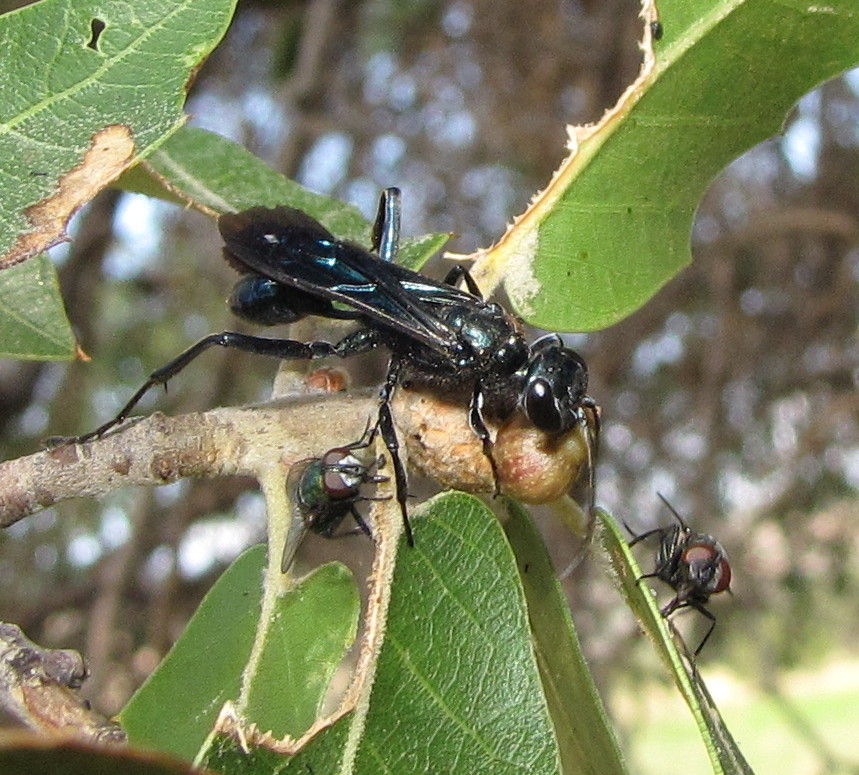
Wasp Wednesday: Another Cricket Hunter, Lyroda subita

Crickets in the family Gryllidae are sufficiently diverse, and abundant enough, to be the target hosts for a variety of parasitoid wasps, especially those in the families Sphecidae and Crabronidae. There are previous posts about the Steel Blue Cricket Hunter, and the genus Liris, but here in eastern Kansas there is another player. Lyroda subita is easily confused with Liris, but the clue is in the "toes."

Like all of the larger cricket-hunting wasps, Lyroda is solitary, each female constructing her own nest, in this case an underground burrow. Whether she digs it herself is the subject of debate. At least some observations indicate the wasps use the abandoned burrows of other solitary wasps rather than excavating a nest themselves. The tunnel of Lyroda subita can be fifteen to thirty centimeters below the surface of the ground. There may be only one cell, or two. Historical records are rather scant.

The female hunts almost exclusively crickets of the family Gryllidae, both adults and immatures (nymphs). She subdues her quarry with a paralyzing sting in a nerve center that renders the victim limp. Transporting such a bulky insect is no problem for the agile wasp. She slings it beneath herself, grasps the cricket's antennae in her mandibles, and away she goes. She can run over the ground with it, but can also glide or even fly with it. Multiple crickets are used to provision a single cell, after which she lays an egg on the last cricket, seals the cell, and then repeats the entire process.

There is at least one record of L. subita using a different host: a pygmy mole cricket of the family Tridactylidae. Since these are mostly subterranean orthopterans, and not that closely related to crickets, the how and why of this anomaly remains unanswered. Other species of Lyroda from other parts of the world are known to use pygmy grasshoppers, family Tetrigidae, as hosts, and those insects occupy similar micro-habitats as pygmy mole crickets. Maybe it is a matter of what is available in a given habitat, then. Pygmy mole crickets and pygmy grasshoppers occur mostly in wet or damp situations along stream banks.

In our Leavenworth, Kansas yard, there are large numbers of Gryllus field crickets, and ground crickets of the subfamily Nemobiinae, offering Lyroda plenty of options.

L. subita is a medium-sized insect. Females range from 10-13 millimeters in body length, males slightly smaller at 6-10 millimeters. Both sexes are slate gray in color with silver highlights, especially on the abdomen. In the right light it can appear the abdomen is banded in dark gray and white. The ocelli, a trio of simple eyes on the crown of the head, between the compound eyes, are present. The most easily observed feature is on each "foot." The last tarsal segment bears a very large pad called an arolium (plural arolia), which differs markedly from the petite feet of the nearly identical Liris genus. Liris also has only a single mid-ocellus, the lateral simple eyes being reduced to longitudinal scars.

This species occurs throughout most of the United States (except for Washington, Oregon and the southwest states), southern Canada, the northern half of Mexico, and also Cuba and Hispaniola. There are twenty-one other species of Lyroda, most of which are found in southeast Asia, plus Africa, Australia, and South America.

Sources: Kurczewski, Frank E., and Margery G. Spofford. 1985. "A New Host Family for Lyroda subita (Hymenoptera: Sphecidae)," The Great Lakes Entomologist 18(3): 113-114.
Bohart, R.M. and A.S. Menke. 1976. Sphecid Wasps of the World: A Generic Revision. Berkeley: University of California Press. 695 pp.
Elliott, Lynette, et al. 2006. "Species Lyroda subita," Bugguide.net
Khvir, Viktor I., and Wojciech J. Pulawski. 2020. "A Revision of New World Lyroda Say, 1837 (Hymenoptera: Crabronidae)," Proceedings of the California Academy of Sciences Series 4, Volume 66, nol 13: 315-330.

Wednesday, June 29, 2022

Wasp Wednesday: Blue Mud Dauber, Chalybion californicum

NOTE: This is an update of my original blog post from August of 2010, with some new images.

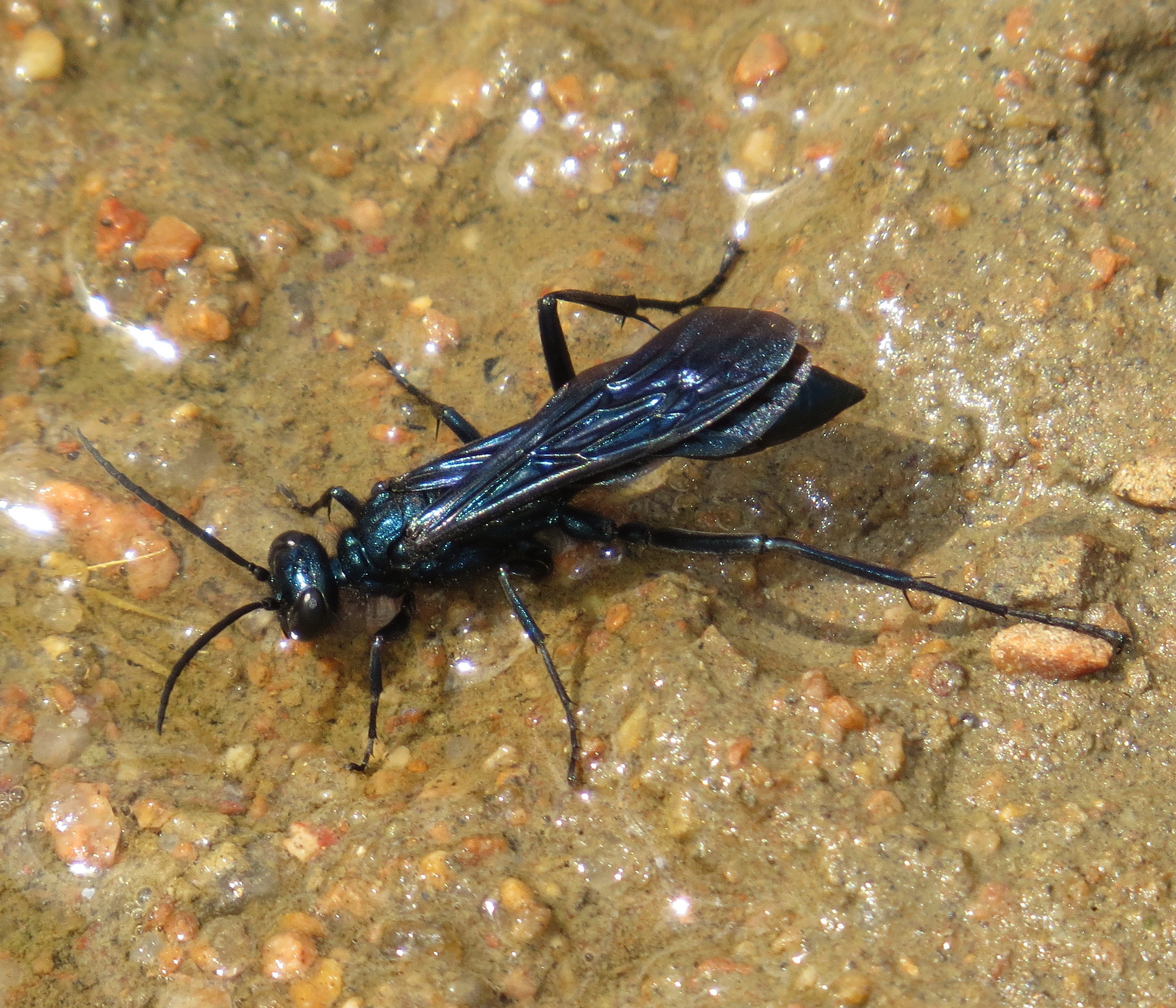
Blue Mud Dauber drinking water in Colorado, USA

Among insect architects, the Blue Mud Dauber, Chalybion californicum, is not Frank Lloyd Wright. What it does have going for it is a remodeling career. Oh, and a reputation as a fierce enemy of black widow spiders.

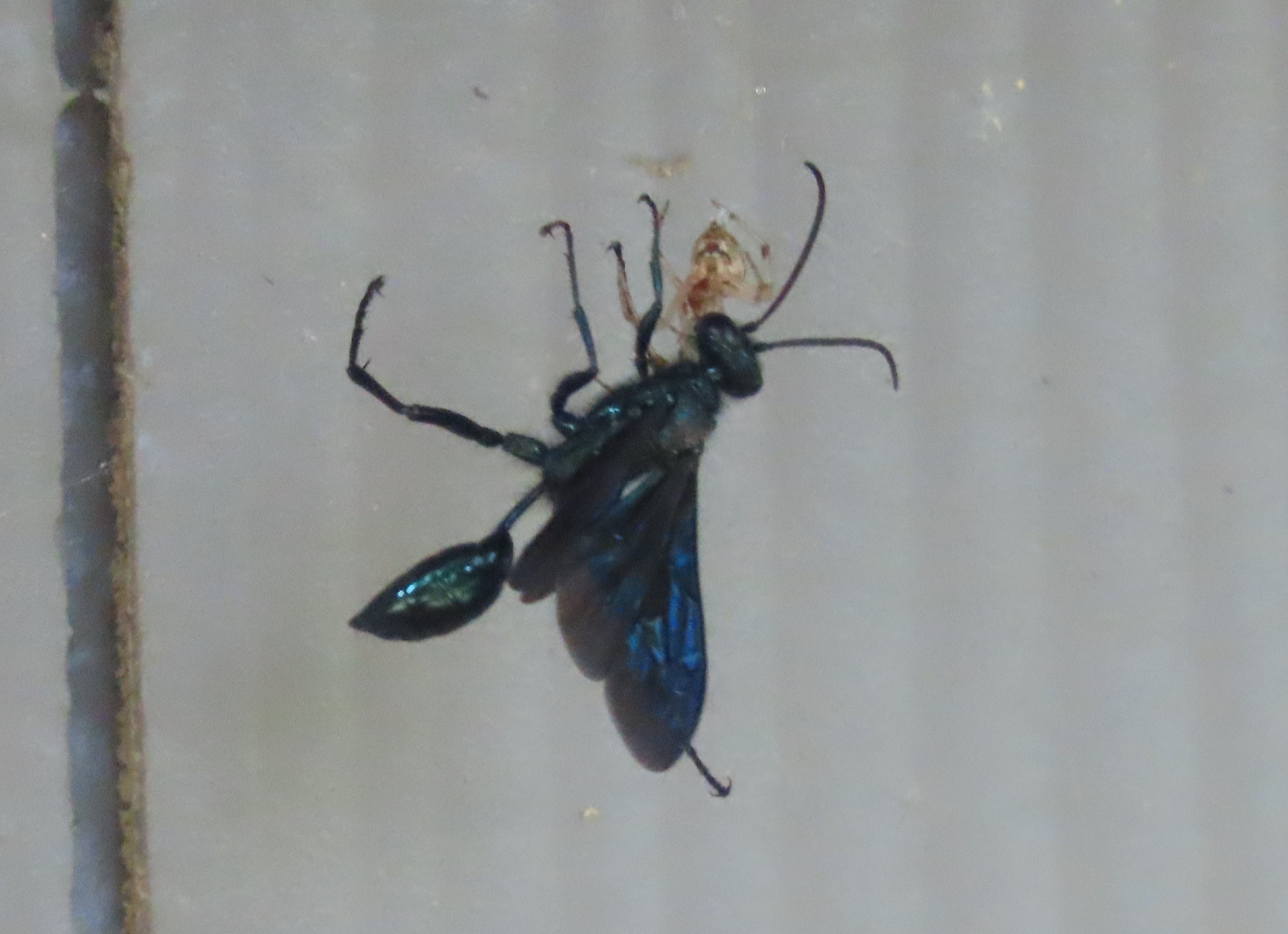
Female Blue Mud Dauber with paralyzed juvenile Western Black Widow in Colorado, USA

Blue mud daubers are solitary wasps in the family Sphecidae. Females take over abandoned nests of their cousin, the Black and Yellow Mud Dauber, Sceliphron caementarium, or, in many cases, evict the larval tenants and food stores of active mud nests. While Sceliphron gathers mud to make her nest, Chalybion carries water to an old nest to soften it and remold it to her needs. The result is a very lumpy version of the normally smooth Sceliphron nest.

Female Blue Mud Dauber on "renovated" nest of Black & Yellow Mud Dauber in Delaware, USA

Chalybion makes up for any engineering deficiencies with a persistent, clever, and energetic approach to catching prey. The female wasp is able to land on a spider web without getting entangled, then do a convincing impression of an insect that is in distress. She vibrates the web and draws the spider out. The poor arachnid comes dashing down a thread expecting dinner and instead seals its own doom. The blue mud dauber stings the spider into paralysis and flies it off to her nest.

A female Blue Mud Dauber in Kansas, USA begins her hunt by alighting on non-sticky threads of a cobweb weaver's snare....
Fanning her wings, she vibrates the web to simulate a struggling insect....
Now she awaits the spider's response....
Nothing....so one more try at luring the arachnid....
Success! The spider rushed to the wasp so quicly that I missed the shot. The wasp stung the spider in a nerve center and it was immediately paralyzed.
Extricating the spider from its web, she flies away with her prize.

Among the known spider hosts for the blue mud dauber are black widows, specifically the Southern Black Widow, Latrodectus mactans. For a highly entertaining account of this I recommend chapter five (“The Terrible Falcons of the Grassland”) in Hunting Big Game in the City Parks, by Howard G. Smith (New York: Abington Press, 1969). Additional spider hosts include mostly other cobweb weavers, family Theridiidae, small orb weavers (Araneidae), and the odd lynx spider (Oxyopidae), crab spider (Thomisidae), or jumping spider (Salticidae).

Female Blue Mud Dauber dismembering a spider in order to feed on its hemolymph (blood). I do not know how frequently the wasps do this.
Missouri, USA

Mud daubers in general stuff a multitude of spider victims into each mud cell before finally sealing it with a curtain of mud. A single egg had been laid on the very first spider stored at the bottom of the cell. The wasp larva that hatches then gradually consumes all the spiders, leaving a smattering of legs as the only indication there was ever anything else in there with them. The mature larva then spins a papery silken cocoon inside which it pupates. A few weeks later (or come spring if it was overwintering) an adult wasp chews a round hole in the end of the cell and exits. Holes in any other part of the mud nest indicate that some kind of wasp parasite chewed its way to freedom instead of the mud dauber.

Male Blue Mud Dauber hot-footing it in Colorado, USA

Male mud daubers are far less industrious than their female counterparts. Their sole mission is to father the next generation.

Meanwhile, they are content to sip nectar from flowers or extrafloral nectarines. They also like oozing sap from wounded trees and, perhaps most of all, the “honeydew” secreted by aphids and scale insects. Both genders of mud daubers like this delicacy, which is nothing more than the sugary liquid waste produced by those sap-sucking buggers.

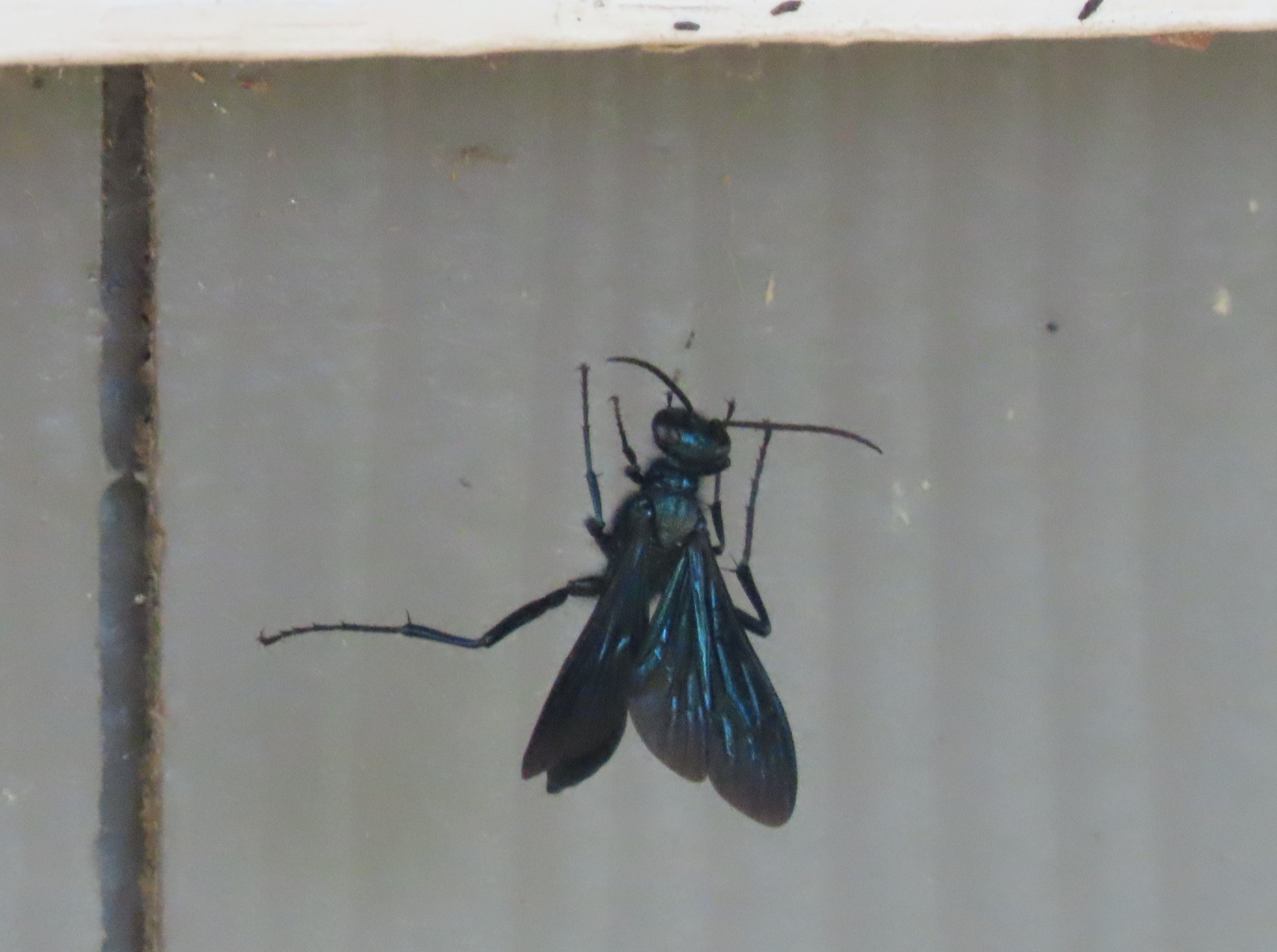
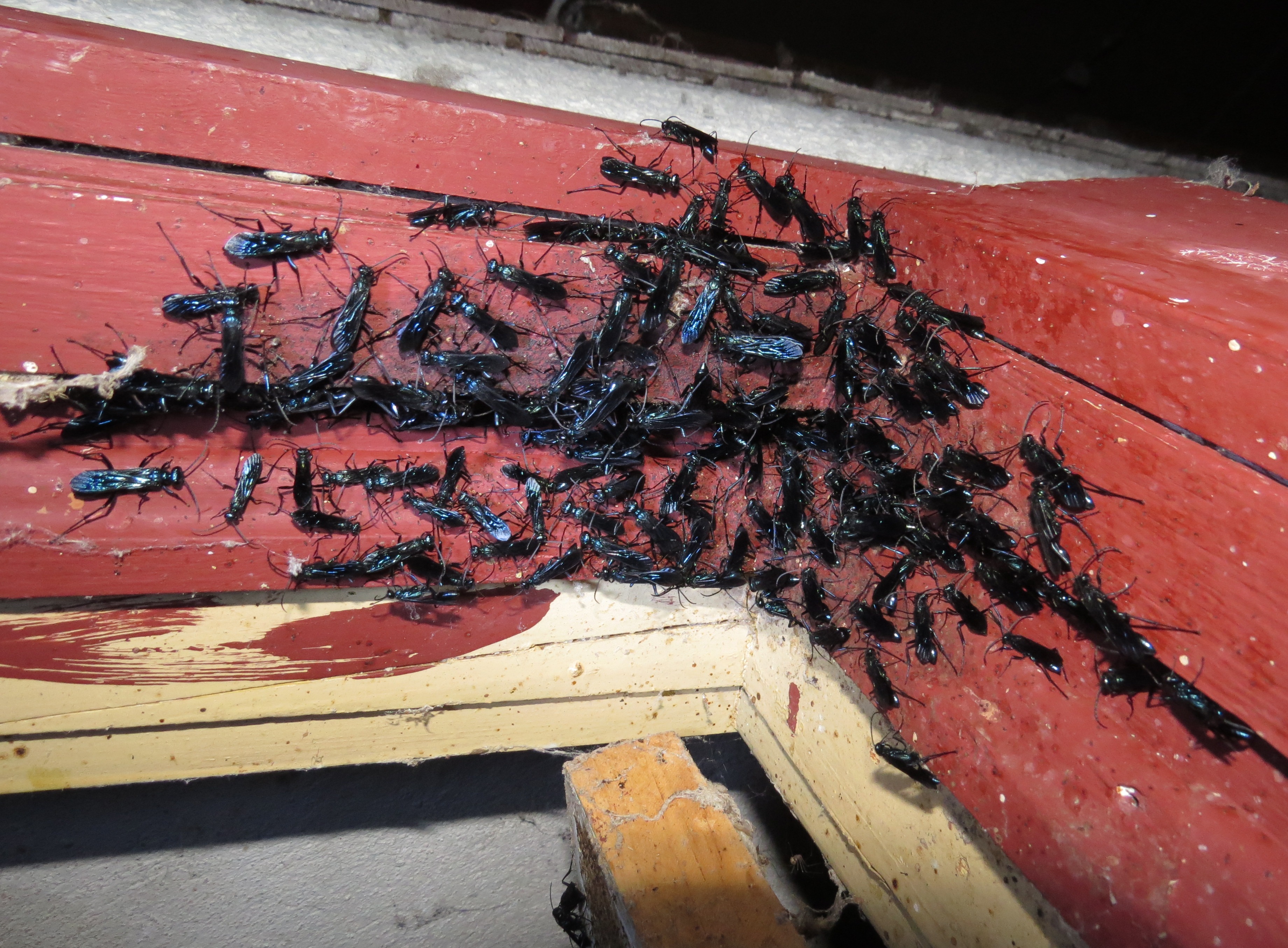
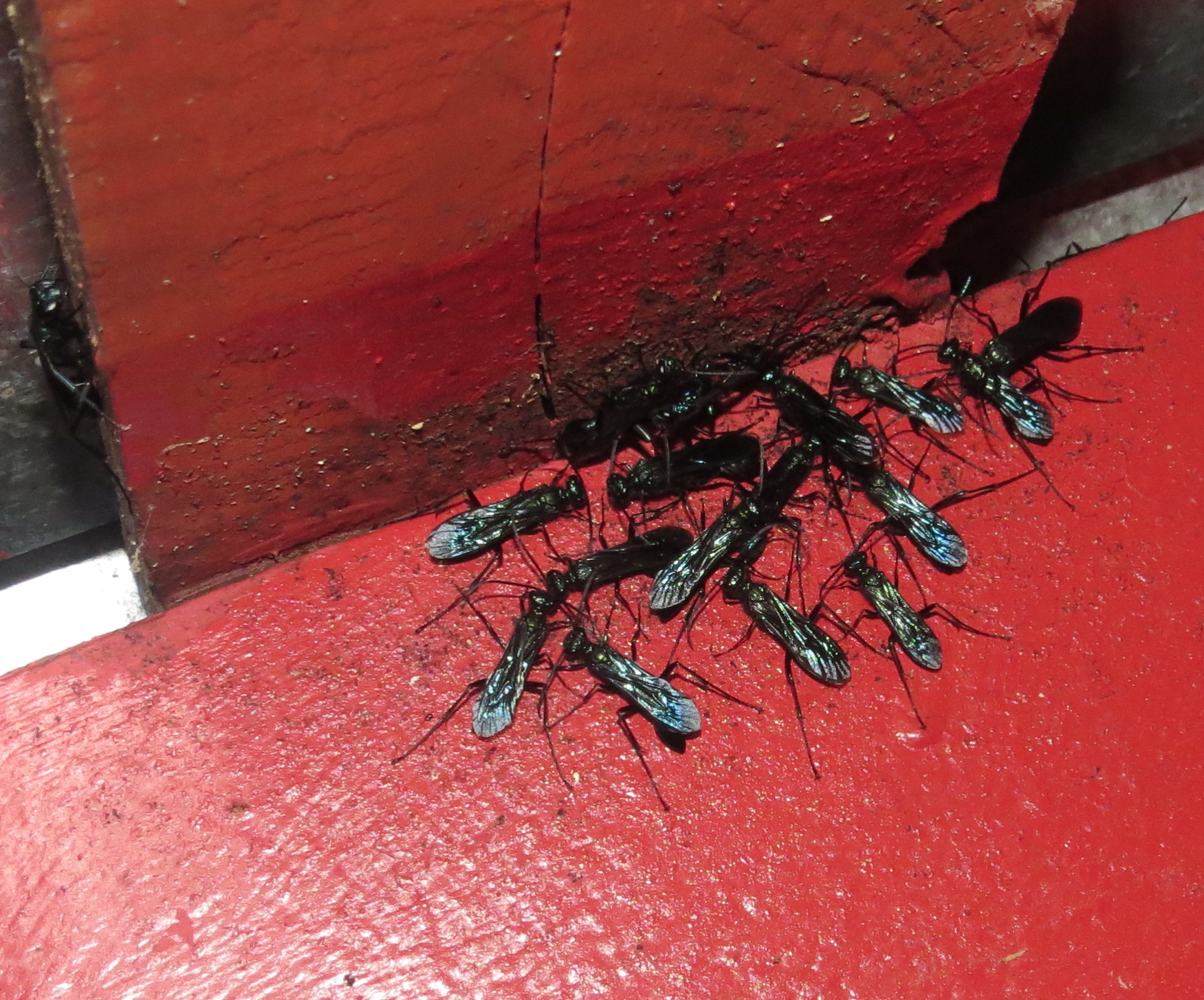
Large nocturnal congregation of male Blue Mud Daubers in a door frame in Colorado, USA

After a heavy day of drinking, males may gather in “bachelor parties” to sleep it off during the night. These congregations of normally solitary wasps can cause a bit of anxiety in people who confront them. Take a look at this image and comment thread for an example.

A smaller group of males in Georgia, USA

It should be noted that there are actually two species of Chalybion found north of Mexico. C. californicum is transcontinental in the U.S. and southern Canada, while C. zimmermanni ranges from Tennessee and North Carolina south to Florida and west to Texas, Arizona, and into Utah. I am curious as to whether these specimens I photographed in southern Arizona are C. zimmermanni given the white, not dark, hairs on the thorax; and the smoky, rather than violaceous, wing coloration (see below).

Probable male Chalybion zimmermani in Arizona, USA

Enjoy making your own observations of these wasps. They are not the least bit aggressive and, because they often nest on the exterior of buildings, are easy to watch.

Probable female Chalybion zimmermani in Arizona, USA

Sources:
Bohart, R. M. and A. S. Menke. 1976. Sphecid Wasps of the World. Berkeley: Universithy of California Press. 695 pp.
Eaton, Eric R. 2021. Wasps: The Astonishing Diversity of a Misunderstood Insect. Princeton, New Jersey: Princeton University Press. 256 pp.
Krombein, Karl V. et al. 1979. Catalog of Hymenoptera in America North of Mexico. Washington, DC: Smithsonian Institution Press. Vol. 2, pp 1199-2209.

Wednesday, October 11, 2017

The Wasp Wall

South Cape May Meadows in Cape May, New Jersey is a property managed by The Nature Conservancy (TNC) for birds and other wildlife. Near the parking lot stands a shed that itself is something of a refuge for a whole community of insects. One wall, facing west and with beams that make something of an overhang or trellis, is being worked over by the Eastern Carpenter Bee, Xylocopa virginica. The abandoned nests of these solitary bees are then used by mason wasps, leafcutter bees, and other solitary Hymenoptera.

The shed at South Cape May Meadows, behind the arbor entrance

During our visit this past September 24, we noticed the holes, then soon saw females of the Four-toothed Mason Wasp, Monobia quadridens, exploring some of those cavities. I wrote about this species previously, detailing its life cycle, but this was the first time I had observed them coming and going from nests.

Female Monobia quadridens entering her nest

One female delivered a paralyzed caterpillar during our observations. It was a surprisingly small larva given the size of the wasp, but then she caches several victims in each cell before laying a single egg, putting up a partition of mud, and then starting a new cell along the length of the tunnel inside the wood.

Female cuckoo wasp, Chrysis sp., prospecting for a host

One might think that nests in such solid material would be impermeable to parasites, but not so. We watched a brilliant blue-green cuckoo wasp, Chrysis sp., investigate some of the holes for occupants. Given a nest in progress, she would infiltrate and lay her own egg inside. Her larva would then consume the prey items left by the rightful owner for its offspring. Cuckoo wasps are nearly impregnable, with a very dense exoskeleton that deflects the bites and stings of host wasps. Cuckoo wasps can roll into a ball to further protect themselves.

Female Leucospis affinis ovipositing in a host nest

A less common parasitic wasp also came to the wall. Leucospis affinis is a large chalcidoid wasp. The female is easily recognized by the whip-like ovipositor that curls over the top of her abdomen. The ovipositor is the organ she uses to lay her eggs....by drilling through the solid wood directly into one of the cells of her host. How she divines the location of a host larva through a layer of dense cellulose is a mystery to me, but her aim is usually true.

Nest closure of mason wasp or carpenter bee

A completed nest of a mason wasp is usually identified by the mud plug that closes the entrance to the hole in the wall. Because the soil at Cape May is essentially all sand, it was difficult to tell if we were looking at a sand closure or a sawdust closure that would be the work of one of the carpenter bees.

Nest closure of leafcutter bee, Megachile sp.

Easier to identify was the completed nest of a leafcutter bee, genus Megachile. Leafcutter bees snip oval pieces from leaves of living plants and fashion those clippings into barrel-shaped cells that they stack along the length of a tunnel in wood, or underground in the case of a few species. The female bee then cuts at least one perfectly circular leaf fragment that serves as a "lid" for the completed cell.

Nest of grass-carrier wasp, Isodontia sp.

We found one hole filled loosely with bits of grass, and we surmise this was the work of yet another kind of wasp, the grass-carrier. These solitary wasps, related to mud daubers in the family Sphecidae, use dry grass to fill, and/or partition, and plug their nest tunnels. Near Cape May Point State Park we did witness a female Isodontia mexicana select and bite off a dry grass stem to take back to her nest, so we know these insects were active.

Female grass-carrier wasp, Isodontia mexicana, cutting a piece of grass

Ironically, one other kind of wasp was tearing the wall down one mouthful at a time. Workers of the Bald-faced Hornet, Dolichovespula maculata, would alight on the wall and begin chewing off wood fibers to mix with their own saliva. This creates a pulp that they use to make durable paper nests. Looking more closely at the wall we realized that the scores of yellow streaks on the otherwise weathered gray wooden surface were where yellowjackets (of which the Bald-faced "Hornet" is just another species) had stripped fibers for use in building their nests.

Bald-faced Hornet gathering wood fibers to make paper

No doubt, earlier in the season there would be even more activity around this wall. The shed is still standing, sturdy as ever, so the insects are not doing much, if any, structural damage. Please consider that if you find that your own shed is becoming home to carpenter bees and other insects. You may find yourself as enthralled as we were by the little ecosystem started by carpenter bees.

Female Monobia quadridens exiting her nest

Sources: Evans, Howard E. 1963. Wasp Farm. Ithaca, NY: Comstock Publishing Associates (Cornell University Press). 178 pp.
Buck, Matthias, Stephen A. Marshall, and David K.B. Cheung. 2008. “Identification Atlas of the Vespidae (Hymenoptera, Aculeata) of the northeastern Nearctic region,” Canadian Journal of Arthropod Identification No. 5: 492 pp. (PDF version).
Krombein, Karl V. 1967. Trap-nesting Wasps and Bees: Life Histories, Nests, and Associates. Washington, DC: Smithsonian Press. 570 pp.
Krombein, Karl V., et al. 1979. Catalog of Hymenoptera in America North of Mexico Vol.2 Apocrita (Aculeata). Washington, DC: Smithsonian Institution Press. Pp. 1199-2209.

Wednesday, September 13, 2017

Ammophila nigricans Revisited

I wrote about this species back in December, 2010 when I had only one image of a sleeping female in South Deerfield, Massachusetts on July 5, 2009. Recently, I had the privilege of imaging another female in Leavenworth, Kansas, on August 24.

These are large, beautiful insects, velvety gun-metal blue with a red band across the abdomen, and black wings. It can be confused with no other member of the genus Ammophila. This particular specimen spent the night in a patch of weeds and flowering mint, eventually waking up to visit many mint blossoms for nectar. This wasp is known to visit many kinds of flowers, in Illinois at least. I collected one specimen from Swamp Milkweed in Cincinnati, Ohio.

Females need to fuel themselves so as to be able to carry out the tasks of providing for their offspring. Each wasp is solitary, digging her own vertical or angled burrow in clayey or sandy soil, terminating in a horizontal chamber at the bottom. Once the nest is excavated, it is off to find a large caterpillar. Known hosts include the larvae of underwing moths (Catocala spp.), the locust underwing (Euparthenos nubilis), and zale moths (genus Zale). Those are hefty caterpillars, but then they are destined to feed the larva of a very robust wasp.

This YouTube video may or may not depict A. nigricans, but the searching behavior must be very similar at the least. The female wasp is not likely to locate a caterpillar based on movement or color, as the caterpillars are very cryptic and usually resting stock still, feeding at night to avoid predators like the wasp. So, she must find her prey by touch.

Ammophila nigricans ranges over the entire eastern United States, from Kansas and Texas to New England, and south to Georgia, Florida, and Louisiana. It does not appear to be nearly as common as most other members of its genus, so I consider myself lucky to have had a few hours observing this one specimen.

SourcesDiscover Life
Krombein, Karl V. and Paul D. Hurd, Jr. 1979. Catalog of Hymenoptera in America North of Mexico vol. 2 Apocrita (Aculeata). pp. 1199-2209.

Wednesday, August 23, 2017

The Wasps and the Fly

You literally don't have to do anything but step out the door to observe fascinating phenomena in the world of insects. I did just that on August 9th, and found myself watching peculiar behavior between a nest of European Paper Wasps, Polistes dominula, and an unidentified fly.

The paper wasp nest has been on the back of our fence gate for months, now. The occupants are amazingly tolerant, even as we come and go. They may get a bit disoriented if we leave the gate open for a lengthy period, but otherwise they are innocuous and we let them be. Imagine my surprise when the thing that has agitated them most was what appeared to be a house fly.

Upon closer examination, the fly had slightly different markings than a house fly, was spinier on the abdomen, and had perhaps longer legs. It walked a lot, nervously, and it was difficult to even get an image of it. Finally, it stopped walking and started, well, stalking towards the wasp nest. One wasp took notice and adopted a very alert posture. Suddenly, the fly flew off its perch and looped around the wasp nest at dizzying speed. It was so quick I was not sure what I was seeing.

The aftermath of the fly's reconnaissance mission was even more dramatic. The one wasp that had seen the fly in the first place suddenly began running frantically and erratically all over the comb, for probably at least ninety seconds. The fly was long gone, but I was suspecting that maybe it had laid an egg and that was the object of the wasp's energetic searching behavior.

Still puzzled by the fly's identity, I took to the internet for the most likely suspects: a tachinid fly, family Tachinidae; or a parasitic sarcophagid (Sarcophagidae). I found a tachinid that looked promising, but viewing images of the species it became readily apparent this was not the right one. Sarcophagids came up empty as well. Furthermore, I have witnessed paper wasps eating sarcophagids, not falling victim to them. Next I looked to my library and found a potential match in a European field guide, of all things. Eustalomyia festiva, a member of the diverse but obscure family Anthomyiidae, looked good. According to the text, it "Breeds in [the] bodies of flies stored by solitary wasps." Ok, but paper wasps are social....

I posted the images shown here on the help group "Hymenopterists Forum" on Facebook, and got this reply from Rui Andrade:

"It looks like Eustalomyia (Anthomyiidae). The larvae are kleptoparasites of wasps."

This makes sense to a degree, but social wasps do not store their prey for later consumption by their larval offspring. They feed masticated prey directly to the larvae. There is therefore no opportunity for a fly larva to develop in a social wasp nest under those circumstances, as a kleptoparasite feeding on prey intended for the host's offspring. The only alternative I can fathom is that the fly is parasitic on the wasp larvae themselves. Cursory review of the literature does not inform my opinion, as they all stubbornly state that solitary wasps are the victims of Eustalomyia. The wasps are not going to let me peer into each cell to see if there is something other than a wasp egg or larva inside, either.

Perhaps this one individual fly was just confused as to the proper host. Maybe it was initially attracted to the bee block ("bee condo") hanging up on another part of the fence, where we have indeed had solitary wasps nesting. This year the bee condo has been devoid of activity for the most part, so maybe scaring the paper wasps was an amusement borne of frustration for this fly. We may never know.

Sources: Chinery, Michael. 2012. Insects of Britain and Western Europe. A Domino Guide. London: Bloomsbury Publishing. 320 pp.
McGavin, George C. 1992. The Pocket Guide to Insects of the Northern Hemisphere. London: Parkgate Books, Ltd. 208 pp.

Wednesday, August 9, 2017

Wasp Wednesday: Another Puzzler

A good many people mistake me for an expert who knows everything about every insect known to man, but I am not. Thankfully, there are entomologists like Doug Yanega who do seem to know everything, but he would be the first to deny that claim as well. Still, I have learned more from him than I can possibly recount. Case in point a wasp that had me scratching my head over the weekend.

This all started out innocently enough. I was down at Chico Basin Ranch, a sprawling 88,000 acre cattle ranch that straddles the El Paso and Pueblo County line on the high plains, looking for grasshoppers with several other members of the Mile High Bug Club and the general public. At our first stop out on the heavily-grazed shortgrass prairie, one of the first insects that got my attention was a small, maybe 20 millimeter-long, slender black-and-red wasp that was running erratically between patches of grass.

I had it pegged as either a thread-waisted wasp in the family Sphecidae, or a spider wasp in the family Pompilidae, both of which behave in this manner as they search for potential prey. I did not have the camera set for speeding Hymenoptera, so the images are a bit blurry. Now I am wishing I had spent more time with this creature, but hindsight is twenty-twenty. I do not recall the wasp ever flying, but I figured a close approach might send it fleeing permanently.

Back at home, reviewing the magnified images on my computer, I quickly decided I had no clue at all as to what I was looking at. It seemed to be a fusion of the two potential suspects I had surmised initially. So, off to the "Hymenopterists Forum" on Facebook I went. Posting the images there got me several "likes," but no one ventured an identification. Enter Doug Yanega, a good friend and colleague from the University of California at Riverside. He is always willing to help others online and in person, and the university's collection is so well organized that he can use it as a reference for cases like mine.

"I just recalled the other name I was thinking of: Pterombrus rufiventris (now in Thynnidae). I can't find any photos of it online, but I caught one in Kansas once and it had me stumped for a while," wrote Doug. Well, nice to know I'm not the only one who has been baffled by this species. Doug went on to add "Just checked our collection, this is Pterombrus rufiventris, and it attacks cicindeline larvae. Very rare but widely distributed. No photos in BugGuide."

It is no wonder that I did not recognize it, because the most common thynnid wasps are in the genus Myzinum, and they look nothing like this. See my blog post on those here.

The Large Grassland Tiger Beetle, Cicindela obsoleta is one known host for this wasp.

Cicindelines are known commonly as tiger beetles, colorful and active predators in their own right. The larval stage typically lives in a vertical burrow with a diameter just barely large enough to accommodate the grub. The larva has a flattened head that is held flush with the top of the burrow, the better to see, lunge after, and seize any unsuspecting insect that happens by. The victim is then dragged into the burrow to be consumed. A wasp has to have a lot of bravery to take on one of these voracious beasts, armed as they are with large and powerful jaws. True, the wasp does have her stinger, and I can only imagine how deftly she must wield it to be successful.

According to field observations by others, the wasp crawls down the burrow of the tiger beetle larva and stings it repeatedly under the head or thorax, before depositing an egg on the grub's abdomen. The mother wasp then plugs the burrow with a solid, compacted layer of soil, and then fills in the remainder of the burrow above the plug with loose soil particles. Her egg hatches in about 3 days, and the wasp grub that emerges grows by feeding on the tiger beetle larva for almost 9 days. The mature wasp larva then detaches from the now-deceased host and spins a cocoon in the burrow of the host. There it overwinters, emerging the following summer with the monsoon rains of July.

Indeed, this year Colorado has seen extraordinarily heavy precipitation from severe storms. Timing is everything, and I consider myself lucky to have crossed paths with this rare insect. These are perhaps the first images online of the species. Keep your eyes out for this, the western subspecies P. rufiventris hyalinatus, and the eastern subspecies P. r. rufiventris, from southern California to Texas, and on to Georgia and Virginia.

Sources: Knisley, C. Barry, Darren L. Reeves, and Gregory T. Stephens. 1989. "Behavior and Development of the Wasp Pterombrus rufiventris hyalinatus Krombein (Hymenoptera: Tiphiidae), a Parasite of Larval Tiger Beetles (Coleoptera: Cicindelidae)," Proc. Entomol. Soc. Wash. 91(2): pp. 179-184.
Krombein, Karl V., et al. 1979. Catalog of Hymenoptera in America North of Mexico Volume 2. Washington, DC: Smithsonian Institution Press. 1199-2209.

Friday, August 26, 2016

Sunflower Extravaganza

Few plants in arid climates can compare to sunflowers (Helianthus spp.) in their attractiveness to insects. Notice I said "plants" instead of "flowers." That is because while the sunflower blossoms are a beacon to bees, many other kinds of insects find secretions from the buds, stems, and leaves to be irresistible, too.

It is actually the sunflower's phyllaries (the bracts forming the involucre or the head or inflorescence of a composite plant), and the base of leaves, where the extrafloral nectaries are located. They produce a sweet substance different from floral nectar that insects crave. The main function of extrafloral nectaries (EFNs) is strongly suspected to be a means of recruiting insects to defend the plant against herbivores. Indeed, ants are the primary visitors to sunflower ENFs, and they vigorously pursue and rout any and all competitors.

A fly, two kinds of spider wasps (Pompilidae), and an incoming sweat bee (male Lasioglossum sp. on right)

Ironically, ants are also "farmers" of aphids, scale insects, and treehoppers that produce their own sweet product called "honeydew." Ants tenderly stroke these other insects until a drop of liquid waste appears at the rear end of their aphid or 'hopper "cow," and the ants eagerly lap it up. The aphids, scales, and treehoppers naturally manufacture honeydew as a by-product of their feeding activities....on the sunflower plant.

Treehoppers (Publilia sp.) tended by ants (Formica sp.)

So, while the ants guard the extrafloral nectaries, they also guard some of the insects doing the plant harm. Apparently no ecological relationship is perfect, but given the abundance of sunflowers, this one seems to work out ok anyway.

Parenthesis Lady Beetle and an ever-present ant

Even lady beetles utilize the ENFs as a source of hydration and vital nutrients during the summer months when there is a significant dip in aphid populations. I have seen several species on sunflower while looking for wasps.

Sunflower predator fest. Clockwise: Soft-winged flower beetle (Collops sp.), ambush bug (Phymata sp.), and assassin bug (Sinea sp.)

Other predatory insects recognize the lure of sunflower ENFs, too. Ambush bugs, Phymata spp., occur in abundance, and their success is measured by the many limp-bodied moths, butterflies, bees, and wasps dangling from their short beaks, or flopped across leaves below them.

Ambush bug with mud dauber wasp prey

It is the wasps, though, that are most astounding in their sheer diversity. I have found almost every conceivable family of wasps visiting sunflowers, and a high degree of diversity within each of those families in many instances.

Tiny chalcid wasp, Trigonura sp.

From the most minute of parasitic Chalcidoidea (a "superfamily" that contains several families of wasps) to large spider wasps and mud daubers, they are all there.

Female velvet ant, Dasymutilla bioculata

Even female velvet ants, wingless wasps which one usually sees scurrying across the ground, will scale tall sunflowers to reach those EFNs. Male velvet ants are even more frequent visitors, of course, with their ability to fly.

Large ichneumon wasp

Some individual plants are indeed tall, surpassing six feet in height. Those are mostly the Common Sunflower, Helianthus annuus. Locally, we also have Prairie Sunflower, Helianthus petiolaris, which is usually shorter, with purplish stems instead of yellowish green, and smaller, darker leaves.

The density of sunflowers in a given area can be mind-boggling as well. They thrive in "disturbed" habitats with sandy soil, which qualifies them to take over most of the urbanized Front Range here. Despite that, insects are noticeably attracted to only a few individual plants. So, once I find an attractive plant swarming with insect life, I stand by and watch as various wasp species come and go.

Female Svastra obliqua

Not a fan of wasps? No worries, a wide variety of bees visit the flowers, especially bumble bees, longhorned bees, leafcutter bees, and various cuckoo bees. Some bees, like Svastra obliqua, are even sunflower specialists. Composite flowers in general are bee magnets, but the very large surface of sunflowers gives bees plenty of bang for their buck in pollen and nectar. Sunflowers also bloom continuously for many weeks, even months, like a seemingly endless fireworks display.

Blue-black spider wasp, Anoplius sp.

One could literally write a book about all the insect visitors to sunflowers. Hm-m-m, that gives me an idea.....Meanwhile, enjoy the spectacle yourself next time you are in sunflower country.

Solitary wasp, Saygorytes sp.

Sources: Hodek, Ivo, Helmut F. van Emden, and A. Honek. 2012. Ecology and Behaviour of the Ladybird Beetles. UK: John Wiley & Sons. 561 pp.
Keeler, Kathleen H. 1979. "Species With Extrafloral Nectaries in a Temperate Flora (Nebraska)," Prairie Naturalist 11(1): 33-38.
Mizell, Russell F. 2015. "Many Plants Have Extrafloral Nectaries Helpful to Beneficials," EDIS, Institute of Food and Agricultural Scienes (IFAS), and University of Florida Extension, Publication #ENY-709.
The Great Sunflower Project.

Male Prairie Yellowjacket, plus spider wasp and ant