Showing posts with label Buprestidae. Show all posts

Wednesday, August 12, 2026

Jewel Beetle Spring

As I write this, Leavenworth, Kansas, USA, is under an (checks notes) “extreme heat warning,” expected to last for another two days at least. It has been an excessively hot summer, and I am recounting memories from spring more than I am making new discoveries. One thing that stands out was the diversity of jewel beetles, family Buprestidae, that I found during the month of May this year.

Blue Spotwood Borer, Agrilus acutipennis

Jewel beetles are also known as metallic woodborers for their often brilliant, iridescent colors; and called flathead borers for the flattened larval stage. The adult beetles are frequently alert, dashing or flying away at the first hint of potential danger, making them a challenge to photograph. Others are exceptionally cryptic, relying on camouflage and stillness to avoid detection in the first place. Some species exhibit all of these characteristics and behaviors.

Emerald Ash Borer from May 30, 2021, Leavenworth, Kansas.

Yes, some species can be pests, namely the Emerald Ash Borer, Agrilus planipennis, but that is a species native to east Asia. It is extremely problematic where it has been introduced. Most jewel beetle species are kept in check by parasitoid wasps, predatory beetles, and other natural controls.

Unidentified Agrilus sp. from Weston Bend State Park, Missouri.

On May 4, Heidi and I went across the river to Weston Bend State Park in Missouri, one of our favorite haunts during spring bird migration. It turned out to be pretty good for insects, too, including some jewel beetles. I spotted one of the many species of the genus Agrilus that can be found in our neck of the woods. These are small, usually well under ten millimeters, very narrow and elongate, and more often than not have muted colors. They are most often seen on foliage in sunny spots in the forest understory, or along forest edges.

Texania campestris, Weston Bend State Park, Missouri.

Heidi, while taking pictures of moss or mushrooms on a stump, suddenly exclaimed that she saw a huge buprestid. Indeed, she found a big specimen of the Hardwood Heartwood Buprestid, Texania campestris. It is very likely the largest species of jewel beetle in our immediate area, ranging from 20-30 millimeters. It can be confused with the pine-boring genus Chalcophora that is found elsewhere in Missouri.

Texania campestris

T. campestris occurs east of the Great Plains, but is more common in the southern U.S. than elsewhere. Known host plants for the larvae include American Beech, American Sycamore, maples, and Black Willow.

Texania campestris

Closer to home, I visited Havens Park here in Leavenworth, on May 13. It is the closest thing to a “wild” park within walking distance. It is a hilly park, at the top of which is something of a plateau. There, at the summit, more or less, is a degraded glade habitat, more xeric than the surrounding forest, dominated by Eastern Redcedar, and some of the hardier oaks.

Blue Spotwood Borer, Leavenworth, Kansas.

I found a handful of jewel beetles flying around, and landing on, some oak saplings in one sunny spot. They turned out to be the Blue Spotwood Borer, Agrilus acutipennis, infrequently to rarely collected, according to one recent source. This is a spectacular species for the genus, at 7-10 millimeters in length, and vivid metallic blue with white scales highlighting the edges of the pronotum (top of thorax), and the sides and venter of the abdomen.

Blue Spotwood Borer

The Blue Spotwood Borer is found east of the Great Plains, well into Canada. Larvae are known to bore in Eastern White Oak, and Overcup Oak, but the adult beetles alight on all kinds of other oaks, hickories, and walnut.

Brachys ovatus, Havens Park, Leavenworth, Kansas.

In contrast to that showy species, I also noticed a Brachys ovatus, doing its best impression of a dried-up leaf edge. At only 4-7 millimeters, it is easily overlooked despite how relatively common it is, throughout eastern North America. Oddly, males of this species are rarely seen, and it may reproduce by parthenogenesis. Larvae bore in Northern Red Oak.

Common Hackberry Agrilus, Havens Park, Leavenworth, Kansas.

I also found an unusually lethargic Common Hackberry Agrilus, Agrilus lecontei, also on an oak leaf. I thought it might even be dead, a victim of a robber fly or other predator. I collected it into a vial, and by the time I got home it was apparent it was very much alive.

Common Hackberry Agrilus alive and well!

This is another small (4-7 mm) species that is supposedly uncommon, despite its widespread distribution east of the Great Plains.

Redbud Borer, Leavenworth, Kansas.

We have several Eastern Redbud trees “volunteering” in our yards, so it was not surprising to discover a Redbud Borer, Ptosima gibbicollis, on one of them on May 18.These little beetles are only 4-7 millimeters, but black with bright yellow markings, so they are easy to see.

Redbud Borer

On May 20, I was surprised and delighted to spot a Two-lined Chestnut Borer, Agrilus bilineatus, on a leaf near our front steps.

Two-lined Chestnut Borer, Leavenworth, Kansas.

Despite the name, this beetle uses a variety of oak species as host trees. It is a widespread and common species east of the Great Plains, but this is the first time I have seen one. It is 4-10 millimeters long.

Two-lined Chestnut Borer

I walk our neighborhood regularly, weather permitting, but on May 22 I took only my phone with me. Naturally, I found a lovely specimen of Anthaxia cyanella on a leaf in a hedge adjacent to an open field.

Anthaxia cyanella, Leavenworth, Kansas.

This brilliant blue beetle is only 4-5 millimeters long, and is apparently infrequently encountered. Larvae are known to bore in Eastern Redbud, Honeylocust, Downy Serviceberry, and River Birch. Adult Anthaxia species in general are usually seen on flowers, especially composites.

Beech Borer, Leavenworth, Kansas.

On May 26, once again with only my phone at hand, I noticed a Beech Borer, Agrilus obsoletoguttatus, in the little butterfly garden along one exterior wall of our local library.

Beech Borer from blacklighting in Leavenworth on June 10, 2021.

This beetle, 4-8 millimeters in length, is quite common east of the Great Plains. Larval host trees include Dwarf Chinkapin Oak, Northern Red Oak, Ohio Buckeye, Eastern Hophornbeam, and Honeylocust, among others.

Heidi and I hiked the VA Trails, another mostly wild park along the Missouri River on the Kansas side here in Leavenworth, on May 27. I didn’t see any jewel beetles until we came back to the parking lot and I noticed a large, recently-downed limb of an oak tree about fifty yards away.

Chrysobothris sp., VA Trails, Leavenworth, Kansas.

Storm damage provides woodboring beetles of all sorts with fresh resources that they quickly locate and oviposit into. Among the more reliable arrivals will be jewel beetles in the genus Chrysobothris. The bad news is that they all look very similar and are extremely challenging to identify.

Sure enough, I found several of these cryptic gems running over the bark of the tree limb. The Chrysobothris femorata species complex is probably what this one falls under. The species is named the Flatheaded Appletree Borer, but there is a wide range of deciduous trees used as hosts. These are probably opportunistic generalists that take advantage of storm damage and logging operations. Chrysobothris are midsize jewel beetles, ranging from 7-16 millimeters in this particular instance.

Chrysobothris sp. Males thump their butts on the log to get the attention of females.

Jewel beetles can be found during most of the warmer months, but spring, even early spring, is perhaps the best time to be looking for them. They are well worth pursuing, and you can help add to our collective scientific knowledge by sharing your observations on iNaturalist, Bugguide, and elsewhere. Happy Hunting!

OK, BYE-E-E-E!

Sources: Paiero, Sten M., et al. 2012. Field Guide to the Jewel Beetles (Coleoptera: Buprestidae) of Northeastern North America. Canadian Food Inspection Agency. 411 pp.
Solomon, J.D. 1995. Guide to Insect Borers of North American Broadleaf Trees and Shrubs. Agriculture Handbook 706. Washington, DC: U.S. Department of Agriculture, Forest Service. 735 pp.

Sunday, July 10, 2022

It Pays to do the Dishes: A Rarely-Seen Beetle is Found

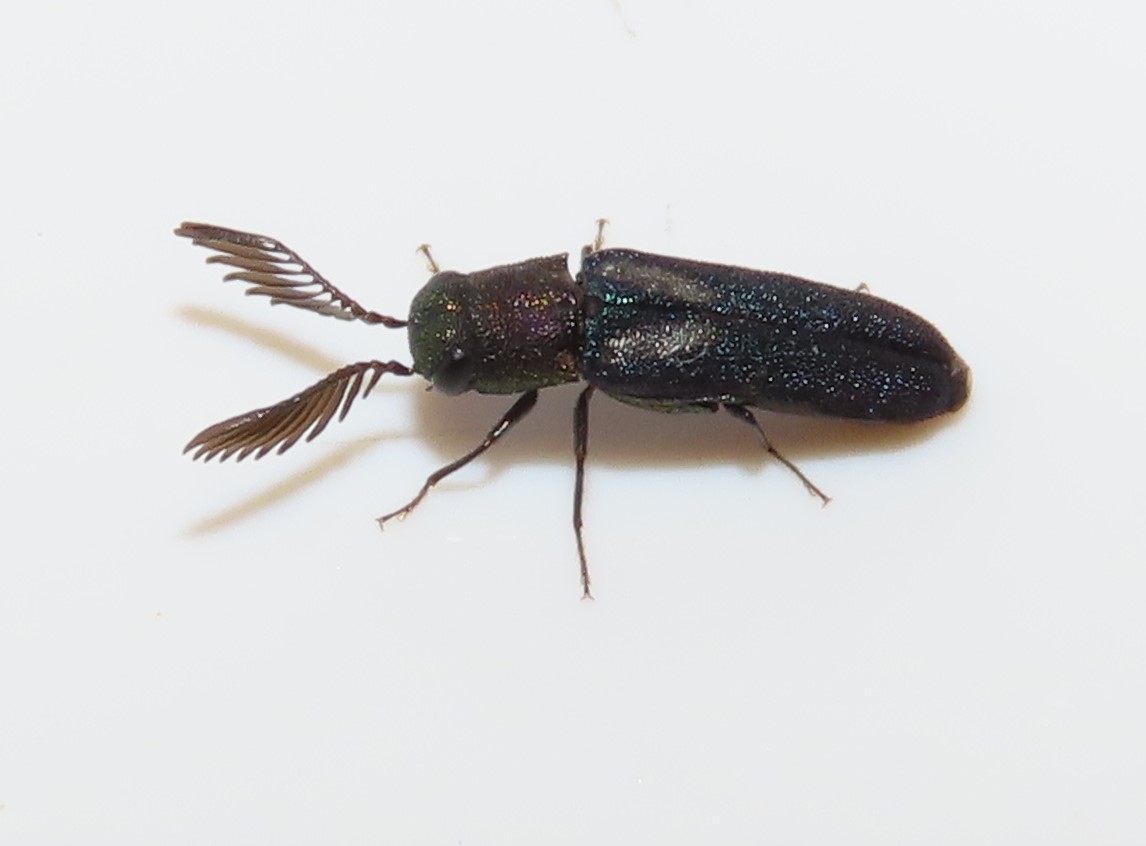
The other day, July 7, I was washing the dishes and noticed a small insect clinging to the outside window screen. Perhaps it had taken shelter during the early morning storms that day….When I was finished with the plates and silverware, I went out to see what the creature was. It was a small jewel beetle, family Buprestidae. I took a picture and decided it was a species of Agrilus that I had not seen before in our Leavenworth, Kansas, USA yard. Boy, was I wrong.

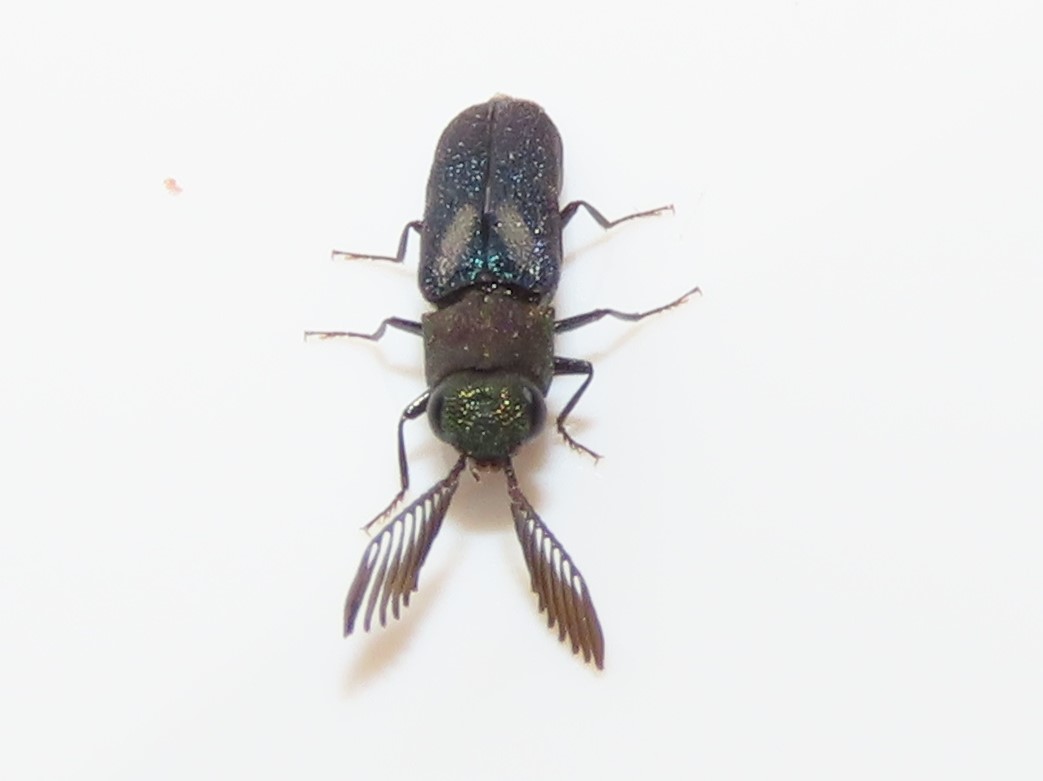
When I first saw it, the beetle had all its appendages tucked in pretty close to its body, but when I disturbed it, it unfurled comb-like (pectinate) antennae, something you do not expect to see in a buprestid. I knew there was at least one species in which the male has this brand of antennae, so I looked it up.

Turns out it is the rarely-seen Xenorhipis brandeli. This specimen is on the large end of the 3-7 millimeter size scale for the species. Given that it is not economically important (damaging), a surprising amount of information is known about it. Unfortunately, most of the relevant papers are locked behind pay walls, and therefore not readily accessible to me.

Xenorhipis brendeli is one of only three species in the genus found in North America north of Mexico, and the only one ranging into the northeast U.S. All exhibit sexual dimorphism in the antennae, females lacking the branches that the males do.

Ringo Compean, commenting on one of my Facebook posts, said “That’s an eyelash bug.” How perfectly descriptive! It is still a subdued beetle compared to many members of the Buprestidae. It is basically black or dark brown with blue, green, and/or bronzy highlights, and yellowish accents on the “shoulders.”

Besides the extravagant antennae, males have a pair of large pits on the underside, on what amounts to their “chest.” These cavities are lined with many setae (hairs) that probably have some sort of chemosensory function. The antennae are definitely tuned to the species-specific pheromone released by virgin females. The insects are diurnal, but there is a narrow window when females emit their attractive scent. Males, at least, are very short-lived, so there is great urgency in finding a mate.

The preferred host trees for Xenorhipis brendeli are apparently hickories (Carya spp.), which includes pecans. There are plenty of hickories in Leavenworth, plus pecans in the bottomlands on Fort Leavenworth. Other known hosts include River Birch and Eastern White Oak.

The female beetle lays her eggs in crevices of bark on small limbs, about 5/8ths inches in diameter. This is of interest because I had piled small, dead and broken tree branches from our yard into a backyard brush pile for birds over the winter months. These were mostly from Pin Oak and maple, though.

The larvae that hatch from the eggs bore under the bark….and that is the extent of the preview I am allowed for the 1966 paper by S. G. Wellso.

The fate of this specimen is spoken for. It will be in the collection of a friend and colleague in Arizona, where it will have relative immortality beyond this blog post, eventually available for loan to scientists elsewhere in the world. Meanwhile, I might have to inspect that brush pile again.

Sources:Paiero Steven M., Morgan D. Jackson, et al. 2012. Field Guide to the Jewel Beetles (Coleoptera: Buprestidae) of Northeastern North America. Ontario: Canadian Food Inspection Agency. 411 pp.
Evans, Arthur V. 2014. Beetles of Eastern North America. Princeton, New Jersey: Princeton University Press. 560 pp.
MacRae, Ted C. 2012. “Extreme sexual dimorphism in Buprestidae: Xenorhipis hidalgoensis,” Beetles in the Bush.
Wellso, S.G. 1966. Sexual Attraction and Biology of Xenorhipis brendeli (Coleoptera: Buprestidae). J. Kansas Ent. Soc. 39: 242-245.
MacRae, Ted. 2008. “A new species of Xenorhipus from Baja California,” Beetles in the Bush.

Saturday, June 25, 2016

Beetle Bonanza

Back on June 13, while my wife and I were headed to a different destination, we passed by a logging mill operation in Black Forest, northeast of Colorado Springs. I wanted to go back another time, and did so on my own this past Thursday, June23, but not without much trial and error. It was a rewarding outing once I got there, with beetles of all kinds flocking to the freshly-cut Ponderosa Pine logs.

Jewel beetle, Chrysobothris dentipes

It turns out I had not been paying enough attention to the route we had taken the first time, and so on Thursday I became hopelessly lost. I phoned my wife and she informed me I was nowhere near the right road. Consequently, I got to the site in the late morning. When I arrived, there was no one to be seen. I looked around anyway, as there were also no postings against trespassing.

The first insects I saw were what I expected: medium-sized jewel beetles, Chrysobothris dentipes, as depicted above. These members of the family Buprestidae look exactly like little shards of pine bark, but they move often enough to be easily seen. Several males were engaging in "butt-thumping" displays to nearby females. Below is a very brief video depicting this. It is surprisingly audible, and also hilarious. I hope to go back again and get a longer video segment.

Also present were a fair number of the magnificent metallic green Phaenops gentilis. Though they are only about 8 millimeters in length, these buprestids are still conspicuous. Like most jewel beetles they are quick to fly when disturbed, though they usually simply run so erratically as to be nearly impossible to get an image of. Females pause often to lay eggs, though, so that is your one opportunity. The one below took time to groom itself and luckily I was in the right place at the right time.

Jewel beetle, Phaenops gentilis

While I was photographing another insect, I glanced down to see a very large buprestid that had landed on my shoulder. I grabbed it, and it turned out to be a Western Sculptured Pine Borer, Chalcophora angusticollis. Measuring 20-33 millimeters, they are among our largest jewel beetles. When they fly, the lifted elytra (wing covers) expose a bright blue, green, or violet abdomen. I brought it, and another specimen, home to photograph.

Western Sculptured Pine Borer

What surprised me most were the large numbers of predatory checkered beetles, family Cleridae, active hunters of bark beetles and other small insects. I thought that I was seeing one species, with individuals of varying sizes, but upon looking at my images it became apparent there were three species.

Checkered beetle, Enoclerus moestus

Enoclerus moestus was the first one I came across. E. lecontei was likewise common.

Checkered beetle, Enoclerus lecontei

Lastly, the largest species was the "Red-bellied Clerid," E. sphegeus. While the adult beetles will kill and consume a variety of other insects, the larvae appear to prey exclusively on bark beetle larvae. You know, like the Mountain Pine Beetle and its relatives that are often blamed for killing entire forests.

Red-bellied Clerid, Enoclerus sphegeus

Longhorned beetles were present on the log stacks as well. I expected the White-spotted Sawyer, Monochamus scutellatus, and indeed I found a couple of females, one of them ovipositing, and a single male. These are large beetles that live up to the longhorn name. Their antennae are exceptionally long, especially in the males.

Female White-spotted Sawyer laying eggs

The most abundant of the longhorns, though, were flower longhorns in the genus Grammoptera. I even found a pair mating.

Flower longhorned beetles, Grammoptera sp., mating

The freak of the longhorn show was the Ribbed Pine Borer, Rhagium inquisitor. The adults look very little like a typical longhorned beetle, having quite short antennae. Two specimens landed on me or in my vicinity.

Ribbed Pine Borer

They are medium-sized at 12-15 millimeters in body length. They get their name from the woven wreath-like ring consisting of coarse wood fibers that the larva creates for its pupal chamber.

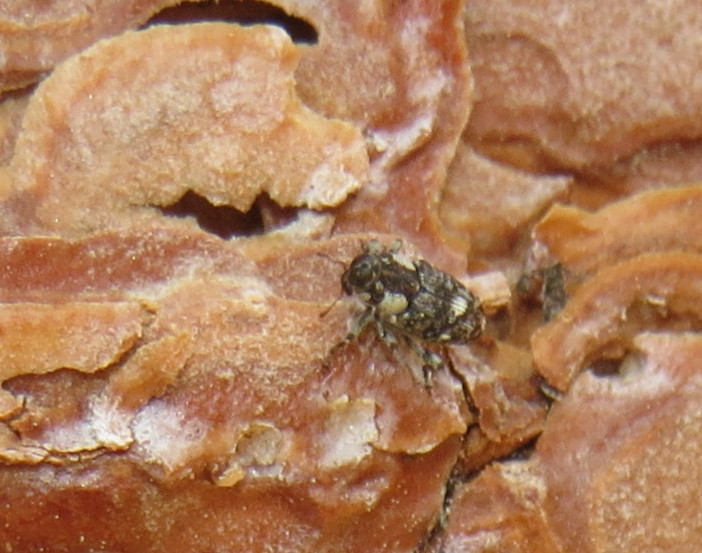
I also found a few oddball beetles including a very tiny weevil, Lechriops californica. At least that is what I think it is. They bore, in the larval stage, under the bark on the trunk and larger branches of various pines.

Tiny weevil, Lechriops californica maybe

Another predatory beetle was a very small clown beetle, family Histeridae. It may belong to the genus Platysoma, which live under bark and hunt the larvae of flies and beetles.

Clown beetle, Platysoma sp.

There were non-beetle insects, too, of course. The most common were the syrphid fly Chalcosyrphus piger. Females were alighting on the logs, presumably to oviposit (lay eggs) there. The larvae of these flies feed on decaying wood, and perhaps fermenting sap.

Syrphid fly, Chalcosyrphus piger

The most exciting find was a female aulacid wasp, family Aulacidae, in the genus Pristaulacus. They are easily mistaken for ichneumon wasps at first glance, but the ovipositor is downcurved at the tip; and the abdomen is connected high on the back of the thorax. These wasps are more closely allied to ensign wasps (Evaniidae) and carrot wasps (Gasteruptiidae). They are parasites of wood-boring beetles, surprise, surprise.

Aulacid wasp, Pristaulacus sp.

I am looking forward to returning to this site, as long as I am welcome. Those towering stacks of big pine logs are a bit intimidating, I have to admit, but worth braving for the bounty of beetles.

Male longhorned beetle, Acanthocinus obliquus

Sources: Cowan, B.D. and W.P. Nagel. 1965. "Predators of the Douglas-Fir Beetle in Western Oregon," Technical Bulletin 86, Agricultural Experiment Station, Oregon State University, Corvallis, Oregon. 32 pp.
Furniss, R.L. and V.M. Carolin. 1977. Western Forest Insects. Miscellaneous Publication No. 1339, U.S. Department of Agriculture, Forest Service, Washington, DC. 654 pp.
Smith, David R. 1996. "Aulacidae (Hymenoptera) in the Mid-Atlantic States, with a Key to Species of Eastern North America," Proc. Entomol. Soc. Wash.. 98(2): 274-291.

Sunday, August 2, 2009

More Beetle Excitement

I got some exciting news this past week that I thought I would share. It involves a species of beetle that I collected while on a photo outing on the Fourth of July near the Quabbin Reservoir in Franklin County, Massachusetts.

While in a forest clearing (well, more of a slash pile of logging residue, actually), I saw a metallic woodboring beetle in the family Buprestidae. It seemed non-descript, much less brilliant in color than others I have seen, but I took its picture anyway. I wanted more images, though, so I captured it alive in a vial and took it home.

After chilling this highly active animal in the refrigerator, I placed it on the kitchen table and took more images. I was finally able to see that it was more or less metallic purple, the granular violet nature of its exoskeleton reflecting the light from my camera flash. It looked like the beetle had perhaps hatched out of a geode rather than a pine tree.

I posted my two images, one “in the wild” and the other “staged,” to Bugguide.net in the hopes of confirming my identification of it as Buprestis striata. Much to my surprise, the consensus among the experts is that this is actually a specimen of Buprestis sulcicollis, a much less commonly-encountered species. It was, in fact, previously unrecorded for the state of Massachusetts, though long suspected of occurring here.

Getting a state record is reasonably remarkable, but considering that I have been here in Massachusetts for a grand total of two months, it feels pretty spectacular. It would be great if it translated to a wage increase, but alas, I suspect all I will get out of it is “this stupid t-shirt” equivalent. As luck (good or bad depending on your viewpoint) would have it, the beetle subsequently died before I got around to releasing it. I will get to decide where the specimen will be deposited, which is a reward unto itself, I think.

The beetle deserves a bit of notoriety, too, but very little is known about Buprestis sulcicollis. Adult beetles measure from eleven to 15.5 mm. The recorded hosts for the larvae are pitch pine and eastern white pine. Its distribution is mostly from the Great Lakes to the Atlantic seaboard, but there are records as far west as Alberta and the Northwest Territories.

I encourage each of you to not assume that whatever creature you encounter is common, known from your area, or even already known to science. Take pictures, note the habitat, any behaviors you observe, and record the date and precise location you found the organism in. You never know what may become of your patient and careful study.