Showing posts with label beetles. Show all posts

Wednesday, August 12, 2026

Jewel Beetle Spring

As I write this, Leavenworth, Kansas, USA, is under an (checks notes) “extreme heat warning,” expected to last for another two days at least. It has been an excessively hot summer, and I am recounting memories from spring more than I am making new discoveries. One thing that stands out was the diversity of jewel beetles, family Buprestidae, that I found during the month of May this year.

Blue Spotwood Borer, Agrilus acutipennis

Jewel beetles are also known as metallic woodborers for their often brilliant, iridescent colors; and called flathead borers for the flattened larval stage. The adult beetles are frequently alert, dashing or flying away at the first hint of potential danger, making them a challenge to photograph. Others are exceptionally cryptic, relying on camouflage and stillness to avoid detection in the first place. Some species exhibit all of these characteristics and behaviors.

Emerald Ash Borer from May 30, 2021, Leavenworth, Kansas.

Yes, some species can be pests, namely the Emerald Ash Borer, Agrilus planipennis, but that is a species native to east Asia. It is extremely problematic where it has been introduced. Most jewel beetle species are kept in check by parasitoid wasps, predatory beetles, and other natural controls.

Unidentified Agrilus sp. from Weston Bend State Park, Missouri.

On May 4, Heidi and I went across the river to Weston Bend State Park in Missouri, one of our favorite haunts during spring bird migration. It turned out to be pretty good for insects, too, including some jewel beetles. I spotted one of the many species of the genus Agrilus that can be found in our neck of the woods. These are small, usually well under ten millimeters, very narrow and elongate, and more often than not have muted colors. They are most often seen on foliage in sunny spots in the forest understory, or along forest edges.

Texania campestris, Weston Bend State Park, Missouri.

Heidi, while taking pictures of moss or mushrooms on a stump, suddenly exclaimed that she saw a huge buprestid. Indeed, she found a big specimen of the Hardwood Heartwood Buprestid, Texania campestris. It is very likely the largest species of jewel beetle in our immediate area, ranging from 20-30 millimeters. It can be confused with the pine-boring genus Chalcophora that is found elsewhere in Missouri.

Texania campestris

T. campestris occurs east of the Great Plains, but is more common in the southern U.S. than elsewhere. Known host plants for the larvae include American Beech, American Sycamore, maples, and Black Willow.

Texania campestris

Closer to home, I visited Havens Park here in Leavenworth, on May 13. It is the closest thing to a “wild” park within walking distance. It is a hilly park, at the top of which is something of a plateau. There, at the summit, more or less, is a degraded glade habitat, more xeric than the surrounding forest, dominated by Eastern Redcedar, and some of the hardier oaks.

Blue Spotwood Borer, Leavenworth, Kansas.

I found a handful of jewel beetles flying around, and landing on, some oak saplings in one sunny spot. They turned out to be the Blue Spotwood Borer, Agrilus acutipennis, infrequently to rarely collected, according to one recent source. This is a spectacular species for the genus, at 7-10 millimeters in length, and vivid metallic blue with white scales highlighting the edges of the pronotum (top of thorax), and the sides and venter of the abdomen.

Blue Spotwood Borer

The Blue Spotwood Borer is found east of the Great Plains, well into Canada. Larvae are known to bore in Eastern White Oak, and Overcup Oak, but the adult beetles alight on all kinds of other oaks, hickories, and walnut.

Brachys ovatus, Havens Park, Leavenworth, Kansas.

In contrast to that showy species, I also noticed a Brachys ovatus, doing its best impression of a dried-up leaf edge. At only 4-7 millimeters, it is easily overlooked despite how relatively common it is, throughout eastern North America. Oddly, males of this species are rarely seen, and it may reproduce by parthenogenesis. Larvae bore in Northern Red Oak.

Common Hackberry Agrilus, Havens Park, Leavenworth, Kansas.

I also found an unusually lethargic Common Hackberry Agrilus, Agrilus lecontei, also on an oak leaf. I thought it might even be dead, a victim of a robber fly or other predator. I collected it into a vial, and by the time I got home it was apparent it was very much alive.

Common Hackberry Agrilus alive and well!

This is another small (4-7 mm) species that is supposedly uncommon, despite its widespread distribution east of the Great Plains.

Redbud Borer, Leavenworth, Kansas.

We have several Eastern Redbud trees “volunteering” in our yards, so it was not surprising to discover a Redbud Borer, Ptosima gibbicollis, on one of them on May 18.These little beetles are only 4-7 millimeters, but black with bright yellow markings, so they are easy to see.

Redbud Borer

On May 20, I was surprised and delighted to spot a Two-lined Chestnut Borer, Agrilus bilineatus, on a leaf near our front steps.

Two-lined Chestnut Borer, Leavenworth, Kansas.

Despite the name, this beetle uses a variety of oak species as host trees. It is a widespread and common species east of the Great Plains, but this is the first time I have seen one. It is 4-10 millimeters long.

Two-lined Chestnut Borer

I walk our neighborhood regularly, weather permitting, but on May 22 I took only my phone with me. Naturally, I found a lovely specimen of Anthaxia cyanella on a leaf in a hedge adjacent to an open field.

Anthaxia cyanella, Leavenworth, Kansas.

This brilliant blue beetle is only 4-5 millimeters long, and is apparently infrequently encountered. Larvae are known to bore in Eastern Redbud, Honeylocust, Downy Serviceberry, and River Birch. Adult Anthaxia species in general are usually seen on flowers, especially composites.

Beech Borer, Leavenworth, Kansas.

On May 26, once again with only my phone at hand, I noticed a Beech Borer, Agrilus obsoletoguttatus, in the little butterfly garden along one exterior wall of our local library.

Beech Borer from blacklighting in Leavenworth on June 10, 2021.

This beetle, 4-8 millimeters in length, is quite common east of the Great Plains. Larval host trees include Dwarf Chinkapin Oak, Northern Red Oak, Ohio Buckeye, Eastern Hophornbeam, and Honeylocust, among others.

Heidi and I hiked the VA Trails, another mostly wild park along the Missouri River on the Kansas side here in Leavenworth, on May 27. I didn’t see any jewel beetles until we came back to the parking lot and I noticed a large, recently-downed limb of an oak tree about fifty yards away.

Chrysobothris sp., VA Trails, Leavenworth, Kansas.

Storm damage provides woodboring beetles of all sorts with fresh resources that they quickly locate and oviposit into. Among the more reliable arrivals will be jewel beetles in the genus Chrysobothris. The bad news is that they all look very similar and are extremely challenging to identify.

Sure enough, I found several of these cryptic gems running over the bark of the tree limb. The Chrysobothris femorata species complex is probably what this one falls under. The species is named the Flatheaded Appletree Borer, but there is a wide range of deciduous trees used as hosts. These are probably opportunistic generalists that take advantage of storm damage and logging operations. Chrysobothris are midsize jewel beetles, ranging from 7-16 millimeters in this particular instance.

Chrysobothris sp. Males thump their butts on the log to get the attention of females.

Jewel beetles can be found during most of the warmer months, but spring, even early spring, is perhaps the best time to be looking for them. They are well worth pursuing, and you can help add to our collective scientific knowledge by sharing your observations on iNaturalist, Bugguide, and elsewhere. Happy Hunting!

OK, BYE-E-E-E!

Sources: Paiero, Sten M., et al. 2012. Field Guide to the Jewel Beetles (Coleoptera: Buprestidae) of Northeastern North America. Canadian Food Inspection Agency. 411 pp.
Solomon, J.D. 1995. Guide to Insect Borers of North American Broadleaf Trees and Shrubs. Agriculture Handbook 706. Washington, DC: U.S. Department of Agriculture, Forest Service. 735 pp.

Saturday, April 11, 2026

The Beetle and the Bee

At the end of February, I finally found a beetle I had been looking for here, for years. Perhaps I had not been scouting for it early enough, but we barely had a winter this year, and I suspect that most years it would have been evident in March. The key was finding an aggregation of its host organism.

Tricrania sanguinipennis is a blister beetle in the family Meloidae. The adult insects measure 9-15 millimeters, but are bright enough, and active enough, that they are easily seen. Their wings, hidden under their red, leathery elytra, are almost vestigial, so they are flightless. Instead they crawl, but rather rapidly, over the surface of the soil, periodically digging where they detect the possible presence of a host.

Kansas is about as far west as this beetle is found, though there are records well north into Saskatchewan, Canada. It occurs over the eastern U.S. to extreme northern Florida, and up into adjacent southern Canada.

The limiting factor is that Tricrania sanguinipennis is a parasitoid of solitary bees that nest in dense aggregations, namely cellophane bees in the genus Colletes.

We have the Unequal Cellophane Bee, Colletes inaequalis, nesting in our yard and/or the adjacent neighbor’s lawn, depending on the year, but those locations are apparently blister beetle-free. It took finding a small aggregation of the bees in a forested park to locate the beetles.

An Unequal Cellophane Bee lurks just inside the entrance to her burrow.

The bees nest in burrows, ideally in sandy soil. The vertical, subterranean tunnels branch into several individual cells, each one an “apartment” for a single bee larva. The grub feeds on a nearly liquid loaf of pollen and nectar. The walls of its room are coated in a type of natural plastic manufactured in glands in its mother’s abdomen, which essentially waterproofs the chamber, and retards mold and fungus.

Back to the beetles. What the female beetles lack in mobility, they more than make up for in fecundity. Each lady can produce hundreds of eggs, over a thousand in some documented instances. How, then, do the beetles gain entry into these tunnels? The answer is that they do not. The larvae do.

The larval stage is unusually lengthy, progressing through six instars. An instar is the interval between molts. It is also strange in that it includes hypermetamorphosis. In this case that means the larval form changes radically in both appearance and behavior from one molt to the next.

Several male Unequal Cellophane Bees waiting for females to emerge.

The first instar larva that emerges from the egg is a sleek, streamlined, highly mobile bee-seeking missile called a triungulin. At the time they are active, it is almost exclusively male Colletes bees that are active, buzzing about and frequently landing to investigate a potential site where a female could emerge. It is at these brief moments when a blister beetle triungulin scampers aboard, affixing itself to the hairs on the underside of the bee’s abdomen.

Oops! An overeager male mistakes another male for a female.

When the male bee at last is able to mate, the triungulin transfers to the female bee. In at least a few instances, the triungulin may attach directly to a female bee that it encounters on the ground. She will eventually, and unwittingly, ferry that parasite, and probably several others, to her new nest burrow. Once inside, it disembarks and infiltrates one of the subterranean nest cells.

The beetle larva usually consumes the egg of the host immediately, but not always. The bulk of its diet will be the honey and pollen left by the bee for its offspring in the cell. It may be a frequent occurrence that more than one beetle larva invades a single bee cell. In that event, cannibalism of the competition resolves the conflict.

The meal of the host egg or larva is usually enough nutrition to trigger the beetle larva’s molt to the next instar. This results in a shocking change from that sleek, active larva into the insect equivalent of a couch potato. The second instar is, shall we say….rotund, and boat-shaped. It commences feeding on the pollen and nectar stores in the cell of the now missing bee offspring. The insect retains this form for the remainder of its larval life. The first three instars shuck their old exoskeleton completely, but the fourth and fifth instars retain each molt in its entirety. Think of it as an object inside a balloon (inside another balloon by the fifth instar). Those larvae actually shrink in size to fit inside the shed “skins.” When molting into the pupa stage, the sixth molt is again broken during shedding, and compacted at the rear of the pupa, which is still inside those other exoskeleton balloons.

It takes until late summer or early fall for the life cycle to complete, the adult beetle remaining encased in its final one or two larval exuviae, where it overwinters, still inside the cell in the host’s nest burrow.

You would think that the bee species hosting this diabolical beetle would be decimated by it, but such is not the case. Each spring there are plenty of the adult bees. What is more of a threat is the potential disconnect between the bees and their nectar plants. Colletes inaequalis visits flowering trees almost exclusively, especially Eastern Redbud, and maple trees. As the phenology of the blooming cycles becomes increasingly unpredictable thanks to climate change, the appearance of the flowers may cease to always coincide with the emergence of the bees that pollinate them.

Sources: Messinger Carril, Olivia, and Joseph S. Wilson. 2021. Common Bees of Eastern North America. Princeton, NJ: Princeton University Press. 286 pp.
Parker, J.B. and Adam G. Boving. 1925. “The Blister Beetle Tricrania sanguinipennis - Biology, Descriptions of Different Stages, and Systematic Relationship,” Proc U.S. Nat. Mus. 64(2491): 1-40. This is a wonderfully exhaustive article, with illustrations of all larval instars.

Monday, April 14, 2025

That's Not an Ant?!

It is always best to avoid making assumptions about insects in the field. I was reminded of that on three seperate occasions this month, all of them involving mimicry of ants by small longhorned beetles in the family Cerambycidae. Early spring is apparently the season for these wood-boring insects, at least here in Kansas. Their resemblance to ants is uncanny, and highly convincing.

Cyrtophorus verrucosus

While exploring our yards and looking for insects on April 2, I noticed what I thought was a carpenter ant climbing on the exterior of our detached garage. I was about to dismiss it, but decided to document it anyway, as it would be new for the year. Imagine my surprise and delight to discover it was instead an adult Cyrtophorus verrucosus. This species has no common name, which is unfortunate given its uniqueness.

The beetle averages only 9 millimeters in body length. Larvae bore in a variety of host trees, including maple, hickory, oak, elm, birch, chestnut, dogwood, Eastern Redbud, American Beech, and even pine. The adult beetles are active from March to July, but are most abundant in early spring. Cyrtophorus verrucosus ranges over most of the eastern U.S., and Canada as far west as Alberta. This was a new species for our property.

I was invited to present the keynote address for a joint meeting of the Kansas Academy of Science, and Central States Entomological Society, in Wichita, Kansas on April 5, and Heidi and I stayed over to go exploring on Sunday, April 6. I reached out to a Facebook and iNaturalist friend, Ryan Philbrick, and we met at the Kansas Wildlife Exhibit in Central Riverside Park. From there we went to Keeper of the Plains, and walked the nice concrete trail along the Arkansas River. At one point, Ryan turned over a small, broken tree limb on the ground. He noticed millipedes and a small "ant" crawling over the bark.

Euderces pini

I trained my camera on the ant and discovered it was another species of longhorned beetle, Euderces pini. At only 7-8 millimeters, and slender, it is even more ant-like than other species. The larval host trees include Flowering Dogwood, Pecan, Winged Elm, and American Beech, but there are several other hardwoods on the menu.

The adult beetles are frequently found on flowers, feeding on pollen and nectar. Even dandelions will suffice until native trees start blooming. Euderces pini occurs in the southern half of the eastern United States, and appears as an adult from March to June.

Currant-tip Borer

Back home, yesterday, April 13, I happened to notice a small ant-like insect on the central air-conditioning unit in the back yard. It was even smaller than the other beetles, but at least it had a common name: the Currant-tip Borer, Psenocerus supernotatus.

Despite its name, this 4-millimeter beetle has been reared from plants other than currant: Green Hawthorn, Tulip Tree (aka Tulip Poplar, Yellow Poplar), and Black Willow. This beetle is widespread in North America, east of the Rocky Mountains, and the adults are found from April to June.

None of these three beetles are considered pests, maybe because they do not affect crops or orchard trees. Their earthtone colors make them rather cryptic, but they are quite active, running rapidly, and flying well.

An actual ant

It is interesting to note the convergence in body shape and coloration between the different genera. They each have white streaks or bars designed to suggest body segmenation where there is none. Ants show marked constrictions between the head, thorax, and abdomen. In these beetles, the thorax may be mistaken for the enlarged head of an ant, and the elytra (wing covers), "divided" into thorax and abdomen by those white markings. The true head of the beetle is relatively small, and in the case of the Currant-tip Borer, directed downward and nearly hidden by the thorax.

There are even more ant-mimicking longhorned beetle species. Give that "ant" a second glance, especially if you see it in isolation, with no other ants nearby. It may turn out to be a beetle instead.

Sources: Lingafelter, Steven W. 2007. Illustrated Key to the Longhorned Woodboring Beetles of the Eastern United States North Potomac, Maryland: Coleopterists Society, Special Publication No. 3. 206 pp.
Yanega, Douglas. 1996. Field Guide to Northeastern Longhorned Beetles (Coleoptera: Cerambycidae). Champaign, Illinois: Illinois Natural History Survey, Manual 6. 174 pp.

Saturday, December 14, 2024

Tuesday, September 20, 2022

Fungus Party-y-y!

Sometimes, with luck, you stumble upon a wonderful circumstance of insect abundance. My partner, Heidi, did so this past Saturday afternoon, September 17, along a trail through Wyandotte County Lake Park, Kansas, USA. She happened to notice a thick mass of mushrooms at the base of a tree. It was literally crawling with insects.

Everybody on the dance floor!

The fungus in question may be a species of “oyster mushroom” in the genus Pleurotus, according to Ben Sikes at the University of Kansas, and with the Kansas Biological Survey. He was kind enough to offer an opinion on my photo of it on iNaturalist. At least some species are fit for human consumption, too, but please do not forage without expert guidance, at least initially. Your experiment in wild culinary arts could end abruptly and permanently if you do not know exactly which mycological fruiting bodies to avoid.

"Get down to it....get down to it...."

Insects, on the other hand, do not seem to care, especially the many varieties of beetles that are collectively known as fungus beetles. There are pleasing fungus beetles (family Erotylidae). There are handsome fungus beetles (Endomychidae), hairy fungus beetles (Mycetophagidae), tooth-necked fungus beetles (Derodontidae), silken fungus beetles (Cryptophagidae), polypore fungus beetles (Tetratomidae), cryptic fungus beetles (Archeocrypticidae), minute tree-fungus beetles (Ciidae), and several genera of darkling beetles (Tenebrionidae) that are found almost exclusively on or in fungi, including woody shelf fungi. I may be forgetting some….

Triplax thoracica, but there may have been another species with a dusky or black belly instead of an orange underside.

The most abundant insect on this particular mushroom cluster is probably a pleasing fungus beetle, Triplax thoracica. That genus, certainly, but that species apparently loves oyster mushrooms. It occurs across the eastern half of the U.S. and adjacent Canada. At only 3-5.6 millimeters in length, they are difficult to spot as individuals, but there were dozens flying in, flying out, and running about.

Uh, oh [abrupt, scratched record sound].

In a prehistoric analogy, Triplax are the herd of plant feeders. Sure enough, there were vicious carnivores prowling through the gills and over the caps of the mushrooms.

Sharp dresser, anyway.

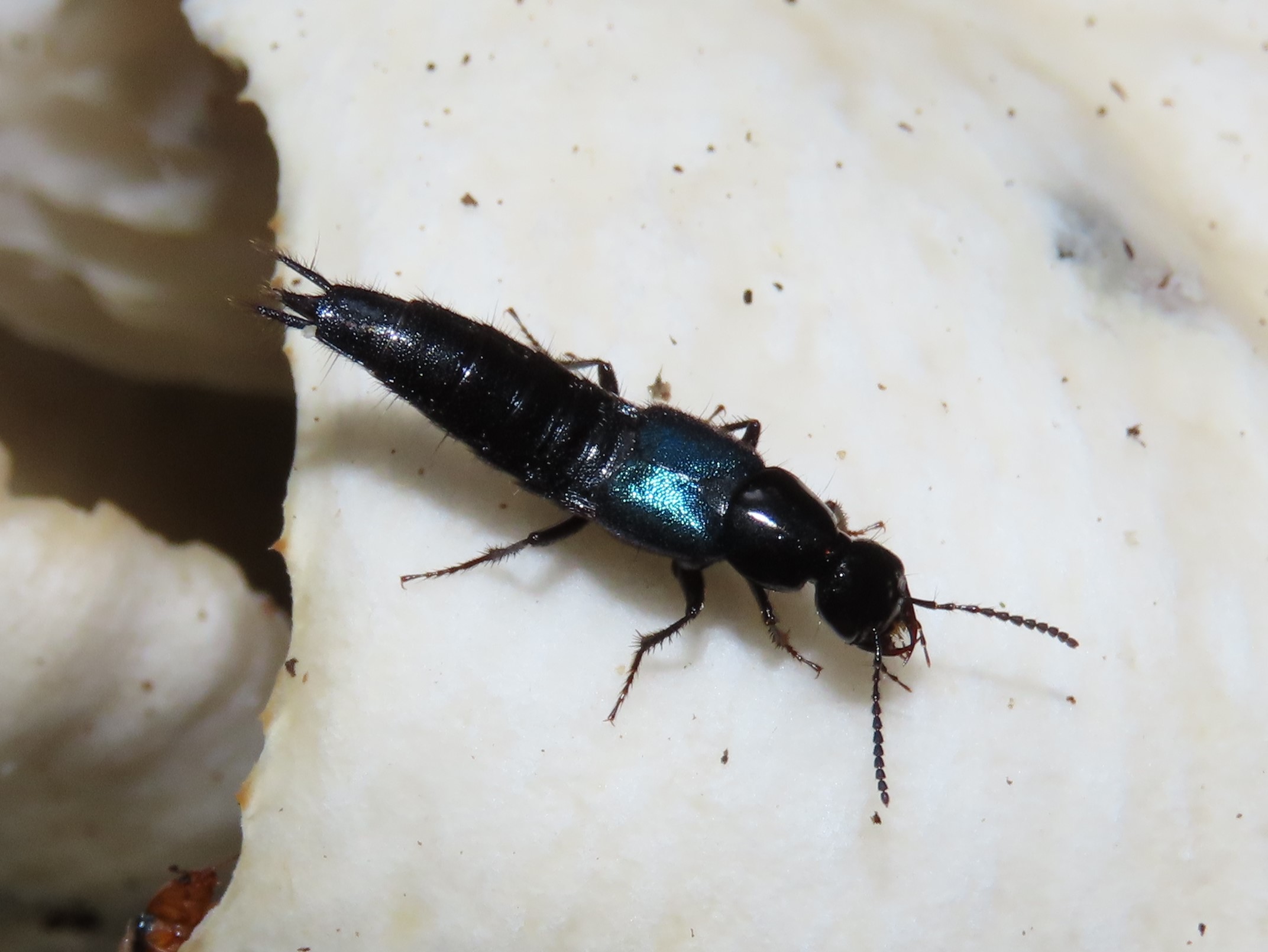
A sleek, serpentine, black rove beetle with metallic blue-green elytra (wing covers) popped into view periodically. Meet Philonthus caeruleipennis, 12-15 millimeters long. Were it a vertebrate, it would no doubt be a weasel, mink, ferret, or other mustelid. It is transcontinental in Canada, but occurs only in the northeast quarter of the U.S. It also occurs in Europe.

Pull the fire alarm! Call 9-1-1!

The equivalent of Tyranosaurus rex in this micro-scenario would be the Brown Rove Beetle, Platydracus maculosus. Measuring 22-35 millimeters, it dwarfs its prey, which in this case was the Triplax fungus beetles.

Serial killer making mincemeat of partygoers.

By now, oblivious to the monsters among them, the Triplax party was becoming something of an orgy, with love trains of males following females. It was quite amusing.

Gettin' busy.

Some of the fungus beetles also had passengers in the form of phoretic mites. The mites, which are probably “mesostigs” in the order Mesostigmata, cause no harm to the beetles. Instead of being parasitic, the mites are hitchhikers, using the beetles as transport to a location where they can feed on insect eggs or other tiny prey.

Mites being a little voyeuristic....

Along with the beetles were pomace flies, family Drosophilidae. These are the “fruit flies” you see in your kitchen around overripe fruit, fermented beverages, and other foods. Drosophilids sare surprisingly diverse, and a good variety can be found around rotting fungi “in the wild.”

Pomace fly disappointed that the mushroom is not spoiling already....

The latecomer to the party was a worker Tennessee Spine-waisted Ant, Aphaenogaster tennesseensis. She was simply looking for dead or injured insects she could take back to her colony to feed her larval sisters.

"Just passing through!

At last, it was time for me to say farewell. Heidi had already progressed down the trail by about fifty yards.

"I'm blowin' this fruit stand!"

Now is a perfect time to go out looking for mushrooms and their associated insects. We left these mushrooms alone, but sometimes it is necessary to tear apart the fungus to find insects. It is best to do so over a white enamel pan, or some other kind of tray so that it catches the insects falling out. Be quick to grab the rove beetles before they take flight. If you do know your mushrooms, then bonus! You can take uninfested specimens to the kitchen instead of the lab. Enjoy your autumn no matter what you do.

Nom-nom-nom-nom....

Sources: Rhine, Lyndzee. 2020. A Pocket Guide to Common Kansas Mushrooms. Wichita: Great Plains Nature Center. 69 pp.
Evans, Arthur V. 2014. Beetles of Eastern North America. Princeton, New Jersey: Princeton University Press. 560 pp.