Showing posts with label Missouri Prairie Foundation. Show all posts

Tuesday, June 16, 2026

Lordi Marker Prairie Bioblitz

Heidi and I participated for the fifth consecutive year in the annual bioblitz conducted by the Missouri Prairie Foundation, on June 6-7, 2026. This year it was at the Lordi Marker Prairie, which is adjacent to some other protected prairie acreage, at least one of which is under the ownership of Missouri Department of Conservation. The area is south-southwest of Sedalia, Missouri, in Pettis County.

Per our usual duties, we led a bug walk each day, and deployed a blacklight at night on Saturday.

The turnout for these events is always excellent, and diverse, with people of all ages and ethnicities gathering in a welcoming space.

Once again, the weather turned out to be better than expected, though those people who tent camped on the property did experience thunderstorms and showers in the middle of the night, early Sunday morning.

An iPhone 14 photo of a Margined Leatherwing beetle on yarrow.

Upon arriving, we were a bit startled by how many flowers were blooming. Especially abundant was New Jersey Tea, but the flowers seemed to attract relatively few insects except for beetles. The Margined Leatherwing, Chauliognathus marginatus, was one of the most abundant of insects, as is usually the case in early June in this part of the country. The Dark Flower Scarab, Euphoria sepulchralis, was also common.

Dark Flower Scarab, Euphoria sepulchralis, on New Jersey Tea.

One of the highlights of our visit was seeing a couple of Regal Fritillary butterflies, Argynnis idalia, formerly Speyeria idalia, flitting from flower to flower in the distance. This is a vulnerable, if not threatened, prairie-dependent insect, which feeds on the leaves of violets in the caterpillar stage. Its presence here indicates a high-quality habitat, even if “reclaimed” from its history as a hayfield. I can apparently show you this species, despite its conservation status.

Regal Fritillary leaving a flower.

There were different group leaders for butterflies, and for bees, and it proved something of a challenge to document many of those pollinator species. They were there, but widely scattered and difficult to intercept. We had somewhat better luck, if only because we had few taxonomic constraints. Anything insect or arachnid was fair game.

An immature White-banded Crab Spider, Misumenoides formosipes, waits in ambush on a flower.

One of the bee experts joined us on Sunday morning, and furnished participants with vials, and nets, they could use to capture specimens and bring them back to show everyone. This worked very well, and we will adopt this strategy for future outings.

Late instar nymph of a Broad-winged Sedge Grasshopper.

Our sharp-eyed and curious party members secured some truly exciting finds. Chief among them were nymphs, and a couple of adults, of the Broad-winged Sedge Grasshopper, Stethophyma celatum. I had never heard of it, either! In fact, I wrongly identified it as a species in the genus Chloealtis, when it doesn’t even belong in the same subfamily. Someone on iNaturalist corrected my repeatedly, which caused me to consult some grasshopper experts I know personally, and they confirmed it. I then apologized to the iNat person for doubting them.

Adult Broad-winged Sedge Grasshopper.

This grasshopper is another prairie obligate denizen, and a significant record.

Another unique species was a large fulgorid planthopper, Cyrpoptus belfragei, pictured above. It looks like a cross between a spittlebug (we saw plenty of evidence of those, too), and a cicada.

As a precaution for potential severe weather, we simply hung the blacklight on the bigtop tent.

Blacklighting produced some cool bugs, too. My favorite was probably a Bruner’s Earth-boring Scarab Beetle, Bolbercerosoma bruneri, that disappeared as quickly as we had uncovered it in a fold at the bottom of the tent flap.

Bruner's Earth-boring Scarab Beetle.

We also documented a vulnerable moth species, which I cannot, in good conscience, disclose its identity. There are enough unscrupulous collectors and dealers that it would put this population at risk of anihilation. Suffice that this prairie exceeds expectations for flora and fauna.

Another interesting moth, the Bog Glyph, Deltote bellicula.

While I am a member of, and volunteer for, the Missouri Prairie Foundation, I am not being compensated for singing its praises. This is one of those rare organizations that pays attention to details, and recognizes the importance of contributions from all demographics, including Indigenous peoples. It works with landowners over the long term to secure protection for habitat in perpetuity.

A longhorned beetle, Batyle suturalis, on a flower.

Those human relationships, between all the volunteers at the bioblitz, and between the nonprofit and private property owners, are what we need to promote across our entire country. It is becoming clear that when left to political institutions, little is truly sacred, and even less is enduring.

Spangled Pelochrista moth, Pelochrista scintillana, was common.

All observations from the bioblitz can be found here on iNaturalist. Please explore iNaturalist projects to find bioblitzes near you, and participate in them. I guarantee you will make new friends, have a great time, and probably make some important discoveries, be they personal or scientific.

Monday, June 9, 2025

Recent "Bug Eric" News

Bioblitz on the Snadon Tract of Coyne Prairie, Missouri, USA.

I was honored to be invited to be a guest on This Green Earth, a podcast, and NPR talk show hosted by KPCW in Park City, Utah, USA, last Tuesday, June 3. I spent a delightful twenty minutes or so with Claire Wiley and Christopher Cherniak, discussing wasps, and my book Wasps: The Astonishing Diversity of a Misunderstood Insect. If you would be interested in having me as a guest on your own podcast, please contact me via email: bugeric247ATgmailDOTcom. Thank you.

This past Saturday and Sunday, Heidi and I participated as group leaders for the annual prairie bioblitz organized by Missouri Prairie Foundation. This year it celebrated National Prairie Day at the Snadon Tract, a new addition to MPF's existing Coyne Prairie in Dade County, Missouri, USA. A future blog post will detail some of our insect and arachnid findings there.

Indian paintbrush flowers on the Snadon Tract of Coyne Prairie.

The bioblitz events of Missouri Prairie Foundation keep getting bigger and bigger. It is humbling to realize that a few attendees come specifically to meet myself and Heidi, and go on "bug walks" with us as we document the macrofauna. MPF is one of the most friendly and accomplished nonprofit organizations I have ever encountered, and I encourage my followers to consider membership or donations.

More personal traveling is on the horizon, but I will do my best to post notification of any public engagements. Meanwhile, the official publication date of my new book, Bugwatching: The Art, Joy, and Importance of Observing Insects is July 22. Please see the top of the sidebar if you wish to preorder. Thank you as always for your loyalty and support.

Friday, June 10, 2022

Thoh-Dah Prairie Bioblitz

Last weekend, June 4-5, my wife and I had the opportunity and honor to participate in a bioblitz of a newly-acquired property of the Missouri Prairie Foundation. Thoh-Dah Prairie is located in St. Clair County, Missouri, U.S.A., and is named for the Osage word for “peace” or “peaceful.” Indeed, it is an idyllic landscape.

Copyright Heidi Eaton

According to MPF, colonialism has been positively brutal to prairies in Missouri. Pre-settlement prairie amounted to roughly fifteen million acres. Today, only about 51,000 acres remain, in scattered patches that are at best tiny refuges of native grasslands. Given the scarcity of such a unique ecosystem, Heidi and I were eager to discover what insects live there.

Carol Davit addresses the crowd before the dedication

An enormous tent was set up to accommodate everyone, and several parties also erected their own camping tents to spend the night. Plenty of resources were provided by MPF, and memberships and merchandise were available for sale along with free publications from Missouri Depart of Conservation.

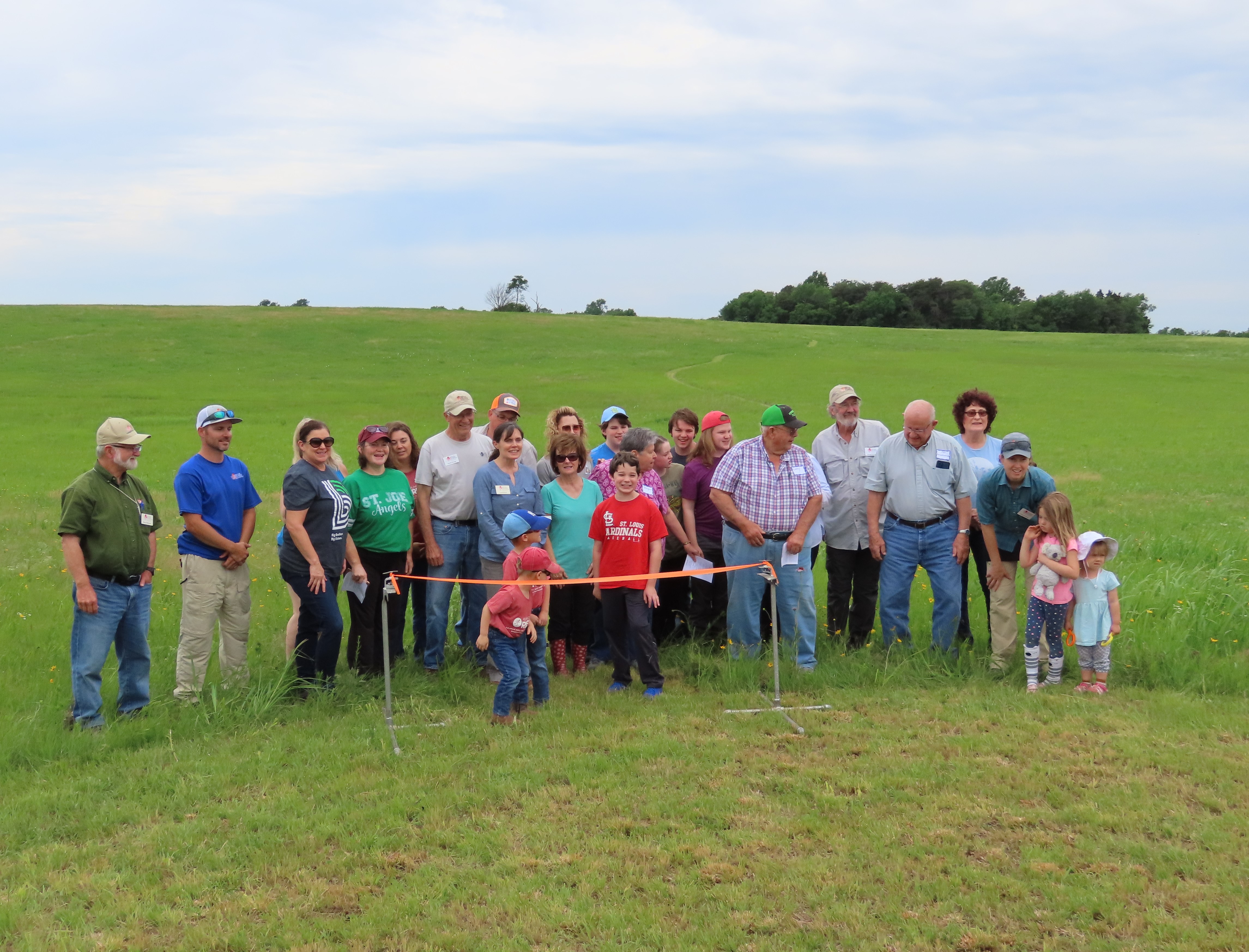
Ready for the ribbon cutting

The event was kicked off with a ribbon-cutting ceremony to dedicate the parcel, now preserved indefinitely thanks to the generosity of the family that managed hayfields there for generations. We immediately took to exploring, and were amazed by the floral diversity alone. Most of the plants we saw would not be found in your average vacant, neglected field. Many are endemic only to this kind of prairie.

Carolina Rose

New Jersey Tea

Sensitive Briar and Tickseed Coreopsis

Painted-cup Paintbrush

Most of the area we covered in our survey of organisms was subjected to a prescribed burn in autumn of last year. You could scarcely tell, as it was lush and green. Dickcissels and Grasshopper Sparrows called from all directions. Swallows frolicked low over the grasses. The skies remained overcast almost the entire time, and there was a brief, late afternoon shower, but we still found plenty of insects.

Clay-colored Leaf Beetle

Following an afternoon of hiking the gentle slopes, we were treated to a potluck. Each party brought a dish, but some of the MPF personnel fried up some fish, and also cooked quail and venison. There were plenty of salads and desserts, including homemade ice cream. Now that is how you do a proper bioblitz.

Bioblitzing makes you hungry....

....and tired
(photo used with permission)

After dark, a sheet and blacklight were set up. Despite the cooling effect of the earlier rain, several interesting species flew in.

Coffee-loving Pyrausta moth

Pyrgotid fly, Pyrgota undata

Firefly, Photuris sp.

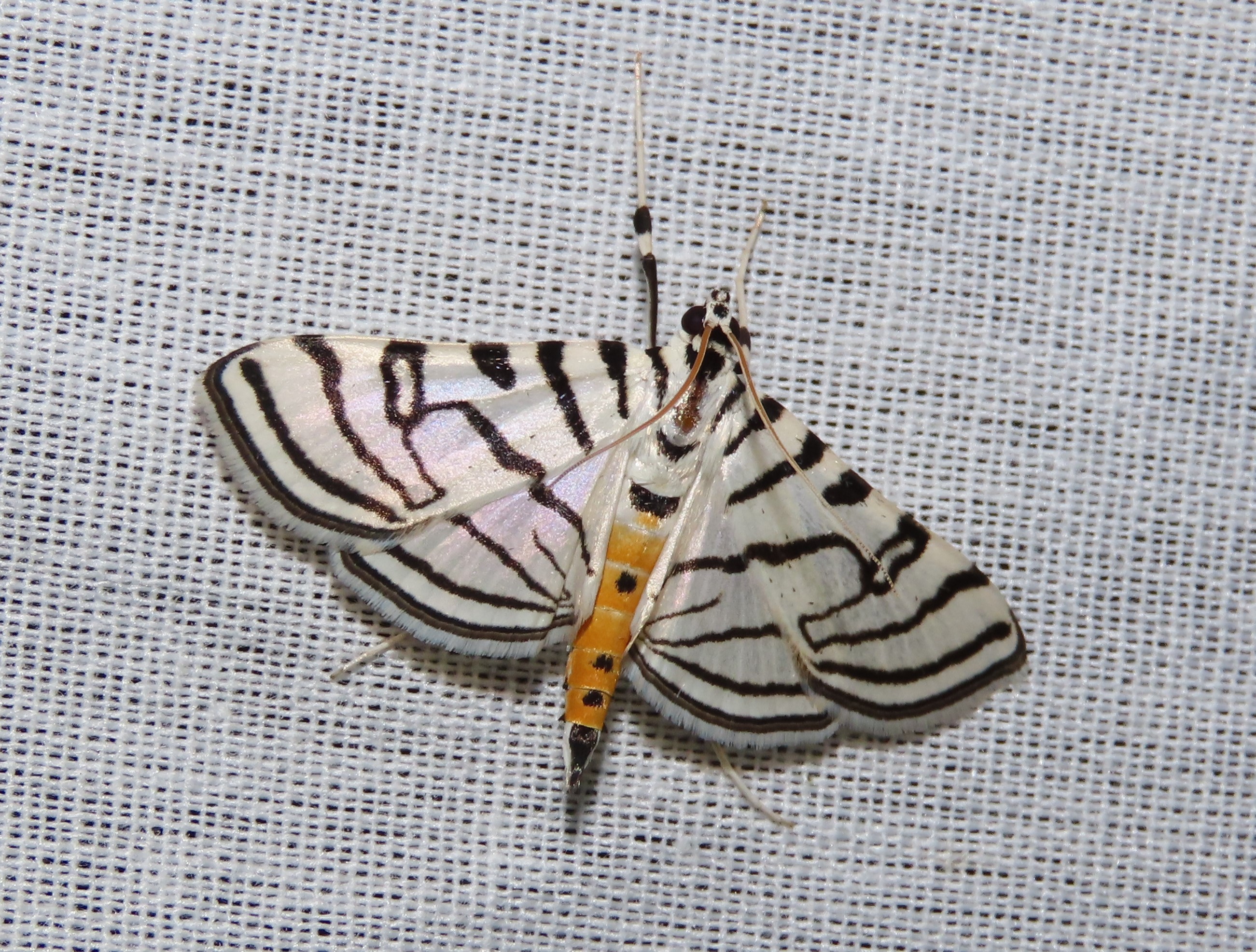
Zebra Conchylodes moth

Sunday, we explored in a different direction, making use of the mown paths that provided avenues for the many, enthusiastic bioblitz participants. Prairies are not all dry and dusty, we learned! There were several wet, boggy areas that proved to be almost entirely different habitats from the surrounding hills that drained into them.

Striped Lynx Spider

A couple of “tree islands,” thick stands of trees and/or shrubs, offered yet another kind of habitat. One larger group of trees surrounded a large pond that we could not comfortably access. The edges of those tree islands were perhaps richer in insect fauna, but such ecotones are well-known for higher diversity.

Azure Bluet damselfly

We got a little carried away, and by the time we returned to “base camp” a little after noon, we found the tent deserted. We are already looking forward to making another trip there to see how the area changes with the seasons, and contribute more data to the MDF for use in education and conservation.

That's all, folks!

Heidi took so many great photos that you can look forward to another blog post of images and captions alone. Meanwhile, please consider membership in the Missouri Prairie Foundation. It has a long, strong record to success stretching over 56 years (since 1966).

Besides identifying, acquiring, and managing remnant prairies such as Thoh-Dah, MDF also encourages rewilding of your own property through the Grow Native! project. This is one of the resources we are using to begin converting our own lawnscape into something much more compatible with the native landscape.

Goat's Rue

Many thanks go to Carol Davit, Executive Director of MPF, Jerod Huebner, Director of Prairie Management, and Erika Van Vranken, Special Projects Coordinator, and Sarah Hinman, board Secretary, for making this event such a success. These are empathetic and appreciative people.