Showing posts with label bioblitz. Show all posts

Tuesday, June 16, 2026

Lordi Marker Prairie Bioblitz

Heidi and I participated for the fifth consecutive year in the annual bioblitz conducted by the Missouri Prairie Foundation, on June 6-7, 2026. This year it was at the Lordi Marker Prairie, which is adjacent to some other protected prairie acreage, at least one of which is under the ownership of Missouri Department of Conservation. The area is south-southwest of Sedalia, Missouri, in Pettis County.

Per our usual duties, we led a bug walk each day, and deployed a blacklight at night on Saturday.

The turnout for these events is always excellent, and diverse, with people of all ages and ethnicities gathering in a welcoming space.

Once again, the weather turned out to be better than expected, though those people who tent camped on the property did experience thunderstorms and showers in the middle of the night, early Sunday morning.

An iPhone 14 photo of a Margined Leatherwing beetle on yarrow.

Upon arriving, we were a bit startled by how many flowers were blooming. Especially abundant was New Jersey Tea, but the flowers seemed to attract relatively few insects except for beetles. The Margined Leatherwing, Chauliognathus marginatus, was one of the most abundant of insects, as is usually the case in early June in this part of the country. The Dark Flower Scarab, Euphoria sepulchralis, was also common.

Dark Flower Scarab, Euphoria sepulchralis, on New Jersey Tea.

One of the highlights of our visit was seeing a couple of Regal Fritillary butterflies, Argynnis idalia, formerly Speyeria idalia, flitting from flower to flower in the distance. This is a vulnerable, if not threatened, prairie-dependent insect, which feeds on the leaves of violets in the caterpillar stage. Its presence here indicates a high-quality habitat, even if “reclaimed” from its history as a hayfield. I can apparently show you this species, despite its conservation status.

Regal Fritillary leaving a flower.

There were different group leaders for butterflies, and for bees, and it proved something of a challenge to document many of those pollinator species. They were there, but widely scattered and difficult to intercept. We had somewhat better luck, if only because we had few taxonomic constraints. Anything insect or arachnid was fair game.

An immature White-banded Crab Spider, Misumenoides formosipes, waits in ambush on a flower.

One of the bee experts joined us on Sunday morning, and furnished participants with vials, and nets, they could use to capture specimens and bring them back to show everyone. This worked very well, and we will adopt this strategy for future outings.

Late instar nymph of a Broad-winged Sedge Grasshopper.

Our sharp-eyed and curious party members secured some truly exciting finds. Chief among them were nymphs, and a couple of adults, of the Broad-winged Sedge Grasshopper, Stethophyma celatum. I had never heard of it, either! In fact, I wrongly identified it as a species in the genus Chloealtis, when it doesn’t even belong in the same subfamily. Someone on iNaturalist corrected my repeatedly, which caused me to consult some grasshopper experts I know personally, and they confirmed it. I then apologized to the iNat person for doubting them.

Adult Broad-winged Sedge Grasshopper.

This grasshopper is another prairie obligate denizen, and a significant record.

Another unique species was a large fulgorid planthopper, Cyrpoptus belfragei, pictured above. It looks like a cross between a spittlebug (we saw plenty of evidence of those, too), and a cicada.

As a precaution for potential severe weather, we simply hung the blacklight on the bigtop tent.

Blacklighting produced some cool bugs, too. My favorite was probably a Bruner’s Earth-boring Scarab Beetle, Bolbercerosoma bruneri, that disappeared as quickly as we had uncovered it in a fold at the bottom of the tent flap.

Bruner's Earth-boring Scarab Beetle.

We also documented a vulnerable moth species, which I cannot, in good conscience, disclose its identity. There are enough unscrupulous collectors and dealers that it would put this population at risk of anihilation. Suffice that this prairie exceeds expectations for flora and fauna.

Another interesting moth, the Bog Glyph, Deltote bellicula.

While I am a member of, and volunteer for, the Missouri Prairie Foundation, I am not being compensated for singing its praises. This is one of those rare organizations that pays attention to details, and recognizes the importance of contributions from all demographics, including Indigenous peoples. It works with landowners over the long term to secure protection for habitat in perpetuity.

A longhorned beetle, Batyle suturalis, on a flower.

Those human relationships, between all the volunteers at the bioblitz, and between the nonprofit and private property owners, are what we need to promote across our entire country. It is becoming clear that when left to political institutions, little is truly sacred, and even less is enduring.

Spangled Pelochrista moth, Pelochrista scintillana, was common.

All observations from the bioblitz can be found here on iNaturalist. Please explore iNaturalist projects to find bioblitzes near you, and participate in them. I guarantee you will make new friends, have a great time, and probably make some important discoveries, be they personal or scientific.

Monday, June 9, 2025

Recent "Bug Eric" News

Bioblitz on the Snadon Tract of Coyne Prairie, Missouri, USA.

I was honored to be invited to be a guest on This Green Earth, a podcast, and NPR talk show hosted by KPCW in Park City, Utah, USA, last Tuesday, June 3. I spent a delightful twenty minutes or so with Claire Wiley and Christopher Cherniak, discussing wasps, and my book Wasps: The Astonishing Diversity of a Misunderstood Insect. If you would be interested in having me as a guest on your own podcast, please contact me via email: bugeric247ATgmailDOTcom. Thank you.

This past Saturday and Sunday, Heidi and I participated as group leaders for the annual prairie bioblitz organized by Missouri Prairie Foundation. This year it celebrated National Prairie Day at the Snadon Tract, a new addition to MPF's existing Coyne Prairie in Dade County, Missouri, USA. A future blog post will detail some of our insect and arachnid findings there.

Indian paintbrush flowers on the Snadon Tract of Coyne Prairie.

The bioblitz events of Missouri Prairie Foundation keep getting bigger and bigger. It is humbling to realize that a few attendees come specifically to meet myself and Heidi, and go on "bug walks" with us as we document the macrofauna. MPF is one of the most friendly and accomplished nonprofit organizations I have ever encountered, and I encourage my followers to consider membership or donations.

More personal traveling is on the horizon, but I will do my best to post notification of any public engagements. Meanwhile, the official publication date of my new book, Bugwatching: The Art, Joy, and Importance of Observing Insects is July 22. Please see the top of the sidebar if you wish to preorder. Thank you as always for your loyalty and support.

Friday, June 10, 2022

Thoh-Dah Prairie Bioblitz

Last weekend, June 4-5, my wife and I had the opportunity and honor to participate in a bioblitz of a newly-acquired property of the Missouri Prairie Foundation. Thoh-Dah Prairie is located in St. Clair County, Missouri, U.S.A., and is named for the Osage word for “peace” or “peaceful.” Indeed, it is an idyllic landscape.

Copyright Heidi Eaton

According to MPF, colonialism has been positively brutal to prairies in Missouri. Pre-settlement prairie amounted to roughly fifteen million acres. Today, only about 51,000 acres remain, in scattered patches that are at best tiny refuges of native grasslands. Given the scarcity of such a unique ecosystem, Heidi and I were eager to discover what insects live there.

Carol Davit addresses the crowd before the dedication

An enormous tent was set up to accommodate everyone, and several parties also erected their own camping tents to spend the night. Plenty of resources were provided by MPF, and memberships and merchandise were available for sale along with free publications from Missouri Depart of Conservation.

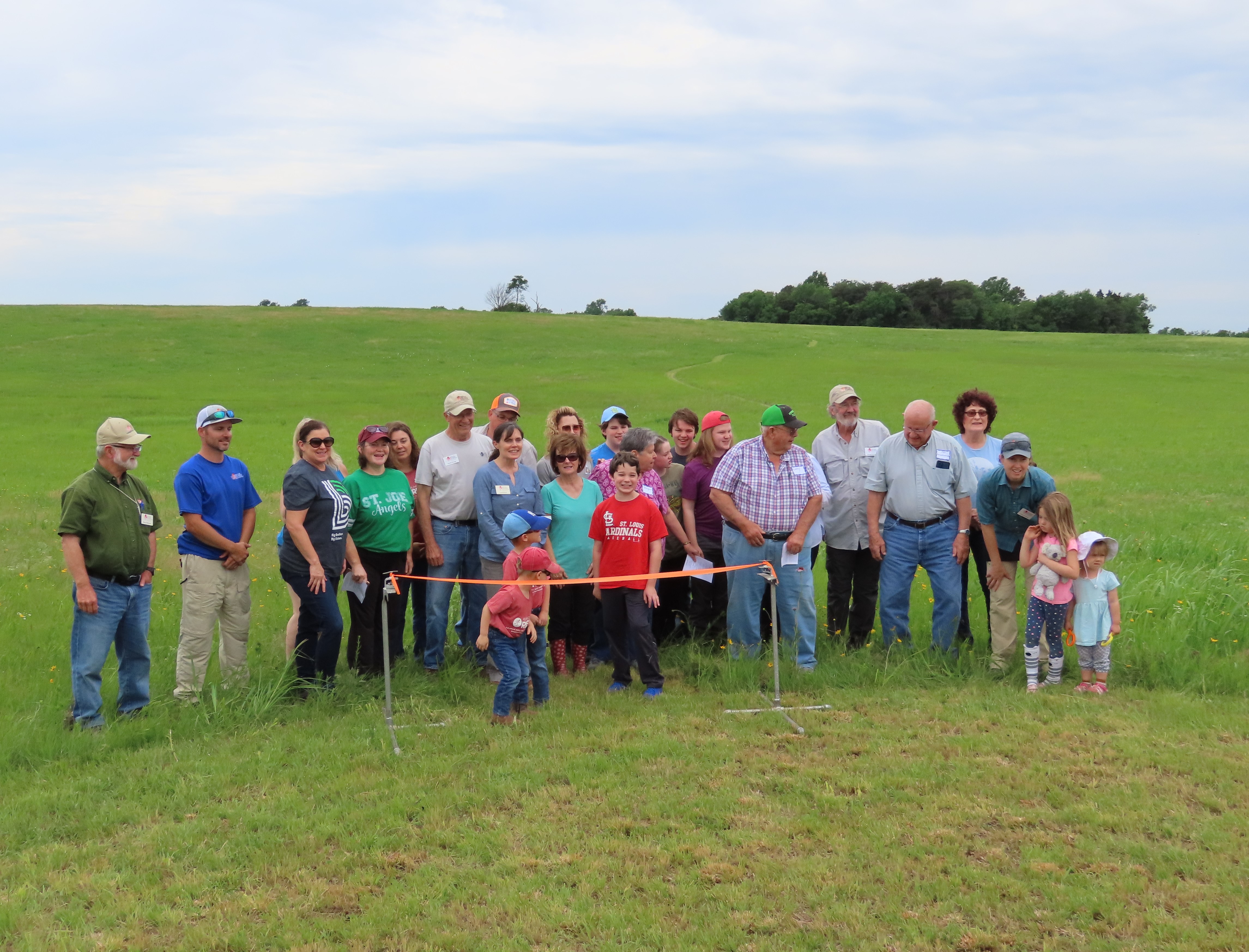
Ready for the ribbon cutting

The event was kicked off with a ribbon-cutting ceremony to dedicate the parcel, now preserved indefinitely thanks to the generosity of the family that managed hayfields there for generations. We immediately took to exploring, and were amazed by the floral diversity alone. Most of the plants we saw would not be found in your average vacant, neglected field. Many are endemic only to this kind of prairie.

Carolina Rose

New Jersey Tea

Sensitive Briar and Tickseed Coreopsis

Painted-cup Paintbrush

Most of the area we covered in our survey of organisms was subjected to a prescribed burn in autumn of last year. You could scarcely tell, as it was lush and green. Dickcissels and Grasshopper Sparrows called from all directions. Swallows frolicked low over the grasses. The skies remained overcast almost the entire time, and there was a brief, late afternoon shower, but we still found plenty of insects.

Clay-colored Leaf Beetle

Following an afternoon of hiking the gentle slopes, we were treated to a potluck. Each party brought a dish, but some of the MPF personnel fried up some fish, and also cooked quail and venison. There were plenty of salads and desserts, including homemade ice cream. Now that is how you do a proper bioblitz.

Bioblitzing makes you hungry....

....and tired
(photo used with permission)

After dark, a sheet and blacklight were set up. Despite the cooling effect of the earlier rain, several interesting species flew in.

Coffee-loving Pyrausta moth

Pyrgotid fly, Pyrgota undata

Firefly, Photuris sp.

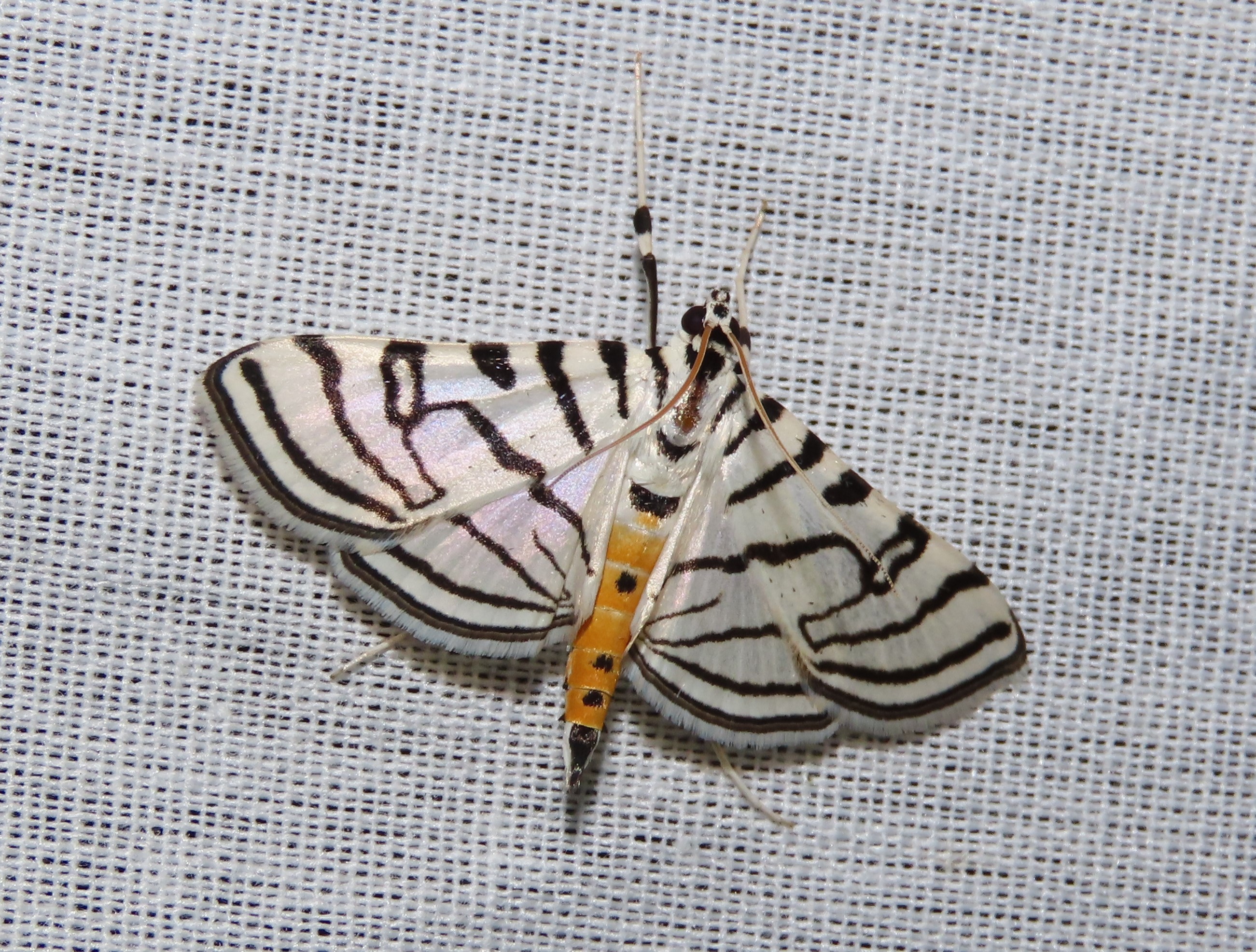
Zebra Conchylodes moth

Sunday, we explored in a different direction, making use of the mown paths that provided avenues for the many, enthusiastic bioblitz participants. Prairies are not all dry and dusty, we learned! There were several wet, boggy areas that proved to be almost entirely different habitats from the surrounding hills that drained into them.

Striped Lynx Spider

A couple of “tree islands,” thick stands of trees and/or shrubs, offered yet another kind of habitat. One larger group of trees surrounded a large pond that we could not comfortably access. The edges of those tree islands were perhaps richer in insect fauna, but such ecotones are well-known for higher diversity.

Azure Bluet damselfly

We got a little carried away, and by the time we returned to “base camp” a little after noon, we found the tent deserted. We are already looking forward to making another trip there to see how the area changes with the seasons, and contribute more data to the MDF for use in education and conservation.

That's all, folks!

Heidi took so many great photos that you can look forward to another blog post of images and captions alone. Meanwhile, please consider membership in the Missouri Prairie Foundation. It has a long, strong record to success stretching over 56 years (since 1966).

Besides identifying, acquiring, and managing remnant prairies such as Thoh-Dah, MDF also encourages rewilding of your own property through the Grow Native! project. This is one of the resources we are using to begin converting our own lawnscape into something much more compatible with the native landscape.

Goat's Rue

Many thanks go to Carol Davit, Executive Director of MPF, Jerod Huebner, Director of Prairie Management, and Erika Van Vranken, Special Projects Coordinator, and Sarah Hinman, board Secretary, for making this event such a success. These are empathetic and appreciative people.

Tuesday, August 31, 2021

Book Review: In One Yard: Close to Nature Book 2

I was introduced to Warren A. Hatch several years ago by a mutual friend. He sent me a copy of the original In One Yard: Close to Nature, which I regretfully never got around to reviewing. I will not make the same mistake with Hatch’s sequel. This book has much to recommend it, no matter where you live.

Mr. Hatch resides in Portland, Oregon, USA, and every organism shown in the book was discovered on his property, the yard of which is only one-sixth of an acre. Clearly, exploring even this small an area can result in constant discovery and astonishment. A reader is going to be inspired to put the book down frequently so as to go looking for mosses, lichens, insects, arachnids, algae, and other living things right outside their door.

This “ignition switch” alone is what makes this book unique and critically important. One could consider it an exercise in vanity (the first book was self-published), but by documenting various species in depth, and showing the reader how he captured the detail and drama of each creature, it becomes a blueprint for how you can do the same. Why you should go to the trouble is self-evident in the countless, captivating images.

The text both explains the natural histories of the organism, and challenges the reader to make their own observations. The stories are an interesting and effective mix of the author’s personal experience, additional knowledge gleaned from literature and correspondence with world-renowned experts, and a periodic, friendly “Mr. Rogers” query to the reader. The author does not put himself above the reader. He defines scientific words with each use, and understands that occasional repetition is a good thing.

The first book was a large, magazine-like paperback. Book two is a smaller, hardback volume. Both are slightly “busy” in their design and layouts, and if there is any fault to the new book, it is in the literal fine print of “Extra Notes” that may be difficult for those with poor vision to easily read. The images are so overwhelming in their excellence and detail that almost anything else can be forgiven anyway.

The one thing that surprises and disappoints is that this book is flying under the public radar. Mr. Hatch’s prior works have rightly received critical acclaim from the scientific community. Hatch has produced posters and DVDs that have also garnered generous reviews; and he was elected a Fellow of the Linnean Society of London in 2003. This is an exceptional honor, as the society was founded in 1788 and has only about 2,000 members. Admirably, Hatch lives a car-free lifestyle.

In One Yard is the perfect complement to Douglas Tallamy’s books Bringing Nature Home, and Nature’s Best Hope. Hatch’s books show you exactly what can result if you cultivate native plants and make even minimal effort to observe and record. Yes, he has invested heavily in the equipment needed to produce what you see on the pages of the book, but what a payoff.

Ideally, we need more Warren Hatchs. More people should do an ongoing bioblitz of their home and property, and share the results widely through blogs, vlogs, Youtube, Instagram, and other media, if not an actual hardcopy book. Be creative. Buy this book as an inspiration and model. In One Yard: Close to Nature Book 2 is available exclusively through Wild Blueberry Media, LLC for a very reasonable $35.00 (postage paid). Don’t take my word for it, just ask Sir David Attenborough who effuses that the book is “splendid” and “it spurs me on.” When a world class, globe-trotting naturalist asks “….whether I haven’t looked at my yard with the concentration and insight that you have,” that is high praise indeed.

Sunday, August 15, 2021

Home Bioblitz, Ongoing

Ever since we moved into our house in Leavenworth, Kansas, USA, in mid-May of this year, we have been keeping a tally of all the species of animal life we see on our property, or from it in the case of flying birds. As of August 12, we have surpassed seven hundred (700) taxa, and that is likely conservative.

Rove beetles, like this one I have yet to identify, have been a dominant taxon (family Staphylinidae) in our home landscape

A taxon is any level of taxonomic classification: Domain to Kingdom, Phylum, Order, Family, Genus, or species, and various divisions in between. It is often impossible to distinguish various species, or even genera or subfamilies, from images of the living creature in the “wild,” so many of the insects and arachnids we have observed may never be identified specifically.

Leafhoppers abound in diversity, too, including Idiodonus kennicotti....

....and Colladonus clitellarius, the Saddled Leafhopper

A bioblitz is typically a twenty-four-hour event at a specific location that is intended to inventory every kind of living organism within the boundaries of said property. More recently, bioblitzes have been conducted over two days, sometimes more, to enhance the experience of participants and get a more thorough survey accomplished. Sometimes, bioblitzes target one particular taxon of interest, like dragonflies and damselflies, for example.

No water feature in our yard, but still we get visits from odonates like Skimming Bluet, Enallagma geminatum

The website and smartphone app iNaturalist has become a handy platform for recording the results of bioblitzes, such as this one at Corral Bluffs Open Space, a new park near Colorado Springs, Colorado, internationally famous for the discovery of several new fossil species, especially early mammals. Making such data and observations widely accessible to the public, as well as to scholars, is an overriding priority for bioblitzes, and it inspires more bioblitzes.

Ants, like this Temnothorax sp., are always abundant, but more diverse than you think

I have been slowly uploading observations of wildlife at our home, and elsewhere we have traveled, to iNaturalist, but I am over one month behind.

Insects are always making more of themselves, like these Black-backed Grass Skimmer flower flies, Paragus haemorrhous

Our property is modest, with a front and back yard, a back porch and a side porch, and a detached garage. We have not yet planted anything new, save for a handful of daisies and coneflowers from a local nursery. We do mow what passes for the lawn, and intend to replace most of it eventually with native plants, and maybe add a small water feature and bird feeders. The front yard is dominated by an enormous red oak.

Daisy Fleabane, a "weed" that volunteered in the back yard, has a long bloom cycle, attracting insects like this Wavy Mucksucker flower fly, Orthonevra nitida

How have we amassed so many species in so little time? We are privileged to have the luxury of unlimited free time at present. Heidi spends most mornings looking and listening for birds in both yards, and beyond. The pigeons are usually flying over the federal penitentiary located two blocks behind us. A pair of Eastern Wood-pewees raised a family in a tree across the street from our front yard. I make a circuit around the yards at least once per day, usually.

We have lots of spiders, and Blue Mud Daubers like this one hunting them

We have not yet tried much in the way of trapping for insects. We did hang up a bee block under the eave by the living room window, but apparently weren’t watching it at the right time of day. About a week ago I noticed two of the holes had been plugged with mud, likely the work of a mason wasp. We occasionally set out overripe fruits, but those are quickly overrun with ants unless we take precautions like standing a section of log like a pedestal in a container of water that acts like a moat.

We have fireslies that flash, like this Big Dipper Firefly, Photinus pyralis!

We do blacklight fairly regularly, though at present my camera flash has ceased to work. My back-up cameras have repeated lens error issues whereby the extendable lens gets stuck. Finding another camera has been problematic as there are shortages of almost every item now due to the pandemic. That said, blacklighting has been the overwhelming source of our diversity. I frequently find “bonus” insects in images where the intended subject was something else entirely.

Blacklighting has brought us gems like this Black-dotted Glyph, Maliattha synochitis

Here is my challenge to you: although we are no longer confined to our homes by the novel coronavirus, consider staying put anyway and devoting time to bioblitz your own place. Even the most sterile apartment is likely to have a few dozen species. You might have to break out a magnifying lens, but they are there. Share your results on iNaturalist, Project Noah, or similar platforms. Ask for help if you are at a loss for ideas on how to get started. Happy hunting!

Sunday, July 28, 2019

Results of the Red Rock Canyon Open Space Bioblitz

View of Pikes Peak from eastern edge of Red Rock Canyon Open Space

Last Friday through Sunday, July 19-21, scientists and citizen scientists descended on one of the most popular recreation sites in Colorado Springs, Colorado: Red Rock Canyon Open Space. The goal was to find as many species of living things as possible in that short time period, and I dare say that we exceeded expectations.

Melissa Blue butterfly

Red Rock Canyon was the first Open Space to be dedicated in Colorado Springs, purchased by the city back in 2003. It took ten years to complete the master plan for the 1,474 acre area. It includes an abandoned quarry, a couple of small reservoirs, and several habitats, from dense coniferous forests in its upper reaches to shortgrass prairie and meadows on the lower slopes and plateaus. It is perhaps better known for its extinct animal life, preserved as fossils in the stone outcrops and uplifts, than it is for what lives there now.

Mule Deer drinking in the evening

Hiking, trail running, horseback riding, rock climbing, and limited mountain biking are all favorite activities for humans who frequent the park. This heavy activity usually presents conflicts with those trying to observe wildlife, but animals in the park are now so adapted to people traffic that the deer all but say "excuse me" as they hustle past you to get a drink at one of the reservoirs.

© Heidi Eaton
A male Blue-eyed Darner dragonfly over one of the reservoirs

When I first proposed the idea of doing a single bioblitz to then-TOPS (Trails, Open Spaces and Parks Program) Manager Chris Leiber back in 2016, he envisioned the event at Red Rock Canyon. That proposal morphed into four bioblitzes at other Open Spaces in celebration of the twentieth anniversary of TOPS in 2017. Finally, we come full circle.

Red-tailed Hawk circling over a meadow

Colorado Springs has endured an unusually wet, cool spring and early summer, making for lush vegetation, but a relative dearth of insect life. Wildflower blooms this year have been short, sporadic, and far-flung, the distances between clumps of flowers greater than normal. The cool weather turned immediately into a heat wave of 90-plus degrees, punctuated with near daily afternoon thunderstorms, and that is what we faced for the bioblitz.

A male Ten-lined June Beetle, Polyphylla decemlineata, one of the first arrivals at the blacklight

Thankfully, we had a dry, hot night Friday night (July 19) on which to do blacklighting for moths and other insects, and it was epic.

© Heidi Eaton
Blacklighting before it got intense

We had three stations, two featuring bright mercury vapor lights to draw insects from farther distances, and one that was outfitted "only" with an ultraviolet (UV) light. All three stations were humming with activity and no two people saw the same insects and arachnids.

A female Spotted Pine Sawyer, Monochamus clamator at the blacklight

During the day, participants fanned out from "base camp" under a pavilion near the reservoirs to explore the surrounding landscape. One of our entomologists, Rose Ludwig, made an exceptional discovery when she took photos of a small, male clearwing moth on Saturday. She revisited the same location on Sunday and got images of the female.

© Rose Ludwig
Male Carmenta wildishorum clearwing moth

All our images and observations were recorded in an iNaturalist project, and there was immediate interest in Rose's find. It turns out to be a Colorado state record for Carmenta wildishorum, a species described only two years ago from specimens taken in New Mexico.

©Rose Ludwig
Female Carmenta wildishorum clearwing moth

Tim Leppek, Aaron Driscoll, Kaya Woodall, Debbie Barnes-Shankster, Bill Shankster, Heidi Eaton, and myself added even more observations of various arthropods to complement the work of botanists, mammologists, birders, and mycologists.

Three-banded Grasshopper, Haddrotettix trifasciatus, a surprising find

With the results of mammal and fungi experts still pending, we have already amassed a stunning 481 taxa (classifications ranging from family-level to species-level) for less than three full days of exploration. Many family designations include more than one genus or species, so numbers are likely to increase as more specific identifications are made. Still, not every genus or species can be identified from images alone. The mushroom experts will be doing detailed DNA work to arrive at their conclusions, for example.

Male sand wasp, Steniolia elegans

The Red Rock Canyon Open Space bioblitz concluded appropriately when the volunteer organizer, Sharon Milito, was presented with a Spirit of the Springs Celebration Award by Mayor John Suthers. Sharon has become a great friend and mentor over the last three years, and without her we would not have bioblitzes and I would not have gotten to visit Jimmy Camp Creek Park and Corral Bluffs Open Space, parcels that are not yet open to the public. I cannot think of anyone more deserving of this honor.

An owlet moth, Xestia bolteri, from the blacklight

Please do check out the iNaturalist project page, hyperlinked a couple paragraphs back, to see the full results of this undertaking. I wish to thank Bell Mead, and Renee McDougal for facilitating involvement of the Mile High Bug Club in all the bioblitzes, and managing our club's booth at base camp.

Tree Swallow fledgling waiting to be fed