Showing posts with label predator. Show all posts

Saturday, April 1, 2017

Predator and Prey: Ants versus "Lions" and "Tigers"

My last post here chronicled predation on termites by ants in the wake of swarming events in my neighborhood. Today I shall turn the tables and demonstrate that ants are not immune to predators themselves. Antlions and tiger beetles are among the few predatory insects that kill and eat ants. Ants can bite, and either sting, or spray formic acid to defend themselves. One cannot blame a potential predator for avoiding that kind of trauma when ants are not much more than an hors d' oeuvres anyway.

Antlion pit of Myrmeleon sp. larva

While looking for tiger beetles in Lake Pueblo State Park, Colorado on March 18, I was surprised to find the funnel trap of an antlion larva in the middle of a game trail. Usually, the pitfall traps of antlions are clustered, and situated in sheltered areas like beneath a rock overhang, at the base of a tree, or other location where rain seldom if ever reaches them. Since the only genus of antlions in the U.S. that makes such traps is Myrmeleon, I knew that had to be the critter lurking at the bottom of the pit.

Antlion larva from Kansas

Buried just beneath the dusty sand was a single, chubby larva, studded with spines on various parts of its body, and with menacing sickle-like jaws. Nearly blind, the insect relies on its sensitivity to vibration to detect potential trouble or potential prey. When an ant or other terrestrial insect blunders into the antlion's steep-walled trap, the larva becomes alert and proactive. It may use those jaws to fling sand onto its victim, hastening its descent to the bottom of the funnel. The predator then grabs its prey and injects it with enzymes that paralyze it and begin the digestive process.

Adult antlion, Myrmeleon exitialis from Colorado

Antlions go through complete metamorphosis, so the larva eventually constructs a cocoon of sand and silk in which it pupates. An adult antlion, more than making up for its youthful ugliness with its delicate wings and slender body, emerges from the pupa at a later date.

Blowout Tiger Beetle, Cicindela lengi, attacking a harvester ant

The fate of ants in the jaws of an antlion may seem morbid, but it is still better than what happens to ants caught by adult tiger beetles. After two consecutive days of unsuccessful searching for tiger beetles closer to home in Colorado Springs, I finally found at least three Blowout Tiger Beetles, Cicindela lengi, on the afternoon of March 23. I was witness to their ability to swiftly dispatch lone worker ants with their huge, toothy jaws.

Open wide....

Most tiger beetle species are agile daytime hunters that haunt sandy habitats like the sandhill bordering the vacant lot where I found these specimens. The insects run quickly, stop, then run again. They fly a short distance if spooked by a potential predator. Their eyesight is keen, vastly more sensitive to motion than a person; but they focus slowly. They literally outrun their eyesight when pursuing prey, and must stop to refocus before rejoining the chase. This herky-jerky hunting strategy is still effective, and few insects spotted by a tiger beetle will live to tell the tale.

Off with its head!

Tiger beetles appear to have the speed and power to attack insects and other invertebrates at least as large as they are, but most of their victims are quite small. Ants seem to be near the limit of what they will take. They make short work of even the feisty Western Harvester Ants, Pogonomyrmex occidentalis, that are abundant in Colorado Springs. The jaws of the beetle quickly dismember the ant, leaving a trail of carnage around the beetle. The beetle's next victim may be a tiny, unidentifiable invertebrate it plucks from between sand grains.

Another C. lengi surrounded by the remains of its Formica sp. ant lunch

Most tiger beetle enthusiasts are fond of remarking that they are glad tiger beetles do not get any larger in size than they do. Indeed, I would not be prowling around dunes and beaches if there were even raccoon-sized tiger beetles in the neighborhood. Since they are much smaller than that, I recommend going in search of them. Their beauty and behaviors are sure to capture your curiosity and sense of wonder.

Sunday, March 26, 2017

Predator and Prey: Ants versus Termites

My neighborhood walk in Colorado Springs the other day, March 25, was like strolling through living confetti at some points. All the local termite colonies were launching swarms of winged males and potential queens (alates as scientists call them). The frail creatures were not ignored by other animals, either, especially ants. Closer inspection of the swarms revealed three species of ants preying on them.

Alate subterranean termites (Reticulitermes sp.) swarming

Termite swarms are not an indication of the impending collapse of your home or any other wooden structure. Yet, that is the first thought that enters the mind of the average person witnessing the spectacle. Such is the power of advertising for pest control companies. Now, a termite swarm inside your home should probably be cause for alarm. Outdoors, subterranean termites like these Reticulitermes sp. are vital to the recycling of decaying wood. They nest in the soil, as their common name suggests, and forage for wood and other dry cellulose in contact with the soil.

The synchronous nature of termite swarms is a marvel. All colonies in a given area need to liberate their reproductive castes at the same time in order to prevent inbreeding, but I have no idea how they "decide" when to do this. The day before we had snow and high winds. The alates issue from the tiniest of cracks in the soil, like toothpaste from the tube, the better to avoid easy detection. Eventually, enough of the insects appear that their gauzy wings reflect the sun and give away their presence. Soldier termites, and workers, too, escort them out and see them off.

Alate termites with workers and soldier (center) escorts

Hundreds, if not thousands, of winged termites begin filling the air. Few will survive the alert eyes and hungry mouths of birds, lizards, and other predators. The early season timing of swarms may in fact be tuned to precede the emergence of reptiles and the arrival of migrant birds. Ants, on the other hand, are already on the prowl.

Worker Formica sp. ant carrying termite prey

Both ants and termites are social insects, so it is fitting they would be deadly enemies and, one would think, well-matched foes. Watching one swarm happen on the edge of a driveway, I began noticing the appearance of worker ants, Formica sp., crossing the driveway. Eventually I saw one toting a winged termite back to the nest. The ant's nest. More ants followed suit.

Pavement ants (Tetramorium caespitum) killing alate termite (bottom) and worker termite (top)

Turning my attention back to where the termites were emerging, I noticed something even more frightening. Tiny "pavement ants," Tetramorium sp., were killing both alates and worker termites right at the termite nest opening. Whereas Formica ants are a bit larger than the termites, the pavement ants were smaller than their prey. How they avoided the menacing jaws of the soldier termites confounds me.

Formica ants near the entrance to their nest, with prey

Just up the street I noticed heavy ant activity originating at the base of a brick-and-mortar mailbox pillar. These were Formica pallidefulva ants, but appeared larger than the other ones I saw previously. It soon became apparent that they were also taking part in the Great Termite Massacre of 2017. Most of them were carrying wingless alates, though.

Ants (Formica pallidefulva) with termite prey

Alate termites, once paired, shed their wings easily. Both pairs of wings have a weak spot that allows the termites to break them off so they can quickly seek cover. The male ("king") termite follows on the heels of his mate (queen) as they form a two-car train in search of a potential nest site. They must do so quickly if they are to avoid the marauding ants.

Dealate queen with her mate trailing her in a "train"

Whether the honey pot ants were taking dealate (wingless reproductives) termites, or just seizing winged individuals and breaking off their wings, remains a mystery. They are certainly easier to transport without those cumbersome wings.

Worker Formica sp. ant carrying termite prey

As I turned the corner to go home, I caught sight of yet another ant, possibly Formica podzolica. It, too, was carrying a defeated termite. The ant seemed at least somewhat disoriented, and I eventually lost track of it in the thick grass at the edge of the curb.

So, termites are both integral to keeping soils fertile with their decomposition activities, and also a bounty for many other organisms that depend on them for food when other insect life is less plentiful. Ants are the lion kings and wolf packs of the macroscopic landscape, keeping termites and other insects from overrunning the planet. The ants are not immune, though, and in my next post we see them on the other end of the predator-prey equation.

Note: Special thanks to James C. Trager for identification of the ant species.

Sunday, August 3, 2014

Ant-hunting spider, Euryopis

To look at a specimen of the genus Euryopis, you would hardly imagine that it is a member of the cobweb weaver family Theridiidae. Apparently it has physical characters that place it there, but when it comes to behavior, this spider departs radically from its tangled-web weaving cousins

I was invited to participate in an informal "bioblitz" back on June 22, 2014, in the upper reaches of the Monument Creek watershed here in El Paso County, Colorado, an elevation of 8,500-9,000 feet. Among our small party were several botanists, one of whom brought me a couple of spiders she found while looking at plants. One of those spiders was a gravid (egg-laden) female Euryopis that I brought home to take better images.

Euryopis is placed in the subfamily Hadrotarsinae of the Theridiidae family based on shared characters like a high carapace (top of cephalothorax) that is nearly as wide as it is long; exceptionally long, flat fangs; certain anatomy of the female genitalia; and the fact that these spiders do not spin prey-catching webs.

There are about twenty species of Euryopis recorded for North America north of Mexico, and all of them are very small. Both genders range from only 1.3-4.7 millimeters in body length, males slightly smaller than females. Most species share the unique sub-triangular shape and bold color pattern on the abdomen as demonstrated by the Colorado specimen shown here.

Typical ambush pose

What is truly amazing about these spiders is their hunting technique. They simply sit with legs outstretched, either on the ground, foliage, or tree trunk, and wait for an ant to brush against them. This triggers a response on the part of the spider, whereby the arachnid runs around the ant, all the while flinging silk from its spinnerets and bonding the ant to the surface of the substrate before the insect knows what happened.

Once the prey is immobilized, the spider bites it, usually on a leg joint, and waits while the venom takes effect. The spider then fashions a silk "sling" that it uses to haul the victim to a place where the spider can feed without disturbance from other ants.

Ants are aggressive and pretty vicious, so few predators bother them. It is a testament to the toughness of Euryopis to mess with them. At least one species feeds almost exclusively on harvester ants, which are among the most pugnacious of all North American ants, equipped with stingers that they deploy without hesitation (Porter and Eastmond, 1981)

My little female spider soon spun an egg sac in captivity. The size of the bundle was surprising considering how small the spider was. It was white, hemispherical in shape, and covered in little tufts of silk as shown in the image above

Euryopis are probably not uncommon spiders, but easily overlooked due to their diminutive size and rather cryptic appearance when presented on the ground or other natural surface. Try seeking them out around ant mounds and places where ant traffic is high.

Sources: Adams, R.J. 2014. Field Guide to the Spiders of California and the Pacific Coast States. Berkeley: University of California Press. 303 pp.
Agnarsson, Ingi. 2004. "Morphological phylogeny of cobweb spiders and their relatives (Araneae, Araneoidea, Theridiidae)," Zool. J. Linn. Soc. 141: 447-626
Bradley, Richard A. 2013. Common Spiders of North America. Berkeley: University of California Press. 271 pp.
Porter, Sanford D. and David A. Eastmond. 1981. "Euryopis coki (Theridiidae), a spider that preys on Pogonomyrmex ants," Research Notes in J. Arach. 10: 275
Ubick, D., P. Paquin, P.E. Cushing, and V. Roth (eds.). 2005. Spiders of North America: an identification manual. American Arachnological Society. 377 pp.

Friday, November 22, 2013

Robber Fly: Heteropogon macerinus

Happy “Fly Day Friday.” Robber flies in the family Asilidae have to be among the most compelling of all insects, as evidenced by the many professional and amateur entomologists who study them. They are diverse in appearance and behavior, and yet there is still much to be learned about them.

This past August I had occasion to visit southern Ohio, and in several places I found specimens of the species Heteropogon macerinus. They are not terribly large, about 10 millimeters long or so, and fairly drab in appearance as you can see from the images here. They are fairly easy to spot, however, because they tend to frequent forest edges where they habitually perch on the tips of twigs at about eye level.

Robber flies like these remind one of flycatchers in the world of birds. They survey the world from their perch, cocking their head this way and that when an insect passes by. Should a flying bug seem to be a potential meal, the robber fly dashes out, grabs its victim, and returns to its perch to feed.

Robber flies have piercing-sucking mouthparts much like a mosquito, but shorter, stouter, and used to prey on other insects, not to feed on the blood of vertebrates. What is visible to us is the sheath that houses the stylets that do the actual piercing, so while it appears that a robber fly has a thick, knife-like beak, the killing and feeding machinery is virtually hair-like.

Asilids have an uncanny ability to find the weak spots in another insect’s armor, and quickly thrust their mouthparts into those areas. Some species go for the “neck,” stabbing through the thin and flexible exoskeleton that joins the head and thorax. Some are able to drive their stylets into the membranes between abdominal segments; or in the seams between various segments of the thorax as this H. macerinus has apparently done to a winged ant in the image below.

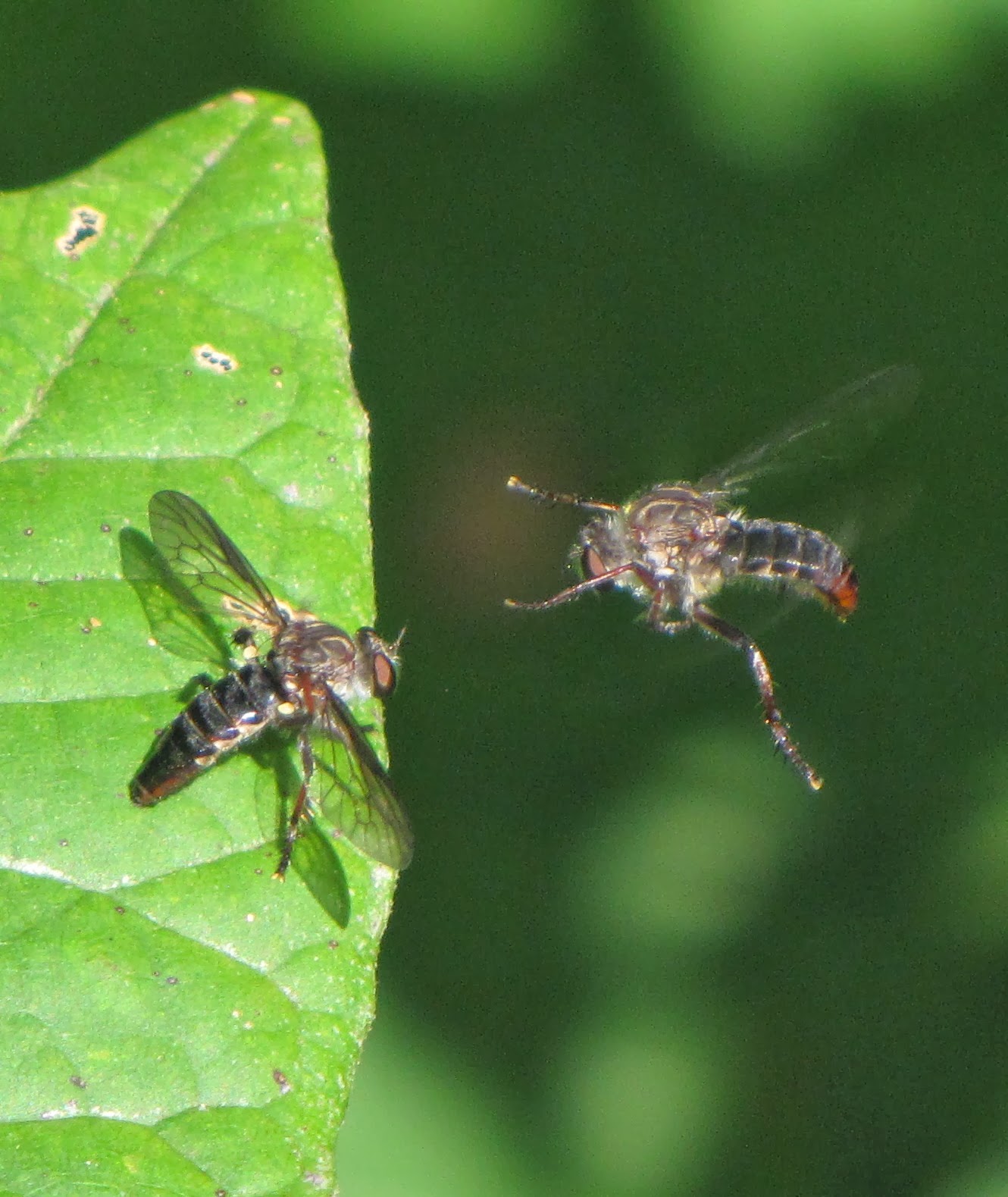
What really got my attention was a courting pair of Heteropogon macerinus that my wife and I spotted at the edge of a cemetery in Lynx, Ohio on August 25, 2013. The tarsi (“feet”) on the front legs of male Heteropogon species are at least slightly decorated with ornamental setae (“hairs”), and he uses these “bracelets” to full advantage. Norm Lavers, on his own robber fly website, describes their behavior most eloquently:

”If you are lucky enough to see the courtship, that will put the identification out of doubt….they all seem to do it the same way. The female makes herself visible by sitting on a twig usually rather high in the air, on the top of a sapling or tall bush. The male hovers before her, his hind legs out wide to the side, perhaps to show off the red coloring. The female responds by throwing up her hind legs (whether that means yes or no I don't know). If the male is allowed to get close enough, he begins stroking her eyeballs with his front claws while he is still hovering, a delicate operation, one presumes. If she likes him, she will eventually let him sit down beside her, where after a while one thing leads to another.”

Fortunately, another person in our party remarked that it would be wonderful to have a video of the aerial dance we were watching there in Ohio, and I remembered my camera has video capabilities. Here is the resulting….pixelage?

Is it any wonder why entomologists become enamored with asilids? The life history of the majority of species remains a mystery. The larval stage of those few that are known seem to be external parasites of beetle grubs, or the larvae of other insects. Your own observations could yield vital new information as to predator-prey relationships, and/or larval hosts.

I have yet to find any place in North America that does not have a pretty diverse assemblage of robber flies, so I challenge you to go looking, even in your own backyard. I will also bet you are likely to get addicted to these charismatic flies once you find them.

Sources: Hull, Frank M. 1962. Robber Flies of the World: The Genera of the Family Asilidae. Washington, DC: Smithsonian Institution Bulletin 224, Parts 1 and 2. 907 pp.
Lavers, Norman. 2007. “Asilidae: Stenopogoninae,” The Robber Flies of Crowley’s Ridge, Arkansas.
Preston-Mafham, Rod and Ken. 1993. The Encyclopedia of Land Invertebrate Behavior. Cambridge, MA: The MIT Press. 320 pp.
Raney, Herschel. 2009. “Heteropogon Page,” Random Acts of Nature.

Tuesday, November 19, 2013

Dinosaur Bug

Few insects cause more head-scratching bewilderment or jaw-dropping awe than adult Wheel Bugs, Arilus cristatus. They look like the offspring of a beetle and stegosaurus with that remarkable cog-like crest on the top of their thorax. These strange “dinosaur bugs” are members of the assassin bug family Reduviidae. While they should be welcomed in the garden as predators of pest insects, they should be treated with respect, too.

Wheel Bugs begin life looking much like other true bugs because they do not have the big crest until they reach adulthood. Young Wheel Bugs are black with a bright red abdomen. You will likely see them crawling about on foliage individually. Similar true bug nymphs, like leaf-footed bugs (family Coreidae), are usually seen in groups.

Wheel Bug nymphs go through five instars (the intervals between molts), gradually losing their bright colors and becoming covered in silvery hairs that give them a coarse, grizzled appearance.


They become larger in size with each molt, and acquire wing pads that will transform into fully functional wings as adult insects. All this time they are stalking other insects as prey, moving in a slow, methodical, deliberate manner that may only amplify the “creepiness” factor for someone prone to fear or dislike insects in general.

The final transformation from nymph to adult, accomplished in the last molt, is a dramatic one. A freshly-emerged adult Wheel Bug is a stunning pink or orange in color, and that trademark crest is now apparent. Two sets of wings are now fully developed. As its new exoskeleton hardens, the insect becomes darker, becoming gray and/or brown.

All assassin bugs use beak-like mouthparts to pierce their prey, injecting paralyzing venom and digestive enzymes into their victim. The internal tissues of the prey are liquefied by this chemical cocktail, and then withdrawn by the assassin through the same channels in its beak. Wheel Bugs are capable of taking prey larger than themselves, but small beetles and moths are among their favorites.

It is not a good idea to handle Wheel Bugs because they can deliver an excruciating bite in self-defense. They may deploy other behaviors to startle potential attackers, too. Assassin bugs have a groove in their “chest” that is flanked by ridges. Their beak normally rests inside this groove, but if alarmed the bug can bob its head vigorously, raking the tip of the beak across those ridges to make a very audible squeaking sound.

Besides making noise, female Wheel Bugs can evert a pair of stink glands from the tip of the abdomen to repel a predator. The glands are large and bright red, creating quite the visual display as well as a fragrant deterrent.

Arilus cristatus is a large insect, adult males being up to 28 millimeters in body length and females up to 32 millimeters. Females have a wider abdomen than males, when viewed from above.

Adult Wheel Bugs are seen most often in late summer and fall, earlier in more southerly latitudes. The species is found from eastern New Mexico north and east to Kansas, Iowa, southern Michigan, and southern New England. It is perhaps most abundant in the southeast states; it also occurs in Mexico.

Mated female Wheel Bugs lay their eggs in distinctive hexagonal masses. The number of eggs in such a cluster varies from about forty to 180. Look for the egg masses on tree trunks and other vertical surfaces where they will overwinter, protected by a shellac-like coating that insulates them from harsh weather, parasites, and other potential mortality factors. Nymphs hatch the following spring.

This is one of the “mystery bugs” I am most often asked about. It is so distinctive that even the most minimal description is enough to determine what the person is talking about. I like that people are curious about this species, and appreciate the opportunity to enlighten them about the unique biology of these predators.

Sources: Eaton, Eric R. 2003. “Amazing Assassins,” Missouric Conservationist. 64(6): 24-27.
Hoffman, Richard L. 2006. Assassin Bugs of Virginia. The Insects of Virginia Number 15. Martinsville: Virginia Museum of Natural History. 74 pp.
Mead, F.W. 2011. “Wheel Bug, Arilus cristatus (Linnaeus) (Insecta: Hemiptera: Reduviidae),” University of Florida IFAS Extension.
Slater, J.A. and R.M. Baranowski. 1978. How to Know the True Bugs. Dubuque, Iowa: Wm. C. Brown Company Publishers. 256 pp.

Friday, March 15, 2013

Fly Day Friday: Comantella robber flies

Here along the Front Range in eastern Colorado, among the first flies of spring are unique little robber flies in the genus Comantella. When I first saw one I thought it looked like a march fly (Bibionidae), but behaved like an asilid.

Comantella are also among the last flies seen in the fall, as demonstrated by the above image taken on Novermber 29, 2011 in Colorado Springs. This unusual seasonal appearance of the adults (early and late), plus the presence of a slender spur on the tip of the front tibia (“shin” segment), helps to separate this genus from similar genera in the Asilidae. They are decidedly humpbacked when viewed in profile. Little appears to be known concerning their biology, though it is suspected that the adult flies overwinter in protected places. One specimen of the species C. fallei was observed preying on a small wolf spider in the genus Pardosa (Dennis, et al., 2012).

The taxonomy of Comantella is not very straightforward, either. At least one expert on asilids believes the genus is in bad need of revision. Current keys to species seem to revolve around the length of the terminal style as compared to the third antennal segment, and coloration of the hairs on the body.

These are small or medium-sized flies, 10-15 mm in length, and covered in long hair, even on their legs. The top of the thorax features a “mane” that can best be described as a Mohawk hairstyle.

There are only four currently-recognized species of Comantella. C. pacifica is found from British Columbia south to Nevada and Utah. C. cristata is known from Idaho and California. C. rotgeri occurs in Colorado, New Mexico, and Alberta. C. fallei ranges in California and Colorado.

I expect to see more of these flies any day now. Last year I found this mating pair on March 12, but the winter was very warm. In all instances I have found Comantella perched on the ground (rarely on vegetation), usually on bare soil, in vast open fields.

Sources: Cannings, Robert A. 2012. “A Checklist of the Robber Flies (Diptera: Asilidae) of British Columbia,” University of British Columbia.
Cole, Frank R. 1969. The Flies of Western North America. Berkeley: University of California Press. 693 pp.
Dennis, D. Steve, Robert J. Lavigne, and Jeanne G. Dennis. 2012. “Spiders (Araneae) as Prey of Robber Flies (Diptera: Asilidae),” J. Entomol. Res. Soc. 14(1): 65-76.
Dennis, D. Steve, Jeffrey K. Barnes, and Lloyd Knutson. 2008. “Pupal cases of Nearctic robber flies (Diptera: Asilidae),” Zootaxa 1868. Auckland, New Zealand: Magnolia Press. 98 pp.


Hull, Frank M. 1962. Robber Flies of the World. Washington, DC: Smithsonian Institution Bulletin 224. 907 pp. (2 vols.).
James, Maurice T. 1941. “The Robber Flies of Colorado (Diptera, Asilidae),” J. Kans. Entomol. Soc. 14(1): 27-53.
Lavigne, R.J., William F. Barr, and G.M. Stephens. “Checklist of the Asilidae of Idaho,” College of Idaho. 26 pp.
Neslon, C. Riley. 1987. “Robber Flies of Utah (Diptera: Asilidae),” Great Basin Nat. 47(1): 38-90.

Friday, March 1, 2013

Fly Day Friday: Three-banded Robber Fly

Too often the first thing that pops into people’s minds when they hear the word “fly” is a house fly or a horse fly, or some other nuisance or pest fly. I think if the popular association were with robber flies, family Asilidae, public opinion of the Diptera would be vastly improved. Case in point is the little Three-banded Robber Fly, Stichopogon trifasciatus.

Far from being pests, or even pesky, robber flies are assassins of other insects, including the ones that bite and sting us. Many species are quite large, but the Three-banded Robber Fly is rather diminutive, measuring only 10-15 millimeters (and the top end of that spectrum might be generous).

Stichopogon trifasciatus is one of ten North American species in the genus Stichopogon, but the most widespread and easily recognized. It ranges from southern Canada to Central America, and coast to coast in North America. The bright silvery or blue-gray of the body, and distinct broad bands on the abdomen help set this fly apart from similar asilids. There is enough variation, however, to be somewhat confusing. The former species S. salinus, collected along the western edge of the Rockies from Idaho to northern Arizona, was recently synonymized with S. trifasciatus (Barnes, 2010).

The habitat and behavior of the Three-banded Robber Fly is suggestive of many tiger beetles. These flies like the beach! Well, rocky or gravelly beaches anyway. I have encountered them most frequently along the rocky edges of rivers and streams, but also well away from water. I found one in Colorado Springs on a rugged unpaved road. They like to be close to the ground, but on an elevated perch if possible. Startle one and, like a tiger beetle, it will take flight for a short distance before alighting again.

The adult flies feed mostly on other small flies, which according to one study amounted to 85% of their diet (true bugs, order Hemiptera, accounted for another 10%). Still, another observer noted that this species preys on small spiders to a large degree (Bromley, 1934). The fly attacks prey that is crawling on the ground, rather than intercepting it in flight as other species are known to do.

The life history of S trifasciatus remains mostly mysterious, but courtship behavior has been observed. The male apparently hovers back and forth before the female, his legs hanging and waving. He then attempts to copulate by pouncing on her (Preston-Mafham, 1993). Doesn’t sound like a romantic day at the beach, but….

Sources: Barnes, Jeffrey K. 2013. “The Genus Stichopogon Loew (Diptera: Asilidae) in America North of Mexico,” Proc. Entomol. Soc. Wash. 115(1): 9-36.
Barnes, Jeffrey K. 2010. “Revision of Nearctic Stichopogon Species (Diptera: Asilidae) With White-banded Abdomens, Including Description of Stichopogon venturiensis, New Species, From Coastal California,” Proc. Entomol. Soc. Wash. 112(3): 367-380.
Bromley, S.W. 1934. “The Robber Flies of Texas (Diptera: Asilidae),” Annals Entomol. Soc. Am. 27: 74-113.
Hull, Frank M. 1962. Robber Flies of the World. Washington, DC: Smithsonian Institution Bulletin 224, Parts 1 and 2. 907 pp.
Preston-Mafham, Rod and Ken. 1993. The Encyclopedia of Land Invertebrate Behaviour. Cambridge, Massachusetts: The MIT Press. 320 pp.
Raney, Herschel. 2003. “Stichopogon Page,” Random Natural Acts

Tuesday, January 8, 2013

True Bug Tuesday: Masked Hunter

Note: This is the debut installment of a semi-regular feature I am dubbing “True Bug Tuesday.” It will likely include reposts of previous entries that cover members of the order Hemiptera.

Remember when your parents told you there were no monsters under your bed? Perhaps they were wrong. Have you ever wondered if you were hallucinating when you swore you saw a self-propelled dust bunny crawling across the floor? You might have been perfectly sane. There is a predatory insect that qualifies as both a miniature monster and an animated dust ball, and it is most often encountered indoors rather than outside.

The Masked Hunter, Reduvius personatus, is a member of the assassin bug family Reduviidae. Fortunately, the only thing it “assassinates” is other insects and related invertebrates. The piercing-sucking mouthparts are sleeved inside a short, stout, segmented beak bent under the insect’s “chin” when not in use.

The most remarkable trait of this species is the appearance of the immature stages, called “nymphs.” True bugs in general go through “gradual” metamorphosis, such that the juvenile stages look much like the adults, except that they are smaller, not sexually mature, and lack wings (if the species in question has wings at maturity). This is true of the Masked Hunter, except that the nymphs actively cover themselves in lint, sawdust, and other debris.

Their bodies are covered in short and long trichomes (hairs) connected to glands that produce a sticky substance. Fine particles adhere to the short trichomes close to the body of the insect, while longer trichomes anchor coarser particles in a second layer of camouflage. A “tarsal fan” of dense, long hairs on the foot of each hind leg helps the nymph apply the trash to the trichomes (Weirauch, 2006).

Each time the baby assassin molts (sheds its exoskeleton to grow in the brief interval before the new exoskeleton hardens), it must repeat the self-decorating process. The disguise helps protect it from potential predators, but might also make it appear harmless to its own prey. The Masked Hunter is probably a generalist predator, but it is often found in association with people and/or colonial birds and bats. It is well known for preying on bed bugs and swallow bugs (true bugs in the family Cimicidae). Other prey records include silverfish, booklice, and at least one harvestman (Arachnida: Opiliones).

Masked Hunters go through five instars. An instar is the period between molts. The nymphs are the ones that overwinter, usually in the fifth instar, but in Canada the life cycle may take two years, the nymphs overwintering in the third and fifth instar (Scudder, 1992). During the winter they are in diapauses, ceasing activity until the following spring. The sixth molt produces the adult insect, a dark, winged animal measuring from 15-22 millimeters in length.

Today, the Masked Hunter is found throughout the Northern Hemisphere. It is assumed that it is European in origin and has been transported to other continents through human travel and commerce. While it can be a common species, it is not prolific, and populations are usually small. Few specimens will occupy any given home or other building.

Assassin bugs are able to produce sound by rubbing one body part against another, a phenomenon known as “stridulation.” In this case, the insect rocks its head up and down, rubbing the tip of its beak across a series of transverse ridges on its "chest." The result is a very audible squeaking sound that may startle any other creature that grabs the bug.

The Masked Hunter is found throughout the Northern Hemisphere. It is assumed to be European in origin and has been transported to other continents through human travel and commerce. Most adult specimens of Reduvius personatus are seen in June and July. Look for them at lights at night where they are occasionally attracted by the buffet of potential prey insects. By day, they hide under bark on logs and in other sheltered situations. Be careful, though, Masked Hunters can deliver a painful bite in self-defense.

Sources: Hoffman, Richard L. 2006. “Assassin Bugs of Virginia,” The Insects of Virginia 15: 1-74.
Scudder, G.G.E. 1992. “The distribution and life cycle of Reduvius personatus (L.) (Hemiptera: Reduviidae) in Canada,” J. Entomol. Soc. B.C. 89: 38-42.
Weirauch, Chrstiane. 2006. “Anatomy of Disguise: Camouflaging Structures in Nymphs of Some Reduviidae (Heteroptera),” Am. Mus. Novit. 3542: 1-18.