Showing posts with label Asilidae. Show all posts

Friday, May 27, 2016

Eight Illinois Wasp and Bee Mimics in Twenty Minutes

One of the few entomologically-rewarding stops on our recent road trip was at the National Trail Rest Area on Interstate 70 near Altamont, Illinois, on May 16. A brief bit of sunshine warmed the woodland edges enough to bring out a wealth of fly diversity, many of which were mimics of various wasps and bees. There were even a few real wasps.

Somula decora syrphid fly

Large patches of touch-me-nots (aka "jewelweed") carpeted the edges of the lawn where it gave way to forest, and the leaves of this plant offered places to bask for many insects. The first fly I spotted was one of my favorites in the family Syrphidae (flower flies). Somula decora is roughly the size of a honey bee, black in color but heavily marked with golden yellow. I suspected that this species is a mimic of scoliid wasps, but at this time of year a more likely candidate for a model would be a queen yellowjacket.

Helophilus sp. syrphid fly

Helophilus spp. are also probably yellowjacket mimics. The vertical yellow stripes on the thorax help to identify them fairly easily. Apparently the larvae develop in decaying plant matter that is submerged in water, as do other Syrphidae species like the "rat-tailed maggots." The adults certainly are sun-loving as their genus name suggests.

Temnostoma sp. syrphid fly

Syrphid flies in the genus Temnostoma are likely mimics of the solitary mason wasps that are in the same family as the social yellowjackets. They carry their mimicry to astonishing extremes. Note that the leading edge of their wings is darkened, mimicking the longitudinal folds of a vespid wasp's wings at rest. Wasps have long, reasonably thick antennae, which Temnostoma flies don't have. No worries, the fly compensates by waving its front pair of legs in front of its face, just like wasp antennae. Wh-a-a-a-a-t?! I know! Next time I'll take video.

Male Ancistrocerus sp. mason wasp

Well, lookie lookie, here comes an honest-to-goodness, certifiable mason wasp. This is a male, as the tip of each antenna is hooked, a distinguishing characteristic for many male eumenine wasps. I am a little hard-pressed for a genus, but I suspect it might be Ancistrocerus. Female mason wasps usually nest in pre-existing cavities like old beetle borings in logs, hollow twigs, etc.

Chalcosyrphus piger syrphid fly

Yet another kind of syrphid fly we saw was this Chalcosyrphus species. They are typically assumed to be mimics of solitary wasps in the families Pompilidae, Crabronidae, or Sphecidae. Indeed, some species even flick their wings like wasps while they run around on foliage or the surface of logs. Their larvae live in decaying wood, but at least a few may feed on fermenting sap. This species has a red abdomen, but others are wholly black or otherwise colored differently. There are 22 species in North America, so identification is difficult without putting a specimen under a microscope.

Xylota sp. syrphid fly

Closely allied to Chalcosyrphus is the genus Xylota. Oddly, this specimen reminded me most of a sawfly or an ichneumon wasp, neither of which is usually capable of stinging in self-defense. The adult flies rarely visit flowers, instead feeding on pollen grains from the surface of leaves. The larvae develop in rotting wood.

Mallota posticata syrphid fly

Many syrphid flies use leaves as a platform on which to groom, which explains the yoga-like moves of this specimen of Mallota posticata, a bumble bee mimic. I swear, grooming flies must be the envy of contortionists. As larvae, these flies grow up in rotting holes in trees.

Eastern Yellowjacket queen, a real wasp!

My, my, here we have another actual wasp, a queen of the Eastern Yellowjacket, Vespula maculifrons, pausing from her search for an underground nesting site. She is likewise grooming. This particular species is very likely the "model" for most of the "mimic" flies we were seeing....and arguably the best mimic was yet to come.

Sphecomyia vittata syrphid fly

The syrphid fly Sphecomyia vittata is simply stunning. It is about the same size as a queen yellowjacket, and even has longer, thicker antennae than almost any other fly, the better to resemble its sting-equipped model. This insect even flies like a queen yellowjacket, in the lazy, zig-zag manner of a queen looking for a nesting site. I recall capturing one of these in Cincinnati and being convinced it was a wasp right up until I had it in the jar. I was jaw-droppingly impressed.

Ichneumon wasp

Ah, here is an ichneumon wasp that looks suspiciously like that Xylota flower fly we saw a few minutes ago. At least some members of the subfamily Ichneumoninae can sting, so maybe looking like one is a better strategy than first imagined.

Laphria sp. robber fly

Somewhere along the line my wife spotted this fly, which I never saw. It is obviously a bumble bee mimic, but it is not a syrphid. It is a robber fly in the family Asilidae, genus Laphria. Looking like a bumble bee works to its advantage in two ways: its potential predators assume it stings. Meanwhile the fly's potential prey assume it is a bee seeking flower nectar. Interestingly, Laphria seem to be particularly fond of small, flying beetles, which they spot from their perches, apprehend in mid-air, and return to a leaf or log to feed upon.

Common Gartersnake, Thamnophis sirtalis

What a rewarding rest stop. Oh, and there was this bonus Common Gartersnake, Thamnophis sirtalis, also soaking up some rays. It never moved an inch as we worked around it to take insect images. Thanks to the maintenance crews at this rest stop for recognizing the importance of leaving natural elements intact around the area, including dead wood for insects to feed on, and birds to nest in. May other states follow your example.

Source: Marshall, Stephen A. 2006. Insects: Their Natural History and Diversity. Richmond Hill, Ontario: Firefly Books, Ltd.732 pp.

Friday, April 3, 2015

Courting Robber Flies

It must be spring. Love is in the air, on twigs, on the ground....at least if you are watching insects. They are courting and mating everywhere. My last couple of outings afield on the plains here in eastern Colorado have given me the opportunity to witness some insect romance up close; and I remembered to use the video function on my camera, too.

Male Ablautus(?) robber fly with leafhopper prey

One particularly abundant insect in early spring is a small robber fly, family Asilidae, possibly in the genus Ablautus. Adults of this dipteran measure only about 6-7 millimeters, and they are sand-colored, so rather difficult to see. They prey on insects smaller than they are. The one in the image above has killed a leafhopper.

I discovered that the males are slightly smaller and more slender than females, with bright white hairs on their faces. Females have gold or ochre-colored hairs on their faces.

Female Ablautus(?) robber fly

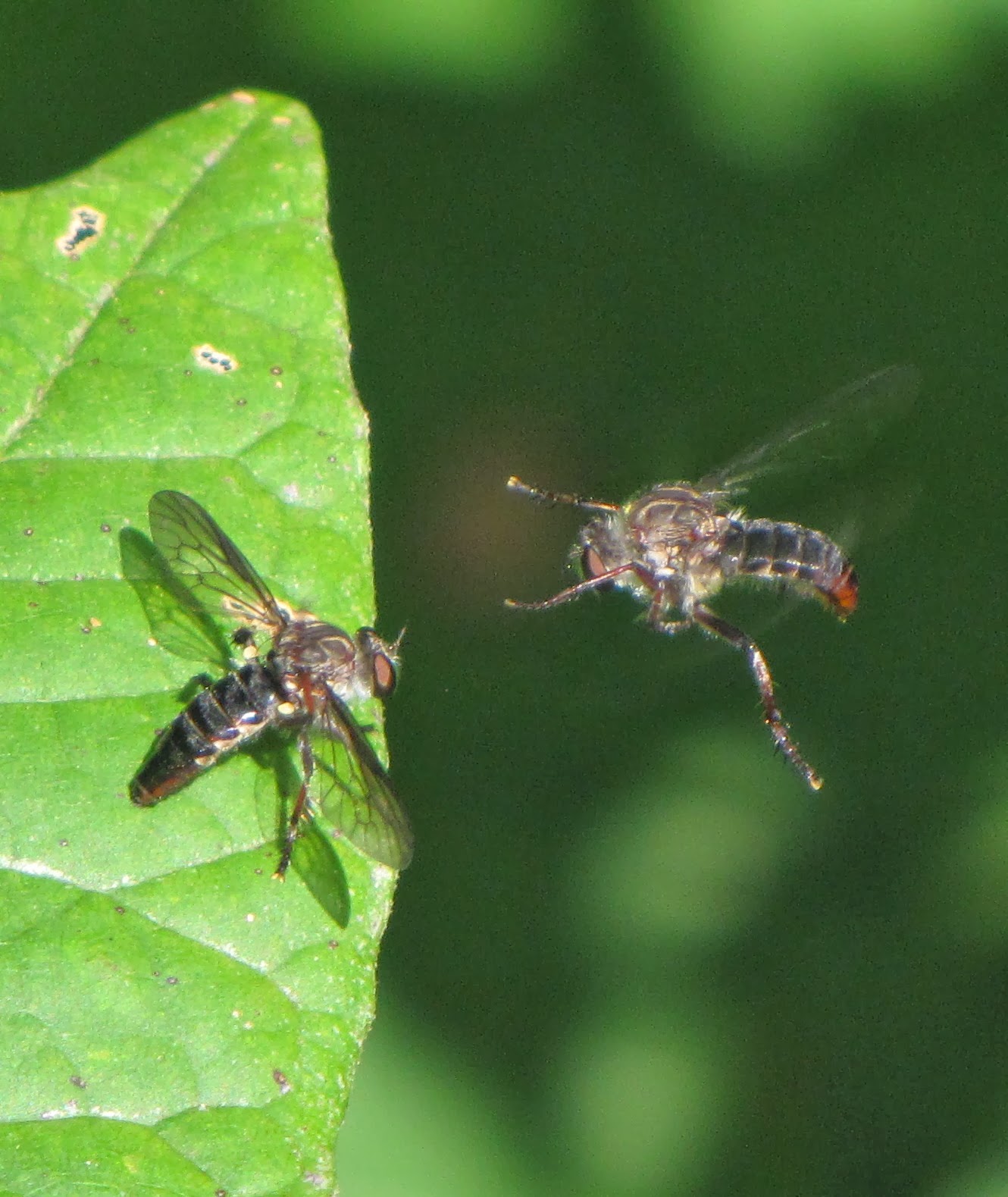
Males are very energetic, and once engaged in courting a female, they are not easily frightened away. So, once I discerned there was a pair of the flies on the ground in front of me, I stopped and watched. This is the amazing result. The male alights near the stationary female, then flies and alights again, sometimes sidling into a different position. Eventually, he waves his front legs in front of her and rocks up and down. It is quite a display.

This next video is of a different pair of flies, perhaps a little farther along in the process, because it has an, uh...."happy ending." The male is the one with the smile on his face.

Many flies have elaborate courtship rituals, but asilids (robber flies) have some of the fanciest. I was lucky enough to also capture video of the aerial display of Heteropogon macerinus in Ohio a couple of years ago.

Robber fly "wedding photo"

I urge you to find your own examples of "bug love," and document them with your camera, even your smartphone. There are plenty of places to share the results online. Maybe your video will even go viral on YouTube. In any event, we stand to learn a good deal more about insect behavior through the efforts of curious citizen scientists.

Friday, November 22, 2013

Robber Fly: Heteropogon macerinus

Happy “Fly Day Friday.” Robber flies in the family Asilidae have to be among the most compelling of all insects, as evidenced by the many professional and amateur entomologists who study them. They are diverse in appearance and behavior, and yet there is still much to be learned about them.

This past August I had occasion to visit southern Ohio, and in several places I found specimens of the species Heteropogon macerinus. They are not terribly large, about 10 millimeters long or so, and fairly drab in appearance as you can see from the images here. They are fairly easy to spot, however, because they tend to frequent forest edges where they habitually perch on the tips of twigs at about eye level.

Robber flies like these remind one of flycatchers in the world of birds. They survey the world from their perch, cocking their head this way and that when an insect passes by. Should a flying bug seem to be a potential meal, the robber fly dashes out, grabs its victim, and returns to its perch to feed.

Robber flies have piercing-sucking mouthparts much like a mosquito, but shorter, stouter, and used to prey on other insects, not to feed on the blood of vertebrates. What is visible to us is the sheath that houses the stylets that do the actual piercing, so while it appears that a robber fly has a thick, knife-like beak, the killing and feeding machinery is virtually hair-like.

Asilids have an uncanny ability to find the weak spots in another insect’s armor, and quickly thrust their mouthparts into those areas. Some species go for the “neck,” stabbing through the thin and flexible exoskeleton that joins the head and thorax. Some are able to drive their stylets into the membranes between abdominal segments; or in the seams between various segments of the thorax as this H. macerinus has apparently done to a winged ant in the image below.

What really got my attention was a courting pair of Heteropogon macerinus that my wife and I spotted at the edge of a cemetery in Lynx, Ohio on August 25, 2013. The tarsi (“feet”) on the front legs of male Heteropogon species are at least slightly decorated with ornamental setae (“hairs”), and he uses these “bracelets” to full advantage. Norm Lavers, on his own robber fly website, describes their behavior most eloquently:

”If you are lucky enough to see the courtship, that will put the identification out of doubt….they all seem to do it the same way. The female makes herself visible by sitting on a twig usually rather high in the air, on the top of a sapling or tall bush. The male hovers before her, his hind legs out wide to the side, perhaps to show off the red coloring. The female responds by throwing up her hind legs (whether that means yes or no I don't know). If the male is allowed to get close enough, he begins stroking her eyeballs with his front claws while he is still hovering, a delicate operation, one presumes. If she likes him, she will eventually let him sit down beside her, where after a while one thing leads to another.”

Fortunately, another person in our party remarked that it would be wonderful to have a video of the aerial dance we were watching there in Ohio, and I remembered my camera has video capabilities. Here is the resulting….pixelage?

Is it any wonder why entomologists become enamored with asilids? The life history of the majority of species remains a mystery. The larval stage of those few that are known seem to be external parasites of beetle grubs, or the larvae of other insects. Your own observations could yield vital new information as to predator-prey relationships, and/or larval hosts.

I have yet to find any place in North America that does not have a pretty diverse assemblage of robber flies, so I challenge you to go looking, even in your own backyard. I will also bet you are likely to get addicted to these charismatic flies once you find them.

Sources: Hull, Frank M. 1962. Robber Flies of the World: The Genera of the Family Asilidae. Washington, DC: Smithsonian Institution Bulletin 224, Parts 1 and 2. 907 pp.
Lavers, Norman. 2007. “Asilidae: Stenopogoninae,” The Robber Flies of Crowley’s Ridge, Arkansas.
Preston-Mafham, Rod and Ken. 1993. The Encyclopedia of Land Invertebrate Behavior. Cambridge, MA: The MIT Press. 320 pp.
Raney, Herschel. 2009. “Heteropogon Page,” Random Acts of Nature.

Friday, March 15, 2013

Fly Day Friday: Comantella robber flies

Here along the Front Range in eastern Colorado, among the first flies of spring are unique little robber flies in the genus Comantella. When I first saw one I thought it looked like a march fly (Bibionidae), but behaved like an asilid.

Comantella are also among the last flies seen in the fall, as demonstrated by the above image taken on Novermber 29, 2011 in Colorado Springs. This unusual seasonal appearance of the adults (early and late), plus the presence of a slender spur on the tip of the front tibia (“shin” segment), helps to separate this genus from similar genera in the Asilidae. They are decidedly humpbacked when viewed in profile. Little appears to be known concerning their biology, though it is suspected that the adult flies overwinter in protected places. One specimen of the species C. fallei was observed preying on a small wolf spider in the genus Pardosa (Dennis, et al., 2012).

The taxonomy of Comantella is not very straightforward, either. At least one expert on asilids believes the genus is in bad need of revision. Current keys to species seem to revolve around the length of the terminal style as compared to the third antennal segment, and coloration of the hairs on the body.

These are small or medium-sized flies, 10-15 mm in length, and covered in long hair, even on their legs. The top of the thorax features a “mane” that can best be described as a Mohawk hairstyle.

There are only four currently-recognized species of Comantella. C. pacifica is found from British Columbia south to Nevada and Utah. C. cristata is known from Idaho and California. C. rotgeri occurs in Colorado, New Mexico, and Alberta. C. fallei ranges in California and Colorado.

I expect to see more of these flies any day now. Last year I found this mating pair on March 12, but the winter was very warm. In all instances I have found Comantella perched on the ground (rarely on vegetation), usually on bare soil, in vast open fields.

Sources: Cannings, Robert A. 2012. “A Checklist of the Robber Flies (Diptera: Asilidae) of British Columbia,” University of British Columbia.
Cole, Frank R. 1969. The Flies of Western North America. Berkeley: University of California Press. 693 pp.
Dennis, D. Steve, Robert J. Lavigne, and Jeanne G. Dennis. 2012. “Spiders (Araneae) as Prey of Robber Flies (Diptera: Asilidae),” J. Entomol. Res. Soc. 14(1): 65-76.
Dennis, D. Steve, Jeffrey K. Barnes, and Lloyd Knutson. 2008. “Pupal cases of Nearctic robber flies (Diptera: Asilidae),” Zootaxa 1868. Auckland, New Zealand: Magnolia Press. 98 pp.


Hull, Frank M. 1962. Robber Flies of the World. Washington, DC: Smithsonian Institution Bulletin 224. 907 pp. (2 vols.).
James, Maurice T. 1941. “The Robber Flies of Colorado (Diptera, Asilidae),” J. Kans. Entomol. Soc. 14(1): 27-53.
Lavigne, R.J., William F. Barr, and G.M. Stephens. “Checklist of the Asilidae of Idaho,” College of Idaho. 26 pp.
Neslon, C. Riley. 1987. “Robber Flies of Utah (Diptera: Asilidae),” Great Basin Nat. 47(1): 38-90.

Friday, March 1, 2013

Fly Day Friday: Three-banded Robber Fly

Too often the first thing that pops into people’s minds when they hear the word “fly” is a house fly or a horse fly, or some other nuisance or pest fly. I think if the popular association were with robber flies, family Asilidae, public opinion of the Diptera would be vastly improved. Case in point is the little Three-banded Robber Fly, Stichopogon trifasciatus.

Far from being pests, or even pesky, robber flies are assassins of other insects, including the ones that bite and sting us. Many species are quite large, but the Three-banded Robber Fly is rather diminutive, measuring only 10-15 millimeters (and the top end of that spectrum might be generous).

Stichopogon trifasciatus is one of ten North American species in the genus Stichopogon, but the most widespread and easily recognized. It ranges from southern Canada to Central America, and coast to coast in North America. The bright silvery or blue-gray of the body, and distinct broad bands on the abdomen help set this fly apart from similar asilids. There is enough variation, however, to be somewhat confusing. The former species S. salinus, collected along the western edge of the Rockies from Idaho to northern Arizona, was recently synonymized with S. trifasciatus (Barnes, 2010).

The habitat and behavior of the Three-banded Robber Fly is suggestive of many tiger beetles. These flies like the beach! Well, rocky or gravelly beaches anyway. I have encountered them most frequently along the rocky edges of rivers and streams, but also well away from water. I found one in Colorado Springs on a rugged unpaved road. They like to be close to the ground, but on an elevated perch if possible. Startle one and, like a tiger beetle, it will take flight for a short distance before alighting again.

The adult flies feed mostly on other small flies, which according to one study amounted to 85% of their diet (true bugs, order Hemiptera, accounted for another 10%). Still, another observer noted that this species preys on small spiders to a large degree (Bromley, 1934). The fly attacks prey that is crawling on the ground, rather than intercepting it in flight as other species are known to do.

The life history of S trifasciatus remains mostly mysterious, but courtship behavior has been observed. The male apparently hovers back and forth before the female, his legs hanging and waving. He then attempts to copulate by pouncing on her (Preston-Mafham, 1993). Doesn’t sound like a romantic day at the beach, but….

Sources: Barnes, Jeffrey K. 2013. “The Genus Stichopogon Loew (Diptera: Asilidae) in America North of Mexico,” Proc. Entomol. Soc. Wash. 115(1): 9-36.
Barnes, Jeffrey K. 2010. “Revision of Nearctic Stichopogon Species (Diptera: Asilidae) With White-banded Abdomens, Including Description of Stichopogon venturiensis, New Species, From Coastal California,” Proc. Entomol. Soc. Wash. 112(3): 367-380.
Bromley, S.W. 1934. “The Robber Flies of Texas (Diptera: Asilidae),” Annals Entomol. Soc. Am. 27: 74-113.
Hull, Frank M. 1962. Robber Flies of the World. Washington, DC: Smithsonian Institution Bulletin 224, Parts 1 and 2. 907 pp.
Preston-Mafham, Rod and Ken. 1993. The Encyclopedia of Land Invertebrate Behaviour. Cambridge, Massachusetts: The MIT Press. 320 pp.
Raney, Herschel. 2003. “Stichopogon Page,” Random Natural Acts

Saturday, July 10, 2010

Robber Flies

Robber flies are conspicuous denizens of the desert southwest, but are common nearly everywhere. You might be seeing them yourself but simply not recognizing what they are. No wonder. Robber flies, also known as “assassin flies,” often resemble wasps or bees more than they do flies. They certainly bear little resemblance to house flies. They don’t carry diseases or bite people, either. Instead, they are swift predators of other insects.

There are nearly one thousand species of the family Asilidae in North America north of Mexico, but that doesn’t mean they have all been discovered yet. I helped discover a new species of Laphria myself, in a park in Cincinnati, Ohio. Prior to my specimens, the species (still awaiting formal description) was known from only one other specimen collected in Pennsylvania.

Robber flies vary greatly in size (3-50 mm), shape, and color pattern. Some are robust bumble bee mimics. Others, like those in the subfamily Leptogastrinae, are slender and nearly invisible as they navigate through tall grasses.

There are some things to look for that are common to all robber flies, however. They have a deep, concave area between the eyes at the top of the head. This helps set them apart from similar flies like mydas flies (Mydidae) and dance flies (Empididae). Robber flies also often have a “bearded” face, with long hairs over their mouthparts. Even with the setae, the stout beak-like mouthparts are often visible.

Look for robber flies in a variety of habitats, from deserts to grasslands to forest openings with dappled sunlight. Robber flies like to perch on the ground, rocks, logs, tree trunks, or foliage where they have a great vantage point to scan the landscape and the sky above them.

Watch one on the tip of a twig or a leaf as it cocks its head toward insects passing overhead. The fly may leave its perch abruptly, but you should stay put. It may well return with a victim to dine on. Asilids are able to intercept flying insects in mid-air, much like a flycatcher bird does. Some species seem to have their food preferences, but most are generalists. Very large robber flies can kill insects as large as adult grasshoppers, or even dragonflies.

Members of the genus Diogmites are known as “hanging thieves” for their habit of swinging from the front or middle pair of legs while manipulating prey with the remaining two pairs, as the one above is doing with a skipperling it caught.

The bite of robber flies is administered with that beak, driven into joints in the exoskeleton of the prey insect. The “necks” of insects are especially vulnerable, and flying beetles are impaled while their elytra are open, exposing chinks in their armor. Paralytic compounds and digestive enzymes are likely injected during the bite as victims cease struggling almost immediately. The fly then withdraws the liquefied internal tissues of its meal.

As easily as adult robber flies are observed, the corresponding larval stage remains quite a mystery. Those species that have been reared are known to be external parasites of beetle grubs, or other insect larvae.

Before you set out into the field to find robber flies, it might help to become familiar with all the different genera you are likely to encounter. Remember that they often resemble insects other than flies. A good place to start learning is the image gallery at BugGuide.net. Click the “images” or “browse” tab near the top of the page to get more images. Another outstanding internet resource is the robber fly site built by Herschel Raney, an extraordinary nature photographer and self-taught expert on asilids. Three individuals are webmasters for a global robber fly website.

As the popularity of these amazing insects continues to grow, no doubt more resources will be created. For those who prefer printed to electronic references, my Kaufman Field Guide to Insects of North America includes two plates devoted to robber flies, with complementary text on the opposite pages.

Stop, listen (for a loud, droning buzz that stops abruptly) and look (carefully, for despite their size robber flies can be rather cryptic) for these winged wonders of the insect world. You will not be disappointed that you did.