Showing posts with label Arachtober. Show all posts

Saturday, October 2, 2021

Arachtober, Part XV!

This year marks the fifteenth anniversary of “Arachtober,” an event initiated on the photosharing website Flickr by my good friends Ashley Bradford and Joseph Connors. Since then, it has extended its silky reach to social media, especially Twitter and Instagram, where searching on #Arachtober will bring up stunning images of spiders, scorpions, solifuges, ticks, and mites, oh my.

© Ashley Bradford & Joseph Connors

The banner shown above was hand drawn by Ashley, and digitized by Joseph. They both have acute powers of observation, and are supremely talented photographers who are constantly experimenting. They have inspired literally thousands of others to focus their lenses on our eight-legged friends, and come together as a global community for at least this one month each year.

You should join in the fun! It is a window on an overlooked, seriously maligned group of organisms, illuminated in a positive light by photographers and scientists. I learn something new almost daily thanks to the stories attached to the photos.

I will forever be indebted to Ashley and Joseph for their supportive friendship, and starting something truly unique, valuable, and enduring. More details about the origin of Arachtober can be found in this livescience.com article.

Wednesday, October 30, 2019

One Night, One House, Seventeen Spider Species

In honor of "Arachtober" over on Flickr, I thought I would share what I discovered when I walked around the exterior of a house, garage, and woodshed at night in the northern reaches of Door County, Wisconsin, USA, on June 24, 2019. We rented the house for a few days for a family gathering. It sits in a forested area right on the shore of Lake Michigan on the Green Bay side, with Plum Island and Washington Island on the horizon. This particular evening was cool and wet, with intermittent rain showers. Imagine what a dry, warm night would be like.

Orb Weavers: Araneidae

Orb weavers often construct their webs under the eaves of structures, and are usually more conspicuous after dark. They seem to understand that outdoor lights attract more prey than they would catch out in the darkness. I spied at least three species this night:

Trashline Orbweaver, Cyclosa sp.

Furrow Orbweaver, Larinioides cornutus

Bridge Orbweaver, Larinioides sclopetarius

Long-jawed Orb Weavers: Tetragnathidae

Interestingly, the one long-jawed orb weaver I found was sitting snugly against the side of the woodshed with no web in sight. It may be that they take the day shift. These spiders are recognized by their long bodies and long legs, and having their webs oriented in the horizontal plane (usually), often over water.

Long-jawed orbweaver, Tetragnatha sp.

Cobweb Weavers: Theridiidae

Cobweb weavers are the spiders most associated with human habitations and buildings. There are plenty of crevices in which to hide, and the style of their snares requires little in the way of points of attachment. The space beneath an overhanging piece of siding offers enough dimension to spin a web.

Immature Common House Spider, Parasteatoda tepidariorum

Male (left) and female cobweb weavers, Steatoda sp.

Funnel Weavers: Agelenidae

Among the most abundant spiders I encountered this night were funnel weavers. Crevices in stonework around the house and garage and shed allowed for a dense population, but some of the younger spiders were simply wandering, perhaps looking for new and better places to spin webs.

Funnel weaver, Coras sp.

Sac Spiders: Clubionidae

Many spiders don't bother spinning webs, but simply prowl around seeking prey. Chief among them are sac spiders. I saw at least three different individuals. They can appear and disappear rather quickly, so there were probably many more that I missed simply due to poor timing. The cool weather did slow them down a bit, though.
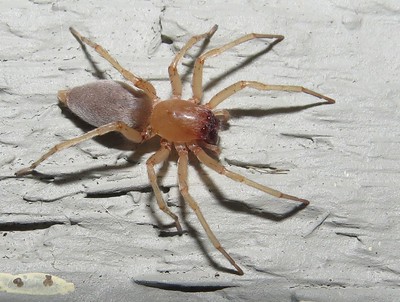
Sac spider female
Female sac spider, Clubiona sp.

Sac spider male
Male sac spider, Clubiona sp.

Wolf Spiders: Lycosidae

Wolf spiders are also common nighttime hunters. They are seen mostly on the ground and on objects in the horizontal plane, but some species are surprisingly agile climbers. Wolf spiders are easily recognized by their eye arrangement. A row of four small eyes near the base of their jaws, with two very large eyes right above that row, and the final two eyes set far back on the carapace.
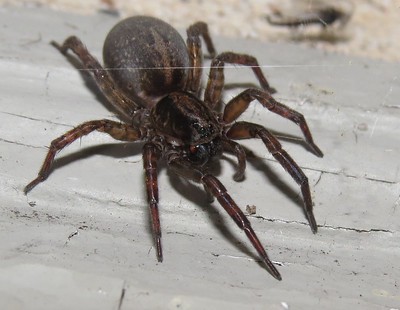
Wolf spider at night
Female wolf spider, Trochosa sp.

Nursery Web and Fishing Spiders: Pisauridae

The largest spiders you are likely to see in the eastern United States and adjacent Canada are the fishing spiders. Despite their name, many species are found far from water, hiding in treeholes and other shelters during the day. They can be startling if encountered suddenly and unexpectedly on tree trunks or the sides of buildings at night. I was prepared to see them and was not disappointed.

Immature Dark Fishing Spider, Dolomedes tenebrosus

Mature male Striped Fishing Spider, Dolomedes scriptus

Jumping Spiders: Salticidae

Most jumping spiders are active by day, but you can still see them at night, especially if they have taken to sheltering in place on the sides of homes and buildings. They hunt by sight, without webs, and are the smallest of the common prowling spiders.

Jumping spider, Naphrys pulex

Adult male jumping spider, Evarcha sp.

Gray form male of the Dimorphic Jumper, Maevia inclemens

Crab Spiders: Thomisidae

Crab spiders can turn up almost anywhere. They are classic ambush hunters, several species hiding in flowers to wait for pollinating insects to come within reach of their elongated first and second pairs of legs. The spiders are highly sensitive to motion, and if you don't approach slowly they are quick to sneak inside a crack or dodge behind foliage.

Female ground crab spider, Xysticus sp.

Sheetweb Weavers: Linyphiidae

Members of this family spin flat, convex, or concave webs, depending on the genus. Each style is tailored to capturing a different suite of insects. The spiders hang upside down on the web and will respond to entangled prey at any time of day. Mature males, like most male spiders, cease to spin webs and devote the remainder of their lives to seeking mates. They do not even feed during their quest.

Female hammock spider, Pityohyphantes sp.

Unidentified male sheetweb weaver

What's lurking around your house? I highly recommend taking the time to inspect the exterior of your home with a flashlight at night. You will be surprised and, hopefully, delighted by the many organisms you find. Besides spiders, I also saw a soil centipede, various woodlice (terrestrial crustaceans that include sowbugs and pillbugs), a harvestman (aka "daddy long-legs," arachnid order Opiliones), and of course many insects. Good luck, happy "Arachtober!"

Saturday, September 30, 2017

"Arach" is Back!

One of the things I look forward to each autumn is the annual Flickr event known as "Arachtober". It is a Flickr group which slumbers between November and the following September, but remains a tradition among arachnophiles and macro photographers. There are always mesmerizing images posted from all corners of the globe.

Marbled Orbweaver, Kansas

Arachtober manages to recruit several new participants each year through word of mouth, blogs, and sheer curiosity. Not only spiders, but scorpions, ticks, mites, harvestmen, and all other arachnids are eligible for inclusion. Don't forget the artistry of spider webs, too, whether dew-adorned or dry.

Apache Jumping Spider male, Colorado

The only hard and fast rule of Arachtober is that the images you post to the group must not have appeared on your own Flickr photostream previously. Allowed quantity of images per day varies at the discretion of the group administrator.

Banded Garden Spider female, Colorado

Overall, interest in spiders seems to be increasing among the general public, and arachnids are achieving a much higher profile than ever before. This is great news, for there is still a great deal of work to be done to combat myth, superstition, misinformation, and fear.

Wolf spider, Alopecosa sp., Colorado

Please consider contributing to "Arachtober" on Flickr, or find another way to dedicate some time to sharing your spider observations, questions, or images. There are many groups on Facebook devoted to spiders and their identification, for example; and presumably, the same applies to Instagram. There is much you can contribute to our collective knowledge by doing so. Thank you.

Sunday, October 5, 2014

Return of "Arachtober!"

Like your favorite horror movie trilogy, sequel, or whatever, Flickr's group "Arachtober" returns with a vengeance(?) this month. It has become an annual treat for arachnophiles and macro photographers, but perhaps a cruel trick on arachnophobes.

Female Philodromus sp. guarding egg sac

This year's edition has special meaning for me because I have been contracted to write a new field guide to U.S. spiders for Princeton University Press. I am also responsible for furnishing images, despite having a small budget for image acquisition. Preceding authors of Princeton guides have set a high standard for image quality, and I feel an obligation to publish the best photos I can get my hands on.

Web of Labyrinth Spider, Metepeira sp.

Arachtober manages to recruit several new participants each year through word of mouth, blogs, and sheer curiosity. Not only spiders, but scorpions, ticks, mites, harvestmen, and all other arachnids are eligible for inclusion. The only hard and fast rule is that the image you post to the group must not have appeared on your own Flickr photostream previously.

Female Southern Black Widow, Latrodectus mactans

Overall, interest in spiders seems to be increasing among the general public. Judging by the many new groups that have been created on Facebook, turnouts at special exhibits like "Eight-legged Encounters," new blogs, and other indications, arachnids are achieving a much higher profile than ever before. This is great news, for there is still a great deal of work to be done to combat myth, superstition, misinformation, and fear.

Male jumping spider, Hentzia palmarum

Please consider contributing to "Arachtober" on Flickr, or find another way to dedicate some time to sharing your spider observations, questions, or images. There is much you can contribute to our collective knowledge by doing so.

Saturday, October 5, 2013

When "Arachtober" Attacks!

October is one of my favorite months, made all the sweeter in the last three years because I have participated in the “Arachtober” group on Flickr.

Many folks who photograph insects and other small animals save the spider images they have accrued over the year to share with the Arachtober pool. This is because one of the few rules of the group is that you post only those images that have not appeared on your Flickr photostream previously. It is worth the wait.

Sometimes, participants forget that there are other arachnids besides spiders: mites, ticks, scorpions, whipscorpions, pseudoscorpions, harvestmen, and others. A few members of the group actually find things like ticks to be too disgusting to embrace even in the artistic sense. A few scorpions and “daddy long-legs” pictures will still manage to appear, though.

The biggest challenge to Arachtober’s popularity this year may be the graphic changes brought to Flickr as a whole by its new owner, Yahoo!. Fewer people view my own photostream any more because of the new format that has rendered Flickr just a shadow of its former clean, aesthetic past. The initial outrage demonstrated by the Flickr faithful has either faded, been completely ignored by Yahoo!, or both. The future of photosharing may be Facebook, Pinterest, Twitter, and Instagram, but mobile devices really don’t do quality images justice.

All the same, I invite you not only to follow Arachtober daily, but to participate as well by sharing your own images of all things eight-legged. Thank you.

Sunday, October 28, 2012

Spider Sunday: Burrowing Wolf Spider

The story behind any given spider image can be quite interesting, and usually teaches the photographer a thing or two. I could not bring this one to you without the help of a number of individuals. The outcome is that I have finally seen a burrowing wolf spider in the genus Geolycosa. Is he not a handsome spider?

I was out with Heidi and some of our mutual friends on a geocaching adventure in the vicinity of Widefield and Security, just southeast of Colorado Springs in El Paso County on Monday, October 22. We stopped to find one cache at a particularly ugly ravine that was obviously used as a dump site. I won’t tell you about the surprising pieces of trash, but one member of our party, walking ahead of me, stopped, looking down, and called out to me. She had found a large spider crossing her path and was kind enough to point it out.

I recognized it as a wolf spider (family Lycosidae), and suspected it was a species in the genus Hogna. It seemed a little small, though. I took many pictures, few of which turned out to my satisfaction, but reviewing them I determined this was a mature male specimen, and it didn’t obviously fit anywhere in the genus Hogna. There is considerable variability in color and markings from one individual to the next, though, so I remained open-minded.

As luck would have it, it is “Arachtober” on Flickr.com, a group that accepts submissions of arachnid images only during the month of October each year. I posted my best image of the wolf spider and expressed my reservations about my identification. Another group member (and personal friend), Lynette Schimming, commented on my image and suggested it might actually be a male burrowing wolf spider, Geolycosa missouriensis. She included this link that shows a couple images of a male of that species. So, I have one Dan L. Johnson to thank now, too. Such is the circuitous route that spider identifications can take.

At least one of my references calls Geolycosa missouriensis the “Missouri Earth Spider.” Another lists it as the “Missouri Wolf Spider.” Indeed, the epicenter of its range is the Great Plains, from southern Canada to Texas, east to New York and west to Utah and Arizona. Like all members of the genus Geolycosa, it spends the majority of its life inside a deep burrow.

These are large spiders. Mature females measure about 21 millimeters, males 15-18 millimeters in body length. A sprawling male can span 34 millimeters. The front legs are stout, built to aid in digging, though most excavation is done with the powerful jaws (chelicerae). The front of the cephalothorax is much higher than the rear portion, which easily separates this genus from other wolf spiders.

Geolycosa missouriensis apparently has at least a two year life cycle, with half-grown individuals overwintering in burrows that may be a meter or more in depth (summer burrows average 20-25 centimeters). The vertical shafts are lined with silk, and enlarged as the spider grows. The mouth of the burrow may be ringed with a turret of silk mixed with debris.

Both genders mature in late summer or early autumn, and mating takes place at this time. Hence, the wandering male we found was likely looking for a spider spouse. Mated females lay their eggs in May or June of the following year. Each female prepares a spherical egg sac like other wolf spiders, and suns the parcel at the mouth of her burrow on warm days. Spiderlings do not disperse very far from their maternal home, so populations tend to be localized, and not easy to detect.

I may return to the area where we found this male sometime next year to look for the burrows of females. They prefer sandy soil in open areas with sparse litter that they incorporate into the turrets of their burrows. I hope I am lucky enough to encounter more of these charismatic arachnids no matter what the location.

Sources: Bercha, R. and R. Leech. 2011. “Geolycosa missouriensis,” Spiders of Alberta.
Evans, Arthur V. 2008. National Wildlife Federation Field Guide to Insects and Spiders of North America. New York: Sterling Publishing Co., Inc. 497 pp.
Fitch, Henry S. 1963. Spiders of the University of Kansas Natural History Reservation and Rockefeller Experimental Tract. Lawrence: University of Kansas. 202 pp.
Kaston, B.J. 1978. How to Know the Spiders (Third Ed.). Dubuque, IA: Wm. C. Brown Company Publishers. 272 pp.

Sunday, October 21, 2012

Spider Sunday: Butterfly Orbweaver

Most of the orb weaver spiders that you see at this time of year are enormous mature females that sit in the center of their webs. Not all members of the family Araneidae are so large, however. A case in point is a species that I found right outside the back door of the house we rented in Cape May, New Jersey earlier this month.

I noticed one of these spiders during the day, huddled in a depression in the eave of the house, next to an egg sac. I took a picture and noticed the ornate, butterfly-shaped pattern on the spider’s abdomen. Once I returned home I was not surprised to find the common name of the species to be the “Butterfly Orbweaver,” Araneus pegnia. Older references use the name Neosconella pegnia.

The “butterfly” can be pinkish or gray or brown or yellowish, varying from specimen to specimen. The entire spider, even as an adult, is not very big. Mature females are only 3.5-8.2 millimeters, and males like the one below are even smaller, 2.5-5 millimeters.

I found that this species is most active at night. At least three specimens, two females and one male, made their living around the back porch light, where many small insects were attracted each evening. The odds of catching prey were obviously increased given this situation. I could never clearly discern the structure of the webs, or whether they were even complete, but references suggest the orbs are at least sometimes incomplete anyway. The circular snare may be missing a sector, with a bundle of signal threads running up to the spider’s retreat on the perimeter. The orb may also be complemented by a network of irregular threads similar to those of labyrinth orbweavers. I did find one female sitting in the hub (center) of her web on one evening, as depicted in the image at the top of this post. Another female was busy creating her web (below).

The lone male I found (image above) was literally hanging out, but perhaps his duty was done. One of the females was already protecting an egg sac. The ova appeared to be obvious, as a ball covered by several layers of opaque silk.

Many of the female’s offspring will not survive to maturity, or at least not live until the first hard frost that kills most late-season orb weavers. The Butterfly Orbweaver is apparently a favorite prey item for the Black and Yellow Mud Dauber wasp, Sceliphron caementarium. The victimized spiders are paralyzed by the wasp’s sting and stuffed into a mud cell as food for a single mud dauber larva.

Araneus pegnia is a far-ranging species. It occurs from at least as far north as Massachusetts, south and west to Ohio and Indiana, the Atlantic and Gulf Coast states, and southern Arizona and California. It is perhaps most common in the southeastern U.S. Outside of the U.S. it ranges to Ecuador in South America. It is also found in the Bahamas, Cuba, and Jamaica. The preferred habitat seems to be in wet areas (bogs in Massachusetts, a river bottom in Costa Rica, for example).

It is certainly easy to dismiss these diminutive spiders as simply immature versions of a larger species, so pay close attention when spider hunting. Autumn is the perfect time to find many kinds of orb weavers, as the leaves fall and their webs are more exposed; and most species have reached maturity.

Sources: Gaddy, L.L. 2009. Spiders of the Carolinas. Duluth, MN: Kollath+Stensaas Publishing. 208 pp.
Howell, W. Mike and Ronald L. Jenkins. 2004. Spiders of the Eastern United States: A Photographic Guide. Boston: Pearson Education. 362 pp.
Levi, Herbert W. 1973. “Small Orb-weavers of the Genus Araneus North of Mexico (Araneae: Araneidae),” Bull Mus Comp Zool 145(9): 473-552.

Sunday, September 30, 2012

Spider Sunday: "Arachtober" is B-a-a-a-a-a-ck!

Just like the sequel to your favorite horror movie, the Flickr group ”Arachtober” is back tomorrow to feature still more “scary” spider, scorpions, solifuges, and other arachnids.

The group gets bigger and better every year as more people register (free and easy), putting up at least one arachnid image per day. The only requirement of note is that you post images that you have not previously added to your own Flickr photo stream.

I have been saving up all my 2012 spider images for just this occasion, though I have used some of them in this blog. Here’s a preview of what I’ll be adding to Arachtober in the coming weeks:


Ground spider, Zelotes sp. (family Gnaphosidae)

Funnel-web weaver, family Agelenidae

Spinybacked Orbweaver, Gasteracantha cancriformis

Western Lynx Spider, Oxyopes scalaris

Thin-legged wolf spider, Pardosa sp.

Jumping spider, Habronattus sp.

I look forward to seeing your images over there as well. There are enough arachnid experts that contribute that we can probably identify any of your “mystery” spiders as well. Good luck!

Sunday, October 9, 2011

Spider Sunday: Arachtober, 2011

It seems like only yesterday that I announced the annual Flickr photo group ”Arachtober” at my other blog, Sense of Misplaced. Well, it is that time of year again, and this year’s edition of the online event is poised to be the best ever.

One needs to have a Flickr account to join the Arachtober group. Then, you must be approved by the group administrator, though this is usually only a formality. Right now, group members can only post one image of a spider, scorpion, or other arachnid per day. Later in the month the limit will increase. The images you contribute should not be ones posted to your Flickr page in previous months.

The fact that Arachtober falls in the same month as Halloween is no coincidence, but the goal of Arachtober is to celebrate the diversity, beauty, and positive impact of our arachnid friends. It is a perfect antidote to haunted house cobwebs and scary fake spider decorations.

Once again I encourage all my arthropod-loving photographer friends to share their favorite images with an audience of other arachnophiles. Please see the above link to my original post for more information on the origin of the event. Thank you.