Showing posts with label orb weavers. Show all posts

Sunday, August 30, 2015

Aculepeira Orb Weavers

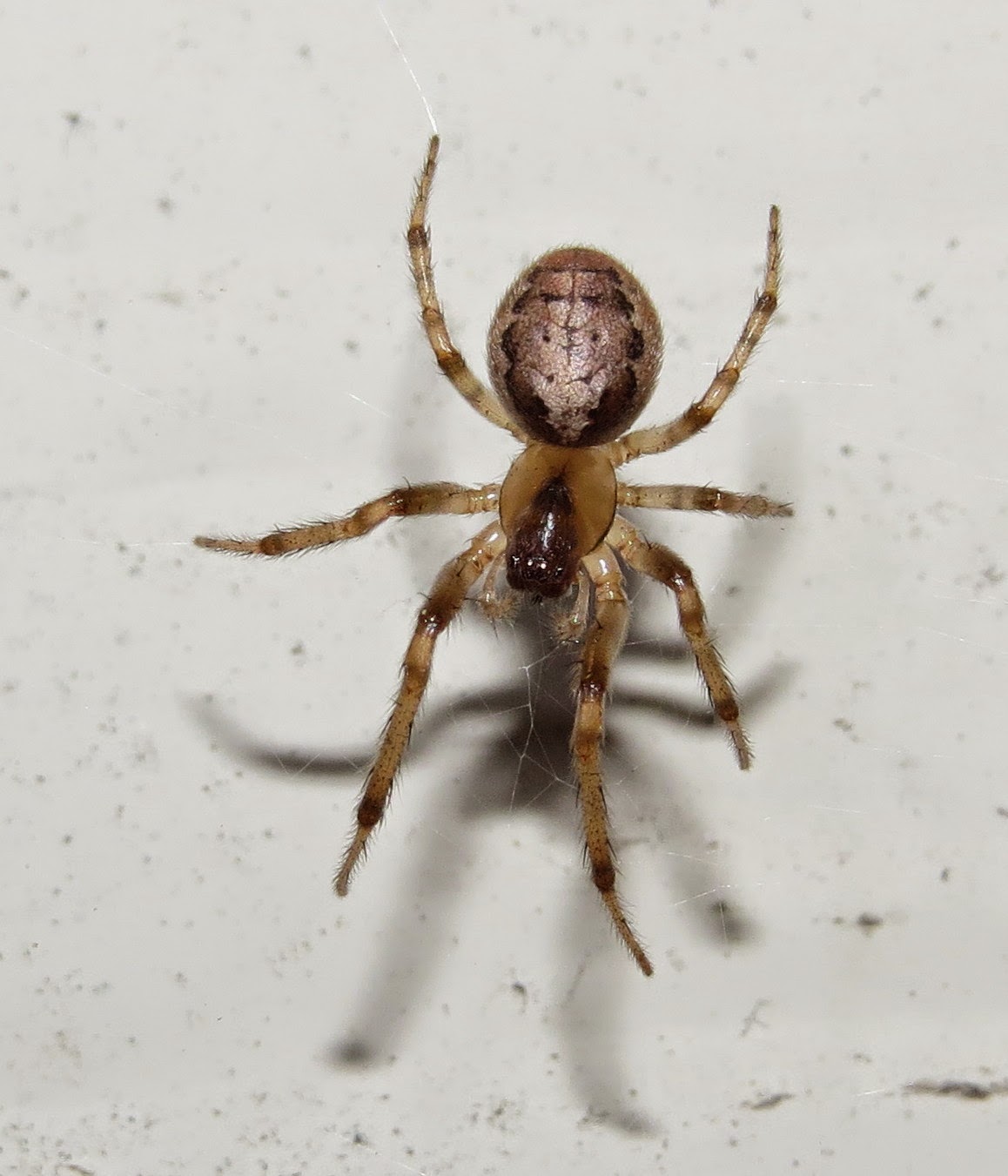
It takes little to excite me when I am out in the field, but back on July 13 I happened upon a spider that was new to me. My wife and I were hiking in Lovell Gulch, just outside of Woodland Park in Teller County, Colorado, enjoying the mixed conifer and aspen forests at an elevation of roughly 8,500 feet. I seem to recall watching an insect in flight when an orb weaver spider caught my attention.

The underside of the spider was most visible as it sat in the hub (center) of its wheel-like web, so I maneuvered as best I could to get a dorsal (top side) view. My initial thought was that this was a spider I had seen dozens of times: the Western Spotted Orb Weaver, Neoscona oaxacensis. Still, something seemed a little bit "off," and sure enough the ventral markings on this spider's abdomen were very different from that of a Neoscona species.

Underside of A. packardi
Underside of Neoscona oaxacensis

Once I got back home, I tried my hunch that it might instead be a species of Aculepeira, even though I had never seen a specimen before. Indeed it was. It turns out that this genus is pretty much restricted to high elevation, and/or high latitude habitats. The three North American species are collectively found from Alaska and the Yukon Territory to northern Mexico. There are also a few records in the northeast U.S. One undescribed "prairie species" has been discovered in western Washington state.

This one is almost certainly Aculepeira packardi, but it takes a microscopic examination of the genitalia of adult specimens to be conclusive. Note that the species name in older references is spelled with two "i"s: A. packardii. The other two species here are A. carbonarioides and A. aculifera (which reaches Guatemala).

Normally, the adult female spider hides in a silken retreat on the periphery of her web during the day, but this was a mostly cool, overcast day, so she may have felt comfortable occupying the center of her snare. The web was strung between the branches of a very low-growing shrub on a gentle slope in an open meadow.

These are good-sized spiders, mature females averaging nearly 11 millimeters in body length, males about 6 millimeters. The markings are pretty consistent, too, which does help a little bit in determining the species.

Interestingly, A. packardi also ranges in the Russian far east, Siberia, and northern China. In North America, it ranges from the Yukon to Labrador, and south to Chihuahua, Mexico and Pensylvania.

One typical dorsal pattern of Neoscona oaxacensis

From now on I will always double check spiders that I "think" I already know. It is a good practice, for you never know if you will find something new; new to you, or even new to science. All text and images © Eric R. Eaton

Sources: Balaban, John and Jane, et al. 2015. "Species Aculepeira packardii," Bugguide.net.
Dondale, Charles D., James H. Redner, Pierre Paquin, and Herbert W. Levi. 2003. The Orb-weaving Spiders of Canada and Alaska (Araneae: Uloboridae, Tetragnathidae, Araneidae, Theridiosomatidae), The Insects and Arachnids of Canada Part 23. Ottawa, Ontario: NRC Research Press. 371 pp.
Schimming, Lynette. 2013. "Genus Aculepeira," Bugguide.net.

Sunday, February 22, 2015

Bridge Orbweaver (Gray Cross Spider)

Downtown Portland, Oregon features a promenade on both sides of the Willamette River, and it is a stroll, bike ride, or jog worth taking simply for the scenery and people-watching. Should you be interested in spiders, it is even more worthwhile. Many manmade structures are occupied on the exterior by the Bridge Orbweaver, Larinioides sericatus. Even in December and early January of this year, specimens of varying ages were abundant.

This species is also known as the "Gray Cross Spider," and it is easily confused with the very similar Larinoides patagiatus, which has no common name. Further complicating matters, the Bridge Orbweaver has been going by the Latin name L. sclopetarius until very recently. A revision of the genus Larinioides was published in the journal Zootaxa about two months ago (see citation below).

These are fairly large spiders, mature females measuring 8-14 millimeters in body length, and males 6-8 millimeters. Their legspan makes them appear even larger to the untrained eye. Both genders share the same distinctive pattern on the carapace (top of cephalothorax) and abdomen. The overall color is generally gray, but some specimens tend toward brown.

Mature male from Massachusetts

The spider normally hides in a retreat on the periphery of its circular web during the day, and emerges to repair or reconstruct the snare at night. The spider then spends the night in the hub of the web, hanging head down. The spiders can also be there in the center of the web on overcast days, and juvenile specimens tend to be more likely to occupy the hub during the day than mature individuals.

Female making a kill in Massachusetts

While this species is particularly common close to water, where emerging aquatic insects like midges and mayflies are an abundant food source, I have also seen the Bridge Orbweaver in other settings in western Massachusetts. It can be a fixture around outdoor lights, where insect prey is drawn in great numbers. Spiders are quick to take advantage of resources like that, and competition for prime "web sites" is keen.

Underside of adult female, Oregon

Larinioides sericatus is found not only in the U.S. and Canada, but Europe as well. It is strongly suspected that it was even introduced to North America from the Old World. Records from Asia are now attributed to yet another species, L. jalimovi. Here, the Bridge Orbweaver is known from the maritime provinces, Quebec, Ontario, Alberta, and British Columbia south to Minnesota, Wisconsin, Illinois, Indiana, Ohio, New England, Virginia, Kentucky, Washington, and northwest Oregon. Isolated records exist for extreme northeast North Carolina, Oklahoma, and northwest Utah, at least some of which probably need confirmation. Recent voucher specimens have been taken in Long Beach, California.

Special thanks to Ivan Magalhäes and Laura Lee Paxson on the Facebook page for the American Arachnological Society for setting me straight as to the proper scientific name for this species.

Sources: Bradley, Richard A. 2013. Common Spiders of North America. Berkeley: University of California Press. 271 pp.
Dondale, C. D., Redner, J. H., Paquin, P. & Levi, H. W. (2003). The insects and arachnids of Canada. Part 23. The orb-weaving spiders of Canada and Alaska (Araneae: Uloboridae, Tetragnathidae, Araneidae, Theridiosomatidae). NRC Research Press, Ottawa, 371 pp.
Hollenbeck, Jeff, et al. 2013. "Species Larinioides sclopetarius - Gray Cross Spider," Bugguide.net.
Šestáková, Anna, Yuri M. Marusik, and Mikhail M. Omelko. 2014. "A revision of the Holarctic genus Larinioides Caporiacco, 1934 (Araneae: Araneidae)," Zootaxa 3894(1): 061-082.

Sunday, February 1, 2015

Missing Sector Orbweaver, Zygiella x-notata

During my stay in Oregon during December and the first week of January, I was surprised to see how many spiders were still active in the relative cold and damp. The most conspicuous of those arachnids were the Missing Sector Orbweavers, Zygiella x-notata, which seemed to occupy the corner of every window frame, outdoor light, or other manmade structure.

This species is easy to identify, simply from the web alone. It looks as if the spider forgot to finish it. A substantial wedge of the sticky spiral is missing from the top half of the web, the central radius in the sector running to a tubular retreat on the periphery where the spider usually resides. The web spans anywhere between 6-14 centimeters in diameter.

Zygiella web, spider in upper right corner

The spiders will come out to sit in the hub (center) of the snare at night, or even on overcast days; and young spiders are more apt to station themselves at the center than older spiders. Adult females measure 7.4-8.7 millimeters in body length, males 6-6.5 millimeters. The color and pattern is pretty consistent across all specimens, as shown in the images here.

Male specimen

Zygiella x-notata is not native to North America, having been introduced here from Europe who knows how long ago. It is well-established here now, from the California coast through western Oregon and Washington, and also along the Atlantic coast, from New England to Virginia. Another adventive species, Z. atrica, is known from northwestern Washington and southern British Columbia. Z. nearctica is boreal, occurring coast to coast in Canada, plus Alaska, New England, the Rocky Mountains to Colorado, and the Appalachians to North Carolina.

Two native species formerly placed in Zygiella have been reclassified into the genus Parazygiella: P. carpenteri with a disjunct occurrence in the Sierra Nevada mountains, California coast, and also southeastern Washington; and P. dispar from southern British Columbia to the vicinity of Monterey, California (though this is a holarctic species also found in Europe). P. carpenteri usually spins a complete orb web.

Spider in tubular retreat with egg sac

Back to Z. x-notata. It is also known under the aliases of "Winter Spider," "Opensector Orbweaver," and "Silver-sided Sector Spider." I recall this species being most abundant along the waterfront of the Columbia River when I was a child, but it is now among the most abundant of spiders even up in the hills of southwest Portland. It certainly associates itself with buildings, bridges, docks, and other structures.

What would these spiders feed on during the winter months? Many moth species fly throughout the colder months in the Pacific Northwest, plus winter crane flies, other dipterans, and some beetles. Orbweavers often crowd their snares around outdoor lights to further improve their odds of catching a meal.

Female with egg sac

Keep exploring during the winter months, even if it is only around the exterior of your home, office, or other building. You might well encounter one of these spiders, or any number of other organisms.

Sources: Adams, R.J. 2014. Field Guide to the Spiders of California and the Pacific Coast States. Berkeley: University of California Press. 303 pp.
Bradley, Richard A. 2013. Common Spiders of North America. Berkeley: University of California Press. 271 pp.
Sollfors, Stephan. 2010. "Zygiella x-notata," EuroSpiders.com
"Zygiella x-notata," NatureSpot.org.uk
"Summary for Zygiella x-notata (Araneae)," British Arachnological Society.

Underside of spider

Sunday, February 2, 2014

Spinybacked Orbweaver

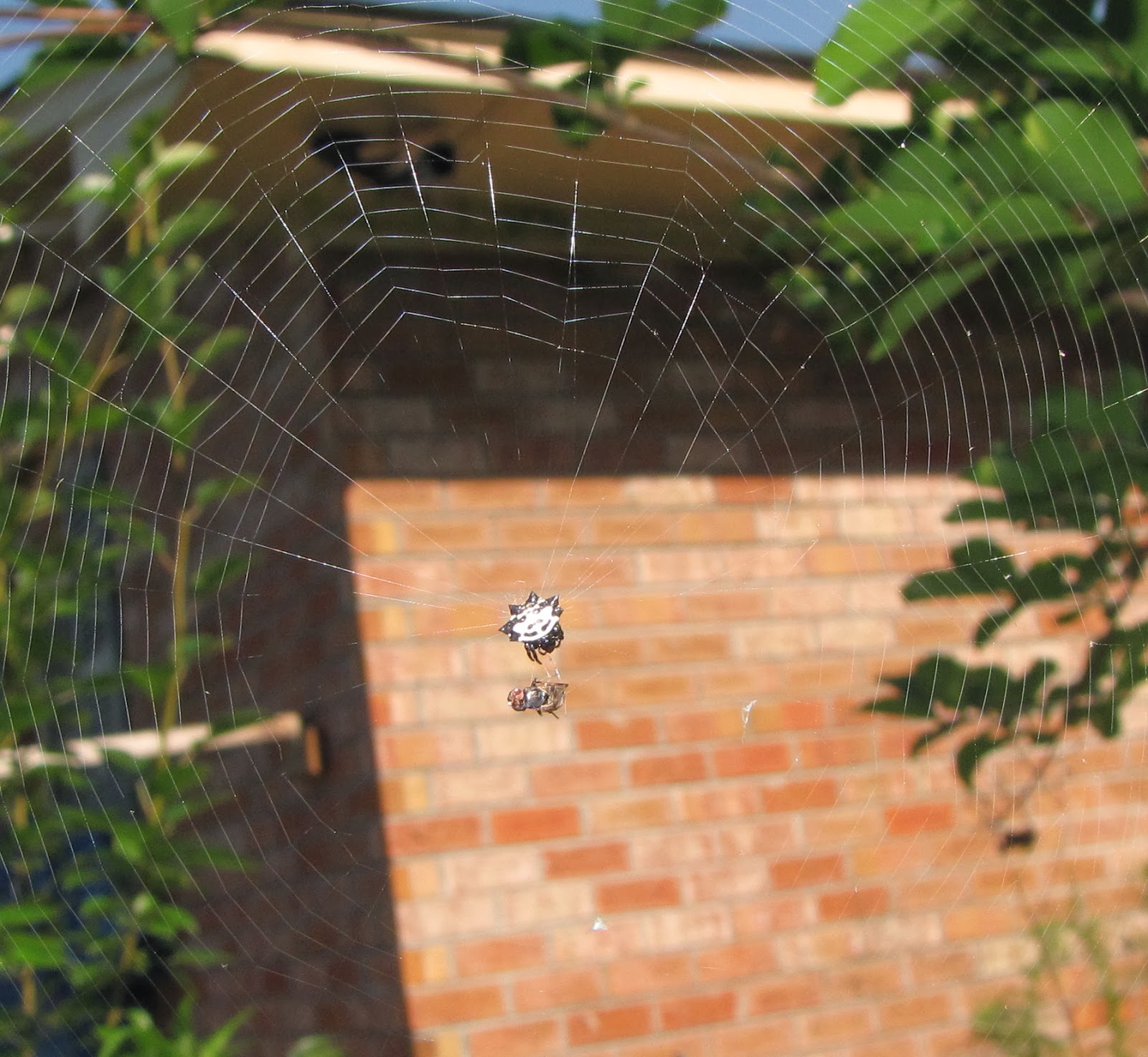
The diversity of shapes in the spider world is amazing. What does the Spinybacked Orbweaver, Gasteracantha cancriformis, remind you of? The genus name translates from the Greek to “belly thorn,” and the species name is Latin for “crab shape.” Indeed, other common names for this species include Crab-like Orbweaver and Crab-like Spiny Orbweaver. It reminds me of one of those medieval mace weapons come to life, or a flesh-and-blood ninja star (shuriken).

This is no soft-bodied arachnid, either. The exoskeleton of the flattened abdomen is thick and hardened, the spikes protruding from it horn-like and stout. A predator would certainly think twice before swallowing something that prickly.

This unique species is unlikely to be confused with any other spider you will encounter, provided you recognize it as a spider and not a piece of windblown debris that happened to be intercepted by a web. They tend to crouch, with their short legs drawn close to their bodies, so no one could fault a person for dismissing the spider as an inanimate object.

The overwhelming majority of specimens you are likely to see are females. The mature spiders are actually wider than they are long, ranging from about 5-9 millimeters in length, but 10-13 millimeters in width. Contrast those dimensions with the tiny males, which are only 2-3 millimeters in body length, and only slightly wider. He is a little rough around the edges but lacks the big spikes of the female.

Male G. cancriformis © Joe Lapp via Bugguide.net

There are several color forms of the females. Most are ivory and black on top, but they can be yellow with black spikes, yellow or white with red spikes, or red with black spikes. The underside is black, mottled with yellow or white spots, and rather wrinkled in appearance. The spinnerets arise from a short turret near the middle of the belly.

The first one of these I ever saw was at the Hemingway House in Key West, Florida in June, 1978. It had spun a web high in a tree and had I not been on a balcony at the time I never would have noticed it. The snare has a large, open hub where the spider sits, and the spiral is not as tight as in species of Micrathena (which also have spiny bodies). The body of the web can span 30-60 centimeters.

The web is often decorated with little tufts of silk along some of the radii near the hub. It is suspected that these knots of silk serve as warning beacons to birds so that the snare is not destroyed by an avian flying through it. Could they also be lures for potential prey? One theory as to the function of a stabilimentum, the band of silk in many Argiope orb weaver webs, is that the ribbon imitates a flower, reflecting ultraviolet light that pollinating insects cue in on.

This can be an abundant spider along woodland edges, citrus groves, even gardens, especially in rural townships from the southern United States to Argentina. Look for it as far north as Maryland, Arkansas, and Oklahoma. I have encountered it regularly in Florida and Texas, but it is known as far west as southern California.

G. cancriformis is most common in late fall and early winter, from October through January, at least in Florida. Mated females deposit eggs in sacs that are attached to the underside of leaves. The egg sac is very distinctive, covered in a rather loose net of coarse yellow silk with a line of green silk down the center of the oval structure.

Egg sac © Kara Tyler-Julian via Bugguide.net

The Spinybacked Orbweaver will always be a species I look forward to seeing anytime I venture into the subtropical southern U.S. Keep a lookout for them in your own travels.

Sources: Bartlett, Troy, et al. 2012. “Species Gasteracantha cancriformis - Spinybacked Orbweaver,” Bugguide.net.
Edwards, G.B. 2000. “Spinybacked Orbweaver,” Featured Creatures, EENY-167, DPI Entomology Circular 308, Florida Department of Agriculture and Consumer Services, Division of Plant Industry.

Sunday, September 1, 2013

Arrowshaped Micrathena spider

It must be a banner year for spiders in southern Ohio. We saw large numbers and quite a diversity of orbweavers alone on our recent trip to Cincinnati and Adams County, August 18-26. Among the more remarkable species was the Arrowshaped Micrathena, Micrathena sagittata. We found several individual females on the trail to Buzzardroost Rock, a preserve managed by The Nature Conservancy in Adams County near the town of Lynx.

The spiny orbweavers, which includes the genera Micrathena and Gasteracantha, are mostly tropical, and some species in the rainforests of southeast Asia, Australia, and Africa are even more extreme in the spikes, horns, and other processes jutting out of their armored abdomens. No doubt a spider studded in spines is not terribly appetizing to a predator.

The Arrowshaped Micrathena is not a particularly large spider, ranging from 8-9 millimeters in body length for mature females to only 4-5 millimeters in males. Males are seen less frequently than females by the casual observer and they lack the spines that adorn their mates. The color and pattern of this species is relatively consistent, as shown in these images.

Looking at the underside of the spider, we see that her spinnerets are located in the center of her abdomen, rather than at the posterior where you would expect them to be. Her venter (underside) is mottled black or brown and yellow, which helps camouflage her from predators that might approach from overhead.

The spiders spin circular webs about one foot in diameter with a tight spiral and an open hub (center). The spider hangs onto the threads that frame the hub, and also secures herself to the hub with strands of silk issuing from her spinnerets. She can drop out of the web and into the leaf litter below if she feels threatened, but then reel herself back to the hub when danger passes. A zigzag band of silk called a “stabilimentum” may be present, if only vaguely, immediately above the center of the web. The function of this decoration is still debated, with theories ranging from it representing a fake flower to attract insect prey, to a way to advertise to birds that a web obstructs their flight path.

The web is usually tilted somewhere between the vertical and horizontal planes, which makes it challenging to get decent images of the architect sitting on it. The abdomen of the spider may also sag, so getting the whole animal in focus is problematic. The spiders usually build their webs in shrubs and among other plants in the understory of deciduous forests, or along forest edges and openings in the canopy. Look for them two to four feet off the ground. They aren’t easy to spot even then. Researchers in Kansas found the webs particularly common in stands of Green Dragon (Arisaema dracontium), Pennsylvania Pellitory (Parietaria pensylvanica), and American Lopseed (Phryma leptostachya).

The snare intercepts flying and jumping insects, like leafhoppers, that the spider then feeds on. Interestingly, these spiders do not wrap their prey as other web-builders do. Flies, small wasps and bees, and beetles have also been recorded as prey of this spider.

Mated, mature females construct fluffy, spherical egg sacs of white silk, about 12 millimeters in diameter and containing roughly 90 eggs. The egg sac is the overwintering stage and mature spiders are seen mostly from July to September.

Micrathena sagittata is found from Maine to Florida and west to Nebraska and Texas, but is probably more common in the southern portion of its range.

Right now is prime spider-hunting season, with webs becoming more obvious as the spiders reach maturity, and leaves start to fall during autumn. Enjoy looking for them.

Sources: Bradley, Richard A. 2013. Common Spiders of North America. Berkeley, California: University of California Press. 271 pp.
Fitch, Henry S. 1963. Spiders of the University of Kansas Natural History Reservation and Rockefeller Experimental Tract. Lawrence, Kansas: University of Kansas Museum of Natural History, Miscellaneus Publication No. 33. 202 pp.
Howell, W. Mike and Ronald L. Jenkins. 2004. Spiders of the Eastern United States: A Photographic Guide. Boston, Massachusetts: Pearson Education. 362 pp.
Jackman, John A. 1997. A Field Guide to Spiders & Scorpions of Texas. Houston, Texas: Gulf Publishing Company. 201 pp.
Kaston, B.J. 1972. How to Know the Spiders (Third Ed.). Dubuque, Iowa: Wm. C. Brown Company Publishers. 272 pp.

Sunday, December 16, 2012

Spider Sunday: Difoliate Orbweaver

Some spiders are almost a complete mystery. They might have a species name, but that does not mean that much is known about their biology or life history. Such is the case with the Difoliate Orbweaver, Acacesia hamata.

This image represents the only specimen I have ever seen, encountered at the Lynx Prairie Preserve in Adams County, Ohio on the morning of August 26, 2011. The species is recognized by the very distinctive pattern on the abdomen. “Difoliate” translates to “two foliums,” a reference to the dagger-like (“cardiac”) mark inside the wider wedge-shaped marking. The roughly triangular or wedge pattern with wavy borders that decorates many orb weavers is called a “folium.”

This orbweaver is of average size, mature females measuring 4.7-9.1 millimeters in body length, males 3.6-5 millimeters. The basic color varies from greenish gray to brown on the legs and carapace, and gray to green on the abdomen. Resting spiders often adopt the pose shown in the image above.

We know that Acacesia hamata is the only species of its genus found north of Mexico. The other five species collectively range from Mexico to Argentina, and are known from only a handful of specimens. A. hamata occurs from New England to Florida and west to Illinois and Texas.

The female I found was on a blade of tall grass in what amounts to a glade: a slice of prairie surrounded by deciduous woodlands. Other scientists have found this species by sweeping grasses in open fields, suggesting this spider prefers this kind of habitat. One other reference lists it as occurring in bushes and shaded woods (Kaston, 1978).

A more recent book describes it building its orb web only at night, taking it down before daybreak. Females startled by bright lights are capable of deconstructing their snare in under sixty seconds. The spider does this by strategically cutting support lines and eating the silk as it rolls up the web beneath it. A complete web is a vertical orb 20-25 centimeters across, strung three to four feet (one meter) above the ground in shrubs. Populations may be fairly dense, but the spider is only locally common (Howell & Jenkins, 2004). Mature individuals are found in early summer or mid-summer.

We still know nothing of the reproductive behavior of this species, or what the egg sac looks like. Does this species prefer one kind of insect as prey? Many such questions remain unanswered.

Try finding Acacesia hamata if you live within its geographic range. Look along forest edges, the ecotone where woods meet meadows, fields, and prairies.

Sources: Fitch, Henry S. 1963. Spiders of the University of Kansas Natural History Reservation and Rockefeller Experimental Tract. Lawrence, KS: University of Kansas Museum of Natural History. 202 pp.
Gaddy, L.L. 2009. Spiders of the Carolinas. Duluth, MN: Kollath+Stensaas Publishing. 208 pp.
Glueck, Susan. 1994. “A taxonomic revision of the orb weaver genus Acacesia (Araneae: Araneidae),” Psyche 101: 59-84.
Howell, W. Mike an Ronald L. Jenkins. 2004. Spiders of the Eastern United States: A Photographic Guide. Boston: Pearson Education. 362 pp.
Kaston, B.J. 1978. How to Know the Spiders. Dubuque, IA: Wm. C. Brown Company Publishers. 272 pp.
Moulder, Bennett. 1992. “A Guide to the Common Spiders of Illinois,” Illinois State Museum Popular Science Series, Vol. X: 1-125.

Sunday, December 2, 2012

Spider Sunday: Cave Orbweaver

One of the oddballs of the family Tetragnathidae is the Cave Orbweaver, Meta ovalis. It does not have the exaggerated jaws, long legs, or elongated body typical of most other long-jawed orb weavers. It even spins a vertical orb web, in contrast to the usual horizontal webs made by other tetragnathids.

Meta ovalis has also gone by the name Meta menardi, but it has been determined that M. menardi is a separate species found only in Europe and Asia (to Korea).

This is an average-sized spider for orb weavers, females measuring 8-10 millimeters in body length an males averaging 9.5 millimeters. The species ranges from southeast Canada to Georgia and west to the Mississippi River, especially along the Appalachian Mountains and the Ozark Plateau. It is one of two North American species in the genus, the other being found only in California.

The typical habitat for cave orb weavers is, surprise, surprise, caves, abandoned mines, old wells, basements, and densely-shaded ravines. That is why I found this specimen on the exterior of a building, in broad daylight, in New Hampshire, on October 11, 2009. Since it was not associated with an obvious orb web, my first thought was that it was a sheetweb weaver in the family Linyphiidae, or maybe a cobweb weaver in the family Theridiidae. The spiny legs ruled out cobweb weavers, but I was still mystified.

I collected the specimen and took it to the lab I was using at University of Massachusetts, Amherst, where I took the two images on the table. Fortunately, I had access to good references and was able to eventually identify it correctly.

This is not a true cave inhabitant in the sense that it dwells only in the entrances and twilight zones of caves, and not in the deep recesses. It has obvious eyes, and is fully pigmented. These characteristics classify it as a “troglophile” rather than a troglobite. The webs are usually built from the ceiling of a given location, especially in protected situations (termed “kettles” and “bells” on the ceiling of caves) where dessicating air currents can’t dry them to death. The spider seems to prefer sitting near the edge of the web rather than its center, but frankly, little research and observations have been done on cave orb weavers.

One exception to the dearth of studies is Meghan Rector’s thesis, cited below. She discovered that immature specimens of the cave orb weaver may be distributed slightly deeper in caves, and construct larger webs to increase the potential for the capture of more scarce prey.

Clearly, more work is needed just to determine the geographic range of this species. Fauna of caverns in general is poorly known, and often endemic to a single cave or cave system. Spelunking, anyone?

Sources: Slay, Michael E., Daniel W. Fong, and Mark D. Kottmyer. 2009. “Meta ovalis (Araneae: Tetragnathidae) observed preying on a troglobiotic milliped, Causeyella (Chordeumatida: Trichopetalidae),” Speleobiology Notes 1: 3-5.
Rector, Meghan Anne. 2009. “Foraging in the Cave Environment: The Ecology of the Cave Spider Meta ovalis (Araneae: Tetragnathidae). Master of Science Thesis. 113 pp.
Reeves, Will K., John B. Jensen, and James C. Ozier. 2000. “New faunal and fungal records from caves in Georgia, USA,” J. Cave Karst Stud. 62(3): 169-179.
Yoder, Jay A., Joshua B. Benoit, et al. 2009. “Entomopathogenic fungi carried by the cave orb weaver spider, Meta ovalis (Araneae, Tetragnathidae), with implications for mycoflora transfer to cave crickets,” J. Cave Karst Stud. 71(2): 116-120.

Sunday, November 18, 2012

Spider Sunday: Hentz's Orbweaver

Some spiders simply cannot be ignored, and judging by the volume of images and questions we get over at Spiders.us, the most conspicuous spider of late summer and fall is one of the spotted orbweavers: Neoscona crucifera. Indeed, the spiders and their webs are very conspicuous.

This species was formerly named Neoscona hentzii, hence the common name. It is also known as the “Barn Spider,” but it unfortunately shares that name with another orbweaver, Araneus cavaticus. The two look similar in size, shape, and color. Neither species has a distinct pattern, but the markings on the underside are often more consistent, and a slightly better way to distinguish the two in the field.

Mature females of N. crucifera measure 9-20 millimeters in body length, while males range from 5-15 millimeters.

This is a widespread spider, found from Massachusetts to Minnesota, Nebraska, Colorado, and southern California, south to Florida and central Mexico. It favors moist woodland habitats, but can turn up in yards, gardens, parks, and even under the eaves of homes and other buildings. Outdoor lighting attracts insects at night, and many kinds of orb weavers seem to know this. So, they may stretch their webs across your front porch, garage door, or other convenient spot where they can intercept moths, flies, katydids, and other potential prey.

Immature N. crucifera build their webs only at night, taking them down at daybreak. By removing their webs they erase any obvious clue to their presence that birds or other predators may notice. The Black and Yellow Mud Dauber, Sceliphron caementarium, and the Organ-pipe Mud Dauber, Trypoxylon politum, are especially adept at finding orb weavers by following the framework of a web. Remember, the foundation lines of spider webs are not sticky, so can be navigated with impunity by both the spider and its predators alike. The cost of losing potential daytime prey captures pales compared to the benefit of remaining undetected by your own predators.

Adult females leave their webs up during the day, the owner hiding at the periphery of the snare in a curled leaf, or huddled on a twig.


She usually sits head-down in the center, or “hub,” at night. As insects become scarce in autumn, she needs to maximize her prey-catching opportunities, both day and night. The spider consumes a damaged web, recycling the silk.

Mature male orb weavers strike out in search of females and may be found wandering almost anywhere. Not only do adult males not bother spinning webs once they are sexually mature, but they actually lose the physical capacity to do so. They no longer manufacture the types of silk necessary to spin a web. All energy goes into finding a mate. The males mature faster than the females, so some may patiently wait in the vicinity of a female’s web until she becomes an adult.


male

Once mated, females prepare an egg sac, laying up to 1,000 eggs in a spherical or convex mass, covering it with a layer of fluffy, yellow silk, and usually concealing it in a rolled leaf. The sac measures only 5-12 millimeters in diameter.

Orb weavers in general are great to have around your home as they kill many insect pests. Their webs are glorious accomplishments of animal architecture; and the spiders themselves are harmless to people and pets, despite their sometimes intimidating size. Enjoy their beauty and presence before the killing frosts come.

Sources: Barnes, Jeffrey K. 2003. “Hentz’s Orbweaver,” University of Arkansas, Arthropod Museum Notes No. 23
Lapp, Joe. 2007. “The Intelligent Neoscona crucifera,” SpiderJoe.com.

Sunday, November 11, 2012

Spider Sunday: Starbellied Orbweaver

There is no shortage of the weird in the spider world, and I found one more example on our trip to Cape May, New Jersey on October 3, 2012. A series of posts linked with nylon rope provides a barrier along the dunes in Cape May Point State Park, and this fence was being utilized by one of the strangest of North American spiders, the Starbellied Orb Weaver, Acanthepeira stellata.

One of my friends on Flickr asked “Why is it star’bellied’ when it's star-butted? Is there more star-ness on its belly?” I have to agree with her. Maybe the person that first saw one described it from the ventral side. The pointy tubercles certainly show up well from both angles. The spikes probably help deter potential predators. Indeed, the abdomen is not as soft as it is in many other spiders.

Acanthepeira stellata is one of four North American species in the genus, collectively found from southeastern Canada south and west to southern California. This species in particular is known from southeast Canada to Florida, and west to Kansas and Arizona.

These are not terribly large spiders. Mature females measure only 7-15 millimeters in body length, males 5-8 millimeters. The shape of the abdomen is distinctive, making them easy to identify in the field. Indeed, fields and meadows with tall grasses and herbs are where I have found them. Most references indicate they prefer this kind of habitat as well, where they lash their webs to rather flimsy stalks and leaves. They are also fairly common in cotton fields and other crops in the southern Great Plains.

Starbellied spiderlings emerge from egg sacs in summer, and overwinter as immature or penultimate (one molt removed from adulthood) specimens. Adult females may be found from May to October, at least in Illinois (Moulder, 1992). Mature males can be seen from May to September. I found adults, or near-adults, in Cape May, and the one pictured at the top of the page appears to be “ballooning.” Ballooning is a dispersal strategy used by many young spiders to travel afar and stake out their own territories. A spiderling typically climbs to a high point, stands on tip-toe (“tip tarsus?”), and issues long strands of silk from its abdomen. These threads are caught by the wind, and when the spider lets go, it may be blown hundreds of feet, if not a mile or more. They can gain serious altitude, too. One baby A. stellata was captured at 1000 feet in the air over Tallulah, Louisiana on December 13, 1930 (Fitch, 1963).

These are orb weavers, and they spin the characteristic round webs of other members of the family Araneidae. The webs span about 6-10 inches, and are rarely more than four feet off the ground. The spider usually sits in the center (hub) of the web, head down, awaiting the impact of a prey insect. When disturbed, the spider invariably drops to the ground and feigns death, legs tucked close to the body. Among leaf litter and tangled grasses, it can virtually disappear until danger passes.

The Black and Yellow Mud Dauber, Sceliphron caementarium, is known to prey on Starbellied Orbweavers, paralyzing victims and stashing them in mud cells as food for its larval offspring.

Acanthepeira stellata itself preys mostly on nymphs (immature) of grasshoppers, plus other medium-sized insects. There is one record of an adult female preying upon an American Green Tree Frog, Hyla cinerea, but this is certainly not a routine event (Lockley, 1990).

Sources: Fitch, Henry S. 1963. Spiders of the University of Kansas Natural History Reservation and Rockefeller Experimental Tract. Lawrence, KS: University of Kansas Museum of Natural History, Misc. Publ. no. 33. 202 pp.
Gaddy, L.L. 2009. Spiders of the Carolinas. Duluth, MN: Kollath+Stensaas Publishing. 208 pp.
Lockley, T.C. 1990. “Predation on the green treefrog by the star-bellied orb weaver, Acanthepeira stellata (Araneae: Araneidae),” J. Arachnol. 18(3): 359.
Moulder, Bennett. 1992. A Guide to the Common Spiders of Illinois. Springfield, IL: Illinois State Museum Popular Science Series, vol. X. 125 pp.
Weber, Larry. 2003. Spiders of the North Woods. Duluth, MN: Kollath+Stensaas Publishing. 205 pp.

Sunday, October 21, 2012

Spider Sunday: Butterfly Orbweaver

Most of the orb weaver spiders that you see at this time of year are enormous mature females that sit in the center of their webs. Not all members of the family Araneidae are so large, however. A case in point is a species that I found right outside the back door of the house we rented in Cape May, New Jersey earlier this month.

I noticed one of these spiders during the day, huddled in a depression in the eave of the house, next to an egg sac. I took a picture and noticed the ornate, butterfly-shaped pattern on the spider’s abdomen. Once I returned home I was not surprised to find the common name of the species to be the “Butterfly Orbweaver,” Araneus pegnia. Older references use the name Neosconella pegnia.

The “butterfly” can be pinkish or gray or brown or yellowish, varying from specimen to specimen. The entire spider, even as an adult, is not very big. Mature females are only 3.5-8.2 millimeters, and males like the one below are even smaller, 2.5-5 millimeters.

I found that this species is most active at night. At least three specimens, two females and one male, made their living around the back porch light, where many small insects were attracted each evening. The odds of catching prey were obviously increased given this situation. I could never clearly discern the structure of the webs, or whether they were even complete, but references suggest the orbs are at least sometimes incomplete anyway. The circular snare may be missing a sector, with a bundle of signal threads running up to the spider’s retreat on the perimeter. The orb may also be complemented by a network of irregular threads similar to those of labyrinth orbweavers. I did find one female sitting in the hub (center) of her web on one evening, as depicted in the image at the top of this post. Another female was busy creating her web (below).

The lone male I found (image above) was literally hanging out, but perhaps his duty was done. One of the females was already protecting an egg sac. The ova appeared to be obvious, as a ball covered by several layers of opaque silk.

Many of the female’s offspring will not survive to maturity, or at least not live until the first hard frost that kills most late-season orb weavers. The Butterfly Orbweaver is apparently a favorite prey item for the Black and Yellow Mud Dauber wasp, Sceliphron caementarium. The victimized spiders are paralyzed by the wasp’s sting and stuffed into a mud cell as food for a single mud dauber larva.

Araneus pegnia is a far-ranging species. It occurs from at least as far north as Massachusetts, south and west to Ohio and Indiana, the Atlantic and Gulf Coast states, and southern Arizona and California. It is perhaps most common in the southeastern U.S. Outside of the U.S. it ranges to Ecuador in South America. It is also found in the Bahamas, Cuba, and Jamaica. The preferred habitat seems to be in wet areas (bogs in Massachusetts, a river bottom in Costa Rica, for example).

It is certainly easy to dismiss these diminutive spiders as simply immature versions of a larger species, so pay close attention when spider hunting. Autumn is the perfect time to find many kinds of orb weavers, as the leaves fall and their webs are more exposed; and most species have reached maturity.

Sources: Gaddy, L.L. 2009. Spiders of the Carolinas. Duluth, MN: Kollath+Stensaas Publishing. 208 pp.
Howell, W. Mike and Ronald L. Jenkins. 2004. Spiders of the Eastern United States: A Photographic Guide. Boston: Pearson Education. 362 pp.
Levi, Herbert W. 1973. “Small Orb-weavers of the Genus Araneus North of Mexico (Araneae: Araneidae),” Bull Mus Comp Zool 145(9): 473-552.

Sunday, September 16, 2012

Spider Sunday: Labyrinth Spiders

Oh what a tangled web they weave: meet the labyrinth spiders in the genus Metepeira. It may come as a surprise to learn that these little arachnids are in the orb weaver family Araneidae. The first thing one usually sees when spotting their web is the tangled network of lines surrounding a thimble-like retreat decorated with debris. Sometimes the retreat itself is all that is obvious.

There are apparently thirteen species of Metepeira currently recognized as occurring in North America north of Mexico. Only one of these is called the Labyrinth Spider: Metepeira labyrinthea, which ranges in the eastern half of the U.S. and north to southern Ontario, Canada. Look for it in shrubs and the low branches of trees along forest edges. The genus is most diverse in the west and southwest. I have found other species of Metepeira to be reasonably common, or even abundant, in arid habitats in the western U.S. (eastern Oregon and southeast Arizona).

The cobweb-like snare is only half of the structure of a Metepeira web. A small orb web completes the picture, but it is not often easy to see. The spider hides in its tent-like retreat, connected to the hub (center) of the orb web by a signal thread. When a prey insect impacts the orb, the spider dashes down to secure its potential meal.

The spiders themselves are not very large. Mature females are 5.5-7.2 millimeters in body length, while males measure only 3-4.5 millimeters. Because their color pattern is so variable, labyrinth spiders can be easily confused with other kinds of orb weavers. This is especially true if you find a specimen that has no associated web. Mature males wander in search of females, so they are often encountered on vegetation without a web.

These spiders usually reach adulthood in late summer or early autumn, at least in more northerly latitudes. Mated females create one or more egg sacs, each of which is roughly cone-shaped and covered in brown, papery silk. The spider stacks these above her in her web.

Interestingly, the species Metepeira spinipes, which ranges from southern Oregon into Mexico, sometimes exhibits social tendencies, individual spiders interlacing their webs over large areas. This cooperative behavior tends to be associated with higher-than-normal prey availability, and also certain kinds of habitats. Prey abundance in turn coincides with years in which the El Niño weather phenomenon asserts itself.

The social nature of that species and the Mexican Metepeira incrassata has another benefit: it reduces the likelihood of any one female spider will be killed by a spider wasp (Pompilidae: Poecilopompilus mixtus); or have her egg sacs fall prey to parasitic wasps (Ichneumonidae).

Sociality is not without its costs, however, and Metepeira incrassata colonies are often infiltrated by kleptoparasitic spiders akin to the ”dewdrop spiders: I wrote about last year. Other kleptoparasitic spiders actually kill the labyrinth spiders outright.

Enjoy looking for labyrinth spiders right now, as this is the time of year they are most in evidence. Just don’t become entangled in trying to identify them to species.

Sources: Balaban, John and Jane, et al. 2012. “Genus Metepeira,” Bugguide.net
Hieber, Craig S. and George W. Uetz. 1990. “Colony size and parasitoid load in two species of colonial Metepeira spiders from Mexico (Araneae: Araneidae),” Oecologia 82(2): 145-150.
Kaston, B. J. 1978. How to Know the Spiders (Third Ed.). Dubuque, Iowa: Wm. C. Brown Company Publishers. 272 pp.
McCrate, Andrea T. and George W. Uetz. 2010. “Kleptoparasites: A two-fold cost of group living for the colonial spider, Metepira incrassata (Araneae: Araneidae),” Behav Ecol Sociobiol 64(3): 389-399.
Rayor, Linda S. 1996. “Attack strategies of predatory wasps (Hymenoptera: Pompilidae; Sphecidae) on colonial orb web-building spiders (Araneidae: Metepeira incrassata),” J Kans Entomol Soc 69(4): 67-75.
Uetz, George W. and Wesley Burgess. 1979. “Habitat structure and colonial behavior in Metepeira spinipes (Araneae: Araneidae), an orb weaving spider from Mexico,” Psyche 86: 79-90.