Showing posts with label biodiversity. Show all posts

Friday, February 7, 2020

Avoiding Despair in the Age of the “Insect Apocalypse”

My social media feed (well, Facebook is admittedly the only one I devote any time to) is full of dire warnings of disappearing bees, fireflies blinking to extinction, and how light pollution and pesticides are dooming everything, and all manner of other negativity. The most empathetic of humans are the ones most devastated by this media bias, and if there is one thing we cannot afford it is the extinction of hope. Here are some things to consider.

Fiery Skipper on mint in a Kansas garden

1. Do not underestimate the ability of natural systems to rebound from even catastrophic events. Nothing is permanent, our present civilization likely included, but as long as there are reservoirs of habitat, recolonization of even the most compromised of locations is possible, provided the refuges are of good size themselves, and reasonably close in proximity to the damaged areas.

This same principle of recovery exists at every level in nature. I like to remind homeowners and gardeners that trees can survive nearly complete defoliation by insects in a given year, provided the plant is healthy in most other respects. Native plants tend to be vastly better at taking a licking and bouncing back than some exotic cultivar.

2. Assert your rights. You have a right to a planet with its full complement of species. Claiming you speak for other species, or suggesting rights of nature, or espousing the need to preserve nature for future generations, are all weak arguments. You are not Dr. Doolittle, and other species don’t care whether we appreciate them or not. Rights of nature is a noble goal, but is a rarely successful strategy, and only when it is initiated and driven by indigenous peoples. Arguing for conservation and preservation for future generations is a loving sentiment, but it undermines the urgency of action we must have. It also ignores the work of previous generations. Things could already be worse were it not for the likes of John Muir, Rachel Carson, Aldo Leopold, Theodore Roosevelt….

It is much more difficult to argue against the idea that other human beings have a right to bird, fish, hunt, and otherwise recreate in a manner that stems from an appreciation of, if not reverence for, wildlife. Use that to your advantage when making your case at the next public hearing, or HOA meeting.

3. Don’t play favorites. We do not get to choose which species to share our property with. Milkweed beetles, bugs, aphids, and moth caterpillars have as much of a right to “your” milkweed plants as Monarch butterflies do. Indeed, you are doing something wrong if your insect diversity is low. Revel in the variety of species. Study them. Share what you learn with others.

4. Lead by example. Don’t wait for someone else to make the first move. Turn your lawn into a meadow or prairie, or at least let the clover, dandelions, and plantain grow. Practice “weed tolerance” for all but the state-listed noxious species. Install “bee condos” as supplemental housing for native, solitary bees and wasps. Leave a heaping brush pile as cover for birds and small mammals. Let things be a little messy. Tell the neighbors you are not a lazy homeowner, but that you are promoting biodiversity. Offer to explain what that means and why you derive joy from it.

Write that letter to the editor. Participate in a public process to draft new codes for property owners (residential, commercial, government) that reflect a commitment to enhance or restore native plant communities and their attendant animal residents. Initiate the process if necessary, through petitioning or pestering your government representatives at whatever level is appropriate.

5. Forge new alliances. Join astronomers in promoting dark sky initiatives to reduce the impact of light pollution on nocturnal animal species. Seek out Native American groups to begin rights of nature campaigns, or address other common environmental issues. Use your white privilege not to lead people of color, but to empower them to take leadership roles for themselves. Heck, start by recognizing you have white privilege and accepting that it may be necessary to solve environmental racism first, before going on to the next issue.

6. Remember the “history” part of “natural history.” Remind yourself and others that we need to pay the same respect to our natural heritage that we pay to our human history. We have “living history” at parks and monuments, yet we do not have a mandate to preserve a historical spectrum of ecosystems within local, state, provincial, regional, and national parks. Why not? Let us relax our notion of “wilderness” to extend beyond roadless areas to urban parks, restored brownfields, manmade wetlands, and other non-traditional definitions. Somewhere between bringing back mastodons and declaring a parking lot an ecosystem, there is room for an expanded definition of wilderness.

No one is going to do all of the above, let alone very well. Pick a place to start. Forgive yourself the failures, most of which will only be what you personally perceive as failures. Add to this list in your comments. Share your own experiences and hopes and how you plan to achieve them. Respond to every demoralizing story with the determination of a rose bush under an aphid attack.

Firefly, Pyractomena sp., Wisconsin

Wednesday, October 30, 2019

One Night, One House, Seventeen Spider Species

In honor of "Arachtober" over on Flickr, I thought I would share what I discovered when I walked around the exterior of a house, garage, and woodshed at night in the northern reaches of Door County, Wisconsin, USA, on June 24, 2019. We rented the house for a few days for a family gathering. It sits in a forested area right on the shore of Lake Michigan on the Green Bay side, with Plum Island and Washington Island on the horizon. This particular evening was cool and wet, with intermittent rain showers. Imagine what a dry, warm night would be like.

Orb Weavers: Araneidae

Orb weavers often construct their webs under the eaves of structures, and are usually more conspicuous after dark. They seem to understand that outdoor lights attract more prey than they would catch out in the darkness. I spied at least three species this night:

Trashline Orbweaver, Cyclosa sp.

Furrow Orbweaver, Larinioides cornutus

Bridge Orbweaver, Larinioides sclopetarius

Long-jawed Orb Weavers: Tetragnathidae

Interestingly, the one long-jawed orb weaver I found was sitting snugly against the side of the woodshed with no web in sight. It may be that they take the day shift. These spiders are recognized by their long bodies and long legs, and having their webs oriented in the horizontal plane (usually), often over water.

Long-jawed orbweaver, Tetragnatha sp.

Cobweb Weavers: Theridiidae

Cobweb weavers are the spiders most associated with human habitations and buildings. There are plenty of crevices in which to hide, and the style of their snares requires little in the way of points of attachment. The space beneath an overhanging piece of siding offers enough dimension to spin a web.

Immature Common House Spider, Parasteatoda tepidariorum

Male (left) and female cobweb weavers, Steatoda sp.

Funnel Weavers: Agelenidae

Among the most abundant spiders I encountered this night were funnel weavers. Crevices in stonework around the house and garage and shed allowed for a dense population, but some of the younger spiders were simply wandering, perhaps looking for new and better places to spin webs.

Funnel weaver, Coras sp.

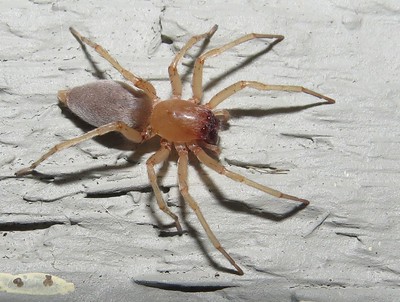
Sac Spiders: Clubionidae

Many spiders don't bother spinning webs, but simply prowl around seeking prey. Chief among them are sac spiders. I saw at least three different individuals. They can appear and disappear rather quickly, so there were probably many more that I missed simply due to poor timing. The cool weather did slow them down a bit, though.

Sac spider female
Female sac spider, Clubiona sp.

Sac spider male
Male sac spider, Clubiona sp.

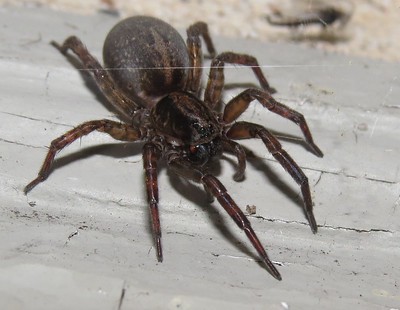
Wolf Spiders: Lycosidae

Wolf spiders are also common nighttime hunters. They are seen mostly on the ground and on objects in the horizontal plane, but some species are surprisingly agile climbers. Wolf spiders are easily recognized by their eye arrangement. A row of four small eyes near the base of their jaws, with two very large eyes right above that row, and the final two eyes set far back on the carapace.

Wolf spider at night
Female wolf spider, Trochosa sp.

Nursery Web and Fishing Spiders: Pisauridae

The largest spiders you are likely to see in the eastern United States and adjacent Canada are the fishing spiders. Despite their name, many species are found far from water, hiding in treeholes and other shelters during the day. They can be startling if encountered suddenly and unexpectedly on tree trunks or the sides of buildings at night. I was prepared to see them and was not disappointed.

Immature Dark Fishing Spider, Dolomedes tenebrosus

Mature male Striped Fishing Spider, Dolomedes scriptus

Jumping Spiders: Salticidae

Most jumping spiders are active by day, but you can still see them at night, especially if they have taken to sheltering in place on the sides of homes and buildings. They hunt by sight, without webs, and are the smallest of the common prowling spiders.

Jumping spider, Naphrys pulex

Adult male jumping spider, Evarcha sp.

Gray form male of the Dimorphic Jumper, Maevia inclemens

Crab Spiders: Thomisidae

Crab spiders can turn up almost anywhere. They are classic ambush hunters, several species hiding in flowers to wait for pollinating insects to come within reach of their elongated first and second pairs of legs. The spiders are highly sensitive to motion, and if you don't approach slowly they are quick to sneak inside a crack or dodge behind foliage.

Female ground crab spider, Xysticus sp.

Sheetweb Weavers: Linyphiidae

Members of this family spin flat, convex, or concave webs, depending on the genus. Each style is tailored to capturing a different suite of insects. The spiders hang upside down on the web and will respond to entangled prey at any time of day. Mature males, like most male spiders, cease to spin webs and devote the remainder of their lives to seeking mates. They do not even feed during their quest.

Female hammock spider, Pityohyphantes sp.

Unidentified male sheetweb weaver

What's lurking around your house? I highly recommend taking the time to inspect the exterior of your home with a flashlight at night. You will be surprised and, hopefully, delighted by the many organisms you find. Besides spiders, I also saw a soil centipede, various woodlice (terrestrial crustaceans that include sowbugs and pillbugs), a harvestman (aka "daddy long-legs," arachnid order Opiliones), and of course many insects. Good luck, happy "Arachtober!"

Thursday, November 29, 2018

Thankful For Small Wonders

On Thanksgiving day I usually make a pilgrimage to the Cheyenne Mountain Zoo, where my wife works as a keeper of orangutans, gorillas, Golden Lion Tamarins, and related primates. Thursdays are part of her regular work schedule, but at least the zoo's grill caters lunch for the staff and their families on the holiday. The rest of the day I do an informal mini-bioblitz looking for uncaged wildlife, mostly insects and spiders, of course. You would be surprised by what you can find in late November.

Convergent Lady Beetle

With all the press about a very legitimate "insect apocalypse," it does me good to get out and realize there still is a respectable degree of arthropod diversity, at least for now, and despite heavy human impacts. Last Thursday I managed to find over thirty (30) species of insects and spiders in casual searching, mostly on fences where it is easier to spot small organisms that are otherwise well-camouflaged or esconced in nooks and crannies and cracks and crevices.

Gall midge, a type of fly

Right now there is a good deal of major construction happening on zoo grounds, so there is upheaval of normally static habitats. The zoo is located on a mountainside, the landscape remaining largely natural with mixed coniferous trees, an understory of Gambel's Oak, chokecherry, and various wildflowers and herbs and grasses, most of them native. Yes, there are fruit trees and various exotic flora planted for visual pleasure, and a butterfly garden designed to attract the more colorful insects found in the region, but mostly the place has a very natural look.

Jumping plant louse, Cacopsylla pararibesiae

Zoos do not like to publicize the native fauna found on their grounds because in some instances non-captive animals can transmit diseases to the vulnerable captive animals. This is cause for both veterinary concern as well as potential disciplinary action by the Association of Zoos and Aquariums, the organization responsible for issuing accreditation to zoos for adherence to basic professional standards. This is certainly understandable, but most native animals seen at zoos are birds, sometimes squirrels, and, overwhelmingly, insects. Zoos that fail to acknowledge and embrace those local creatures are doing a disservice to visitors.

Ichneumon wasp

It bears repeating to say that "biodiversity begins at home," and demonstrating how visitors can promote biodiversity on their own property should be a priority at zoos and botanical gardens. That can take the form of a butterfly garden, brush pile, a drilled block of wood that functions as a "bee condo" for solitary bees, or a small water feature to service birds and aquatic insects. You should probably take this only as far as hummingbird feeders, at least here in Colorado where bears and other dangerous wildlife will take full advantage of any food you offer to other kinds of birds, squirrels, and even your own pets. It is in fact a violation of law to feed wildlife.

Flat bark bug, family Aradidae

Simple signage can do a lot to inform zoo guests about the local ecosystems and the role of various animals in maintaining them. Indeed, there are placards around the zoo that do address pollinating insects, bark beetles, etc. It is a start, and something other zoos should emulate as it applies to their own unique macro-fauna.

Ant-mimic spider, Castianeira sp.

Besides the "bugs" themselves, I am grateful for citizen science and social media outlets where I can share images of what I find, and hopefully encourage others to follow suit on their next visit to the zoo, city park, community garden, or even their own backyard. At this time of year, even a bioblitz in your shed or garage or basement can turn up a surprising variety of life forms. Just don't tell your spouse or your mom if they have hostile inclinations toward uninvited animals.

Seed bug, family Lygaeidae

I post regularly to iNaturalist, and occasionally to Facebook....and I need to get back to Project Noah. Whether you know a cockroach from a carpet beetle or a butterfly from a moth, no matter. Share what you observe. Others will help you learn about the critter in question. You may even find something previously unknown to your neck of the woods, to your state, province, or even new to science altogether. There is no end to the discoveries that await you.

A small dung beetle, Scarabaeidae: Aphodiinae

Thursday, July 12, 2018

An Insect "State of the Summer" Report

Here in Colorado Springs, Colorado, and elsewhere in the state, it has been anything but a normal summer. Not that there is any such thing as "usual" in this age of aridification and climate change, of course. What follows are personal, anecdotal observations related to weather, insect diversity, and insect abundance so far this season.

Mammatus clouds signal impending hail
Weather

There are only three words needed to describe the weather this summer: Hot, dry, and stormy. We have had recent stretches of ninety-plus degree days, well above the expected average. The excessive heat has been punctuated by severe thunderstorms. At our home, we have had more hail events this year than in the five-plus previous years that I have lived here....and we were lucky. One major hail storm dumped baseball-sized ice balls on the city of Fountain, just a few miles down the highway from Colorado Springs. Repairs to vehicles and roofs and other damaged property will take months and cost many thousands of dollars.

Accumulated hail in our backyard today!

Beyond the city, at least fifteen wildfires have burned thousands of acres of forest and grassland, rendering wildlife habitat and recreational destinations unfit for man or beast for years to come. That does not even address the human dwellings and other structures that were lost in the blazes. Now, heavy rains like we had at our home today will cause flash flooding over the burn scars, and lead to water damage at the bottom of slopes.

Aristotelia elegantella, a tiny twirler moth new to our yard
Insect Diversity

Insect diversity appears....relatively stable, though it is difficult to assess for reasons that will become clear later in this story. Interestingly, every time I turn on our backyard blacklight I seem to attract some species new to me and new to our growing "home list" of animal organisms that now exceeds 440 taxa (levels of classification from Kingdom to species and every level in between). I have managed to excite even seasoned moth experts with some of the nocturnal Lepidoptera that are turning up. We have even had a pine sawyer (Monochamus clamator) and bark beetles (Dendroctonus sp.) come to the blacklight. I suspect someone brought firewood down out of the mountains and the beetles are emerging from it.

Spotted Pine Sawyer, Monochamus clamator
Insect Abundance

Numbers of individual insects are way down. I have to work hard just to find species normally overwhelmingly present. It is this situation that has made assessing diversity more difficult. It is disturbing to note how few insects there are visiting wildflowers, but wildflowers are fewer and farther in between, too, smaller in size and lower-growing than usual, making it difficult to detect them, let alone any pollinators. Yellow Sweet Clover, Melilotus officinalis, an exotic invasive that is now well-established throughout the U.S., and its relative White Sweet Clover, are overwhelmingly abundant this year. They normally attract plenty of pollinators, but I find almost none.

Overwhelming parasitic mite load on Melanoplus sp. grasshopper

Another worrisome observation is that the few arthropods doing well are mostly parasites of other arthropods. Parasitic mite loads on grasshoppers are in some instances frighteningly high. Bee flies are doing well but their hosts, solitary wasps and bees among others, are not prospering. Cuckoo wasps and cuckoo bees are at about average density and distribution.

Bee flies, like this Poecilanthrax arethusa, seem to be doing fine

Even the European Paper Wasps nesting on our back gate have failed to produce more than about two new workers the entire summer so far. That is shocking since they are among the most successful of social predatory wasps.

The New Normal?

Should this year be the beginning of a trend, it would be devastating. Our drought-stricken landscape needs to be watered with historically normal rain patterns or another Dust Bowl will be upon us, threatening not only wildlife diversity but human sustenance in the form of crops and livestock. The forest wilderness cannot take further fragmentation if wildlife populations are to endure, especially large predators that require vast individual territories for hunting and rearing offspring. We need to start treating our own properties as potential wildlife habitat, planting with native vegetation. It may be that we also need to assume some degree of latitudinal climate change and plan accordingly, adopting drought-resistant cultivars into our landscaping.

Our backyard milkweed garden ravaged by today's hail

What are you observing where you live? Share your stories and concerns and possible solutions. This blog is a community built by all of you, please speak up.

Wednesday, July 22, 2015

A Beautiful Place to "Bee"

If the word "bee" was a verb, Colorado would be a very good place to "bee." The diversity of native bee species is high, with at least 946 species of bees in the state. This past month alone I have personally observed many interesting bees.

Male cactus bee, Diadasia enavata, approaching milkweed flowers
 
Slowly, more people who are not scientists are learning that there are bees other than the Honey Bee and bumble bees. The overwhelming majority of our native North American bees are solitary, each female constructing her own nest as a burrow in the ground, a hollowed-out pithy twig, or a pre-existing cavity in wood, rock or masonry. A few mason bees make free-standing mud nests. Some of the ground-nesting sweat bees express some degree of sociality, with daughters helping their mother raise a second generation of offspring.

Male leafcutter bee, Hoplitis hypocrita
 
Male bees often congregate in the neighborhood of places where females are nesting, creating the impression that they are social and "swarming." Male bees lack stingers, but to those unaware of that fact an active aggregation of flying males can be intimidating.

My wife organized a group of naturalists to visit "Emerald Valley" on the back side of Cheyenne Mountain, beyond the reach of The Broadmoor resort camp, on June 29. A break from the mostly overcast and rainy weather we've been having allowed us to observe several species of bees. Even the trail itself provides bare earth that burrowing bees like to nest in.

Male yellow-faced bee, Hylaeus basalis
 
Most bees are difficult to identify from images alone, but I am fortunate to have colleagues like Hartmut Wisch, a naturalist in southern California, and John Ascher at the American Museum of Natural History, who are so familiar with native bees that they can make many species-specific identifications from images of live bees. Hartmut helped me identify the surprisingly large male Hylaeus basalis from Emerald Valley; and John shocked me by identifying the bigger, hairy males on the trail as "plasterer bees" (aka "cellophane bees") in the genus Colletes. Females of both Colletes and Hylaeus coat the cells of their underground nests with glandular secretions that are organic polymers (plastic!). This keeps the pollen and nectar from spoiling as the larval bee eats it.

Male plasterer bee, Colletes sp.
 
Other higher-elevation species include leafcutter bees like the genus Hoplitis, some of which are metallic green or blue. Males drive each other off, and flirt with females, around logs with beetle borings where the females make nests.

Sometimes, you are what attracts bees. I had the pleasure of entertaining a female "sweat bee," genus Halictus, as she sipped my perspiration during the Emerald Valley trip.

Female sweat bee, Halictus sp.
 
A trip to Lovell Gulch in Woodland Park, Colorado (Teller County, elevation over 8,000 ft.) on July 13 gave Heidi and I a treat in the form of a female Megachile melanophaea pausing with her burden of a piece of leaf she had just cut. Thanks to John Ascher and Étienne Normandin for making the identification. Leafcutter bees shear oval pieces from soft leaves or flower petals to fashion barrel-shaped cells they stack along the length of a pre-existing tunnel in wood, or a burrow in the soil. Perfectly round leaf pieces cap a finished barrel, which will contain a pollen-and-nectar ball and an egg.

Female leafcutter bee, Megachile melanophaea
 
Back down here on the plains, additional bees can be found. The sandy soil is a perfect substrate for ground-nesting bees like Calliopsis zebrata in the family Andrenidae. I was surprised by the size of the males of this species. Most Calliopsis are very small. Males fly relentlessly over places where females nest, landing ever so briefly now and then.

Male mining bee, Calliopsis zebrata
 
Flowers are, naturally, where you see most bees as they sip flower nectar and, if they are females, collect pollen. We are having an exceptionally wet year (wettest May on record for El Paso County), and while wildflowers have prospered, there appears to be a dearth of pollinators in terms of abundance, at least.

Bees do have their enemies, and sometimes those enemies are other bees. I was stumped by one particularly large, solitary bee I encountered on May 28 in Cheyenne Mountain State Park. The insect landed on the trail and stayed there, allowing me to approach close enough to take pictures. Doug Yanega of the University of California, Riverside, another top-notch bee expert, kindly provided the identification of Melecta pacifica fulvida. It turns out this species is a cleptoparasite of the digger bee Anthophora pacifica. The female Melecta enters the burrow of its host and lays an egg there. The larva that hatches then eats (steals) the pollen and nectar intended for the host's offspring.

Female cuckoo bee, Melecta pacifica
 
I do hope that if you don't live in Colorado, you will be able to visit and take in the rich diversity of flora and fauna here. I would be happy to go afield with you and introduce you to our "bee"-autiful flora and fauna.

Source: Scott, Virginia, John S. Ascher, Terry Griswold, and César R. Nufio. 2011. The Bees of Colorado. Natural History Inventory of Colorado No. 23. 112 pp. (PDF version)..

Sunday, July 8, 2012

Summer 'hoppers Part I

Note: Today’s “Spider Sunday” appears on my companion blog, Sense of Misplaced, for reasons that will become clear if you visit that site.

Here on the Front Range and high plains of central Colorado, it seems that grasshoppers are ever-present and the diversity ever-changing. The continuing drought has no doubt contributed to the overall abundance of Acrididae (short-horned grasshoppers) this year. I was finding adult Speckle-winged Rangeland Grasshoppers, Arphia conspersa, on the last day of February, and it has only gotten more amazing since.

Easily the most exciting discovery I made was spotting the Crowned Grasshopper, Trachyrhachys coronata. I imaged the female shown below on June 2, just up the street in a vast vacant lot with very short grasses and herbs, and small, widely scattered elm trees. I was completely perplexed by the leopard-spotted pattern on what is really a pretty slender animal. Most leopard-spotted grasshoppers are very large and robust.

Enter David Ferguson, a grasshopper expert who lends his knowledge to Bugguide.net. I e-mailed him the image above and pleaded for help. He recognized it as a female Crowned Grasshopper, a seldom-seen species. Indeed this picture, and the one of a male taken on June 29 (below) may be the only images of live specimens in existence, at least in the digital age. No wonder I couldn’t find a match on Bugguide or elsewhere.

The most common species of Trachyrhachys is T. kiowa, shown below. Note the blue hind tibia. When it flies, the hind wings are either clear or yellow, with little or no contrasting black band. Hard to note such details when they explode from underfoot and then quickly land again. This one is on the wing right now, a very common species.

The enormous female Red-shanked Grasshopper, Xanthippus corallipes, shown below, is more typical of the leopard-spotted grasshoppers. She keeps her most vibrant colors mostly concealed. The back of her head is blue, and the inner surface of her hind femora (“thighs”), and the entirety of her hind tibiae, are bright vermilion. Her hind wings, visible only when she is flying, are bright yellow with a black band.

By the side of the road at a major intersection I found the slender little ‘hopper below, Derotmema haydeni. It was so hot that it was elevating itself on only four of its six legs, and headed for the shade of a small plant at the first opportunity. This species can have yellow or red hind wings with a black band.

In contrast to the colorful band-winged grasshoppers described above are the super-camouflaged “slant-faced” grasshoppers that mimic grasses, not the surface of the soil. Slant-faced grasshoppers are generally striped, whereas band-winged grasshoppers are speckled or spotted. The Velvet-striped Grasshopper, Eritettix simplex, is anything but simple. It has enough variation to convince you that there are several species rather than just one. The typical form is shown here (brown and white):

They also come in green and brown (and white):

Wait, there’s more. This specimen that I found on the door jamb of my apartment I had pegged as Opeia obscura, but no-o-o-o, just another Eritettix simplex.

The Velvet-striped Grasshopper is surely one of the most abundant species here in Colorado Springs. Virtually every vacant lot has them.

An even more handsome species is the Striped Slant-faced Grasshopper, Amphitornus coloradus. It favors bunchgrasses and I only found it in one little patch amid yucca and prickly pear cacti.

Stay tuned. Last Monday I went through the wilderness between Cañon City and Pueblo and turned up some incredibly stunning grasshoppers. You literally have not seen anything yet!