Showing posts with label Lepidoptera. Show all posts

Wednesday, September 2, 2026

Good News and Bad

Lately, I have not been motivated to write, but two recent events in particular prompt today’s post. Neither has happened yet, actually, but both have been announced. One of them invites your participation, and the other erases future opportunities to enjoy a visit to a renowned institution.

Butterfly Big Day is September 12, 2026. Captive butterflies in butterfly houses don't count, though.

The other day I was approached by a colleague, via a social media messaging channel, and asked to promote the first “Butterfly Big Day,” taking place on September 12. This is an attempt to take an almost literal snapshot of global butterfly abundance and diversity through community science. The one-day project is sponsored by a variety of organizations and working groups, including The Urban Butterfly Initiative, which created the event.

Participation in the Butterfly Big Day involves joining the iNaturalist project, and uploading your photos of butterflies seen on that day to the platform.

World Wasp Week is September 20-28.

In the process of joining the Big Butterfly Day project, I learned that World Wasp Week is also coming up fast: September 20-28. The same procedure exists for that undertaking as well: Join the iNaturalist project, then upload your images of wasps, bees, ants, sawflies, and related members of the order Hymenoptera, seen during that time period. Autumn, in the northern hemisphere, is typically a great time to see wasp diversity. Don’t forget the tiny ones. In fact, that is where the greatest wasp variety exists, and none of those little creatures sting, either.

Don't forget the tiny wasps, like this diapriid, for World Wasp Week!

Flowers are the logical place to observe and record wasps, but it also pays to look at aphid colonies. Aphids secrete copious amounts of a sugary liquid waste called honeydew, and wasps, ants, bees, and other insects crave it. Turn on your porch light at night, because a surprising number of wasps are nocturnal. Many of those are very small, but there are some large ichneumon wasps that will likely visit, too.

There is another date looming that is, unfortunately, not so full of joy and excitement. The Academy of Natural Sciences of Drexel University in Philadelphia just issued a press release announcing that the museum will be closing to the public as of September 27. This abruptly ends a nearly 200-year run of existence for the museum, which was its own entity, the Academy of Natural Sciences of Philadelphia, until 2011, when it became an affiliate of Drexel University. Coincidence? Maybe.

The Academy of Natural Sciences of Drexel University, in Philadelphia, USA.

The statement that was broadcast cited the Covid pandemic as a major factor in decreased attendance, from which the museum has apparently never fully recovered from. The museum administration claims that it maintains a commitment to public education and engagement, but is consolidating resources to protect the large and historically valuable collections housed within the facility.

The letter also asserts that they are not underestimating the impact this decision will have. Oh, but they are underestimating that. The repercussions for museums across the entire United States, and also abroad, will be anxiety-inducing at best, and drastic at worst.

What the average person hears in the media statement is “We value a vault of dead organism specimens over the education of living human beings.” It affirms the existing beliefs of many that science is elitist and exclusionary.

I have to bite my tongue when I hear friends and colleagues praising the museum for prioritizing the collections. I get it. I have worked in collections myself, including the Smithsonian Institution (on private contract in the 1980s). They are invaluable and irreplaceable. The problem is, we have done a terrible job of communicating that value to people who don’t work in museums. Science is suffering from public distrust enough as it is, without closing a major portal to understanding it.

I have friends who have worked at the Academy of Natural Sciences, and others in Philadelphia who know the museum intimately. This is beyond gut-wrenching for them, and is arguably a slap in the face to their years of employment, volunteerism, and patronage. I have never been to the museum myself, but am deeply mourning the fact that I will never be able to.

Enough. Go out there and document the butterflies, wasps, and other creatures, while you still can. Visit museums and nature centers while they are still open to you. Take nothing for granted, but do your best to guarantee a future that is better than our present.

Wednesday, July 29, 2026

Moth Week 2026 by Phone

I am so far behind in uploading camera photos to my computer and external hard drives that I literally “phoned it in” for National Moth Week, July 18-26. The photos in this post were taken with my iPhone 14. I promise that eventually I will have camera photos added to most of my observations posted on iNaturalist.

Our set-up at Atchison State Fishing Lake.

Officially, according to the current status on iNat for the Moth Week project in Kansas, I finished with a little over 90 species of moths in 234 observations. That was better than I expected. June is typically a more productive month for moth diversity here in northeast Kansas, USA. I am also not very proficient in identifying moths. I must thank the very knowledgeable and generous experts on iNaturalist for helping me out.

Suzuki's Promalactis Moth
Linden Prominent.

I began the week by putting out our blacklight in the front yard, near the giant Pin Oak tree that is probably responsible for feeding most of our insect diversity, both literally and figuratively. The weather the entire week was mostly hot, and vastly more humid than we usually experience here, so that was in our favor.

White-lined Sphinx from the back yard.

Two days later, on July 20, I switched to the back yard. We now have an outlet on the exterior of our detached garage, so I also plugged in a bright white light. We usually use a lightweight Jackery generator to run both the blacklight and a terribly dim LED white floodlight. The brighter light with the traditional bulb drains the generator in less than a couple of hours, compared to the LED. I welcome suggestions for a brighter white light that will run longer through the Jackery.

Heidi spotted this Curved-ribbon moth, Dinumma deponens on the door to the garage. This species is native to Asia.

It is surprising how different the results can be between our two yards. The backyard includes overhanging branches of a Silver Maple in the neighbor’s yard, plus a strip of mostly native herbaceous plants like White Snakeroot, goldenrod, Coreopsis, and coneflower, some of which Heidi planted, some of which is volunteering.

Maple Looper moth.

We also have volunteer Eastern Redbud, Eastern Black Walnut, hackberry, and young Pin Oaks planted by the resident squirrels. Our backyard “lawn” features sedges, plantain, LOTS of violets (the ornamental variety), clover, wood sorrel, and other non-native species.

Walnut Catoptilia moth.

Heidi decided we should try blacklighting out of town, at the Atchison State Fishing Lake in Atchison County, Kansas, so on July 21, we gave it a try. As expected, we were initially inundated with midges from the nearby lake. Caddisflies and aquatic beetles also showed up in large numbers. I think I will wear a mask next time we are anywhere near water, to avoid inhaling the smaller insects.

Heidi found this freshly-emerged Honey Locust Moth on the ground, then put it on a tree trunk where the insect fully inflated its wings.

While we were waiting for things to simmer down at the lights, we looked around the forest edges, and managed to find a few moths that way, too, along with the odd beetle, spider, or other nocturnal creature.

A Crocus Geometer moth, species unknown, Atchison State Fishing Lake.

We did not get back home until nearly two o’clock the next morning, but it was well worth the trip, and we will probably try again in the future. There was only one tent in the campground, and only two other vehicles came along. No one bothered us, though it helped that we were there on a weekday and not a weekend.

Hagen's Sphinx really does have this lovely mossy green tinge to it.

The night of July 24, I decided to be lazy and merely turn on the front porch light. Again, it is surprising what will come to the porch light versus the blacklight. Then again, at the porch light there are usually fewer numbers of insects, and I can concentrate on individual specimens.

A very shiny micro moth, Homosetia argentinotella, at the front porch light.

This is where I often find unique “micro” moths. Indeed, I added at least one new one to our home list of fauna and flora. I encourage everyone who participates in National Moth Week, or who routinely blacklights for insects, to pay special attention to micros. You could easily document something new to your county, state, or even the country.

A male White-marked Tussock Moth on the side of our house during the day.

Saturday evening, July 25, after a wonderful dinner at a local Italian restaurant, I walked through downtown Leavenworth and discovered several moths that were still present on storefronts, having been attracted to lights the night before.

This Maple Zale moth is not so well camouflaged on a windowsill in downtown Leavenworth.

I was secretly hoping to find a Black Witch in one of the recessed alcoves, but no luck. There have been records of that giant subtropical moth in the Kansas City area, but not yet this year.

Virginia Creeper Sphinx from downtown Leavenworth.

From downtown, I walked up to my in-laws’ home and set up the blacklight in their back yard, something we hadn’t done in years. It was a near total bust. We were overwhelmed by caddisflies, literally thousands of them.

Spotted Phosphila Moth.

Ironically, away from the light I found a nice specimen of the Spotted Phosphila Moth, Phosphila miselioides. That was the highlight of the night, and we packed it in early.

An unidentified plume moth by our front porch during the day.

We ended the week on July 26 by setting up the blacklight in the front yard again, and shining the bright white light onto a sheet of foamcore in the back yard (we need another sheet). Naturally, some of the nicer moths I was only able to get photos of just after midnight. I may cheat a little and backdate a camera photo or two for moths that I know I saw prior to the closing bell. That’s allowed, right?

Yellow-winged Oak Leafroller moth at front yard blacklight.
I swear I saw this Painted Lichen Moth flying behind the sheet before midnight. Honest!

I hope you had success in your own Moth Week adventures, or that you will consider participating in future years. It is truly wonderful, fascinating, and sometimes challenging experience. It is even better with a small party of other excited people.

Sunday, November 2, 2025

Remembering Moth Week 2025

Yes, I am terribly behind in making public my sightings of insects, arachnids, and other wildlife this year. I finally have my observations for National Moth Week 2025 loaded onto iNaturalist, but I will share some of them here in this post.

Zebra Conchylodes Moth, Eddyville, Kentucky.

Heidi was generous enough to secure us tickets to the Coldplay concert in Nashville, Tennessee, USA, so we spent almost the entirety of the week in that area of the country. We began in the Land Between the Lakes National Recreation Area. When we arrived, the weather was rainy and not at all conducive to looking for insects, but it was also the day before the start of National Moth Week.

This Pink-shaded Fern Moth was the first of its kind I'd ever seen.

We stayed at a small rental house near Eddyville, Kentucky, surrounded by deciduous forest. The first night, we simply left the front porch light on, and looked at the few insects that flew in, using the awning over the porch as convenient cover from the showers.

This Lost Owlet moth was also new to me.

The subsequent two nights were better. We put out our blacklight the second night, under the carport by a large metal garage building. The building had its own, motion-activated light, which helped draw more bugs to our sheet. The landscape was still quite wet, however.

Tulip-tree Beauty, a large geometer moth, was common at our lights....
....but harder to see on a tree trunk!

We debated whether to turn on the blacklight for our third and final night in Eddyville, but I decided against it. We did turn on a light over the back porch, though, and that attracted a good number of insects, including moths.

A Posturing Arta moth, posturing.

As we headed south, we entered Tennessee, and stopped at the lovely Cedar Pond Picnic Area. The sun had broken through permanently by now, so there was more insect activity. Around the pond were a couple of overlooks, and at one of those we startled a butterfly off a pile of scat from some mammal’s recent visit. On closer inspection, we noticed there was also a Nessus Sphinx Moth taking advantage of the fresh dung.

Nessus Sphinx moth enjoying(?) fresh dung.

While we were in Nashville, we stayed at a hotel that did not permit us to do any blacklighting. Plus, there was the concert itself. If you have never been to a stadium concert for your favorite band, I recommend the experience. Highly exhilarating, and worth the expense.

Deep Yellow Euchlaena Moth, Giant City State Park, Illinois.

From Nashville we headed west to southern Illinois, an area rich in both biodiversity, and protected natural areas in which to enjoy it. There are wildlife refuges, state parks, and other places that have grassroots support from local friends groups, resulting in excellent maintenance and outstanding sources of firsthand knowledge.

Rosy Maple Moth.

We decided to visit Crab Orchard National Wildlife Refuge on the way to our destination of Giant City State Park. The visitor center was being remodeled, and it was about to close for the day, but we met a couple who volunteer there. They were friendly, and very helpful. Exploring the exterior of the building, I found a beautiful Rosy Maple Moth, still hanging out by a light it had been drawn to the previous night.

Caterpillars, like this one of a tussock moth, count, too, during National Moth Week. Lower Cache River, Illinois.

Jennifer Randolph, the naturalist and nature center manager at Giant City State Park had invited me to give a presentation on moths for her volunteers and anyone else interested, so we stayed at a cabin in the park for three nights.

The "working" part of our vacation, presenting on moths at Giant City State Park.

The first two nights we set up a blacklight on our cabin porch, and were rewarded with a spectacular variety and quantity of insects. The cabins are basically duplexes (front to back) offering comfortable accommodations for guests, and situated far enough apart that you are not disturbing your neighbors with quiet nighttime activities.

The Bad-wing is actually a real beauty.

On our last night, we set up our lights a fair distance away at a picnic shelter elsewhere in the park. There was a pole light by the shelter that complemented our dim white light and portable blacklight. We did not see many species different from what we had at our cabin, but there were some notable exceptions.

A large and lovely Azalea Sphinx.

On our drive back home, we stopped for a rest, rather randomly, at a Casey’s store in New Florence, Missouri. When I glanced up as we pulled into our parking spot, I could hardly believe my eyes. I blurted out an excited “Oooh, oooh!,” and pointed, wide-eyed, at the enormous female Imperial Moth perched on the wall beneath a light.

Imperial Moth, female.

Moth Week could have ended there and I would have been happy, but we got home to Leavenworth, Kansas in time to set up our blacklight in the front yard for the final night, July 27. A few more species were added, and then it was over.

Unidentified dagger moth, genus Acronicta, Leavenworth, Kansas.

All of my observations can be seen at the hyperlink in the first paragraph of this blog post. Meanwhile, Heidi’s observations can be found here. We almost always see different species, even in the same place. Plus, her photos are usually better.

Linden Prominent moth was a new visitor to our Leavenworth, Kansas yard.

While there is an official National Moth Week, almost any time of the year can be its own moth week. There are still moths flying here in Leavenworth, at least until the first hard freeze. Turn on your porch light and see what lives in your own neighborhood.

Basswood Leafroller Moth, Leavenworth, Kansas.

NOTE: In the current, highly-charged political atmosphere, I strongly suggest navigating friends group websites for recreation areas, national parks, wildlife refuges, and other properties operated by the federal government, to avoid being subjected to biased and irrelevant content. Thank you.

Wednesday, July 16, 2025

Accidental Achievement

When we lived in Colorado Springs, I would walk our neighborhood regularly, if not daily, unless the weather was severe. Little did I know that one such constitutional would yield something globally significant.
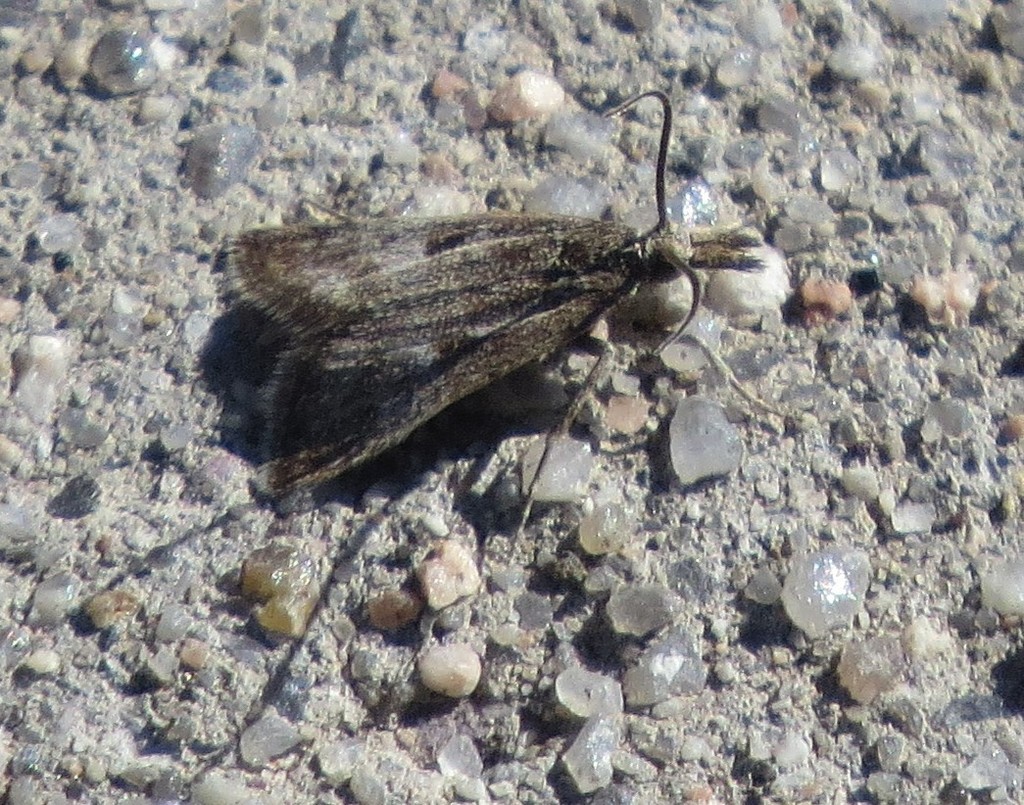
My photo of the male moth.

On the afternoon of November 5, 2020, passing a vacant lot up the street that I had passed by almost daily, I noticed small moths flying around. Many moth species fly late into autumn, so that alone did not intrigue me. Many moths fly during daylight hours, so that was not unusual, either. Curious me wanted to document the thing anyway, but that was easier said than done. The moths were wary, and quickly disappeared into weeds when they landed, camouflaged.

Finally, one of them landed on the sidewalk, and as I recall a bit of a breeze kept it from taking flight again immediately. Not the best of photos, but I put it on iNaturalist anyway. I wasn’t even completely sure of the family, but I figured something so common would be recognized by an expert eventually.

My iNaturalist entry.

Fast forward to November of 2024, and I receive an email from Andrew Warren informing me that not only was this moth a species new to science, but that it also qualified to be in a new genus. I was shocked. How could something that abundant be completely overlooked until now?

It turns out I had the correct family (Crambidae), but obviously could not have put a more specific name to it. It didn’t have one! The paper describing the moth is now published, and anyone can view it here. I was not at liberty to share this story until after the publication, as a common courtesy to the authors.

Better image of a male, photo © Andrew Warren.

Allow me to briefly summarize, if you do not want the long story in the journal article. The moth has so far been collected between October 20 and November 22. Mine is so far the only record for El Paso County, but it is suspected to occur all along the Front Range, possibly into Wyoming in the north and New Mexico in the south. This is based on the host plant for the caterpillar, which is a grass known as Sand Dropseed, Sporobolus cryptandrus.

The larvae probably feed on the roots of the plant, because the moths have only been found in situations where the dropseed was either mowed or trampled. Seriously. Where the plants are upright, no moths. Sure enough, the vacant lot where I found mine was mowed regularly, much to my dismay until I learned this story.

The female moth, photo © Christian Nunes.

The females of the moth, which now bears the name Coloradactria frigida, are flightless, with heavy bodies and short wings. No wonder I never saw those. They certainly must emit a pheromone to attract the males.

Other known localities for the moth are in Douglas County around Castle Rock, and in Weld County, all in Colorado. Late autumn searching elsewhere should certainly turn up new records.

A mating pair of the moths, photo © Christian Nunes.

The lesson I have learned from this is that you can, and should, never assume anything when it comes to entomology. You do not even have to know what you are doing to make an earth-shattering discovery. We collectively know very little. It is your curiosity that counts. That, and your willingness to share what you find with others. Do the documenting with photographs, videos, and sound recordings, and put them out there. Please.

Source: Warren, Andrew D., Clifford D. Ferris, Bernard Landry, Jeremy Authier, Theo Leger, Julia Bilat, and Christian A. Nunes. 2025. “A New Genus and Species of Crambinae (Pyraloidea: Crambidae) With Brachypterous Females From Colorado, U.S.A.,” Journal of the Lepidopterists’ Society 79 (2): 73-84.

Tuesday, August 13, 2024

National Moth Week 2024 Recap from Kansas City

We are in the Greater Kansas City Metro area, anyway, here in Leavenworth, Kansas. National Moth Week ran from July 20-28 this year, which was helpful because the weather was unstable and somewhat volatile, and we were traveling during the end of that time span. Our results were mixed, but they did include some new species for our property.

Chickweed Geometer Moth, Haematopis grataria, is a pretty dependable species for National Moth Week.

This part of the United States has received more rain this year than in the previous three that we have experienced. Oddly, this seems to have driven insect diversity and abundance down. Our plants are doing well. I had no idea that violets could grow that tall and that dense, for example. The goldenrod may be taller than I am by the time it blooms.

Green Cloverworm Moth, Hypena scabra, is common here most of the summer.
Black-bordered Lemon Moth, Marimatha nigrofimbria, has been a "regular" in our yard this year.

I walked our yard in the daytime on the afternoon of July 21, and flushed the above three moth species from our “lawn.”

Clemens' Grass Tubeworm Moth, Acrolophus popeanella.

That night I switched on the light for our covered side porch, which is only about five feet from the neighbor’s house, but only managed to attract a couple of grass tubeworm moths. Returning to the front entrance, I discovered what I believe to be an adult Variegated Cutworm lodged on the inside of the screen door.

Variegated Cutworm Moth, Peridroma saucia, I think.

Ironically, an unidentified tortricid moth appeared on the side porch screen door during the day on July 25.

Unidentified tortricid moth.

On July 26 I hiked over to Havens Park, one of the few forested places in town, in hopes of flushing some underwing moths, as I have had fair luck in the past. Lo and behold, I did get one, an Epione Underwing, Catocala epione, that stuck around just long enough for me to get a couple of images. Breaking through countless spider webs strung across the trail was worth it after all.

Epione Underwing, Catocala epione.

I set up our entolight blacklight twice, once in the back yard on the night of July 23, and again in the front yard on July 26. The difference in the species between the two locations is rather surprising. Frankly, given that the federal prison, lit up like Las Vegas every night, is less than two blocks away, I am mystified as to how we attract anything.

Maple Looper Moth, Parallelia bistriaris.

The back yard yielded a few moths, mostly small and common species, but also delivered a couple of lovely, larger moths. When blacklighting, it helps to remember to look on foliage, tree trunks, fence posts, and other surfaces just beyond the reach of the illumination of your lights. Many moth species are “too shy” to come directly to the sheet.

Banded tussock moth, Halysidota sp., found in the shadows just beyond the reach of the light.

The front yard, like the back yard, had few moths at the light until about eleven PM. Naturally, every time I decided I should turn out the light for the night, something new would show up. I think I eventually went to bed around one AM. Thankfully, the neighbors tolerate our “hobby.”

Spotted Peppergrass Moth, Eustixia pupula.

Among the novel finds in the front yard was one of the crocus geometer moths in the genus Xanthotype. They cannot be identified to species from photos, so we will settle for genus.

Crocus geometer moth, Xanthotype sp.

Another interesting moth was a Yellow-collared Slug Moth, Apoda y-inversum. Their helmet-shaped caterpillars apparently feed only on the leaves of hickory trees.

Yellow-collared Slug Moth, Apoda y-inversum.

All of my moth observations for the week can be found here on iNaturalist.

Packard's Wave, Cyclophora packardi, and a pygmy leafmining moth, Stigmella sp., immediately below it.

Next year I will try and schedule public events, as we did last year on Fort Leavenworth, for both a variety of habitat, and as a way to introduce others to the magic of moths. I hope all of you were able to enjoy this year’s edition of National Moth Week wherever it found you.

Zeller's Macalla, Macalla zelleri, a type of pyralid moth. Wish we had more, as their caterpillars feed on Poison Ivy.