Showing posts with label butterflies. Show all posts

Monday, December 2, 2024

Artistic License

Our bathroom, small as it is, has a moth and butterfly theme. It is my partner’s doing, with her selection of the shower curtain, and arrangement of the poster and pictures I brought to the party when we moved in together. It makes for colorful accents to the white tiles, countertop, and light gray paint job, done rather hastily by the last owner it would appear. What I find most fascinating are the flaws in the art, done with intention.

The shower curtain is a subdued, matte, silvery gray nylon, with eleven different moths, and one butterfly, printed repeatedly. The renderings are surprisingly accurate, representing actual, existing species. They are oriented in different directions and arranged such that the repeating pattern is disguised. You have to exit the room and stand a bit out in the short hallway to get the full picture.

The moths and butterfly on the curtain are to scale, as near as I can tell. All are perfect except for the Luna Moth, the largest one, which has prominent nicks and tears in its pale green wings with a streaming, creased and curled tail on each hind wing. This is a frequent condition of older, living Luna Moths, so it heightens the realism.

Opposite the sink, the mirror and rail of lights above it, and the commode, hangs a vertical, framed poster of colorful butterflies, with a few moths thrown in, on a pure white background. They are arranged in a radiating pattern, oriented north, northeast, or northwest. In contrast to the shower curtain, this is a photo, or photos, of real insects, preserved in the classic wings-open-at-ninety-degrees pose. They are not to scale, which suggests that the entire poster is a mosaic of individual photos.

Flanking the poster are smaller, framed pictures I cut from old magazines. They represent the paintings of the late John Cody, descendant of Buffalo Bill. He specialized in painting giant silkmoths, mostly tropical moths with broad wings, and sometimes long, flowing tails. The Luna Moth is one example of that group, collectively known as Saturniidae.

Giant silkmoths live short adult lives. Days, maybe a couple of weeks at most. They do not even feed, lacking the proboscis that most moths and butterflies possess, coiled beneath their chins when not in use to sip nectar. The silkmoths burn fat reserves they accrued in the caterpillar stage. Cody reared most of his moth models, from cocoons he imported. It was the only way to guarantee perfect specimens with pristine, vibrant colors.

Staring at the poster while on the throne one day, I noticed something I had been oblivious to previously: Every single specimen is missing its antennae. The abdomens were missing from the gaudy, metallic blue Morpho butterflies, but it is standard practice to remove that body part from specimens. As Morphos decompose, the oily fats in the abdomen ooze onto the wings, staining them and masking the famous metallic sheen that makes those butterflies so coveted by collectors. I have only seen intact Morphos as living individuals flying through indoor butterfly exhibits at zoos.

The antennae of butterflies poses no such problem in compromising the color of the specimen. Why remove them, then, from either the insect or the photo of it? Did the artist think the slender filaments were somehow too distracting, and in the interest of cosmetics needed pruning? There are not even tweezers in our medicine cabinet for eyebrow plucking.

I find it difficult to enjoy the poster now, with that bit of tragic information now indelibly etched in my mind. It seems a little faded, or dull, and imparts a tinge of sadness that the maker felt another creature needs to be “improved” by his hand. The title of the poster is “Flights of Fancy,” but the fancy seems tarnished now. I increasingly find myself studying Cody’s paintings instead, where all is well, and he has even put them in a more natural setting, on foliage with a black or colored background. Their wings droop, as they do in life, and the magnificent, feathery antennae are still there.

Sunday, February 3, 2019

Stop Saying the Monarch is a "Gateway Species" for an Appreciation of Other Insects

The media, and overzealous advocates for the Monarch butterfly, Danaus plexippus, have convinced the public that the sky continues to fall. Recent headlines about how the Monarch is going extinct because the overwintering population in California is at a low ebb, down 86% in one year, elicit fear for the butterfly's future. The constant drumbeat of dire situations for the insect is one of several tactics used to keep the Monarch in the spotlight.

Meanwhile, it was also announced that the census of the overwintering Monarchs in Mexico showed an increase of 144%. These discrepancies in abundance from year to year are typical of large populations of pretty much any organism. So, why the panic?

The Monarch is the Giant Panda of invertebrates. It has a lobby built of organizations that stand to lose money unless they can manufacture repeated crises. Well-intentioned as they are, they are siphoning funding away from efforts to conserve other invertebrate species that are at far greater risk. The Monarch is not going extinct. It is even found on other continents. Only in North America is there the spectacular phenomenon of long-distance migration, but to date not a single population has perished.

A popular argument for making the Monarch an invertebrate icon is that "being such an icon has really helped us reach the average person about habitat and native plants and conservation, and by extension, the environment and climate change," as one friend on social media put it. Well, if only that were true. If people who care about the Monarch had any understanding of ecology at all, they would not be complaining that "there are beetles eating the milkweed I planted for Monarchs!" They would not be devastated because one wasp killed one of the caterpillars. They would not ask "how do I get rid of [insect x] and still keep my butterflies?" Nature does not work that way. It does not allow you to play favorites.

Those who rear in captivity Monarch caterpillars found in the wild rarely understand the complexities of the insect's life cycle. Fertile female butterflies flit leaf to leaf, "tasting" each milkweed plant by scratching the foliage with their tarsi (feet). This irritates the plant, causing it to reveal just how toxic it is. Milkweed plants, named for their milky sap, contain potent toxins called cardiac glycosides. Monarchs have evolved not only to cope with those poisons, but to sequester them for their own defense, advertised in the caterpillars by a bold pattern of black, yellow, and white bands. However, many individual milkweed plants are still too toxic to be consumed by insects.

Walk through a large patch of milkweed and plant after plant may be devoid of Monarch caterpillars, milkweed beetles, weevils, aphids, and other milkweed specialists. Then, one plant....everybody. They all found the weakest plant, still toxic, but not deadly to them. People who rear Monarchs may not understand this and wonder why their caterpillars are eating poorly or even dying.

Ok, enough complaining about an undereducated but compassionate public. Are there solutions? Yes. Number one, entomologists and naturalists need to stop obsessing over Monarchs and do a vastly better job of teaching about how ecology works, stressing why we need to foster and tolerate all organisms, regardless of whether they are likeable. We must advocate for landscaping with native trees, shrubs, and flowers of all kinds through programs like Habitat Hero by Audubon Rockies. We need to address city codes and the rules of HOAs to reflect the importance of doing away with manicured lawns and exotic plants that offer no habitat or sustenance for wildlife. The nursery industry needs to come around and support initiatives for natural landscapes at the personal property level, in business and industrial parks, and along road corridors.

Thank you, this concludes this public service announcement, brought to you by face-palming entomologists everywhere who study insects other than the Monarch.

Friday, October 20, 2017

Are We Saving Species by Rescuing One Individual Bug?

NOTE: I had to change the original title of this post because, believe it or not, it is a trademarked phrase! The owner of said patent/copyright informed me of this on September 17, 2019 and asked that I remove the title.

Increasingly, thanks to social media, I am struck by how many people attempt to save individual insects they find injured or lethargic. On one hand this empathy for other life forms is encouraging, but on the other hand the energy investment is grossly misplaced.

© Youtube.com

The problem is that the media has painted honey bees and Monarch butterflies in particular as highly vulnerable if not on the brink of extinction. The implied message is that every individual of these species needs protection in every way possible! Consequently, people spend more time "rescuing" individual specimens than in protecting or creating habitat, working to curb pesticide use in their community, or engaging in other strategies that would have a far greater impact on improving the health of the entire species.

Another problem is that most people are not knowledgeable enough to recognize when a given insect really is in trouble. The wrong assessment happens over and over with bees in particular. Bees often become inactive when it gets too cold for them. They rest on whatever object is available and often this is a more conspicuous spot than normal. A good Samaritan human believes the insect is in peril and needs the equivalent of a sugar-water IV, stat! No, it does not.

Further, in late summer and fall, chances are you are saving a male bee, which is even less useful. Male bees live a short life in which their only purpose is to mate with a female. They do not possess pollen baskets, so are less effective pollinators than female bees.

Another aspect of life that we forget is that insects, like any organism, are prone to developmental problems that cannot be overcome. Improper emergence from a chrysalis will leave a butterfly crippled beyond repair. It happens. Insects reproduce in large numbers to overcome those deficits. Insects are incredibly durable once they mature, and losing half a wing barely slows down a butterfly or a bee. We should be in awe as much, if not more, than in sympathy, let alone pity.

Ok, so last month my wife and I were on vacation in Cape May, New Jersey, and we happened upon a Monarch trapped in a spider web. We intervened. It was a quick fix, simply disentangling the insect and sending it on its way. The whole investment was maybe forty seconds. We understood the insect could collide with a vehicle later that same day. Our expectations for the survival of individual insects are low, given our knowledge of their biology.

Contrast that example with an online video that shows how to mend a broken wing on a Monarch. More than a few such organizations have exploited the "sky is falling" scenarios centered on the Monarch, and one has to question the motives of some of them. Yes, older, established conservation organizations use overly alarming narratives, too, but the best ones measure their tone and can point to historic successes in legislation and habitat protection.

You want to curb insect mortality? Then give up driving. For every insect you nurse back to health, you kill dozens, if not hundreds in the course of operating your motor vehicle. Even bicyclists take their toll. I have seen countless insects mortally wounded, or crushed, on bike paths.

Basically, insects are better served by actions aimed at enhancing habitat health, and planting native vegetation in the landscape of your own property where you are able. Tear out the lawn, or most of it, and do your best to mimic the natural ecosystem where you live. Want to go a step farther? Start a dialogue with city and county officials to restructure weed ordinances and other codes that currently restrict the ability of homeowners to plant for wildlife. Educate your homeowners association to make those communities more wildlife-friendly without compromising safety and property values.

Also, stop insisting that one species is somehow more worthy of our attention than any other. Stop categorizing insects as "friend" or "foe." Such distinctions do not apply to the overwhelming majority of life on this planet.

Be proud of yourself for having empathy for other living things; but, channel that into something that will make a difference beyond the individual insect or arachnid. Do intervene for birds, mammals, reptiles, and amphibians, all of which have far longer lifespans than invertebrates, but make sure you do it legally and correctly. Carry on.

Wednesday, July 19, 2017

White Prairie Clover: An Awesome Blossom

I am not a botanist by any stretch of the imagination, but I am pretty sure that the insect magnets in the shortgrass prairie field up the hill from my home here in Colorado Springs, Colorado, are White Prairie Clover, Dalea candida. What follows is a sampling of the many bees, wasps, butterflies, flies, and other insects that come to the flowers of this plant; and a little information on Dalea in general. Much of the pollinator enhancement literature touts Purple Prairie Clover, D. purpurea, so one has to dive deeper.

A cuckoo bee, Nomada sp., forages while a male sweat bee, Lasioglossum sp., approaches

Prairie clovers are in the pea family Fabaceae. White Prairie Clover in Colorado occurs from 3,400-7,200 feet in elevation, and blooms from June to August. It is a low-growing plant, flowers on stalks up to two feet tall, but the ones I see are no more than one foot tall and sometimes difficult to discern among the tall grasses, cacti, and yucca they share the prairie habitat with. This species is widespread from the Front Range across the Great Plains, north to Saskatchewan and Wisconsin, and as far east as Tennessee, Georgia, and South Carolina.

Common Checkered-skipper, Pyrgus communis

The flowers are arranged in a cone, and bloom from the bottom to the top. The cycle can last up to a month, providing insects with pollen and nectar over a longer period than most flowers, and often at a time when few other plants are blooming. The down side to this plant, from the perspective of the photographer/entomologist is that insects quickly move to the side of the flower opposite the photographer, where they are hidden from view, then fly to another florescence and repeat. I missed a good number of opportunities because insects move across the flowers so speedily.

Male Hunt's Bumble Bee, Bombus huntii

Bees of all stripes seem to enjoy White Prairie Clover, and male bees may visit not only for nectar but for mating opportunities with foraging females. I saw far more male sweat bees, Lasioglossum (subgenus Dialictus), for example, than I did females. Even male bees can be sufficiently hairy enough to perform pollination services, even though they are not gathering pollen to feed to offspring. This is especially true for bumble bees and longhorned bees.

Sweat bee, family Halictidae

Female mining bee, Calliopsis sp.

Male longhorned bee, tribe Eucerini, family Apidae

Cuckoo bee, Triepeolus sp.

A second species of Triepeolus

Butterflies visit the flowers, too, mostly for nectar, but the caterpillar stage of some species feeds on the foliage of Dalea. This is the case for the Southern Dogface, a rather scarce species here in Colorado. In addition to the butterflies shown here, I also spotted a Variegated Fritillary making a brief stop on a blossom.

A "crescent" butterfly, Phyciodes sp.

Two Reakirt's Blues, Echinargus isola

At least one moth visited White Prairie Clover during my two separate observations: the Jaguar Flower Moth, Schinia jaguarina.

Jaguar Flower Moth, Schinia jaguarina

Wasps were highly diverse and plentiful visitors, but made some of the shortest refueling stops of all the insects observed.

Great Golden Digger wasp, Sphex ichneumoneus

Thread-waisted wasp, Ammophila pictipennis

Female Ammophila procera

Male Ammophila procera

Ammophila ferruginosa

Black & Yellow Mud Dauber, Sceliphron caementarium

Male sand wasp, Bembix sp.

Male beetle-killer wasp, Cerceris sp.

Male beewolf wasp, Philanthus ventilabris

Male thynnid wasp, Myzinum sp.

Female thynnid wasp, Myzinum sp.

Cuckoo sand wasp, Stizoides renicinctus

Flowers that are attractive to pollinators are also attractive to their predators and parasites, and that was certainly obvious during my watch periods. The bee assassin, Apiomerus sp., was somewhat surprising because the bug is so conspicuous atop such a small flower. I suspect it was having little or no success. Meanwhile, the odd, cream-colored ambush bug, Phymata sp., could achieve proper concealment, even to the point that I recall seeing only one when there were surely many.

Bee assassin bug, Apiomerus sp.

Thick-headed flies accost bees or wasps in mid-air and ram an egg between the victim's abdominal plates. The fly larva that hatches then feeds as an internal parasite. This often kills the host, but not always.

Thick-headed fly, Zodion sp.

Thick-headed fly, Physocephala sp.

My personal experience is that white flowers, or at least pale flowers, attract a far greater diversity of insects than red, blue, or purple flowers, and even more than yellow flowers in some cases. It is puzzling to me that few pollinator advocates bother to reveal that fact. Maybe because everything is bee- and butterfly-centered, and still color-intensive in the landscaping sense, white flowers get short shrift in recommendations for the garden.

Grasshopper wasp, Prionyx atratus or Prionyx subatratus

It may be worth it to harvest seeds from wild plants, but please do not dig up mature White Prairie Clover. The plant has a deep taproot. One may also wish to consult their state's Native Plant Society for potential sources of seed. The plant flourishes in full sun and dry soils, requiring only a medium quantity of water.

Green-eyed wasp, Tachytes sp.

I will try and produce more floral-themed, pollinator-rich posts in the future to help readers in making landscaping decisions that support native plants as opposed to exotic ornamentals and inappropriate cultivars. Feel free to make suggestions as to additional resources.

Mason wasp, Euodynerus sp.

Sources: Holm, Heather. 2017. Bees: An Identification Guide and Native Plant Forage Guide. Minnetonka, Minnesota: Pollination Press LLC. 224 pp. Useful mostly for Upper Midwest U.S.
Mader, Eric, et al. 2011. Attracting Native Pollinators. North Adams, Massachusetts: Storey Publishing. 372 pp. A Xerces Society guide.
EasternColoradoWildflowers
WildflowerDotOrg
Prairie Nursery

Tuesday, May 16, 2017

Another Rarity: Nysa Roadside-Skipper in Colorado

This is what you get for exploring, observing, recording, and being curious: Surprises. I am not well-versed in things butterfly, but I do know when I haven't seen a particular species before. Even if I cannot say anything about a creature in the field, I can go and research it later. Such was the case of the Nysa Roadside-Skipper encountered on Monday, May 15, in Lamar, Prowers County, Colorado.

It always starts innocently enough, and sometimes results from disappointment over something else. I would much rather find interesting wasps, beetles, grasshoppers, and true bugs instead of butterflies, but it so happened that recent bad weather (a cold snap a couple weeks ago and heavy rains more recently) left little to find besides Lepidoptera in Lamar. Some Lepidopterist out there is going to make me envious by finding a cool wasp now.

So, my wife, Heidi, and our mutual friend Jill White Smith, took the field looking for birds and whatever other wildlife we could see. Jill is a very accomplished photographer. You can see her work at Nature Made Photography on Facebook, in fact. She does "people photography," too, as she puts it. She is also very generous and welcoming, and eagerly showed us around to her favorite haunts.

One of those habitats is an abandoned, unpaved road that is quickly becoming part of a dune or sandhill adjacent to the riparian corridor of Willow Creek, south of the Lamar Community College campus. Flies, damselflies, a few bees, and butterflies flew up every few steps. I happened to notice one small one land in the road, and I focused my camera. I could tell it was a skipper, but not one I had ever seen before. I had left my field guides at home, but that only served to build suspense.

We got home from the three-plus hour drive around eleven at night. After unloading the car, I consulted my Kaufman Field Guide to Butterflies of North America. Thanks to Jim Brock and Kenn Kaufman, I quickly found my mystery skipper: the Nysa Roadside-skipper, Amblyscirtes nysa. The only "problem" was that the range map for the species does not include Colorado. Heidi did a bit more research and found only one Colorado record online at Butterflies and Moths of North America (BAMONA), and no Colorado records on Bugguide.net. I consulted an old book, Butterflies and Moths of the Rocky Mountain States, and found no historical records for Colorado.

What do we know about this insect? Its known range is from Mexico, southeast Arizona, southern New Mexico, and the western two-thirds of Texas north and east through Oklahoma and the eastern two-thirds of Kansas, barely crossing into Missouri. There are between one and three generations ("broods") each year, depending on the geographic location of a given population. The caterpillars feed on grasses. The Kaufman guide adds: "Males perch in wash bottoms, road depressions, or along trails very early n the morning before retiring to shade for the afternoon." This guy was overdue for a nap, then, at almost 10:00 AM.

We also saw what I thought was a small Common Sootywing, but it turns out what I saw was the dorsal (top) view of this same skipper. I narrowly missed an opportunity to get a shot, but here is one of a specimen in Arizona:

© Philip Kline via Bugguide.net

Lastly, while taking images of the skipper, I noticed what might be the cutest beetle ever. I had to bring it home to get images. As near as I can tell, it is a darkling beetle in the genus Edrotes, for which there are also no Bugguide records for Colorado.

Discoveries like these await you, too. You do not have to know what you are looking at to enjoy the moment, capture it in pixels or digital video, and share it with others. You explore and observe often enough and long enough, and you are almost guaranteed to find something truly unusual, or even unknown.

Sources: Brock, Jim P. and Kenn Kaufman. 2003. Kaufman Field Guide to Butterflies of North America. Boston: Houghton Mifflin Co. 384 pp.
Ferris, Clifford D. and F. Martin Brown. 1981. Butterflies of the Rocky Mountain States. Norman: University of Oklahoma Press. 442 pp.

Saturday, August 20, 2016

Don't Sweat 'em

During the heat of summer, we all perspire. Some insects find that bodily function irresistible. Among them are sweat bees, various flies, and even butterflies. It is believed that the salts, minerals, and other compounds in our sweat are necessary for these insects, and difficult to find elsewhere. While you might assume that any insect landing on you intends to bite or sting, rest assured these insects are harmless.

Female sweat bee, Halictus rubicundus

Solitary and semi-social bees in the family Halictidae are collectively known as "sweat bees" because of their habit of lapping up human sweat with their short "tongues." They may tickle at most, but if you smack one absent-mindedly, it may indeed sting if it is a female bee. Male bees lack stingers.

Two different sweat bees, both Lasioglossum species

Sweat bees come in a variety of sizes and colors, from miniscule brassy Lasioglossum species to brilliant metallic Agapostemon species (and related genera). Members of the genus Halictus are medium-sized and brown or blackish with white bands across the abdomen. Nearly all species nest in the soil, each female excavating her own burrow.

Female sweat bee, Agapostemon sp.

Compounding the problem of recognizing the different insects that seek out your sweat is the fact that many flies in the family Syrphidae are wrongly called "sweat bees" in casual and regional language. Syrphid flies are more properly called "flower flies" here in the U.S. and Canada, and "hover flies" in Europe.

Tiny Toxomerus syrphid flies are often mistaken for sweat bees

Like bees, they can be important pollinators of flowers, but it is in their youth that they are most beneficial. The larvae of many flower flies prey on aphids, which are major crop and garden pests. Thus, the more syrphid flies, the better, even if they do want to drink your perspiration.

Unidentified syrphid fly on my arm, lapping sweat

Plenty of other flies, mostly blow flies (family Calliphoridae), and flesh flies (family Sarcophagidae), will land on us, too. Even some tachinid flies (Tachinidae) will wander around on bare hands and arms. They may not all be there for moisture or salts.

Tachinid fly using me as a lookout post

Some of these flies may be males that are simply using us as convenient perches from which to defend their territory. They will periodically fly off to chase away competing males, or pursue passing females.

Some butterflies are well-known for requiring certain minerals to complete their life cycle. Usually, male butterflies congregate around mud puddles, puddles of urine or piles of scat left by mammals, or even rotting carcasses, where they obtain nutrients that they will pass to females during mating.

Hackberry Emperor butterfly getting salts from animal dung instead of sweat

Males with a higher mineral content are more desirable to females, though how this is determined remains something of a mystery. She puts the transferred chemicals to good use in producing her eggs.

Occasionally, some butterflies will use us as substitutes for their usual mineral resources. I once had a Hackberry Emperor butterfly land on my toe while I was sunbathing in a park in Cincinnati. I had another land right on my sunglasses in a different location in Ohio, but he viewed me as a convenient perch from which to defend his territory.

Female Lasioglossum sweat bee with tongue extended, lapping sweat

Most research into the attractiveness of human sweat to insects has been directed at blood-feeding insects such as mosquitoes and other biting flies. Consequently, there is relatively little known, and much assumed, about the fascination non-biting "bugs" have with our skin pore excretions. One thing scientists can agree on? Don't sweat the sweat bees.

Tiny female Lasioglossum sweat bee on my fingernail

Source: Gibb, Timothy. 2015. "Do Not Confuse Hover Flies with Sweat Bees," Purdue Plant & Pest Diagnostic Laboratory, Purdue Extension, Purdue University.

Unidentified tachinid fly grooming itself on my arm

Sunday, July 3, 2016

Emerald Valley, 2016

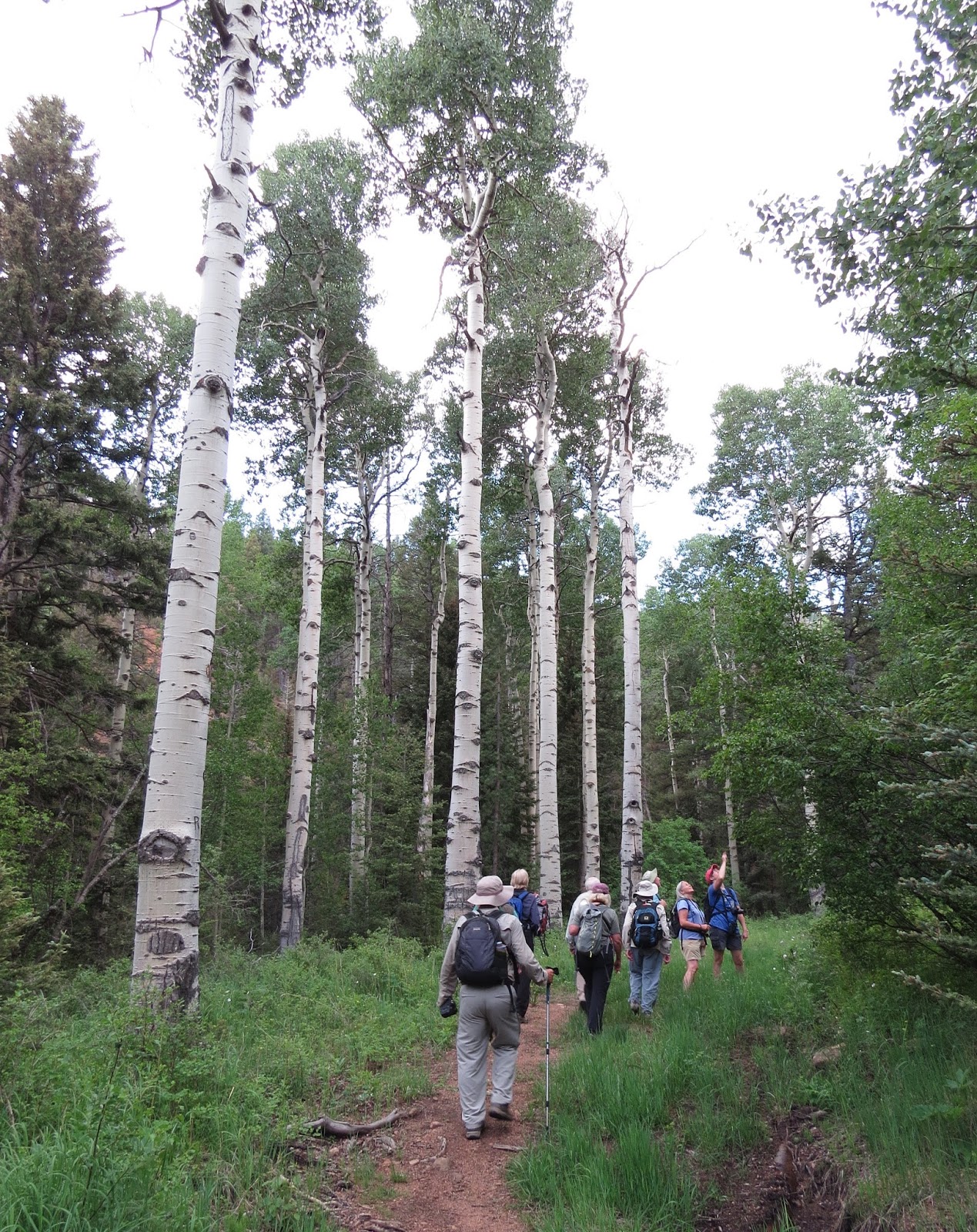
For several years now, Heidi and I have been making an annual pilgrimage to Emerald Valley, which lies in the northwest corner of Cheyenne Mountain here in El Paso County, Colorado, and at over 7,500 ft. in elevation. Every third or fourth Monday in June, weather and Old Stage Road conditions permitting, we have joined or led the Aiken Audubon Society outing affectionately titled "Blooms, Birds, and Butterflies." They added "bugs" when I came along in 2012.

This year we had a total of eleven able hikers and flora and fauna enthusiasts. The forest and meadow scenery alone is worth the trip, with conifers and aspens towering overhead, and wildflowers of every description under foot.

Indeed, one of the major attractions is a trio of orchid species that we seek to count every year as a measure of ecosystem health and vitality. This year, all three species were in veritable profusion.

Most spectacular of all are Yellow Lady Slipper orchids, Cypripedium parviflorum. We tallied something like 287 plants, most in bloom, some not. We speculated on what pollinates this spectacular plant, and I had to look up the particulars online. It turns out that bees are attracted to the blooms by color and fragrance, but upon entering the bulbous "shoe" they find no pollen or nectar. The interior of the flower is disorienting, and forces the bee to exit out the back where it either picks up packets of male pollen that adhere to the insect's back, or deposits existing pollen packets to a female receptacle organ, or both.

Bees are not terribly dumb, and after a couple exercises in futility they learn to avoid the orchid altogether. Consequently, few plants reproduce each year, but fertilized flowers produce a multitude of seeds to make up the deficit. Seeds germinate successfully only if they land in soil populated by a certain symbiotic fungus. Transplanted orchids are destined to fail in the absence of this fungus.

Another common orchid, at least this year, is the Green Bog Orchid, Platanthera aquilonis, which grows almost exclusively along the very edges of streams and in soil prone to flooding or puddling. We tallied roughly fifty or sixty of those, but they are so cryptic that we undoubtedly overlooked dozens more.

The oddest and most scarce orchid was the Spotted Coralroot, Corallorhiza maculata, a species that favors drier conditions than the other two. It is wholly dependent on microrhizal fungi to provide it nutrients, as it does not perform photosynthesis like most plants do. We found all six or eight specimens associated with conifers, growing beneath them.

Red-naped Sapsucker

While birds generally remained out of sight on this trip, we heard plenty, including a MacGillivray's Warbler. We did catch glimpses of Dark-eyed Junco, Steller's Jay, Western Tanager, American Robin, Yellow-rumped Warbler, Brown Creeper, and Northern Flicker. We heard Hermit Thrush and plenty of Warbling Vireos and House Wrens. Our favorite sighting was probably a pair of Red-naped Sapsucker woodpeckers, a species we see almost every time we visit Emerald Valley.

Weidemeyer's Admiral butterfly

Butterflies were common and diverse. Starting early as we do to avoid the inevitable stormy afternoons, we don't see some species, like Common Ringlet, until late morning or early afternoon. Present from the get-go is Weidemeyer's Admiral, males of which are territorial and ever-present along the road/trail.

Arctic Blue butterfly

Arctic Blues are having a good year, too, and you can see them on flowers or "puddling" at wet spots along the trail. Early on they bask on foliage, absorbing some solar radiation to help power their flight muscles.

Dreamy Duskywing skipper

The Dreamy Duskywing, a type of skipper, was a bit of a surprise. They are smaller than many other duskywings, but males perform the same territorial behavior of perching on tall, prominent objects and flying off to chase females or evict rival males.

Mourning Cloak butterflies sipping sap

At one point along the trail we came across a willow that was oozing sap from various wounds on its main branches. This attracted a multitude of Mourning Cloak butterflies, and a couple of Hoary Comma butterflies as well. Both species are "anglewings" that overwinter as adult butterflies.

Hoary Comma butterfly

These specimens represented the next generation, though. They were in excellent condition, with vibrant colors and intact wing edges (Hoary Comma has ragged wing edges by definition, though).

Mating Poplar-and-Willow Borer weevils

Also on the willow were a pair of mating weevils that I later identified as, no surprise here, Poplar-and-Willow Borer, Cryptorhynchus lapathi. They resemble little lumps of lichen, even individually, so it pays to take a second look when seeking them. The species is actually native to Eurasia, having been introduced here decades ago.

Female Trichiosoma triangulum sawfly

Also on the willow was a large female sawfly, Trichiosoma triangulum, probably looking for a leaf to insert her eggs into. The larvae of sawflies are caterpillar-like vegetarians that feed just like moth or butterfly caterpillars.

Male Elm Sawfly, Cimbex americana

Another member of this same family of sawflies (Cimbicidae), but larger still, is the Elm Sawfly, Cimbex americana. Several hefty males of this species were engaging in aerial duels in a meadow farther back down the trail. These are intimidating wasps, but they do not sting and can be approached closely if you are patient and stealthy.

Field Crescent butterfly on Black-eyed Susan coneflower

The meadows that punctuate the forest hold a great deal of insect diversity, but rather than make an exhaustive inventory here, I have created a photo album for "Emerald Valley, 2016" on my Flickr photostream.