Showing posts with label wildflowers. Show all posts

Friday, February 6, 2026

Remembering Another Mentor

I had intended to make this post years ago. The subject deserves better. He is the late Leonard L. Wiley of Portland, Oregon. Though my relationship with him was brief, he made a lasting impact. He may have felt the same way about me, as you will see.

© The Oregonian

Mr. Wiley passed away in 1987, at the age of eighty-two. He was introduced to me by my father. As a jeweler, my dad knew Leonard as a diamond dealer. I was told that Mr. Wiley carried the precious stones in a brown paper back, and also carried a large revolver. I can vaguely attest to seeing the diamonds, laid out on the counter at my father’s store.

Leonard Wiley was best known to the rest of society as a world class botanist and writer. He authored the books Rare Wildflowers of North America (1968), Wild Harvest (1966), and The Granite Boulder: A Biography of Frederic Homer Balch (1970). He was also a regular contributor to Northwest Magazine in The Oregonian newspaper. It was in this capacity that we are forever connected.

The following is a transcript of an article Mr. Wiley wrote about me, published in The Oregonian on August 23, 1970, after he, myself, and my parents had gone on a day hike in Oneonta Gorge, a location adjacent to the Columbia River Gorge that divides Oregon and Washington. The title of the piece is “Just ask this nine-year-old: Leonard Wiley found that Eric asks no foolish questions.” Enjoy his wonderful writing style….

”Eric Eaton and I went to Oneonta Gorge to learn about wild plants. Before taking to the trail I opened a book and pointed out how to tell the difference between the Vine Maple, Acer circinatum, and the Smooth Leaved Maple, Acer glabrum. Both of these tree-shrubs resemble each other very closely and are found in this area.

Eric missed the first one we came to but quickly spotted the second. This achievement of a nine-year-old boy was more than I would expect from most adults.

Every person who has brought joy and happiness in my life I originally met merely by chance. And it was this factor that brought me Eric’s friendship. I had some business to transact with his parents, Bob and Violet. I was introduced to the small boy about a year ago and at first wasn’t much impressed for Eric is not the kind of a person who tries to impress with his importance.[LOL!] In fact he told me on the trail that he does not know much. Maybe so. But I have known a couple of PhD’s who know less.

Science is knowledge possessed as a result of study or practice. When does a person become a scientist? When his zeal and enthusiasm for his particular branch of learning dominate his life. With most, if it comes at all it arrives during maturity. Eric was a scientist before I ever heard of him.

Highly talented people are often lopsided. But Eric is well rounded socially. He plays with his school mates, gets along well with young and old and, at first, appears like most any other boy of his age.[I disagree with almost all of this, but it is his article….]

I like him immensely – and I’m also a bit afraid to engage him in a conversation. If you pitch a curve at him he’ll knock in a home run. I discovered this the hard way. I gave him a chameleon [Green Anole lizard] to help cement a thriving friendship. He looked at it critically and asked ‘Is it a male or a female?’ What the devil do I know about such things? Without consulting a book he told me. Now, when I think a certain subject will come up at our next meeting I get out my books and dig deeply.

He has little interest in money [still true!]. His meager allowance and funds obtained from odd jobs all go into books. His natural history library comprises about 50 volumes as well as subscriptions to various scientific journals, some of which I had never heard of before. His teachers think he is a fine student. They also think they earn their salaries. I agree with them. I have never head Eric ask a pointless question. When he makes a remark or asks for information you better have a sensible answer unless you enjoy making a fool of yourself.

On the trail he never looked back. His eyes roved to left and right, searching for something interesting. He fund a plant with the flowering stem arching over the trail. ‘What do you suppose that is?’ I told him that it was the False Solomon’s Seal. ‘Wow, what a name!’

At nine it is unreasonable to expect him to be the world’s most talented diplomat. As I was wobbling along the rocky trail Eric commented ‘You were hiking when you were younger.’ I gave him a brief ‘yes’ and changed the subject.

Our first botanical ordeal came early on this excursion. We came to an old rock slide. Eric: ‘What’s all this moss doing on these rocks?’ If you think this is a stupid question you aren’t very bright yourself.

I pointed to some lichens tightly growing n the surface of some of the rocks. These primitive plants somewhat resemble rocks. They are among the first plants to attack rocks in the process of disintegration into soil. A medium size lichen may be a hundred years old. Nature is in no hurry. After the lichens are established the mosses and liverworts in vade to speed the break down of the stones. Then the ferns follow. Finally the flowering plants appear. It may take a truck load of centuries for these assorted plants to produce soil. It is very important to life itself.

As we walked along the trail his mother told me a few more things I didn’t know about the boy. He is the resource expert on nature in his third grade class. But his interest in nature started in kindergarten where he discovered dinosaurs. If he wakes in the middle of the night he talks about nature. The Eatons have a lively time.

Stumps have a remarkable fascination for Eric. We examined every one we found near the trail. Those a little farther away drew comment. This, of course, slowed down our progress. Finally Bob called out, ‘Eric, do you have to look at every stump?’ Eric pays no attention to questions of this kind. I showed Eric the mosses and liverworts n some of the stumps while there were ferns and flowering plants on others. One tree had a hollow stump. I reached in and pulled out a handful of debris composed of leaves that had blown in and decayed parts of the inner trunk. This material had largely turned into soil. The other way soils are created.

We discussed a great many other botanical subjects too but the decayed vegetation and the disintegration of rocks seemed to impress Eric the most.

I am sure there are many other boys [and girls, and agender persons!] like Eric in the world but I consider myself fortunate to know one of them.”

Wow, I must have bottled up my enthusiasm for insects during that hike, though it explains my obsession with stumps. I do hope that I have made Mr. Wiley proud with my chosen career path. He showed me that sharing your knowledge with others can have a profound impact.

Sadly, there is hardly an online trace of Leonard L. Wiley, save for his books, which find themselves on sale at various websites. I may need to learn how to make entries on Wikipedia. He certainly deserves to be remembered.

Friday, August 26, 2016

Sunflower Extravaganza

Few plants in arid climates can compare to sunflowers (Helianthus spp.) in their attractiveness to insects. Notice I said "plants" instead of "flowers." That is because while the sunflower blossoms are a beacon to bees, many other kinds of insects find secretions from the buds, stems, and leaves to be irresistible, too.

It is actually the sunflower's phyllaries (the bracts forming the involucre or the head or inflorescence of a composite plant), and the base of leaves, where the extrafloral nectaries are located. They produce a sweet substance different from floral nectar that insects crave. The main function of extrafloral nectaries (EFNs) is strongly suspected to be a means of recruiting insects to defend the plant against herbivores. Indeed, ants are the primary visitors to sunflower ENFs, and they vigorously pursue and rout any and all competitors.

A fly, two kinds of spider wasps (Pompilidae), and an incoming sweat bee (male Lasioglossum sp. on right)

Ironically, ants are also "farmers" of aphids, scale insects, and treehoppers that produce their own sweet product called "honeydew." Ants tenderly stroke these other insects until a drop of liquid waste appears at the rear end of their aphid or 'hopper "cow," and the ants eagerly lap it up. The aphids, scales, and treehoppers naturally manufacture honeydew as a by-product of their feeding activities....on the sunflower plant.

Treehoppers (Publilia sp.) tended by ants (Formica sp.)

So, while the ants guard the extrafloral nectaries, they also guard some of the insects doing the plant harm. Apparently no ecological relationship is perfect, but given the abundance of sunflowers, this one seems to work out ok anyway.

Parenthesis Lady Beetle and an ever-present ant

Even lady beetles utilize the ENFs as a source of hydration and vital nutrients during the summer months when there is a significant dip in aphid populations. I have seen several species on sunflower while looking for wasps.

Sunflower predator fest. Clockwise: Soft-winged flower beetle (Collops sp.), ambush bug (Phymata sp.), and assassin bug (Sinea sp.)

Other predatory insects recognize the lure of sunflower ENFs, too. Ambush bugs, Phymata spp., occur in abundance, and their success is measured by the many limp-bodied moths, butterflies, bees, and wasps dangling from their short beaks, or flopped across leaves below them.

Ambush bug with mud dauber wasp prey

It is the wasps, though, that are most astounding in their sheer diversity. I have found almost every conceivable family of wasps visiting sunflowers, and a high degree of diversity within each of those families in many instances.

Tiny chalcid wasp, Trigonura sp.

From the most minute of parasitic Chalcidoidea (a "superfamily" that contains several families of wasps) to large spider wasps and mud daubers, they are all there.

Female velvet ant, Dasymutilla bioculata

Even female velvet ants, wingless wasps which one usually sees scurrying across the ground, will scale tall sunflowers to reach those EFNs. Male velvet ants are even more frequent visitors, of course, with their ability to fly.

Large ichneumon wasp

Some individual plants are indeed tall, surpassing six feet in height. Those are mostly the Common Sunflower, Helianthus annuus. Locally, we also have Prairie Sunflower, Helianthus petiolaris, which is usually shorter, with purplish stems instead of yellowish green, and smaller, darker leaves.

The density of sunflowers in a given area can be mind-boggling as well. They thrive in "disturbed" habitats with sandy soil, which qualifies them to take over most of the urbanized Front Range here. Despite that, insects are noticeably attracted to only a few individual plants. So, once I find an attractive plant swarming with insect life, I stand by and watch as various wasp species come and go.

Female Svastra obliqua

Not a fan of wasps? No worries, a wide variety of bees visit the flowers, especially bumble bees, longhorned bees, leafcutter bees, and various cuckoo bees. Some bees, like Svastra obliqua, are even sunflower specialists. Composite flowers in general are bee magnets, but the very large surface of sunflowers gives bees plenty of bang for their buck in pollen and nectar. Sunflowers also bloom continuously for many weeks, even months, like a seemingly endless fireworks display.

Blue-black spider wasp, Anoplius sp.

One could literally write a book about all the insect visitors to sunflowers. Hm-m-m, that gives me an idea.....Meanwhile, enjoy the spectacle yourself next time you are in sunflower country.

Solitary wasp, Saygorytes sp.

Sources: Hodek, Ivo, Helmut F. van Emden, and A. Honek. 2012. Ecology and Behaviour of the Ladybird Beetles. UK: John Wiley & Sons. 561 pp.
Keeler, Kathleen H. 1979. "Species With Extrafloral Nectaries in a Temperate Flora (Nebraska)," Prairie Naturalist 11(1): 33-38.
Mizell, Russell F. 2015. "Many Plants Have Extrafloral Nectaries Helpful to Beneficials," EDIS, Institute of Food and Agricultural Scienes (IFAS), and University of Florida Extension, Publication #ENY-709.
The Great Sunflower Project.

Male Prairie Yellowjacket, plus spider wasp and ant

Sunday, July 3, 2016

Emerald Valley, 2016

For several years now, Heidi and I have been making an annual pilgrimage to Emerald Valley, which lies in the northwest corner of Cheyenne Mountain here in El Paso County, Colorado, and at over 7,500 ft. in elevation. Every third or fourth Monday in June, weather and Old Stage Road conditions permitting, we have joined or led the Aiken Audubon Society outing affectionately titled "Blooms, Birds, and Butterflies." They added "bugs" when I came along in 2012.

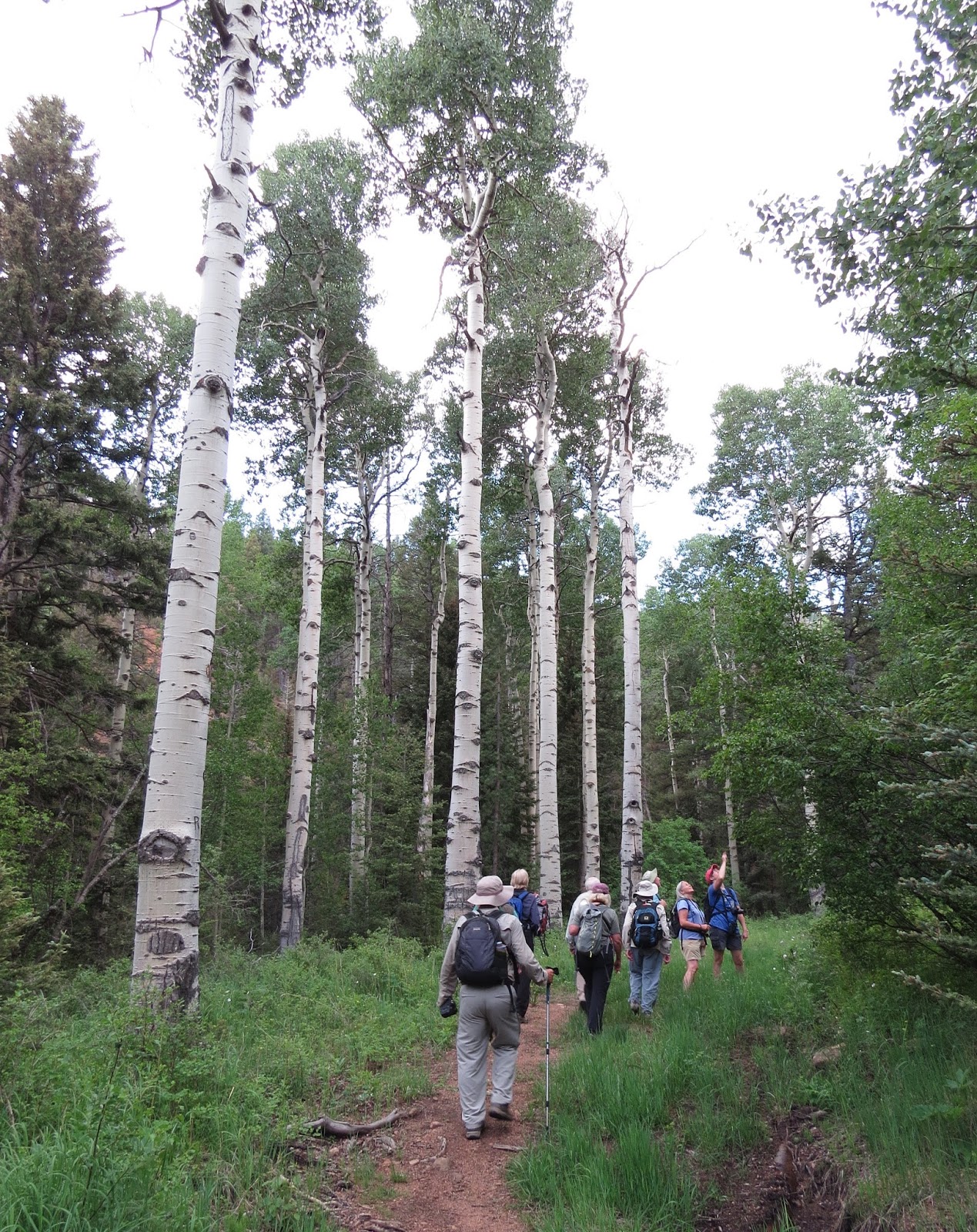
This year we had a total of eleven able hikers and flora and fauna enthusiasts. The forest and meadow scenery alone is worth the trip, with conifers and aspens towering overhead, and wildflowers of every description under foot.

Indeed, one of the major attractions is a trio of orchid species that we seek to count every year as a measure of ecosystem health and vitality. This year, all three species were in veritable profusion.

Most spectacular of all are Yellow Lady Slipper orchids, Cypripedium parviflorum. We tallied something like 287 plants, most in bloom, some not. We speculated on what pollinates this spectacular plant, and I had to look up the particulars online. It turns out that bees are attracted to the blooms by color and fragrance, but upon entering the bulbous "shoe" they find no pollen or nectar. The interior of the flower is disorienting, and forces the bee to exit out the back where it either picks up packets of male pollen that adhere to the insect's back, or deposits existing pollen packets to a female receptacle organ, or both.

Bees are not terribly dumb, and after a couple exercises in futility they learn to avoid the orchid altogether. Consequently, few plants reproduce each year, but fertilized flowers produce a multitude of seeds to make up the deficit. Seeds germinate successfully only if they land in soil populated by a certain symbiotic fungus. Transplanted orchids are destined to fail in the absence of this fungus.

Another common orchid, at least this year, is the Green Bog Orchid, Platanthera aquilonis, which grows almost exclusively along the very edges of streams and in soil prone to flooding or puddling. We tallied roughly fifty or sixty of those, but they are so cryptic that we undoubtedly overlooked dozens more.

The oddest and most scarce orchid was the Spotted Coralroot, Corallorhiza maculata, a species that favors drier conditions than the other two. It is wholly dependent on microrhizal fungi to provide it nutrients, as it does not perform photosynthesis like most plants do. We found all six or eight specimens associated with conifers, growing beneath them.

Red-naped Sapsucker

While birds generally remained out of sight on this trip, we heard plenty, including a MacGillivray's Warbler. We did catch glimpses of Dark-eyed Junco, Steller's Jay, Western Tanager, American Robin, Yellow-rumped Warbler, Brown Creeper, and Northern Flicker. We heard Hermit Thrush and plenty of Warbling Vireos and House Wrens. Our favorite sighting was probably a pair of Red-naped Sapsucker woodpeckers, a species we see almost every time we visit Emerald Valley.

Weidemeyer's Admiral butterfly

Butterflies were common and diverse. Starting early as we do to avoid the inevitable stormy afternoons, we don't see some species, like Common Ringlet, until late morning or early afternoon. Present from the get-go is Weidemeyer's Admiral, males of which are territorial and ever-present along the road/trail.

Arctic Blue butterfly

Arctic Blues are having a good year, too, and you can see them on flowers or "puddling" at wet spots along the trail. Early on they bask on foliage, absorbing some solar radiation to help power their flight muscles.

Dreamy Duskywing skipper

The Dreamy Duskywing, a type of skipper, was a bit of a surprise. They are smaller than many other duskywings, but males perform the same territorial behavior of perching on tall, prominent objects and flying off to chase females or evict rival males.

Mourning Cloak butterflies sipping sap

At one point along the trail we came across a willow that was oozing sap from various wounds on its main branches. This attracted a multitude of Mourning Cloak butterflies, and a couple of Hoary Comma butterflies as well. Both species are "anglewings" that overwinter as adult butterflies.

Hoary Comma butterfly

These specimens represented the next generation, though. They were in excellent condition, with vibrant colors and intact wing edges (Hoary Comma has ragged wing edges by definition, though).

Mating Poplar-and-Willow Borer weevils

Also on the willow were a pair of mating weevils that I later identified as, no surprise here, Poplar-and-Willow Borer, Cryptorhynchus lapathi. They resemble little lumps of lichen, even individually, so it pays to take a second look when seeking them. The species is actually native to Eurasia, having been introduced here decades ago.

Female Trichiosoma triangulum sawfly

Also on the willow was a large female sawfly, Trichiosoma triangulum, probably looking for a leaf to insert her eggs into. The larvae of sawflies are caterpillar-like vegetarians that feed just like moth or butterfly caterpillars.

Male Elm Sawfly, Cimbex americana

Another member of this same family of sawflies (Cimbicidae), but larger still, is the Elm Sawfly, Cimbex americana. Several hefty males of this species were engaging in aerial duels in a meadow farther back down the trail. These are intimidating wasps, but they do not sting and can be approached closely if you are patient and stealthy.

Field Crescent butterfly on Black-eyed Susan coneflower

The meadows that punctuate the forest hold a great deal of insect diversity, but rather than make an exhaustive inventory here, I have created a photo album for "Emerald Valley, 2016" on my Flickr photostream.

Monday, February 22, 2016

Don't Dig Those Dandelions?!

Many of us conduct certain rituals in our yards and gardens without questioning why; not the least of these is "weeding." We are taught to despise any plant that volunteers itself in the flowerbed or the lawn. We are conditioned to uphold certain standards, and look to the marketplace for products to help us with that. Fortunately, the tide may be changing. Take dandelions for example.

© Marc Keelan-Bishop

I was surprised and delighted to see this meme pop up in Facebook recently, daring to suggest that we should be lazy(?!) in our approach to the inevitable blooming of dandelions.

Jewel beetle, Anthaxia sp.

In my own experience, especially in the western United States, I can vouch for the fact that a startling variety of insects exploit dandelions in early spring when few other flowers are in bloom. Birders will be pleased to know that Lesser Goldfinches and House Sparrows, at the least, feed on the seeds.

Checkered Skipper
Variegated Fritillary
Painted Lady

Dandelion, Taraxacum officinale, is an introduced species in North America, presumably brought here by European settlers in the 1600s as a food crop. Indeed, the Common Dandelion has much to recommend it in nutritional value, and herbal medicine. The greens can be eaten raw, while older leaves are best if cooked. You can brew dandelion wine; and the roots, when baked and ground, make a decent coffee substitute. The diuretic properties of the plant are well-known.

Andrena mining bee, © Elaine Mansfield
Sweat bee, Lasioglossum sp.
Sweat bee, Halictus sp.

Meanwhile, bees of all stripes take advantage of the dandelion's robust nectar and pollen supplies, and early-blooming schedule when few native plants are yet in flower. Indeed, dandelions bloom throughout the warmer months, filling voids in natural bloom cycles between spring, summer, and fall peaks.

Celery Looper Moth
Melipotis moth, Melipotis sp.

Our disdain for dandelions seems to be of a cosmetic nature, and a reminder that we are not the masters of Nature, even in our own backyard. Consequently, we turn to herbicides, which only compound our problems by killing other, desirable plants, and contaminating groundwater and streams, rivers, and lakes.

Cutworm Hunter wasp, Podalonia sp.
European Paper Wasp

Ironically, it has been demonstrated that even if you mow dandelions, they will "learn" to grow shorter, flowering at a height just beneath the lawnmower blades. Might as well learn to live with them. Just tell your guests that you still have a green thumb, but you are also promoting biodiversity.

Sources: Bradbury, Kate. 2015. "Let dandelions Grow. Bees, beetles, and birds need them," The Guardian.
Wunder, Michael. 2015. "City spares dandelions to help pollinators," The Waverly News (Nebraska, USA).
IDÉOmedia

Flower fly, family Syrphidae
Yellow Dung Fly, a predator
Tachinid fly, a parasite of pest caterpillars

Tuesday, June 7, 2011

More posts at Sense of Misplaced

Looking for a nature fix? Remember that I also run the blog Sense of Misplaced. I have added posts there documenting some of the places I traveled to in southern California last month, and more will follow. It is a busy time for me, and I'll be traveling again soon, so your patience with the Bug Eric blog is appreciated. Thank you.