Showing posts with label larvae. Show all posts

Friday, October 30, 2015

The Maggot on the Rosebush: Aphid-eating Flower Fly Larvae

Gardeners cannot always be faulted for not understanding who their insect friends are. Entomologists have done a relatively poor job of advising the public on what garden insects are pests, and which are beneficial. It is especially problematic when you consider metamorphosis. You do not always know which larva corresponds to which adult, and whether both life stages are helpful or harmful. Case in point, larvae of flower flies (family Syrphidae), also known as "hover flies."

The overwhelming majority of flower flies in the subfamily Syrphinae are aphid predators in their larval stages. What you might easily mistake for just another flower- or foliage-munching caterpillar on your rosebush is probably one of these allies in your war on pests.

Killing an aphid!

Not that you would even notice them, as they can be incredibly cryptic, disguised as a discolored patch on the edge of a leaf, or a shed pollen cone on a pine tree....

Flower fly larva on pine needle

Female syrphid flies lay eggs in or near aphid colonies. The tiny larvae that hatch feed and grow, with three instars before pupation. An instar is the interval between molts. Despite its elastic appearance, the larva still has an exoskeleton that must be shed in order for the insect to grow larger. The final molt results in the pupa stage, a convex pear-shaped lump attached to a leaf, stem, or other substrate. The adult fly eventually emerges from the capsule-like pupa.

A little Allograpta sp. flower fly

Most adult syrphids strongly resemble wasps or bees, to the degree that they frequently fool entomologists. Like their hymenopteran models, the flies are capable pollinators of various flowers, visiting blossoms for nectar and picking up pollen in the process.

Adult female Syrphus sp. laying eggs in aphid colony

Flower flies can be recognized by their hovering behavior (few bees are capable of hovering, oddly enough), enormous eyes that meet at the top of the head in males, and nearly meet in females, and only one pair of wings to a bee's two pairs. Flower flies also have very short antennae in most cases, whereas bees and wasps have longer, thicker antennae, often "elbowed" where the first, long segment is connected to the remaining shorter segments.

A tiny Toxomerus sp. pollinating a flower

Lastly, while bees and wasps have chewing mandibles and sometimes a tongue-like arrangement of other mouthparts, flower flies have an extendable...."arm" tipped with a sponge-like pad. This organ is retracted under the fly's "chin" when not in use.

Adult Eupeodes or Syrphus sp.

Syrphid flies are among the most abundant of garden insects, especially conspicuous in spring and fall when aphid populations are at their peak. Watch for them and be careful not to accidentally kill their larvae when you are contemplating taking aphid control into your own hands. Between syrphid larvae, lady beetle larvae, and lacewing larvae, you may not have to do anything to keep aphids from reaching destructive numbers.

Another one bites the dust!

Sources: There are several excellent online resources about syrphids.
Rotheray, Graham E. 1993. "Colour Guide to Hoverfly Larvae in Britain and Europe," Dipterists Digest. No. 9. Sheffield, England: Derek Whitely and the Royal Museum of Scotland. 160 pp.
Flower Fly Survey of Los Angeles County
University of California Integrated Pest Management website on syrphids.
Texas A & M University website

Friday, July 10, 2015

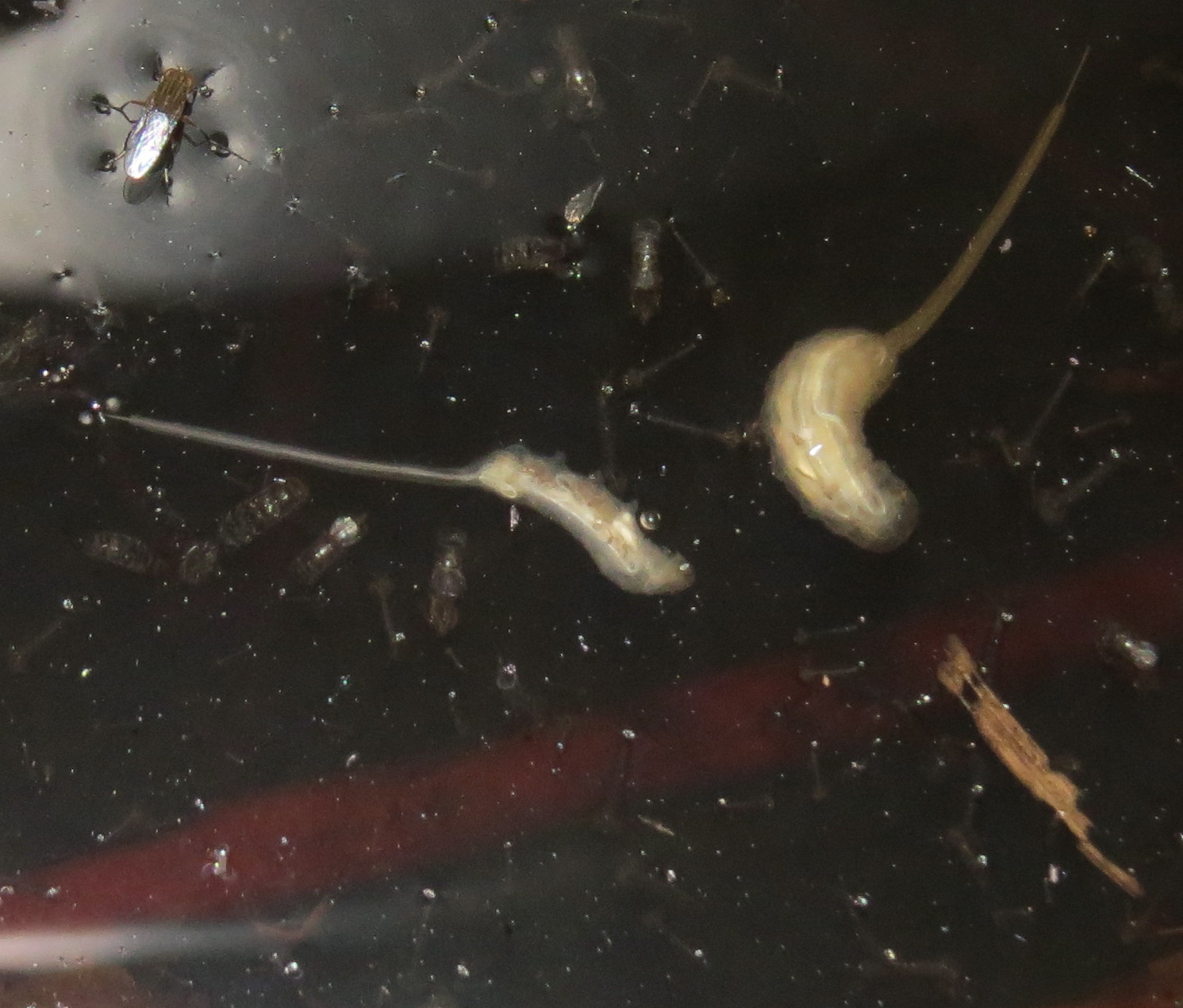
Fly Day Friday: Rat-tailed Maggots

I recently started working part-time at Songbird Supplies, LLC, located inside Summerland Gardens here in Colorado Springs. One of the perks has been encountering insects I seldom see. Julie, the proprietor of Summerland Gardens, called me over the other day to help her identify a "primordial soup" bug in one of the water gardens she is cultivating. I was surprised and delighted to find the critters in question were "rat-tailed maggots," the larvae of flower flies in the tribes Eristalini and Sericomyiini (subfamily Eristalinae, family Syrphidae). I had seen them maybe one other time previously.

The conundrum faced by folks with water container gardens is this: do I put in "mosquito dunks" to kill the mosquito larvae, or do I refrain so that the syrphid larvae can grow up into pollinator-capable adult flies? There is no right or wrong answer. Syrphid flies are definitely not endangered species, so I might deploy the dunks.

Note the leg-like "knobs" along the length of the body of the rat-tailed maggot on the left

The rat-tailed maggots are named for the posterior spiracles, which are fused into an extensible breathing siphon that connects them to the water surface at all times. Meanwhile, at the other end, they are filtering bacteria and other microbes from organic matter in the water. Larvae of some species exist in rather dense material like saturated manure, which barely qualifies as aquatic, but is too wet for other dung-eating fly larvae. The low oxygen levels in this kind of substrate are no problem because the maggot's spiracles are always connected to the surface.

The length of the "snorkel" varies greatly depending on the genus of flies. Eristalis larvae have very long tubes, as shown in the images here; Chrysogaster falls at the other end of the spectrum, with quite a short siphon.

Different genera occupy different aquatic niches. Mallota and Mylopeta, for example, live in the water that collects in tree holes. Sericomyia larvae live mostly in bog mat pools. Chrysogaster thrive along the edges of ponds and among emergent vegetation. The most commonly-encountered species are probably in the general Eristalis, Eristalinus, Helophilus, and Palpada, since they are most likely to be seen in urban, suburban, and rural areas. They live in putrid and organic-rich standing water. I know they are sometimes found while cleaning rain gutters.

Once the larva reaches maturity, it seeks dry land on which to pupate. Teh pupal capsule is hard, and resembles a tiny mouse in shape.

Adult Drone Fly, Eristalis tenax, Colorado

The "Drone Fly," Eristalis tenax, is the most common adult version of a rat-tailed maggot that one is likely to see. It is a stunning mimic of the honey bee. Likely introduced ages ago from Europe, it is now an established and widespread species across the entire North American continent. It is also a fairly respectable pollinator, visiting wildflowers, and the blossoms of orchard trees and landscape plants.

Here is an interesting piece of trivia: It is speculated that it was rat-tailed maggots that gave rise to the biblical account of "bees" spontaneously appearing from the rotting carcasses of animals. Certainly, the fluid decomposing material in a corpse would be a perfectly acceptable habitat for Drone Fly larvae.

Adult male Eristalis tenax, Arizona

Sources: Carr, John F. 2013. "Rat-tailed Maggots," Bugguide.net.
McAlpine, J.F. (editor). 1987. Manual of Nearctic Diptera Volume 2. Ottawa: Agriculture Canada. Monograph No. 28. pp. 675-1332.
Merritt, Richard W. and Kenneth W. Cummins. 1978. An Introduction to the Aquatic Insects of North America. Dubuque, Iowa: Kendall/Hunt Publishing Company. 441 pp.
Pfiester, Margaret, and Phillip E. Kaufman. 2009. "Rat-tailed Maggot," Featured Creatures. University of Florida Department of Entomology and Nematology.

Saturday, October 18, 2014

"Doodlebugs" (Antlions)

Growing up in Oregon, all I knew initially of antlions was what I read in books. The insects are members of the family Myrmeleontidae in the order Neuroptera. So, they are related to lacewings, mantispids, spongillaflies, and their kin. I wasn't even sure antlions could be found in the Pacific Northwest, but I was fascinated by the "pits" that the larvae supposedly dug to trap ants and other insects.

Adult antlion, Colorado

The images in books never gave a sense of scale, so I imagined that the funnel-like holes must approach the size of a saucer. Ha! Most antlion pits are about the diameter of a quarter, as shown in the image below.

"Standard size" Myrmeleon pits on gentle slope, Colorado

Sometimes they are larger, but the size of the crater does not correspond to the size of the larva that digs it. The breadth and depth has more to do with soil texture, and whether there is a slope or not.

Larger Myrmeleon pits on steeper slope, Colorado

Antlion larvae might be considered among the ugliest and/or most terrifying of insects, and indeed they must be to their victims. Most are about the size of a large pea, but they are wrinkly, studded with spines, and with spindly legs. Their most remarkable feature is a pair of long, hooked mandibles.

Antlion larva, Kansas

Ironically, these mini-monsters are best known by the cute moniker of "doodlebugs." They can create random, cursive "doodles" in sand in the process of finding a new place to dig a pit, and that may be the source of the colloquial name.

Actually, it is only larvae of the genus Myrmeleon that make the trademark pits here in North America. Pretty much all the other genera simply bury themselves just below the surface of the soil and wait with jaws agape for a hapless insect to pass by.

Antlion larva, Colorado

Myrmeleon larvae can only walk backwards, but they do so rapidly. They dig a pit by walking in reverse, and in a spiral, throwing sand with their jaws and the flattened top of their head. They then lie in wait beneath the soil at the very bottom of the pit. The sloping sides of the funnel are highly unstable and any small insect that reaches the lip of the trap begins descending immediately. The larva senses the vibrations and throws additional sand onto the victim to hasten its doom.

The jaws of a doodlebug are hollow, and the larva injects a cocktail of enzymes that paralyzes its victim and begins extra-oral digestion of its tissues. The doodlebug then reverses flow, imbibing the liquified innards of its prey. The resulting dry carcass is then catapulted out of the pit with a violent thrust of the antlion's head.

Scotoleon nigrilabris female, Colorado

Doodlebugs more than make up for the horrid appearance of their youth by metamorphosing into delicate, slender, lacy-winged adults that superficially resemble damselflies. These fairy-like insects fly clumsily, and are most often seen among tall grasses, especially at dusk.

Myrmeleon immaculatus, Massachusetts

Note the short, thick, clubbed antennae that instantly distinguish them from damselflies. Males frequently have a much longer abdomen, tipped with bracket-like claspers. This is especially true of the genus Scotoleon.

Adult male Scotoleon, Arizona

Despite the fact that adult antlions are fairly large, they are ridiculously cryptic. I have personally witnessed flying antlions alight on grass stems or twigs, and instantly align themselves so perfectly as to be essentially invisible. Dark spots and speckles on the wings break up their outline, but they also flatten themselves seamlessly against the substrate.

Myrmeleon exitialis, Colorado

There are eighteen (18) genera of antlions recorded north of Mexico, with 94 species. Some are truly spectacular, like the three species in the genus Glenurus that sport black, white, and pink wingtips.

Glenurus luniger, Arizona

The genus Vella includes three species, which are true giants. Adults have a wingspan of 100-120 millimeters or more. They are found in about the southern third of the U.S., and are frequently attracted to lights at night.

Vella americana, Texas

Look for the larval pits of Myrmeleon in fine, powdery soil, or sawdust around rotten logs. Where there is one there are usually several. Prime situations for such colonies are at the base of trees, beneath rock overhangs, under bridges, the dirt floor of old barns and sheds, and any other situation that remains perpetually dry. They can be in exposed situations, but I find that is rarely the case.

Myrmeleon pits under a rock overhang, Arizona

Watch for adult antlions at your porch light at night.

You can tickle doodlebugs at the bottom of their pit with a grassblade or twig, and get them to throw sand or grab the offending object. You can also keep them in captivity by providing a fairly deep container of fine sand and periodically dropping in ants and other invertebrates. They can take down surprisingly large prey.

Adult antlion, Ohio

Antlions pupate inside a silken capsule the larva spins underground, incorporating grains of sand into the cocoon.

Enjoy looking for, and observing, these amazing insects, then share your story here, on Facebook, or elsewhere, like The Antlion Pit (though I am not certain this is still an active website).

Brachynemurus abdominalis, Massachusetts

Tuesday, October 14, 2014

Carpet Beetles, Genus Anthrenus

As a volunteer answer-man for AllExperts.com, I receive many questions pertaining to carpet beetles, tiny coleopterans in the family Dermestidae. In fact, I venture to say that at least seventy percent of the queries I get are related to carpet beetles and their larvae. Ironically, I now live in a region where these beetles are relatively scarce.

Anthrenus sp. larva, Colorado

Yesterday, I finally found a living larva of the most troublesome genus most people find: Anthrenus. The hairy grub was only about four millimeters in length, and crawling up the bathroom wall. This is an unfortunate commentary on our housekeeping habits, I suppose, but even the cleanest homes will have carpet beetles at one time or another. It takes precious little to feed them.

Carpet beetle larvae eat all manner of dried animal products, especially the shed hair and skin cells of pets and people. This food supply accumulates faster than you might imagine and, despite vacuuming regularly, can persist in out-of-the-way corners and beneath furniture.

Additional items on the carpet beetle menu include wool blankets and garments, furs (but you don't have animal hides, right?), taxidermy mounts, dry pet food, and insect collections (including my own, horror of horrors!).

Adult Anthrenus lepidus, Colorado

Getting rid of an infestation of dermestids is a real challenge. Traditional methods are of questionable effect. One of my good friends in entomology and pest control, Bill Warner, has found that moth balls, which have the active ingredient of naphthalene, are not just useless. He has observed carpet beetle larvae eating the substance. Ok, so what about moth crystals, with the active ingredient PDB (paradichlorobenzene)? At high enough concentration, that seems to work, and I have used moth crystals to protect my own insect collection. Unfortunately, PDB is potentially carcinogenic, according to the World Health Organization. The U.S. Environmental Protection Agency claims it is "not likely to be carcinogenic to humans" (National Pesticide Information Center website).

The best course of action when faced with numerous carpet beetle larvae is to discard the infested item. If you cannot bear to part with whatever is under attack, then a cycle of freezing and thawing over the course of several weeks may do the trick. This is how most museums now handle pest control in their entomology collections.

Prevention is the best cure for dermestids. Store vulnerable foodstuffs, like dried meats and dry pet food, in metal, glass, or durable plastic containers with tight-fitting lids. Store woolens, silks, and furs in a cedar chest when not in use. Cedar has proven repellent qualities and is not toxic to people or pets. Vacuum and clean your home regularly.

Adult Anthrenus sp., Massachusetts

Adult carpet beetles are pretty tiny (2-4 mm), and frequently mistaken for lady beetles since they are round, and often patterned with bands or spots of brown, black, and white. The beetles fly well and seek escape to the outdoors. Consequently, they are most often observed on windowsills, or discovered in light fixtures.

While carpet beetle larvae are pretty much "juvenile delinquents," the adult beetles can be surprisingly efficient pollinators of some flowers, especially in spring. The Buffalo Carpet Beetle, Anthrenus scrophulariae, is particularly common in flowers.

Larva of Anthrenus verbasci, © Canada Dept. of Agriculture

Carpet beetle larvae are covered in tiny hairs called setae, and these hairs can break off and become airborne, especially from the molts (shed "skins") of the larvae. These setae can cause irritation, or even trigger rhinitis or asthma in people prone to allergic reactions. Contact dermatitis is a more uncommon reaction, and an infestation has to be pretty severe to result in any kind of medical consequences (Peacock, 1993).

There are eighteen (18) species in the genus Anthrenus currently recognized in North America, and several of those are cosmopolitan pests now found worldwide as a result of international commerce. There are other common types of carpet beetles as well, with the genera Trogoderma and Attagenus being common in households. I will address those in separate blog posts.

Sources: Boone, Mike. 2013. "Genus Anthrenus - Carpet Beetles," Bugguide.net.
Gibson, Arthur and C.R. Twinn. 1931. Household Insects and Their Control. Ottawa: Department of Agriculture, Canada. 87 pp.
National Pesticide Information Center.
Peacock, Enid R. 1993. Adults and Larvae of Hide, Larder, and Carpet Beetles and Their Relatives (Coleoptera: Dermestidae) and of Derodontid Beetles (Coleoptera: Derodontidae). London: Royal Entomological Society of London. Handbooks for the Identification of British Insects, vol. 5, part 3. 84 pp.

Monday, March 11, 2013

Moth Monday: Sophora Worm

One of the challenges I enjoy is matching caterpillars to their adult moths, and vice versa. Usually one of the two is spectacular and obvious, and the other is cryptic and/or scarce. Such was the case when I encountered the larvae known as the Sophora Worm, Uresiphita reversalis, of the family Crambidae.

I found many of the caterpillars amid their silken webbing on a common ornamental shrub in Tucson, Arizona on May 20, 2010. Turns out the plant was Texas Mountain Laurel, Sophora secundiflora, easily identified by its large, purple flowers and resulting robust pea-like pods. This is a native host for the moth, but the caterpillars are also known to eat non-native “broom” plants such as French Broom (Genista monspessulana), and other Genista species. This habit has given rise to an alternate name for the Sophora Worm: “Genista Broom Moth.”

Additional host plants include lupines (Lupinus), acacia (Acacia), false indigo (Baptisia), and other leguminous plants. It is also reported from Crapemyrtle (Lagerstroemia indica) and honeysuckle (Lonicera), but these are probably incidental.

The caterpillars feed out in the open, in groups, and during the day, in stark contrast to most caterpillars that are solitary and nocturnal, the better to avoid potential predators. The bold colors suggest that Uresiphita reversalis is distasteful to their enemies, and indeed they accumulate the toxins of their host plants for use in their own self-defense. They sequester the quinolizidine alkaloids found in their leguminous host plants, incorporating the chemicals into their exoskeleton. Even so, damsel bugs and other predatory insects with piercing-sucking mouthparts simply bypass this external defense by puncturing the cuticle and feeding on the internal tissues of the caterpillars (Bernays and Montllor, 1989).

The length of the life cycle of this species varies considerably depending on season and latitude. It can be as short as five weeks from egg to adult under optimal summer conditions in southern climes, and as long as 25 weeks in winter in the more northerly reaches of its range. There may be four or five generations annually. In Berkeley, California there are two major flight periods, one from March to May and the other from July to October. Overwintering usually occurs in the pupal stage, but adults are sometimes found during this season as well.

Eggs are laid in clusters (averaging about 19 per clutch in the lab) on the upper- or underside of leaves. The larvae go through five instars (an instar is the interval between molts). Pupation occurs inside an opaque, white cocoon woven amid dense webbing.

The adult moth has a wingspan of 27-34 millimeters. They are seen most often during the day and are easily startled from their resting place. The body and legs of the moth are bright white. The hind wings, usually not visible when the insect is at rest, are bright yellow or orange.

One reference asserts that the Sophora Worm is native to Mexico and the southwest U.S. and has spread with its hosts up the coast of California to the Bay area; and also north and east to the Great Lakes and mid-Atlantic states, even Maine and Nova Scotia. It became established in Los Angeles in 1930, spreading rapidly from there. By the 1980s it was spreading through the San Joaquin and Sacramento Valleys (Powell and Opler, 2009).

I didn’t find an adult moth until more than a year later. The specimen imaged here was in the same neighborhood where I found the caterpillars, on June 11, 2011.

Note that this moth was formerly classified in the family Pyralidae, and is often still placed there incorrectly on several internet resources. It is currently in the family Crambidae, subfamily Pyraustinae.

Sources: Bernays, E.A. and C.B. Montllor. 1989. “Aposematism of Uresiphita reversalis Larvae (Pyralidae),” J. Lep. Soc. 43(4): 261-273.
Leen, Rosemary. 1995. “Biology of Uresiphita reversalis (Guenée) and Comparison With U. polygonalis maorialis (Felder) (Crambidae),” J. Lep. Soc. 49(2): 163-170.
Powell, Jerry A. and Paul A. Opler. 2009. Moths of Western North America. Berkeley: University of California Press. 369 pp.

Monday, February 28, 2011

Moth Flies

It’s a moth! It’s a fly! It’s….a “moth fly!” So goes the confusion upon encountering one of the most common yet confounding dipterans. Moth flies belong to the family Psychodidae in the order Diptera. Most people have seen these diminutive, fuzzy creatures in the bathroom, perched on the side of the sink basin, or on a nearby wall. Where do they come from? Are they harmful?

The answer to the second question is easier than the first. Moth flies are not harmful, at least in the sense of public health. They do not bite, unlike their cousins the sand flies, also in the family Psychodidae, but members of a different subfamily. Sand flies not only bite, but are vectors of leishmaniasis, a parasitic disease occurring mostly in the tropics. Moth flies are mostly a nuisance, though they can reach high population densities around sewage treatment plants.

Adult moth flies are active mostly in the evening hours, and are attracted to lights after dark. Consequently, they may easily enter the home through an open door or window. While they can breed indoors (more on that later), they normally seek wet, decaying organic matter where the female can lay from 30-200 eggs in a loose cluster. Typical sites that attract them include clogged rain gutters, compost heaps, birdbaths, sewer drains, septic tanks, and filter beds at sewage treatment facilities.

I find it amusing that the scientific name of one of the most common species of moth flies, the “Filter Fly,” is Clogmia albipunctata. They certainly don’t cause clogged drains. In fact, they may be better at preventing clogs than a bottle of Draino or Liquid Plumber. This common household species can carry out its life cycle inside the pipes under your sink or shower, no matter how clean your bathroom is.

The eggs hatch between 32 and 48 hours after the female lays them, the larvae proceeding to feed on algae, fungi, microbes, and other organic matter in the gelatinous film of goo lining the average sink drain. I suspect that the many questions I receive about “worms” in the sink or shower refer to mature larvae of Clogmia that are seeking a place to pupate, or that are flushed from their normal feeding niche. It takes a larva from nine to fifteen days to reach the point where they are ready to graduate to the pupal stage. The pupa usually resides on the surface of the same organic film as the larva inhabits. An adult fly emerges from the pupa in an astounding 20-40 hours.

Moth fly larvae are actually considered beneficial organisms in the treatment of municipal sewage, so bear that in mind the next time you encounter one. You have to admire them just a little bit for capitalizing on the artificial habitats we have inadvertently created for them.

Sources: For way better images of adults and larvae, take a look at this remarkable life cycle series shot by my good friend Ashley Bradford. She is definitely not the squeamish sort! Also check out this fantastic fact sheet produced by the Connecticut Agricultural Experiment Station. It gives more detailed information than I have room for here, including how to prevent infestations and deal with existing ones.

Monday, July 27, 2009

Lab Excitement

It got a little exciting in the lab today. A live, giant beetle and a dead parasite made my day much more interesting than the average Monday.

Jeff Boettner and Craig Hollingsworth showed up around lunch time with a Tuppermaid (or Rubberware, I always get those two confused) container holding a magnificent specimen of a pine sawyer. A woman brought the insect to Craig, thinking it might be a grasshopper because of the long antennae. Neither Craig nor Jeff had seen this particular species before, though it was obvious to them it was no grasshopper.

Consulting BugGuide, we eventually reached a consensus that the insect was a male “northeastern sawyer,” Monochamus notatus (Drury). Female sawyers have much shorter antennae, and shorter front legs. According to the Field Guide to Northeastern Longhorned Beetles by Douglas Yanega, this species ranges from 23-35 millimeters in body length. This one was every bit of that. Northeastern sawyers occur pretty much east of the Rocky Mountains and bore in dead and dying conifers as larvae, favoring pines. Harvested firewood can yield the beetles indoors when they emerge in stored situations. This specimen is now destined to be pinned for posterity in the University of Massachusetts insect collection. I suppose it achieves something close to immortality in this case. Hopefully more live specimens will show up, as most of my impromptu images did not turn out very well.

Another interesting find came as I was sorting leafhopper nymphs and other hemipterans preserved in alcohol from pitfall traps. One of the nymphs had some kind of dark object attached to its underside, between the first and second pairs of legs.

It turned out to be the larva of a dryinid wasp (family Dryinidae), bizarre parasites of leafhoppers and some other insects. One of the effects of ethanol on dead insects is a clearing of the pigments in some specimens, and increased magnification clearly shows the larval dryinid curled inside a capsule-like pouch.

Adult dryinids are even stranger than the larvae. Females are often wingless, and sport scissor-like front feet used for gripping the leafhopper while an egg is laid on it. The adult wasps have also been observed catching, killing, and half-consuming prey instead of using it as a host for their offspring. For more images of both larvae and adults, please see the BugGuide reference page and Alex Wild’s fantastic images of an adult female.

Hm-m-m-m, I wonder what tomorrow will bring?