Showing posts with label male. Show all posts

Tuesday, October 24, 2017

Another Viral Moth Video....

In service to my colleagues who have waning patience as they are bombarded with the latest social media sensation, I offer this explanation to the moth with the "tentacles" coming out of its posterior. Here is the circulating image, but there is also a video that is associated with most Facebook posts.

© "Gandik" via Facebook

Ok, first things first. This moth is Creatonotos gangis, an arctiine (tiger) moth from southeast Asia and Australia. The specimen shown is a male. He is everting his androconial glands or coremata (Greek for "feather duster"). The glands are normally concealed within his body, and are inflated at will by air pressure or blood pressure. Less dramatic versions of these organs are known as "hair pencils." Usually concealed within his abdomen, the coremata are deployed when he is seeking acceptance by a mate.

Male pyralid moth deploying his "hair pencils" © Nicky Bay

Wait, you thought female insects were the ones using pheromones (scents used mostly to attract the opposite gender, but with other functions, too, especially in social insects)? Well, me, too, so I did a little digging. Turns out that the male's sexual chemicals are not meant for long-distance attraction of females, but to communicate his "fitness" as a mate. So, the products of androconial glands have been likened to aphrodisiacs, tranquilizers, or narcotics, aimed at seducing the female. Ok, but how? It is a long story....

© David Rentz via Joanie Mars on Facebook

As caterpillars, many tiger moths (subfamily Arctiinae of the owlet moth family Erebidae) feed on toxic plants. Milkweed is a good example. The plant is packed full of cardiac glycosides, potent poisons intended to discourage herbivores, including caterpillars, from consuming it. Not only are some caterpillars able to overcome the toxicity, they incorporate it into their own bodies to make themselves toxic to their predators. This is called sequestering, and the commandeered poison stays with the insect throughout metamorphosis and into adulthood. One of the byproducts in male moths is the pheromone emanating from those androconial glands. He thus demonstrates to the female that he is genetically superior based on a greater quantity of accumulated toxins that she can then pass on to her offspring.

Our common U.S. Acrea Moth everting his glands © Rosella Flores

This is a relatively dry explanation of these remarkable structures in male tiger moths. You owe it to yourself to be better entertained and further enlightened by an article in Wired magazine by my good friend and colleague Gwen Pearson. Even the graphics are better, and a GIF has never been funnier, at least in the context of entomology.

Close-up of male Acrea Moth glands © openi.nlm.nih.gov

So, far from "terrifying" as a similar viral graphic was labeled in a headline from Huffpost, these glands are an amazing example of evolution, just like elk antlers and other male adornments. Please share the fascination, without the sensationalism. Thank you.

Thursday, June 15, 2017

What a Spider!

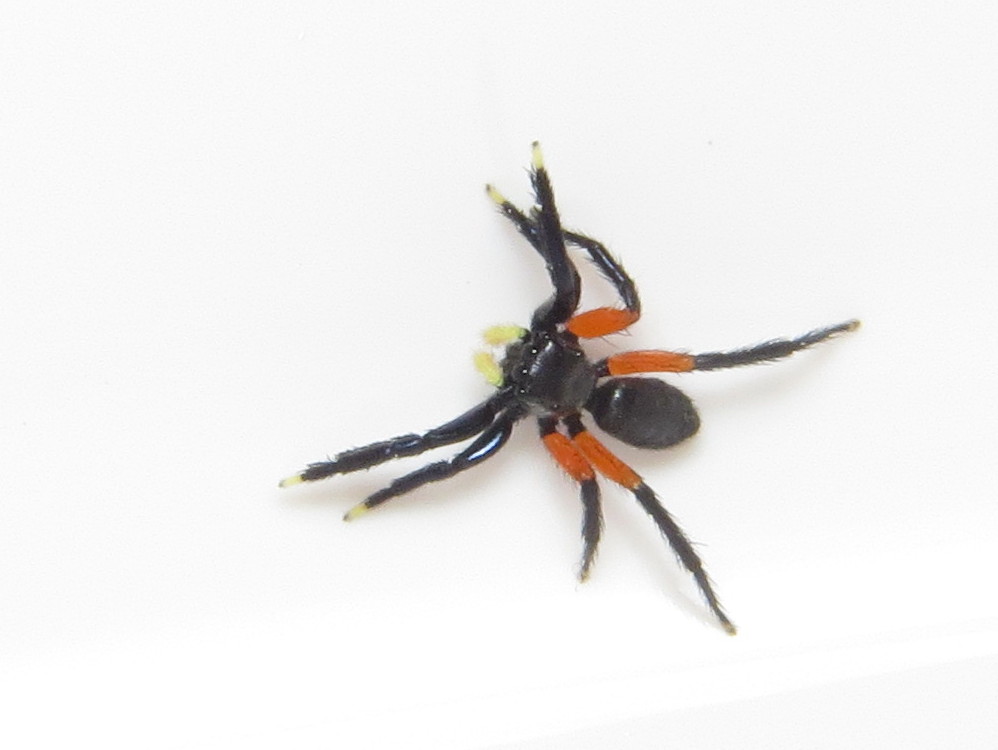
Sometimes you find something that you think might be a major discovery, only to learn that is not the case. Does it diminish your enthusiasm for the whole experience? Not at all. That is especially true when you find something as colorful as a male of the jumping spider Euophrys monadnock. Your expertise is in fact enhanced no matter what expectations you start out with.

The morning of June 8 I found myself granted access to part of Cheyenne Mountain State Park where the public is...."discouraged" from going. It is close, too close, to NORAD installations on the mountain, an important part of national security. One of the perks of being a park volunteer is getting opportunities like this to investigate more pristine and unique habitats.

Anyway, on the ground beneath Ponderosa Pines and understory thickets of Gambel's Oak and other shrubs, I spotted a little (3-4 millimeters) jumping spider hopping over the grass and leaf litter. My initial assumption was that it had to be a species of Habronattus. Members of that genus are often about the same size, usually ground-dwellers rather than arboreal, and frequently adorned with ornate colors in the male gender. Colorado also appears to be an epicenter of Habronattus diversity. I captured the spider in a plastic vial so I could get better images later.

Imagine how puzzled I was when, back at home, an internet search could find no matches with any Habronattus species. I think I finally "Googled" something like "Salticidae, black, orange legs," and lo and behold, I got some image results for Euophrys monadnock. It was not recorded (yet) for Colorado in Bugguide, by online standby. Additional research did find several records of the species for Colorado, even of recent vintage.

The Colorado Spider Survey, based at the Denver Museum of Nature and Science* and supervised by Dr. Paula Cushing, is an amazing resource. There, I found records of this species from Roxborough State Park in Douglas County, on August 9, 2014; Upper Maxwell Falls in Jefferson County, July 29, 2010; Lump Gulch in Gilpin County, June 24, 2009; and 1.6 miles along FR 175 NW of Mt. Pisgah, also in Gilpin County, on August 10, 2009. Using the World Spider Catalog, which has PDF files of almost all the scientific publications devoted to spiders, I found perhaps the original record of Euophrys monadnock for Colorado: collected in the 1890s in "West Cliff," now spelled "Westcliffe," by Theodore Cockerell. The species is one of northerly latitudes and high elevation, found across Canada and south to California, North Dakota, Wisconsin, Ohio, and Pennsylvania, and along the Rockies.

A Wikipedia article on the species explains the species was first described in 1891 by James Henry Emerton, a preeminent arachnologist of his day. The male gender, anyway, certainly cannot be confused with any other spider. The female is more....subdued, shall we say, but that is the case for most jumping spiders where there is often extreme sexual dimorphism (graphic differences between genders).

The male makes full use of his contrasting colors in displaying to a female. He lifts his front legs, which are adorned with thick brushes of black hair. He also lifts his third pair of legs to expose those bright orange femora, and orients the fourth pair of legs such that the female can see those orange femora as well. Jumping spiders are, unlike web-building spiders, highly visual, with acute eyesight that is not approached by any other land invertebrate.

My wife and I managed to get a few pictures of this highly active spider inside a casserole dish at home, before she released the spider outside the park, but at roughly the same elevation, same habitat, and same mountain for that matter. From a scientific perspective, it is usually preferable to retain the specimen, but considering the utter uniqueness of this species, we felt it was unnecessary to sacrifice this one.

Sources: Banks, Nathan. 1895. "The Arachnida of Colorado," Annals of the New York Academy of Science. 8: 415-434.
Bradley, Richard A. 2013. Common Spiders of North America. Berkeley: University of California Press. 271 pp.
Kaston, B.J. 1972. How to Know the Spiders (3rd edition). Dubuque, Iowa: Wm. C. Brown Company Publishers. 272 pp.
Jumping spiders (Arachnida: Araneae: Salticidae) of the worldWorld Spider Catalog

Sunday, May 31, 2015

Dimorphic Jumping Spider, Maevia inclemens

When I lived in Ohio I had the great honor of being introduced to Dr. George Uetz at the University of Cincinnati. At the time he had a graduate student, Dave Clark, who was doing research on the courtship behavior of the Dimorphic Jumping Spider, Maevia inclemens. Ever since then I have had a special place in my heart for this unique member of the Salticidae.

"Tufted form" male, Missouri

What makes this spider so special, you ask? The name says it all. The male of this species comes in two distinct forms: a "tufted form" that is all-black with white legs; and a "gray form" with black pinstripes and orange spots and chevrons. Not only do they look like separate species, but they behave like two different spiders, too. Each male performs a complex dance that is different from that of the other form.

"Tufted form" male, Indiana

The tufted form, named for the triple-Mohawk style hairdo, literally stands on tiptoe, dips his abdomen, and waves his front pair of legs overhead at a prospective mate. The gray form takes a "low rider" position and sidles back and forth.

"Gray form" male, Kansas

Dave Clark capitalized on those differences, as well as his expertise in video, and created animations of a tufted form male doing a gray form dance, and vice versa. He then played his mixed-up dance mix in front of live female spiders. Jumping spiders have better eyesight than any other terrestrial invertebrate, so they could actually watch, and react to, the videos on a monitor. This was back in the late 1980s, so Dave dubbed his lab "MTV" for "Maevia Television."

"Gray form" male, Kansas

The Dimorphic Jumper is a species commonly encountered in the eastern half of the U.S. where it prowls understory foliage, climbs on walls and fences, and occasionally enters homes. These are not overly large spiders, males ranging from 4.8-7.0 millimeters in body length, females 6.5-10 millimeters. Females have consistent markings, being mostly pale with a pair of orange or red racing stripes running down the back of the abdomen.

The first time I saw a tufted form male of this species, it was on a sidewalk in Cincinnati and I initially mistook it for a carpenter ant. This species is not generally considered an ant mimic, but considering that carpenter ants forage in the same places as Maevia, it is not out of the question I suppose.

Juvenile female or gray form male, Massachusetts

So what was the result of those experiments? The dance of the black form male is apparently more successful at attracting the attention of a female from a greater distance, while the dance of the gray form male is better at wooing a lady spider closer to him. You can see videos here on YouTube of both kinds of males performing. There is no word on whether the females presented with the wrong combo of male appearance and dance moves suffered psychological damage.

"Is there a female down there?"

Sources: Bradley, Richard A. 2013. Common Spiders of North America. Berkeley: University of California Press. 271 pp.
Clark, David L. and George W. Uetz. 1993. "Signal efficacy and the evolution of male dimorphism in the jumping spider, Maevia inclemens," Proc. Natl. Acad. Sci. USA 90: 11954-11957.
Guarisco, Hank, Bruce Cutler, and Kenneth E. Kinman. 2001. "Checklist of Kansas Jumping Spiders [illustrated]," Kansas School Naturalist 47(1).
Moffett, Mark W. 1991. "All Eyes on Jumping Spiders," Nat. Geo. Mag. 180(3): 42-63.

Saturday, October 25, 2014

Another Odonata Record

Earlier this year I was fortunate enough to report a species of dragonfly never before seen in Colorado. Last Monday, October 20, I got lucky again, with a Fremont County record for the Black-fronted Forktail, Ischnura denticollis. This is a type of damselfly in the family Coenagrionidae.

I can only take credit for spotting the insect in the field, along the edge of a backwater pond in John Griffin Regional Park, CaƱon City, Colorado. It was clearly a male damselfly, perched on a rock by the shore, with nearby cattails. The area is part of the "Riverwalk" along the Arkansas River. I decided to snap a few pictures, if only because insects in general were few and far between that day. Also, the rock was the steadiest object with the gusty winds that were blowing. Anyway, I didn't think much about the whole encounter, except that I was puzzled by a forktail that did not have the usual requisite blue or green spots (or stripes) on the back of the thorax. Oh, well.

Once we returned home, it was my wife, Heidi, that took it upon herself to look up the diminutive (22-26 mm in body length) creature online and in books we have in our library.

"Hey," she said, "I think that damselfly might be something pretty cool." She had already consulted several resources by this time, and concluded that it was an unusual geographic location, and therefore a potential county record.

I uploaded my own images, cropped them, and posted them on Facebook to group pages where I know dragonfly and damselfly experts lurk. Sure enough, it was determined to be a Black-fronted Forktail, a county record, and an exceptionally late date of observation.

Males of this species are pretty easily identified. Besides lacking pale markings on the dorsum (top) of the thorax, the blue on the abdominal segments 8 and 9 is restricted to a spot on the top, instead of a ring around the entire couple of segments. Unfortunately, females are much more difficult to identify, resembling several other forktails.

The late date is perhaps not too much of a surprise because these are oddly long-lived insects as adults, persisting about six weeks in some instances. At least one specimen was shown to have lived 42 days.

The Black-fronted Forktail is a decidedly western species, ranging from southeast Oregon and southwest Idaho through California, Nevada, western Utah, Arizona, and New Mexico. It does not occur in the Cascade, Sierra Nevada, or Rocky Mountains, but creeps north again into eastern Colorado, on out to west Texas, Oklahoma, and Kansas.

Look for adults on the wing at almost any time of the year in the southerly reaches of this forktail's range, but reliably between about April and October just about anywhere else. They hang out around springs, both hot and cold, ponds with lots of emergent vegetation, and even very slow-moving stretches of streams.

Sources: Abbott, J.C. 2006-2014. Odonata Central: an online resource for the distribution and identification of Odonata.
DuBois, Robert. 2010. Dragonflies & Damselflies of the Rocky Mountains. Duluth, MN: Kollath+Stensaas Publishing. 301 pp.
Paulson, Dennis. 2009. Dragonflies and Damselflies of the West. Princeton, NJ: Princeton University Press. 535 pp.

Sunday, January 26, 2014

A Spider Surprise

Hardly a field outing goes by when I am not confronted by some insect or spider I have never seen before, and such was the case on October 25, 2013. I had been on a mission to take more images of Red-shouldered Bugs, Jadera haematoloma, when seeking the answer to a question I had led to an unexpected spider discovery.

My wife and I had encountered the Red-shouldered Bugs earlier, on October 21, while walking the dog on the Rock Island Trail here in Colorado Springs. The insects were all on the ground, clambering no higher than the tip of a yucca leaf blade. Why were they feeding on fallen seeds and not climbing into the trees, I wondered.

I decided to investigate further on the twenty-fifth, looking more carefully on the trunks of the shrub-like ornamental trees. Ok, there’s one bug on the trunk, still pretty close to the ground. What about higher up? Oh, my! I was startled to find a rather large jumping spider ascending the trunk. With a formidable predator like that stalking the “canopy,” I don’t blame any bugs for not venturing off the ground. Further, the leaf litter provides a cozy layer of insulation from the cold autumn weather, and the bugs were taking advantage, no doubt.

The spider really got my attention and I snapped off a couple of images in the dim light of late afternoon. I decided to capture the arachnid and take it home for closer examination and photography under more controlled conditions. I seemed to recall seeing images of this particular species previously, but a thorough search of books and articles failed to produce anything.

The more I looked, the more puzzled I became. So, I posted images in the forum at Spiders.us, where both amateurs and experts help people like me make identifications. One expert was intrigued enough that he solicited the opinion of renowned jumping spider authority G.B. Edwards. The result was a probable state record for Phidippus arizonensis. My specimen is a male, however, and Dr. Edwards suggested the remote possibility that it could be an undescribed species, the female of which has been collected in New Mexico.

Sticking with the more likely scenario, I learned that despite its name, P. arizonensis is not known from Arizona. Records exist for Mexico, New Mexico, Texas, and now apparently Colorado. I have retained the specimen, which is still alive and eating regularly. When it finally expires I will preserve it for the Colorado Spider Survey at the Denver Museum of Nature and Science.

Males of P. arizonensis average a little over 9 millimeters in body length (8.35-10.02). Females are larger (9.02-13.36 millimeters), and dramatically different in appearance. Females have an overall yellowish appearance with spots and stripes on the abdomen. The vaguely metallic blue-black color of this male is pretty typical; and this is the only species in which the fringe of hairs on the front legs is entirely yellow in color.

Historical collection records indicate this species is most often found in the understory of oak woodlands at elevations between 5,000 and 7,000 feet. Colorado Springs is at 6,025 feet; and indeed the natural habitat in which I found this specimen is a sandstone ridge dominated by Gambel’s Oak that is stunted into tall shrubs.

When you are out looking for arthropods, pay attention to your “gut.” If something looks odd, out of place, or otherwise intriguing, there is a good chance it is worth paying closer attention to. Our collective knowledge of the habits, distribution, and abundance of invertebrates in general is pretty weak, and your spotting could be invaluable.

Source: Edwards, G.B. 2004. “Revision of the Jumping Spiders of the Genus Phidippus (Araneae: Salticidae),” Occasional Papers of the Florida State Collection of Arthropods Vol. 11: 1-156.