Showing posts with label Oregon. Show all posts

Friday, February 6, 2026

Remembering Another Mentor

I had intended to make this post years ago. The subject deserves better. He is the late Leonard L. Wiley of Portland, Oregon. Though my relationship with him was brief, he made a lasting impact. He may have felt the same way about me, as you will see.

© The Oregonian

Mr. Wiley passed away in 1987, at the age of eighty-two. He was introduced to me by my father. As a jeweler, my dad knew Leonard as a diamond dealer. I was told that Mr. Wiley carried the precious stones in a brown paper back, and also carried a large revolver. I can vaguely attest to seeing the diamonds, laid out on the counter at my father’s store.

Leonard Wiley was best known to the rest of society as a world class botanist and writer. He authored the books Rare Wildflowers of North America (1968), Wild Harvest (1966), and The Granite Boulder: A Biography of Frederic Homer Balch (1970). He was also a regular contributor to Northwest Magazine in The Oregonian newspaper. It was in this capacity that we are forever connected.

The following is a transcript of an article Mr. Wiley wrote about me, published in The Oregonian on August 23, 1970, after he, myself, and my parents had gone on a day hike in Oneonta Gorge, a location adjacent to the Columbia River Gorge that divides Oregon and Washington. The title of the piece is “Just ask this nine-year-old: Leonard Wiley found that Eric asks no foolish questions.” Enjoy his wonderful writing style….

”Eric Eaton and I went to Oneonta Gorge to learn about wild plants. Before taking to the trail I opened a book and pointed out how to tell the difference between the Vine Maple, Acer circinatum, and the Smooth Leaved Maple, Acer glabrum. Both of these tree-shrubs resemble each other very closely and are found in this area.

Eric missed the first one we came to but quickly spotted the second. This achievement of a nine-year-old boy was more than I would expect from most adults.

Every person who has brought joy and happiness in my life I originally met merely by chance. And it was this factor that brought me Eric’s friendship. I had some business to transact with his parents, Bob and Violet. I was introduced to the small boy about a year ago and at first wasn’t much impressed for Eric is not the kind of a person who tries to impress with his importance.[LOL!] In fact he told me on the trail that he does not know much. Maybe so. But I have known a couple of PhD’s who know less.

Science is knowledge possessed as a result of study or practice. When does a person become a scientist? When his zeal and enthusiasm for his particular branch of learning dominate his life. With most, if it comes at all it arrives during maturity. Eric was a scientist before I ever heard of him.

Highly talented people are often lopsided. But Eric is well rounded socially. He plays with his school mates, gets along well with young and old and, at first, appears like most any other boy of his age.[I disagree with almost all of this, but it is his article….]

I like him immensely – and I’m also a bit afraid to engage him in a conversation. If you pitch a curve at him he’ll knock in a home run. I discovered this the hard way. I gave him a chameleon [Green Anole lizard] to help cement a thriving friendship. He looked at it critically and asked ‘Is it a male or a female?’ What the devil do I know about such things? Without consulting a book he told me. Now, when I think a certain subject will come up at our next meeting I get out my books and dig deeply.

He has little interest in money [still true!]. His meager allowance and funds obtained from odd jobs all go into books. His natural history library comprises about 50 volumes as well as subscriptions to various scientific journals, some of which I had never heard of before. His teachers think he is a fine student. They also think they earn their salaries. I agree with them. I have never head Eric ask a pointless question. When he makes a remark or asks for information you better have a sensible answer unless you enjoy making a fool of yourself.

On the trail he never looked back. His eyes roved to left and right, searching for something interesting. He fund a plant with the flowering stem arching over the trail. ‘What do you suppose that is?’ I told him that it was the False Solomon’s Seal. ‘Wow, what a name!’

At nine it is unreasonable to expect him to be the world’s most talented diplomat. As I was wobbling along the rocky trail Eric commented ‘You were hiking when you were younger.’ I gave him a brief ‘yes’ and changed the subject.

Our first botanical ordeal came early on this excursion. We came to an old rock slide. Eric: ‘What’s all this moss doing on these rocks?’ If you think this is a stupid question you aren’t very bright yourself.

I pointed to some lichens tightly growing n the surface of some of the rocks. These primitive plants somewhat resemble rocks. They are among the first plants to attack rocks in the process of disintegration into soil. A medium size lichen may be a hundred years old. Nature is in no hurry. After the lichens are established the mosses and liverworts in vade to speed the break down of the stones. Then the ferns follow. Finally the flowering plants appear. It may take a truck load of centuries for these assorted plants to produce soil. It is very important to life itself.

As we walked along the trail his mother told me a few more things I didn’t know about the boy. He is the resource expert on nature in his third grade class. But his interest in nature started in kindergarten where he discovered dinosaurs. If he wakes in the middle of the night he talks about nature. The Eatons have a lively time.

Stumps have a remarkable fascination for Eric. We examined every one we found near the trail. Those a little farther away drew comment. This, of course, slowed down our progress. Finally Bob called out, ‘Eric, do you have to look at every stump?’ Eric pays no attention to questions of this kind. I showed Eric the mosses and liverworts n some of the stumps while there were ferns and flowering plants on others. One tree had a hollow stump. I reached in and pulled out a handful of debris composed of leaves that had blown in and decayed parts of the inner trunk. This material had largely turned into soil. The other way soils are created.

We discussed a great many other botanical subjects too but the decayed vegetation and the disintegration of rocks seemed to impress Eric the most.

I am sure there are many other boys [and girls, and agender persons!] like Eric in the world but I consider myself fortunate to know one of them.”

Wow, I must have bottled up my enthusiasm for insects during that hike, though it explains my obsession with stumps. I do hope that I have made Mr. Wiley proud with my chosen career path. He showed me that sharing your knowledge with others can have a profound impact.

Sadly, there is hardly an online trace of Leonard L. Wiley, save for his books, which find themselves on sale at various websites. I may need to learn how to make entries on Wikipedia. He certainly deserves to be remembered.

Monday, October 17, 2022

Jim Anderson: My Original Mentor

Last week I learned that my first true mentor, Jim Anderson, passed away on September 22, 2022 at the age of 94. It was my intention to honor him while he was still among the living, but I did not make that enough of a priority. That oversight in no way reflects what a powerful and positive influence he was on my life, and the lives of so many others.

Jim Anderson at 82 years young

I am reasonably certain that my mother was the one who took the initiative in connecting me to Jim. She was a veteran in the television and radio industry, and at the time I first met Jim he was doing a local show on nature for Oregon Public Broadcasting. I seem to recall that our initial meeting was in his studio, in fact.

Concurrently, Jim was employed as an educator with the Oregon Museum of Science and Industry (OMSI). From there, he became director of the Children’s Zoo and conservation and education programs at what was then the Portland Zoo (now the Oregon Zoo in Washington Park).

Jim introduced me to other biologists and naturalists, too, including Mike Houck, who went on to become the Urban Naturalist for the Audubon Society of Portland. Jim and Mike did programs at OMSI field stations and camps, which I had the privilege of visiting periodically on weekends.

The Nature Conservancy hired Jim to manage its Ramsey Canyon Preserve in the Huachuca Mountains of southeast Arizona for three years, but Jim and his wife Sue returned to his beloved Oregon to run the nature center at Sunriver resort south of Bend in the early 1970s. It was there that I caught up with him again. Had my late mother not been so overprotective, I might have spent time with him exploring lava tube caves, or maybe even assisting in banding raptors.

Myself and Jim at Sunriver in August, 1971

Eagles, hawks, and owls were always the center of Jim’s wild universe. He even flew with them, in a manner of speaking. He got a commercial pilot license, and was an accomplished pilot of glider planes. He even instructed student glider pilots.

Among Jim’s enduring menagerie of animals was “Owl,” a Great Horned Owl that had lost an eye. Remarkably, the bird regenerated the eye and, after several years of behavioral rehabilitation, Jim released “Owl” with great fanfare at Sunriver. Owl was immediately harassed by an American Kestrel, such is the drama of nature.

Jim surveyed and banded birds of prey in central Oregon for over fifty years, the last decade or so with the company of his wife, Sue. She wisely insisted that climbing cliffs and trees was too dangerous for someone in his eighties, and Jim begrudgingly retired.

One of the milestones I am most proud of is when I was first published in Ranger Rick magazine, because I had grown up reading Jim’s articles in that publication. He wrote consistently, for many periodicals, and had a column in The Nugget Newspaper of Sisters, Oregon. He also appeared regularly in The Source Weekly of nearby Bend, Oregon. Jim was an outstanding photographer, too, and most of his articles included his images. He compiled his most memorable and hilarious stories in Tales from a Northwest Naturalist, published in 1992.

Everything came full circle for me when Jim agreed to be best man at my wedding to Heidi, on April 29, 2012. A few years later we saw Jim for the last time at his home in Sisters. I had the privilege of introducing another young man, and his then girlfriend (now marital partner), at that time. The couple lived in Bend, and I hope they were able to visit with Jim and Sue again before Jim and Sue moved to Eugene, Oregon to be closer to their children.

Jim, myself, and my mother at my wedding

Being an only child, I had a difficult time socializing with my peers. It was with adults that I felt most comfortable, but Jim nudged me to expand the boundaries of my comfort zone. He was always patient and encouraging, but also insistent, especially when it came to my education. I am glad I still have a few years left, hopefully, to become an even better human being, and a less hesitant one when opportunities present themselves.

Jim's photo of Heidi and I

From what I hear from Sue, I am one of many disciples of Jim. His enthusiasm was contagious, his breadth of knowledge and interests seemingly boundless (did I mention he sang in church choirs?), and his self-reliance admirable. There was no machine he could not repair with bailing wire. He had an old-fashioned wit and sense of humor, and a genuine love and appreciation for all of those he invested his time and counsel in. They do not make men like him very often nowadays. Rest in peace, Jim, you deserve eternal joy and love.

Sunday, January 25, 2015

Basket-web Weavers

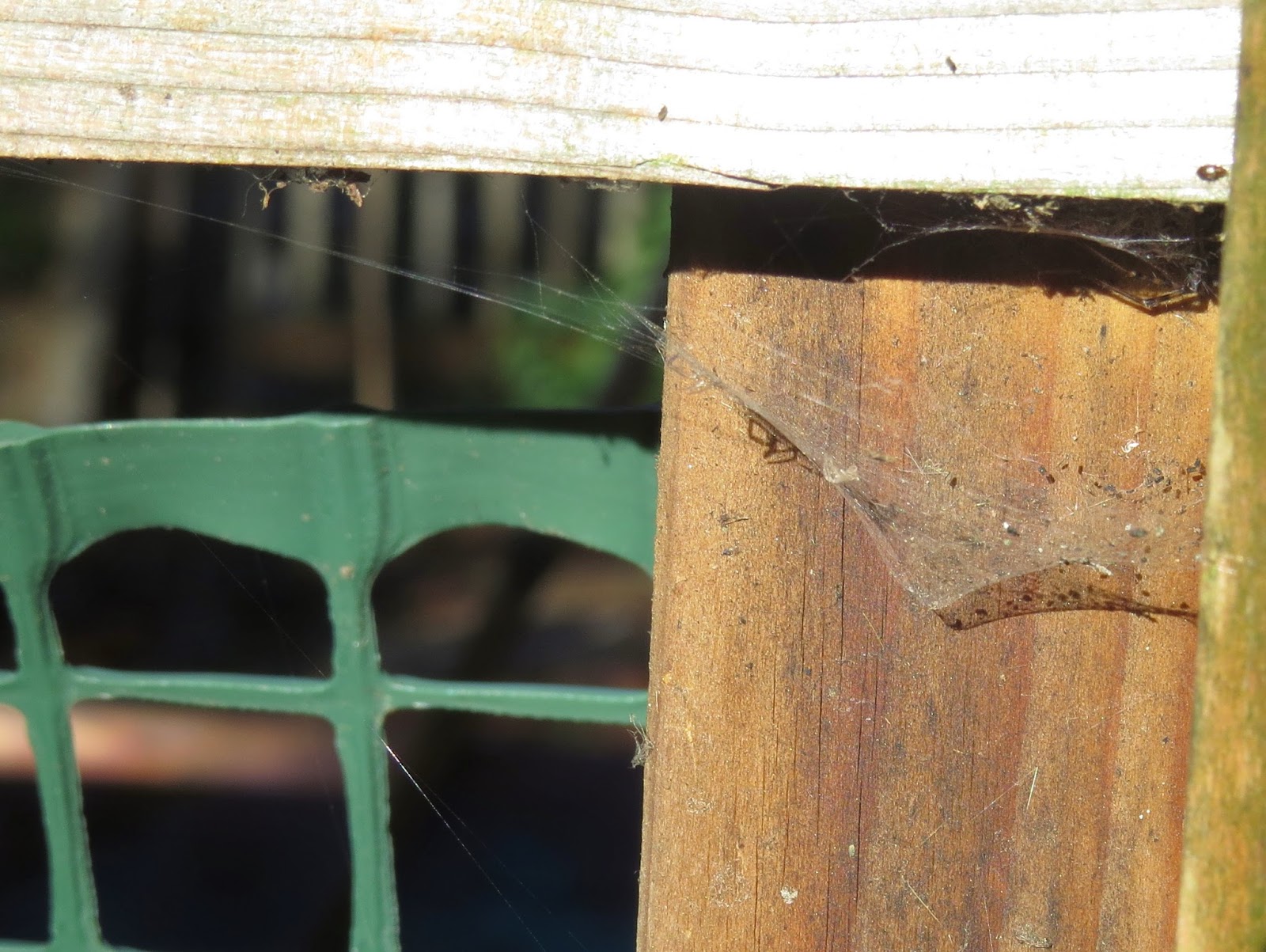
Many spiders simply cannot be found easily during the day. One case in point are what I am calling "basket-web weavers" in the genus Calymmaria, family Hahniidae. There is no official common name for either the genus or the family, despite the fact that these are common and diverse arachnids.

During my recent visit to Portland, Oregon in December and early January, I made a point to look for spiders around the apartment complex where my late mother had lived. I was not disappointed. One of the most abundant spiders was some species of Calymmaria, though I was surprised by how many other spiders were still active in the relative cold, and certainly damp, weather that is characteristic of the Pacific Northwest at this time of year.

There are 31 species of Calymmaria found north of Mexico, all but two of which are found along the Pacific coast, east to the Cascade Mountains (some species in the Sierra Nevada Mountains). Those other two species are confined to the Appalachian Mountains.

The adults of Calymmaria measure 2-10 millimeters in body length depending on the species, and the ones I were finding were on the high end of that spectrum. In fact, at first I mistook them for members of the genus Tegenaria in the funnel-web weaver family Agelenidae. I learned while researching this post that indeed Calymmaria was once classified in the Agelenidae, and some species even placed in Tegenaria.

Calymmaria web on a fence

The webs of these spiders are truly unique. The bulk of the web is an inverted cone, anchored to a substrate both above and below. The spider also weaves a thin sheet close to the object from which the cone is suspended. Typically, the snares are built under loose bark, or in furrows in bark, beneath moss on rocks or logs, amid rocks by streams, under cliff overhangs, the entrances of caves, or even on buildings, which is where I found the spiders imaged here.

The spider emerges at night to hang beneath the sheet above the cone, though sometimes it may venture over the exterior of the cone. Prey is small insects, especially flies, which the spider attacks, bites, and retreats, maybe multiple times, before hauling the victim back to the platform web to feed.

The species I found is very likely C. emertoni, but without collecting adults, especially males, and examining specimens under a microscope, I cannot be positive. Calymmaria bifurcata is essentially identical save for subtle differences in their genitalia. Females of bifurcata range from 5.89-8.25 mm, while emertoni is 5.02-7.95 mm.

I grew up in Portland, in the very neighborhood I was visiting last month, but I never went prowling around at night, and therefore missed this particular spider altogether in my youth. Today, of course, I have to be cautious lest someone call the authorities for my suspicious behavior.

I still recommend that naturalists be nocturnal as well as diurnal. I try and make myself more conspicuous at night, though, figuring that someone with criminal intentions will be more furtive. I'll let you know how that turns out.

Sources: Adams, R.J. 2014. Field Guide to the Spiders of California and the Pacific Coast States. Berkeley: University of California Press. 303 pp.
Heiss, John Stabe and Michael L. Draney. 2004. "Revision of the Nearctic Spider Genus Calymmaria (Araneae, Hahniidae)," J. Arachnol. 32: 457-525.
Ubick, D., P. Paquin, P.E. Cushing, and V. Roth (eds.) 2005. Spiders of North America: an identification manual. American Arachnological Society. 377 pp.

Saturday, January 17, 2015

My First Mentor: Mom

My recent trip out to Oregon to look in on my mother, Violet Eaton, turned out to be my last time with her. She passed away on December 9, 2014. Going through her belongings in the aftermath reminded me that I owe her a great deal for her support of my interests in entomology, and nature in general, during my childhood.

Violet J. Eaton, 1996

Mom did not have a very good childhood herself, having gone through the foster care system, eventually coming to live with the woman I knew as "grandma" growing up. My mother also survived tuberculosis (twice, in 1949 and 1962), divorces from my father and stepfather, and raising me pretty much single-handedly. Back then there were few, if any, resources for single mothers, and returning to the workforce relatively late in life was a real challenge. She even kicked her smoking habit in the 1990s.

Mom was extraordinarily resourceful, and how she found professional mentors for me in an age without electronic resources is beyond me. I remember that a doctor friend of hers knew an allergist who specialized in allergies to insects and was a member of the Oregon Entomological Society. We eventually got introduced and Dr. Perlman took me to a number of meetings of the OES starting when I was about twelve years of age. The OES members quickly took me under their wings, even making sure to clarify various concepts and insect body parts during lectures at the meetings; and they helped me identify specimens in my collection when there were few reference books for Pacific Northwest fauna.

Mom and me, 1975

Meanwhile, back home, mom was helping me capture specimens. She was fond of telling people "If anyone would have told me I'd be standing on a stepstool looking like the Statue of Liberty while catching a spider on the ceiling, I would have told them they were crazy." Mom, I think it was a Scotophaeus blackwalli "mouse spider." She fetched silverfish off the ceiling, too.

By the time I got to high school I was being encouraged by my biology teacher, Karen Wallace, to continue pursuing my entomology hobby. I was also in the Boy Scouts, but found the troop organization reminded me too much of the military, so I quit. My sophomore year, we heard that there was an environmental science Explorer Post (ironically, still party of the Boy Scouts) forming at a nearby state park. I had finally found my people. The post was coed, too, which didn't hurt any, and included students from several Portland high schools. Our advisor, Dave Simpson, was the park naturalist, and he did a wonderful job of balancing projects like trail maintenance with field trips, invited speakers at our meetings, and other fun activities.

Dave is now retired and living in Salem, Oregon, but he made a point of driving up to visit me while I was in Portland, on New Year's Eve day, no less. We had lunch together and he related that my mom was the only parent who reached out to him to learn more about both the Explorer Post and Dave himself. I guess he passed muster because I was in the post for three years.

Mom and me, 1989

Mom made sure I got into college, too, helping me apply for scholarships. I even received one through Gaylord Broadcasting Company, her employer at the time (KYTE radio in Portland). Once I got into Oregon State University, I continued my involvement with the Oregon Entomological Society and was elected president my sophomore year. Considering most of the members were grad students or older, I was quite flattered.

I never finished my degree, which I think was something of a disappointment to my mom. I know that she was proud of me for what I did achieve, despite my lack of academic credentials, and I hope to do her proud the remainder of my life.

Mom and me, 1992

Mom is a real inspiration for her dedication to helping other people through personal relationships and events, organizations, and programs she created. She co-founded the Conchords Chorale in 1982, and they are still singing today, performing at various venues, especially around the holidays. Mom also created "Rebound," a series of free monthly classes for those age 50 or over who were unemployed or underemployed. That program ran from 1979-1982 at the Hillsdale library branch in southwest Portland. She even produced a music appreciation class for Portland Community College in 2000.

My mother was probably best known for organizing reunions and "hen parties" for her Grant High School class of 1946. Many of those who attended her celebration of life gathering on January 8 were indeed high school classmates.

Mom and me, 2004

Although she never really took to the digital age, mom always sent greeting cards for birthdays, anniversaries, and other special occasions. She clipped articles, inspirational quotes, and poems out of newspapers and magazines and sent them to friends and family all over the world. She also enjoyed long telephone conversations, and especially in-person meetings over lunch or dinner.

I imagine that Facebook and Twitter would have been very poor substitutes for her when it came to interacting with people, though she did express disappointment that she couldn't read my blog or see the images I was taking and posting to Flickr. It might pay to remember that there really is no substitute for a warm handshake and face-to-face conversation. I hope that I can carry on that tradition and balance my digital life with immersion in real life. Thanks for all the lessons and inspiration, mom. Love, Eric

Mom, 2006

Wednesday, September 10, 2014

A Spider Wasp, Aporus luxus

When I lived in Oregon, one of the most common spider wasps I encountered was a lovely little iridescent blue-black species, Aporus luxus. My wife and I traveled to Oregon earlier this year, and on July 12 I found the two specimens pictured here at a rest stop on Interstate 5.

One of the easiest ways of identifying the seven members of the genus Aporus is by the way the front of the thorax slopes gradually toward the head, giving a very streamlined appearance. The front legs are short, and indeed all the legs are proportionately shorter than in other spider wasps. The antennae are relatively short and thick, a trait they share with the unrelated genus Evagetes, but the latter has a much blockier thorax.

At only 8-15 millimeters in body length, these are not large insects that are apt to attract your attention in the field, but they are common wasps on flowers of Queen Anne's Lace (aka Wild Carrot), Daucus carota, and other umbelliferous blossoms that afford the wasps nectar and an unobstructed view of potential incoming danger. While thus occupied they are fairly easy to approach. Constantly moving, they still make a challenging target for photography.

Aporus luxus has also been found on flowers of buckwheat (Eriogonum spp.), rabbitbrush (Chrysothamnus spp.), gumweed (Grindelia spp.), spurge (Euphorbia spp.), Woollyhead Parsnip (Sphenosciadium capitellatum), sweetbush (Bebbia sp.), elderberry (Sambucus spp.), mesquite (Prosopis spp.), Desert Willow (Chilopsis linearis), and saltcedar (Tamarix spp.). The wasps also visit the extrafloral nectaries of Common Sunflower, Helianthus annuus, and the honeydew secreted by aphids, and exudates of galls on oak trees.

The life history of the larval stage is almost wholly unknown. An adult male wasp was reared from a wafer-lid trapdoor spider, Aptostichus sp., in the family Euctenizidae. The spider is stung into paralysis by the adult female wasp, and she utilizes the spider's own burrow as her nest, depositing a single egg on her victim. There is only one generation in most cases, though in southernmost latitudes there are apparently two generations annually.

This species ranges from central British Columbia to central Baja California, eastward to western Idaho and Utah, and most of Arizona. There is one record from Montezuma County, Colorado (Evans, 1997). Adult specimens are most common between the months of May and October.

Sources: Evans, Howard E. 1997. "Spider Wasps of Colorado (Hymenoptera, Pompilidae): an Annotated Checklist," The Great Basin Naturalist 57(3): 189-197.
Fensler, Nick. 2006. "Genus Aporus," Bugguide.net.
Wasbauer, M.S. and L.S. Kimsey, 1985. "California Spider Wasps of the Subfamily Pompilinae," Bull. of the California Insect Survey vol. 26. Berkeley: University of California Press. pp. 1-130.

Wednesday, March 5, 2014

Life in a Paper Palace

Back in the 1980s I began my writing career as a volunteer with the Audubon Society of Portland (Oregon). A group of us produced an award-winning publication called The Urban Naturalist. I thought it might be interesting to visit some of those old articles, like this one in the spring, 1987 issue.

It is a battle royal. Queen versus queen, locked in deadly combat with gnashing jaws and jabbing, venomous stingers. A scene from a science fiction soap opera? Alexis versus Crystal? No. At stake is a kingdom of social wasps and the beginning of an annual dynasty.

While most wasps are solitary, the yellowjackets, hornets, and paper wasps are colonial. No true hornets occur in Oregon, but six species of yellowjackets thrive in the Portland area. All belong to the family Vespidae. Three types of adult wasps are present in a mature colony: one reproductive female or queen, many subordinate females called workers, and males or drones. Each princess and prince begins life as an egg, laid in a single, hexagonal paper cell. The egg hatches into a hungry, white larva. Workers feed the grub protein in the form of chewed-up insects or pieces of carrion. The larva grows rapidly, eventually filling its confining cell. Soon, the larva weaves a silken dome over its cell and transforms into a pupa, the resting stage in which its organs are miraculously rearranged into those of an adult wasp. The full-fledged insect then chews off the cap on its cell and emerges.

The entire colony goes through a similar life cycle, beginning in early spring. Not every nest has a violent genesis, but real estate is hard to find and competition is keen. If fate leads a queen to a site already occupied by a nest, she may engage the resident queen in a duel to the death.

Once established, the royal family can grow and prosper through the summer, wrapped inside an architectural masterpiece. The marvelous combs of cells, where the offspring develop, are made wholly of wood fibers, chewed into a papery pulp and mixed with saliva. The combs are stacked, connected by sturdy paper pillars. A multi-layered paper envelope encloses the combs to insulate and complete the durable castle.

The workers expand and repair the elaborate structure, and also defend themselves and nestmates, using their needle-like stingers liberally. Some species can even spray their venom! Only the females possess a stinger which is evolved from the ovipositor, an egg-laying organ. If a battle between queens leaves a young colony orphaned, workers can even produce progeny themselves. Normally, the presence of the matriarch suppresses the reproductive potential of the workers. In her absence, they may lay unfertilized eggs which give rise to males!

The population of a typical colony peaks at a few hundred to several thousand royal subjects when new queens and males mature in the late summer and early fall. They are not accorded the pomp and circumstance granted a royal wedding, but the brief nuptial flights serve their purpose of procreation. Afterwards, the males soon perish.

Male Western Yellowjacket

With the departure of the queens, including the founding mother, the empire begins to crumble. The workers, normally passive, become highly agitated, attacking other creatures without provocation. They may cannibalize the larval wasps remaining in the nest, or simply throw them out.

The kingdom they created with such care, they now seem to destroy with ruthless determination, reminiscent of the deterioration of the Roman empire. For yellowjackets, though, there is a resurrection. After mating, the queens seek appropriate places to spend the winter in hibernation. Most often they hide under bark on stumps and logs, curling their legs and wings beneath them. They awake the following spring to initiate their own colonies.

Be on the lookout for yellowjacket nests overhead and underfoot. The baldfaced “hornet,” Dolichovespula maculata, builds its enormous nests among blackberry canes, low in trees, and shrubbery. Some of these structures are as big as basketballs! Thankfully, the occupants are gentle in nature. Most importantly, these large black and white wasps kill great numbers of flies to feed the larvae in the nest. Sometimes, they prey on other yellowjackets, too.

D. arenaria also builds above ground, often suspending its aerial palaces from human dwellings. The nests, and the wasps themselves, are usually small. These are yellowjackets in the truest sense, colored in alternating bands of black and yellow. They, too, prey on other insects to feed their younger siblings.

By far the most abundant and pesky species is the Western Yellowjacket, Vespula pensylvanica. Large colonies of this wasp live in subterranean nests, built in abandoned rodent burrows, rock walls, and similar cavities. What makes them a nuisance is their habit of scavenging for foodstuffs at picnics, in garbage cans, and other urban situations.. They are predators, too, sometimes killing honeybees to feed on the nectar stored in a bee’s gut. They also will swarm over ripe fruit to feed on the juices, and sip the honeydew secreted by aphids and scale insects.

The Common Yellowjacket, V. vulgaris [Edit: now V. alascensis], is very similar to the Western Yellowjacket in size, color, and habits. It, too, often feeds on carrion and human foodstuffs and becomes a pest.

Prairie Yellowjacket queen (center) with "xanthic" (yellow) and "melanic" (black) workers

V. consobrina, the Blackjacket, resembles a smaller version of the Baldfaced Hornet, being black with sparse white lines. These scarce insects live in small colonies underground and are strictly predatory.

The Prairie Yellowjacket, V. atropilosa, is also an uncommon predator.

Yet another species will likely invade Portland this year. The German Yellowjacket, V. germanica, was originally introduced to the eastern U.S. from Europe. Besides being slightly more aggressive than native species, it has a tendency to nest in houses, between the walls! Isolated colonies have been discovered in California and western Washington, especially along the I-5 corridor. Traffic to Expo ’86 is probably responsible, at least in part, for ferrying this unwelcome immigrant to the Northwest.

Should it be necessary to remove a nest, one can do so with constructive consequences. At least one lady, Betty Pope of Rivergrove, Oregon, will rid you of problem colonies by freezing their female tenants. Their bodies can then be processed into extracts used in the treatment of stings in hypersensitive victims.

On the whole, yellowjackets are beneficial organisms. They dispose of large numbers of pest insects, and also help pollinate flowers. Studying their social behavior may shed some light on human relationships. We may learn that their mysterious population booms and busts are a metaphor for man, a disturbing thought tempered only by the reminder that yellowjackets have learned to cope successfully in an ever-changing world.

I see I had a flair for the dramatic back then. What else has changed? Entomologists were not as easily accessible back then, before personal computers and the internet. I had to use a typewriter and the telephone, and the library.

Sunday, August 19, 2012

Spider Sunday: Breaking News

I was debating with myself about what species to feature in this week’s “Spider Sunday,” when I got wind of a story that immediately trumped all other options. Not only was there the formal announcement of a new species of spider, but one that represented an entirely new family of spiders as well. It takes a very unique species to demand its own family, but this arachnid is strange indeed.

Several press outlets carried the story, many including images of this odd spider. Not surprisingly, there is some conflicting information and perhaps exaggeration.

What is known for certain is that the spider had to be formally described and named before the discovery could be made public. That official record is in the latest issue of the professional journal ZooKeys, a peer-reviewed online publication of Pensoft Publishers. This in itself is newsworthy. Online journals shrink the timeline between discovery of species and the broadcast of those discoveries. Even so, this spider was found initially in 2010. Online journals also mean that you don’t have to live next to a university library to be able to access authoritative serial publications.

Let’s get back to the spider, though. What makes it unique? There is no question that the most distinguishing feature is the long, articulated, blade-like claws on the tip of each leg. The spiders are found on the ceiling of caves in southern Oregon (one report included northern California and British Columbia in the distribution), suspended upside down in very small, minimalist webs. It is thought that they wait for small, flying insects to come within range of their lanky legs, then hook their prey with those sickle-like claws.

These are not small animals. The legspan of a mature specimen can exceed two inches (five centimeters). As scientist Charles Griswold, the lead author in the journal article, explained in a BBC radio interview, they look even larger in the beam of a headlamp. The spiders are not blind, but have only six eyes as opposed to the usual eight for most spiders. Live specimens in Griswold’s lab at the California Academy of Sciences refused to eat.

The last time a new species of spider required the erection of a new family was back in 1990, when a South African spider was described. You have to go back to the 1890s to find the last time a new family of spiders was established for a North American spider.

The new family is named Trogloraptoridae. The spider’s official species name is Trogloraptor marchingtoni. The genus name is a combination of Greek and Latin that translates to “cave robber.” The species is named for Neil Marchington, a deputy sheriff for Deschutes County, Oregon, who first showed scientists the spiders inside a cave. Marchington is also a member of the Western Cave Conservancy and an amateur biologist.

Cave organisms in general are poorly understood, and highly vulnerable. Populations of cave animals tend to be small, specifically adapted to a lightless habitat, and prone to perish with the slightest change in that environment. It is largely thanks to the efforts of organizations like the Western Cave Conservancy that any effort at all is made to preserve and protect caves. Irresponsible spelunkers (cave explorers) can easily damage a cave just by touching formations and thereby changing the chemistry that forms caves. Vandals can deface and destroy caves; and development above a cave can result in contamination of groundwater that courses through the cave, if not causing the cave to collapse in part or in its entirety.

I take special delight in learning that this new species was found in my home state of Oregon. The coniferous forests there have relatively poor biodiversity compared to deciduous forests, deserts, and rainforests, but there is no argument that the species found in the Pacific Northwest are often unique. I hope to get back there again in the future, if only to find insects and spiders that I know exist there, but that I have never seen. I’ll have to add this spider to that list!