Showing posts with label arthropods. Show all posts

Wednesday, August 23, 2023

Bug Fair 2023 Recap

I had not attended the annual Bug Fair at the Natural History Museum of Los Angeles County (California) since about 2011, so I was overdue in seeing old friends and making new ones. Heidi and I had a wonderful time, and stayed in the area for the week afterwards to enjoy some of the natural areas in the greater Los Angeles region, as well as spend time socializing. The fair itself is a major event, one that regularly sets museum attendance records for the year. During the global pandemic, there was no Bug Fair until 2022, and even then it was a scaled-down version. This year it was back to full strength.

My table at the Bug Fair

Bug Fair happens the weekend before the Memorial Day weekend every year, and takes over two halls, plus the rotunda, and various outdoor extensions of the museum. It includes vendors of entomological supplies, live specimens, and preserved specimens. Many organizations and government agencies have tables as well, and there are a fair number of artists. I was the only author with a dedicated table.

Monarch Art, if I recall correctly
BioQuip Bugs, which was purchased when BioQuip folded
Greg Lewallen's booth
Micro Wilderness live insects and arachnids
We were next to a vendor selling carnivorous plants
The museum rotunda featured some educational exhibits
UC Riverside booth in the rotunda
Beetlelady's table display
Outside, on the back patio, museum personnel dressed as bugs played music for lunching guests

Lisa Gonzalez, one of my friends from prior Bug Fairs, is now the Program Manager of Invertebrates. Among her multiple talents is macro photography. Her images of museum specimens, taken with a focus stacking camera apparaatus, were on exhibit during the fair. I love that the interpretive text was in both English and Spanish.

I grossly underestimated the enduring popularity of the printed word, and sold out of some of my books the first day. The following day, we were taking prepaid orders and promising free shipping. I will know better next time, but when that will be is anyone's guess. I am currently working on another book, for which I do not yet have a publisher. An agent is reviewing the proposal, and hopefully we can begin shopping it around to various houses in the near future.

What do you do after a long day at the Bug Fair? Enjoy dinner out with Beetlelady, of course.

It was rejuvenating to see old friends like the Beetlelady, Dr. Stephanie Dole, who has built a pop-up insect museum she deploys at various venues upstate. She is also a gifted artist, cosplay enthusiast, and mother to two wonderful children.

Business cards I collected during the fair

I would highly recommend Bug Fair as an event worth planning a vacation around. The greater Los Angeles region has a surprising number of parks with unique flora and fauna, a perfect complement to the exotic specimens to be found at the fair. There are plenty of cultural experiences, too. Shoot, I'd go back for the churro cart in Long Beach alone.

Sunday, August 15, 2021

Home Bioblitz, Ongoing

Ever since we moved into our house in Leavenworth, Kansas, USA, in mid-May of this year, we have been keeping a tally of all the species of animal life we see on our property, or from it in the case of flying birds. As of August 12, we have surpassed seven hundred (700) taxa, and that is likely conservative.

Rove beetles, like this one I have yet to identify, have been a dominant taxon (family Staphylinidae) in our home landscape

A taxon is any level of taxonomic classification: Domain to Kingdom, Phylum, Order, Family, Genus, or species, and various divisions in between. It is often impossible to distinguish various species, or even genera or subfamilies, from images of the living creature in the “wild,” so many of the insects and arachnids we have observed may never be identified specifically.

Leafhoppers abound in diversity, too, including Idiodonus kennicotti....

....and Colladonus clitellarius, the Saddled Leafhopper

A bioblitz is typically a twenty-four-hour event at a specific location that is intended to inventory every kind of living organism within the boundaries of said property. More recently, bioblitzes have been conducted over two days, sometimes more, to enhance the experience of participants and get a more thorough survey accomplished. Sometimes, bioblitzes target one particular taxon of interest, like dragonflies and damselflies, for example.

No water feature in our yard, but still we get visits from odonates like Skimming Bluet, Enallagma geminatum

The website and smartphone app iNaturalist has become a handy platform for recording the results of bioblitzes, such as this one at Corral Bluffs Open Space, a new park near Colorado Springs, Colorado, internationally famous for the discovery of several new fossil species, especially early mammals. Making such data and observations widely accessible to the public, as well as to scholars, is an overriding priority for bioblitzes, and it inspires more bioblitzes.

Ants, like this Temnothorax sp., are always abundant, but more diverse than you think

I have been slowly uploading observations of wildlife at our home, and elsewhere we have traveled, to iNaturalist, but I am over one month behind.

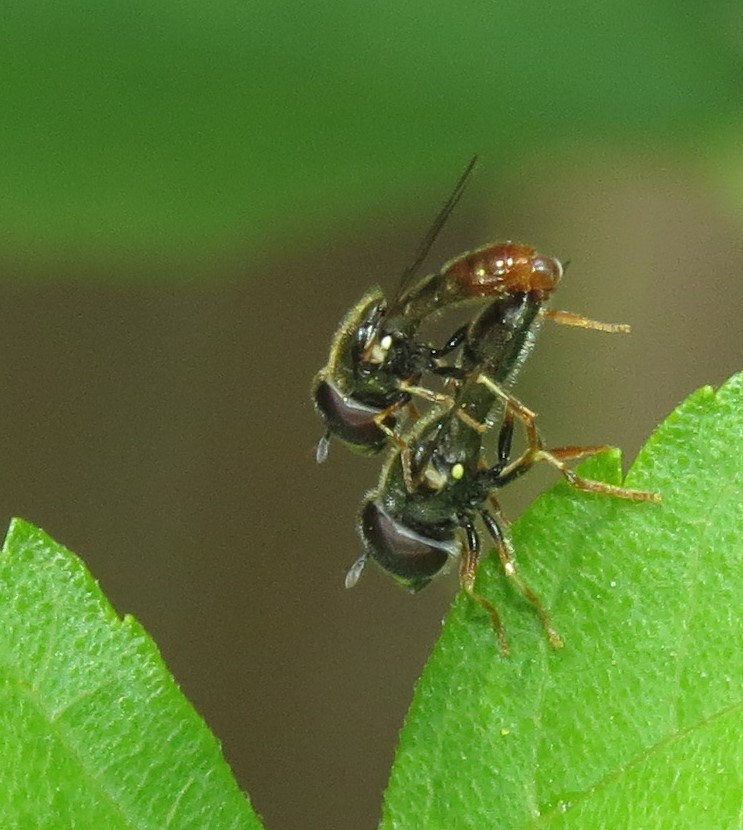
Insects are always making more of themselves, like these Black-backed Grass Skimmer flower flies, Paragus haemorrhous

Our property is modest, with a front and back yard, a back porch and a side porch, and a detached garage. We have not yet planted anything new, save for a handful of daisies and coneflowers from a local nursery. We do mow what passes for the lawn, and intend to replace most of it eventually with native plants, and maybe add a small water feature and bird feeders. The front yard is dominated by an enormous red oak.

Daisy Fleabane, a "weed" that volunteered in the back yard, has a long bloom cycle, attracting insects like this Wavy Mucksucker flower fly, Orthonevra nitida

How have we amassed so many species in so little time? We are privileged to have the luxury of unlimited free time at present. Heidi spends most mornings looking and listening for birds in both yards, and beyond. The pigeons are usually flying over the federal penitentiary located two blocks behind us. A pair of Eastern Wood-pewees raised a family in a tree across the street from our front yard. I make a circuit around the yards at least once per day, usually.

We have lots of spiders, and Blue Mud Daubers like this one hunting them

We have not yet tried much in the way of trapping for insects. We did hang up a bee block under the eave by the living room window, but apparently weren’t watching it at the right time of day. About a week ago I noticed two of the holes had been plugged with mud, likely the work of a mason wasp. We occasionally set out overripe fruits, but those are quickly overrun with ants unless we take precautions like standing a section of log like a pedestal in a container of water that acts like a moat.

We have fireslies that flash, like this Big Dipper Firefly, Photinus pyralis!

We do blacklight fairly regularly, though at present my camera flash has ceased to work. My back-up cameras have repeated lens error issues whereby the extendable lens gets stuck. Finding another camera has been problematic as there are shortages of almost every item now due to the pandemic. That said, blacklighting has been the overwhelming source of our diversity. I frequently find “bonus” insects in images where the intended subject was something else entirely.

Blacklighting has brought us gems like this Black-dotted Glyph, Maliattha synochitis

Here is my challenge to you: although we are no longer confined to our homes by the novel coronavirus, consider staying put anyway and devoting time to bioblitz your own place. Even the most sterile apartment is likely to have a few dozen species. You might have to break out a magnifying lens, but they are there. Share your results on iNaturalist, Project Noah, or similar platforms. Ask for help if you are at a loss for ideas on how to get started. Happy hunting!

Wednesday, January 16, 2019

Death Into Art

There are countless artists who render insects and other animals with traditional media like pen, ink, pencil, paints, clay, wood, and other materials, creating a realistic representation of the organism itself or, alternatively, a whimsical or inspired interpretation thereof. What, then, do we make of art that uses deceased life forms as the medium?

Detail of Jennifer Angus' In the Midnight Garden, 2015
© Smithsonian Magazine

Your appreciation, or disapproval, may hinge on one or more facets of personal taste or ethics. Have we given collective thought to the implications of such works? Maybe we should. People tend to place animals into one or more general categories. One category is reserved for other species that benefit people directly, and usually economically, though often framed as pets or companions for which we like to think there is no "price" we could assign to those individual animals.

Another group we call "pests," or vermin, enemy species that cost us economically in terms of damage to property, pets, livestock, or livelihoods. They may even cost us our lives if they are species that can prey upon us. Those are the two major categories, though most species fall through the chasm between the two, ignored or unknown to most members of Homo sapiens

Ideally, when it comes to animals, art is a way to enhance the appreciation of other species, encourage us to think differently about them, inform us as to their unique behaviors and place in the bigger picture (outside the frame, if you will), and inspire us to learn more once we leave the gallery. I personally know dozens of artists who share that intent, and who execute amazing works. I also know artists for whom I assume that is the foundation of their works, but who use insects themselves as raw material for their works. This begins to make me feel uncomfortable.

© Christopher Marley

The overwhelming message I receive from artwork composed of dead insects or their body parts is that the creature itself is not a complete expression of beauty unless it is modified by human hands into something "greater." I am quite certain this thought never crosses the mind of the artist, and that is understandable. I might even go so far as to say it is human nature to have the desire to "improve" other objects, other species. Look at every domesticated animal, every plant cultivar.

The second ethical aspect of turning deceased animals into art has to do with sourcing. Where did the specimens come from? The acclaimed artist Damien Hirst is currently creating art from dead butterflies, carefully removing the wings and applying them to boards in colorful patterns. He obtains specimens by purchasing old collections. Re-using and repurposing, so what is so bad about that? Nothing, if the collections have no scientific value, but a travesty if the specimens had location data with them. They belong in museums in that event. Other artists use "farmed" specimens bred in captivity so there is no detriment to wild populations.

An absolute purist would argue that even the best sourcing of specimens is still taking away from the carbon and nutrient cycles that other organisms benefit from. Hirst and other artists might consider simply putting out dead insects and letting carpet beetles and booklice reduce them to powder that can then be used to create more art. What an installation that would be, to bring awareness to the natural process of decay.

Dermestid beetle damage
© deanslab.org

The final insult, and I would welcome a better word, is that the artist employing organisms or their parts makes money from the exploitation of nature's works. Artists might consider donating at least a percentage of income to wildlife conservation organizations for the protection of the living versions of the dead ones they use in their works. Maybe, like Christopher Marley, they do and it is simply not widespread public knowledge.

Artists have the power to change our minds, our attitudes, and our behaviors, but it would be nice to see more respectful methods in the madness. More murals. Huge insect images like the ones rendered by Portugese artist Sergio Odeith. Spectacular glassworks like those of Rafael Glass. The real creative challenge, then, is finding new ways to exhalt nature without exploiting her. It can be done. I have faith that way.

Wednesday, January 2, 2019

Book Review: Bugged Delivers a Mixed Bag

Well over a year ago, someone at St. Martin's Press contacted me by e-mail asking me to review David MacNeal's latest effort, Bugged: The Insects Who Rule the World and the People Obsessed with Them (2017, St. Martin's Press, 297 pp). They would hardly take no for an answer, sent me an advance uncorrected page proof, and so finally, here is my assessment, colored by the circumstances of my receipt of the book, my lack of familiarity with MacNeal's previous works, and my personal biases, which I will reveal honestly.

First, my sincerest compliments to the author for his most thorough research, his diligent reading of numerous books and scientific papers, and in-person visits with the human subjects highlighted in Bugged. Whatever shortcomings the book may have, the foundation it was built on is as solid as they come. Additionally, I can say that in my opinion the book gets markedly better the farther the reader gets into it. Unfortunately, I found the first one-third to two-thirds of the book to be an exercise in the author's ego, perhaps due to my own peculiar style that I prefer to write in, and the approach to the subject that I would rather read.

The chapters reflect an overall theme that I am personally averse to: that in order to validate their existence, all non-human organisms must prove they have an economic value to humanity.

MacNeal may simply be trying too hard in the first chapters to convince the reader that he is edgy, funny, irreverent, intellectual, and jet-setting. It comes off as self-centered in my opinion, and aimed more toward those who value shock-and-awe prose. I prefer that an author remove themselves as much as possible from non-fiction, save for memoirs and autobiographies. I personally try to get out of the way of the story when I am writing myself, unless my direct experience is the story. I see no need for profanity ever, not because I am opposed to it, but because I think it can be a distraction if not a detraction from the rest of the words used. I do not try and paint myself as intellectually superior by throwing around words and phrases from foreign languages.

The choice of categories that define the chapters was predictable: Insect specimens as novel merchandise, social insects as a parallel to human societies, insect and spider sex lives, insects as disease-carriers, the pest control industry, insects in forensic science, insects and other arthropods as the source of inventions and advancement of technology, insects as live entertainment in Asia, entomophagy (intentional human consumption of insects as food), and honey bees as perhaps the most important of all insects (to mankind).

The chapters reflect an overall theme that I am personally averse to: that in order to validate their existence, all non-human organisms must prove they have an economic value to humanity. Maybe MacNeal recognizes this and is planning a sequel that will visit topics like endangered insects and the people working to save them, the economic impact of "ecological services" provided by insects and related invertebrates, and the myriad of citizen science projects available for his readers to participate in and become active contributors to science instead of passively entertained by his books. MacNeal does give a nod to ecological services, as almost literally a footnote (another aspect of books that I find distracting and mildly irritating); and he lists a few conservation organizations in the acknowledgements at the end of the book.

The bottom line is that I am glad the book was written, but I would have preferred that someone else had written it. If you enjoy this brand of storytelling that focuses on both insects and people, you may be better off reading works by Richard Conniff or Sue Hubbell.

Does MacNeal succeed in recruiting a new generation of entomology-appreciators? Hard to say. I think it takes actual in-person engagement with scientists to achieve that, and I hope that Bugged encourages readers to take that next, crucial step toward a better understanding of invertebrates in general, and an appreciation of those people, not the eccentrics you presume them to be, who make a living in the science of entomology.

Thursday, November 29, 2018

Thankful For Small Wonders

On Thanksgiving day I usually make a pilgrimage to the Cheyenne Mountain Zoo, where my wife works as a keeper of orangutans, gorillas, Golden Lion Tamarins, and related primates. Thursdays are part of her regular work schedule, but at least the zoo's grill caters lunch for the staff and their families on the holiday. The rest of the day I do an informal mini-bioblitz looking for uncaged wildlife, mostly insects and spiders, of course. You would be surprised by what you can find in late November.

Convergent Lady Beetle

With all the press about a very legitimate "insect apocalypse," it does me good to get out and realize there still is a respectable degree of arthropod diversity, at least for now, and despite heavy human impacts. Last Thursday I managed to find over thirty (30) species of insects and spiders in casual searching, mostly on fences where it is easier to spot small organisms that are otherwise well-camouflaged or esconced in nooks and crannies and cracks and crevices.

Gall midge, a type of fly

Right now there is a good deal of major construction happening on zoo grounds, so there is upheaval of normally static habitats. The zoo is located on a mountainside, the landscape remaining largely natural with mixed coniferous trees, an understory of Gambel's Oak, chokecherry, and various wildflowers and herbs and grasses, most of them native. Yes, there are fruit trees and various exotic flora planted for visual pleasure, and a butterfly garden designed to attract the more colorful insects found in the region, but mostly the place has a very natural look.

Jumping plant louse, Cacopsylla pararibesiae

Zoos do not like to publicize the native fauna found on their grounds because in some instances non-captive animals can transmit diseases to the vulnerable captive animals. This is cause for both veterinary concern as well as potential disciplinary action by the Association of Zoos and Aquariums, the organization responsible for issuing accreditation to zoos for adherence to basic professional standards. This is certainly understandable, but most native animals seen at zoos are birds, sometimes squirrels, and, overwhelmingly, insects. Zoos that fail to acknowledge and embrace those local creatures are doing a disservice to visitors.

Ichneumon wasp

It bears repeating to say that "biodiversity begins at home," and demonstrating how visitors can promote biodiversity on their own property should be a priority at zoos and botanical gardens. That can take the form of a butterfly garden, brush pile, a drilled block of wood that functions as a "bee condo" for solitary bees, or a small water feature to service birds and aquatic insects. You should probably take this only as far as hummingbird feeders, at least here in Colorado where bears and other dangerous wildlife will take full advantage of any food you offer to other kinds of birds, squirrels, and even your own pets. It is in fact a violation of law to feed wildlife.

Flat bark bug, family Aradidae

Simple signage can do a lot to inform zoo guests about the local ecosystems and the role of various animals in maintaining them. Indeed, there are placards around the zoo that do address pollinating insects, bark beetles, etc. It is a start, and something other zoos should emulate as it applies to their own unique macro-fauna.

Ant-mimic spider, Castianeira sp.

Besides the "bugs" themselves, I am grateful for citizen science and social media outlets where I can share images of what I find, and hopefully encourage others to follow suit on their next visit to the zoo, city park, community garden, or even their own backyard. At this time of year, even a bioblitz in your shed or garage or basement can turn up a surprising variety of life forms. Just don't tell your spouse or your mom if they have hostile inclinations toward uninvited animals.

Seed bug, family Lygaeidae

I post regularly to iNaturalist, and occasionally to Facebook....and I need to get back to Project Noah. Whether you know a cockroach from a carpet beetle or a butterfly from a moth, no matter. Share what you observe. Others will help you learn about the critter in question. You may even find something previously unknown to your neck of the woods, to your state, province, or even new to science altogether. There is no end to the discoveries that await you.

A small dung beetle, Scarabaeidae: Aphodiinae

Wednesday, November 14, 2018

Book Review: Hidden Kingdom is More Than "Eye Candy"

The latest offering from scientist, author, and photographer extraordinaire Piotr Naskrecki is sure to surprise and delight even the most seasoned tropical naturalist, student of entomology, and globe-trotting eco-traveler. Hidden Kingdom: The Insect Life of Costa Rica (Comstock Publishing Associates, Cornell University Press, 2017) represents one of the best introductions to arthropods in general, regardless of the geographic limitations noted in the title.

The centerpiece of this book, like his previous works, the critically acclaimed The Smaller Majority and Relics: Travels in Nature's Time Machine, is Naskrecki's mind-blowing imagery of creatures easily overlooked in the natural landscape. He literally renders his subjects larger than life, but then explains how the impact of these invertebrates far exceeds their diminutive stature. So, the magnified macro-world in pictures is simply a reflection of the unheralded, underestimated import of insects, spiders, other arachnids, and crustaceans to the rest of life on Earth. He further communicates this with clear, assertive prose that elevate any reader's understanding of the natural world.

The organization of the book makes it all the more inviting to those who might be unfamiliar with insects (the first chapter asks "What is This?"), or even downright afraid of them. He addresses the intimidation factor head-on in the chapter "Is it Dangerous?" He deftly explains why appearances like "Horns, Spines, and Claws" can be deceiving, but tiny sand flies and mosquitoes can put you in the hospital because of the tinier-still parasitic microbes that they inject when they bite you.

Remaining chapters discuss how insects survive through camouflage, chemical defenses, advertisement of those chemical defenses, and mimicry of other species with chemical defenses, as well as how insects communicate and how those devices for talking to each other allowed some insects to ascend to the truest societies in the animal kingdom.

Scientific terms are generally explained in context, with their first usage in the text, though the book might still have benefited by a glossary, even in place of the index. Some of the taxonomy (scientific classification) differs from what I have come to know, but there exist differences even in scientific circles and these discrepancies cannot be considered errors. Yes, there are a couple of grammatical errors, but I have yet to read a contemporary book without any.

Naskrecki refrains from preaching about the imperiled ecosystem that is tropical forests, and considering that he no doubt witnesses deforestation and other destructive practices every time he goes afield, this restraint is admirable and refreshing. If anyone ever asks "what's the big deal" if we cut down the Amazon, hand them a copy of Hidden Kingdom and ask them to get back to you. This book is a testament to exactly what is at stake for not just the healthy functioning of our planet, but for the future of advances in medicine and other human endeavors.

I would not hesitate to recommend Hidden Kingdom as a textbook for any college-level introductory entomology course. The initial chapter alone informs all the major orders of insects, independent of Costa Rica; but, those professors who teach classes in tropical natural history would do well to assign this book in advance of field trips to the New World rainforests, and dry forests.

Naskrecki has made advances in tropical biology of a magnitude comparable to Darwin, Wallace, and other heroic naturalists of a bygone era. One can scarcely believe that Piotr has the time to write and illustrate books, share his findings on social media (Facebook in particular), lead film crews into the forest (PBS Nature's six-part "Gorongosa Park: Rebirth of Paradise"), or mentor other photographers (BugShot macrophotography workshops), but he accomplishes all of this and more. His is a brilliant mind and generous spirit that are a rare combination. Naskrecki is without question one of the most publicly accessible scientists of our time, even considering that the digital age makes nearly everyone "followable."

Hidden Kingdom is a paperback book of 208 pages. Forgive the awkward dimensions (10 X 10 inches), as it dramatically amplifies the impact of the magnificent photos. Reward and promote excellence in science and art by treating yourself, your family, and friends to a copy of this most outstanding reference.

Sunday, August 12, 2018

Pseudoscorpions: The Strangest Arachnids?

Yes, the image below is of a crane fly in the family Limoniidae, but what is that other thing attached to it? The crane fly showed up at our backyard blacklight a few nights ago in Colorado Springs, and by itself would have been interesting. Its hitchhiking companion made it even more spectacular.

Crane fly with pseudoscorpion gripping its leg

Pseudoscorpions are tiny arachnids, most of them under five millimeters in length, that never fail to provoke head-scratching among people unfamiliar with them. They look like they could be baby scorpions that are missing their telson ("tail"), but they are literally in an order unto themselves: Pseudoscorpiones. They are fairly common, but seldom seen because they frequent microhabitats under bark on trees, stumps, and logs, or leaf litter or topsoil, or in mammal nests or caves, or other places that require a dedicated effort to uncover them. It is only those species that occasionally turn up in our "caves" (homes) that catch our attention.

I wrote about pseudoscorpions previously, for Missouri Conservationist magazine, thanks to fantastic photographs by Ashley Bradford and Ted MacRae, but this week's find finally allowed me my own imaging opportunities. It is interesting that the insects favored as transportation by pseudoscorpions are frequently those associated with decaying wood: longhorned wood-boring beetles (Cerambycidae), braconid wasps that are parasites of wood-boring beetles, and in this case a female crane fly which I would bet oviposits (lays eggs) in decaying wood.

Pseudoscorpions are predatory on other small invertebrates such as springtails, barklice, fly larvae, and mites. They seize their prey with the pincer-like chelae at the ends of their "arms." Those heavy, muscular appendages are actually modified mouthparts called pedipalps. Many species of pseudoscorpions have venom glands in the chelae that help subdue struggling victims. From there, the prey is passed to the plier-like chelicerae, or jaws, that puncture the body wall of the prey, or crush it, and allow for the introduction of regurgitated enzymes to begin the extraoral digestive process. The resulting liquified material is then ingested by the pseudoscorpion.

Bizarre? We are just getting started. The chelicerae also house silk glands, and pseudoscorpions spin silk to encase clutches of eggs, for shelter during molting and overwintering, or even as a retreat from which they can wait in ambush for unsuspecting prey to pass within reach.

Using another animal for transportation is a behavior called phoresy, and that appears to be the chief means of dispersal for pseudoscorpions. They do not have wings, after all, and are so tiny that getting from one optimal niche to another under their own power is almost impossible. Also, they do not "balloon" as many spiders do, spinning silken threads that are caught by the wind and waft the spider to a new home.

After the crane fly died, the pseudoscorpion disembarked and I was able to get the images you see here. I discovered they are much more agile than I anticipated. This one could scuttle backwards fairly rapidly, run forward quickly, and it could easily climb the slick walls of our casserole dish "studio." Maneuvering the tiny creature with an artist's paintbrush was challenging since the animal could simply grip a single bristle and refuse to let go.

The social life and love life of pseudoscorpions is surprisingly complicated. Members of some species can live side by side without antagonizing each other, displaying unique and rhythmic movements of their bodies and/or pedipalps to communicate. Meanwhile, courtship between male and female in nearly all species is accomplished through a variety of behaviors. In all cases, the male packages his sperm in a spermatophore. In the most primitive scenario, he simply deposits on the ground or other substrate where he hopes a female encounters it. She will then pick up the spermatophore in her genital opening.

Males of other pseudoscorpion species will only deposit a spermatophore if they encounter a female. These males may then spin a simple or elaborate, three-dimensional silken bower to help funnel the female to the location of the spermatophore. This greatly improves the male's chances of reproductive success.

Mating can be more intimate in the most "advanced" species. This involves what is best described as dancing, the male grasping the female's pedipalps in his, and gently but firmly guiding her over the spermatophore he has just deposited. There may be subtle choreography and pre-programmed body movements involved in that. They may even kiss, if you will, interlocking their chelicerae.

Pseudoscorpion from leaf litter in Massachusetts

Despite the extent of our collective knowledge of pseudoscorpions, new species are discovered with a surprising degree of regularity. Those who study caves and other specialized habitats; and those who study rodents and other vertebrates, would be wise to keep their eyes out for pseudoscorpions. Meanwhile, carefully inspect the insects at your porch light and you might eventually find one of these arachnids on an insect attracted by your beacon.

Sources: Johnson, Elizabeth A., and Kefyn M. Catley. 2002. Life in the Leaf Litter. New York: American Museum of Natural History. 28 pp.
Weygoldt, Peter. 1969. The Biology of Pseudoscorpions. Cambridge, Massachusetts: Harvard University Press. 145 pp.

Saturday, March 5, 2016

Insect Video Resources

I have recently been adding videos to my own Bug Eric YouTube channel, but my skills are rather weak and my equipment not as sophisticated as that of some of my friends. So, allow me to introduce you to videographers who produce some truly stunning work that you may find useful.

The Bug Chicks, Kristie (L) and Jessica (R)
The Bug Chicks

Kristie Reddick and Jessica Honaker are academically-qualified entomologists who are also gifted with superb marketing skills and a talent for communicating scientific knowledge in easily-understood language. You may be familiar with them for their appearance in four nationally-televised commercials for Windows 10, which started airing the evening of the Academy Awards. The Bug Chicks are masters at using a playful approach with an audience of children, but also understand how to engage parents and teachers.

The core of The Bug Chicks empire are short, informative, accurate, and hilarious videos that impart facts in an endearing and entertaining way. Not sure why Kristie and Jess have not yet received Oscars themselves. I laughed my way to learning what a "solenophage" is, just now, thanks to their video about lice.

The Bug Chicks have an infectious enthusiasm for what they do that is sure to win your heart. Meanwhile, they are true professionals who are sticklers for accuracy, don't talk down to their audience, and empower young people, especially girls. They are the role models and mentors we should all aspire to be.

Mark Berman and P.R. Mantis
Bugman Educational Entoprises

Mark Berman is also a professional entomologist. He and his sidekick "P.R. Mantis" bring the world of insects, spiders, and other arthropods to audiences all over Ohio and beyond as Bugman Education. Mark is, like The Bug Chicks, able to captivate adults as well as children. He has even given TED talks in Columbus. Innovative videos are often at the heart of Mark's presentations and displays. His YouTube channel is managed by P.R. Mantis, and showcases some excellent camerawork and production skills. Check it out.

Dick Walton © Shawneen Finnegan from Facebook
Dick Walton Natural History Services

Richard Walton may be "old school" in his documentary-style approach to wildlife videography, but few do it better, or have managed to record such a wide variety of insect species. He does not limit himself to invertebrates, either, nor any one geographical area. Please see for yourself at his website. He aims to not only film the natural behaviors of his subjects, but to make new predator-prey and host-parasite associations as well. Dick is a gentleman and a scholar, accredited in natural history education and with a wealth of publications and teaching experience under his belt. He has served more conservation organizations and government agencies than I can list here. I will let his body of work, much of it available online, do the talking.

I have had the honor of meeting all of these people and am impressed not only by the quality of their products and services, but by the content of their character. No ego in any of them, just a fierce commitment to instill an appreciation for the natural world in others. They do so with love and respect for their audiences. We can learn much from them, and not all of that has to do with "bugs," either.

Have I ignored other talented entomologists and filmmakers? No doubt I have. Please feel free to share your own heroes and their work through your comments on this post. Don't forget to include links to their websites, YouTube channels, blogs, and other online presences. Maybe you create videos. Do not be shy, please. Promote yourself, too.

Sunday, January 24, 2016

What's in Your Home?

A recent study revealing the surprising diversity of invertebrates in the average American home has been publicized in the last week through articles in a plethora of magazines, newspapers, and online outlets. Among them are The Atlantic, Wired, the News & Observer, Entomology Today, even Science Knocks on YouTube. The question for you, dear reader, is "what's in your home?"

Gall midges like this one (family Cecidomyiidae) are apparently among the most common indoor insects

The actual study, if you want to read it, was published in the journal Peer J, under the title "Arthropods of the great indoors: characterizing diversity inside urban and suburban homes". Matthew A. Bertone, Misha Leong, Keith M. Bayless, Tara L.F. Malow, Robert R. Dunn, and Michelle D. Trautwein are the authors. They did a systematic but gentle job of capturing specimens in 50 homes in and around Raleigh, North Carolina, USA. We should also applaud the homeowners who volunteered for the study.

I think I would be highly embarrassed to have anyone see the condition of my own home, though I do proudly assert that I am not a lousy housekeeper, I am promoting biodiversity! In fact, I have kept track of the arthropods in our Colorado Springs townhouse the last four years, and though I haven't even emptied the light fixtures to see what bugs have died there, or otherwise done a thorough examination, I have found at least 28 species of arthropods.

That total is apparently low on the spectrum revealed by Bertone and his colleagues, who found 32-211 "morphospecies" per home. A morphospecies is a specimen representative of something that is easily differentiated from other organisms, but not identifiable to a true species without much closer examination. Now I really am sheepish. I'll have to look harder.

Brown Marmorated Stink Bug from Oregon

Winter is actually a great time for indoor bug-hunting because you have species that are ever-present, but also those that have made their way indoors for the winter, like Multicolored Asian Lady Beetles, Brown Marmorated Stink Bugs, and Western Conifer Seed Bugs. That firewood you brought in might spawn some longhorned beetles and other wood-boring insects, too.

It is encouraging, but not surprising, that the overwhelming majority of species collected in the study are not the pest species you might expect, but at most "nuisance" insects and spiders that pose no threat to people, pets, or property. This is the message that needs to reach the masses: We can coexist. Indeed, we already are.

Thursday, November 12, 2015

New Mexico Dragonfly Blitz - Day 1

Since it is "Throwback Thursday," it seems an appropriate day to begin recalling a wonderful adventure from earlier this fall. Heidi and I decided to participate in a "dragonfly blitz" in southwest New Mexico, from August 27-30, based at City of Rocks State Park between Deming and Silver City. Our first day, the twenty-seventh, was spent driving from Colorado Springs to the park and then on to our bed and breakfast in Silver City.

Bronzed Cutworm Moth from El Morro Rest Area

Rest stops along the interstate are often a good place to find insects, birds, and other wildlife. Our first such stop on I-25 was at the El Morro Rest Area north of Trinidad, Colorado (milepost 17.72). The building is something of a big flight-intercept trap for various insects that blunder inside. Outside, orb weaver spiders string their snares from under the eaves.

Cat-faced Orbweaver from El Morro Rest Area

I also found two swallowtail butterfly chrysalids anchored to the walls. Common Grackles patrolled the parking area for snack scraps.

Mating walkingsticks, Diapheromera velii, at Walking Sands Rest Area

After crossing into New Mexico, we decided to have lunch at a favorite stop called Walking Sands Rest Area, about fifteen miles north of Socorro, New Mexico. It is aptly-named given the shifting dune habitat, most of which is part of the Sevilleta National Wildlife Refuge. Mormon Tea and other odd plants abound, providing cover for lizards, grasshoppers, mantids, walkingsticks, jumping spiders, and other interesting creatures.

Mating blister beetles, Pyrota bilineata, at Walking Sands Rest Area

There are restrooms, vending machines, and three-sided picnic shelters on a raised platform. This comes in handy if the wind is the least bit gusty, but the effect is also rather creepy because you can't see other people from the picnic shelters until they are right in front of you. Maybe I have just seen the movie Duel too many times....

Cooper's Hawk at City of Rocks State Park

Eventually we reached City of Rocks State Park, which resembles exactly that: a seemingly random deposit of large rock formations and boulders in the middle of the Chihuahua Desert. We were immediately greeted by birds, including a Rock Wren and a covey of Gambel's Quail. A Cooper's Hawk also flew through one of the campgrounds.

Gambel's Quail at City of Rocks State Park

Despite being late in the afternoon, early in the evening, there were still insects visiting flowers, especially Sleepy Orange butterflies. We finally crossed paths with our hosts, Tony and Shela, and learned what to expect the next day. Several parties were camping in the park, others lodging in various (relatively) nearby locations.

Sleepy Orange butterfly at City of Rocks State Park

Heidi and I then drove to our bed and breakfast, the Gallery 400 Inn & Art Gallery. I have to hand it to Heidi for picking yet another great little place to hang our hats.

Male rhinoceros beetle

After settling in, we went to dinner in downtown Silver City. We saw our first dragonfly of the trip, startling a large darner (family Aeshnidae) from its roost inside a storefront alcove. After sunset, enormous rhinoceros beetles, Xyloryctes thestalus began flying around. Naturally, I had to take an after-dinner stroll to see what else might be prowling. I was not disappointed.

Vinegaroon

I had barely turned the corner around the block from our b & b when I came upon a bizarre creature investigating a hole in a wall where the wall met the sidewalk. It was a vinegaroon! I had never seen a "wild" Mastigoproctus giganteus until right then. At my approach it dove into the hole in the wall, but either could not get its entire body inside or decided the cavity would not provide a viable refuge. A little delicate prodding and it backed out. I ushered it into a yogurt cup and took it back to the inn for photo ops.

It turned out that the vast majority of rhinoceros beetles were to be found along "The Big Ditch," a riparian corridor subject to periodic flooding. The "ditch" was once Silver City's main street, but is now a linear park.

Female rhinoceros beetle

A brightly-lit service station across from downtown yielded a little camel spider (Eremobates sp.), which I also took back for better pictures. I later returned all creatures to the outdoors.

Solifuge (aka "camel spider")

I was pleasantly surprised by this first day of our trip, and it proved to be a good omen of things to come. Stay tuned, I will share more in the coming weeks.