Showing posts with label ichneumon wasps. Show all posts

Wednesday, December 7, 2022

A Potential New Host Record for Calliephialtes grapholithae (Hymenoptera: Ichneumonidae) from a Paper Wasp nest (Hymenoptera: Vespidae: Polistes metricus)

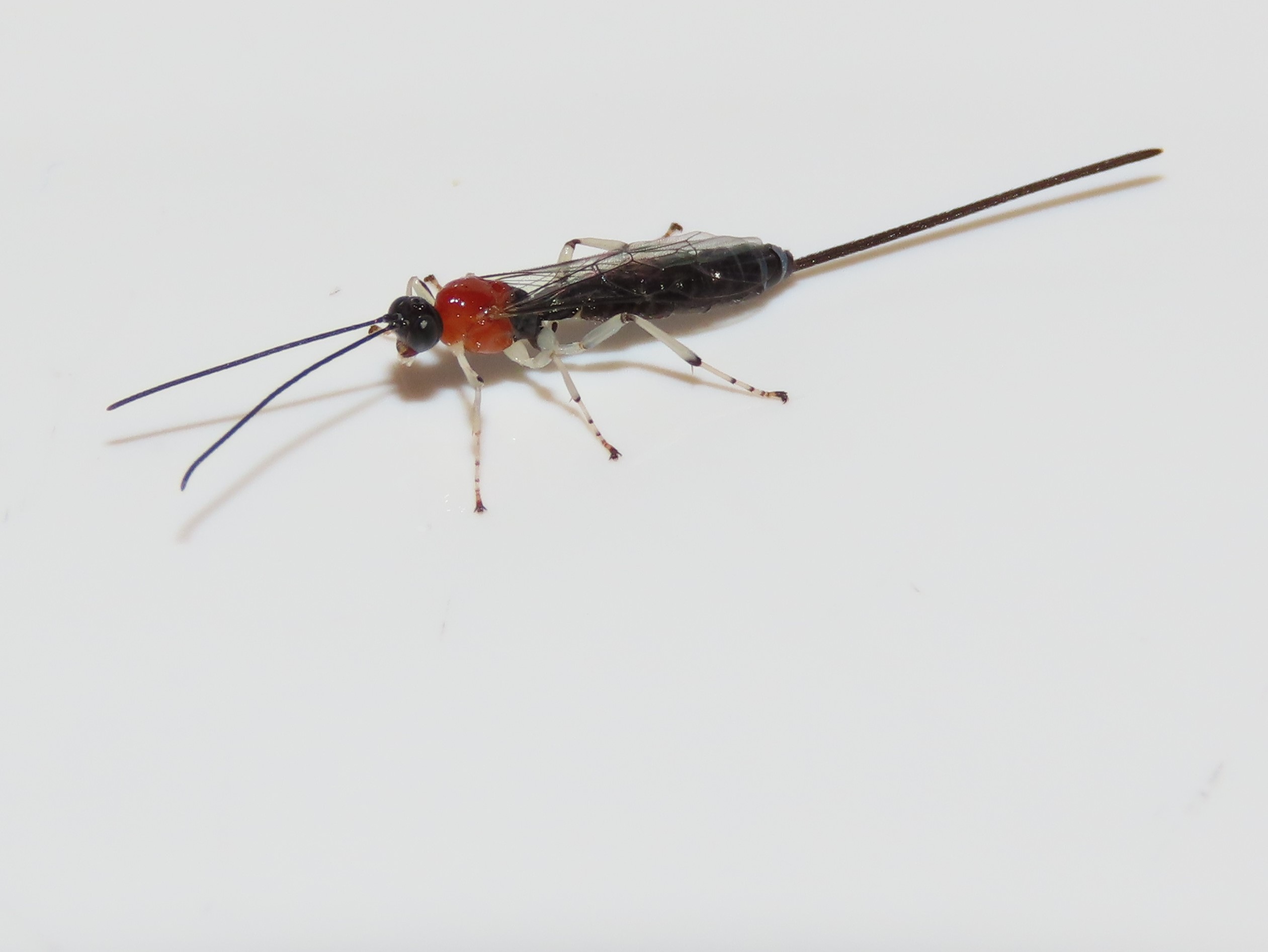
Adult female ichneumon wasp, Calliephialtes grapholithae

It started out innocently enough. Back in 2021, a Facebook post by Sloan Tomlinson (@thatwaspguy on Twitter) caught my attention. He had reared small parasitoid wasps, Elasmus polistis, from an abandoned paper wasp nest that he had contained. I messaged him to learn more, and then followed his suggestion to try this myself.

Nest of Polistes metricus from 2022

We had a nest of the Metric Paper Wasp, Polistes metricus, in a corner of the recessed frame of our back porch doors (French doors) at our home in Leavenworth, Kansas, USA. After the wasps left, I cut down the nest and placed it into a plastic container. Shortly thereafter, in about mid-November, a large number of small parasitoid wasps emerged that were not the same as those that Sloan Tomlinson had reared out. That is a separate mystery from the one I am documenting today.

This year, 2022, we had two Polistes metricus nests, one in each corner of the door frame. One succeeded better than the other by a substantial margin, and I repeated the exercise of cutting down the larger nest and containing it in late autumn. Besides the large number of tiny, metallic parasitoid wasps, I got a shocking surprise.
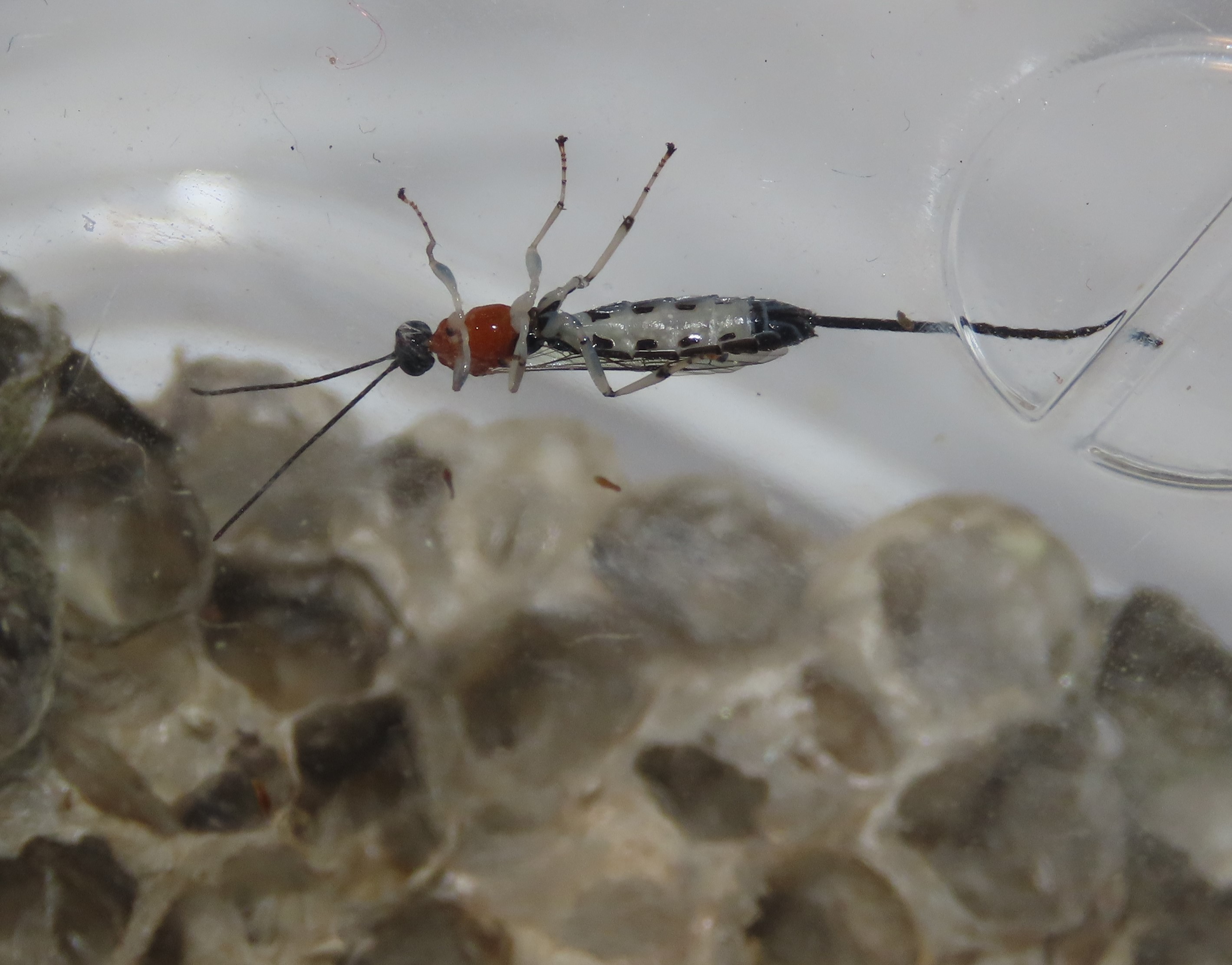
My partner, Heidi, and I went on a vacation in late October. When we returned, I was amazed to find a live female ichneumon wasp, one nearly deceased male, and one deceased male, inside the container with the Polistes nest. The insect was not one of the species that is a known parasitoid of paper wasps. I was able to identify it as Calliephialtes grapholithae, but that made no contextual sense. All of the known hosts for that species are caterpillars of moths.
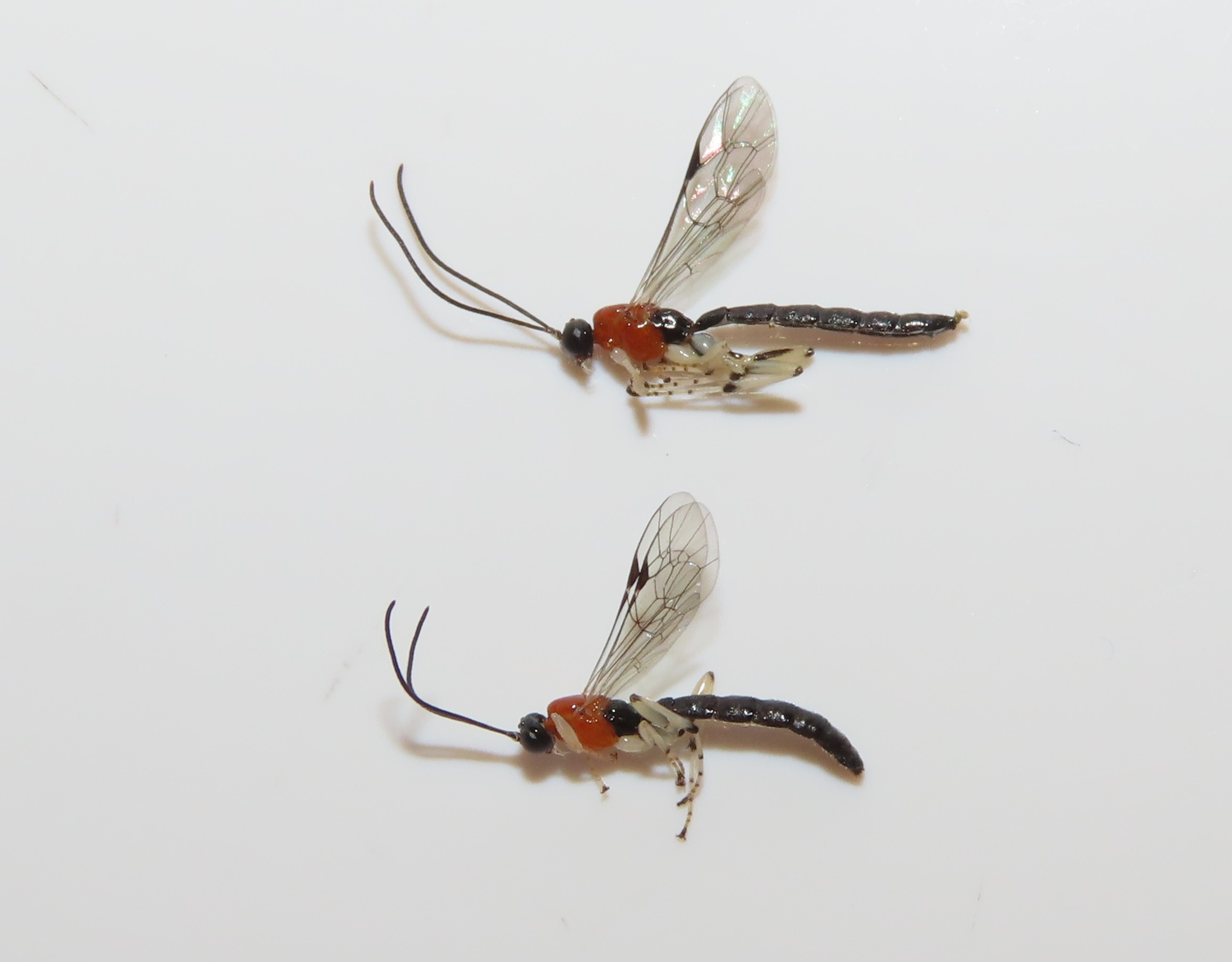
Adult males of Calliephialtes grapholithae

Previously recorded hosts for C. grapholithae include larvae of the following Lepidoptera: Acrobasis betulella, (formerly A. hebescella), A. juglandis, A. rubrifasciella (recorded as A. nibrifasciella (Pyralidae: Phycitinae); Carmenta texana (Sesiidae: Sesiinae); Cydia caryana (recorded as Laspeyresia caryana, the Hickory Shuckworm, Tortricidae: Olethreutinae); Meskea dyspteraria (Thyrididae: Siculodinae); Periploca ceanothiella (recorded as Stagmatophora ceanothiella, Cosmopterigidae: Chrysopeleiinae); Thyridopteryx ephemeraeformis (Psychidae: Oiketicinae); Megalopyge opercularis, the Evergreen Bagworm (Megalopygidae). Most of these taxa represent a “concealed host,” such as the Evergreen Bagworm and Hickory Shuckworm.

The only way the association of C. grapholithae with paper wasps can be made is if there is a moth larva involved in some fashion. It so happens that there is. The Sooty-winged Chalcoela, Chalcoela iphitalis, is such a moth (Crambidae: Glaphyriinae). The caterpillar stage is predatory on the larvae of Polistes wasps, inside their nests. Webbing spun by the caterpillars is a clue to their presence. Apparently, the adult female moth approaches the nest at night, when the adult wasps are less alert. Still, she may lay her eggs on the back of the nest, and let her tiny larval offspring find their way into a cell.

Caterpillar of Chalcoela iphitalis from paper wasp nest

Sure enough, I happened to notice one of these moth caterpillars, strikingly similar to a paper wasp larva, in the bottom of the container with the nest and its other associates. There is little doubt in my mind that C. iphitalis is a host for the ichneumon wasp Calliephialtes grapholithae. The pattern of this wasp seeking concealed hosts fits, though how the wasp navigates a well-defended nest of paper wasps is beyond my imagination. I am hoping that such an infiltration can be documented, or that someone else will independently rear the ichneumon from a paper wasp nest. Until that time, I cannot assert, unequivocally, the host relationship.

Adult Chalcoela iphitalis moth

I also wonder if the sever drought experienced by eastern Kansas this past summer had anything to do with the proliferation of the moths that plague the paper wasps. I noticed more than usual. One of the two nests almost failed completely, though one of the foundress wasps may have died prematurely, slowing the nest’s rate of growth, eventually halting it.

Much remains to be discovered about even the most common of insects, especially when it comes to ecological relationships to other species. I urge my readers to undertake what observations and experiments they can to further enlighten our understanding of the natural world.

Sources: Carlson, Robert W. “Database of Hymenoptera in America north of Mexico,” Discover Life
Hoskins, Jonathan. 2021. “Species Calliephialtes grapholithae,” Bugguide.net
McCormac, Jim. 2017. “Wasp-eating moth fills rare niche,” Ohio Birds and Biodiversity
Calliephialtes grapholithae,” iNaturalist.org

Wednesday, June 8, 2016

Strange Behavior Explained (Sort of)

The other day (Monday, June 6 to be exact) I was exploring Adams Open Space behind the public library in Fountain, Colorado with my wife. I happened to notice a small ichneumon wasp on the underside of a leaf and snapped a couple of images. This was the best one, and I was shocked to see a cluster of eggs beneath the wasp's abdomen. What was going on?

It had been my previous understanding that female ichneumon wasps deposited their eggs on or in their host, as they are parasitic on other kinds of insects (and spiders in some cases). Why was this one laying her eggs in a mass on the surface of foliage?

I posted the picture and posed that question to a Facebook group of world authorities on Hymenoptera, the order of insects to which ichneumons belong. The next morning I got an answer, courtesy of one Sasha Varga, a doctoral student in the Ukraine. First, he offered the genus identification of Polyblastus. That was surprise enough because the overwhelming majority of ichneumon wasps can barely be identified to subfamily from images alone. Thank you, Sasha!

Varga went on to explain that "as I understand, egg remains on the ovipositor after unsuccessful oviposition, but only one and why Polyblastus accumulates several eggs I really don't know." I was simply impressed with Sasha's command of the English language at this point. Ok, so now I at least have some clarified information I can run with.

Wait, Jitte Groothuis added a link to an article that might shed a little additional light. Jitte is likewise a PhD student, at Wageningen University in the Netherlands. Wow, this little observation of mine is circling the globe....

The article cited is entitled "Eggs and Egg Loads of Field-collected Ctenoplematinae (Hymenoptera: Ichneumonidae): Evidence for Phylogenetic Constraints and Life-History Trade-Offs." It is authored by Heather M. Cummins, Robert A. Wharton, and Aubrey M. Colvin, all of Texas A & M University. It was published in 2011 in the Annals of the Entomological Society of America, vol. 104, no. 3, pages 465-475. This sounds like it is over my head, too, so let's investigate together.

Apparently, an understanding of this paper hinges on an understanding of the differences in life histories between various groups of ichneumon wasps. Some ichneumons are "idiobionts," which means that further development of the host insect is arrested at the time it is parasitized by the idiobiont. Typically, a pupa stage is targeted, but sometimes a larva host, and the ichneumon wasp larva is invariably an external parasite. Idiobiont ichneumon wasps are also much more likely to be "generalists" with a wider range of host insects they can expolit.

Other ichneumon wasps are "koinobionts," meaning that the host organism continues its development at least until the wasp larva completes its development, at which time the host often (usually?) dies. Koinobionts can be either external or internal parasites, though the wasp larva is usually attached to the host, never straying to another host or otherwise moving freely away from the host. Koinobionts are also much more likely to be specialized on a narrow range of host species, in contrast to the generalist idiobionts.

Our Polyblastus here is a koinobiont. In its larval stage it is an ectoparasite (external parasite) of sawfly larvae. The adult wasp emerges from the cocoon spun by the host sawfly larva. This makes sense. We even found a female Elm Sawfly, Cimbex americana at the same location on the same day, so we know potential hosts are present.

According to the abstract of the article, the egg loads of female koinobionts like our Polyblastus are "significantly larger" than the egg loads of idiobiont ichneumons, though the eggs themselves are smaller in koinobionts. Unfortunately, an abstract is all I could find online. I will amend this post should I secure a copy of the entire paper. Maybe having so many eggs, our female wasp is forced to carry some of them externally? How does she keep from losing some simply in the course of searching for a host? How does she manage to attach her eggs to the host one at a time (assuming she deposits ova singly)?

Once again, an innocent observation turns into a convoluted and puzzling mystery. That is exactly what I love about entomology, though. It is a science that keeps you in a constant state of awe, forces you to think imaginatively, and challenges your research skills to the maximum.

Sources: Carlson, Bob. 2010. "Tribe Tryphonini," Bugguide.net.
Cummins, Heather M., Robert A. Wharton, and Aubrey M. Colvin. 2011. "Eggs and Egg Loads of Field-collected Ctenoplematinae (Hymenoptera: Ichneumonidae): Evidence for Phylogenetic Constraints and Life-History Trade-Offs," Ann. Entomol. Soc. Am. 104(3): 465-475.
Goulet, Henri and John T. Huber, eds. 1993. Hymenoptera of the World: An identification guide to families. Ottawa, Ontario: Agriculture Canada. 668 pp.

Wednesday, December 4, 2013

Ichneumon Wasp: Ceratogastra ornata

Welcome to "Wasp Wednesday." The wasp family Ichneumonidae is one of the most diverse in the order Hymenoptera, especially in the largely temperate climate of North America. Many species look superficially alike, even if they belong to different genera. One of the few species I can usually identify in the field is Ceratogastra ornata, which I still often mistake for a spider wasp anyway.

This wasp is well-named, for it is ornately patterned with yellow and reddish brown or black, depending on the geographic location where one finds them. In fact, four subspecies are recognized. Collectively, they are distributed from southern Ontario, Massachusetts, and southern Wisconsin west to eastern California and south to northern Florida, Louisiana, and Mexico.

Specimens from the northern reaches of the species’ range are generally darker, including the wings, with reduced yellow markings. Specimens from farther south and west, like the one shown here from Colorado Springs, are distinctly paler.

It has been suggested that this wasp is a mimic of stinging spider wasps in the genus Poecilopompilus. Indeed, the similarities in color and pattern are striking, though the spider wasps are slightly larger than the ichneumon's 10-12 millimeter body length in most cases. Here in Colorado Springs, I found another spider wasp, Ceropales, to be a potential model for the ichneumon.


Ceropales sp.

How do you tell the ichneumon wasp from the spider wasp it mimics? Look at the antennae for one clue. Ichneumon wasps have many, short antennal segments while spider wasps have far fewer, and longer, segments. Wing venation offers other characters, but one seldom gets a good look. Images of ichneumons may capture the “horse head” cell near the middle of the front wing, the horse’s “nose” pointed toward the wingtip.

Look for Ceratogastra ornata visiting flowers, especially composites. They are not only seeking nectar, but hosts for their larval offspring as well. You might see a wasp that appears to be stinging a flower bud, but this behavior is aimed at the eggs of a moth instead.

Details are sketchy, but apparently females of some moths in the genus Feltia (family Noctuidae, the owlet moths) lay their eggs in certain flowers. The caterpillars that hatch then migrate to the ground where they finish their life cycle as subterranean “cutworms.” The ichneumon wasp intercepts the egg stage, or newly-hatched caterpillar, injecting her own egg into the host. Her larva lives as an internal parasite of the caterpillar, likely letting it mature before feeding in earnest and ultimately dooming its host.

I have personally witnessed female Ceratogastra ornata ovipositing in buds of Common Ragweed, Ambrosia artemisiifolia. The entomologist J.C. Bridwell has also observed this, and found them ovipositing in Eupatorium thoroughworts as well. The wasps also visit goldenrod flowers, but are not known to oviposit among the blossoms (Carlson, 2009). The specimen shown here was favoring the extrafloral nectaries of Common Sunflower, Helianthus anuus.

The inability to identify ichneumon wasps to species should not be a barrier to observing them, or even collecting them. We know precious little about the biology and geographic range of the majority of species. Your images, posted to Bugguide.net, could shed light on this interesting group. Bob Carlson, a world authority on Ichneumonidae, often offers his expertise there as well.

Sources: Carlson, Robert W. 2009. “Database of Hymenoptera in America North of Mexico,” Discover Life
Eaton, Eric R., et al. 2011. “Species Ceratogastra ornata,” Bugguide.

Wednesday, March 6, 2013

Wasp Wednesday: Not What You Think

Note: Special thanks to Bob Carlson and David Wahl for reviewing these images and confirming the identification. Ichneumon wasps are a tricky lot!

It is well known that many different kinds of insects mimic stinging wasps in order to foil their own predators. This is known as Batesian Mimicry, whereby the harmless or nearly defenseless animal achieves protection by resembling a poisonous or venomous “model” animal. There is another type of mimicry known as Müllerian Mimicry in which unrelated poisonous or venomous organisms share bold patterns, typically black and yellow, black and red, black and orange, or black and white. Tarantula hawk wasps, which deliver a very painful sting, are typically colored black or metallic blue with bright orange or red wings. In southeast Arizona, there is a large ichneumon wasp, Rhynchophion flammipennis, that also sports this wardrobe.

The wasp is a member of the subfamily Ophioninae, most if not all members of which are capable of stinging themselves, using their short, sharp ovipositors in self-defense. So, it is possible that this mimicry is Müllerian rather than Batesian. Many ichneumon wasps that do not sting still mimic the stinging spider wasps (Pompilidae), thread-waisted wasps (Sphecidae), and crabronid wasps (Crabronidae).

At least one host for Rhynchophion flammipennis is the Tobacco Hornworm, Manduca sexta. The female wasp locates the host caterpillar and injects an egg into its body. The wasp larva that emerges from the egg then feeds as an internal parasite (endoparasitoid). They are “koinobionts,” meaning that they attack very young caterpillars, and draw out their own life cycle such that the host caterpillar continues to grow and mature.


The closely-related Tomato Hornworm, Manduca quinquemaculata

The wasp larva inside waits patiently, then feeds in earnest as the caterpillar nears pupation, destroying it before it actually does pupate. The wasp larva then spins a dense silken cocoon in which it pupates. Since sphinx moth caterpillars pupate underground, the wasp cocoon is likewise located in the pupal chamber in the soil.

This species is known to occur in Arizona, Mexico, Nicaragua, and Ecuador. It is a member of the tribe Enicospilini, most of which are tropical wasps. There are only two other known species in the genus. While most Ophioninae are nocturnal, Rhynchophion are day-active. They even visit flowers for nectar.

Curiously, I have found other images of this species online, but in every case the antennae are black. Perhaps antenna color varies with gender? Certainly much remains to be learned about this spectacular wasp, including whether it has other hosts. Anyone who rears sphinx moths from Arizona, Mexico, or Central America should make note of any parasitic Hymenoptera that emerge from their livestock.

The specimen imaged here was observed at the mouth of Madera Canyon in Pima County, Arizona on August 21, 2011. It hung motionless from the Desert Broom plant it was clinging to. Perhaps it collided with a vehicle entering the canyon and was recuperating.

Sources: Carlson, Robert W. 2009. “Family Ichneumonidae,” Database of Hymenoptera in America north of Mexico. Discover Life.
Gauld, Ian D. and David B. Wahl. 2013. “Subfamily Ophioninae,” Genera Ichneumonorum Nearcticae. The American Entomological Institute.
Kester, K. and J. Tuttle. 1999. “Host identified for Rhynchophion flammipennis (Hymenoptera: Ichneumonidae). Southwest. Nat. 44(1): 87-88.

Wednesday, August 15, 2012

Wasp Wednesday: Mesostenus

I am finding a great diversity of wasps (and other insects) visiting the leaves and stems of sunflowers (Helianthus spp.) this summer here in Colorado Springs. Among them is an ichneumon wasp in the genus Mesostenus. Boldly marked in black, white, and red, they are difficult to miss despite their small size (about 6-13 millimeters in the specimens illustrated here).

Sunflowers have special structures called “extrafloral nectaries” that secrete a sweet liquid that insects crave, especially ants. The ants try and drive off every other competing insect, which is mostly wasps, bees, and flies. Some plants are more attractive than others, and the reasons for that are probably many. We have had a sustained drought here on the Front Range, verging on the “extreme” side of the scale. Record-breaking hot temperatures have also withered many annual plants. It is metabolically expensive for sunflowers to produce the nectar, so some individual specimens probably forgo the production process. This leaves them at least slightly more vulnerable to herbivorous insects that the ants would normally fend off along with the flies and wasps.

Because the wasps are constantly dodging the ants, it is difficult to get good images of them. They are persistent, however, and may eventually settle down long enough for me to get a clear shot while they lap up the sunflower’s exudates. At least it is easy to tell the difference between the females and males. Mesostenus is one of the many genera in the Ichneumonidae where the female possesses a long, tail-like egg-laying organ called an ovipositor. Males (below) lack an ovipositor, obviously.

Many people mistake the ovipositor for a stinger, and react with alarm to a wasp that looks like it could penetrate a down jacket with its venomous weapon. The device is instead employed to lay eggs in the host insects the wasps parasitize.

There are ten species of Mesostenus in North America north of Mexico, but the genus is nearly worldwide in overall distribution. About four of those species can be found in Colorado. M. sicarius is closely tied to certain cacti (Opuntia spp.), of which we have prickly-pear here in the Springs.

The long ovipositors come in handy when inserting an egg in a stem-boring or shoot-boring caterpillar like that in the genus Acrobasis, in the moth family Pyralidae. The wasps are also important parasites of stored product pests like the Indianmeal Moth, Plodia interpunctella, also in the Pyralidae. The American Plum Borer, Euzophera semifuneralis, has caterpillars that feeds beneath the bark of host trees, a habit that still leaves them vulnerable to Mesostenus gracilis, the species that might be shown here. Not surprisingly, the caterpillar of the Sunflower Moth, Homoeosoma electella, is also a host. Mesostenus also parasitizes caterpillars of the moth families Crambidae and Tortricidae.

We only know host associations for a few of these wasps, so rearing caterpillars may yield new host records. That is true for other Ichneumonidae as well. Folks who try raising caterpillars through to moths or butterflies are often profoundly disappointed when a wasp (or fly) emerges from the larva or chrysalis instead. I urge people to take care to preserve the insect anyway, noting the species (or genus or family) of caterpillar from whence it came. It could turn out to be a valuable observation.

Sources: Carlson, Robert W. 2009. “Database of Hymenoptera in America North of Mexico,”Discover Life.
Cushman, R.A. 1929. “A Revision of the North American Ichneumon-flies of the Genius[sic] Mesostenus and Related Genera,” Proc U S Nat Mus 74(2761): 1-58 (Smithsonian Digital Repository, available as a PDF).

Wednesday, March 28, 2012

Wasp Wednesday: Spilichneumon

One of the more common early spring wasps here in the Front Range of Colorado is an ichneumon wasp in the genus Spilichneumon. According to the Database of Hymenoptera in America north of Mexico there are at least four species in the state, so perhaps I am seeing more than one.

These wasps are active and skittish enough that they defy my ability to get really crisp images of live specimens, but I have found two deceased individuals on bike trails here in Colorado Springs. Plus, my fiancée found one at the Cheyenne Mountain Zoo. This specimen is shown below.

These wasps overwinter as adults, inside rotten logs and other protected situations, so they are among the first wasps one is likely to encounter by winter’s end.

Members of the genus Spilichneumon are not well-known, at least in the western U.S. The global range of the genus is the northern hemisphere (termed “holarctic”), and Oriental. Here in North America, most species are found in the extreme northern U.S., Canada, and Alaska, and along major mountain ranges as far south as Arizona.

This is yet another wasp you can count among your friends. Spilichneumon is an internal parasite of noctuid moth caterpillars. The female wasp finds a caterpillar and injects a single egg into it. Her larval offspring then feeds inside the caterpillar, allowing the host to eventually graduate to its pupal stage. The wasp larva pupates inside the host and emerges from the host chrysalis as an adult wasp.

I wonder if Spilichneumon competes with the cutworm-hunting sphecid wasps in the genus Podalonia? Both go after the same prey, at least in part, but Podalonia appears to be far more abundant here than the ichneumons. My observations may be biased, however, since I am usually out at the warmest part of the day, when Podalonia is most active. Spilichneumon, and other genera in the subfamily Ichneumoninae, tend to shun extreme heat and direct sunlight.

Look for this genus where you live. See Bugguide for better images. Look on the forest floor in open woodlands, as the wasps tend to seek their prey among leaf litter.

Wednesday, September 7, 2011

Wasp Wednesday: Pachysomoides fulvus

Sometimes, the worst enemy of a wasp is another wasp. Paper wasps in North America have much to fear from a stealthy little ichneumon wasp named Pachysomoides fulvus. I had the good fortune of finding one biding her time in the vicinity of a nest of Northern Paper Wasps, Polistes fuscatus in Adams County, Ohio last month.

This parasitic wasp ranges from New York to Florida, and west to California and British Columbia, but does not appear to be abundant anywhere.

The female wasp lays her eggs on larvae or pupae of paper wasps inside the cells of the exposed paper comb. Young nests populated only by the foundress are especially vulnerable since the “queen” must leave the nest to hunt food for her offspring. Interestingly, an image over at Bugguide.net appears to show one of these wasps ovipositing in the wall of a cell that has at most only an egg in the bottom. Perhaps the larval ichneumon would emerge once the larval paper wasp had hatched.

I found more detailed information on the life history of Pachysomoides fulvus difficult to come by online, at least without buying access to articles from journal warehouses like Jstor. I have also packed up all my books now in preparation for moving. I might revisit this unique wasp, and will alert you if I am able to add more.

There is a second species of Pachysomoides in the U.S. that bears the unfortunate name of P. stupidus. Considering it is willing to confront a population of much larger wasps, the epithet might be appropriate! P. stupidus occurs in the southeast, from North Carolina to Florida and Texas and southern Illinois. It is an ornate, black and white banded insect with orange legs.

In this species, the female wasp lays several eggs on a pre-pupal Polistes grub. The larvae that hatch from those eggs then feed gregariously as external parasites on the pupa. Because the larval paper wasp spins a silken cap over its cell before pupating, the parasitic ichneumon larvae can feed undetected by the adult wasps on the exterior of the nest. Up to thirty-one larvae have been observed on one paper wasp pupa (Pickering, 1980).

Sources: Pickering, John. 1980. Larval Competition and brood sex ratios in the gregarious parasitoid Pachysomoides stupidus. Macmillian Journals Limited.

Wednesday, August 24, 2011

Wasp Wednesday: Pimpla sanguinipes

I should know by now that nothing comes easy in entomology. Here I figured I could just whip out a short piece on an ichneumon wasp I imaged in southern California back on March 26, but no-o-o-o, it looks like even the name I have for it, courtesy of Bob Carlson via Bugguide.net, might be outdated. Meet Pimpla sanguinipes, or whatever alias it goes by these days.

Actually, it looks like the appropriate name for this member of the family Ichneumonidae is Coccygomimus sanguinipes. Bugguide lists Coccygomimus as a “synonym” for Pimpla, so maybe it still *is* Pimpla.

The wasp I found at the salt marsh preserve in Carpenteria is further defined by the subspecies name erythropus. I do wonder what all these references to “blood” mean, though the wasp does have reddish-orange legs.

Dr. Carlson pointed out the complexity of all this in a personal communication with Vasile Bagazzoli, a volunteer editor at Bugguide:

"erythropus and sanguinipes might really be two separate species, judging from the fact that they occupy different habitats: sanguinipes in arid areas and erythropus in forested areas. Townes even had differences in punctation for the two. His concept of subspecies was very dubious, and he did not strictly apply the concept in a geographical sense and named many sympatric subspecies, many of which I relegated to synonymy in the 1979 catalog. But this case was different, and I might have just elevated the two taxa to species level but did not. I don't remember if I had a reason for not doing it, but maybe it was because there was a dearth of specimens in the National Collection from which I could form an opinion."

Dr. Carlson is retired from the Systematic Entomology Laboratory at the National Museum of Natural History in Washington, DC. He also studied under the “grandfather” of ichneumon taxonomy, Henry T. Townes.

Ok, back to the actual wasp, and what *it* does for a living. The species ranges west of the Rocky Mountains from Idaho to New Mexico and west to the Pacific coast including British Columbia and southern California.

Females seek out moth caterpillars in which to lay their eggs. Their hosts include tent caterpillars (Malacosoma spp.), buck moths (Hemileuca sp.), the Virginia Tiger Moth (Diacrisia virginica), the Douglas Fir Tussock Moth (Orgyia pseudotsugata), Western Tussock Moth (O. vetusta), Coddling Moth (Cydia pomonella), Genista Broom Moth (Uresiphita reversalis), Gooseberry Fruitworm (Zophodia convolutella), Barberry Geometer (Coryphista meadii), the Oak Looper (Lambdina punctata), and two other geometer moths (Eucaterva variaria and Prochoerodes forficaria). Several of these moths are abominable pests, so this generalist parasite is a welcome friend to agriculture and forestry.

The physical dimensions of this wasp don’t fit its superhero reputation. Females range between 10.5-12.5 millimeters in length, males around 8.5 mm. The black body, orange legs, and short, stout ovipositor help to identify the species fairly easily. We just can’t decide what name to call it.

Wednesday, July 13, 2011

Wasp Wednesday: Therion morio

Unfortunately, here in the Sonoran Desert of southern Arizona, there is not a great diversity of ichneumon wasps, at least not the larger, more colorful species that one finds routinely in the deciduous forests of eastern North America. I was delighted to find a female specimen of Therion morio at the Vernon Wildlife Area near Mukwonago, Wisconsin on June 25. Even more amazing, it actually paused long enough for me to snap a few images. The one below is the best of the lot in the dim light of the forest understory.

This species is about the size of a black and yellow mud dauber, and it would not be surprising to find it is indeed a mimic of Sceliphron caementarium. The rule of thumb with ichneumon wasps is that if it looks like a stinger, then it isn’t a stinger. Such is the case here. The female has a short, spine-like egg-laying organ called an ovipositor. She does not use it in self-defense, only to inject eggs into caterpillars.

The larvae of this wasp are internal parasites of moth caterpillars, including the Fall Webworm, Hyphantria cunea, so this ichneumon should be considered a beneficial biological control of such pests. Other recorded hosts include the larvae of other tiger moths (family Arctiidae): Cycnia inopinatus; the Virginia Tiger Moth, Spilosoma virginica; the Saltmarsh Caterpillar, Estigmene acrea; and the Spotted Tiger Moth, Lophocampa maculata. While the wasp’s egg is laid in a caterpillar host, the adult offspring will emerge from the moth’s pupal stage.

Therion morio, which has no common English name, is a widespread species ranging from Nova Scotia south to Florida and west to Washington, northwest Nevada, southeast Kansas, and Mexico.

Sources: Carlson, Robert W. 2009. “Ichneumonidae,” DiscoverLife.org

Wednesday, April 20, 2011

Wasp Wednesday: Colpotrochia

Prowling around outdoor lights at night to look for insects can be fraught with difficulty, especially in a small town. The first time I went out to investigate the lights of South Deerfield, Massachusetts, I was confronted by the local constabulary. Hey, can I help it if the best-lit buildings are banks and the U.S. Post Office? I cleared a background check and was rewarded in the long run by encounters with many six-legged personalities, including this ichneumon wasp in the genus Colpotrochia on June 23, 2009. Oh, by the way, I found it by the lights on the police station.

The genus Colpotrochia is placed in the subfamily Metopiinae, the members of which all lay eggs in the host larva, emerging as adult wasps from the host pupa. According to the Database of Hymenoptera in America North of Mexico there are four North American species in the genus, all ranging from the Atlantic coast to barely west of the Mississippi River. Two of those are known in Massachusetts: C. crassipes and C. trifasciata. These are not very large insects, averaging between six and ten millimeters in body length.

Gardeners will be delighted to learn that the female wasps use their very short ovipositor to lay eggs in caterpillars, especially leafrollers in the family Tortricidae. The wasp grub that hatches inside the caterpillar slowly consumes its host, avoiding disruption of the caterpillar’s life cycle until after it pupates. Instead of a moth emerging from the pupa, out comes a wasp.

Those interested in identifying ichneumons to the subfamily level (no mean feat) might start with this PDF file, an Identification Key to the Subfamilies of Ichneumonidae, by Gavin Broad. It provides a very good start for learning how to tell ichneumons from braconids, and other basic information, all well-illustrated.

Special thanks goes to Bob Carlson for identifying my image after I posted it to BugGuide.

Wednesday, January 12, 2011

Wasp Wednesday: Neamblyjoppa?

I better start this post with a disclaimer. There is much circumstantial evidence that the wasp depicted here is the species Neamblyjoppa nasutus, but no concrete proof since I did not collect the specimen. It definitely *is* an ichneumon wasp in the family Ichneumonidae, subfamily Ichneumoninae.

Special thanks goes to Robert Carlson, a renowned authority on ichneumon wasps who got me in the ballpark by properly classifying these images when I posted them to Bugguide.net. I found the wasp at the Tucson Botanical Gardens right in the heart of town on September 14, 2010. It was resting amid dense foliage to escape the heat of the late afternoon. It was roused by my approach, and flew deeper into the vegetation. I eventually relocated the insect and got the head-on image.

When I next visited the collections in the entomology department at the University of Arizona here in Tucson I made it a point to look for specimens of this wasp, and indeed I found at least a close match: Neamblyjoppa, the name scribbled on a piece of paper in the unit tray that held the specimen. Posting this possibility with my images back at Bugguide drew this response from Dr. Carlson:

”Heinrich described Neamblyjoppa in 1962 from a single species that he knew from three females, two in the Canadian National Collection and one in the collection of Henry Townes. The females are amblypygous. The most critical character for recognizing the genus appears to be the unusual clypeus, which bears a median swelling that becomes bipartite below, branching toward the apical margin of the clypeus. Because of this character, Heinrich chose to name the species nasutus. I leave it to you to decide whether the view of the clypeus in your image 457119 hints at this. The coloration agrees well with the Heinrich's description. This sort of coloration seems common among southwestern Ichneumoninae. The holotype of nasutus was collected in Florida Canyon, Santa Rita Mts., at 4000 ft. One of the two paratypes was collected in the Santa Rita Mts., and the other was collected in Sabina Canyon, Tuscon.”

That should read “Sabino Canyon,” and the National Recreation Area is north of Tucson, not in the city limits. Still, the habitat is nearly the same, so that tends to strengthen my suspicions for the identity of the wasp.

Bob Carlson gave me even more of an education by describing the wasp as an “amblypygous” female. When I asked what that meant, he replied:

”The term is one that Heinrich used, but the terminology is also applied in the formal name of the tailless whip scorpions, the Amblypygi, and the Bug Guide page on them provides the derivation of the term. In the case of the kinds of ichneumoninae that are amblypygous as opposed to oxypygous, the ovipositor is very short and the subgenital plate is very broad. Amblypyous Ichneumoninae oviposit into mature larvae or prepupae rather than pupae of Lepidoptera.”

This basically means the wasp has no “tail,” the form the ovipositor takes on oxypygous ichneumonids, streaming behind the wasp like a long tail or spear.

Insects that are not deemed “economically important” suffer a great deal from neglect. Little if anything is known about their life histories, prey, host plants or animals, and geographic distribution. I continue to encourage you to make your own discoveries with camera, notepad, camcorder, or net and killing jar. We collectively have lots of work to do.

Wednesday, December 29, 2010

Wasp Wednesday: Chirotica

I never expect to encounter wasps in the middle of December, but then I also don’t go out looking for them at that time of year. A trip to the Sabino Canyon Recreation Area north of Tucson on December 19 has me re-thinking that assumption. I was surprised by the number and diversity of wasps I saw. Among the more interesting was an ichneumon wasp I later identified as belonging to the genus Chirotica.

Fred Heath, a volunteer naturalist at Sabino Canyon, had invited me along for a short hike in the late morning and early afternoon. He knows the area very well and was able to point out everything from plants to puffballs. On a willow tree full of bagworms (moth family Psychidae), a flash of movement caught my eye. A very elegant-looking ichneumon wasp was exploring one of the branches of the willow.

Ichneumons are notoriously quick to fly at the slightest movement, so I did not expect this wasp to stick around. Much to my surprise it simply continued its searching behavior, allowing me a couple images with my camera before it departed. What was this female looking for?

It turns out that the four North American species of Chirotica are parasites of….bagworms! It all made sense, and a series of images on the website Bugguide.net even show one of these wasps investigating a bagworm cocoon.

The “stinger” on my specimen is actually the female’s egg-laying organ, called an ovipositor. She does not use this structure as a weapon in self-defense and so is harmless to inquisitive people like me. Not that I could have caught her by hand anyway.

Anyone with an infestation of bagworms would likely welcome more of these wasps, but I honestly have no idea just how common (or scarce) they are. You can learn about the known distribution of our four species by using the Database of Hymenoptera in America North of Mexico. Bob Carlson, an expert on ichneumon wasps who is now retired from the National Museum of Natural History (Smithsonian) put together that part of the database.

Ichneumons are among the most diverse group of insects on the planet, so even an “armchair entomologist” can make significant contributions to science by documenting specimens through collection and imaging, but especially through rearing the wasps from host insects like butterfly and moth caterpillars.

Wednesday, October 20, 2010

Wasp Wednesday: Odontocolon

When I was in western Massachusetts last fall, the neighbors across the street in South Deerfield had to have a dying maple tree removed. I came home one evening to find the tree in pieces, neatly cut by a chainsaw. Naturally, I wanted to investigate the insect fauna of the new deadfall. Among the creatures to be seen on those early October days were ichneumon wasps of the genus Odontocolon.

Many thanks go to Bob Carlson, an expert on the family Ichneumonidae who recognized the genus from my images. He has almost single-handedly organized the pages and pages of ichneumons over at Bugguide.net.

Odontocolon is one of four genera in the subfamily Xoridinae. All are recognized as parasites of wood-boring beetles and/or Hymenoptera. There are 23 species of Odonotcolon found north of Mexico. Several are “holarctic,” meaning they are native to the entire northern hemisphere. The genus is recognized in part by the teeth on the hind femur. Females have long ovipositors (see image above), while males do not (see below).

Those ovipositors come in handy since the wasp has to drill into the wood to reach her target. Cutting down the maple tree exposed several grubs of longhorned woodborers (Cerambycide) lying on the stump.

Maybe this is what the wasps were after, but they ignored the helpless beetle grubs out in the open. Perhaps the wasps knew those grubs would be bird food any minute, or would die in some other fashion before the larval wasps could make meals out of them. In any event, I was able to witness one female ovipositing in the stump.

An egg is laid on the living beetle grub, and the female then withdraws her ovipositor to go looking for another host. The larva that hatches from her egg lives as an external parasite on its host, taking its time as the host itself matures. Sometimes a female wasp will oviposit on the pupa of the host, rather than the grub. The result is the same: her larval offspring will consume the host and emerge from the host’s pupa.

Many other ichneumon wasps are parasitic on wood-boring insects, the most spectacular being the giant ichneumons in the genus Megarhyssa which I wrote about last year, before I started “Wasp Wednesday.” Autumn is the perfect time to look for ichneumons on dead and dying trees, so go take a look.

Thursday, June 11, 2009

Giant ichneumon wasps

Prowling around a pile of cut logs near my temporary residence in South Deerfield, Massachusetts on the evening of June second, I almost literally stumbled upon one of the most spectacular wasps on the continent. Female giant ichneumon wasps in the genus Megarhyssa may look menacing, wielding a whip-like “tail” that can exceed their own body length, but they cannot sting and in fact are quite shy, easily startled by sudden movements. It is a pity that people are often so alarmed by these insects, as they have an extraordinary life cycle.

That long, streaming appendage at the end of her abdomen is not a stinger, as the uninitiated tend to assume, but an egg-laying organ called an ovipositor. What she does with it is truly remarkable. She is seeking the grubs of another stingless wasp, the “pigeon horntail,” Tremex columba. Horntail grubs bore in the solid wood of dead, dying, or severely-weakened trees. Along comes a giant ichneumon wasp. The ichneumon somehow “divines” the location of the horntail grub inside the tree or log, then arches her back to pull her ovipositor into position to drill into the wood to reach the horntail grub. Whether she actually penetrates the solid wood, or winds her thread-like organ through existing cracks and crevices is still a mystery, but she manages to deliver her nearly fluid egg to its target host. The ovipositor is actually three filaments: two form a sheath for the actual ovipositor, bracing the animal’s abdomen and allowing the ovipositor to work smoothly without undo bowing.

Once her mission is accomplished, and her egg is attached to the horntail grub, the adult female ichneumon slowly withdraws her ovipositor and begins the process over again, walking the log or tree with antennae outstretched like divining rods.

Meanwhile, her egg eventually hatches, and the larval ichneumon attaches to the exterior of the horntail grub. It will wait patiently for its host to reach a large, nearly mature size, then begin consuming it. The horntail grub is doomed, destined to yield an adult ichneumon rather than a horntail wasp.

Look for giant ichneumons around dead or dying trees at all times of the day. While ovipositing, females are vulnerable, and one can sometimes see where a wasp was taken by a predator. A hair-like filament protruding from a log is all that is left of the wasp in such cases.

Male giant ichneumons like this one can also indicate the presence of females as they vie for mating opportunities. Note that they almost resemble a different species of wasp! Many males may gather at the site where a female is about to emerge. It is quite a spectacle.

Four species of giant ichneumons collectively occur over most of North America. The ones shown here are probably the species Megarhyssa macrurus. Females can vary considerably in size depending on the size of their host as larval wasps. Smaller individuals tend to have reduced spotting on the wings (or no spots at all). Enjoy looking for these insects and observing their amazing behavior.