Showing posts with label solitary. Show all posts

Wednesday, August 17, 2022

Wasp Wednesday: Aulacids

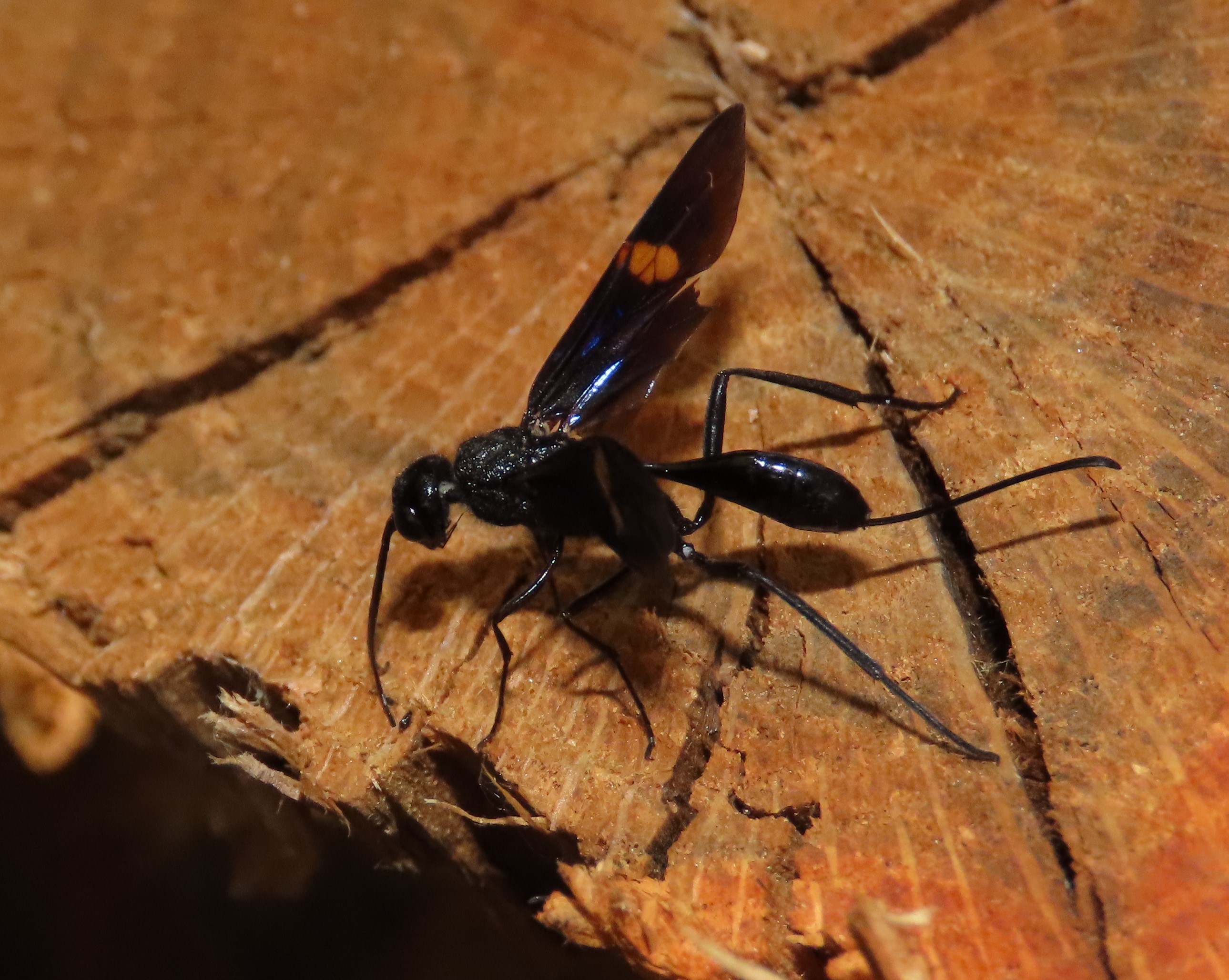
Pristaulacus fasciatus female

Sometimes an unfortunate event yields something interesting later. More on that in a minute. Aulacid wasps are seldom seen, but also often overlooked due to their superficial resemblance to ichneumon wasps. They are found in similar situations as ichneumons, and behave similarly. Two genera and 185 species make up the family Aulacidae, and they collectively occur on all continents except Antarctica. There are thirty-two species in North America.

At 3 AM on June 1, 2022, a massive limb broke off of the Pin Oak tree in our front yard in Leavenworth, Kansas, USA. It apparently hit the ground before striking our house, but it did enough damage to require a new roof and gutters. Removal of the limb took place later that day, and I had the service that did the work leave the log sections in a pile around the base of the tree, where they sit currently. The least I could get out of this minor tragedy would be some interesting insects.

A female Chrysobothris sp. jewel beetle. Her larval offspring are potential hosts for aulacids.

Cut, living wood emits aromatic compounds that attract insects eager to exploit the resource. These include wood-boring beetles in the families Cerambycidae (longhorned beetles), and Buprestidae (jewel beetles or metallic wood-boring beetles) that lay their eggs in bark crevices. The beetle larvae that hatch then bore into the wood. In turn, the parasitoids of these beetles arrive. Aulacid wasps are known to be parasitoids of these beetles, especially the larvae of the longhorned beetles, as well as larval wood wasps in the family Xiphydriidae.

Another potential host for aulacids: Graphisurus fasciatus, a longhorned beetle.

I had collected aulacids in Cincinnati, Ohio when I lived there, and those specimens now reside with the rest of my collection at the Denver Museum of Nature and Science. I had not photographed any, except for one specimen of Pristaulacus rufitarsis in Colorado. I had the good fortune of getting permission to look for insects at a slash pile of freshly-cut pine in Black Forest, just north of Colorado Springs.

Pristaulacus rufitarsis female in Colorado, USA

Here in Kansas, on the western-most fringe of the eastern deciduous forest, I was not sure whether these wasps would occur here. I was delighted to finally spot a female of Pristaulacus fasciatus on the pile of logs in our front yard in late July. Since then, through mid-August, I have seen at least three specimens, and finally managed to get respectable images. All have been females. Perhaps mating takes place away from the logs and trees that the females scour for evidence of their intended hosts.

It has been interesting observing these wasps. They walk haltingly across the logs, bobbing their abdomens slightly, and slowly rowing their wings, which is enough to give one cause to think they might be stinging spider wasps. Indeed, Pristaulacus fasciatus may be part of a small mimicry ring, which I’ll address in a future post.

I notice that the female wasp probes every crack and crevice by inserting her antennae deeply into it, perhaps divining the location of a host that way. Once she locates a victim, she commences ovipositing. Grooves on the inner surface of her hind coxae (basal-most segments, connected directly to her thorax, help guide and stabilize her thin ovipositor as she inserts it.
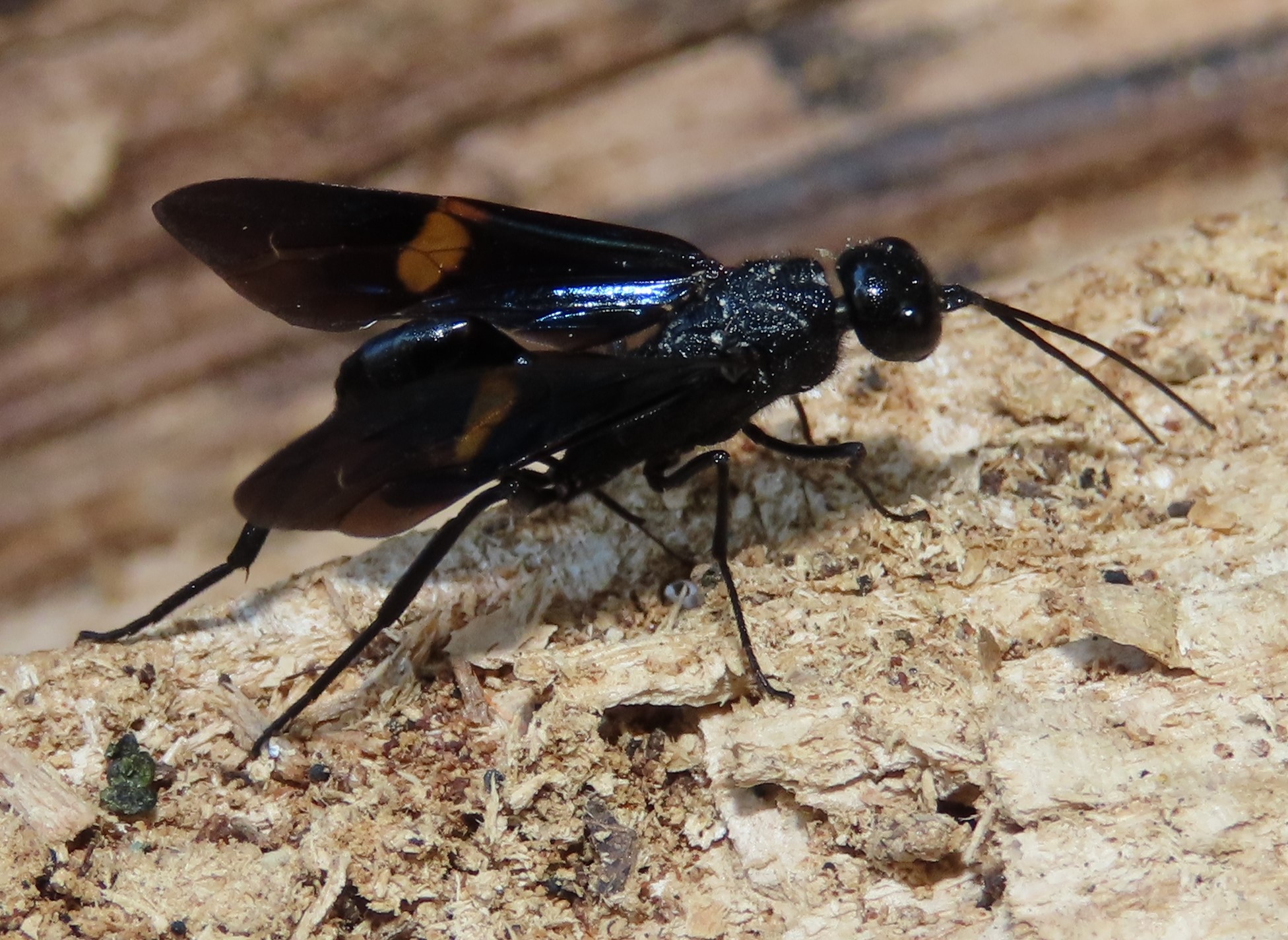
Her ovipositor is entering the wood between her hind leg and middle leg.

Aulacids are identified by the attachment of the abdomen high on the thorax, a short “neck” behind the head, and a somewhat sinuous, not straight, ovipositor. The first two characters reveal the relationship of aulacids to ensign wasps and carrot wasps under the umbrella superfamily Evanoidea. Aulacus is the other genus, with species typically a bit smaller than Pristaulacus. Females of P. fasciatus have a body length averaging around 16 millimeters, while males are slightly smaller at 13 millimeters. They are conspicuous insects, easily spotted but only in these unusual situations.

Look for P. fasciatus from eastern Texas and Nebraska eastward, though it appears absent from most of the southeast U.S. and Canada. There is one record in New Mexico on iNaturalist.
Sources: Eaton, Eric R. 2021. Wasps: The Astonishing Diversity of a Misunderstood Insect. Princeton, NJ: Princeton University Press. 256 pp.
Smith, David R. 1996. “Aulacidae (Hymenoptera) in the Mid-Atlantic States, With a Key to Species of Eastern North America,” Proc. Entomol. Soc. Wash. 98(2): 274-291.

Saturday, July 28, 2018

Wasp-watching

It has been difficult to build-up enthusiasm this summer because insect abundance is way down here in Colorado Springs, but when I get to witness an event like I did yesterday, it makes me glad I went out and made an effort.

Female Ammophila sp. with heavy load

I happened to glimpse a very odd, fairly large insect out of the corner of my eye. It took me a minute to realize it was not a single insect, but two: a female Ammophila sp. thread-waisted wasp toting a caterpillar she had paralyzed. She was trying to locate the concealed nest burrow she had excavated before going hunting, and was wandering around rather aimlessly, but at high speed.

At one point she cached the caterpillar so she could orient herself without such a burden. It worked. She found her burrow, then went back and got the caterpillar. I was lucky to get any images of the transport because she moved so speedily and kept going in and out of focus. Even an attempt at video may have been almost useless. Her agility, with such a heavy load, was impressive. It would be like you or me running at full speed carrying a sofa between our legs.

Removing the "door" to her burrow

She abruptly dropped the caterpillar, and in a matter of seconds uncorked the stone plugging her nest burrow. She quickly entered her burrow, turned around inside, and re-emerged to grab the caterpillar and pull it in. She has to be this fast to avoid tiny parasites known as "satellite flies" that will lay tiny maggots on the caterpillar before the wasp can get it secured underground. Indeed, there was at least one miltogrammine fly flitting at the entrance to the burrow.

Pulling the caterpillar into her burrow

About a minute or so passed with both the wasp and her caterpillar underground. Finally, she emerged topside and quickly retrieved the stone that had plugged the burrow opening previously. She replaced the stone and began kicking sand on top of it. Notice how she curls her front "feet" to maximize the tarsal rake of spines that aid her in digging and filling. At one point she was startled by a curious ant and took to the air for a spit second. Ants can raid wasp burrows and cart off the caterpillar and wasp egg as food for their own young back at the colony.

Replacing the "door" to her burrow

By now I was getting a bit stiff from having stood in the same place for a long while. When I left the wasp, she was apparently unsatisfied with the nest closure and was actively chewing down to the rock plug. I left her in peace to finish what she had started.

Kicking sand to conceal the entrance

The whole sequence of events involved in the provisioning of a nest by a solitary wasp is truly remarkable. She has to dig her burrow and, load after load, flies off with armfuls of soil to fling across the landscape, lest some predator or parasite recognize her nest from piles of "tumulous" around the opening. Next, she fills in the burrow entrance, obliterating all evidence of any cavity whatsoever. She may make a brief orientation flight and then go off to hunt. How does she ever find the burrow again? We cannot even remember where we parked our car, or left our cell phone, and we reportedly have much larger brains than wasps do.

Startled by an ant

Once she has completed her mission of providing one paralyzed caterpillar for a single offspring, she goes off to start the process all over again, somewhere else. Does the wasp immediately forget about the burrow she just completed? How does that instinct work? It has to be plastic enough to address unique situations and overcome obstacles.

Up and away for good?

Over the coming months, in that underground cell, a wasp larva will hatch from the egg and begin consuming its still-living but inactive larder. Scientists believe that insects have no pain receptors, so that must be a blessing to the caterpillar. Were it deceased, though, the caterpillar would quickly rot under the assault of bacteria and fungi. After consuming the caterpillar, the wasp larva enters the pupa stage, as equally inert as the caterpillar on the outside, but inside the pupa there is a massive reorganization of cells converting the grub-like larva in to a sleek, winged adult wasp. Some genes are turned on, others are turned off. It is amazing to contemplate that a wasp larva, or caterpillar, has inside it the latent ability to execute all the behaviors of the adult. It somehow "knows" it cannot fly, does not need flower nectar, and cannot reproduce as a larva. It understands at some fundamental level that its only job is to eat and grow.

Some finishing touches

The next time you are out hiking, and a wasp flies up from under your feet, stop for a second. Back up a little. Does the wasp return to the vicinity? If so, keep watching. She is probably in the process of working on a nest burrow and will resume her activities if you stand still. It takes a little practice just to think about this possibility, but the rewards can be astonishing.

Thursday, February 26, 2015

Green-eyed Wasps, Tachytes

Identifying wasps in the field is often problematic for a number of reasons. Wasps move quickly, and often you only get a glimpse. Mimicry complicates matters and you may actually be looking at a fly, moth, beetle, or true bug. "Field marks" are seldom visible, at least without a magnifying lens. One exception is the genus Tachytes, in the family Crabronidae. The larger species in the genus often have huge green eyes.

Tachytes from South Deerfield, Massachusetts

These insects have been referred to as "sand-loving wasps" in some literature, but they nest in a variety of soil types. I think they deserve the name "green-eyed wasps" because that character is more vivid, even if it does not apply to every species. Males in particular have very large eyes, the better to detect passing females or rival males while scanning the landscape from their perch on a stone, leaf, flower, or twig.

Male Tachytes defending territory from perch in Colorado

Interestingly, one of the hallmarks of the Larrini tribe within the Crabronidae is the reduction of their "simple eyes" (ocelli) to the point of being mere "scars." In Tachytes, the ocellar scars are shaped like golf clubs, having long "tails" running part way down the head. The image below shows the scars between the compound eyes, at the point where they begin to diverge from one another.

Close-up of Tachytes from Colorado

The female wasps excavate burrows in the ground, the tunnels ranging from 7 centimeters to nearly one meter in length, and to a depth of 7.5 to 70 centimeters. Several individual cells are arranged along the length of the burrow, or at the end of tunnels that branch from the main shaft. Some species dig their nests just inside the entrances of burrows made by other organisms such as rodents, lizards, or cicada killer wasps; and at least one species works at night.

All North American species provision those cells with immature grasshoppers (Acrididae), pygmy grasshoppers (Tetrigidae), katydid nymphs (Tettigoniidae), or pygmy mole "crickets" (Tridactylidae). The female wasp paralyzes the victim with her sting, then straddles it, grasps it by the antennae with her jaws, and flies it back to her nest. There, she deposits her prize in one of the cells. One to thirteen victims are placed in each cell, and an egg is laid on the last one.

Male Tachytes atop female in Colorado

Males employ two strategies to find mates. They emerge before females, so at first they defend small territories in the vicinity of areas where females are likely to emerge. Later in the season they defend territories around nesting sites. I have observed them defending territories around nectar resources, too, namely a solitary blooming saltcedar tree (Tamarix sp.) in a large expanse of degraded shortgrass prairie here in Colorado Springs.

The male pounces on the back of a female, pinning her wings to her body, and then beginning courtship behavior. Apparently this amounts primarily to waving his antennae frantically over the female's face, as shown in the short video below. This behavior may not hold true for all Tachytes species, and certainly the duration of courtship and copulation can vary dramatically.

Should the female be receptive, mating ensues. The image below clearly shows a male deploying his....um....ahem...."junk" in preparation for mating. Ok, the technical term is "aedeagus," composed of two "penis valves," and it is the blunt, central structure protruding from the tip of the abdomen in the image. The longer, more slender appendages framing the aedeagus are the "gonostyles." The "volsella" is a shorter spur at the base of each gonostyle. Insect genitalia are complex organs designed to work as a female "lock" and male "key" to prevent cross-breeding with similar species. Indeed, dissection of the male genitalia is often required for species identification in many insects.

Tachytes pair from Colorado

There are 35 species of Tachytes in North America north of Mexico. They are among our more common solitary wasps, easily observed as they feed on flower nectar, though they flit rapidly from blossom to blossom. Males also land on foliage, stones, or the ground, usually returning repeatedly to the same perch or one very close by. This represents the territorial defense behavior, and it allows for great photographic opportunities provided you don't make sudden movements. Happy wasp watching.

Sources: Bohart, Richard M. 1994. "A Key to the Genus Tachytes in America North of Mexico with Descriptions of Three New Species (Hymenoptera, Sphecidae, Larrinae)," Proc. Entomol. Soc. Wash. 96(2): 342-349.
Bohart, R.M. and A.S. Menke. 1976. Sphecid Wasps of the World. Berkeley: University of California Press. 695 pp.
Krombein, Karl V. and Paul D. Hurd, Jr. 1979. Catalog of Hymenoptera in America North of Mexico Vol. 2 Apocrita (Aculeata). Washington, DC: Smithsonian Institution Press. pp. 1199-2209.
Kurczewski, Frank E. and Margery G. Spofford. 1986. "Observations on the Nesting Behaviors of Tachytes parvus Fox and T. obductus Fox (Hymenoptera: Sphecidae)," Proc. Entomol. Soc. Wash. 88(1): 13-24.
Kurczewski, Frank E. and Edmund J. Kurczewski. 1984. "Mating and Nesting Behavior of Tachytes intermedius (Viereck) (Hymenoptera: Sphecidae)," Proc. Entomol. Soc. Wash. 86(1): 176-184.
Kurczewski, Frank E. and Edmund J. Kurczewski. 1971. "Host Records for Some Species of Tachytes and Other Larrinae," J. Kansas Entomol. Soc.. 44(1): 131-136.
Kurczewski, Frank E. 1966. "Behavioral Notes on Two Species of Tachytes That Hunt Pygmy Mole Crickets (Hymenoptera: Sphecidae, Larrrinae)," J. Kansas Entomol. Soc. 39(1): 147-155.
O'Neill, Kevin M. 2001. Solitary Wasps: Behavior and Natural History. Ithaca: Comstock Publishing Associates (Cornell University Press). 406 pp.

Wednesday, February 5, 2014

Double-banded Scoliid wasp

Black and white insects, especially those that are of good size, never fail to attract attention. One of those conspicuous types is the Double-banded Scoliid, Scolia bicincta. These large, hairy wasps are commonly seen on autumn wildflowers like goldenrod (Solidago spp.), thoroughworts (Eupatorium spp.), and milkweed (Asclepias spp.).

Wasps in the family Scoliidae are easily recognized by their relatively large size, robust hairy bodies, and often blue or violet wings with dense horizontal ridges near the tips. Females have short antennae while males have long antennae. Males also have a “pseudostinger,” sometimes three-pronged, on the last abdominal segment. Females have a true stinger, retracted inside the abdomen when not being deployed.

S. bicincta is named for the two broad, white bands across the front half of the abdomen. The insect is otherwise black with bluish reflections on the wings. Size varies from 15-25 millimeters in body length. The species ranges across the eastern U.S. from southern New England to Nebraska and Kansas, south to Florida and Louisiana.

This wasp is not quite as abundant as its cousin the Blue-winged Wasp, but it is by no means rare. No host records exist for the Double-banded Scoliid, as far as I can fathom, but it is assumed to be parasitic on subterranean scarab beetle grubs.

An adult female wasp somehow divines the presence of a beetle larva underground, digs down to it using her exceptionally spiny legs, and stings the grub into paralysis. She either utilizes the grub’s existing burrow as its tomb, or carries it deeper and fashions a crude cell-like crypt. She then lays a single egg on the grub and abandons it.

The wasp larva that hatches from the egg feeds as an external parasite for roughly two weeks. When finished, the larva spins a cocoon and overwinters inside. Come spring it forms a pupa, completing its metamorphosis into an adult wasp shortly thereafter. Adult wasps are on the wing from July through September or October, their flight period depending on geographic latitude to at least some degree.

Look for the male wasps flying close to the ground in a lazy figure-eight pattern. They emerge before females and are eager to find a virgin of the opposite gender, even if she has not yet surfaced from her pupal chamber. Males roost for the night either individually or in loose groups, curling themselves around stems or twigs.

Scoliid wasps should be considered beneficial to your yard, lawn, garden, or farm, where they help to keep those pesky “white grubs” under control. Meanwhile, the adult wasps are fairly effective pollinators considering they are flower visitors out for nectar only. Their hairy bodies can accrue a coat of pollen that they then carry to the next flower.

Source: Grissell, E.E. 2007. “Scoliid Wasps of Florida, Campsomeris, Scolia, and Trielis spp. (Insecta: Hymenoptera: Scoliidae),” Featured Creatures, DPI Entomology Circulars 179 and 185, University of Florida.

Wednesday, October 10, 2012

Wasp Wednesday: The "Horse Guard"

Heidi and I were away last week in Cape May, New Jersey for a belated honeymoon, celebrating in the same place we had our first “date” back in October, 2010. We went a week earlier this time, and visited some locations we had missed on our last trip. Consequently, we saw some different birds and insects, including a wasp that was on my “bucket list.”

The Triangle Point Butterfly Garden, a tiny park near Cape May Point State Park, is planted with a variety of native and exotic flowers that attract many kinds of insects. We visited in the early afternoon of October 5, and found another party looking at the butterflies, but wondering what the big black and white wasps were.

”Oh, my God, that’s a Horse Guard!” I couldn’t contain my enthusiasm as I frantically focused my zoom lens on the wasp. I had forgotten that Stictia carolina, the largest of our “sand wasps” aside from cicada killers, ranged this far north, and persisted into the autumn months.

The Horse Guard is found from New Jersey and Pennsylvania south to Florida and west to Illinois, Kansas, and New Mexico (barely). It is most abundant in the southern Great Plains. Though solitary, each female excavating her own nest, many wasps may nest in a small area of sandy soil.

How did the Horse Guard get its name, you might ask? Also known as “cowfly tigers” and “insecto policia,” the wasps are specialist predators that chiefly attack horse flies. Naturally, the best place to hunt horse flies is around equines. The female wasps will fly around a horse, up and down each leg, searching for their prey. They can even fly backwards in front of a moving horse. This hunting behavior is frequently interpreted as aggression by “hornets” by the average, intimidated horseback rider or ranch hand. Once people understand the intent behind the wasps’ persistent hovering, the usual reaction is one of relief and elation.

”That’s fantastic! How can I encourage more of these wasps for horse fly control?”

Short of importing a sand dune, as the late Howard E. Evans writes in his book Wasp Farm, there is very little one can do to ensure the presence of horse guards at any given farm or ranch. The best thing to do is simply not kill them or accidentally obliterate their nesting areas.

Males search for females by engaging in “sun dances,” which are level flights in circles, figure eights, or sinuous patterns, occasionally perching on low herbs, dung, stones, or on the ground. These patrol beats are most often in the vicinity of female nesting areas, and usually in the morning hours. They will actively chase each other, or molest other large insects that pass through their individual territories.

Females take a surprisingly long time to complete a burrow, taking an average of 22-30 hours. Burrows are usually initiated in the morning, with frequent breaks as the sun becomes more intense, with digging activity increasing again in the late afternoon. The wasp closes the tunnel each time she leaves the vicinity. The burrow is a diagonal excavation, averaging 35-51 centimeters in length, and to a depth of 18-24 centimeters. Soil properties influence these numbers. The tunnel terminates in a single cell, where the wasp deposits a single egg.

Once the nest is completed, the wasp begins hunting, feeding her larval offspring in the progressive fashion that birds do. Between visits, the wasp makes both an inner closure that seals off the terminal cell, and an outer closure that obscures the nest entrance at the surface. Fifteen to thirty-five flies may be fed to the average wasp larva during its lifetime. Larger flies (like horse flies), mean fewer flies are necessary to feed a growing larva. Still, the hunting tactics of the wasps can be very effective in protecting livestock from blood-sucking flies.

The double closure of the burrow between the frequent visits by the mother wasp helps eliminate many of the opportunities parasites usually use to gain entry into sand wasp nests. “Satellite flies” in the family Sarcophagidae (subfamily Miltogramminae) do deposit their own tiny larvae on the prey carried into the nest by the female Horse Guard, but those larvae are generally content consuming the leftovers of prey, rather than attacking the wasp larva itself.

Interestingly, while I was employed by the Cincinnati Zoo in 1988, we received pupae of horse guards from Mississippi that yielded both the expected wasps, but also “Cow Killer” velvet ants, Dasymutilla occidentalis. This would imply that occasionally the Horse Guard offspring fall prey to larvae of velvet ants.

There are two other species of Stictia in the southern U.S., but even more in the New World tropics (28 species total).

Look for the Horse Guard if it ranges in your part of the U.S. All the specimens imaged here are females, by the way. Males, active much earlier in the season, have the white markings confined to the front half of the abdomen only.

Sources: Bohart, R.M. and A.S. Menke. 1976. Sphecid Wasps of the World: A Generic Revision. Berkeley, California: University of California Press. 695 pp.
Evans, Howard E. 1966. The Comparative Ethology and Evolution of the Sand Wasps. Cambridge, Massachusetts: Harvard University Press. 526 pp.
O’Neill, Kevin M. 2001. Solitary Wasps: Behavior and Natural History. Ithaca, New York: Comstock Publishing Associates (Cornell University Press). 406 pp.
Pulawski, Wojciech J. 2011. “Catalog of Sphecidae sensu lato,” California Academy of Sciences

Wednesday, August 22, 2012

Wasp Wednesday: Euodynerus annulatus

Back on July 9, 2012, I visited the Florissant Fossil Beds National Monument in Teller County, Colorado. The area is well-known for amazing specimens of fossil insects, but the ones that live there now are pretty interesting, too. Take, for example, the mason wasp Euodynerus annulatus.

This species is widespread, found from coast to coast in the United States, south to Mexico; and in the Canadian provinces of British Columbia, Alberta, Saskatchewan, and Ontario (though the last record for Ontario was in 1954; and the record for Saskatchewan is very recent). There are five subspecies, three of them western in their distribution. The color and markings vary considerably among those different subspecies.

These are also fairly sizeable wasps, the length of the front wing varying from 8.5-10.5 millimeters. The species could be confused with the very common Euodynerus hidalgo, but the propodeum (hindmost segment of the thorax) is not as angulate in E. annulatus. The hind margins of the first and second dorsal abdominal segments (tergites) are also not clear and reflexed (turned up) as they are in E. hidalgo.

What surprised me the most about this wasp was learning that instead of using pre-existing cavities, or making mud nests, females of Euodynerus annulatus excavate burrows. Not only that, but they extend the tunnel aboveground as a curved mud “chimney.” Several individual cells branch from the main burrow underground. This wasp does not seem to be particular about the soil type, finding hard soil or soft soil perfectly suitable for its nest. The species does seem to favor situations close to water, as the female will regurgitate water to soften the soil during nest-building.

The chimney might help make the nest easier to defend from potential parasites, but it apparently serves as the source of mud pellets to make the final nest closure as well. Eventually, the turret is deconstructed entirely and the nest entrance made nearly invisible and flush with the surrounding soil (Rau and Rau, 1918).

The female wasps use caterpillars from the moth families Crambidae, Pyralidae, and Noctuidae as food for their larval offspring. The caterpillars are only weakly paralyzed (Rau and Rau describe some instances in which the larvae were still ambulatory), usually several placed in each cell. A single egg is suspended from a short thread attached to the wall of the cell before it is stocked with caterpillars. When all cells are provisioned, the nest entrance is sealed and the wasp leaves to begin a new nest.

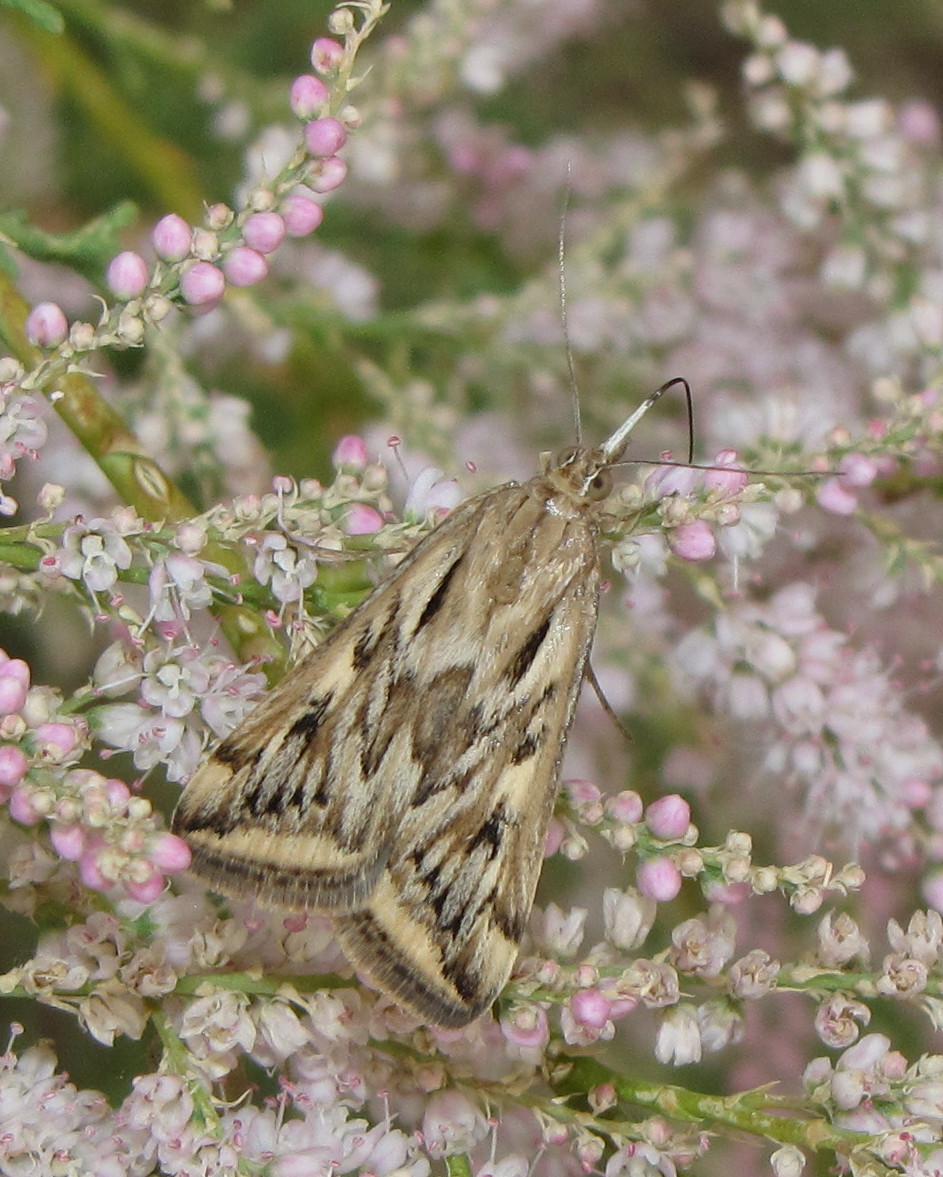
Caterpillars of the genus Loxostege were recorded as a major host by Rau and Rau, and certainly the Alfalfa Webworm and its relations are exceedingly abundant here along the Front Range. Here’s what the adult moth looks like:

Male specimens of Euodynerus annulatus can be recognized by the hooked tips of the antennae, and their less robust appearance. I found both a male and female taking nectar from an early-blooming rabbitbrush plant (Ericameria sp.) at Florissant Fossil Beds.

Ironically, while no nest parasites are recorded for this mason wasp, the adult wasps are vulnerable to a type of insect called a “twisted-wing parasite,” Pseudoxenos hookeri. Parasitized wasps will have bulges in the abdomen, with what look like bullets wedged between abdominal segments. More on these bizarre animals in a future post.

I must thank Dr. Matthias Buck, Associate Curator of Invertebrate Zoology at the Royal Alberta Museum in Edmonton for identifying the wasps in these images, and describing a bit of their biology. I am hoping to get him down to Colorado at some point to see for himself the amazing diversity of Eumeninae to be found here.

Sources: Buck, Matthias, Stephen A. Marshall, and David K.B. Cheung. 2008. “Identification Atlas of the Vespidae (Hymenoptera, Aculeata) of the northeastern Nearctic region,” Canadian Journal of Arthropod Identification No. 5: 492 pp (PDF version).
Krombein, Karl V., et al. 1979. Catalog of Hymenoptera in America North of Mexico (volume 2 Apocrita (Aculeata). Washington, DC: Smithsonian Instititution Press. 2188 pp.
Rau, Phil and Nellie. 1918. Wasp Studies Afield. Princeton, NJ: Princeton University Press. 372 pp. (Dover edition, 1970). Note that Euodynerus annulatus is described as Odynerus geminus on pages 300-312.

Wednesday, November 23, 2011

Wasp Wednesday: Ant-queen Kidnappers

It is thanks to the book Big Game Hunting in the City Parks that I learned as a child of the “Ant-queen Kidnapper” wasps in the genus Aphilanthops. The captivating account by author Howard G. Smith of one of the female wasps hunting and transporting her prey was just too amazing to believe. Turns out it is a true story, just seldom witnessed.

The genus Aphilanthops, in the family Crabronidae and subfamily Philanthinae, occurs only in North America, including Mexico. There are four species, and at least two of them prey on on the winged queens of ants in the genus Formica. They can easily be mistaken for beewolf wasps in the genus Philanthus, but the inner eye margins of Aphilanthops are straight, not emarginated (notched) as they are in beewolves.

You are most likely to encounter the adult wasps as they drink nectar from flowers. The specimen of A. frigidus shown here was spotted in South Deerfield, Massachusetts in the late morning of July 19, 2009. This species ranges across much of the continent from Nova Scotia to British Columbia, and south along the major mountain ranges to the Carolinas, New Mexico and Arizona, and central California (mostly along the coast).

How the relationship between these wasps and their prey evolved is beyond me, but timing is truly everything in this case. The adult female wasp must be ready to take advantage of the short window in which ant colonies swarm. Ant colonies liberate males and new queens typically only once each year. Several ant nests must do this simultaneously to facilitate exchanges in genetic material and thus prevent inbreeding. So, the ant-queen kidnappers don’t have much time to apprehend their victims. Maybe only one day.

Each female Aphilanthops frigidus excavates her own nest burrow, usually in flat or gently sloping sandy soil. Several wasps usually nest in close proximity to one another, but whether they are actively competing for prey from the same ant nests is not obvious. The burrow descends underground at about a forty-five degree angle and terminates in a “waiting room” at 12-25 centimeters below the surface. Up to four ant queen victims are stored in the cell while the wasp constructs additional cells that will host her offspring. These “brood cells” may be 23-45 centimeters underground. Two to three ants are stored in each brood cell, a single egg laid on one of the victims. The cell is then plugged, and the wasp then addresses the next cell. Just how many brood cells are typical of a single nest is unknown. Once finished provisioning all the cells, the was fills in the burrow entrance with additional soil.

Accounts of attacks on the ant queens vary. Howard Smith reports that ant queens are attacked almost immediately upon emerging from the nest. Other observations conclude that the ants are attacked upon landing after their nuptial flights. At some point, the wasps detach the wings of their victims before storing them. The ants are flown back to the nest threshold where they are laid while the wasp inspects the interior of the burrow, then re-emerges to drag the ant down the tunnel by an antenna.

There are no observations of any species other than A. frigidus, so there is a lot to be learned in the future. The most common species I found in Arizona was A. hispidus (image above and below), which is abundant on the blossoms of Seepwillow (Baccharis salicifolia) in August and September. A. frigidus is active mostly from late June to mid-August, at least in New York state where Howard E. Evans studied that species.

Ant-queen kidnappers are not immune from their own villains, principally the “satellite flies” in the family Sarcophagidae. Senotainia trilineata is a confirmed parasite that lays its larvae (yes, the female fly “larviposits”) on the ant victims during their transport to the wasp’s burrow. Metopia leucocephala and Euaraba tergata are also prime suspects in nest failures, as they have been observed loitering in the vicinity of nest aggregations.

Consider doing your own “stake-out” at any wasp nest. Make a video if you are able. Chances are you can add to our scientific knowledge, if not make pioneering discoveries about prey and parasite relationships, seasonality, and other natural history.

Sources:Bohart, R. M. and E. E. Grissell. 1975. “California wasps of the subfamily Philanthinae (Hymenoptera: Sphecidae),” Bulletin of the California Insect Survey 19: 1-92.
Bohart, R. M. and A. S. Menke. 1976. Sphecid Wasps of the World. Berkeley: University of California Press. 695 pp.
Krombein, Karl V. and Paul D. Hurd, Jr. 1979. Catalog of Hymenoptera in America North of Mexico Vol. 2 Apocrita (Aculeata). Washington, DC: Smithsonian Institution Press. Pp. 1199-2209.
Smith, Howard G. 1969. Hunting Big Game in the City Parks. New York: Abingdon Press. 240 pp.

Wednesday, November 16, 2011

Wasp Wednesday: Anacrabro ocellatus

You can often get a clue as to the identity of a wasp by noting what kind of prey she is toting. Ok, so this only works with female wasps, and it is largely a matter of luck to catch one in the act of subduing or transporting prey. Still, if you see a little (6-7 mm) black and yellow wasp in possession of a plant bug in the family Miridae, it is probably Anacrabro ocellatus, in North America anyway.

The funny thing about the image above is that until I uploaded it to my computer and cropped it, I thought the subject was a yellow-faced *bee* in the genus Hylaeus. I shot this by the Campus Pond on the University of Massachusetts campus in Amherst on August 6, 2009.

Anacrabro is a genus with two species north of Mexico. A. ocellatus, with two subspecies, is widespread east of the Rocky Mountains. A. boerhaviae is recorded in the extreme southwestern U.S. and in Mexico.

Most of the other genera in the tribe Crabronini, family Crabronidae, are fly-killers that use species of the order Diptera as food for their offspring. By contrast, Anacrabro seeks plant bugs in the family Miridae, order Hemiptera. Specifically, A. ocellatus hunts almost exclusively for adults of the “Tarnished Plant Bug,” Lygus lineolaris, pictured below.

Tarnished Plant Bugs are certifiable pests. They are generalist feeders that afflict over half of all cultivated plant species in the continental U.S. Substantial numbers of them can certainly cause severe damage to crops and garden plants. Thank goodness the wasp likes to stock them in the larder for her brood.

Anacrabro ocellatus is a “fossorial” wasp, meaning that the female digs a burrow in the soil for her nest. Each wasp digs a nearly vertical tunnel 9-16 centimeters deep, though the shaft may wind or loop in hard-packed soil. Short side tunnels may be present half-way down, but more typically longer side burrows diverge in various directions near the bottom of the main tunnel. Very short passages radiate from these longer side tunnels, each terminating in a single cell. It is into these chambers that 4-9 prey bugs are placed as food for a single wasp larva per cell. Each nest has from one to ten or so cells. Do the math and that makes Anacrabro a pretty heroic pest control species. Females may construct more than one nest, too.

Studies have shown that this wasp suffers relatively little from nest parasites, though in some instances the contents of the subterranean cells were preyed upon by ants. The nest entrance is often concealed by overhanging weedy vegetation, and the female wasp takes pains to disperse the excavated soil, so perhaps such strategies pay off in reduced incidences of parasitism.

Between hunting and nest-digging, females refresh themselves on flower nectar, especially at the umbels of wild carrot (aka “Queen Anne’s Lace,” Daucus carrota). They also visit goldenrod (Solidago), milkweed (Asclepias), and other flowers. That is where you are most likely to encounter them.

Besides its prey preferences, Anacrabro can be separated from very similar-looking wasps such as Ectemnius, Lestica, and Crabro by the very concave underside of the abdomen.

Sources: Bohart, R. M. and A. S. Menke. 1976. Sphecid Wasps of the World. Berkeley: University of California Press. 695 pp. (and source of the drawing above, by Judy Jay).
Kurczewski, Frank E. and David J. Peckham. 1970. “Nesting behavior of Anacrabro ocellatus ocellatus (Hymenoptera: Sphecidae),” Ann Entomol Soc Am 63(5): 1419-1424.

Wednesday, November 10, 2010

Wasp Wednesday: Ammophila femurrubra

It probably became apparent several postings ago that the vast majority of insects have no “common name” in English. Today’s featured species, Ammophila femurrubra, is no exception. In fact, information on this handsome wasp seems to be lacking as well.

Little in the way of research funds and scientific attention is lavished on most insects unless they are of economic importance (read “pests”). You could argue that Ammophila thread-waisted wasps that prey on caterpillars in agricultural settings actually *are* economically important, but in a good way. Most administrators and bureaucrats that dole out research dollars don’t seem to be convinced, however. Consequently, any observations and documentation on such solitary wasps is usually executed voluntarily by “amateur entomologists” that in today’s language we call “citizen scientists.”

Chief among the pioneers to illuminate the biology of solitary wasps were George and Elizabeth Peckham, whose ground-breaking work Wasps, Social and Solitary (Archibald Constable and Company, Ltd., 1905) set the standard for their American followers. Phil and Nellie Rau, who published Wasp Studies Afield in 1918 (Princeton University Press), continued the Peckham’s legacy. There was also Edward G. Reinhard, author of The Witchery of Wasps (The Century Company, 1929); and John Crompton, who penned The Hunting Wasp (Houghton Mifflin Company, 1955). We also owe a debt of gratitude to the reigning champion of popular entomology, the late Howard Ensign Evans. His masterpiece Wasp Farm (Natural History Press, Doubleday, 1963) remains an inspiration to my own writing and love of the Hymenoptera. Still, Evans is best known for his book Life on a Little-Known Planet (Dutton, 1968), easily the best popular book on insects ever published.

So what does this have to do with Ammophila femurrubra? It means we need another Howard Evans to investigate the biology and behavior of this species. All I was able to determine in my research is that the species ranges in the “southwestern U.S.” How enlightening. My personal observations would tend to reinforce the idea that it is typical of the genus, even “sleeping” in the manner of other Ammophila. It is one of the more common species in urban Tucson, so perhaps it is more adaptable to habitat fragmentation than other species. At about 25 millimeters in length it is of average size for the genus, too.

As always, I encourage all of you to be observant and record your observations if possible. You really never know what you are adding to our collective body of knowledge.

Saturday, June 20, 2009

Let Sleeping Wasps Lie

Awhile back I wrote an entry about the sleeping habits of solitary bees (“Let Sleeping Bees Lie”) that I observed and photographed in Tucson, Arizona. Here in western Massachusetts, I was fortunate enough to observe the sleeping habits of solitary wasps in the genus Ammophila, family Sphecidae. Known commonly as thread-waisted wasps, the females are energetic hunters of caterpillars, which they paralyze and store in a subterranean burrow as food for a single offspring.

There are many species of Ammophila found across most of North America, but they reach their greatest diversity in the arid west. More on that in a later post.

Get a grip!

How these wasps manage to get any sleep in this incredibly awkward position is beyond my comprehension. Maybe it is the wasp version of yoga, I don’t know. Simply gripping a twig with your jaws must be hard enough, let alone propping your body at an angle away from your perch. Though solitary, it is not at all uncommon to find loose aggregations of several thread-waisted wasps bedding down in a small area, like this. I once found a cluster of them at Smith Rock State Park in Oregon that was packed so densely that I initially mistook them for some strange flowering plant.

Like solitary bees, the wasps tend to turn in early, just around dusk. They can also appear to be in torpor (the scientific word for inactivity), but actually be quite alert and able to rapidly disengage from their perch. I approached another specimen on a later date, and it quickly regained “consciousness,” much to my chagrin.

There are sleeping bees here in Massachusetts, too, that adopt the same “look ma, no hands” biting grip as the cuckoo wasps in Tucson. This little bee is another parasitic type, in the genus Nomada, family Apidae. They are parasitic on other solitary bees, especially members of the genus Andrena.

Keep a careful eye out for these sleeping insects, especially in open areas with dry, twig-like vegetation, and around forest edges, even around your yard or garden. Solitary wasps and bees can be approached fearlessly, as they are not aggressive and females will not sting unless physically molested. The males possess no stingers. Well, all this talk about sleep has me yawning. I think I’ll turn in early. I also have a strange compulsion to bite the bedpost….