Showing posts with label Sphecidae. Show all posts

Wednesday, June 29, 2022

Wasp Wednesday: Blue Mud Dauber, Chalybion californicum

NOTE: This is an update of my original blog post from August of 2010, with some new images.
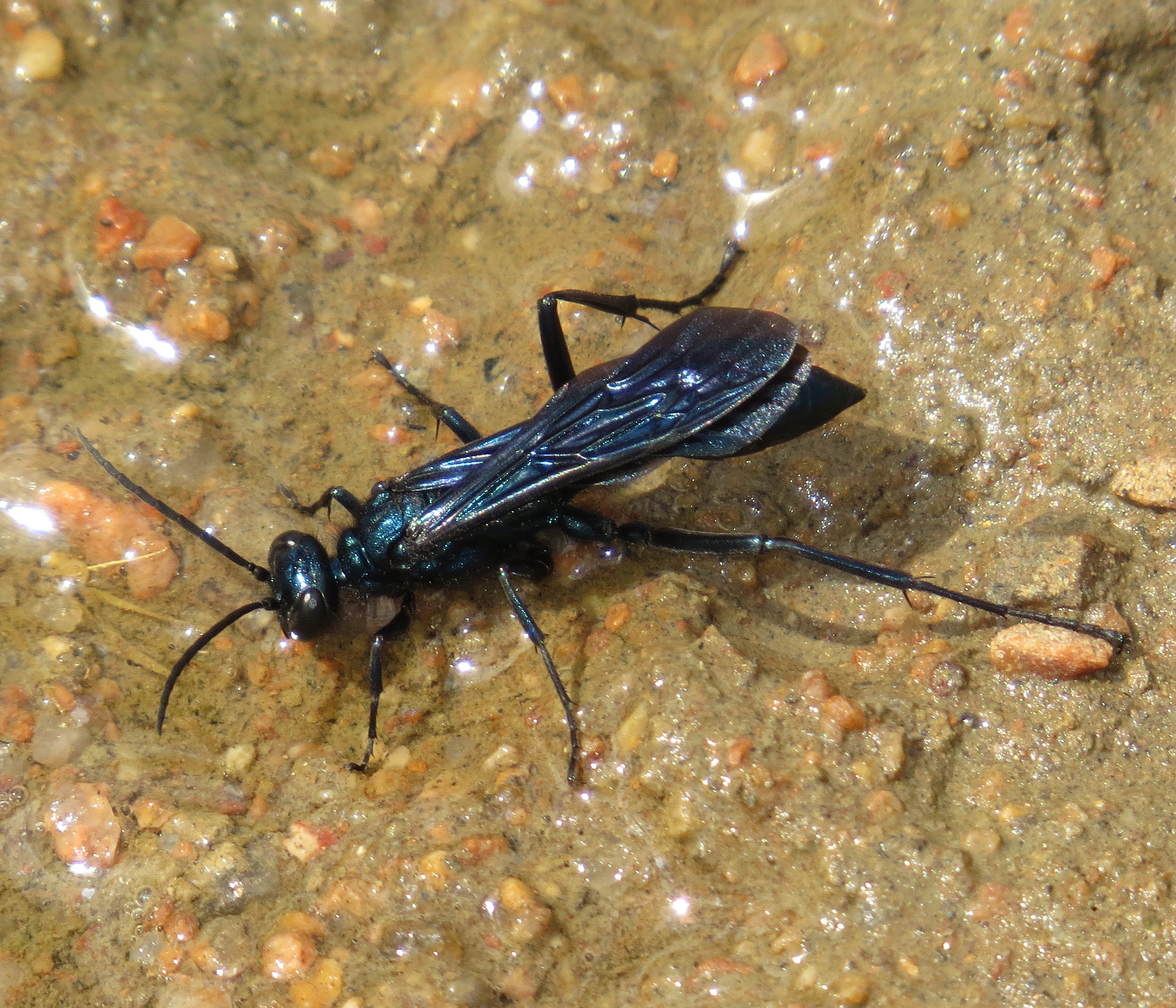
Blue Mud Dauber drinking water in Colorado, USA

Among insect architects, the Blue Mud Dauber, Chalybion californicum, is not Frank Lloyd Wright. What it does have going for it is a remodeling career. Oh, and a reputation as a fierce enemy of black widow spiders.

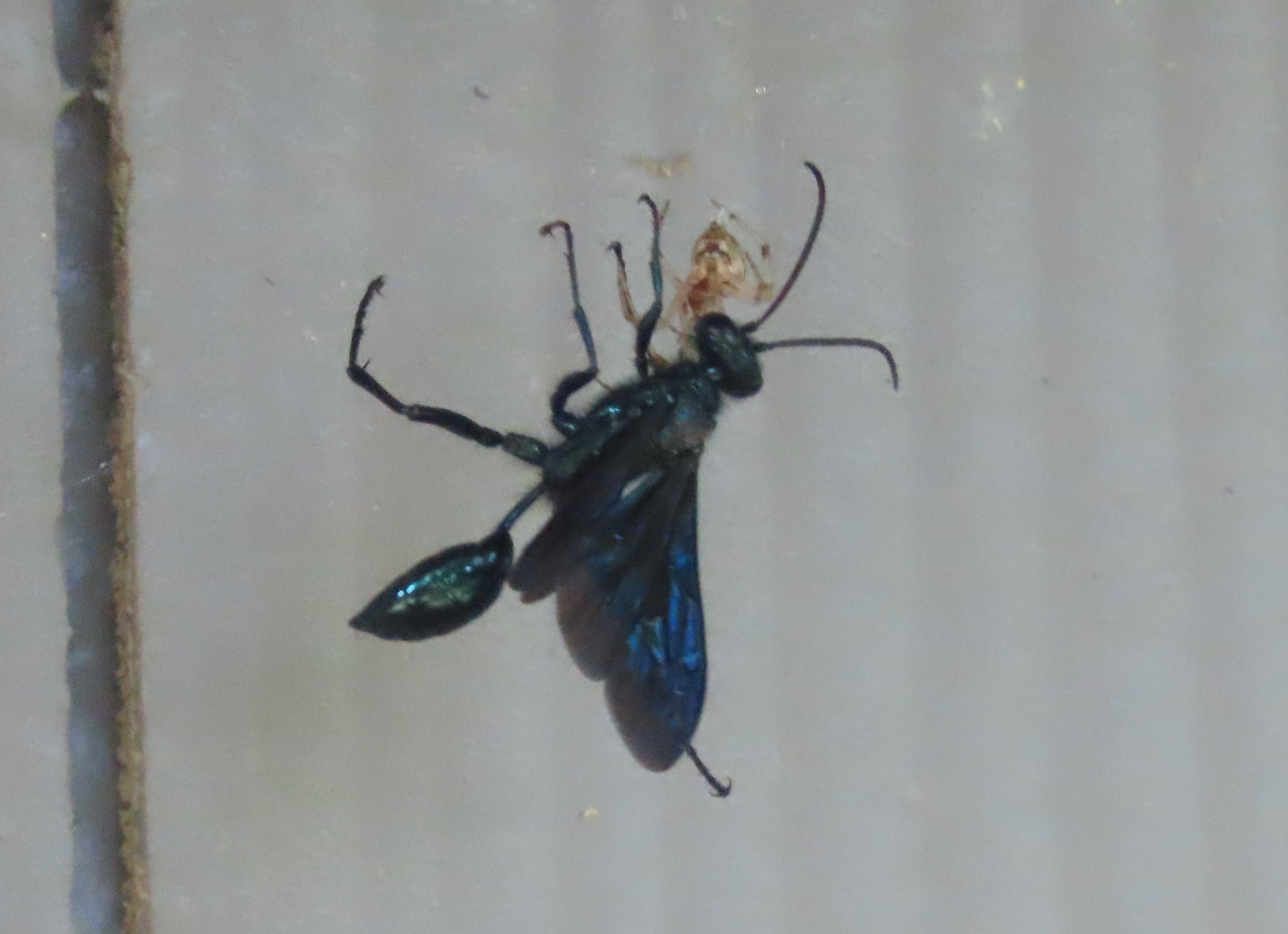
Female Blue Mud Dauber with paralyzed juvenile Western Black Widow in Colorado, USA

Blue mud daubers are solitary wasps in the family Sphecidae. Females take over abandoned nests of their cousin, the Black and Yellow Mud Dauber, Sceliphron caementarium, or, in many cases, evict the larval tenants and food stores of active mud nests. While Sceliphron gathers mud to make her nest, Chalybion carries water to an old nest to soften it and remold it to her needs. The result is a very lumpy version of the normally smooth Sceliphron nest.

Female Blue Mud Dauber on "renovated" nest of Black & Yellow Mud Dauber in Delaware, USA

Chalybion makes up for any engineering deficiencies with a persistent, clever, and energetic approach to catching prey. The female wasp is able to land on a spider web without getting entangled, then do a convincing impression of an insect that is in distress. She vibrates the web and draws the spider out. The poor arachnid comes dashing down a thread expecting dinner and instead seals its own doom. The blue mud dauber stings the spider into paralysis and flies it off to her nest.

A female Blue Mud Dauber in Kansas, USA begins her hunt by alighting on non-sticky threads of a cobweb weaver's snare....
Fanning her wings, she vibrates the web to simulate a struggling insect....
Now she awaits the spider's response....
Nothing....so one more try at luring the arachnid....
Success! The spider rushed to the wasp so quicly that I missed the shot. The wasp stung the spider in a nerve center and it was immediately paralyzed.
Extricating the spider from its web, she flies away with her prize.

Among the known spider hosts for the blue mud dauber are black widows, specifically the Southern Black Widow, Latrodectus mactans. For a highly entertaining account of this I recommend chapter five (“The Terrible Falcons of the Grassland”) in Hunting Big Game in the City Parks, by Howard G. Smith (New York: Abington Press, 1969). Additional spider hosts include mostly other cobweb weavers, family Theridiidae, small orb weavers (Araneidae), and the odd lynx spider (Oxyopidae), crab spider (Thomisidae), or jumping spider (Salticidae).

Female Blue Mud Dauber dismembering a spider in order to feed on its hemolymph (blood). I do not know how frequently the wasps do this.
Missouri, USA

Mud daubers in general stuff a multitude of spider victims into each mud cell before finally sealing it with a curtain of mud. A single egg had been laid on the very first spider stored at the bottom of the cell. The wasp larva that hatches then gradually consumes all the spiders, leaving a smattering of legs as the only indication there was ever anything else in there with them. The mature larva then spins a papery silken cocoon inside which it pupates. A few weeks later (or come spring if it was overwintering) an adult wasp chews a round hole in the end of the cell and exits. Holes in any other part of the mud nest indicate that some kind of wasp parasite chewed its way to freedom instead of the mud dauber.

Male Blue Mud Dauber hot-footing it in Colorado, USA

Male mud daubers are far less industrious than their female counterparts. Their sole mission is to father the next generation.

Meanwhile, they are content to sip nectar from flowers or extrafloral nectarines. They also like oozing sap from wounded trees and, perhaps most of all, the “honeydew” secreted by aphids and scale insects. Both genders of mud daubers like this delicacy, which is nothing more than the sugary liquid waste produced by those sap-sucking buggers.
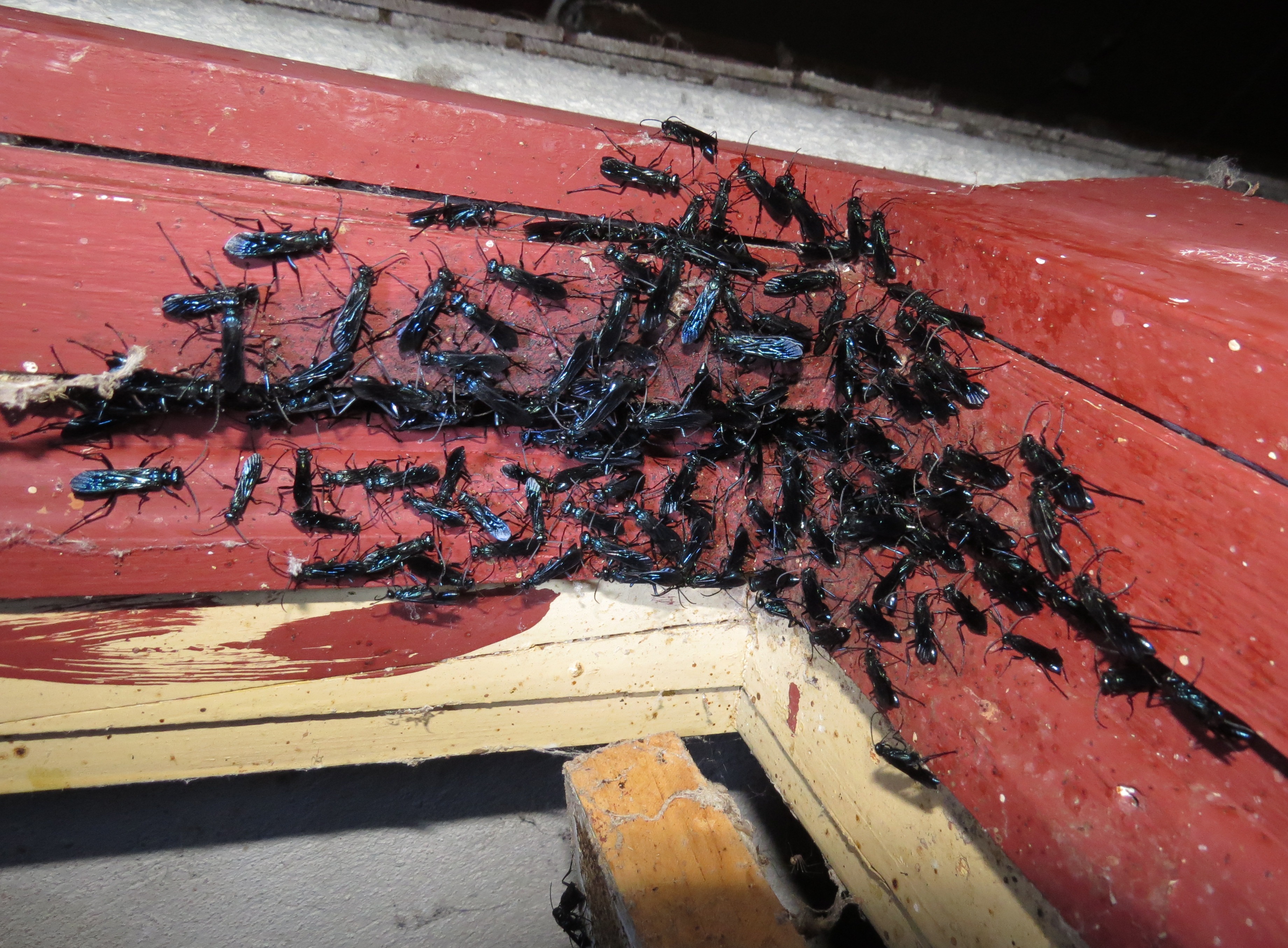
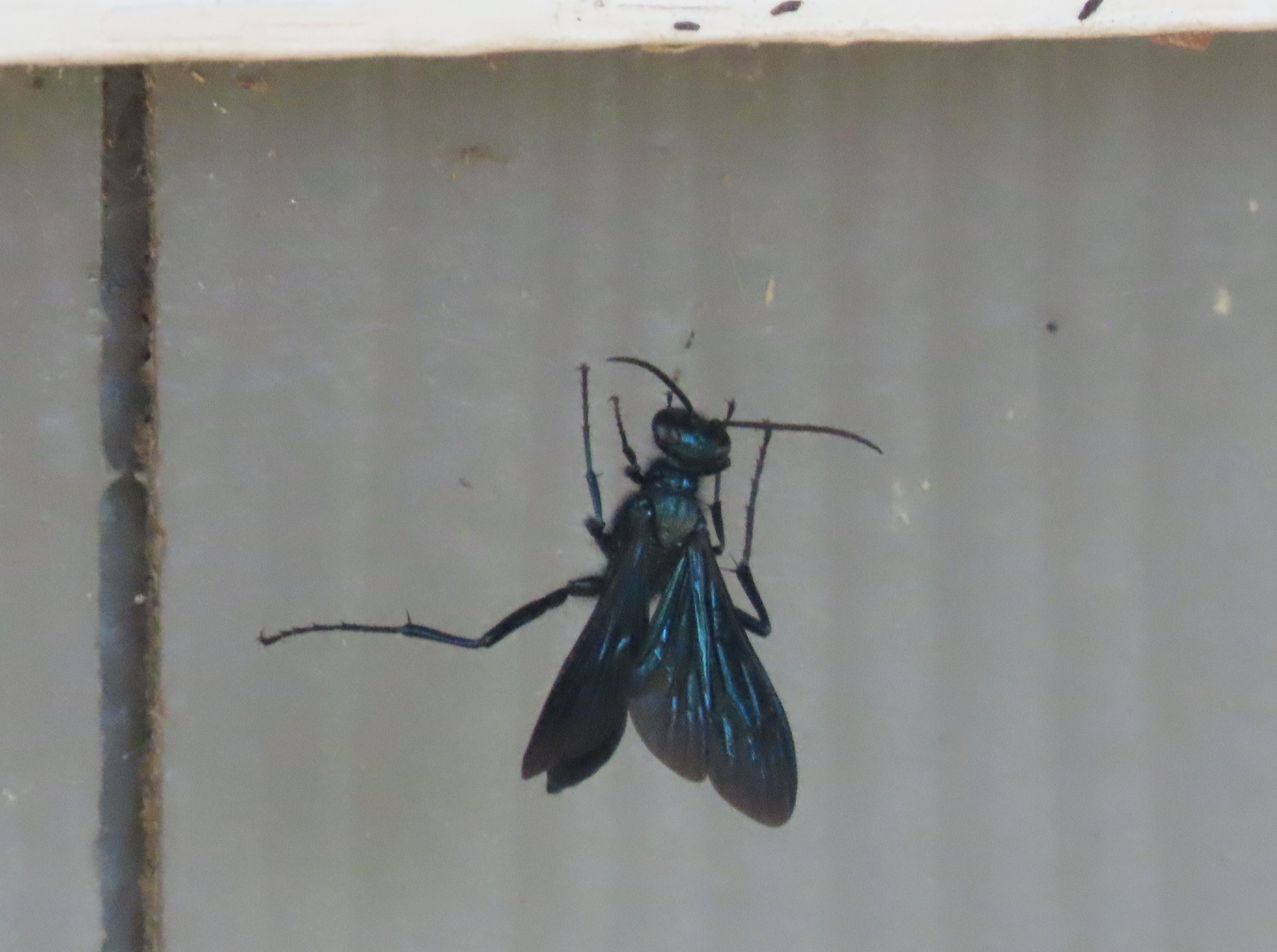
Large nocturnal congregation of male Blue Mud Daubers in a door frame in Colorado, USA

After a heavy day of drinking, males may gather in “bachelor parties” to sleep it off during the night. These congregations of normally solitary wasps can cause a bit of anxiety in people who confront them. Take a look at this image and comment thread for an example.
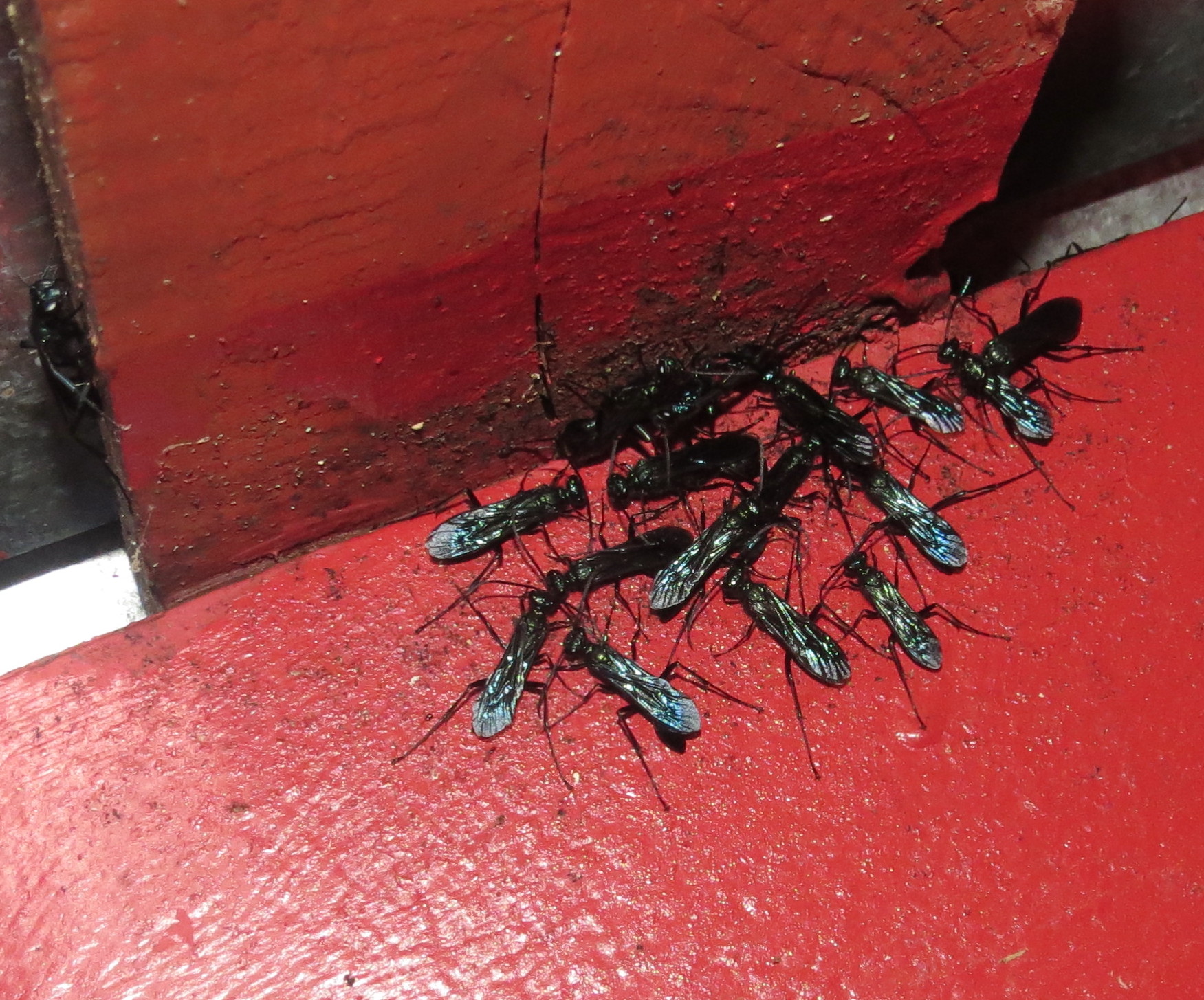
A smaller group of males in Georgia, USA

It should be noted that there are actually two species of Chalybion found north of Mexico. C. californicum is transcontinental in the U.S. and southern Canada, while C. zimmermanni ranges from Tennessee and North Carolina south to Florida and west to Texas, Arizona, and into Utah. I am curious as to whether these specimens I photographed in southern Arizona are C. zimmermanni given the white, not dark, hairs on the thorax; and the smoky, rather than violaceous, wing coloration (see below).

Probable male Chalybion zimmermani in Arizona, USA

Enjoy making your own observations of these wasps. They are not the least bit aggressive and, because they often nest on the exterior of buildings, are easy to watch.
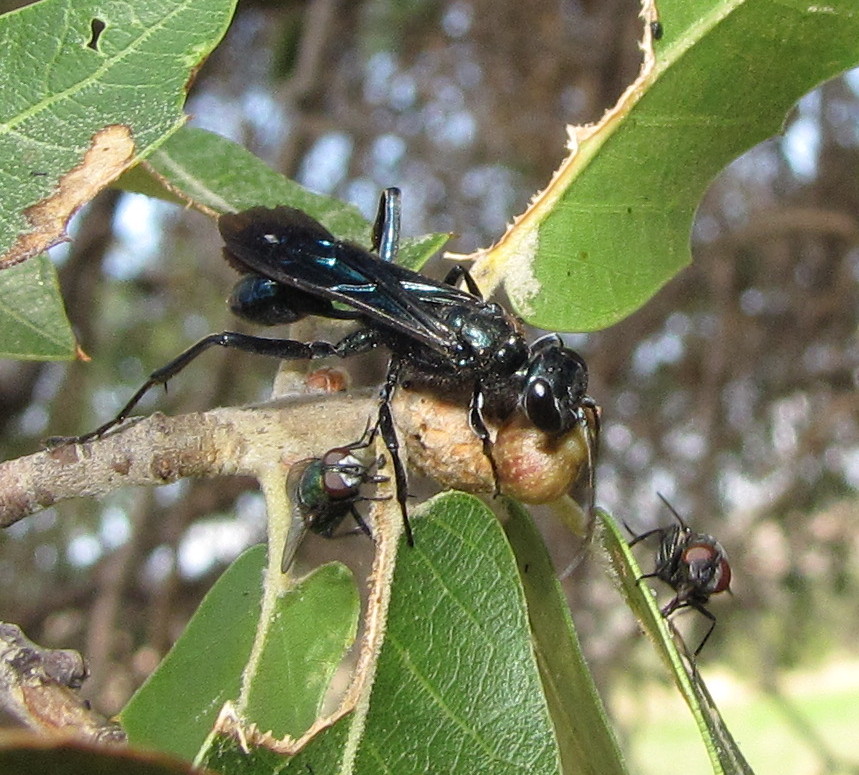
Probable female Chalybion zimmermani in Arizona, USA

Sources:
Bohart, R. M. and A. S. Menke. 1976. Sphecid Wasps of the World. Berkeley: Universithy of California Press. 695 pp.
Eaton, Eric R. 2021. Wasps: The Astonishing Diversity of a Misunderstood Insect. Princeton, New Jersey: Princeton University Press. 256 pp.
Krombein, Karl V. et al. 1979. Catalog of Hymenoptera in America North of Mexico. Washington, DC: Smithsonian Institution Press. Vol. 2, pp 1199-2209.

Saturday, July 28, 2018

Wasp-watching

It has been difficult to build-up enthusiasm this summer because insect abundance is way down here in Colorado Springs, but when I get to witness an event like I did yesterday, it makes me glad I went out and made an effort.

Female Ammophila sp. with heavy load

I happened to glimpse a very odd, fairly large insect out of the corner of my eye. It took me a minute to realize it was not a single insect, but two: a female Ammophila sp. thread-waisted wasp toting a caterpillar she had paralyzed. She was trying to locate the concealed nest burrow she had excavated before going hunting, and was wandering around rather aimlessly, but at high speed.

At one point she cached the caterpillar so she could orient herself without such a burden. It worked. She found her burrow, then went back and got the caterpillar. I was lucky to get any images of the transport because she moved so speedily and kept going in and out of focus. Even an attempt at video may have been almost useless. Her agility, with such a heavy load, was impressive. It would be like you or me running at full speed carrying a sofa between our legs.

Removing the "door" to her burrow

She abruptly dropped the caterpillar, and in a matter of seconds uncorked the stone plugging her nest burrow. She quickly entered her burrow, turned around inside, and re-emerged to grab the caterpillar and pull it in. She has to be this fast to avoid tiny parasites known as "satellite flies" that will lay tiny maggots on the caterpillar before the wasp can get it secured underground. Indeed, there was at least one miltogrammine fly flitting at the entrance to the burrow.

Pulling the caterpillar into her burrow

About a minute or so passed with both the wasp and her caterpillar underground. Finally, she emerged topside and quickly retrieved the stone that had plugged the burrow opening previously. She replaced the stone and began kicking sand on top of it. Notice how she curls her front "feet" to maximize the tarsal rake of spines that aid her in digging and filling. At one point she was startled by a curious ant and took to the air for a spit second. Ants can raid wasp burrows and cart off the caterpillar and wasp egg as food for their own young back at the colony.

Replacing the "door" to her burrow

By now I was getting a bit stiff from having stood in the same place for a long while. When I left the wasp, she was apparently unsatisfied with the nest closure and was actively chewing down to the rock plug. I left her in peace to finish what she had started.

Kicking sand to conceal the entrance

The whole sequence of events involved in the provisioning of a nest by a solitary wasp is truly remarkable. She has to dig her burrow and, load after load, flies off with armfuls of soil to fling across the landscape, lest some predator or parasite recognize her nest from piles of "tumulous" around the opening. Next, she fills in the burrow entrance, obliterating all evidence of any cavity whatsoever. She may make a brief orientation flight and then go off to hunt. How does she ever find the burrow again? We cannot even remember where we parked our car, or left our cell phone, and we reportedly have much larger brains than wasps do.

Startled by an ant

Once she has completed her mission of providing one paralyzed caterpillar for a single offspring, she goes off to start the process all over again, somewhere else. Does the wasp immediately forget about the burrow she just completed? How does that instinct work? It has to be plastic enough to address unique situations and overcome obstacles.

Up and away for good?

Over the coming months, in that underground cell, a wasp larva will hatch from the egg and begin consuming its still-living but inactive larder. Scientists believe that insects have no pain receptors, so that must be a blessing to the caterpillar. Were it deceased, though, the caterpillar would quickly rot under the assault of bacteria and fungi. After consuming the caterpillar, the wasp larva enters the pupa stage, as equally inert as the caterpillar on the outside, but inside the pupa there is a massive reorganization of cells converting the grub-like larva in to a sleek, winged adult wasp. Some genes are turned on, others are turned off. It is amazing to contemplate that a wasp larva, or caterpillar, has inside it the latent ability to execute all the behaviors of the adult. It somehow "knows" it cannot fly, does not need flower nectar, and cannot reproduce as a larva. It understands at some fundamental level that its only job is to eat and grow.

Some finishing touches

The next time you are out hiking, and a wasp flies up from under your feet, stop for a second. Back up a little. Does the wasp return to the vicinity? If so, keep watching. She is probably in the process of working on a nest burrow and will resume her activities if you stand still. It takes a little practice just to think about this possibility, but the rewards can be astonishing.

Wednesday, September 13, 2017

Ammophila nigricans Revisited

I wrote about this species back in December, 2010 when I had only one image of a sleeping female in South Deerfield, Massachusetts on July 5, 2009. Recently, I had the privilege of imaging another female in Leavenworth, Kansas, on August 24.

These are large, beautiful insects, velvety gun-metal blue with a red band across the abdomen, and black wings. It can be confused with no other member of the genus Ammophila. This particular specimen spent the night in a patch of weeds and flowering mint, eventually waking up to visit many mint blossoms for nectar. This wasp is known to visit many kinds of flowers, in Illinois at least. I collected one specimen from Swamp Milkweed in Cincinnati, Ohio.

Females need to fuel themselves so as to be able to carry out the tasks of providing for their offspring. Each wasp is solitary, digging her own vertical or angled burrow in clayey or sandy soil, terminating in a horizontal chamber at the bottom. Once the nest is excavated, it is off to find a large caterpillar. Known hosts include the larvae of underwing moths (Catocala spp.), the locust underwing (Euparthenos nubilis), and zale moths (genus Zale). Those are hefty caterpillars, but then they are destined to feed the larva of a very robust wasp.

This YouTube video may or may not depict A. nigricans, but the searching behavior must be very similar at the least. The female wasp is not likely to locate a caterpillar based on movement or color, as the caterpillars are very cryptic and usually resting stock still, feeding at night to avoid predators like the wasp. So, she must find her prey by touch.

Ammophila nigricans ranges over the entire eastern United States, from Kansas and Texas to New England, and south to Georgia, Florida, and Louisiana. It does not appear to be nearly as common as most other members of its genus, so I consider myself lucky to have had a few hours observing this one specimen.

SourcesDiscover Life
Krombein, Karl V. and Paul D. Hurd, Jr. 1979. Catalog of Hymenoptera in America North of Mexico vol. 2 Apocrita (Aculeata). pp. 1199-2209.

Wednesday, April 1, 2015

Grand Theft Caterpillar (caught on video)

Parasitoid wasps, those species in which the female incapacitates its host, and often caches one or more victims in a burrow, mud nest, or natural cavity, are not above stealing prey from others of their own kind, rather than doing an honest day's hunting. Such was the case I captured recently on video, while watching a Podalonia cutworm hunter in my Colorado Springs neighborhood.

Walking a path through degraded shortgrass prairie habitat, I suddenly noticed this wasp, with her prey, in the middle of the trail. She may have been feeding on the caterpillar's hemolymph (blood), or just making sure the larva was properly paralyzed.

She was nearly motionless for some time, so it came as a bit of a shock when it became apparent she was at the very entrance of a burrow she had excavated before going hunting. Here, in the video clip below, she finishes opening the tunnel, then drags her prize underground. Notice she is a "puller," carrying "armloads" of soil out of the nest rather than scratching it out behind her in a fountain of sand like sand wasps do.

Emerging from the tunnel after burying the cutworm, the female wasp suddenly took flight. I heard a loud buzzing and noticed she was engaged in a literal knock-down drag-out battle with another female Podalonia. The tangle of wings, legs, and bodies persisted a surprisingly long time before the two separated.

I could not tell who the victor was, until a wasp dragged the caterpillar back out of the nest burrow. Clearly, the winner was the usurper, and she was now claiming her spoils.

What is revealing about the complex instincts of hunting wasps is how their internal "program" demands they follow a strict sequence of behaviors, regardless of circumstance. So, the wasp repeatedly stung the already-paralyzed caterpillar, as it would if it had hunted the larva instead of pilfering it from the other wasp.

This drama was playing out in mid afternoon, and I had to get back home to eat something, feed and walk the dog, and whatever other chores I had been neglecting. Consequently, I could not determine whether the thief had not yet excavated her own burrow. She deposited the caterpillar and scurried seemingly randomly before beginning to dig. Perhaps she was opening her own burrow, or digging a new one. She tried digging in another, nearby spot as well, but I had to leave before the whole situation played out completely.

When I left, the original wasp had returned, and the paralyzed caterpillar at the center of the robbery was, ironically, sitting equidistant from both wasps. For all I know, the honest wasp was able to reclaim her property.

Podalonia version of detente

Every day in the world of "bugwatching" is an adventure, and your likelihood of witnessing such captivating episodes increases the more time you are outdoors looking. Sure, there is a fair degree of luck involved, but I guarantee you will see and hear many amazing behaviors if you are the least bit alert.

Wednesday, October 8, 2014

A Foreign Mud Dauber: Update

Back in the spring of this year, I broke the story of a new immigrant species to the U.S. that my wife found at the zoo where she works. The story is here, but today's post is the sequel. Initially, I thought that wasp might represent an isolated incident, a single specimen that managed to sneak over in a shipment to the zoo. That is clearly not the case now.

the Asian Sceliphron curvatum

Taking advantage of an unseasonably warm autumn afternoon on October 6, my wife and I went to Quail Lake Park here in Colorado Springs to look for birds and other wildlife. The park is in the foothills of the Front Range, not that far from the zoo. There, on the muddy shore of the artificial reservoir, in the dimming light of late afternoon, we saw a trio of wasps. Two were familiar natives: The Western Yellowjacket, Vespula pensylvanica, and the Black and Yellow Mud Dauber, Sceliphron caementarium.

Our native Sceliphron caementarium

Heidi asked if the third, smaller wasp was also a mud dauber, and I answered yes, pretty much dismissing it as simply an unusually dark S. caementarium. I took images, though, and looking at the result I was both excited and crushed. Here was another specimen of Sceliphron curvatum, and she was clearly gathering mud to make a nest. This is pretty conclusive evidence that this Asian species is now established here in the U.S.

Nearby the lakeshore is the restroom building for the park, and I wondered if this wasp had her nest there. Ironically, cliff swallows had built numerous nests under the roof over the "porch," but I could find no evidence of any insect nests, not even paper wasps. Some of the beams are hollow metal, though, and it is certainly conceivable that wasps are nesting out of sight.

S. curvatum about to take off with a ball of mud

I suspect that Sceliphron curvatum exists in other regions of the U.S., too, particularly around the Appalachian Mountains, but has simply been overlooked. It may not be abundant yet, but that can change quickly. When I lived in Cincinnati, Ohio, I recall finding my first specimens of the introduced European Paper Wasp (Polistes dominula) to be a novelty in the early- to mid-1990s. A few years later they were the second most common species of paper wasp I was seeing.

Again, I ask my readers to be on the lookout for this "new" mud dauber, and make your observations and images known through every means possible, especially social media like Facebook and Twitter where you are likely to get almost immediate confirmation or refutation of your identification. The more eyes looking out for unusual insects the better.

Thursday, May 1, 2014

Exclusive! Important Wasp BOLO

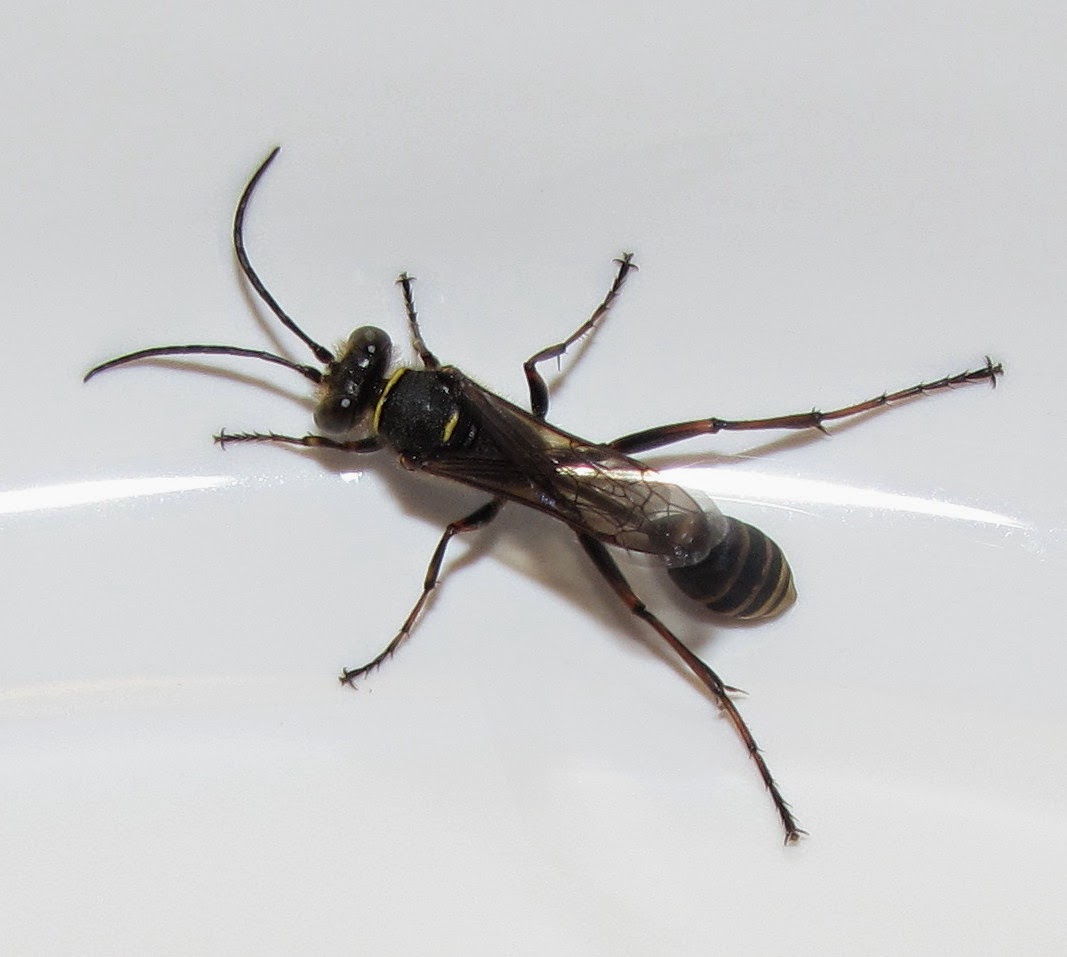
My wife, Heidi, seems to have a knack for finding noteworthy insects at her workplace, the Cheyenne Mountain Zoo. Her most recent discovery is apparently the first confirmed U.S. record of Sceliphron curvatum, an Asian mud dauber wasp in the family Sphecidae. This is a species you need to Be On the Look Out for, and that should be reported to your state or provincial department of agriculture.

Initially, I thought the wasp Heidi captured on April 29 was a blue mud dauber in the genus Chalybion, as it appeared to be dark with few, if any markings, but the container was rather opaque. Removing the wasp from the container and taking images revealed it was actually a species of Sceliphron, of which the native species S. caementarium is locally abundant.

Still, something seemed a bit off. The wasp was indeed dark, devoid of most of the usual bright yellow markings on the legs and body. I quickly uploaded the images to my computer, and posted one on a Facebook interest group for experts in the order Hymenoptera. Meanwhile, I did a little investigating online, and found images in Bugguide.net from Montreal that resembled the specimen.

The Bugguide category is currently “Sceliphron curvatum-or-deforme” because the two species, native to Asia, are apparently difficult to distinguish. I then looked up Google images for S. curvatum and it became clear that the Colorado Springs specimen was at least a close ally of that species.

Back to Facebook. Étienne Normandin of Montreal, and Doug Yanega, an entomologist at the University of California, Riverside, both came to the same conclusion I had, but they have authoritative credentials that I do not.

Sceliphron curvatum is noticeably smaller than our native species, ranging from 15-25 millimeters in body length as opposed to 24-28 millimeters for S. caementarium. Other than size, and differences in color pattern, the two wasps are very similar in their natural history. Each female wasp constructs her own mud nest consisting of one or several cells attached to protected surfaces such as beneath a cliff overhang, under bridges, under the eaves of buildings, or inside old barns. S. curvatum evidently has a propensity for nesting indoors, attaching mud cells to walls, piles of old books, clothing, and furniture. This more “domestic” lifestyle no doubt makes it a prime candidate for spreading far and wide via international commerce. It is easy to overlook a small, earthtone object attached to something.

Mud daubers are predators of spiders, with more generalist tendencies than spider wasps in the family Pompilidae. So, nearly any kind of spider is fair game. Many spiders are paralyzed and piled into a single mud cell before the mother wasp lays a single egg and seals the cell. The larva that hatches feeds on the cache of food, eventually pupating. The adult wasp that emerges then chews its way out of its clay crib

S. curvatum is native to India, Nepal, Pakistan, Kazakhstan, and Tadjikistan, in the foothills of the Himalayas and other mountain ranges. Great. The Front Range of Colorado is essentially the same habitat. It was first reported from Europe in southeastern Austria in 1979. Since then it has spread to Slovenia, Italy, Croatia, Switzerland, France, Hungary, Germany, Serbia and Montenegro, Greece, the Czech Republic, and Slovakia (Bosusch, et al., 2005). Much of its range extension is attributed to the wasp’s own natural dispersal capabilities.

The species has also turned up in and around Buenos Aires, Argentina, as reported in 2008 (Compagnucci and Alsina, 2008). On July 7, 2013, images of a specimen of S. curvatum, next to a mud cell, were posted to Bugguide.net from Montreal, Quebec, Canada, representing the first North American record for the species.

Please put this species on your radar, and maybe pay closer attention to mud daubers in general since it is easy to overlook this newcomer.

Sources: Bogusch, P., P. LiÅ¡ka, J. Lukáš, and A. Dudich. 2005. “Spreading and summary of the knowledge of the invasive sphecid wasp Sceliphron curvatum (Smith 1870) in the Czech Republic and Slovakia (Hymenoptera: Apocrita, Sphecidae),” Linzer Biol. Beitr. 37(1): 215-221.
Compagnucci, Luis A. and Arturo Roig Alsina. 2008. “Sceliphron curvatum, una nueva avispa invasora en la Argentina (Hymenoptera: Sphecidae),” Revista de la Sociedad Entomológica Argentina 67(3/4): 63.

Wednesday, January 15, 2014

Ammophila in Action

Here in Colorado Springs on July 16, 2013 I had the good fortune of encountering an adult female thread-waisted wasp, Ammophila procera, lugging a caterpillar to a burrow she had prepared previously. Even better, I remembered that my camera has the capability to take video.

I was taking pictures of a skipper butterfly when I caught a glimpse of something moving almost under my feet. It was the wasp hauling her prey through the tangled vegetation. Getting images is a challenge because if you are too far away you get little detail, but if you venture too close you disrupt the behavior if you don’t scare the wasp into abandoning its prey altogether. I have done the latter before and felt guilty afterwards.

I was initially intent on getting the still images, when I remembered I could also get video. That was the same moment the wasp took off at a breakneck pace, making it almost impossible to follow her. Her ability to run with such awkward cargo would put a human athlete to shame. Anyway, she eventually paused, propping her limp caterpillar victim in the crotch of a plant while she went off to explore parts unknown.

I patiently waited and, sure enough, she returned. Soon, she resumed her trek, eventually reaching a more open spot. She promptly dropped the caterpillar, removed a large clod or pebble that was blocking her burrow entrance, dove down, turned around, popped back up, grabbed the caterpillar, and in an instant there was no sign of either creature. Without knowing the location of the burrow entrance ahead of time, I did not stand a prayer of recording the action.

A short time passed, presumably while the wasp laid an egg on her victim, and then she appeared at the surface again. She quickly began closing the burrow, permanently, this time, and at last I was able to capture her energetic activities in moving pixels. The location of all this drama was close enough to an airport that the sound of arriving and departing aircraft overwhelmed much of the audio, but I managed to find a portion that was relatively quiet. Listen for the buzz of the wasp’s wing muscles as she works.

Since this encounter I have learned how to recognize when a wasp might have a burrow in a certain spot. If I walk by and startle a wasp, but it does not leave, there is high potential that she has a burrow in the immediate vicinity and I should back off slightly and watch where she goes. I managed to get video of another Ammophila and two Prionyx atratus later that same day I got this video.

You can improve your chances of capturing the behavior of solitary wasps by being observant of their behavior, and putting yourself in the appropriate habitat. Open areas with sandy soil are favored nesting sites for many different species of wasps. They are not aggressive insects, but instead intent on accomplishing the business of providing for their future offspring. Happy wasp-watching!

Thursday, September 5, 2013

Caught on Video: Prionyx atratus

I have been neglectful in exploiting my camera’s ability to shoot video as well as still images, until this year. I use a Canon PowerShot SX10 IS, and it does a nice job delivering the quality still images you see here on my blog. I am surprised by the detail I can get in video, too, perfect for documenting insects in action, with all their odd behaviors. One of my first subjects was a thread-waisted wasp, Prionyx atratus. Actually, I know I took video of at least two different females, both in the process of stocking their underground burrows with paralyzed grasshoppers.

July 16, 2013 was, for whatever reason, my lucky day to find several wasps engaged in nesting behavior. Up the street from our townhouse here in Colorado Springs is a vast open area cut by Sand Creek, a mostly dry riverbed or “arroyo,” and the surrounding soil is likewise sandy and very hospitable to burrowing insects of all sorts. Many “social trails” weave throughout the vacant, degraded shortgrass prairie, and it was in these trails that Prionyx atratus were nesting.

Normally, wasps resting on the ground are quick to fly far away at your approach, so I was confused as to why this one wasp was not eager to make an exit. Instead, it was persistent in running around my feet. I backed off and noticed freshly-excavated sand at the mouth of a small hole. I watched, and sure enough, the female wasp made her way back to her construction site. I shot many still pictures before I even thought to try video, so she was nearly finished opening the nest when I shot the following clip.

Notice how she “pulls” loads of soil out of the burrow, using her front legs. This is in contrast to other wasps that actively kick sand out behind them (Bembix “sand wasps” for example).

Prionyx atratus, like most members of the genus, dig nest burrows after obtaining prey. After securing prey, they leave their paralyzed victim a good distance away from where they begin digging, perhaps minimizing the opportunity for parasites like the tiny “satellite flies” you can see in the video that stake out a nest and wait for an opportunity to lay their own eggs (satellite flies actually “larviposit,” laying tiny, live larvae) on the wasp’s prey.

What surprised me was the speed with which the wasp retrieved her prey and hauled it head first down into the nest. I only managed this still shot.

Later, I came across a second wasp, and this time I did manage to capture her retrieving her prey. She still nearly outran my ability to keep up with her through the lens. Keep in mind, too, that grasshoppers are not lightweight insects. She has no problem trucking the creature overland despite its size and weight. I imagine that feat would be comparable to a human carrying a sofa in their arms and teeth, holding the couch out in front of them. And then running with it.

Prionyx closes her nest as carefully as she digs it, packing the loose soil into the tunnel for at least a centimeter, then obliterating all evidence of her labors on the surface before flying off to start another nest elsewhere. Here is a short clip of the closing process.

This species is a stocky animal not easily confused with similar wasps given a good look. The body is relatively short, the abdomen not extending beyond the wingtips when the wasp is at rest. The legs are relatively short and very spiny, more so than in other sphecid wasps. The abdomen is nearly spherical, not oval or elongate like most other wasps. This species is entirely black, females with silvery or gold faces, owing to appressed, reflective scales. Females average 15 millimeters in body length, males 12 millimeters. Their stocky form makes the look substantially larger.

Look for this insect across virtually the entire U.S. and southwest Canada (British Columbia and Saskatchewan near the border). Take heed if a wasp sticks around in your presence, she may have a burrow close by.

Sources: Bohart, R.M. and A.S. Menke. 1976. Sphecid Wasps of the World. Berkeley: University of California Press. 695 pp.
Pickering, John, et al. 2013. Discover Life.

Wednesday, January 16, 2013

Wasp Wednesday: Great Black Wasp

Few North American wasps are as conspicuous as the Great Black Wasp, Sphex pensylvanicus. This all-black insect with violet reflections on its wings is so large as to sometimes be mistaken for a tarantula hawk wasp. Males average 22 millimeters in body length, while females are about 28 millimeters (up to 35 mm) and more robust.

This is also a common and widespread species, ranging from southeast Canada to northern Mexico, and as far west as southern California. It is absent from the Pacific Northwest, and while I lived in Arizona for a decade, I did not encounter this species there, either. It is perhaps most abundant along forest edges in deciduous woodlands, sumac thickets, gardens, and fields with scattered trees.

Habitat preference is governed by the need for the adult wasps to find flower nectar to fuel their flight; and for females to find katydid prey. Milkweed (Asclepias spp.), thoroughworts (Eupatorium spp.), mountain mint (Pycnanthemum spp.), buttonbush (Cephalanthus occidentalis), camphorweed (Pluchea spp.), Rattlesnake Master (Eryngium yuccifolium), White Sweet Clover (Melilotus alba), and goldenrod (Solidago spp.) are among this wasp’s favorite rest stops. Females dig burrows in soft soil, usually in sheltered spots such as the dirt floors of abandoned barns or other outbuildings.

Though they are solitary, several females may nest in close proximity to one other. Each burrow is an angled tunnel about an inch in diameter and over one foot long. At the end of the burrow is a chamber from which other cells are added over time. The female leaves the nest entrance open while she goes about finding katydids. Her prey can be enormous. Adult Greater Angle-wing Katydids (Microcentrum rhombifolium) can be 52-63 millimeters long and are quite heavy. The Lesser Angle-wing Katydid (M. retinerve) is another prey species, as is Scudderia furcata, the Fork-tailed Bush Katydid. An average of three paralyzed katydids goes into each cell in the nest, a single egg being laid on the first of those victims.


Greater Angle-wing Katydid female

The wasp larva that hatches from the egg feeds and grows for about ten days, eventually reaching a length of 30-35 millimeters, and a diameter of 7-10 millimeters. Larval insects are almost always larger than the adult stage because so much energy is spent in the pupal stage. The larva probably passes the winter in a pre-pupal state, pupating the following spring and then emerging in summer.

Female Great Black Wasps are incredibly successful at finding katydids. One field researcher, Reverend John A. Frisch of Woodstock College in Maryland plugged the nest entrances in one aggregation. The result was 252 katydids piled up in only five days. That worked out to an average of nearly 17 katydids per wasp per day (Evans, 1963). The wasps fly with that heavy load, too.

Hauling a large, heavy katydid back to the nest can attract unwanted attention, and one entomologist in Rhode Island observed House Sparrows (Passer domesticus) and, to a lesser degree, Gray Catbirds (Dumetella carolinensis) intercepting female wasps and relieving them of their paralyzed prey. As many as one-third of return trips by all the female wasps observed ended this way: empty-handed (Benntinen & Preisser, 2009).

The adult wasps themselves can be parasitized by Paraxenos westwoodi, one of the insects called stylopids or “twisted-wing parasites.” Wasps that have deformities of the abdominal segments, often with a bullet-like capsule or two protruding between segments, are victims of stylopids.

An interesting piece of historical trivia is that this species was the first insect subject of a paper by a naturalist native to North America. Observations of the Great Black Wasp by John Bartram (Philadelphia) were presented to the Royal Society (Royal Society of London for Improving Natural Knowledge) by Peter Collinson in 1749. The species was not officially described until 1763 by Carl Linnaeus.

Sources: Benntinen, Justin and Evan Preisser. 2009. “Avian kleptoparasitism of the digger wasp Sphex pensylvanicus,” Can. Ent. 141(6): 604-608.
Evans, Howard E. 1963. Wasp Farm. Ithaca, NY: Comstock Publishing Associates (Cornell University Press). 178 pp.