Showing posts with label Ammophila. Show all posts

Saturday, July 28, 2018

Wasp-watching

It has been difficult to build-up enthusiasm this summer because insect abundance is way down here in Colorado Springs, but when I get to witness an event like I did yesterday, it makes me glad I went out and made an effort.

Female Ammophila sp. with heavy load

I happened to glimpse a very odd, fairly large insect out of the corner of my eye. It took me a minute to realize it was not a single insect, but two: a female Ammophila sp. thread-waisted wasp toting a caterpillar she had paralyzed. She was trying to locate the concealed nest burrow she had excavated before going hunting, and was wandering around rather aimlessly, but at high speed.

At one point she cached the caterpillar so she could orient herself without such a burden. It worked. She found her burrow, then went back and got the caterpillar. I was lucky to get any images of the transport because she moved so speedily and kept going in and out of focus. Even an attempt at video may have been almost useless. Her agility, with such a heavy load, was impressive. It would be like you or me running at full speed carrying a sofa between our legs.

Removing the "door" to her burrow

She abruptly dropped the caterpillar, and in a matter of seconds uncorked the stone plugging her nest burrow. She quickly entered her burrow, turned around inside, and re-emerged to grab the caterpillar and pull it in. She has to be this fast to avoid tiny parasites known as "satellite flies" that will lay tiny maggots on the caterpillar before the wasp can get it secured underground. Indeed, there was at least one miltogrammine fly flitting at the entrance to the burrow.

Pulling the caterpillar into her burrow

About a minute or so passed with both the wasp and her caterpillar underground. Finally, she emerged topside and quickly retrieved the stone that had plugged the burrow opening previously. She replaced the stone and began kicking sand on top of it. Notice how she curls her front "feet" to maximize the tarsal rake of spines that aid her in digging and filling. At one point she was startled by a curious ant and took to the air for a spit second. Ants can raid wasp burrows and cart off the caterpillar and wasp egg as food for their own young back at the colony.

Replacing the "door" to her burrow

By now I was getting a bit stiff from having stood in the same place for a long while. When I left the wasp, she was apparently unsatisfied with the nest closure and was actively chewing down to the rock plug. I left her in peace to finish what she had started.

Kicking sand to conceal the entrance

The whole sequence of events involved in the provisioning of a nest by a solitary wasp is truly remarkable. She has to dig her burrow and, load after load, flies off with armfuls of soil to fling across the landscape, lest some predator or parasite recognize her nest from piles of "tumulous" around the opening. Next, she fills in the burrow entrance, obliterating all evidence of any cavity whatsoever. She may make a brief orientation flight and then go off to hunt. How does she ever find the burrow again? We cannot even remember where we parked our car, or left our cell phone, and we reportedly have much larger brains than wasps do.

Startled by an ant

Once she has completed her mission of providing one paralyzed caterpillar for a single offspring, she goes off to start the process all over again, somewhere else. Does the wasp immediately forget about the burrow she just completed? How does that instinct work? It has to be plastic enough to address unique situations and overcome obstacles.

Up and away for good?

Over the coming months, in that underground cell, a wasp larva will hatch from the egg and begin consuming its still-living but inactive larder. Scientists believe that insects have no pain receptors, so that must be a blessing to the caterpillar. Were it deceased, though, the caterpillar would quickly rot under the assault of bacteria and fungi. After consuming the caterpillar, the wasp larva enters the pupa stage, as equally inert as the caterpillar on the outside, but inside the pupa there is a massive reorganization of cells converting the grub-like larva in to a sleek, winged adult wasp. Some genes are turned on, others are turned off. It is amazing to contemplate that a wasp larva, or caterpillar, has inside it the latent ability to execute all the behaviors of the adult. It somehow "knows" it cannot fly, does not need flower nectar, and cannot reproduce as a larva. It understands at some fundamental level that its only job is to eat and grow.

Some finishing touches

The next time you are out hiking, and a wasp flies up from under your feet, stop for a second. Back up a little. Does the wasp return to the vicinity? If so, keep watching. She is probably in the process of working on a nest burrow and will resume her activities if you stand still. It takes a little practice just to think about this possibility, but the rewards can be astonishing.

Wednesday, September 13, 2017

Ammophila nigricans Revisited

I wrote about this species back in December, 2010 when I had only one image of a sleeping female in South Deerfield, Massachusetts on July 5, 2009. Recently, I had the privilege of imaging another female in Leavenworth, Kansas, on August 24.

These are large, beautiful insects, velvety gun-metal blue with a red band across the abdomen, and black wings. It can be confused with no other member of the genus Ammophila. This particular specimen spent the night in a patch of weeds and flowering mint, eventually waking up to visit many mint blossoms for nectar. This wasp is known to visit many kinds of flowers, in Illinois at least. I collected one specimen from Swamp Milkweed in Cincinnati, Ohio.

Females need to fuel themselves so as to be able to carry out the tasks of providing for their offspring. Each wasp is solitary, digging her own vertical or angled burrow in clayey or sandy soil, terminating in a horizontal chamber at the bottom. Once the nest is excavated, it is off to find a large caterpillar. Known hosts include the larvae of underwing moths (Catocala spp.), the locust underwing (Euparthenos nubilis), and zale moths (genus Zale). Those are hefty caterpillars, but then they are destined to feed the larva of a very robust wasp.

This YouTube video may or may not depict A. nigricans, but the searching behavior must be very similar at the least. The female wasp is not likely to locate a caterpillar based on movement or color, as the caterpillars are very cryptic and usually resting stock still, feeding at night to avoid predators like the wasp. So, she must find her prey by touch.

Ammophila nigricans ranges over the entire eastern United States, from Kansas and Texas to New England, and south to Georgia, Florida, and Louisiana. It does not appear to be nearly as common as most other members of its genus, so I consider myself lucky to have had a few hours observing this one specimen.

SourcesDiscover Life
Krombein, Karl V. and Paul D. Hurd, Jr. 1979. Catalog of Hymenoptera in America North of Mexico vol. 2 Apocrita (Aculeata). pp. 1199-2209.

Wednesday, January 15, 2014

Ammophila in Action

Here in Colorado Springs on July 16, 2013 I had the good fortune of encountering an adult female thread-waisted wasp, Ammophila procera, lugging a caterpillar to a burrow she had prepared previously. Even better, I remembered that my camera has the capability to take video.

I was taking pictures of a skipper butterfly when I caught a glimpse of something moving almost under my feet. It was the wasp hauling her prey through the tangled vegetation. Getting images is a challenge because if you are too far away you get little detail, but if you venture too close you disrupt the behavior if you don’t scare the wasp into abandoning its prey altogether. I have done the latter before and felt guilty afterwards.

I was initially intent on getting the still images, when I remembered I could also get video. That was the same moment the wasp took off at a breakneck pace, making it almost impossible to follow her. Her ability to run with such awkward cargo would put a human athlete to shame. Anyway, she eventually paused, propping her limp caterpillar victim in the crotch of a plant while she went off to explore parts unknown.

I patiently waited and, sure enough, she returned. Soon, she resumed her trek, eventually reaching a more open spot. She promptly dropped the caterpillar, removed a large clod or pebble that was blocking her burrow entrance, dove down, turned around, popped back up, grabbed the caterpillar, and in an instant there was no sign of either creature. Without knowing the location of the burrow entrance ahead of time, I did not stand a prayer of recording the action.

A short time passed, presumably while the wasp laid an egg on her victim, and then she appeared at the surface again. She quickly began closing the burrow, permanently, this time, and at last I was able to capture her energetic activities in moving pixels. The location of all this drama was close enough to an airport that the sound of arriving and departing aircraft overwhelmed much of the audio, but I managed to find a portion that was relatively quiet. Listen for the buzz of the wasp’s wing muscles as she works.

Since this encounter I have learned how to recognize when a wasp might have a burrow in a certain spot. If I walk by and startle a wasp, but it does not leave, there is high potential that she has a burrow in the immediate vicinity and I should back off slightly and watch where she goes. I managed to get video of another Ammophila and two Prionyx atratus later that same day I got this video.

You can improve your chances of capturing the behavior of solitary wasps by being observant of their behavior, and putting yourself in the appropriate habitat. Open areas with sandy soil are favored nesting sites for many different species of wasps. They are not aggressive insects, but instead intent on accomplishing the business of providing for their future offspring. Happy wasp-watching!

Wednesday, December 8, 2010

Wasp Wednesday: Ammophila wrightii

Ok, I couldn’t resist writing about one more species in the genus Ammophila, if only because it represents a distinct pair of species that differs considerably from other members of their species group. Ammophila wrightii, and its relative A. formicoides, are mimics of ants.

I was fortunate to find this specimen nectaring on flowers of Burroweed (Isocoma tenuisecta) at the Arizona Sonora Desert Museum just west of Tucson on the afternoon of September 26, 2010. One rarely sees this insect on flowers. Females are usually actively crawling on the ground in the manner of harvester ants. They are easily mistaken for those social insects and thus frequently overlooked.

This is one of the smaller species of Ammophila (under 20 mm), and colored almost uniformly reddish brown. The species ranges from California and Nevada east to northern Nebraska and south to at least the Mexican border. There is one record from north-central Oregon. Oddly, most western specimens have three submarginal cells in the front wing while specimens from the eastern portion of its range have only two submarginal cells. Why the extra wing vein in some specimens remains a mystery. Both A. wrightii and A. formicoides also have a low, flattened pronotal collar (base of the “neck”). It is hard to believe, but both species are in the same species group as the gargantuan Ammophila procera!

Ammophila wrightii exhibits at least one rather primitive behavioral characteristic: The nest burrow is excavated after a prey item is collected, instead of beforehand. Burrows are vertical in orientation, and only inchworm caterpillars from the moth family Geometridae are recorded as hosts.

Not a great deal of field observations on this species have been recorded since C. H. Hicks published his in the journal Psyche in 1934. That was back when the species went by the name Sphex wrightii. Obviously, there is room for improvement. Go forth my friends, and seek your fortune of knowledge.

Special thanks to my friend and mentor Arnold Menke who identified my images.

Wednesday, December 1, 2010

Wasp Wednesday: Ammophila nigricans

We’re going into overtime on “Ammophila Month,” so we can conclude with what may be the most elegant and impressive of all the eastern species in this genus: A. nigricans. This species is easily as large as A. procera, but readily identified by the lack of silver stripes on the thorax, the overall deep blue-black body with red on the abdomen, and the black wings.

I was fortunate enough to encounter this particular specimen around 5:00 PM on July 5, 2009 in South Deerfield, Massachusetts. She was in the process of finding a place to settle in for the night and was quite tolerant of my photographic activities. This is often the best time to look for Ammophila wasps in general, because of this “sleeping” behavior.

The wasps will grip a grass stem or twig with their jaws, then prop their slender bodies at about a forty-five degree angle away from their perch. It doesn’t look very comfortable, but this stiff posture appears to suit the wasps just fine. You can sometimes find several species of Ammophila in the same general vicinity as they bed down at dusk. There are certainly often several individuals of the same species in close proximity, as in the image below of an unidentified species.

When they are awake, females of Ammophila nigricans are all business. Each wasp digs a vertical or angled burrow in clayey or sandy soil, terminating in a horizontal chamber at the bottom. Once the nest is excavated, it is off to find a large caterpillar. Known hosts include the larvae of underwing moths (Catocala spp.), the locust underwing (Euparthenos nubilis), and zale moths (genus Zale). Those are hefty caterpillars, but then they are destined to feed the larva of a very robust wasp. This YouTube video may or may not depict A. nigricans, but the searching behavior must be very similar at the least. The female wasp is not likely to locate a caterpillar based on movement or color, as the caterpillars are very cryptic and usually resting stock still, feeding at night to avoid predators like the wasp. So, she must find her prey by touch.

I hope you have enjoyed this introduction to this genus of wasps, and that you are excited to find specimens of your own once the warm weather returns to your location. Meanwhile, feel free to share your past observations here. Happy holidays to you!

Wednesday, November 24, 2010

Wasp Wednesday: Ammophila aberti

One of the most beautiful species of thread-waisted wasps is Ammophila aberti, found commonly here in southern Arizona. It actually ranges throughout western North America, east as far as Iowa, and south into Mexico. These sleek, silvery wasps are a little larger than the average Ammophila, approaching the length of A. procera, but not nearly as robust.

I was fortunate enough to come across a fairly large nesting aggregation of this species at Ft. Lowell Park in east Tucson on May 11, 2009. The female wasps were digging in a very flat area with hard, baked soil. They would literally take bites out of the earth in order to excavate their nests. Despite the abundance of wasps, it was still a challenge to get images of them. The wasps would dig a bit, fly up, settle again, and repeat the process. Consequently, I had many images with no wasp in sight!

It turns out that the nesting behavior of Ammophila aberti has been well documented. One study revealed that females may initiate more than one nest at a time. Some had simultaneously started eight different burrows, up to a dozen for one ambitious specimen. Few of the nests were finished, however. Could they be creating “dummy” nests designed to confuse parasites like velvet ants that will dig open the nests of their hosts? That would be an ingenious ploy if so.

It may also take a female wasp a long time to furnish food for its offspring. A single egg is laid on the first caterpillar to be stored in the cell at the end of the vertical or angled burrow. By the time the last caterpillar is hunted, the larva from that egg may be reaching maturity. This has been interpreted by some researchers as progressive or “delayed” provisioning, feeding the larva as it develops, but clearly this is not the case. It may simply take some female wasps longer to find a full complement of caterpillars. Also, prolonged inclement weather may delay hunting activities for the females. Lastly, temporary scarcity of prey may delay the ability of the females to find caterpillars.

Ammophila aberti might be considered something of a generalist in that it uses a wide variety of Lepidoptera species in provisioning its nests. The study cited above recorded caterpillars from five different families of moths and butterflies (and skippers) used by this wasp: Geometridae, Noctuidae, Pyralidae, Hesperiidae, and Pieridae. An average of about six caterpillars per nest was the norm for the Colorado study of this species.

Another trait exhibited by this species is prey-stealing from other wasps in the nesting aggregation. A female returning to her nest is vulnerable to robbery since she must put down her caterpillar catch to open the temporary plug on her burrow. She may be attacked by one or more others of her kind that try to wrest the caterpillar from her. The hijacking is frequently successful. Further, some wasps may actually dig open the nest of another wasp and pilfer the paralyzed cache, though this is a rarer phenomenon.

As is the case with most other fossorial (burrowing) wasps, satellite flies (Sarcophagidae: Miltogramminae) are a constant threat to parasitize the nest. Interestingly, I observed another potential parasite in the form of a bee fly, Thyridanthrax sp. The female flies were hovering over the open nests of the wasps, lobbing eggs down into the tunnels in the manner of a jet bomber. Thanks to Joel Kits for making the identification from the above image, originally published on Bugguide.net.

Clearly, there is still much to be learned about this, and the vast majority of other species of solitary wasps. So, next summer, resolve to get out and make your own observations. You are almost guaranteed of making groundbreaking contributions to our collective knowledge. Meanwhile, have a very happy Thanksgiving holiday. Good luck provisioning your table with things more appetizing (and hearty) than caterpillars 

Wednesday, November 17, 2010

Wasp Wednesday: Ammophila pictipennis

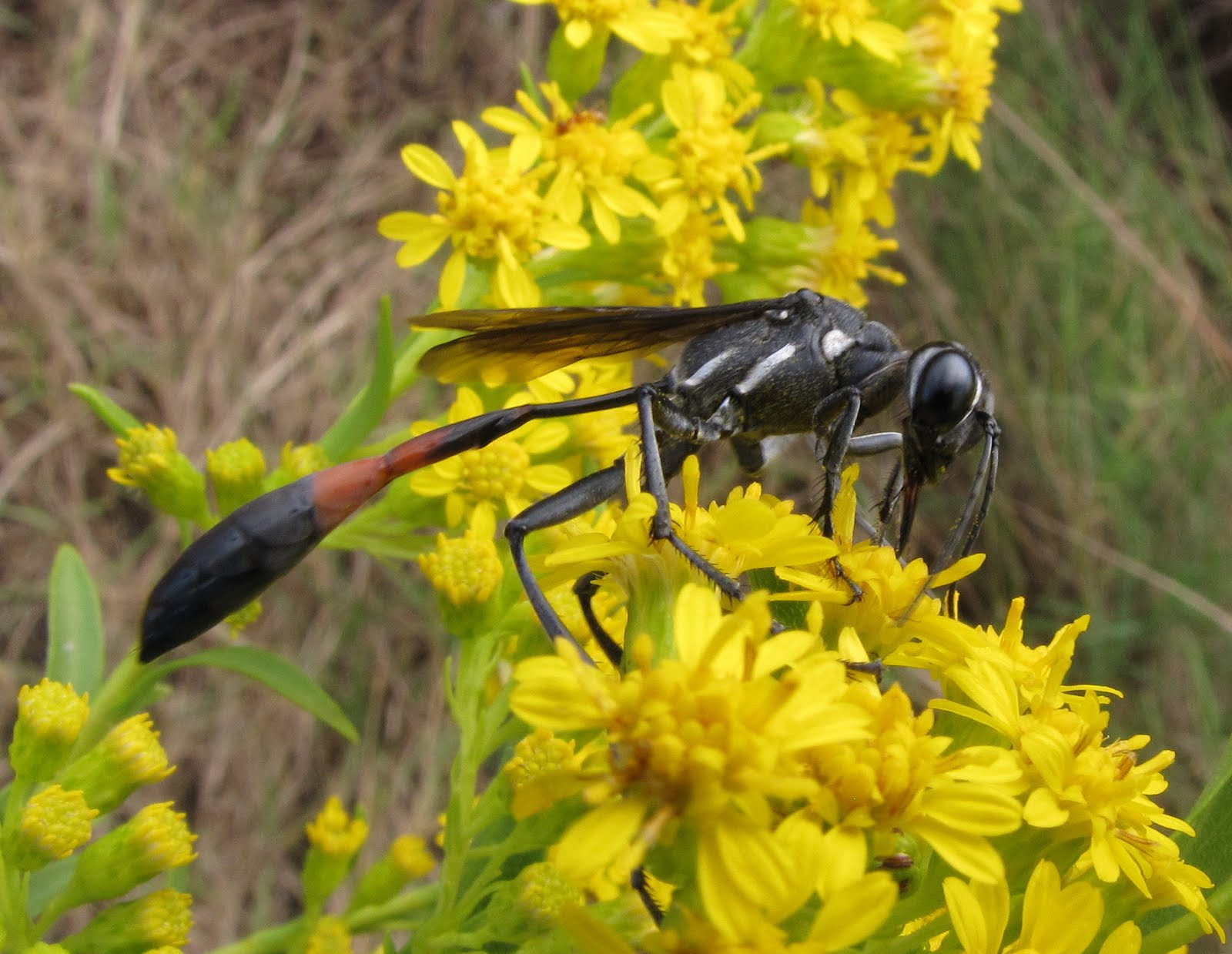
One of the most common, and most handsome members of the genus Ammophila east of the Rockies (and south to Mexico City) is A. pictipennis. It is black in color, with red on the abdomen, and the black areas have metallic blue reflections in the right light. The wings are orange or yellow. The orange wings and lack of any silver bars on the side of the thorax help identify the species easily.

The individual above was imaged in Ocean City, New Jersey, fairly early on an overcast morning (October 19, 2010). It is in the classic “sleeping” posture adopted by Ammophila wasps during the night and inclement weather. The wasps grip a stem with their jaws, and prop their bodies at about a forty-five degree angle with their second and third pairs of legs. They often roost in loose clusters, jockeying for the best locations before settling down. This seems like odd behavior for supposedly solitary wasps. I once found a tight cluster of several Ammophila at Smith Rock State Park in Oregon. I initially thought it was a cluster of seeds or berries drooping from a short, erect plant.

When not resting, a female A. pictipennis is a busy insect. The species usually nests in sand, but will also excavate its shallow, vertical or nearly vertical burrow in hard-baked soil. The shaft is barely longer than the wasp herself, but ends in a nearly perpendicular cell that is spacious enough to accommodate the wasp and a lone caterpillar host. The specimen below was imaged at the Orange Airport in Orange, Massachusetts, September 7, 2009. She had brought a caterpillar to the vicinity of the burrow and was preparing to open it.

Known host caterpillars used by this species include mostly cutworms like the Armyworm, Mythimna unipucta, the Spotted Cutworm, Xestia c-nigrum, the Yellow-striped Armyworm, Spodoptera ornithogalli, and the Corn Earworm, Helicoverpa zea. There is at least one record of a caterpillar of the Common Sootywing (a skipper), Pholisora Catullus being used as prey.

Image above courtesy of Giff Beaton

The nesting behavior of this species is covered in detail by Phil and Nellie Rau in Wasp Studies Afield (Princeton University Press, 1918). Their interpretation of the wasps reveals at times perhaps more about the human observers than the reality of the instinctive processes going on in the insects. Still, it makes captivating reading and creates a real appreciation for the toiling labor of these creatures, as in the process of closing a nest:

”In her next selection she seems to be more particular. She goes here and yonder, pausing at clods and tiny pebbles, sometimes lifting them or turning them over. When finally she finds one that suits her fancy…she brings it in her mandibles and, grasping it firmly, she rubs, pounds and hammers down the dirt on the top of the hole until all traces of the fill are obliterated. When she has finished, we ourselves cannot discern the spot. Her task, so skillfully done, is now at an end; she throws her tool aside a few inches and flits away with an utterly careless air, as if she had forgotten all interest whatsoever in this place – and quite possibly she has. It is interesting to note that she cannot be persuaded to use this tool before the precise time for it. Once we tossed her a tiny pebble while she was yet busy grinding to pieces her clods with a pestle-and-mortar motion, but she only took it, without ado, and laid it back on her rubbish-heap, where an annoying bit of stick and a troublesome cinder had already been placed. Later on, when she was ready for her hammer, she went directly and, to our great delight, got our pebble which she had so stolidly spurned only a few minutes before….”

The image of an ungrateful hymenopteran is at least slightly amusing.

Subsequent research has shown that the “tool use” is simply the culmination of a series of instinctive behaviors. Still, one has to wonder if there was an individual “smart” wasp that increased the survival chances of her offspring by securing the closure of the nest burrow more thoroughly in this manner. Certainly, velvet ants are expert at detecting the subterranean nests of their hosts and digging them open, so such parasites must exert strong evolutionary pressure on the wasps to prevent break-ins.

A little more technical information is available on this page from Discover Life; and once again Dick Walton provides a wonderful online video that highlights the differences in nest excavation between A. pictipennis and A. procera. See if you can make your own observations of these fascinating species.

Wednesday, November 10, 2010

Wasp Wednesday: Ammophila femurrubra

It probably became apparent several postings ago that the vast majority of insects have no “common name” in English. Today’s featured species, Ammophila femurrubra, is no exception. In fact, information on this handsome wasp seems to be lacking as well.

Little in the way of research funds and scientific attention is lavished on most insects unless they are of economic importance (read “pests”). You could argue that Ammophila thread-waisted wasps that prey on caterpillars in agricultural settings actually *are* economically important, but in a good way. Most administrators and bureaucrats that dole out research dollars don’t seem to be convinced, however. Consequently, any observations and documentation on such solitary wasps is usually executed voluntarily by “amateur entomologists” that in today’s language we call “citizen scientists.”

Chief among the pioneers to illuminate the biology of solitary wasps were George and Elizabeth Peckham, whose ground-breaking work Wasps, Social and Solitary (Archibald Constable and Company, Ltd., 1905) set the standard for their American followers. Phil and Nellie Rau, who published Wasp Studies Afield in 1918 (Princeton University Press), continued the Peckham’s legacy. There was also Edward G. Reinhard, author of The Witchery of Wasps (The Century Company, 1929); and John Crompton, who penned The Hunting Wasp (Houghton Mifflin Company, 1955). We also owe a debt of gratitude to the reigning champion of popular entomology, the late Howard Ensign Evans. His masterpiece Wasp Farm (Natural History Press, Doubleday, 1963) remains an inspiration to my own writing and love of the Hymenoptera. Still, Evans is best known for his book Life on a Little-Known Planet (Dutton, 1968), easily the best popular book on insects ever published.

So what does this have to do with Ammophila femurrubra? It means we need another Howard Evans to investigate the biology and behavior of this species. All I was able to determine in my research is that the species ranges in the “southwestern U.S.” How enlightening. My personal observations would tend to reinforce the idea that it is typical of the genus, even “sleeping” in the manner of other Ammophila. It is one of the more common species in urban Tucson, so perhaps it is more adaptable to habitat fragmentation than other species. At about 25 millimeters in length it is of average size for the genus, too.

As always, I encourage all of you to be observant and record your observations if possible. You really never know what you are adding to our collective body of knowledge.

Wednesday, November 3, 2010

Wasp Wednesday: Ammophila procera

I am declaring November as “Ammophila Month,” with the postings on Wednesdays dedicated to different species of this diverse genus of thread-waisted wasps in the family Sphecidae. There are over sixty species in the genus in North America. We’ll start with one of the most spectacular, Ammophila procera, which I was able to photograph near the lighthouse at Cape May Point State Park in New Jersey.

This is not a small wasp, females at least approaching two inches (25-38 mm according to the Bugguide.net page) in length. It ranges across the entire continent from southern Canada to Guatemala. This is the largest species in the eastern U.S. to sport the silver stripes on the side of the thorax, a hallmark of most members of the genus.

I was able to get very close to this female as she was nectaring on goldenrod blossoms, but that is typical of most species of Ammophila. They are solitary, and shy or gentle in nature. They are quite distracted while feeding on nectar, but otherwise very alert and quick to fly. Nesting females are very persistent, however, and if frightened away from a burrow they are excavating will return most of the time to finish it.

Females of Ammophila procera nest in compact sand, so finding this one at the beach on October 15 was not too surprising. The burrow varies from slanted to vertical and ends in a single cell. Once the burrow is completed, the wasp exits, covering the opening and making an orientation flight so she can find it again. Then, off she goes to find a caterpillar.

She will attack a large caterpillar, stinging it into paralysis and then lugging it back to the nest. She grips the caterpillar with her mandibles and middle legs in a manner that seems to render the prey rigid, allowing her to run in a pretty agile manner, all things considered. She can also fly with the caterpillar oriented beneath her body for maximum aerodynamic efficiency. To see one flying with a caterpillar is quite something. The caterpillar often contrasts greatly in color with the wasp, making for an absurd visual unless you know what is going on.

Known host caterpillars for A. procera include caterpillars of the Prominent Moth family Notodontidae such as the White-dotted Prominent Moth, Nadata gibbosa, the Variable Oakleaf Caterpillar, Heterocampa manteo, H. Astarte (no common name), the Morning-glory Prominent, Schizura ipomoeae, members of the genera Datana and Symmerista; and at least one record of the One-eyed Sphinx, Smerinthus cerisyi.

Despite its size and imposing nature, A. procera is not without its own enemies. Among its parasites are “satellite flies” in the family Sarcophagidae, especially Senotainia vigilans and Metopia laterallis. The female flies follow a prey-laden female wasp to her burrow and then look for a chance to lay their own “live” larvae at the mouth of her nest burrow.

You owe it to yourself to see these wasps in action, and I have just the thing to get you hooked on their amazing biology. Dick Walton has shot some amazing videos of this was which can be seen at his websiteDick Walton Natural History Services. The one for the species discussed even includes the satellite flies! Watch for their cameo appearance about midway through the clip.

Have a great week, friends, and remember to tune in again next Wednesday for another installment of “Ammophila Month.”

Saturday, June 20, 2009

Let Sleeping Wasps Lie

Awhile back I wrote an entry about the sleeping habits of solitary bees (“Let Sleeping Bees Lie”) that I observed and photographed in Tucson, Arizona. Here in western Massachusetts, I was fortunate enough to observe the sleeping habits of solitary wasps in the genus Ammophila, family Sphecidae. Known commonly as thread-waisted wasps, the females are energetic hunters of caterpillars, which they paralyze and store in a subterranean burrow as food for a single offspring.

There are many species of Ammophila found across most of North America, but they reach their greatest diversity in the arid west. More on that in a later post.

Get a grip!

How these wasps manage to get any sleep in this incredibly awkward position is beyond my comprehension. Maybe it is the wasp version of yoga, I don’t know. Simply gripping a twig with your jaws must be hard enough, let alone propping your body at an angle away from your perch. Though solitary, it is not at all uncommon to find loose aggregations of several thread-waisted wasps bedding down in a small area, like this. I once found a cluster of them at Smith Rock State Park in Oregon that was packed so densely that I initially mistook them for some strange flowering plant.

Like solitary bees, the wasps tend to turn in early, just around dusk. They can also appear to be in torpor (the scientific word for inactivity), but actually be quite alert and able to rapidly disengage from their perch. I approached another specimen on a later date, and it quickly regained “consciousness,” much to my chagrin.

There are sleeping bees here in Massachusetts, too, that adopt the same “look ma, no hands” biting grip as the cuckoo wasps in Tucson. This little bee is another parasitic type, in the genus Nomada, family Apidae. They are parasitic on other solitary bees, especially members of the genus Andrena.

Keep a careful eye out for these sleeping insects, especially in open areas with dry, twig-like vegetation, and around forest edges, even around your yard or garden. Solitary wasps and bees can be approached fearlessly, as they are not aggressive and females will not sting unless physically molested. The males possess no stingers. Well, all this talk about sleep has me yawning. I think I’ll turn in early. I also have a strange compulsion to bite the bedpost….