Showing posts with label thread-waisted wasps. Show all posts

Wednesday, January 15, 2014

Ammophila in Action

Here in Colorado Springs on July 16, 2013 I had the good fortune of encountering an adult female thread-waisted wasp, Ammophila procera, lugging a caterpillar to a burrow she had prepared previously. Even better, I remembered that my camera has the capability to take video.

I was taking pictures of a skipper butterfly when I caught a glimpse of something moving almost under my feet. It was the wasp hauling her prey through the tangled vegetation. Getting images is a challenge because if you are too far away you get little detail, but if you venture too close you disrupt the behavior if you don’t scare the wasp into abandoning its prey altogether. I have done the latter before and felt guilty afterwards.

I was initially intent on getting the still images, when I remembered I could also get video. That was the same moment the wasp took off at a breakneck pace, making it almost impossible to follow her. Her ability to run with such awkward cargo would put a human athlete to shame. Anyway, she eventually paused, propping her limp caterpillar victim in the crotch of a plant while she went off to explore parts unknown.

I patiently waited and, sure enough, she returned. Soon, she resumed her trek, eventually reaching a more open spot. She promptly dropped the caterpillar, removed a large clod or pebble that was blocking her burrow entrance, dove down, turned around, popped back up, grabbed the caterpillar, and in an instant there was no sign of either creature. Without knowing the location of the burrow entrance ahead of time, I did not stand a prayer of recording the action.

A short time passed, presumably while the wasp laid an egg on her victim, and then she appeared at the surface again. She quickly began closing the burrow, permanently, this time, and at last I was able to capture her energetic activities in moving pixels. The location of all this drama was close enough to an airport that the sound of arriving and departing aircraft overwhelmed much of the audio, but I managed to find a portion that was relatively quiet. Listen for the buzz of the wasp’s wing muscles as she works.

Since this encounter I have learned how to recognize when a wasp might have a burrow in a certain spot. If I walk by and startle a wasp, but it does not leave, there is high potential that she has a burrow in the immediate vicinity and I should back off slightly and watch where she goes. I managed to get video of another Ammophila and two Prionyx atratus later that same day I got this video.

You can improve your chances of capturing the behavior of solitary wasps by being observant of their behavior, and putting yourself in the appropriate habitat. Open areas with sandy soil are favored nesting sites for many different species of wasps. They are not aggressive insects, but instead intent on accomplishing the business of providing for their future offspring. Happy wasp-watching!

Wednesday, June 1, 2011

Wasp Wednesday: Podalonia

A friend recently asked if I might be able to identify a wasp from images taken by a third person. That person, Jeffry B. Mitton, was then kind enough to grant permission to use his images to complement my own photographic documentation of the “cutworm wasps,” genus Podalonia.

These slender, thread-waisted wasps are frequently mistaken for other members of the family Sphecidae. Females look like small Sphex species, while males are easily confused with Ammophila wasps. Podalonia and Ammophila both belong to the subfamily Ammophilinae in fact. There are nineteen species known in North America, but the genus also occurs in Central America, Eurasia, and Africa. Identification of the species hinges on minute characters like the presence or absence of arolia (tiny pads between the claws on each “foot”), so images of live, wild wasps rarely suffice for species determination.

Cutworm wasps are named for the habit of the solitary females to hunt for soil-dwelling caterpillars (“cutworms”), paralyze them, and store them as food for the wasp’s offspring. The wasp digs her burrow after she procures the prey, which is the opposite behavior sequence of most wasps in the Sphecidae family. Only one caterpillar goes in the bottom of each burrow, and a single egg is laid upon it. The opening of the tunnel is then sealed and the wasp begins seeking another victim to repeat the process. I have yet to photograph one of these wasps with a caterpillar, but that is what Jeff Mitton did. Unfortunately, I do not know how to save those images from the e-mail to my computer. So, here is an image from Kim Moore instead.

Another phenomenon I have not witnessed is the nightly aggregation of some species in sheltered spaces. Ironically, I was on a field trip with an entomology class from El Camino College on the weekend of May 21-22 when one of the students discovered a gathering of female Podalonia under bark on a Ponderosa Pine stump. This was at the James Reserve in the San Jacinto Mountains of southern California. Several specimens of the wasps were collected before I learned of the find, and a return to the stump revealed no specimens present. Males also aggregate, as confirmed by this image. Several hundred individuals can pack together in such clusters. This behavior is thought to correlate with inclement weather, and possibly overwintering in the case of females, but perhaps it is a more common occurrence.

Mating is something these wasps seem to do quite frequently, judging by my own images. Males are on top. Both genders enjoy sipping flower nectar, and sometimes they satisfy their thirst and sex drive at the same time.

Podalonia are most abundant in the western United States, but you should be on the lookout for them almost anywhere. They are certainly welcome allies in the garden and agricultural field where they can dispatch a good number of pest caterpillars. Meanwhile, you can find videos of some of the European species in action on YouTube.com and Wildlife Insight.

Sources: Kurczewski, Frank E., Mark F. O’Brien, and Margery G. Spoffford. 1992. “Nesting Behavior of Podalonia robusta (Cresson) (Hymenoptera: Sphecidae),” J. Hym. Res. 1(1): pp. 235-239.
Murray, William Donald. 1940. “Podalonia (Hymenoptera: Sphecidae) of North and Central America,” Entomologica Americana Vol. XX, Nos. 1 & 2: pp. 1-82.
O’Brien, Mark F. and Frank E. Kurczewski. 1982. “Ethology and Overwintering of Podalonia luctuosa (Hymenoptera: Sphecidae),” The Great Lakes Entomologist Vol. 15, No. 4: pp. 261-275.

Wednesday, November 17, 2010

Wasp Wednesday: Ammophila pictipennis

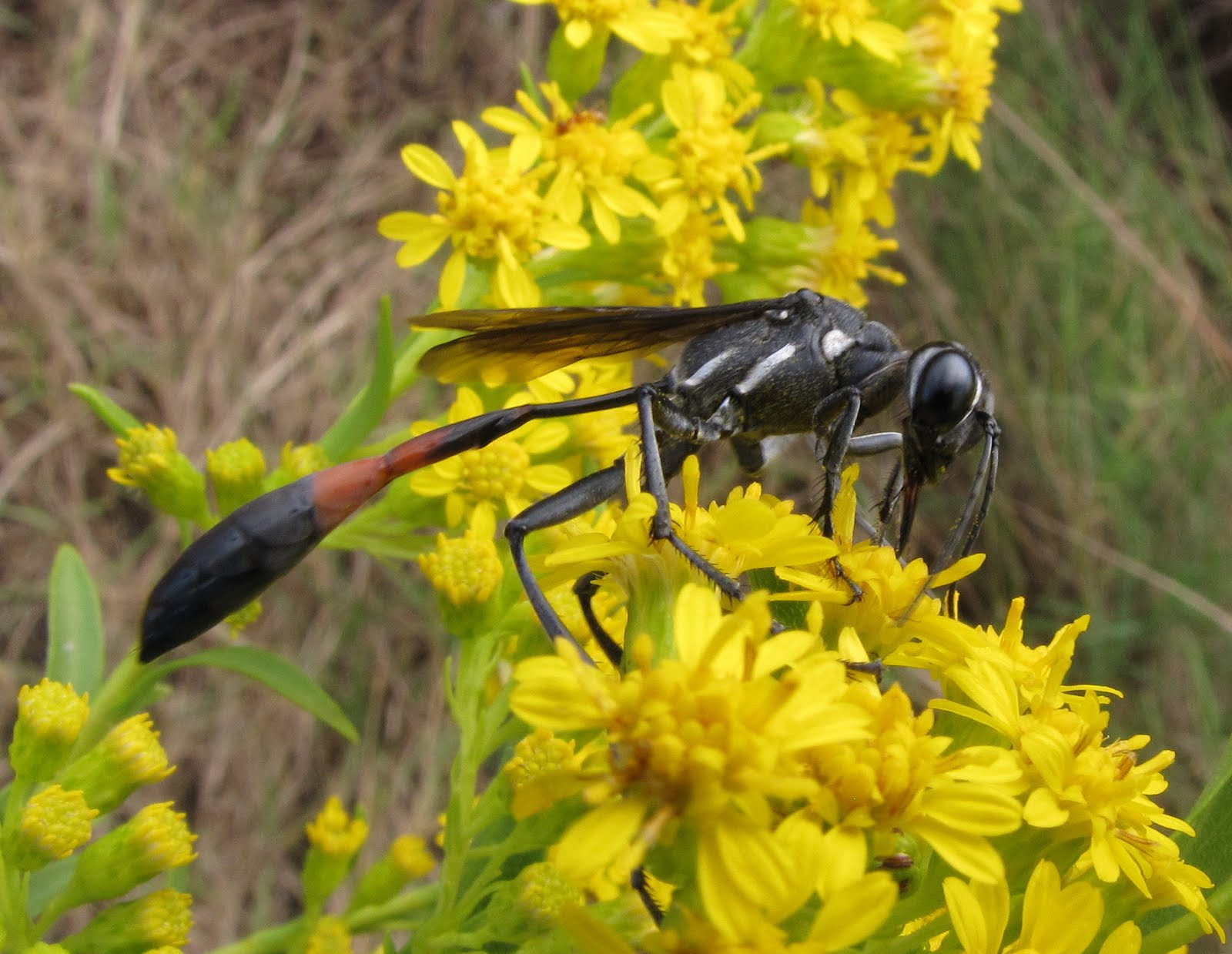
One of the most common, and most handsome members of the genus Ammophila east of the Rockies (and south to Mexico City) is A. pictipennis. It is black in color, with red on the abdomen, and the black areas have metallic blue reflections in the right light. The wings are orange or yellow. The orange wings and lack of any silver bars on the side of the thorax help identify the species easily.

The individual above was imaged in Ocean City, New Jersey, fairly early on an overcast morning (October 19, 2010). It is in the classic “sleeping” posture adopted by Ammophila wasps during the night and inclement weather. The wasps grip a stem with their jaws, and prop their bodies at about a forty-five degree angle with their second and third pairs of legs. They often roost in loose clusters, jockeying for the best locations before settling down. This seems like odd behavior for supposedly solitary wasps. I once found a tight cluster of several Ammophila at Smith Rock State Park in Oregon. I initially thought it was a cluster of seeds or berries drooping from a short, erect plant.

When not resting, a female A. pictipennis is a busy insect. The species usually nests in sand, but will also excavate its shallow, vertical or nearly vertical burrow in hard-baked soil. The shaft is barely longer than the wasp herself, but ends in a nearly perpendicular cell that is spacious enough to accommodate the wasp and a lone caterpillar host. The specimen below was imaged at the Orange Airport in Orange, Massachusetts, September 7, 2009. She had brought a caterpillar to the vicinity of the burrow and was preparing to open it.

Known host caterpillars used by this species include mostly cutworms like the Armyworm, Mythimna unipucta, the Spotted Cutworm, Xestia c-nigrum, the Yellow-striped Armyworm, Spodoptera ornithogalli, and the Corn Earworm, Helicoverpa zea. There is at least one record of a caterpillar of the Common Sootywing (a skipper), Pholisora Catullus being used as prey.

Image above courtesy of Giff Beaton

The nesting behavior of this species is covered in detail by Phil and Nellie Rau in Wasp Studies Afield (Princeton University Press, 1918). Their interpretation of the wasps reveals at times perhaps more about the human observers than the reality of the instinctive processes going on in the insects. Still, it makes captivating reading and creates a real appreciation for the toiling labor of these creatures, as in the process of closing a nest:

”In her next selection she seems to be more particular. She goes here and yonder, pausing at clods and tiny pebbles, sometimes lifting them or turning them over. When finally she finds one that suits her fancy…she brings it in her mandibles and, grasping it firmly, she rubs, pounds and hammers down the dirt on the top of the hole until all traces of the fill are obliterated. When she has finished, we ourselves cannot discern the spot. Her task, so skillfully done, is now at an end; she throws her tool aside a few inches and flits away with an utterly careless air, as if she had forgotten all interest whatsoever in this place – and quite possibly she has. It is interesting to note that she cannot be persuaded to use this tool before the precise time for it. Once we tossed her a tiny pebble while she was yet busy grinding to pieces her clods with a pestle-and-mortar motion, but she only took it, without ado, and laid it back on her rubbish-heap, where an annoying bit of stick and a troublesome cinder had already been placed. Later on, when she was ready for her hammer, she went directly and, to our great delight, got our pebble which she had so stolidly spurned only a few minutes before….”

The image of an ungrateful hymenopteran is at least slightly amusing.

Subsequent research has shown that the “tool use” is simply the culmination of a series of instinctive behaviors. Still, one has to wonder if there was an individual “smart” wasp that increased the survival chances of her offspring by securing the closure of the nest burrow more thoroughly in this manner. Certainly, velvet ants are expert at detecting the subterranean nests of their hosts and digging them open, so such parasites must exert strong evolutionary pressure on the wasps to prevent break-ins.

A little more technical information is available on this page from Discover Life; and once again Dick Walton provides a wonderful online video that highlights the differences in nest excavation between A. pictipennis and A. procera. See if you can make your own observations of these fascinating species.

Wednesday, November 3, 2010

Wasp Wednesday: Ammophila procera

I am declaring November as “Ammophila Month,” with the postings on Wednesdays dedicated to different species of this diverse genus of thread-waisted wasps in the family Sphecidae. There are over sixty species in the genus in North America. We’ll start with one of the most spectacular, Ammophila procera, which I was able to photograph near the lighthouse at Cape May Point State Park in New Jersey.

This is not a small wasp, females at least approaching two inches (25-38 mm according to the Bugguide.net page) in length. It ranges across the entire continent from southern Canada to Guatemala. This is the largest species in the eastern U.S. to sport the silver stripes on the side of the thorax, a hallmark of most members of the genus.

I was able to get very close to this female as she was nectaring on goldenrod blossoms, but that is typical of most species of Ammophila. They are solitary, and shy or gentle in nature. They are quite distracted while feeding on nectar, but otherwise very alert and quick to fly. Nesting females are very persistent, however, and if frightened away from a burrow they are excavating will return most of the time to finish it.

Females of Ammophila procera nest in compact sand, so finding this one at the beach on October 15 was not too surprising. The burrow varies from slanted to vertical and ends in a single cell. Once the burrow is completed, the wasp exits, covering the opening and making an orientation flight so she can find it again. Then, off she goes to find a caterpillar.

She will attack a large caterpillar, stinging it into paralysis and then lugging it back to the nest. She grips the caterpillar with her mandibles and middle legs in a manner that seems to render the prey rigid, allowing her to run in a pretty agile manner, all things considered. She can also fly with the caterpillar oriented beneath her body for maximum aerodynamic efficiency. To see one flying with a caterpillar is quite something. The caterpillar often contrasts greatly in color with the wasp, making for an absurd visual unless you know what is going on.

Known host caterpillars for A. procera include caterpillars of the Prominent Moth family Notodontidae such as the White-dotted Prominent Moth, Nadata gibbosa, the Variable Oakleaf Caterpillar, Heterocampa manteo, H. Astarte (no common name), the Morning-glory Prominent, Schizura ipomoeae, members of the genera Datana and Symmerista; and at least one record of the One-eyed Sphinx, Smerinthus cerisyi.

Despite its size and imposing nature, A. procera is not without its own enemies. Among its parasites are “satellite flies” in the family Sarcophagidae, especially Senotainia vigilans and Metopia laterallis. The female flies follow a prey-laden female wasp to her burrow and then look for a chance to lay their own “live” larvae at the mouth of her nest burrow.

You owe it to yourself to see these wasps in action, and I have just the thing to get you hooked on their amazing biology. Dick Walton has shot some amazing videos of this was which can be seen at his websiteDick Walton Natural History Services. The one for the species discussed even includes the satellite flies! Watch for their cameo appearance about midway through the clip.

Have a great week, friends, and remember to tune in again next Wednesday for another installment of “Ammophila Month.”