Showing posts with label Europe. Show all posts

Thursday, December 21, 2017

Insects in the News

One of my unfortunate duties as a blogger of truth and science, here and at Sense of Misplaced, is that I must occasionally dispense bad news. There are plenty of awful stories these days, but bear with me and I'll conclude with something uplifting.

The insect story getting the most press right now, by far, is the "Insect Armageddon" opinion piece in the New York Times, and the follow-up article about the German citizen scientists who made the observations. It appears that there has been a precipitous decline in insect abundance in many parts of Europe, up to 75% over the last twenty-five years. Should the numbers hold up to repetition, this is indeed alarming, if not catastrophic. Insects are the foundation of all major biological processes. You can do the math, use your imagination, and draw the obvious conclusions.

There are plenty of places to point blame for the demise of insect populations, and wildlife declines in general, but accusations and rhetoric are not likely to reverse the course of events. We have to act personally, and locally, to go about changing things for the positive. That means resisting the urge to grab the over-the-counter insecticides, planting native trees, shrubs, and flowers in our urban and suburban landscapes, growing our own vegetables without using chemical treatments, putting up "bee condos" for solitary bees....There is no end to what we can do, and it does make a difference. You are setting an example, for one thing.

jAmerican Burying Beetle, © EcoArkansas.com

Meanwhile, our very own government agencies are against us here in the U.S. Make no mistake about it, the current edition of the federal administration is out to ruin public lands in many ways. I already wrote about U.S. Fish & Wildlife granting permission for the construction of a strip mall known as "Coral Reef Commons" on globally endangered pine rockland habitat near Miami, Florida. The President's directive to shrink Bears Ears National Monument and Grand Staircase-Escalante National Monument is further proof of the overriding policy to open public lands to private interests, namely those in the natural resource extraction industries.

It is also quite probable that a lawsuit filed by The Independent Petroleum Association of America, American Stewards of Liberty, and Osage Producers Association will result in the de-listing of the endangered American Burying Beetle, Nicrophorus americanus. This is in spite of the fact that there is grave concern as to whether the species is truly "recovered." It is found only in a handful of isolated locations whereas its historical range was over most of the eastern U.S. It also remains largely a mystery as to why it disappeared in the first place. Until a better understanding is reached, any action toward removing the species from the endangered list is premature at best, and irresponsible at the least. God forbid any creature, Native American population, or other sacred entity stand in the way of short-term profits for greedy corporations.

Oh, well, two can play the lawsuit game, and recently the National Butterfly Center in Mission, Texas filed suit against the federal government to block construction of the border wall, which would cut right through that private preserve. Take that! I have visited this area and can attest to the rich diversity of all organisms there, thanks to the caretakers who are so devoted to it. Many, if not most, United States records for mostly Mexican butterfly species are recorded from the National Butterfly Center. It is on every naturalist's bucket list of places to visit. A wall cannot be erected there, or through the Santa Ana National Wildlife Refuge....

Bee-mimicking clearwing moth, Heterosphecia tawonoides, © Marta Skowron Volponi

Ok, I promised some good news, and here it is. It was recently revealed that a spectacular species of clearwing moth was rediscovered after a gap of 130 years in the scientific record. Known previously from only a single specimen housed in a museum in Vienna, Austria, Heterosphecia tawonoides was observed in the Taman Nagara rainforest of Malaysia. It just goes to show how little we know about a planet we are hell bent on destroying in the name of "progress."

Resolve for the new year to get involved, get outdoors, document, record, and report what you find. You never know where your personal discoveries will lead; or whether you are the only thing standing between a lone population of some creature and its potential extirpation. I'm facing that right now myself, but more on that later.

Wednesday, January 20, 2016

"New" Insight Into Behavior of Some Cuckoo Wasps (Chrysididae)

There is always something new to learn. That is the promise of entomology, and it is validated almost daily. Just last week (January 11) I came across this amazing image of Omalus puncticollis by Emily Hobson on my Facebook newsfeed. Since I know that many species of cuckoo wasps feed on the "honeydew" secreted as a sugary, liquid waste product by aphids and related true bugs, I suspected that the wasp in this photo was stimulating the little bug into producing some honeydew.

Female cuckoo wasps do not have stingers, so I knew that this was not a case of the wasp stinging a victim to then either consume herself or take back to a nest.....or so I thought. Cuckoo wasps are parasites of other kinds of wasps, and it turns out that this is what the wasp was up to, but indirectly.

One of the comments on the image revealed the extraordinary truth:

"This is really interesting. The species is probably Omalus violaceus, and the pic shows a behaviour, what is not formally described until now. The female Chrysididae wasp lays its egg into the Aphid. When a Crabonidae wasp (e.g. Pemphredon) takes the aphid as prey and carries it into its nest, then the chrysidid larva will appear earlier and develop in the nest instead of the larva of the crabronid wasp. Until now, many wasp researchers still think that the Chrysididae infect the host nest directly, which is not true. This behaviour is observed or suspected for Omalus and related genera, and for Holopyga." - Christian Schmid-Egger

So, the chrysidid wasp larva is a "cleptoparasite" that eats the food provided by the host wasp for its offspring. It literally steals from the mouths of the host larva, starving it to death.

These images were taken in Europe, but we have related species in North America, including a few that have immigrated from overseas as a result of accidental introductions on global commerce. I wrote about one such species, Pseudomalus auratus, in a previous blog post.

The comment thread from the Facebook "Entomology" group post reveals this might be the first photographic documentation of this behavior in this particular species, as noted by Alexander Berg, who also gives references:

"Actually it is described, for Omalus by Winterhagen P (2015), Holopyga by Veenendaal R (2012), and we also discuss it in Paukkunen et al 2015 (doi: zookeys.548.6164) for Pseudomalus (something Veenendaal has also postulated)....I don't think anyone doubts it occurs in all Pseudomalus, Omalus and Holopyga...."

Science and social media is becoming a marriage made in heaven, not only for informing the general public, but for communication between scientists, too. I am left now to wonder how much else I think I know, that I really don't know. In any event, you'll know when I know.

Special thanks to Emily Hobson for sharing her images, and for Christian Schmid-Egger for permission to use his quote here.

Sunday, February 22, 2015

Bridge Orbweaver (Gray Cross Spider)

Downtown Portland, Oregon features a promenade on both sides of the Willamette River, and it is a stroll, bike ride, or jog worth taking simply for the scenery and people-watching. Should you be interested in spiders, it is even more worthwhile. Many manmade structures are occupied on the exterior by the Bridge Orbweaver, Larinioides sericatus. Even in December and early January of this year, specimens of varying ages were abundant.

This species is also known as the "Gray Cross Spider," and it is easily confused with the very similar Larinoides patagiatus, which has no common name. Further complicating matters, the Bridge Orbweaver has been going by the Latin name L. sclopetarius until very recently. A revision of the genus Larinioides was published in the journal Zootaxa about two months ago (see citation below).

These are fairly large spiders, mature females measuring 8-14 millimeters in body length, and males 6-8 millimeters. Their legspan makes them appear even larger to the untrained eye. Both genders share the same distinctive pattern on the carapace (top of cephalothorax) and abdomen. The overall color is generally gray, but some specimens tend toward brown.

Mature male from Massachusetts

The spider normally hides in a retreat on the periphery of its circular web during the day, and emerges to repair or reconstruct the snare at night. The spider then spends the night in the hub of the web, hanging head down. The spiders can also be there in the center of the web on overcast days, and juvenile specimens tend to be more likely to occupy the hub during the day than mature individuals.

Female making a kill in Massachusetts

While this species is particularly common close to water, where emerging aquatic insects like midges and mayflies are an abundant food source, I have also seen the Bridge Orbweaver in other settings in western Massachusetts. It can be a fixture around outdoor lights, where insect prey is drawn in great numbers. Spiders are quick to take advantage of resources like that, and competition for prime "web sites" is keen.

Underside of adult female, Oregon

Larinioides sericatus is found not only in the U.S. and Canada, but Europe as well. It is strongly suspected that it was even introduced to North America from the Old World. Records from Asia are now attributed to yet another species, L. jalimovi. Here, the Bridge Orbweaver is known from the maritime provinces, Quebec, Ontario, Alberta, and British Columbia south to Minnesota, Wisconsin, Illinois, Indiana, Ohio, New England, Virginia, Kentucky, Washington, and northwest Oregon. Isolated records exist for extreme northeast North Carolina, Oklahoma, and northwest Utah, at least some of which probably need confirmation. Recent voucher specimens have been taken in Long Beach, California.

Special thanks to Ivan Magalhäes and Laura Lee Paxson on the Facebook page for the American Arachnological Society for setting me straight as to the proper scientific name for this species.

Sources: Bradley, Richard A. 2013. Common Spiders of North America. Berkeley: University of California Press. 271 pp.
Dondale, C. D., Redner, J. H., Paquin, P. & Levi, H. W. (2003). The insects and arachnids of Canada. Part 23. The orb-weaving spiders of Canada and Alaska (Araneae: Uloboridae, Tetragnathidae, Araneidae, Theridiosomatidae). NRC Research Press, Ottawa, 371 pp.
Hollenbeck, Jeff, et al. 2013. "Species Larinioides sclopetarius - Gray Cross Spider," Bugguide.net.
Šestáková, Anna, Yuri M. Marusik, and Mikhail M. Omelko. 2014. "A revision of the Holarctic genus Larinioides Caporiacco, 1934 (Araneae: Araneidae)," Zootaxa 3894(1): 061-082.

Tuesday, March 19, 2013

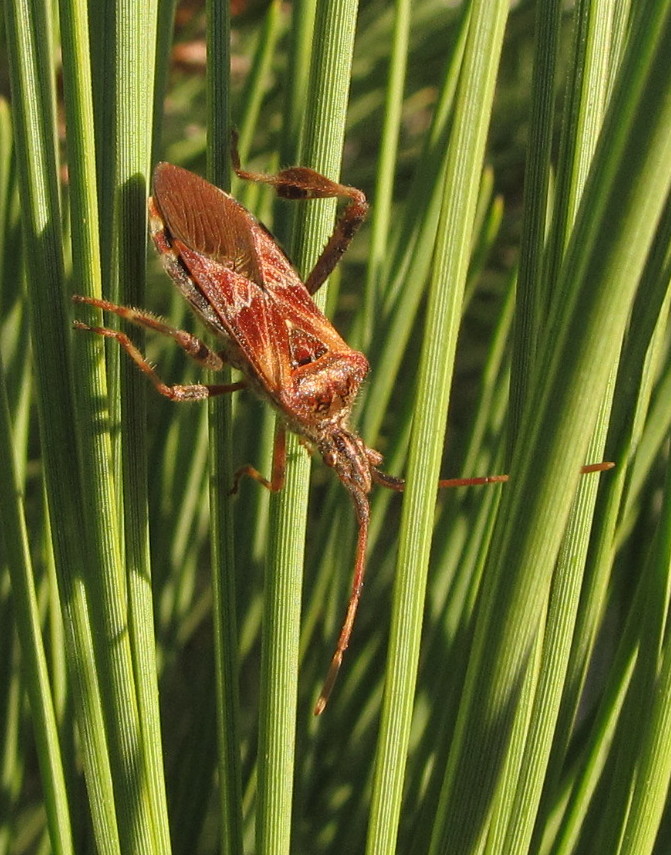
True Bug Tuesday: Exporting the Western Conifer Seed Bug

We spend a great deal of time and energy in the U.S. wringing our hands over invasive species from Europe and Asia, but we forget we sometimes export our own pests in return. Last week, a thread emerged on the Entomo-l listserv from a doctoral student in France who inquired about how to control the Western Conifer Seed Bug, Leptoglossus occidentalis. Seems it was first detected in Europe in northern Italy in 1999, but has since spread through most of the continent. It was first found in the United Kingdom at Weymouth College in Dorset in January, 2007.

This rapid colonization should come as no surprise. Here in its native North America, the WCSB has shown the same propensity for expanding its range. Once confined to the western U.S., it began creeping eastward in the 1950s. By the 1990s it had reached the east coast.

Leptoglossus occidentalis is generally considered at most a nuisance pest that likes to spend the winter inside homes where it emerges at inopportune times, flies with a loud droning noise, and produces a disagreeable (to some people at least) odor when accosted.

The conversation on Entomo-l revealed that the bug is not always so innocuous. It has beak-like mouthparts and it can pierce polyethylene (PEX) tubing used in plumbing and radiant heating. The bugs secrete a protein in their saliva that forms a protective sheath around their mouthparts while they feed, and this sheath is left behind as evidence. Hence, investigators were able to sleuth the culprit in the case of the “weeping” pipes that lose water through the pinhole punctures caused by bugs exploring novel surroundings (Bates, 2005).

Obviously, a much more pressing concern for our friends abroad is the prospect of WCSB becoming a forest pest. They feed on seeds inside the cones of conifers, especially pines but also Douglas Fir and Eastern (Canadian) Hemlock. They rarely cause significant damage in natural stands, but are a potential problem in conifer seed orchards.

Indeed, laboratory studies show that late-season feeding in particular can have adverse effects, reducing the storage reserves of lipids and buffer-insoluble (crystalloid) proteins by up to 78% and 97% respectively in seeds of Douglas Fir (Bates, et al., 2001). WCSB certainly impacts second-year cones in orchards. Seed production can be reduced by 75% in Lodgepole Pine under some circumstances (Bates, et al., 2002).

Our collective desire for “free” trade and global commerce guarantees that we will continue to exchange fauna and flora that could become problematic outside their native regions. Are we properly informed of the risks? One is left to wonder about the consequences.

Sources: Bates, Sarah L., Cameron G. Lait, John H. Borden, and Allison R. Kermode. 2001. “Effect of feeding by the western conifer seed bug, Leptoglossus occidentalis, on the major storage reserves of developing seeds and on seedling vigor of Douglas-fir,” Tree Physiol. 21: 481-487.
Bates, Sarah L., Ward B. Strong, and John H. Borden. 2002. “Abortion and Seed Set in Lodgepole and Western White Pine Conelets Following Feeding by Leptoglossus occidentalis (Heteroptera: Coreidae),” Environ. Entomol. 31(6): 1023-1029.
Bates, S.L. 2005. “Damage to common plumbing materials caused by overwintering Leptoglossus occidentalis (Hemiptera: Coreidae),” Can. Entomol. 137: 492-496.
Taylor, Steven J., Gluseppi Tescari, and Mauro Villa. 2001. “A Nearctic Pest of Pinaceae Accidentally Introduced Into Europe: Leptoglossus occidentalis (Heteroptera: Coreidae) in Northern Italy,” Ent. News 112(2): 101-103.

Sunday, August 21, 2011

Spider Sunday: The Cross Spider

’Tis late summer, now, in most parts of North America, anyway, and orb weaver spiders are becoming more conspicuous as they mature into large adult specimens and spin bigger webs (soon to be revealed by falling autumn foliage). Among the most abundant of these spinners is the “Cross Spider,” Araneus diadematus.

The Cross Spider is a European immigrant, just like most of us human residents of the U.S. and Canada, so the species feels most at home in northern climes. It is recorded from Newfoundland and Nova Scotia to British Columbia and south to northern California, Michigan, Ohio, Pennsylvania, New York and Rhode Island. It is plenty accustomed to people, too, so it is a regular occupant of gardens and yards in urban areas.

Araneus diadematus gets its popular English name not from an angry disposition, but because it usually sports silvery-white dots that form the pattern of a traditional Christian cross on its abdomen. This is a relatively consistent marking, but as with most orb weavers, there can be exceptions. The spiders usually hang head-down in the very center (hub) of their webs, but sometimes an individual spider may be more reclusive, and connect herself to the web via a bundle of “signal threads” that run from the hub to her hiding place in a rolled-up leaf or other nearby retreat.

The reaction of homeowners to the presence of this and other species of orb weavers runs the gamut from curiosity to consternation. No species of orb weaver is known to be dangerously venomous to people or pets, so there is no reason to fear them. The spiders themselves will literally shake at the close approach of a person or other large animal, vibrating their web and no doubt startling the inquisitive visitor. Should that tactic fail, most orb weavers drop abruptly from their web, anchoring a dragline to the hub so they can climb back up once danger passes.

This species happens to include some real celebrities. No, seriously. “Anita” and “Arabella” were two female Cross Spiders sent into space on Skylab 3 in 1973 to study the effects of zero gravity on web construction. Prior to that, several specimens were used as guinea pigs in the study of how psychoactive drugs affect spiders’ ability to spin webs. Those experiments were first conducted by a German scientist beginning in 1948, then repeated by NASA scientists in 1984. For an absolutely hilarious send-up of that research, you must see ”The Wood Spider” video on YouTube. I take no responsibility for laughter-induced fatalities.

An adult female Cross Spider has an average body length of about 13 millimeters, though gravid females certainly appear larger. Like the story of Charlotte’s Web, each spider’s life from egg to adult spans only a year. Enjoy their handiwork and pest-controlling services while you can.

Sunday, July 3, 2011

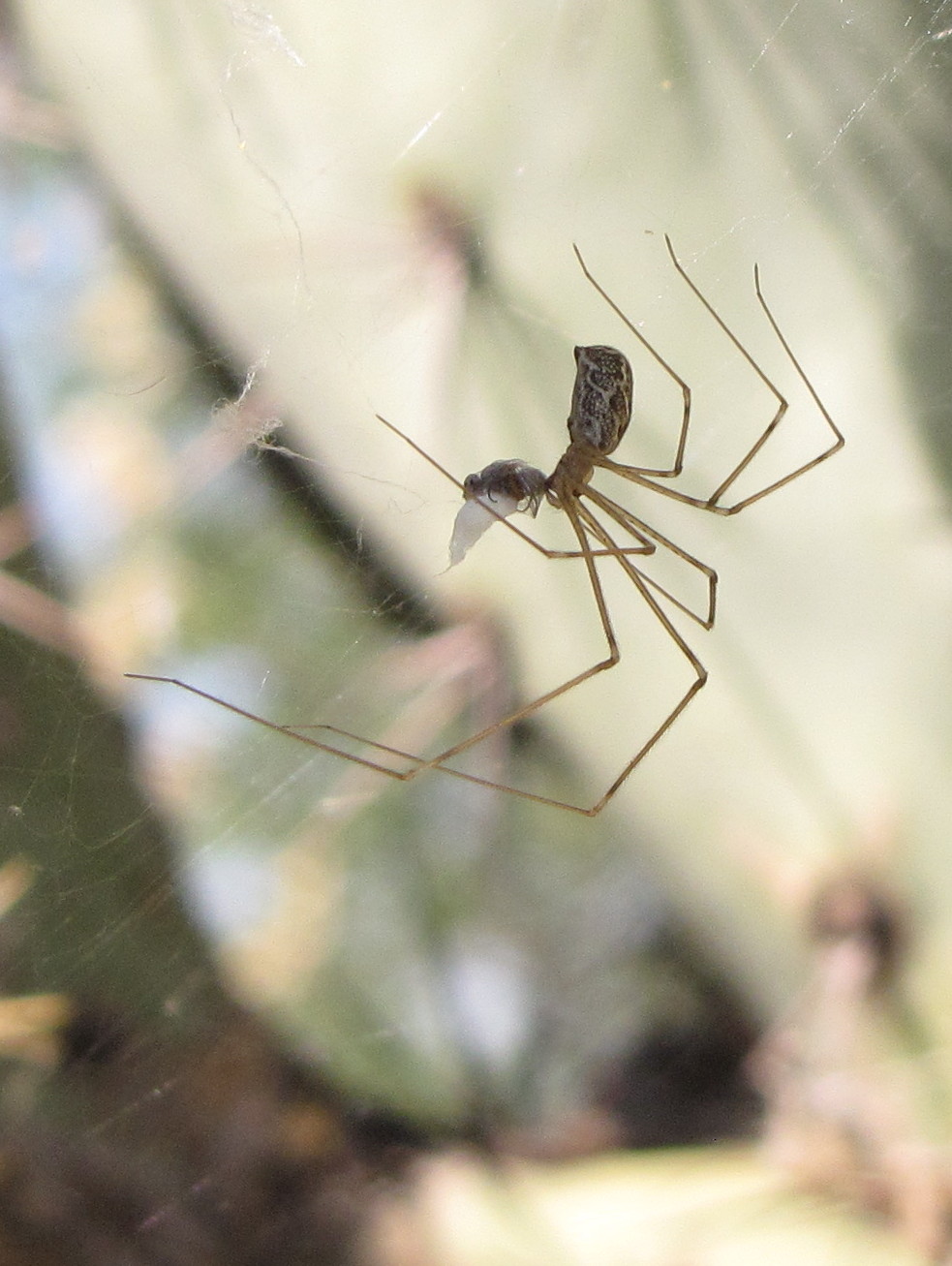
Spider Sunday: Marbled Cellar Spider

Cellar spiders are named for their habit of building their webs in cool, dark places such as basements, old mine shafts, wells and the like. Indeed, many members of the family Pholcidae do frequent such situations. However, this is not true of the Marbled Cellar Spider, Holocnemus pluchei.

The Marbled Cellar spider is actually native to the Mediterranean region of Europe. The earliest known record in North America comes from Sutter County, California in 1974. Because this species closely resembles the common Long-bodied Cellar Spider, Pholcus phalangioides, it is possible that it became established prior to 1974. The current U.S. distribution of the Marbled Cellar Spider ranges east to at least central Texas, and north to southern Oregon.

I find this species to be far more common outdoors than I do indoors here in southern Arizona. The webs of Holocnemus are irregular but decidedly dome-like, at least when one individual spider is off by itself. This is rarely the case, though, and many specimens will together form nearly contiguous webs that stretch far and wide. Dr. Elizabeth Jakob of the University of Massachusetts (Amherst) has found that up to fifteen individual spiders may share a communal web at any one time, with “membership” changing periodically. The spiders do compete over prey items, but skirmishes are rarely protracted.

Nearly any building overhang or dense tangle of vegetation will do for a web location. The primary criterion seems to be that the spiders do need shade from the unrelenting sun. At the Tucson Botanical Gardens I find a favorite place for this species to build its webs is among the leathery, spine-studded leaves of agave plants. Not many enemies of these spiders want to pursue them among the botanical equivalent of barbed wire.

The body length of mature female Holocnemus pluchei spiders is only 6-8 millimeters (males 5-7 mm, see image above), but their long, sprawling legs make them appear much larger. While this species is not regarded as dangerously venomous to people or pets in terms of the virulence of its venom, it has recently been discovered to have allergenic properties. According to this article, the species produces arginine kinase, a newly-described asthma-inducing allergen.

You want even more information and images? Some fantastic close-ups of this species can be found at the EuroSpiders and Spider Pharm websites. Austin Bug has a great article discussing common pholcid spiders of the Austin, Texas area, including the Marbled Cellar Spider. There is a PDF file available of the article ”Contests Over Prey by Group-Living Pholcids (Holocnemus pluchei)” in the Journal of Arachnology. Another PDF article discusses ”Food Level and Life History Characteristics in a Pholcid Spider (Holocnemus pluchei)” in the journal Psyche.

Wednesday, June 8, 2011

Wasp Wednesday: Bristly Rose Slug

Wasps are sometimes named after their larvae. This is certainly true of many of the common sawflies in the family Tenthredinidae. Case in point: the “Bristly Rose Slug,” Cladius difformis. True to its epithet, the larvae of this insect are covered in tiny setae (hairs) and feed voraciously on roses. I was lucky enough to document both the adult and immature stages in a friend’s garden in Redondo Beach, California last month.

I spotted the adult female wasp on the morning of May 16 as she basked in the sun and groomed herself on a leaf adjacent to a rose bush. This is not a large insect, only about 6 mm in body length.

A male then suddenly appeared, and just as suddenly they were copulating. Note the sexual dimorphism, especially in the antennae of the male. This branching type of antenna is termed “pectinate” and is not uncommon in some wasps and beetles. The couple soon became unhitched and the male went his merry way.

The female wasp, had I been able to follow her long enough, would have laid her eggs in a rose leaf. She uses her saw-like ovipositor (hence the common name of the family) to cut into the upper surface of the midrib vein and create a pocket where she will deposit a single egg. The process is repeated several times on the same leaf. The ovipositor is a complex arrangement of a “lance” and at least one pair of “lancets,” all normally concealed inside a blade-like sheath when not being deployed. The lancets act in concert to cut through the leaf tissue, braced by the lance.

The tiny larvae that emerge from the egg begin to skeletonize small portions of the leaf. The larvae go through five instars (periods between molts), and their appetites seem to increase with each molt. Eventually they are creating enormous holes in the rose leaves.

I found several larger larvae (12-13 mm, nearly mature) on May 23. Their resemblance to caterpillars is obvious, but they have more pairs of prolegs (“false legs” that run the length of the abdomen) than do larvae of moths and butterflies (which have five or fewer pairs of prolegs). It is easy to see why this insect is considered a garden pest, given the heavy damage it can inflict. It is also known to feed on raspberries and strawberries. The larvae eventually pupate in a papery cocoon.

It is assumed that the Bristly Rose Slug was introduced to North America from northern Europe. Many authorities in fact synonymize Cladius difformis with Cladius pectinicornis of the Old World. David R. Smith, a renowned expert on sawflies here in North America, asserts that the two are distinctly separate species. The Bristly Rose Slug occurs on both coasts of North America, and from Nova Scotia to British Columbia. It seems to range only through the northern third of the United States except for the coastlines.

There are not many options available for control of this species, so handpicking the larvae off of leaves may be your best bet. The biological control “Bt” (Bacillus thuringiensis) is not effective.

There is more information, and more images, available online, of course, including the complete life cycle in images here.