Showing posts with label invasive species. Show all posts

Sunday, November 6, 2022

The Changing Conversation Around Invasive Species

Recently, the debate about invasive species has become more polarized than ever, with a degree of defensiveness and anger not seen previously. The reasons for this are many, some difficult to admit to.

Chinese Clematis may be invasive, but it deserves a less bigoted name.

I attended a webinar a few weeks ago in which the presenter asserted that “invasive species” is a “militarized term.” My instinctive reaction was that this was accusatory, bordering on defamation of science, when there is clear evidence that the introduction of a species to a new ecosystem can have devastating consequences.

Spongy Moth is still a bonafide forest pest, but now has a more appropriate moniker.

Pondering his comment further, it occurred to me that most of the animals, and plants, we label as invasive have some sort of obvious and negative economic impact. We have, as a consumer culture, become conditioned to frame everything in terms of business and monetary interests rather than ecological concerns. This has become more complicated by angst over climate change, and the resulting vulnerability of humanity to emerging threats, be they viruses or “murder hornets.”

20200512-P1090983 Vespa mandarinia japonica
© Yasunori Koide and Wikimedia Commons. Asian Giant Hornet only "murders" in the beehive, but is a serious threat to apiculture because of that proclivity.

The sudden, and/or overwhelming appearance of a novel organism is going to cause alarm, and the public seldom has comprehensive, appropriate knowledge for interpretation of potential impacts. We are at the mercy of what news outlets tell us. Because traditional print, radio, and television media now compete with social media, sensationalism is the order of the day. “Click bait” banners prevail over more accurate but less provocative headlines.

© Kim Fleming and Bugguide.net. Joro Spider, Trichonephila clavata, is not currently considered invasive.

Initial forecasts can also be premature. The jury is still out on whether some recently-introduced species will become problematic. They may not. The Joro Spider is a case in point. It is locally abundant in some parts of the southeast U.S., but whether this translates to a displacement of native spiders remains an unanswered question.

We collectively have a fascination with heroes and villains, too, and there are no more menacing villains than alien-looking insects, spiders, and other arthropods. Fantasy melds with reality and it becomes difficult to separate the two if you are not scientifically literate, or have a business model that demands public hatred of a particular creature.

© USDA ARS, public domain. Spotted Lanternfly, Lycorma delicatula, adult and nymphs. This species is a potential agricultural pest of serious magnitude.

In opposition to nativism is the idea that there is no such thing as invasive species. After all, man is part of nature, and therefore our actions are natural processes. The outcomes of those activities are circumstances to which we, and other species, will adapt.

It may be no coincidence that a backlash against the idea of invasive species is more evident now that we are recognizing, and attempting to mitigate, a history of colonialism. A convincing argument could be made that White settlers are the original invasive species. Here, in North America, we annihilated and displaced Indigenous members of our own species. We enslaved others. To this day we continue missionary work and other forms of colonialism. Therefore, the idea of invasive species becomes one of self-loathing, certainly an eventual threat to White supremacy and privilege. White people do not want to see themselves as villains.

Meanwhile, we demonize human immigrants and refugees as criminals and threats to domestic labor pools. We clamor for the closure of borders to our fellow humans, but allow our boundaries to be permeated by everything else. Not that human-imposed boundaries reflect natural ones.

The Cross Orbweaver, Araneus diadematus, is an example of a naturalized arachnid in North America.

Scientists have an uphill battle in resolving these opposing perspectives and initiating constructive dialogue. Looking to the past we see how some species from foreign lands have become “naturalized” over time, becoming innocuous additions to our flora and fauna. The average citizen may be shocked to learn that dandelions are not native to the U.S. They have become a fixture in our lawnscapes, even if we are instructed to use weed-killers against them.

Myrtle Spurge, aka "Donkeytail," Euphorbia myrsinites, is classified as a noxious weed in some jurisdictions, but not everywhere.

What is lost in all of this is attribution of the modern problem of invasive species to global consumer culture. Historically, human colonists brought other species with them as a guarantee of food and other necessary resources when venturing into unknown territory. Soon after, those species and their products became valuable in trade, a way to establish meaningful and positive relationships with Indigenous peoples, or other settlers. The pace of travel was slow, and the scale of enterprise miniscule compared to twenty-first century business.

Today, we mostly covet plants and animals of far-off lands. Plants, especially, can harbor potential insect pests. The containers used to transport international commerce are frequently occupied by insects, rodents, and other organisms. We seldom make that connection between our consumer habits and the state of ecosystems around the world.

Captive Reticulated Python. Release of unwanted Burmese Pythons into the Everglades by irresponsible pet owners has been....problematic.

We cannot turn the clock back, but we should make more informed and conscientious individual choices in the marketplace. We should promote the welfare of Indigenous peoples, and actively seek their counsel and leadership in crafting a world better able to withstand climate change. A permanent end to colonialism would not be a bad thing, either.

Sunday, July 17, 2022

What is, and is NOT, a Japanese Beetle

It is that time of year again in North America when everything is a Japanese Beetle. No matter whether you are a trusted and reliable expert, other people will insist that Green June Beetles, Fig Beetles, Dogbane Leaf Beetles, and various other beetles, are in fact Japanese Beetles. Why is this the case? There is much misinformation online and in the media. Family, friends, coworkers, and others present themselves as experts and make incorrect identifications. Mobile phone "apps" can also be misleading, given the relative infancy of image recognition software and deep learning, which frequently compounds errors instead of correcting them. Here is everything you need to know about how to recognize the Japanese Beetle, Popillia japonica, as well as lookalike species.

L-R: Japanese Beetle, Green June Beetle, Emerald Flower Scarab

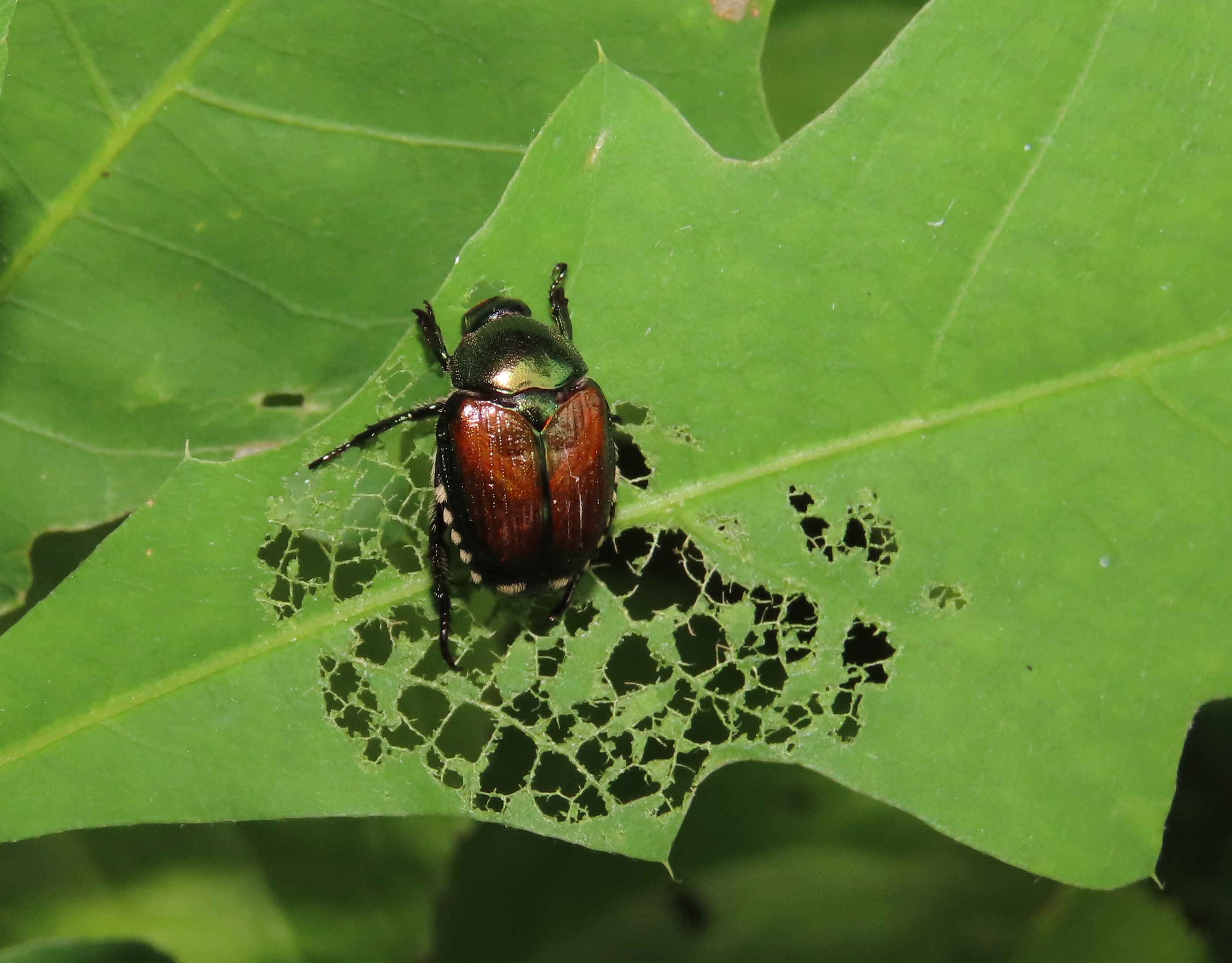
The Japanese Beetle, as its name implies, occurs naturally in Japan and northern China. An accidental introduction of this species to New Jersey in 1916 is apparently what launched the beetle's domination of yards and gardens over most of the eastern United States and southeast Canada. It delivers a double whammy to urban and suburban areas by feeding on the roots of turf grasses in its subterranean larval (grub) stage, and on the foliage of more than three hundred (300) species of plants as an adult insect. The beetles are "skeletonizers," leaving a net-like pattern of leaf veins in the wake of their chewing. Grape and rose are among their favorites.

Typical "skeletonizing" damage by Japanese Beetle

Japanese beetles are classified as scarab beetles, in the family Scarabaeidae, subfamily Rutelinae, collectively known as the shining leaf chafers. The adults become suddenly abundant about mid-summer. They fly well, quickly dispersing themselves over the landscape. Their sheer numbers, the telltale pattern of damage they do to foliage, their size, and their behavior help to make them easy to identify with a little practice.

Japanese Beetles congregating and mating

These are smaller insects than you might expect, ranging from 8.9-11.8 millimeters in body length. That is less than half an inch. They vary in color by individual and age, but most are shining metallic green and red. The flanks of the abdomen are adorned with tufts of white hairs, a feature no other lookalike beetle has. The elytra (wing covers) are striated (have grooves), which also helps set them apart from similar beetles. The hind legs are long and stout, with sharp spurs coming from the tip of the tibial segment (think "shin"). When disturbed, Japanese beetles will flare their hind legs out and up, presenting their spiked weaponry. They can give you a good prick should you insist on seizing one.

Japanese Beetle in defensive pose

The antennae of adult Japanese Beetles are short, with a series of leaf-like plates at the tip, typical of all scarab beetles and their allies. The term for this style of antenna is "lamellate" for "plate-like." The plates are covered in receptors that are tuned to species-specific pheromones for locating others of their kind. Pheromone traps, sold commercially, work well if your goal is to draw even more Japanese Beetles to your yard or garden. Hand-picking the insects and drowning them in pails of water, with a dash of dish soap to break the surface tension, may be the best way to control them. Time consuming for certain, but highly specific to the target pest, and otherwise environmentally friendly.

Green June Beetle, Cotinis nitida

The number one victim of mistaken identity in the Japanese Beetle game is far and away the innocuous Green June Beetle, Cotinis nitida, another scarab beetle that is native to the United States. This insect is much larger, at 15-27 millimeters in size. It is mostly matte green with some degree of iridescence in the right light, especially on the insect's underside. It may or may not be marked with ochre trim, and lines on the wing covers. You may hear these beetles before you see them, as they fly loudly. Green June Beetles, and their relative, the Fig Beetle (Cotinis mutabilis), are classified as "flower chafers" in the subfamily Cetoniinae. They have a special hinge on each wing cover that allows the elytra to remain closed while the membranous hind wings are deployed for flight. Consequently, flower chafers bear a great resemblance to large bees while cruising around looking for food or mates. Green June Beetle feeds on flower nectar and pollen, but occasionally damages ripe fruit; and they also feed on fermenting sap from wounds on trees. This makes them a mild pest under circumstances of orchards and nurseries. As grubs, Green June Beetles feed on decomposing organic matter. You will often see females diving headlong into compost and manure heaps to lay their eggs. In nature they look for rich humus.

Emerald Flower Scarab

Another flower chafer sometimes mistaken for a Japanese Beetle is the Emerald Flower Scarab, Euphoria fulgida. This beautiful beetle measures 13.4-19.8 millimeters. It is often highly active and quicker to fly than the other beetles mentioned so far. It varies considerably in color according to both the individual and the geographic locality it lives in. Specimens from the foothills of the Front Range in Colorado, for example, are deep purple and brilliant turquoise.

Dogbane Leaf Beetle

Recently, I had a....disagreement with someone in social media about the identity of yet another beetle, the Dogbane Leaf Beetle, Chrysochus auratus. At 8-13 millimeters, it approximates the size of a Japanese Beetle. It is superficially colored the same, too, being brilliant metallic green, red, blue, bronze, or copper, depending on the angle of light hitting the creature. That is where the similarity ends. The Dogbane Leaf Beetle belongs to a completely different family, the Chrysomelidae. One look at the long, uniformly segmented antennae, tells you it is not a scarab. Its legs are not armed with spines or teeth, and it has cute, wide little feet for gripping plants. Most decisive, however, is the food preference for this species. Dogbane Leaf Beetle feeds only on....surprise....dogbane. You may occasionally encounter an individual that has alighted on some other plant in the course of trying to find a mate or another dogbane plant, but there will never be large numbers of them on anything but dogbane.

Female Tiphia wasp searching for buried scarab grubs

All manner of control strategies have been applied to the Japanese Beetle, yet here it is, still with us, in arguably greater numbers than ever, and steadily expanding its empire. We have imported the Spring Tiphia wasp, Tiphia vernalis, from China in 1925, a natural enemy. The female wasp digs up a beetle grub, stings it into temporary paralysis, lays an egg on it, and abandons it. The larval wasp that hatches feeds on the grub externally, eventually killing it. We also employ Bacillus popilliae, known better as "milky spore disease" to combat the grubs. The bacterium turns the beetle larvae a milky white color in the process of killing them, but it also affects native scarab grubs.

A large robber fly, Laphria lata, has skewered a Japanese Beetle on its proboscis

Be careful in how you control Japanese Beetles, lest you adversely impact garden allies. Assassin bugs, particularly the Wheel Bug, and robber flies, are among the chief predators of Japanese Beetles, but they need as natural a landscape as possible to proliferate and be effective controls. Invasive species are an artifact of global consumerism, and coveting thy (foreign) neighbor's flora. Resist the temptation and help prevent the next pest from gaining a foothold.

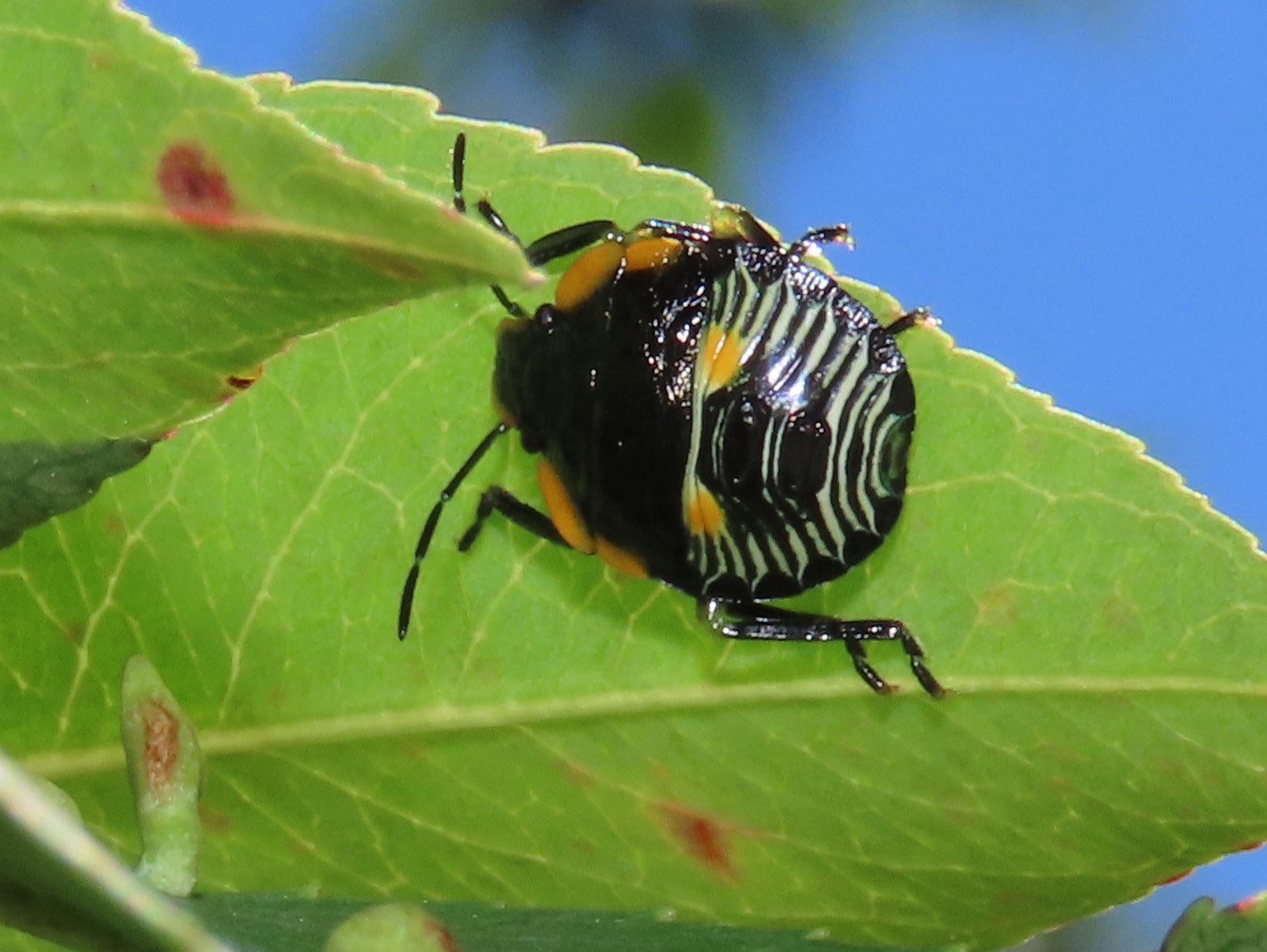
Nope, not a Japanese Beetle. Not even a beetle, but the nymph of a Green Stink Bug.

Sources: Evans, Arthur V. 2014. Beetles of Eastern North America. Princeton, New Jersey: Princeton University Press. 560 pp.
Ratcliffe, Brett C. 1991. The Scarab Beetles of Nebraska. Lincoln: University of Nebraska. Bulletin of the University of Nebraska State Museum, vol. 12. 333 pp.
Berenbaum, May R. 1995. Bugs in the System: Insects and Their Impact on Human Affairs. New York: Addison-Wesley Publishing Company, Inc. 377 pp.
Fahmy, Omar. 2007. "Species Tiphia vernalis - Spring Tiphia," Bugguide.net
Eaton, Eric R. and Kenn Kaufman. 2007. Kaufman Field Guide to Insects of North America. Boston: Houghton Mifflin. 392 pp.

Tuesday, May 5, 2015

A "New" Beetle in Colorado

Exploring South Cheyenne Cañon the morning of May 2, I casually turned over a chunk of solid but rotten wood to find a large rove beetle clinging to it. Since I don't see staphylinids every day, let alone a large one, and because they typically move faster than your average insect, I bottled it up and brought it home to take a few images. Little did I know what would become of this innocent event.

Rove beetle, Tasgius winkleri, about 10-12 mm

By the time I got around to putting the little fellow (it *is* a male, given the dilated front tarsi - expanded "feet") in my casserole dish staging area, he was clearly not in the best of health. Rove beetles, family Staphylinidae, are well-known for secreting foul substances or odors in self-defense, and I wonder if he asphyxiated himself in the close quarters of the pill vial.

Having limited familiarity with rove beetles, I accepted this was probably a native species of Platydracus, which includes many of our larger rove beetles. Just to be safe, I posted a couple of images on the Facebook group "Friends of Coleoptera at the Natural History Museum (Entomology Museum)." The natural history museum is the one in London, England, but the members of the Facebook group are from all over and collectively knowledgeable beyond measure. Not to mention courteous and kind.

Well, in short order I had many "likes" for the images, and a few random comments suggesting identifications. None of them were Platydracus. Agmal Qodri didn't have an answer, but knew someone who might. "What's your opinion, Adam Brunke?," wrote Agmal. Before Adam could chime in, Harald Schillhammer offered that the beetle was "Tasgius winkleri or T. melanarius." Adam Brunke then concluded it to be Tasgius winkleri.

Considering that most identifications of insects, let alone staphylinids which are among the most diverse of all insect families, hinges on minute characters like length and placement of setae (hairs), I was astounded to get a species ID from my images. There it was, though. What was perhaps helpful was the fact that this beetle is actually native to Europe, where of course it would be familiar to many members of the Facebook group.

Alfred Newton filled in the blanks with his comment: "The range of this European species must be expanding - T. winkleri appeared on both east and west coasts of North America about 90 years ago, has spread westward as far as Illinois, but was not known from anywhere near Colorado." Wow.

I did a little digging to find out more about this beetle and learned it was first reported on U.S. soil in New York in 1938; but it was probably present at least as early as 1931. Since then it has been discovered in the states of New Hampshire, Pennsylvania, Michigan, Illinois, Washington, Oregon, and California, plus the provinces of Ontario and British Columbia.

Before 1987, this species went by the name Tasgius globulifer, which it turned out included the species T. melanarius, too. Such "splitting" of one species into two or more is the result of hard work by taxonomists who are alert enough to recognize character differences overlooked by their predecessors.

You might want to keep an eye out for this beetle in your neck of the woods. It is "synanthropic," meaning that it is seldom, if ever, found far from humans, and seems to thrive in habitat heavily disturbed by us Homo sapiens. So, look under stones and boards in your garden or neighborhood park, in leaf litter, the edges of wetlands, and similar moist niches.

Source: Brunke, A., A. Newton, J. Klimaszewski, C. Majka, and S.A. Marshall. 2011. Staphylinidae of Eastern Canada and Adjacent United States. Key to Subfamilies; Staphylininae: Tribes and Subtribes, and Species of Staphylinina. Canadian Journal of Arthropod Identification No. 12.

Wednesday, October 8, 2014

A Foreign Mud Dauber: Update

Back in the spring of this year, I broke the story of a new immigrant species to the U.S. that my wife found at the zoo where she works. The story is here, but today's post is the sequel. Initially, I thought that wasp might represent an isolated incident, a single specimen that managed to sneak over in a shipment to the zoo. That is clearly not the case now.

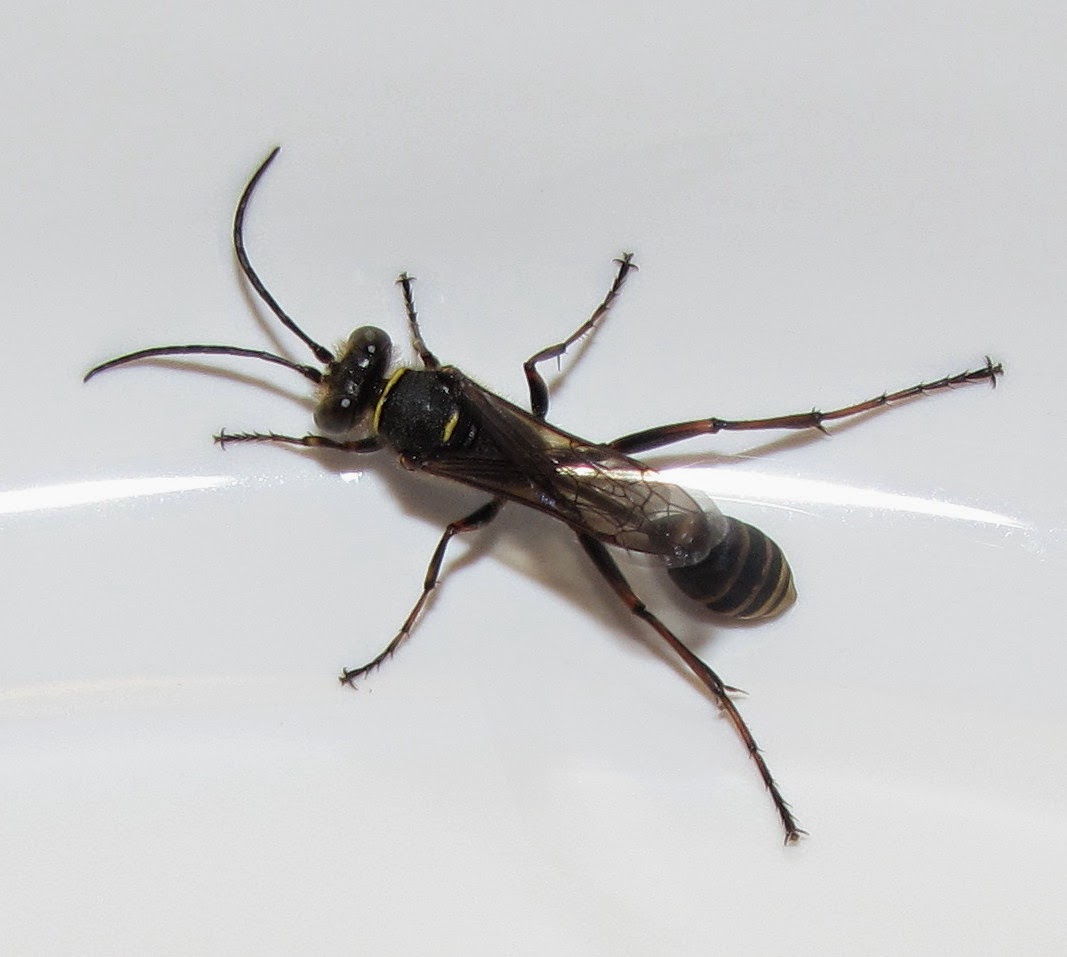
the Asian Sceliphron curvatum

Taking advantage of an unseasonably warm autumn afternoon on October 6, my wife and I went to Quail Lake Park here in Colorado Springs to look for birds and other wildlife. The park is in the foothills of the Front Range, not that far from the zoo. There, on the muddy shore of the artificial reservoir, in the dimming light of late afternoon, we saw a trio of wasps. Two were familiar natives: The Western Yellowjacket, Vespula pensylvanica, and the Black and Yellow Mud Dauber, Sceliphron caementarium.

Our native Sceliphron caementarium

Heidi asked if the third, smaller wasp was also a mud dauber, and I answered yes, pretty much dismissing it as simply an unusually dark S. caementarium. I took images, though, and looking at the result I was both excited and crushed. Here was another specimen of Sceliphron curvatum, and she was clearly gathering mud to make a nest. This is pretty conclusive evidence that this Asian species is now established here in the U.S.

Nearby the lakeshore is the restroom building for the park, and I wondered if this wasp had her nest there. Ironically, cliff swallows had built numerous nests under the roof over the "porch," but I could find no evidence of any insect nests, not even paper wasps. Some of the beams are hollow metal, though, and it is certainly conceivable that wasps are nesting out of sight.

S. curvatum about to take off with a ball of mud

I suspect that Sceliphron curvatum exists in other regions of the U.S., too, particularly around the Appalachian Mountains, but has simply been overlooked. It may not be abundant yet, but that can change quickly. When I lived in Cincinnati, Ohio, I recall finding my first specimens of the introduced European Paper Wasp (Polistes dominula) to be a novelty in the early- to mid-1990s. A few years later they were the second most common species of paper wasp I was seeing.

Again, I ask my readers to be on the lookout for this "new" mud dauber, and make your observations and images known through every means possible, especially social media like Facebook and Twitter where you are likely to get almost immediate confirmation or refutation of your identification. The more eyes looking out for unusual insects the better.

Thursday, May 1, 2014

Exclusive! Important Wasp BOLO

My wife, Heidi, seems to have a knack for finding noteworthy insects at her workplace, the Cheyenne Mountain Zoo. Her most recent discovery is apparently the first confirmed U.S. record of Sceliphron curvatum, an Asian mud dauber wasp in the family Sphecidae. This is a species you need to Be On the Look Out for, and that should be reported to your state or provincial department of agriculture.

Initially, I thought the wasp Heidi captured on April 29 was a blue mud dauber in the genus Chalybion, as it appeared to be dark with few, if any markings, but the container was rather opaque. Removing the wasp from the container and taking images revealed it was actually a species of Sceliphron, of which the native species S. caementarium is locally abundant.

Still, something seemed a bit off. The wasp was indeed dark, devoid of most of the usual bright yellow markings on the legs and body. I quickly uploaded the images to my computer, and posted one on a Facebook interest group for experts in the order Hymenoptera. Meanwhile, I did a little investigating online, and found images in Bugguide.net from Montreal that resembled the specimen.

The Bugguide category is currently “Sceliphron curvatum-or-deforme” because the two species, native to Asia, are apparently difficult to distinguish. I then looked up Google images for S. curvatum and it became clear that the Colorado Springs specimen was at least a close ally of that species.

Back to Facebook. Étienne Normandin of Montreal, and Doug Yanega, an entomologist at the University of California, Riverside, both came to the same conclusion I had, but they have authoritative credentials that I do not.

Sceliphron curvatum is noticeably smaller than our native species, ranging from 15-25 millimeters in body length as opposed to 24-28 millimeters for S. caementarium. Other than size, and differences in color pattern, the two wasps are very similar in their natural history. Each female wasp constructs her own mud nest consisting of one or several cells attached to protected surfaces such as beneath a cliff overhang, under bridges, under the eaves of buildings, or inside old barns. S. curvatum evidently has a propensity for nesting indoors, attaching mud cells to walls, piles of old books, clothing, and furniture. This more “domestic” lifestyle no doubt makes it a prime candidate for spreading far and wide via international commerce. It is easy to overlook a small, earthtone object attached to something.

Mud daubers are predators of spiders, with more generalist tendencies than spider wasps in the family Pompilidae. So, nearly any kind of spider is fair game. Many spiders are paralyzed and piled into a single mud cell before the mother wasp lays a single egg and seals the cell. The larva that hatches feeds on the cache of food, eventually pupating. The adult wasp that emerges then chews its way out of its clay crib

S. curvatum is native to India, Nepal, Pakistan, Kazakhstan, and Tadjikistan, in the foothills of the Himalayas and other mountain ranges. Great. The Front Range of Colorado is essentially the same habitat. It was first reported from Europe in southeastern Austria in 1979. Since then it has spread to Slovenia, Italy, Croatia, Switzerland, France, Hungary, Germany, Serbia and Montenegro, Greece, the Czech Republic, and Slovakia (Bosusch, et al., 2005). Much of its range extension is attributed to the wasp’s own natural dispersal capabilities.

The species has also turned up in and around Buenos Aires, Argentina, as reported in 2008 (Compagnucci and Alsina, 2008). On July 7, 2013, images of a specimen of S. curvatum, next to a mud cell, were posted to Bugguide.net from Montreal, Quebec, Canada, representing the first North American record for the species.

Please put this species on your radar, and maybe pay closer attention to mud daubers in general since it is easy to overlook this newcomer.

Sources: Bogusch, P., P. Liška, J. Lukáš, and A. Dudich. 2005. “Spreading and summary of the knowledge of the invasive sphecid wasp Sceliphron curvatum (Smith 1870) in the Czech Republic and Slovakia (Hymenoptera: Apocrita, Sphecidae),” Linzer Biol. Beitr. 37(1): 215-221.
Compagnucci, Luis A. and Arturo Roig Alsina. 2008. “Sceliphron curvatum, una nueva avispa invasora en la Argentina (Hymenoptera: Sphecidae),” Revista de la Sociedad Entomológica Argentina 67(3/4): 63.

Tuesday, April 8, 2014

The Bagrada Bug

California and Arizona have an immigration problem. No, not those immigrants; I am referring to an insect known as the Bagrada Bug, Bagrada hilaris. This member of the stink bug family Pentatomidae is native to Africa but has found its way to the U.S. where it has quickly become a crop pest. It is also known as the "Painted Bug."

The Bagrada Bug has not been here long. It was first detected in June of 2008 in Los Angeles County, but is now found abundantly throughout southern California and adjacent southern Arizona, eastward through southern New Mexico and into Texas. It had previously established itself in Italy, Malta, and southern Asia.

This insect is frequently mistaken for the native “Harlequin Bug,” Murgantia histrionic, but the Bagrada Bug is about half the size of its native cousin, adults measuring a mere 5-7 millimeters.

Murgantia histrionica, the "Harlequin Bug"

The nymphs of B. hilaris are occasionally dismissed as beneficial lady beetles due to their bright red and black markings. There are five nymphal instars, an “instar” being the interval between molts.

Bagrada hilaris nymph

What makes the Bagrada Bug problematic is its appetite for plants in the cabbage and mustard family (Brassicaceae in today’s classification, Cruciferae of previous eras). So, kale, turnips, broccoli, radishes, and related vegetables are all on its menu. It doesn’t end there, either. The bug is also known to feed on potato, sorghum, cotton, papaya, maize, various legumes, and other crops. Ornamental plants like sweet alyssum and candytuft are also vulnerable.
The appearance of this pest in the U.S. caught everyone off guard, including entomologists. Its biology and natural enemies are barely known, so few control methods can be applied, let alone biocontrol agents like parasites and predators. We don’t even know exactly how fast the Bagrada Bug is spreading.

You can help improve our understanding of the distribution of B. hilaris by keeping an eye out for it and reporting your observations to your state department of agriculture. Having images to back up your identification can help immensely.

Almost all information on the Bagrada Bug in the U.S. is found online because the species is such a recent introduction here. The most trusted resources are websites with URL addresses ending in “.edu” or “.gov.” Commercial sources are often less accurate.

Sources: Arakelian, Gevork. 2013. “Bagrada Bug,” Center for Invasive Species Research, University of California, Riverside.
Flint, Mary Louise, et al. 2013. “Pest Alert! Bagrada Bug,” UC IPM Online, University of California.
Wisch, Hartmut, et al. 2012. “Species Bagrada hilaris - Bagrada Bug,” Bugguide.net.

Monday, October 7, 2013

The Emerald Ash Borer Invades Colorado

I am usually excited in the positive sense when insects make headlines, but there are exceptions. It was devastating to learn recently that the Emerald Ash Borer, Agrilus planipennis, has been detected here in Colorado. Why is this discovery such a big deal? It has to do in part with the customary response to this exotic invader in other locations where it has shown up.

The Colorado Department of Agriculture announced on Friday, September 27, 2013 that the Emerald Ash Borer (EAB) had been discovered in Boulder County earlier in the month. While ash trees are apparently not native to Colorado, they are planted widely as part of the “urban forest” in many cities along the Front Range. Consequently, those trees are vulnerable to this invasive pest.

The reaction of many municipalities to the presence of EAB is the pre-emptive removal of the insect’s host trees. Visions of a wholesale slaughter are going through my mind right now. It is not pretty. It is costly, too, and leaves one less alternative for greenery and shade in what is a pretty bleak landscape on the fringe of the Great Plains. Shade is hard to come by, and there are few tree species that don’t have objectionable side effects. Cottonwoods shed copious amounts of cottony seeds in the spring. Locust trees grow quickly but their falling leaves get sucked into car air filters and find their way into every crack and crevice.

The thing that is really tragic is that the spread of the EAB is pretty much preventable. Various agencies and organizations have tried to get out the message about not moving firewood between states (even between counties), but the plea has either fallen on deaf ears, or not been broadcast loud enough. This is such an important message that it really warrants the Ad Council’s help in airing public service announcements on television and radio.

What is the history of this pest, you ask. According to EmeraldAshBorer.info, the Emerald Ash Borer was first discovered in the United States near Detroit, Michigan in 2002. At least, that is when entomologists first recognized it. It could have been present prior to 2002. Authorities surmise that it probably arrived in solid wood packing material originating from its native Asia. In short order the EAB was also found in Ontario, Canada, Ohio, and northern Indiana (by 2004). More were detected in northern Illinois and Maryland in 2006, then western Pennsylvania and West Virginia in 2007, followed by Missouri and Virginia in 2008. Since then it has also turned up in Minnesota, New York, Kentucky, Iowa, Tennessee, Connecticut, Kansas, Massachusetts, New Hampshire, North Carolina, Georgia, and now Colorado.

The life cycle of the beetle makes it difficult to quickly detect and almost impossible to control. The adult beetles typically emerge in mid-late May, with peak numbers in late June. Mated females begin laying eggs within two weeks of their emergence. The larvae hatch in about one to two weeks and begin boring into the inner bark and cambium layer of the host tree, disrupting the transportation of nutrients to the top of the tree. The larvae continue boring from late July to early October, overwintering in a chamber where they will pupate in the early spring. Sometimes the cycle is extended to two years.

The only symptoms of an EAB infestation outwardly visible are the gradual and subtle thinning of the tree’s canopy, and dying of branches in the uppermost reaches. Small trees can be killed by the beetle in one or two years, whereas larger trees may succumb in 3-4 years. The beetle probably selects stressed or otherwise already weakened trees as preferred hosts, but healthy trees can be attacked, too. The ongoing drought in the Front Range enhances the probability of the EAB becoming a widespread problem very quickly.

Please be on the lookout for the Emerald Ash Borer in your own state, province, or county, whether or not the species has already been detected there. Report your observations to your state department of agriculture, taking them specimens whenever possible. Thank you.

Tuesday, March 19, 2013

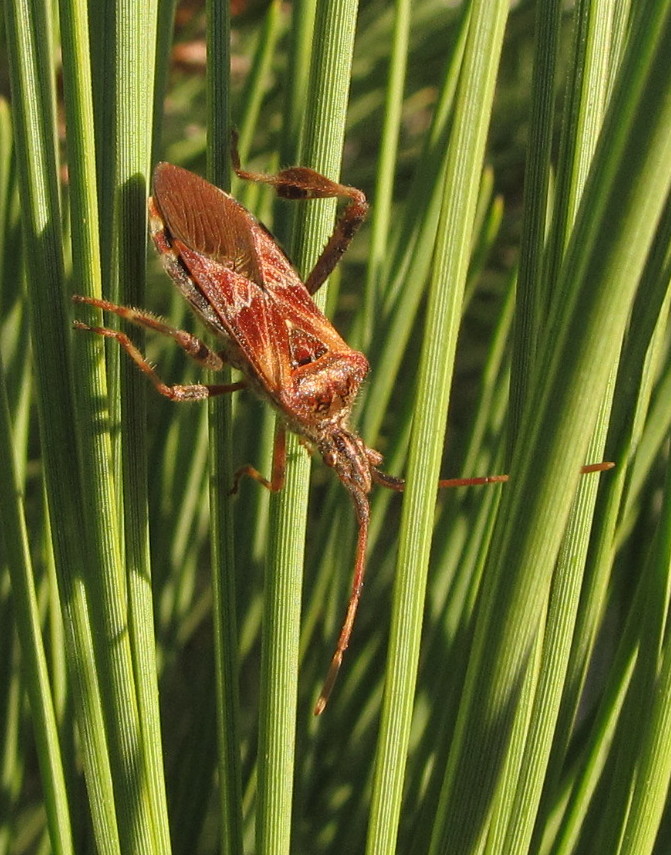
True Bug Tuesday: Exporting the Western Conifer Seed Bug

We spend a great deal of time and energy in the U.S. wringing our hands over invasive species from Europe and Asia, but we forget we sometimes export our own pests in return. Last week, a thread emerged on the Entomo-l listserv from a doctoral student in France who inquired about how to control the Western Conifer Seed Bug, Leptoglossus occidentalis. Seems it was first detected in Europe in northern Italy in 1999, but has since spread through most of the continent. It was first found in the United Kingdom at Weymouth College in Dorset in January, 2007.

This rapid colonization should come as no surprise. Here in its native North America, the WCSB has shown the same propensity for expanding its range. Once confined to the western U.S., it began creeping eastward in the 1950s. By the 1990s it had reached the east coast.

Leptoglossus occidentalis is generally considered at most a nuisance pest that likes to spend the winter inside homes where it emerges at inopportune times, flies with a loud droning noise, and produces a disagreeable (to some people at least) odor when accosted.

The conversation on Entomo-l revealed that the bug is not always so innocuous. It has beak-like mouthparts and it can pierce polyethylene (PEX) tubing used in plumbing and radiant heating. The bugs secrete a protein in their saliva that forms a protective sheath around their mouthparts while they feed, and this sheath is left behind as evidence. Hence, investigators were able to sleuth the culprit in the case of the “weeping” pipes that lose water through the pinhole punctures caused by bugs exploring novel surroundings (Bates, 2005).

Obviously, a much more pressing concern for our friends abroad is the prospect of WCSB becoming a forest pest. They feed on seeds inside the cones of conifers, especially pines but also Douglas Fir and Eastern (Canadian) Hemlock. They rarely cause significant damage in natural stands, but are a potential problem in conifer seed orchards.

Indeed, laboratory studies show that late-season feeding in particular can have adverse effects, reducing the storage reserves of lipids and buffer-insoluble (crystalloid) proteins by up to 78% and 97% respectively in seeds of Douglas Fir (Bates, et al., 2001). WCSB certainly impacts second-year cones in orchards. Seed production can be reduced by 75% in Lodgepole Pine under some circumstances (Bates, et al., 2002).

Our collective desire for “free” trade and global commerce guarantees that we will continue to exchange fauna and flora that could become problematic outside their native regions. Are we properly informed of the risks? One is left to wonder about the consequences.

Sources: Bates, Sarah L., Cameron G. Lait, John H. Borden, and Allison R. Kermode. 2001. “Effect of feeding by the western conifer seed bug, Leptoglossus occidentalis, on the major storage reserves of developing seeds and on seedling vigor of Douglas-fir,” Tree Physiol. 21: 481-487.
Bates, Sarah L., Ward B. Strong, and John H. Borden. 2002. “Abortion and Seed Set in Lodgepole and Western White Pine Conelets Following Feeding by Leptoglossus occidentalis (Heteroptera: Coreidae),” Environ. Entomol. 31(6): 1023-1029.
Bates, S.L. 2005. “Damage to common plumbing materials caused by overwintering Leptoglossus occidentalis (Hemiptera: Coreidae),” Can. Entomol. 137: 492-496.
Taylor, Steven J., Gluseppi Tescari, and Mauro Villa. 2001. “A Nearctic Pest of Pinaceae Accidentally Introduced Into Europe: Leptoglossus occidentalis (Heteroptera: Coreidae) in Northern Italy,” Ent. News 112(2): 101-103.

Tuesday, January 22, 2013

True Bug Tuesday: Brown Marmorated Stink Bug

Ok, ok, I confess. I watch that awful Animal Planet show Infested! What is often more appalling than the crises faced by the people showcased in the program are the rampant errors and hyperbole provided by many of the “experts.” One recent episode, however, was probably not overly exaggerated. It featured a family whose rural Pennsylvania home was overrun with Brown Marmorated Stink Bugs, Hyalomorpha halys, that were seeking winter shelter.

I have written about this invasive species previously, in a feature on ”Common Indoor Insects of Autumn”, having never seen one in person. That changed last year when my wife and I visited Cape May, New Jersey. Many structures, from buildings to Port-O-Lets, were being investigated by the bugs as potential winter hang-outs. The insects were also common on foliage and vehicles.

Since my first article, things have gotten even worse. H. halys is now found in most states east of the Mississippi River, plus the Pacific Coast states, and now Utah. Furthermore, it has elevated its status to that of a bonafide agricultural pest. In fact, it is essentially number one on the U.S. Department of Agriculture’s “most wanted” list.

The Brown Marmorated Stink Bug is what is called a “generalist” feeder, meaning that there are a wide variety of plants on its menu. Most insects are “host-specific,” unable to eat plants outside of one genus or family. The Monarch butterfly is a good example of a host-specific insect. The caterpillars can only eat the foliage of milkweed and closely-related plants. Contrast this picky diet with that of H. halys. Over 300 species of plants are palatable to it in the nymph and adult stages.

This versatility in host plants translates to a potent economic impact. The bug accounted for $37 million in losses to apple-growers alone in 2010. Other crops adversely affected include raspberries and blackberries; and organic farmers reported losses of beans, peppers, and tomatoes. The cosmetic damage alone can render some produce unsalable.

Like all true bugs, stink bugs feed on plant sap and juices through beak-like piercing-sucking mouthparts. Their sipping and sucking can cave-in corn kernels, wither fruits, and leave unsightly stains behind.

Adult male Brown Marmorated Stink Bugs also emit an “aggregation pheromone,” a kind of aromatic chemical cocktail that attracts other males, females, and nymphs to food sources. So, as if a single bug isn’t bad enough, he recruits friends and family. Scientists may be getting closer to using that pheromone as a weapon against the bug, by drawing them into traps, for example.

Back to that episode of Infested!. It had a happy ending. Initially demoralized by the overwhelming number of bugs holding them prisoner indoors and eventually infiltrating their home, the family turned the problem into profit. The father devised a light trap to attract and kill the bugs, and is now selling his invention to others.

Sources: Gibson, Caitlin. 2013. “Stink bugs could mount a comeback this spring,” The Washington Post, January 5, 2013.
Murray, Todd, et. Al. 2012. Pest Watch: Brown Marmorated Stink Bug. Washington State University Extension Fact Sheet FS079E. 5 pp..

Sunday, January 20, 2013

Spider Sunday: Foreign Spider Now in Florida

Surprise, surprise, surprise, yet another exotic invader has recently been discovered in the Sunshine State. When you have pythons, tegu lizards, and other alien animals roaming free and reproducing in the swamps, a tiny arachnid might seem to be no big deal. Still, it is symptomatic of greater problems in protecting our native ecology that extend beyond lax regulation of the pet trade. This particular species, Cithaeron praedonius, is native to the Old World, from western Africa (Gambia), to Greece, Libya, and Malaysia. It is an accidental introduction to Australia and Brazil (Carvalho, et al., 2007). The first report of this species in the U.S. came from Port Richey in Pasco County, Florida, in February, 2011.


© "MrWheeler" via Bugguide.net

The manner in which the Florida record was revealed reflects the importance of citizen scientists and the power of the internet. A member of the Arachnoboards online community posted images of a spider he had found and that he was having trouble identifying. He then enlisted the help of Florida arachnologist G.B. Edwards. The mystery was solved in part when another Arachnoboards member located in Italy suggested the species. Specimens subsequently sent to Edwards allowed him to confirm the identification conclusively (Edwards & Stiles, 2011).

Whether this was an isolated incident of introduction seems to have been answered with a “no,” as another record was reported this last week on Bugguide.net, another influential internet resource for identifying North American insects and other arthropods. The location this time is Winter Springs, a suburb of Orlando, in Seminole County, Florida.

Cithaeron praedonius is a spider that hunts “on foot,” rather than spinning a web and waiting for prey to be intercepted by the silken snare. In fact, this species may be a specialized predator of other spiders. Observations have shown that in the first Florida case, the live specimens in captivity readily fed on native cobweb weavers, as well as juvenile Brown Widow spiders. Given its nomadic nature, perhaps the species has already spread to neighboring counties from the Port Richey location.


© "MrWheeler" via Bugguide.net

The spider is clearly reproducing, as flat, round egg sacs were found at the Pasco County location. Spiders of different ages were also observed. Each spider creates a silken “nest” in which to molt, and perhaps rest when it is not actively hunting. Otherwise, the spider dispenses with silk in its daily life.

These are small spiders, mature females averaging about 5 millimeters in body length, males about 3 millimeters. The compact arrangement of the eyes might fool one into thinking they might be juvenile males of the Southern House Spider, Kukulcania hibernalis. Worse yet, they could be mistaken for young recluse spiders (Loxosceles sp.).


© "MrWheeler" via Bugguide.net

If you have seen Cithaeron praedonius, or any other unfamiliar spider, consider taking clear images and submitting them to Bugguide, or Project Noah, or another community where scientists and the public interact. Securing specimens and preserving them in ethyl alcohol, along with a label noting the date and location of capture (plus the collector’s name), is tremendously important in confirming identifications later.

Our invasive species have many points of origin and many avenues of access to new territories thanks to unregulated (free?) trade, our internationally mobile society, and our fascination with organisms both floral and faunal, from foreign soils. Perhaps we should be more satisfied with the life that lives here already, and how we can better protect it from exotic competition.

Sources: Carvalho, Leonardo S., Alexandre B. Bonaldo, and Antonio D. Brescovit. 2007. “The first record of the family Cithaeronidae (Araneae, Gnaphosoidea) to the new world,” Revista Brasileira de Zoologica 24(2): 512-514.
Edwards, G.B. and Joe T. Stiles. 2011. “The first North American records of the synanthropic spider Cithaeron praedonius O.P.-Cambridge (Araneae: Gnaphosoidea: Cithaeronidae), with notes on its biology,” Insecta Mundi 0187: 1-7.

Wednesday, July 6, 2011

Wasp Wednesday: European Paper Wasp

The Fourth of July holiday here in the United States celebrates our successful declaration of independence from British rule. Who would have thought that a bunch of settlers could pull that off? Well, the tradition continues as other European species continue to establish themselves on American soil. One of the most successful has been Polistes dominula, known here as the European paper wasp.

Note that this species has also been known as Polistes dominulus, but that name was a violation of Latin “gender” rules according to the International Commission on Zoological Nomenclature. No, there really is such an organization. I don’t fully understand the change, either, but I acknowledge that the Kaufman Field Guide to Insects of North America is in error. My bad, to be corrected whenever we are directed to turn out a revised edition.

The first observation of P. dominula in North America was made by G. C. Eickwort near Boston, Massachusetts in 1978. It is native to Eurasia, occurring over most of central and southern Europe, east to China and south to northern Africa and the Middle East. It therefore has a long history of living alongside people, and that affiliation is reflected in the largely urban distribution of the species here in the states. My own experience while collecting in Cincinnati was shocking. The European Paper Wasp went from an uncommon novelty in 1994 to probably the dominant species of Polistes by 1998. Now this species is known from most states and southern Canada, except for much of the Great Plains and Prairie Provinces (and apparently the Appalachian region as well).

Paper wasps are social, forming relatively small colonies. They build exposed combs from woody fibers they chew into a durable papery material. While the European Paper Wasp seems to prefer to nest in cavities (making them an enemy to those who put out bird boxes and check them), the species will also nest under the eaves of buildings and even among the tangled branches of shrubs. Nests peak at only a few dozen individual wasps, usually in late autumn.

Polistes dominula is rather small for a paper wasp, with a forewing length measuring 9-13 mm. Its compact body, relatively short legs, and bold black and yellow color pattern has contributed to it being mistaken for one of the yellowjackets, a different kind of social wasp in the same family, Vespidae. The orange antennae of P. dominula help one to identify the species with ease. No other social wasp in North America has orange antennae.

Like other paper wasps, the European Paper Wasp feeds its larval offspring pulverized caterpillars. The adult “worker” wasps are very efficient hunters, and there has been worry that some of our native butterfly and moth species may suffer from this new predatory pressure. The flip-side of that concern is that garden pests like cutworms and armyworms are probably being suppressed by the added predator species. P. dominula will take other insect prey, too, which allows it to be even more successful than our caterpillar-focused native species.

Adult wasps can be found nectaring on flowers, especially grape and other umbelliferous blossoms. The wasp above, imaged on the campus of the University of Massachusetts (Amherst) was chasing off all other insects attempting to visit the flower it was stationed at. This species can also damage ripening grapes in vineyards, and cherries in orchards (at least in western Colorado). Paper wasps are also very fond of “honeydew,” the sweet liquid waste products produced by aphids, scale insects, and related true bugs.

This wasp has been studied intently, and one headline-making investigation demonstrated that female dominance hierarchy in a given colony is predicated on the facial markings of the individual wasps. This does not necessarily correspond to overall fitness, though larger specimens tend to overwinter more successfully.

Only the female paper wasps survive the winter, tucked into insulated crevices where they achieve a state of lowered metabolism known as “torpor.” They then emerge the following spring to found or co-found new nests. Ultimately, only one female will lay eggs in the nest, even if another female cooperated in building the nest.

Interestingly, while most of our native paper wasp species are plagued by stylopids, the “twisted-wing insects” of the order Strepsiptera, P. dominula appears to be immune to these parasites, or nearly so. Paper wasps with what appear to be seeds wedged between abdominal segments are victims of stylopids.

There is much information about this species online, but be careful where you surf. Perhaps the most comprehensive and accurate species account is from the Identification Atlas of the Vespidae of the Northeastern Nearctic Region. A PDF article on Polistes dominula found in South Dakota, USA” also offers good information.