Showing posts with label Aiken Audubon Society. Show all posts

Friday, October 7, 2016

The Great Grasshopper Hunt II

I am terribly behind in chronicling field experiences I have participated in this summer, including the second annual(?) "grasshopper hunt" co-sponsored by Mile High Bug Club and the Aiken Audubon Society. Our first one was held last year at Homestead Ranch Regional Park near Peyton, Colorado. This time we opted to head farther south and a little farther east to Chico Basin Ranch; and we were led by grasshopper expert Bill Maynard.

Our intrepid participants © Bell Mead

The ranch is a sprawling 87,000 acres that straddles the El Paso and Pueblo County line. Its wide array of habitats, from sandhills to artificial wetlands, makes for high biodiversity, especially among insects and grasshoppers in particular. In only a few hours our party of roughly ten people observed forty (40) species of grasshoppers, plus many other insects and arachnids.

Pink form of the Broad-banded Grasshopper, Trimerotropis latifasciata

Bill is rather new to the study of grasshoppers, but he quickly masters many aspects of natural history. He is already recognized as a leading authority on birds and dragonflies, with many state and county records to his credit. It is only a matter of time before the same can be said of his expertise in the order Orthoptera to which grasshoppers belong.

Rather than overwhelming you with images here, I will direct you to the Mile High Bug Club Flickr Group where you can peruse the image collection at your leisure.

Snakeweed Grasshopper, Hesperotettix viridis

We would be remiss if we did not also acknowledge the hospitality of the Chico Basin Ranch staff, especially Tess Leach and her family. Her two children were especially curious, and remarkably patient and gentle in their approach to the many grasshoppers we saw.

Three-banded Grasshopper, Hadrotettix triafasciatus (foreground), signaling to a Broad-banded Grasshopper (background) to get out of its territory

The intense heat of that August 6 day sent some members of our party packing by about noon, but who could blame them? The Plains Harvestfly, a type of cicada, made it seem hotter still with its loud, oppressive buzz. All in all, the "expedition" was a resounding success, and no vehicles or people were injured during the odyssey.

Plains Harvestfly, Neotibicen dealbatus

While plains and deserts are prime habitats for grasshoppers, you can find them nearly everywhere. You will be surprised by the number of species you can discover in your own backyard, neighborhood park, vacant lot, or any other patch of wildness. Even now, with the first frosts approaching, grasshoppers are among the few insects left in any abundance. Go take a look for them.

Sunday, July 3, 2016

Emerald Valley, 2016

For several years now, Heidi and I have been making an annual pilgrimage to Emerald Valley, which lies in the northwest corner of Cheyenne Mountain here in El Paso County, Colorado, and at over 7,500 ft. in elevation. Every third or fourth Monday in June, weather and Old Stage Road conditions permitting, we have joined or led the Aiken Audubon Society outing affectionately titled "Blooms, Birds, and Butterflies." They added "bugs" when I came along in 2012.

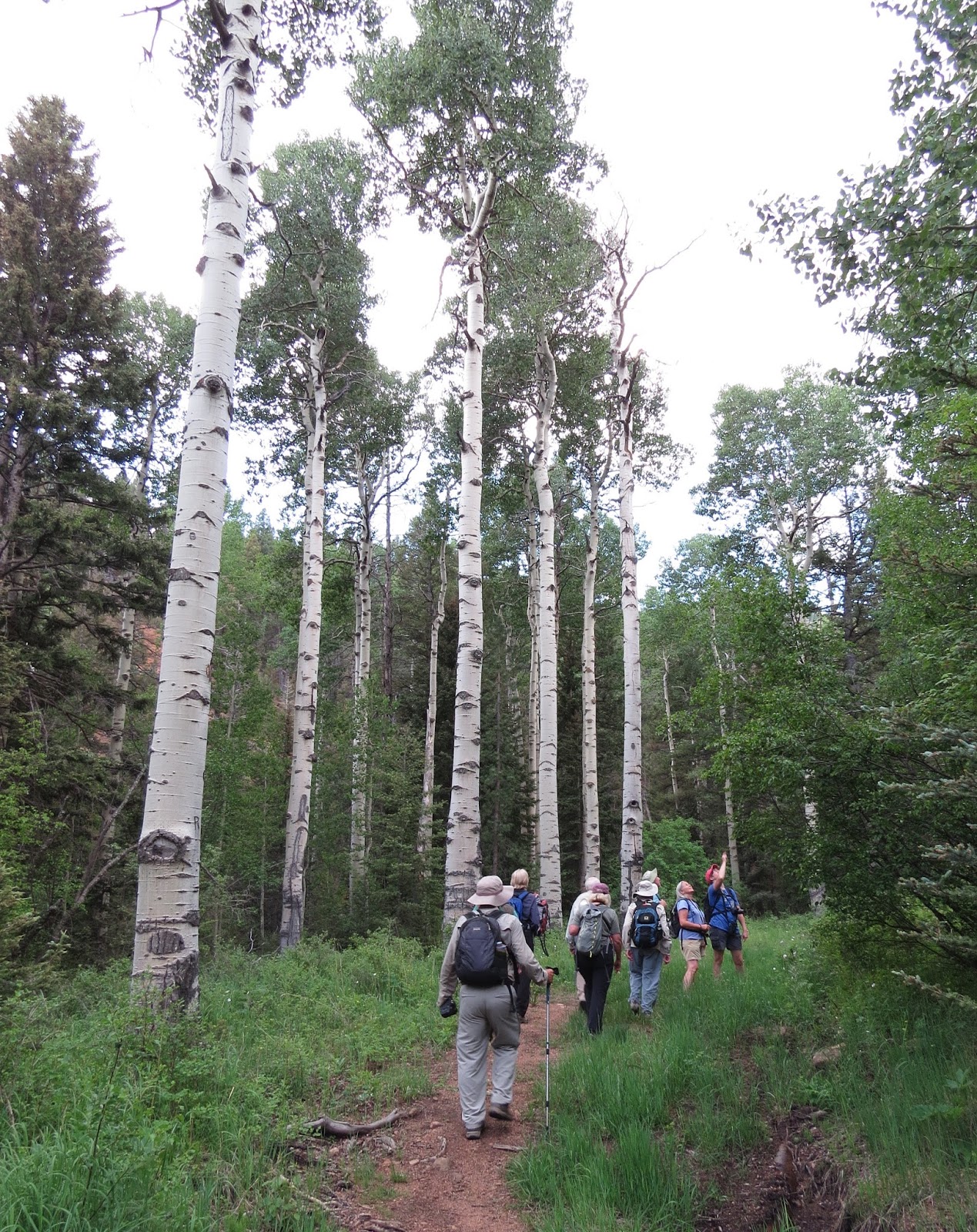
This year we had a total of eleven able hikers and flora and fauna enthusiasts. The forest and meadow scenery alone is worth the trip, with conifers and aspens towering overhead, and wildflowers of every description under foot.

Indeed, one of the major attractions is a trio of orchid species that we seek to count every year as a measure of ecosystem health and vitality. This year, all three species were in veritable profusion.

Most spectacular of all are Yellow Lady Slipper orchids, Cypripedium parviflorum. We tallied something like 287 plants, most in bloom, some not. We speculated on what pollinates this spectacular plant, and I had to look up the particulars online. It turns out that bees are attracted to the blooms by color and fragrance, but upon entering the bulbous "shoe" they find no pollen or nectar. The interior of the flower is disorienting, and forces the bee to exit out the back where it either picks up packets of male pollen that adhere to the insect's back, or deposits existing pollen packets to a female receptacle organ, or both.

Bees are not terribly dumb, and after a couple exercises in futility they learn to avoid the orchid altogether. Consequently, few plants reproduce each year, but fertilized flowers produce a multitude of seeds to make up the deficit. Seeds germinate successfully only if they land in soil populated by a certain symbiotic fungus. Transplanted orchids are destined to fail in the absence of this fungus.

Another common orchid, at least this year, is the Green Bog Orchid, Platanthera aquilonis, which grows almost exclusively along the very edges of streams and in soil prone to flooding or puddling. We tallied roughly fifty or sixty of those, but they are so cryptic that we undoubtedly overlooked dozens more.

The oddest and most scarce orchid was the Spotted Coralroot, Corallorhiza maculata, a species that favors drier conditions than the other two. It is wholly dependent on microrhizal fungi to provide it nutrients, as it does not perform photosynthesis like most plants do. We found all six or eight specimens associated with conifers, growing beneath them.

Red-naped Sapsucker

While birds generally remained out of sight on this trip, we heard plenty, including a MacGillivray's Warbler. We did catch glimpses of Dark-eyed Junco, Steller's Jay, Western Tanager, American Robin, Yellow-rumped Warbler, Brown Creeper, and Northern Flicker. We heard Hermit Thrush and plenty of Warbling Vireos and House Wrens. Our favorite sighting was probably a pair of Red-naped Sapsucker woodpeckers, a species we see almost every time we visit Emerald Valley.

Weidemeyer's Admiral butterfly

Butterflies were common and diverse. Starting early as we do to avoid the inevitable stormy afternoons, we don't see some species, like Common Ringlet, until late morning or early afternoon. Present from the get-go is Weidemeyer's Admiral, males of which are territorial and ever-present along the road/trail.

Arctic Blue butterfly

Arctic Blues are having a good year, too, and you can see them on flowers or "puddling" at wet spots along the trail. Early on they bask on foliage, absorbing some solar radiation to help power their flight muscles.

Dreamy Duskywing skipper

The Dreamy Duskywing, a type of skipper, was a bit of a surprise. They are smaller than many other duskywings, but males perform the same territorial behavior of perching on tall, prominent objects and flying off to chase females or evict rival males.

Mourning Cloak butterflies sipping sap

At one point along the trail we came across a willow that was oozing sap from various wounds on its main branches. This attracted a multitude of Mourning Cloak butterflies, and a couple of Hoary Comma butterflies as well. Both species are "anglewings" that overwinter as adult butterflies.

Hoary Comma butterfly

These specimens represented the next generation, though. They were in excellent condition, with vibrant colors and intact wing edges (Hoary Comma has ragged wing edges by definition, though).

Mating Poplar-and-Willow Borer weevils

Also on the willow were a pair of mating weevils that I later identified as, no surprise here, Poplar-and-Willow Borer, Cryptorhynchus lapathi. They resemble little lumps of lichen, even individually, so it pays to take a second look when seeking them. The species is actually native to Eurasia, having been introduced here decades ago.

Female Trichiosoma triangulum sawfly

Also on the willow was a large female sawfly, Trichiosoma triangulum, probably looking for a leaf to insert her eggs into. The larvae of sawflies are caterpillar-like vegetarians that feed just like moth or butterfly caterpillars.

Male Elm Sawfly, Cimbex americana

Another member of this same family of sawflies (Cimbicidae), but larger still, is the Elm Sawfly, Cimbex americana. Several hefty males of this species were engaging in aerial duels in a meadow farther back down the trail. These are intimidating wasps, but they do not sting and can be approached closely if you are patient and stealthy.

Field Crescent butterfly on Black-eyed Susan coneflower

The meadows that punctuate the forest hold a great deal of insect diversity, but rather than make an exhaustive inventory here, I have created a photo album for "Emerald Valley, 2016" on my Flickr photostream.

Thursday, October 1, 2015

The Grasshopper Hunt

The Aiken Audubon Society here in Colorado Springs asked me to speak at their September monthly meeting, and to lead a field trip beforehand. I chose the topic of grasshoppers since there is so much diversity here. The field trip was to Homestead Ranch Regional Park near Peyton, Colorado (El Paso County). I was surprised and delighted by the turnout, and the interesting animals we encountered.

Carolina Grasshopper basking

We were fortunate to have two young men, Seth and Zach Vogel, and their father, Tim, along for the trip. The boys helped find many more animals than we would have were we left to my own devices. They have a keen eye, endless stamina, and great enthusiasm. Tim employed a GoPro® camera to record parts of the expedition in this video.

© Tim Vogel

The Mile High Bug Club was represented by Bell Mead and myself; and Aiken Audubon by Jeannie Mitchell, Leslie Holzmann, and Bill Maynard. Alison Kondler even came down from the Denver area. Thankfully, the weather was sunny, but not too hot.

Plains Lubber grasshopper

We had not even made it beyond the playground and picnic shelter before we saw Carolina Grasshoppers basking on the pavement, and the boys had found an enormous Plains Lubber Grasshopper, Brachystola magna. The latter brought out the "'hopper-razzi," cameras clicking away.

Plains Lubber grasshopper draws a crowd

Further along the trail through grassy habitat on a gentle slope, we encountered several species of spur-throated grasshoppers in the genus Melanoplus, plus Pallid-winged Grasshoppers (Trimerotropis pallidipennis), and the Northwestern Red-winged Grasshopper, Arphia pseudonietana.

While I was explaining how to identify a particular species, the boys brought over a really nice find: a male Mormon "Cricket." The Mormon Cricket, Anabrus simplex, is not a true cricket, nor a grasshopper, but a kind of shield-backed katydid.

Mormon "Cricket" male

Seth and Zach located these large insects by homing in on their "song," a kind of buzzing sound produced by the males rapidly rubbing their short wings together.

We entered a narrow zone of pine trees near the summit of the slope we were traversing, and that brought us another species of grasshopper, apparently confined to that wooded habitat. The Kiowa Grasshopper, Trachyrhachys kiowa, is another of the "band-winged grasshoppers" named for the dark band on the colored hind wing. The hind wings are only visible when the insect flies, and most grasshoppers fly only short distances before landing and once again becoming nearly invisible owing to their superb camouflage.

Kiowa Grasshopper with hind wing spread

Band-winged grasshoppers can make noise in flight. This is called "crepitation," and is a rattling or crackling sound, presumably as front and hind wing rub together....but the sound can be produced at will, so it is something of a mystery how it is produced.

The hill terminates in a rolling plateau, and the grassland changes a bit in composition. Here we heard slant-faced grasshoppers, hidden from view. Slant-faced grasshoppers cling to vegetation in the vertical plane rather than crawling on the ground like band-winged grasshoppers usually do. They produce sound not by crepitation but by "stridulation." The male grasshopper rubs the inside surface of his hind femur ("thigh") against veins of the folded front wing. The result is a "zip-zip-zip" kind of song.

We ended our hike at a circular water trough for horses and cattle, fed by a well with a windmill pump. The water looked awful, but was full of life. It took no time at all for Zach to spy a Barred Tiger Salamander (Ambystoma mavortium), one of at least two inhabiting the pool.

Barred Tiger Salamander

There were also water striders (insect family Gerridae), backswimmers (Notonectidae), diving beetles (Dytiscidae), and a Giant Water Scavenger Beetle, Hydrophilus triangularis (family Hydrophilidae). Various dragonflies circled as well.

Giant Water Scavenger Beetle

Everyone appeared delighted by the whole adventure, and I am very happy to see what is apparently a growing demand for field outings geared to organisms other than birds, or at least in addition to birds. I would very much like to do more of this kind of thing, all over the U.S., so keep those invitations coming!