Friday, February 20, 2015

Insidious Insect Fungi

The Walking Dead is a popular television show these days, but reality is perhaps even more sinister. Did you know that there are fungi that hijack the brains of insects causing them to behave in ways that benefit the fungus? It's true, and you have probably seen evidence of this macabre life cycle without knowing the answer to the mystery.

Fly infected with fungus attached to a leaf (Massachusetts)

Cheryl Harner, a naturalist and writer at Weedpicker's Journal, asked me about this bizarre phenomenon a couple of years ago, and I always meant to learn more about it myself. You owe it to yourself to check out her blog, and I'll try to complement her post rather than compete with it. She did an excellent job of researching and linking, though.

Dead grasshopper nymph that has climbed a grass stem due to funal infection (Massachusetts)

It is not just grasshoppers and ants that are victimized by what are called "entomopathic" fungi. Flies are among the most conspicuous of hosts. You have probably seen flies clinging to foliage or twigs in odd, contorted positions, with bloated abdomens. The spores of the Entomophthora muscae fungus have their hosts literally bursting at the seams, the membranes between the abdominal segments.

Meanwhile, grasshoppers and related orthopterans are plagued by Entomognatha grylli, and lady beetles are often afflicted with Laboulbeniales fungi.

The life cycle of fungi in the order Entomophthorales begins when a spore lands upon an insect. However, many of the fungi are very host-specific, so if a spore lands on the "wrong" bug it is likely done for. Should the spore contact the correct host, it soon germinates, penetrating the cuticle of the insect and growing internally, absorbing the host's nutrients, eventually killing it. Before the doomed creature perishes, the fungus does something remarkable. In many cases it stimulates the host to seek a high point, either by climbing or flying, whether or not the insect normally performs such behavior. This phenomenon is sometimes referred to as "summit disease."

Headless grasshopper corpse in wake of fungal infection (Colorado)

Once the host insect ascends a grass stem, for example, the fungus sends out special structures called rhizoids that are white, thread-like filaments. These fibers often emerge from the insect's tarsi ("feet") or mouthparts, anchoring the bug to the substrate such that it is not easily dislodged after death. Now the spores erupt, sometimes in the form of fruiting bodies like other fungi, or simply exuding from holes in the host's cuticle.

Carolina Leafroller ("cricket") showing fungal rhizoids penetrating its feet and anchoring it to the leaf (Ohio)

Grasshoppers are among the most conspicuous victims if only because of their size, but most types of insects, and spiders, too, are vulnerable to fungal infection. The typical appearance of fungus victims are stiff, dessicated specimens that are essentially mummified.

Harmonia axyridis with perithecia of Hesperomyces virescens at the tip of its wingcovers (elytra)

Fungi in the order Laboulbeniales affect beetles in particular, and are very different in their mode of dispersal and effect on the host. Hesperomyces virescens apparently afflicts only the Multicolored Asian Lady Beetle, Harmonia axyridis, at least here in North America. It is microscopic, and is essentially a sexually transmitted disease since the overwhelming means of infection occurs during mating of the host. Spores can also transfer when large groups of overwintering lady beetles force the insects to rub against each other.

Mating pair of Harmonia axyridis in Illinois exhibiting symtoms of Hesperomyces virescens

Most adult beetles exhibit symptoms in the form of tiny, yellow, scale- or flake-like protrusions from the cuticle, especially at the tip of an elytron (wing cover). These are the fruiting bodies, called perithecia, from which spores are issued, if I comprehend the literature and language of mycology correctly. Interestingly, the fungus has little or no effect on the host, but depends on it for reproduction.

When one thinks of mortality factors that affect insects, or most other animals, we tend to forget the impact of fungal organisms. Maybe I have seen one too many episodes of the television show Monsters Inside Me, but I have a whole new respect for fungi now. It helps to remember that fungi are often very host-specific, so handling a fungus-ridden bug is not going to pose a health threat to a human. As far as we know.

Fungus-infected fly corpse on leaf (Colorado)

Sources: Eiseman, Charley and Noah Charney. 2010. Tracks & Signs of Insects and other Invertebrates. Mechanicsburg, Pennsylvania: Stackpole Books. 582 pp.
Parker, Abigail M., et al. 2010. "with Labioulbeniales fungus," Bugguide.net.

Monday, February 16, 2015

From My Inbox

Once the general public gets wind of your expertise in entomology, you are invariably inundated with requests for identifications of specimens, images, even fuzzy recollections that are then related to you. The digital age has made entomologists and naturalists much more accessible, and I believe that is a very good thing. Exterminators have always been accessible. It is also a good thing for those of us answering inquiries because it often presents a challenge, or a window to species from faraway lands, or in some cases represents a new or potentially invasive species.

Semanotus amethystinus (Amethyst Cedar Borer) from "Sara S." in Portland, Oregon via What'sThatBug.com

One of my regular "clients" is the webmaster for What's That Bug?, a very popular website that receives submissions from all over the globe. Daniel Marlos, who runs the site, started it on a relative lark as an example of pop culture. He quickly found he was filling a huge void, but had little knowledge of entomology himself. Over the years that has changed dramatically, and Daniel can now identify most common critters. He is better at identifying Australian insects and arachnids than I am. Still, he gets stumped every once in awhile, and will e-mail me for help.

Much of the time, I am clueless, too, but I enjoy the investigative work of coming up with an answer if I can. Take this submission from "Sweetpea" in Montreal, Quebec, Canada, for example. I did not recognize this longhorned beetle and thought it might be something exotic that found its way there in the fashion of the notorious Asian Longhorned Beetle. A quick search of Bugguide.net proved it was actually the native "Linden Borer," Saperda vestita. I learned something in the process of helping.

Here's another example. My response to Daniel is under the images.

"Daniel:

We were both wrong! You thought it was a clerid or a tenebrionid. I thought for certain it was a spider beetle (Anobiidae: Ptininae or Ptinidae). Turns out it is a longhorn! Here:

Bugguide.net

Crazy. I knew it looked familiar, but it took looking in an old, dusty copy of Essig’s Insects and Mites of Western North America to find a figure that matched.

Would love to share these images on Bugguide and maybe in a blog post. Thanks.

Eric"

Sometimes I even get forwarded e-mails as the chain of included experts expands even longer. One of my friends in Arizona sent me the image below that depicts an ovipositing female bee fly at the Gilbert Water Ranch near Phoenix, Arizona.

© Laurie Nessel

I am increasingly impressed and delighted by how observant and curious many people are about the invertebrate world.

Occasionally, friends will simply share images they think I would enjoy, like this male Anise Swallowtail photographed by David M. Elwonger on the summit of Signal Butte in the Pike National Forest here in Colorado. I had not been aware that the species occurred east of the Rockies prior to his e-mail to me.

© David M. Elwonger

Please, keep the proverbial cards and letters coming, there is no such thing as a stupid question or unimportant observation. At the very least, if it is important to you, then it is important to me, too.

Saturday, February 14, 2015

New Feature: Blog Categories

Better late than never I have finally gotten around to grouping some of my posts by category, using the "Link Lists" gadget that Blogger offers in the "layout" part of "design." The category list is located at the top of the right hand sidebar.

Now you can find all the "Wasp Wednesday," "Spider Sunday," and most of the "OrThoptera Thursday" posts conveniently, without having to scroll through all 500+ posts. Additionally, I offer categories for commonly-encountered indoor insects and biting "bugs" for the casual visitor who may want to try and quickly identify something they found at the home or workplace.

I hope you find this new feature useful, and I welcome suggestions for additional categories. My other post topics seem diverse enough that any other categories would, at this time, be relatively minor, though. I aim to be responsive to my readers, but I get precious little feedback. That either means I am delivering useful material, or no one cares one way or the other. Ha! I am hoping it means the former.

Sunday, February 1, 2015

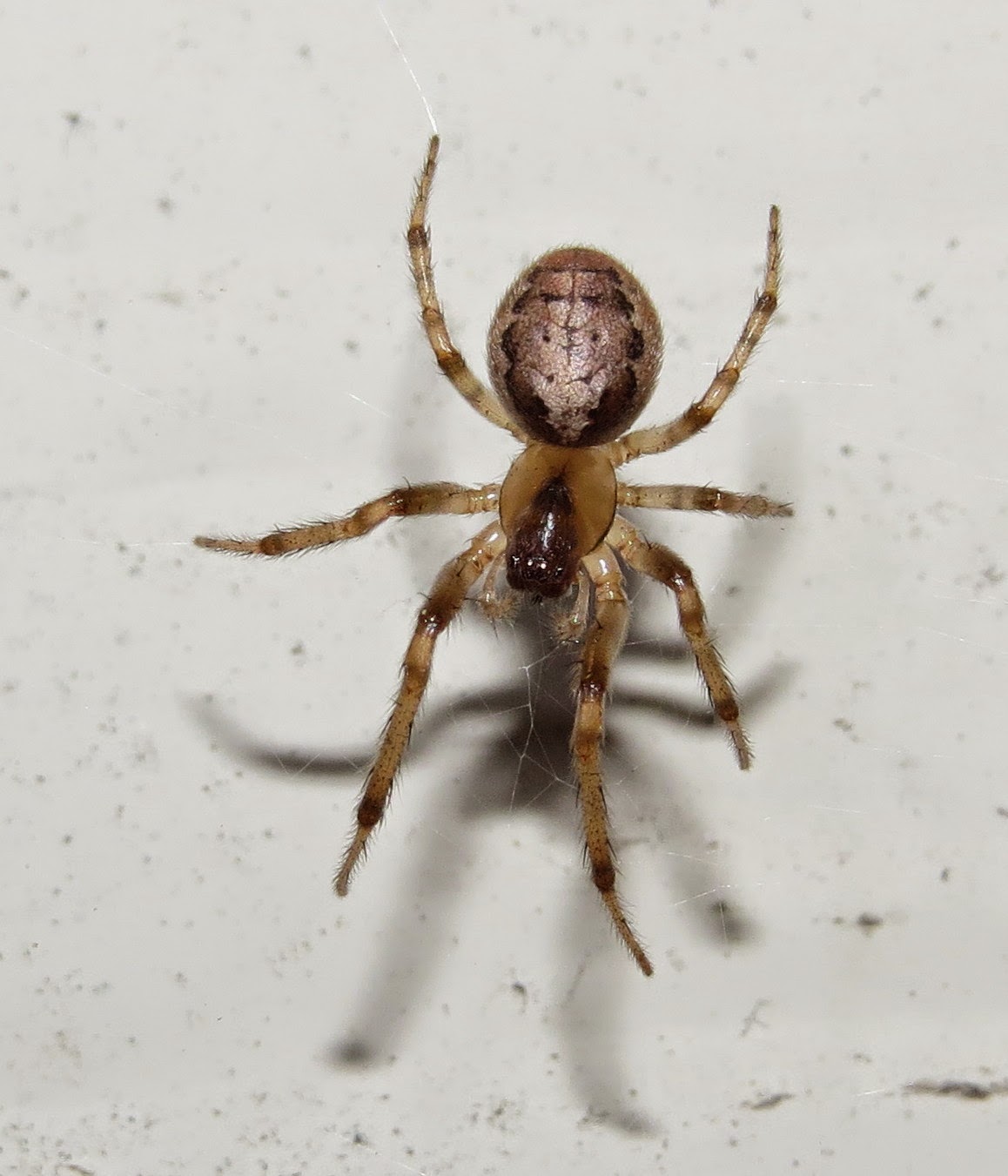
Missing Sector Orbweaver, Zygiella x-notata

During my stay in Oregon during December and the first week of January, I was surprised to see how many spiders were still active in the relative cold and damp. The most conspicuous of those arachnids were the Missing Sector Orbweavers, Zygiella x-notata, which seemed to occupy the corner of every window frame, outdoor light, or other manmade structure.

This species is easy to identify, simply from the web alone. It looks as if the spider forgot to finish it. A substantial wedge of the sticky spiral is missing from the top half of the web, the central radius in the sector running to a tubular retreat on the periphery where the spider usually resides. The web spans anywhere between 6-14 centimeters in diameter.

Zygiella web, spider in upper right corner

The spiders will come out to sit in the hub (center) of the snare at night, or even on overcast days; and young spiders are more apt to station themselves at the center than older spiders. Adult females measure 7.4-8.7 millimeters in body length, males 6-6.5 millimeters. The color and pattern is pretty consistent across all specimens, as shown in the images here.

Male specimen

Zygiella x-notata is not native to North America, having been introduced here from Europe who knows how long ago. It is well-established here now, from the California coast through western Oregon and Washington, and also along the Atlantic coast, from New England to Virginia. Another adventive species, Z. atrica, is known from northwestern Washington and southern British Columbia. Z. nearctica is boreal, occurring coast to coast in Canada, plus Alaska, New England, the Rocky Mountains to Colorado, and the Appalachians to North Carolina.

Two native species formerly placed in Zygiella have been reclassified into the genus Parazygiella: P. carpenteri with a disjunct occurrence in the Sierra Nevada mountains, California coast, and also southeastern Washington; and P. dispar from southern British Columbia to the vicinity of Monterey, California (though this is a holarctic species also found in Europe). P. carpenteri usually spins a complete orb web.

Spider in tubular retreat with egg sac

Back to Z. x-notata. It is also known under the aliases of "Winter Spider," "Opensector Orbweaver," and "Silver-sided Sector Spider." I recall this species being most abundant along the waterfront of the Columbia River when I was a child, but it is now among the most abundant of spiders even up in the hills of southwest Portland. It certainly associates itself with buildings, bridges, docks, and other structures.

What would these spiders feed on during the winter months? Many moth species fly throughout the colder months in the Pacific Northwest, plus winter crane flies, other dipterans, and some beetles. Orbweavers often crowd their snares around outdoor lights to further improve their odds of catching a meal.

Female with egg sac

Keep exploring during the winter months, even if it is only around the exterior of your home, office, or other building. You might well encounter one of these spiders, or any number of other organisms.

Sources: Adams, R.J. 2014. Field Guide to the Spiders of California and the Pacific Coast States. Berkeley: University of California Press. 303 pp.
Bradley, Richard A. 2013. Common Spiders of North America. Berkeley: University of California Press. 271 pp.
Sollfors, Stephan. 2010. "Zygiella x-notata," EuroSpiders.com
"Zygiella x-notata," NatureSpot.org.uk
"Summary for Zygiella x-notata (Araneae)," British Arachnological Society.

Underside of spider