Showing posts with label fungi. Show all posts

Tuesday, September 20, 2022

Fungus Party-y-y!

Sometimes, with luck, you stumble upon a wonderful circumstance of insect abundance. My partner, Heidi, did so this past Saturday afternoon, September 17, along a trail through Wyandotte County Lake Park, Kansas, USA. She happened to notice a thick mass of mushrooms at the base of a tree. It was literally crawling with insects.

Everybody on the dance floor!

The fungus in question may be a species of “oyster mushroom” in the genus Pleurotus, according to Ben Sikes at the University of Kansas, and with the Kansas Biological Survey. He was kind enough to offer an opinion on my photo of it on iNaturalist. At least some species are fit for human consumption, too, but please do not forage without expert guidance, at least initially. Your experiment in wild culinary arts could end abruptly and permanently if you do not know exactly which mycological fruiting bodies to avoid.

"Get down to it....get down to it...."

Insects, on the other hand, do not seem to care, especially the many varieties of beetles that are collectively known as fungus beetles. There are pleasing fungus beetles (family Erotylidae). There are handsome fungus beetles (Endomychidae), hairy fungus beetles (Mycetophagidae), tooth-necked fungus beetles (Derodontidae), silken fungus beetles (Cryptophagidae), polypore fungus beetles (Tetratomidae), cryptic fungus beetles (Archeocrypticidae), minute tree-fungus beetles (Ciidae), and several genera of darkling beetles (Tenebrionidae) that are found almost exclusively on or in fungi, including woody shelf fungi. I may be forgetting some….

Triplax thoracica, but there may have been another species with a dusky or black belly instead of an orange underside.

The most abundant insect on this particular mushroom cluster is probably a pleasing fungus beetle, Triplax thoracica. That genus, certainly, but that species apparently loves oyster mushrooms. It occurs across the eastern half of the U.S. and adjacent Canada. At only 3-5.6 millimeters in length, they are difficult to spot as individuals, but there were dozens flying in, flying out, and running about.

Uh, oh [abrupt, scratched record sound].

In a prehistoric analogy, Triplax are the herd of plant feeders. Sure enough, there were vicious carnivores prowling through the gills and over the caps of the mushrooms.
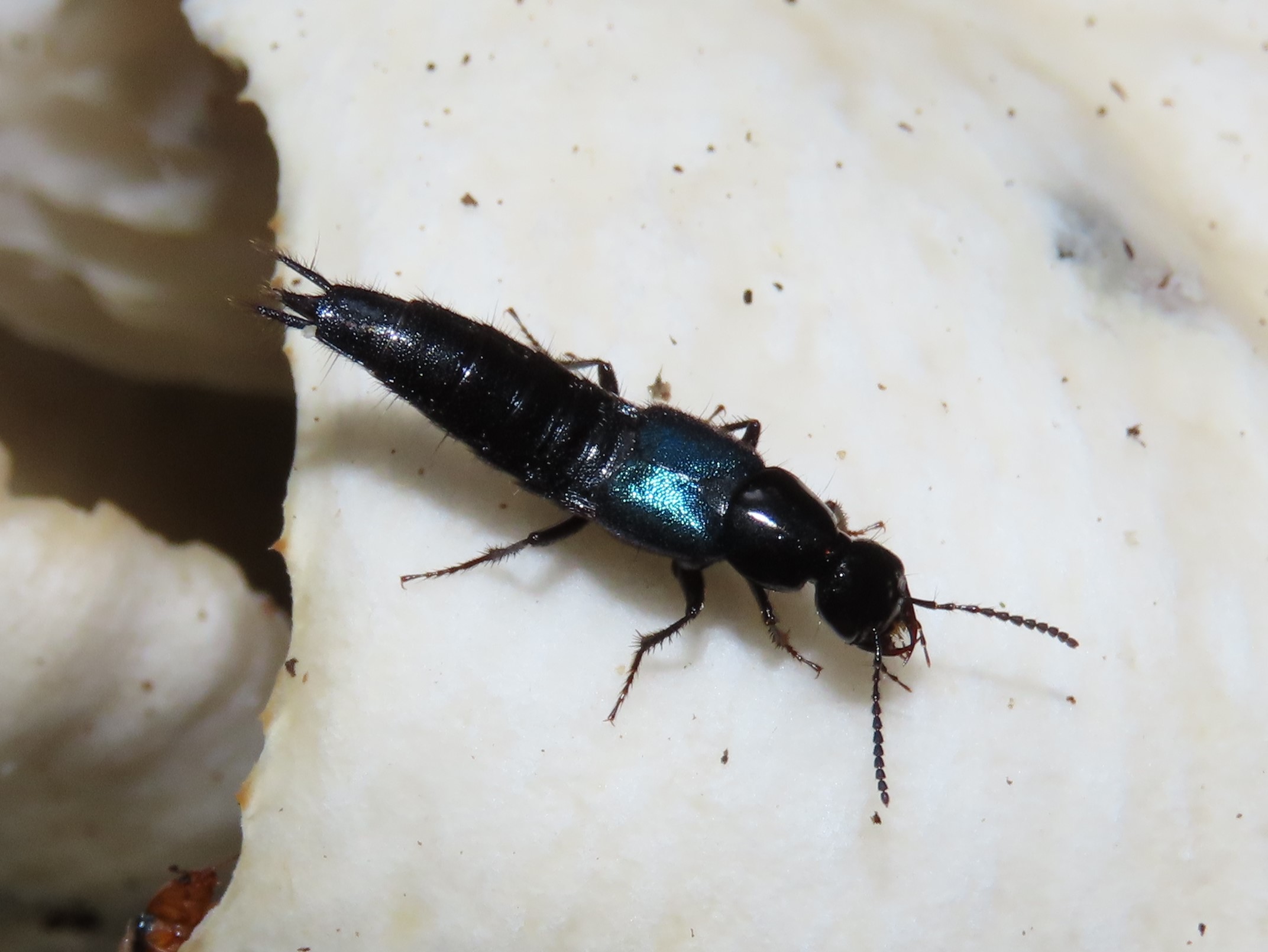
Sharp dresser, anyway.

A sleek, serpentine, black rove beetle with metallic blue-green elytra (wing covers) popped into view periodically. Meet Philonthus caeruleipennis, 12-15 millimeters long. Were it a vertebrate, it would no doubt be a weasel, mink, ferret, or other mustelid. It is transcontinental in Canada, but occurs only in the northeast quarter of the U.S. It also occurs in Europe.

Pull the fire alarm! Call 9-1-1!

The equivalent of Tyranosaurus rex in this micro-scenario would be the Brown Rove Beetle, Platydracus maculosus. Measuring 22-35 millimeters, it dwarfs its prey, which in this case was the Triplax fungus beetles.

Serial killer making mincemeat of partygoers.

By now, oblivious to the monsters among them, the Triplax party was becoming something of an orgy, with love trains of males following females. It was quite amusing.

Gettin' busy.

Some of the fungus beetles also had passengers in the form of phoretic mites. The mites, which are probably “mesostigs” in the order Mesostigmata, cause no harm to the beetles. Instead of being parasitic, the mites are hitchhikers, using the beetles as transport to a location where they can feed on insect eggs or other tiny prey.

Mites being a little voyeuristic....

Along with the beetles were pomace flies, family Drosophilidae. These are the “fruit flies” you see in your kitchen around overripe fruit, fermented beverages, and other foods. Drosophilids sare surprisingly diverse, and a good variety can be found around rotting fungi “in the wild.”

Pomace fly disappointed that the mushroom is not spoiling already....

The latecomer to the party was a worker Tennessee Spine-waisted Ant, Aphaenogaster tennesseensis. She was simply looking for dead or injured insects she could take back to her colony to feed her larval sisters.

"Just passing through!

At last, it was time for me to say farewell. Heidi had already progressed down the trail by about fifty yards.

"I'm blowin' this fruit stand!"

Now is a perfect time to go out looking for mushrooms and their associated insects. We left these mushrooms alone, but sometimes it is necessary to tear apart the fungus to find insects. It is best to do so over a white enamel pan, or some other kind of tray so that it catches the insects falling out. Be quick to grab the rove beetles before they take flight. If you do know your mushrooms, then bonus! You can take uninfested specimens to the kitchen instead of the lab. Enjoy your autumn no matter what you do.

Nom-nom-nom-nom....

Sources: Rhine, Lyndzee. 2020. A Pocket Guide to Common Kansas Mushrooms. Wichita: Great Plains Nature Center. 69 pp.
Evans, Arthur V. 2014. Beetles of Eastern North America. Princeton, New Jersey: Princeton University Press. 560 pp.

Friday, February 20, 2015

Insidious Insect Fungi

The Walking Dead is a popular television show these days, but reality is perhaps even more sinister. Did you know that there are fungi that hijack the brains of insects causing them to behave in ways that benefit the fungus? It's true, and you have probably seen evidence of this macabre life cycle without knowing the answer to the mystery.

Fly infected with fungus attached to a leaf (Massachusetts)

Cheryl Harner, a naturalist and writer at Weedpicker's Journal, asked me about this bizarre phenomenon a couple of years ago, and I always meant to learn more about it myself. You owe it to yourself to check out her blog, and I'll try to complement her post rather than compete with it. She did an excellent job of researching and linking, though.

Dead grasshopper nymph that has climbed a grass stem due to funal infection (Massachusetts)

It is not just grasshoppers and ants that are victimized by what are called "entomopathic" fungi. Flies are among the most conspicuous of hosts. You have probably seen flies clinging to foliage or twigs in odd, contorted positions, with bloated abdomens. The spores of the Entomophthora muscae fungus have their hosts literally bursting at the seams, the membranes between the abdominal segments.

Meanwhile, grasshoppers and related orthopterans are plagued by Entomognatha grylli, and lady beetles are often afflicted with Laboulbeniales fungi.

The life cycle of fungi in the order Entomophthorales begins when a spore lands upon an insect. However, many of the fungi are very host-specific, so if a spore lands on the "wrong" bug it is likely done for. Should the spore contact the correct host, it soon germinates, penetrating the cuticle of the insect and growing internally, absorbing the host's nutrients, eventually killing it. Before the doomed creature perishes, the fungus does something remarkable. In many cases it stimulates the host to seek a high point, either by climbing or flying, whether or not the insect normally performs such behavior. This phenomenon is sometimes referred to as "summit disease."

Headless grasshopper corpse in wake of fungal infection (Colorado)

Once the host insect ascends a grass stem, for example, the fungus sends out special structures called rhizoids that are white, thread-like filaments. These fibers often emerge from the insect's tarsi ("feet") or mouthparts, anchoring the bug to the substrate such that it is not easily dislodged after death. Now the spores erupt, sometimes in the form of fruiting bodies like other fungi, or simply exuding from holes in the host's cuticle.

Carolina Leafroller ("cricket") showing fungal rhizoids penetrating its feet and anchoring it to the leaf (Ohio)

Grasshoppers are among the most conspicuous victims if only because of their size, but most types of insects, and spiders, too, are vulnerable to fungal infection. The typical appearance of fungus victims are stiff, dessicated specimens that are essentially mummified.

Harmonia axyridis with perithecia of Hesperomyces virescens at the tip of its wingcovers (elytra)

Fungi in the order Laboulbeniales affect beetles in particular, and are very different in their mode of dispersal and effect on the host. Hesperomyces virescens apparently afflicts only the Multicolored Asian Lady Beetle, Harmonia axyridis, at least here in North America. It is microscopic, and is essentially a sexually transmitted disease since the overwhelming means of infection occurs during mating of the host. Spores can also transfer when large groups of overwintering lady beetles force the insects to rub against each other.

Mating pair of Harmonia axyridis in Illinois exhibiting symtoms of Hesperomyces virescens

Most adult beetles exhibit symptoms in the form of tiny, yellow, scale- or flake-like protrusions from the cuticle, especially at the tip of an elytron (wing cover). These are the fruiting bodies, called perithecia, from which spores are issued, if I comprehend the literature and language of mycology correctly. Interestingly, the fungus has little or no effect on the host, but depends on it for reproduction.

When one thinks of mortality factors that affect insects, or most other animals, we tend to forget the impact of fungal organisms. Maybe I have seen one too many episodes of the television show Monsters Inside Me, but I have a whole new respect for fungi now. It helps to remember that fungi are often very host-specific, so handling a fungus-ridden bug is not going to pose a health threat to a human. As far as we know.

Fungus-infected fly corpse on leaf (Colorado)

Sources: Eiseman, Charley and Noah Charney. 2010. Tracks & Signs of Insects and other Invertebrates. Mechanicsburg, Pennsylvania: Stackpole Books. 582 pp.
Parker, Abigail M., et al. 2010. "with Labioulbeniales fungus," Bugguide.net.