Showing posts with label Pisauridae. Show all posts

Sunday, October 12, 2014

Spider v. Spider: A case of predation by Cesonia bilineata (Araneae: Gnaphosidae) upon spiderlings of Pisaurina mira (Araneae: Pisauridae)?

When my wife and I were traveling in Georgia, we stayed at a bed and breakfast near Madison. The inn is situated on over 88 acres of farmland, forest, and river, and teems with wildlife from birds to insects. We spent the entire day of June 14, 2014 exploring the grounds. Along one forest edge I was fortunate to find a female nursery web spider, Pisaurina mira, guarding spiderlings. She was perhaps falling down on the job, though, as another spider appeared to have free run of the nursery web, feasting on spiderlings.

A female P. mira is a formidable creature. She can measure 12.5-16.5 millimeters in body length, with an impressive sprawling legspan. Her size alone would seem to be intimidating enough. No matter, apparently, to a female ground spider, Cesonia bilineata, which was present in the nursery web among shrubbery well off the ground. Adults of this spider are half the size of the nursery web spider, female C. bilineata being a mere 4.3-7.0 millimeters from front to back, and with much shorter legs.

I did not observe the ground spider in the act of feeding on the spiderlings, but she was more plump than usual. There were living spiderlings and shed exoskeletons from spiderling molts present in the nursery web.

Cesonia bilineata might make a habit of feeding on the spiderlings of other species, as one researcher observed the species in the nursery web of a Green Lynx Spider, Peucetia viridans, in South Carolina (Willey and Adler, 1989). So far the evidence for predation on spiderlings guarded by the mother spider is apparently "circumstantial," but intriguing and highly suggestive. C. bilineata is, in fact, known to prey on other spiders by attacking the victim from behind (Bradley, 2013)

Female Pisaurina mira guarding nursery web to right of image

I also find it curious that so many of the "ground spiders" are highly arboreal, more likely to be found clambering about on foliage and twigs, or scaling walls, than to se seen scurrying over the surface of the soil. They are incredibly agile, too.

Cesonia bilineata is a common, widespread spider in the eastern United States from New England south to the Florida panhandle and west to Nebraska. Look for it in wooded habitats.

Sources: Bradley, Richard A. 2013. Common Spiders of North America. Berkeley: University of California Press. 271 pp.
Willey, Marianne B. and Peter H. Adler. 1989. "Biology of Peucetia viridans (Araneae, Oxyopidae) in South Carolina, with Special Reference to Predation and Maternal Care," J. Arachnol. 17(3): 275-284.

Sunday, May 18, 2014

A Nursery Web Spider, Pisaurina dubia

Spiders can be very confusing to identify. There is a great deal of “convergent evolution” in appearance and behavior between very different genera, even families. I found myself momentarily wrong earlier this month when a lanky, striped spider wandered onto the sheet of our blacklight setup in a suburban neighborhood in Manhattan, Kansas. It was the first time I had seen a specimen of Pisaurina dubia, a type of nursery web spider in the family Pisauridae.

Note pale second leg on right, regenerated after being lost previously

Most members of the Pisauridae are large or very large when mature, but those in the genus Pisaurina spend the winter as sub-adults, so they are slightly smaller in size in the spring. Consequently, I mistook this one for another kind of spider. This spider measured only about 12-15 millimeters in body length, so my initial identification was one of the slender crab spiders in the genus Tibellus, family Philodromidae.

Tibellus slender crab spider

The “habitat” where the spider was prowling was a lawn, which is also rather atypical for nursery web spiders that favor much taller grass at the least, and usually shrubs and trees, too. Mature females construct “nursery webs” amid foliage at least a few inches off the ground where they suspend their egg sac just prior to the emergence of the spiderlings. Mom guards the youngsters until they molt again and disperse.

Turns out that a lawn is not foreign territory after all, at least not for this species. P. dubia also occurs in the litter and understory of woods, along forest edges, in barns on hay bales (well, one specimen anyway), and on the exterior of homes, sometimes straying indoors (Guarisco, 1994). This spider has even been found living in pitcher plants, climbing around on Spanish moss (actually a type of bromeliad), in sugarcane fields, and low vegetation in wetlands in the southeast U.S.

© Jon P. Inghram via Bugguide.net

To my knowledge, this species has no common name, but I might suggest it be called the “Horned Nursery Web Spider” or “Tufted Nursery Web Spider.” One of the distinguishing features of Pisaurina dubia appears to be a central tuft of hair that usually projects from between the eyes at the front of the cephalothorax like a tiny horn (see image above).

This species ranges across the southern two-thirds of the eastern U.S. from New Jersey to Florida, and east to eastern Nebraska, Kansas, Oklahoma, and Texas.

Sources: Balaban, John and Jane, et al. 2005. “Species Pisaurina dubia,” Bugguide.net
Carico, James E. 1972. “The Nearctic Spider Genus Pisaurina (Pisauridae),” Psyche 79: 295-310.
Guarisco, Hank. 1994. “Natural History Observations of the Spider, Pisaurina dubia (Hentz) (Araneae: Pisauridae) in Northeastern Kansas,” Trans. Kans. Acad. Sci. 97(3-4): 149-152

Sunday, December 9, 2012

Spider Sunday: Nursery Web Spider

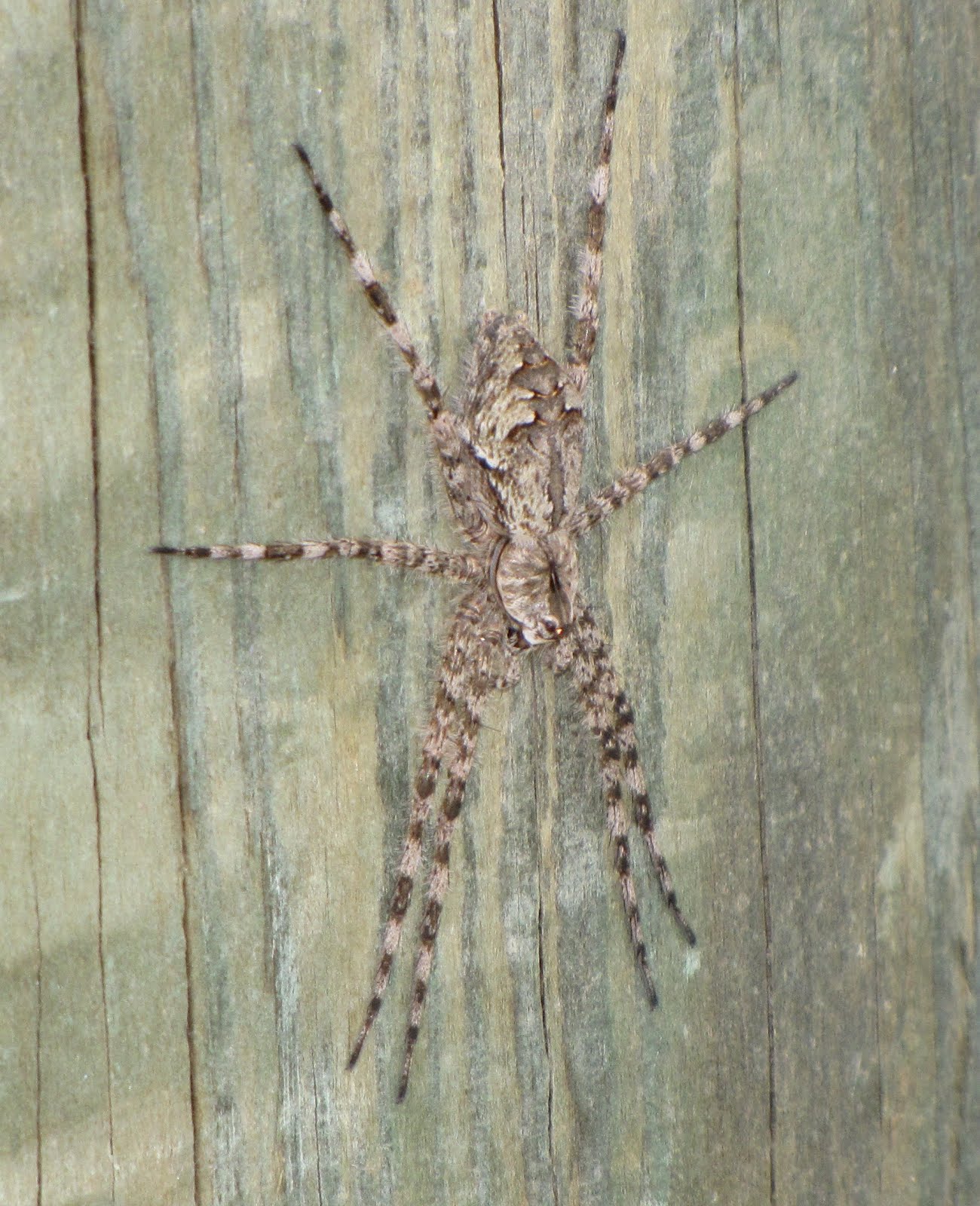
If Spiders.us had a top ten list for the spider species we are asked to identify most often, then the nursery web spider, Pisaurina mira, would certainly be on it. This is a large, abundant spider, especially in New England where there are lots of people who see it.

This species also reaches adulthood in the spring, just when people are going out into their yards and gardens. You could not be blamed if you encountered one unexpectedly and decided you’d had enough of this outdoor stuff for the rest of the year. Female Pisaurina mira measure from 12.5-16.5 millimeters in body length, males 10.5-15 millimeters. They are “leggy,” too, so that makes them look larger still (35-45 mm legspan).

Members of the family Pisauridae are collectively known as “nursery web spiders” because of the habit of the female suspending her egg sac in a tangled web just prior to the spiderlings emerging. The mother spider guards both the sac and the spiderlings that hatch, until they molt once more and disperse. This web envelopes a small section of foliage, usually well off the ground in weeds or a shrub.

Pisaurina mira is a hunting spider that otherwise spins no web, or at most minimal “scaffolding” where it sits motionless in ambush on foliage during the day and/or night. They may also hunt actively, sometimes visiting outdoor lights to catch the many insects attracted to the artificial beacons. Despite their small eyes, they are superior at detecting motion, responding quickly to potential prey, or fleeing from perceived danger.

Recognizing this spider is not always easy. Most mature individuals are light brown, beige, or grayish with a broad, dark stripe down the entire length of their body. Immature specimens, and some adults, lack the distinct stripe, however. The spider often rests with the first two pairs of legs held tightly together.

Mating takes place in mid-summer. The male employs a silken “veil” to bind the first and second pairs of legs of his mate whilst they are both suspended from draglines. Each mated female prepares an egg sac, carting the white sphere in her jaws.

© Michelle Lynn St. Sauveur via Bugguide.net

She eventually finds a suitable place to hide her egg sac, such as beneath a folded leaf, and shrouds the whole thing in her nursery web. Her young are the arachnid equivalent of teenagers by autumn, and they seek a snug place to overwinter. Inside cracks and crevices, and beneath loose bark or stones are good places to find them.

Despite their intimidating size, nursery web spiders are not considered to be dangerously venomous to people or pets. To the contrary, they are highly beneficial predators of insect pests in your yard, garden, farm or orchard. The species ranges from southern Ontario and Quebec in Canada to Florida, west to Minnesota, Nebraska, Kansas, Oklahoma, and the Rio Grande Valley of Texas. Look along forest edges in the understory, among grapevines, and on weeds in open fields.

They can be mistaken for wolf spiders at first glance, but are much more likely to be found in the vertical plane rather than on the ground. The eye arrangement differs between the two as well. Pisaurina has all eyes basically the same size.

Sources: Bruce, John A. and James E. Carico. 1988. “Silk use during mating in Pisaurina mira (Walckenaer) (Araneae, Pisauridae),” J. Arachnol. 16: 1-4.
Carico, James E. 1972. “The Nearctic Spider Genus Pisaurina (Pisauridae),” Psyche 79: 295-310.

Sunday, July 29, 2012

Spider Sunday: Whitebanded Fishing Spider

When Heidi and I went to South Carolina early last May, one of the animals on my “hope to see” list was the Whitebanded Fishing Spider, Dolomedes albineus. It took until the last day of our trip, but I finally found one at the Whack-a-Mole Natural….Wait, that’s not right. The Whatchamacallit National….No….Ah, yes, the Waccamaw National Wildlife Refuge.

The spider was sitting on a piling supporting a floating dock on the Pee Dee River. This is not a small spider. Mature females measure about 23 millimeters in body length (just under an inch). Males average 18 millimeters. Ordinarily, the spider’s mottled gray pattern blends perfectly with lichen-spotted tree trunks where it waits in ambush for an unsuspecting insect or other small animal to wander within striking range.

This particular arachnid perceived motion very well. I ended up chasing it around the piling before it finally settled down. Oddly, it did not bolt, but simply sidled slowly to a new position on the piling. Creepy. Creepy in a creeping, stealthy, smart kind of way.

The white band that gives this spider its common name is the area immediately under the eyes and above the chelicerae (jaws). Maybe it should be called the “whitefaced fishing spider” instead. Sometimes the entire carapace (dorsal surface of the cephalothorax) is white, save for a black spot in the center. Indeed, the color pattern of this species is highly variable. Some individuals are even a mossy green color with darker markings.

This is a fishing spider that really is most common along the edges of aquatic habitats, especially the cypress swamps of the southeast U.S. Its geographic range is from Florida inland and north to the Appalachian Mountains of North Carolina, as well as the Mississippi River basin as far north as Kentucky and southern Missouri.

Not much is known about the life history, habits, and behavior of this species, so your own observations might lend something new to science. At least one researcher, James Carico, noted that adults sometimes congregate in tree holes and crevices, perhaps in a “mating swarm,” though that would be a rare behavior for most arachnids (Carico, 1973).

Like all pisaurids, D. albineus females carry the egg sac in their jaws before eventually creating a “nursery web” amid foliage, bridge beams, or other situations. The female then guards the egg sac and the spiderlings that emerge from it. Once the spiderlings have their first molt outside of the egg sac, they disperse. Their mother then resumes hunting, having fasted during her parental duties.

I consider myself lucky to have seen this magnificent spider, and I hope that you will add it to your own “must see” list of arachnids. You do have one of those by now, right?

Sources: Carico, James E. 1973. “The Nearctic Spiders of the Genus Dolomedes (Araneae: Pisauridae),” Bull Mus Comp Zool 144: 435-488.
Gaddy, L.L. 2009. Spiders of the Carolinas. Duluth, Minnesota: Kollath+Stensaas Publishing. 208 pp.
Howell, W. Mike and Ronald L. Jenkins. 2004. Spiders of the Eastern United States: A Photographic Guide. Boston: Pearson Education. 363 pp.

Sunday, December 18, 2011

Spider Sunday: Tinus peregrinus

Nursery web spiders of the family Pisauridae are more diverse than I thought. I had been under the impression that there were only two genera in North America: Pisaurina and Dolomedes. Turns out there is another: Tinus. Thanks to Lynette Schimming at Bugguide.net, I found out that what I thought were immature fishing spiders I had observed in Tucson, Arizona and Mission, Texas were actually adults of Tinus peregrinus.

Whereas most adult fishing spiders and nursery web spiders are quite large (body length 10-28 mm), Tinus peregrinus maxes out at around 10 millimeters body length, males a millimeter shorter still.

This species ranges across the southwest U.S. from southern California to the southern tip of Nevada, and east to Texas and Missouri. It also occurs in northern Mexico. The “type locality,” the site where the first known specimen was collected, is listed as Hot Springs, Arkansas, but it is suspected that this is in error.

Virtually nothing is known of the life history and biology of this animal. Egg sacs in preserved collections are dated late July and early August. I have observed this species under bark on trees near the edges of ponds, and also at the edges of window frames. It would appear that once an individual spider finds a location that suits it, the spider stays put. One specimen I found in the corner of a window had several shed exoskeletons in its web, suggesting it had resided there for some time. No wonder, the web was also full of tiny midges (flies in the family Chironomidae) that had swarmed the lighted building at night.

Like most spiders in the Pisauridae, T. peregrinus appears to prefer the vertical plane, rarely found on the ground.

Sources: Carico, James E. 1976. “The Spider Genus Tinus (Pisauridae),” Psyche 83: 63-78
Kaston, B. J. 1978. How to Know the Spiders (Third Edition). Dubuque, Iowa: Wm. C. Brown Company Publishers. 272 pp.

Sunday, July 17, 2011

Spider Sunday: Six-spotted Fishing Spider

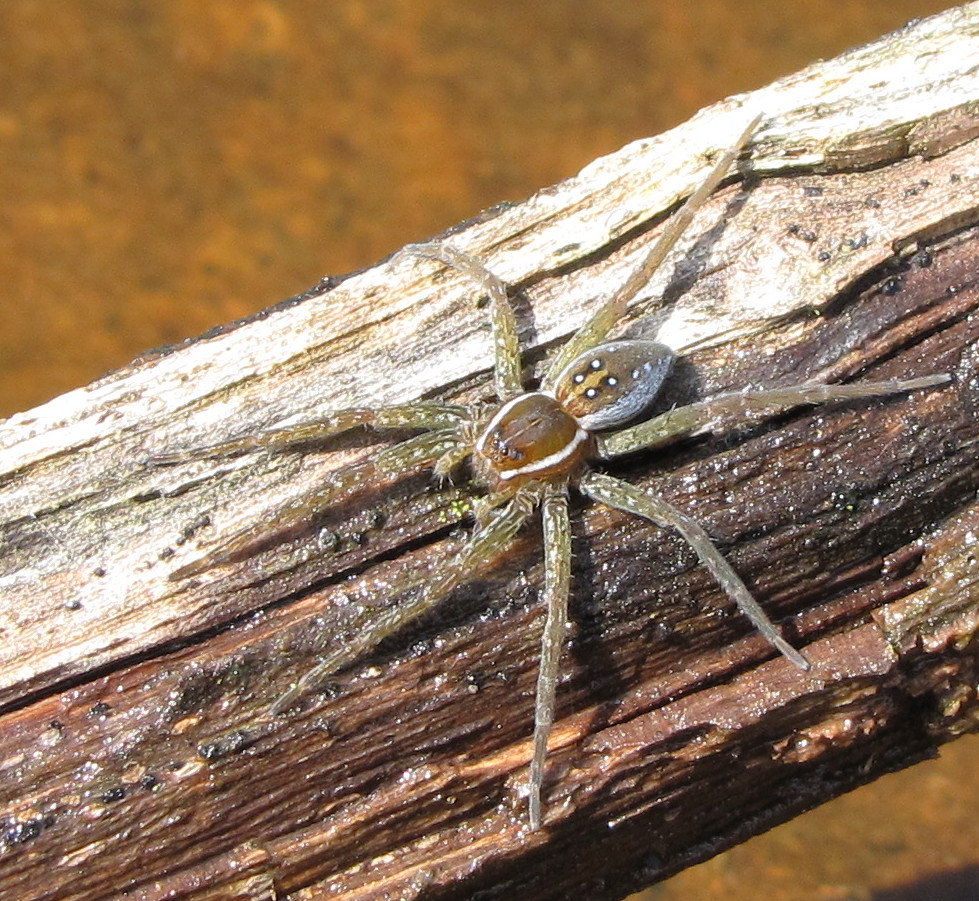
Among my most favorite spiders are the fishing spiders in the genus Dolomedes, family Pisauridae. They are elegant ambush hunters, and perhaps none more so than the Six-spotted Fishing Spider, Dolomedes triton. This species is widespread in North America, but not seen that frequently, being especially scarce in the Midwest and Rocky Mountains.

These are not small spiders, mature females attaining a body length of 17-20 millimeters, and males 9-13 millimeters. Their extensive legspan makes them appear larger still. They can vary considerably in color and pattern from one individual specimen to another, but the “standard” form sports two rows of white spots on the abdomen. They don’t always add up to the spider’s namesake six, though.

Fishing spiders are famed for their feats of predatory strength in killing small fish, tadpoles, and frogs. Indeed, D. triton is capable of preying on aquatic vertebrates four to five times the spider’s own weight. The spider reacts to the concentric waves created by a surfacing organism. The spider cannot see well, but its sense of touch more than makes up for any visual deficiency. It is able to pinpoint the epicenter of waves with extraordinary precision, and strike with lightning speed. Still, it rarely goes after large prey, and succeeds less than 10% of the time (unless the prey item actually bumps into the spider, in which case the success rate increases to 16%). Most items on the spider’s menu are terrestrial or aerial insects that get blown onto the water’s surface, or fall from overhanging vegetation.

D. triton can pursue prey underwater, but that is a rare behavior. It is more likely to dive to avoid its own predators, namely the spider wasp Anoplius depressipes. Fine hairs covering the spider’s body trap a layer of air against its breathing holes when the spider goes under. Again, this is usually a last ditch attempt at escape when all else fails.

The spider normally rests motionless on emergent vegetation or floating objects in the quiet water of a pond, lake, or river backwater, maintaining contact with the water surface with the first two pair of legs. This is not to say that the spider can’t propel itself across the surface of the water if it wants to. It can, in fact, do so passively or actively, and slowly or rapidly.

Fishing spiders can raise their front pair of legs into the wind and be blown by the most imperceptible of breezes. This form of locomotion is called “sailing,” and the spider has little control over its speed. The most common form of movement over the water executed by Dolomedes is called “rowing.” The spider actually makes the water surface itself do the work. The tip of each leg creates a dimple on the water surface, and by stroking the third and second pair of legs backwards (in that order), the dimples act as oars, pushing water toward the rear of the spider and moving it forward. This is a rather leisurely mode and speed of travel.

When a fishing spider wants to flee a predator or pursue fast prey, it can shift to “gallop” speed. In this case, the spider abandons the dimple propulsion strategy and simply slices the water rapidly with the tips of its legs. Its body is elevated above the surface when galloping, and at certain points the animal is completely airborne. This method of locomotion can result in astonishing maximum speeds of three feet per second. The spider cannot sustain that velocity for very long, however.

Male D. triton spiders have the unenviable task of convincing females that they are not an appetizer. So, they may initiate courtship by literally being “jerks,” using their legs to generate an unmistakable series of rhythmic surface waves that contact the female spider. Alternatively, he may follow the female’s silken dragline, then engaging in rapid leg-tapping as he approaches her more closely. The two spiders touch legs in an apparent identity-verification dance.

Mated females create a spherical egg sac that they cart around in their jaws and pedipalps until just before the spiderlings are likely to hatch. At that point the mother spider spins a “nursery web” and suspends the egg sac inside. She will then guard the egg sac, and the spiderlings that hatch from it. Once the spiderlings molt again, they will disperse and the female will resume her normal hunting lifestyle.

Sources: Zimmer, Carl. 2000. “Walking on Water,” Natural History, vol. 109, no. 3, pp 30-31 (April, 2000).