Showing posts with label arachnology. Show all posts

Wednesday, October 30, 2019

One Night, One House, Seventeen Spider Species

In honor of "Arachtober" over on Flickr, I thought I would share what I discovered when I walked around the exterior of a house, garage, and woodshed at night in the northern reaches of Door County, Wisconsin, USA, on June 24, 2019. We rented the house for a few days for a family gathering. It sits in a forested area right on the shore of Lake Michigan on the Green Bay side, with Plum Island and Washington Island on the horizon. This particular evening was cool and wet, with intermittent rain showers. Imagine what a dry, warm night would be like.

Orb Weavers: Araneidae

Orb weavers often construct their webs under the eaves of structures, and are usually more conspicuous after dark. They seem to understand that outdoor lights attract more prey than they would catch out in the darkness. I spied at least three species this night:

Trashline Orbweaver, Cyclosa sp.

Furrow Orbweaver, Larinioides cornutus

Bridge Orbweaver, Larinioides sclopetarius

Long-jawed Orb Weavers: Tetragnathidae

Interestingly, the one long-jawed orb weaver I found was sitting snugly against the side of the woodshed with no web in sight. It may be that they take the day shift. These spiders are recognized by their long bodies and long legs, and having their webs oriented in the horizontal plane (usually), often over water.

Long-jawed orbweaver, Tetragnatha sp.

Cobweb Weavers: Theridiidae

Cobweb weavers are the spiders most associated with human habitations and buildings. There are plenty of crevices in which to hide, and the style of their snares requires little in the way of points of attachment. The space beneath an overhanging piece of siding offers enough dimension to spin a web.

Immature Common House Spider, Parasteatoda tepidariorum

Male (left) and female cobweb weavers, Steatoda sp.

Funnel Weavers: Agelenidae

Among the most abundant spiders I encountered this night were funnel weavers. Crevices in stonework around the house and garage and shed allowed for a dense population, but some of the younger spiders were simply wandering, perhaps looking for new and better places to spin webs.

Funnel weaver, Coras sp.

Sac Spiders: Clubionidae

Many spiders don't bother spinning webs, but simply prowl around seeking prey. Chief among them are sac spiders. I saw at least three different individuals. They can appear and disappear rather quickly, so there were probably many more that I missed simply due to poor timing. The cool weather did slow them down a bit, though.
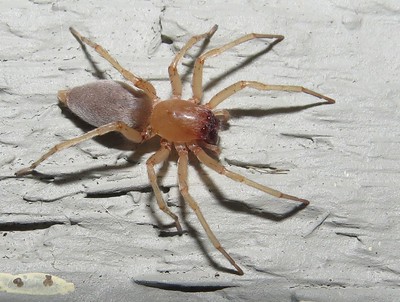
Sac spider female
Female sac spider, Clubiona sp.

Sac spider male
Male sac spider, Clubiona sp.

Wolf Spiders: Lycosidae

Wolf spiders are also common nighttime hunters. They are seen mostly on the ground and on objects in the horizontal plane, but some species are surprisingly agile climbers. Wolf spiders are easily recognized by their eye arrangement. A row of four small eyes near the base of their jaws, with two very large eyes right above that row, and the final two eyes set far back on the carapace.
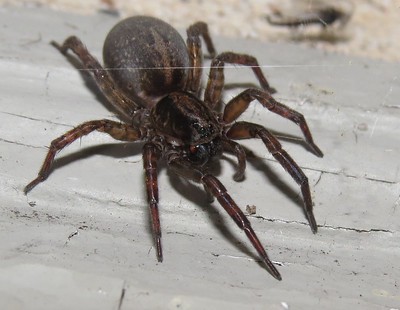
Wolf spider at night
Female wolf spider, Trochosa sp.

Nursery Web and Fishing Spiders: Pisauridae

The largest spiders you are likely to see in the eastern United States and adjacent Canada are the fishing spiders. Despite their name, many species are found far from water, hiding in treeholes and other shelters during the day. They can be startling if encountered suddenly and unexpectedly on tree trunks or the sides of buildings at night. I was prepared to see them and was not disappointed.

Immature Dark Fishing Spider, Dolomedes tenebrosus

Mature male Striped Fishing Spider, Dolomedes scriptus

Jumping Spiders: Salticidae

Most jumping spiders are active by day, but you can still see them at night, especially if they have taken to sheltering in place on the sides of homes and buildings. They hunt by sight, without webs, and are the smallest of the common prowling spiders.

Jumping spider, Naphrys pulex

Adult male jumping spider, Evarcha sp.

Gray form male of the Dimorphic Jumper, Maevia inclemens

Crab Spiders: Thomisidae

Crab spiders can turn up almost anywhere. They are classic ambush hunters, several species hiding in flowers to wait for pollinating insects to come within reach of their elongated first and second pairs of legs. The spiders are highly sensitive to motion, and if you don't approach slowly they are quick to sneak inside a crack or dodge behind foliage.

Female ground crab spider, Xysticus sp.

Sheetweb Weavers: Linyphiidae

Members of this family spin flat, convex, or concave webs, depending on the genus. Each style is tailored to capturing a different suite of insects. The spiders hang upside down on the web and will respond to entangled prey at any time of day. Mature males, like most male spiders, cease to spin webs and devote the remainder of their lives to seeking mates. They do not even feed during their quest.

Female hammock spider, Pityohyphantes sp.

Unidentified male sheetweb weaver

What's lurking around your house? I highly recommend taking the time to inspect the exterior of your home with a flashlight at night. You will be surprised and, hopefully, delighted by the many organisms you find. Besides spiders, I also saw a soil centipede, various woodlice (terrestrial crustaceans that include sowbugs and pillbugs), a harvestman (aka "daddy long-legs," arachnid order Opiliones), and of course many insects. Good luck, happy "Arachtober!"

Wednesday, February 28, 2018

This Girl!

One sure-fire way to make me smile is by introducing me to any young person who is passionate about something. It matters little to me exactly what the subject of their fascination is, but that they are enthusiastic and eager to share what they know. Young people energize elders who have expertise but have become lethargic and cynical of the future in their fields of authority. Meanwhile, children learn even more from those willing to mentor them.

Earlier this month I had the occasion to meet Miss Abigail Nilson-Bartlett, brought to a membership meeting of the Mile High Bug Club by her dad, Ryan, on February 12. They travelled to and from a Denver suburb to our Colorado Springs meeting location. I am not sure who was happier they did: Me or them.

Abigail, at seven years old, firmly asserts that "I am an arachnologist," and I believe her. She can pronounce the word, and then back it up with information that is not widespread knowledge for anyone outside of arachnology. She keeps a couple of pet tarantulas at home, caring for them judiciously such that they are comfortable and healthy, and handled only occasionally. In fact, she wants people to know that "I have a caring for bugs. When they are hurt I care of them well until they are healed. I am a bug doctor and try to help when I can." Her favorite non-spider arthropod is the "rainbow stag beetle."

She considers her greatest accomplishment so far to be assisting her father in a search for wild tarantulas in southeast Colorado. She met Dr. Paula Cushing, one of the premier professional arachnologists in the world, when she accompanied Ryan to volunteer at the twentieth International Congress of Arachnology that was held in Golden, Colorado in 2016. Dr. Cushing is a tough act to follow, but at least I could provide Abigail with a signed copy of my field guide.

During the course of our Mile High Bug Club meeting I made a presentation entitled "Wasp/Not Wasp," an interactive PowerPoint in which the audience is invited to determine which of two images depicts a wasp. Most slides were of a wasp and a complimentary "mimic" like a fly or a moth, but some displayed two wasps, or two mimics. Abigail participated with great enthusiasm, and was often correct in her answers. After listening to me explain the "nth" example of some wasp or mimic that preys on spiders, she asked why it is that there are so many insects that kill her beloved spiders. I can totally empathize. I often ask that about crocodiles and mantids that are shown over-and-over in the media eating some animal I like a lot more. Anyway, I did my best to explain that every species has its role in the biosphere and we have to respect that even if we don't like it. "Like ecology?" she asked. All of us older people were dumbstruck because we were at least teenagers before we learned that word. "Yes," I replied after regaining my faculties, "that's the framework that everything fits in. Yes."

L-R: Amelia, Ryan, Abigail

Abigail's slightly older sister Amelia is an accomplished gymnast, but is also interested in natural history. Trips to far-flung gymnastic meets allow the whole family to explore new cities and have travel adventures along the way. They recently returned from Santa Fe, New Mexico, in fact.

It has been awhile since I have either made myself available to mentor students and children, or been afforded the opportunity, and I am grateful to the MHBC for providing a way to do that. We have other young people participating in club events, and I hope that continues to expand. I urge my readers to seek out organizations, events, and other avenues through which they can be mentors as well, whether in entomology or any other career or recreational pursuit. We need to repair trust to where it was when we were growing up. We are the village now, but we have to prove ourselves as responsible adults who truly have the interests of children and their families at heart.

Thank you, Abigail, for helping restore my faith in our next generation of human beings, regardless of whatever they become professionally when they "grow up." You already have a mature sense of self-confidence, and social skills I wish I had myself at your age.