Showing posts with label climate change. Show all posts

Thursday, January 8, 2026

New Year’s Insects and Spiders

Happy New Year to my friends and followers! I do hope that you are finding reasons to celebrate, and are getting out into nature. Our local weather here in northeast Kansas, USA, has been unseasonably mild, to the point of nearly breaking high temperature records. Yesterday, January 7, it was sixty-eight degrees on the Fahrenheit scale. Our average historical high is in the high thirties or low forties. Consequently, I have found a few insects and arachnids active in our yard.

Spined Soldier Bug, Podisus maculiventris

A few months ago, one person admonished me for using the word “bug” too liberally, to include other insects, and even other arthropods. Technically, it is a proper complaint, but scientists are not my intended audience here, and the overall goal is to improve public appreciation of every related organism that suffers persecution and disdain. In honor of this person’s observation, I will start by giving examples of actual bugs, true bugs in the order Hemiptera, that I have seen here in January, 2026.

It is surprising how many true bugs overwinter in the adult stage, and will stir themselves “awake” on warm winter days. Among the most obvious are stink bugs. Many people across the United States are familiar with the non-native Brown Marmorated Stink Bug (BMSB), but I have not yet encountered one this month. Instead, I have been surprised by this season’s population of the Spined Soldier Bug, Podisus maculiventris, a type of predatory stink bug. You read that correctly, this stink bug, along with several other species, preys on other insects. Normally, I see precious few of them, but this past autumn they were everywhere, especially along forest edges.

Stink bug, Banasa calva

Another stink bug I saw recently is Banasa calva, or at least I think so. There are eleven species in the genus in North America, and several of them look identical to this one. Species identification relies on characters best observed under a microscope. This is one of the usual species that feeds on sap of trees and shrubs, but is rarely, if ever, a pest.

Leafhopper, Erythridula? sp.

Leafhopper, Stirellus bicolor

Three-Banded Leafhopper, Erythroneura tricincta

Usually, the bugs I find this late (or early) in the cold months are leafhoppers, family Cicadellidae. They are small enough to be overlooked easily, but I managed to spot at least three different species recently. They are often so wary as to be difficult to approach, flying before you can train a camera or phone on them. Looking on both the interior and exterior surface of our backyard fence, and on the exterior of our house, usually proves fruitful. These insects also feed on plant sap. A few species are major crop, orchard, and vineyard pests because they can transmit plant viruses.

Aphid

I am well aware that many species of aphids spend the winter on alternate host plants, different from the plants that they feed on in warmer months, but I was still shocked to find one that had alighted on our fence. A single species of aphid my differ drastically in physical appearance between its winter and spring/fall populations.

Multicolored Asian Lady Beetle

Most beetles stay well-concealed in leaf litter, under bark, and in other nooks and crannies, but lady beetles in particular will surface on warmer days to prowl sun-warmed surfaces.

Non-biting midge

Flies are insects that you wouldn’t expect to be the least bit active, but if you look closely enough, you are still likely to find some. Chief among them are tiny, non-biting midges that defy identification. Even expert midge specialists find them challenging.

Winter crane fly

There are some flies that you can find only during the colder months, and the winter crane flies of the family Trichoceridae are perhaps the largest of them. At least if you measure their lanky leg span of three-fourths of an inch or so. I see them almost daily on the side of our house, our garage, and clinging to the wooden fence. The larvae require moist or wet terrestrial habitats where they feed mostly on decaying vegetable matter, fungi, debris in rodent burrows, and similar niches.

Moth fly, Psychoda sp.

A different moth fly of another genus?

Moth flies are very small and cryptic, and also resemble moths more than flies. Their larvae feed on decaying organic matter.

Frit fly

Another kind of frit fly with different antennae

Another unexpected family of flies I have observed so far this year are frit flies, also known as grass flies and “eye gnats,” in the family Chloropidae. They are almost impossible to spot at only 2-3 millimeters. I imaged several blemishes on our fence before one of them metamorphosed into one of these flies. Ha! They have a variety of lifestyles, though most live as larvae mining the stems of grasses.

F-winged Barklouse

Barklice, in the order Psocodea, are usually most abundant and diverse in late fall, but the only one I have seen so far is the F-winged Barklouse, Graphopsocus cruciatus, one of the introduced species, from Europe. They graze on microflora like algae and fungi on plant leaves, but I usually see them roaming the exterior of our house.

Fall Cankerworm male

Fall Cankerworm female

Moths. Moths! There are several moths that occur as adults in late autumn through early winter. I usually see the Fall Cankerworm, Alsophila pometaria, a type of geometer or “inchworm” moth, in late fall, but it wasn’t until this mnth that I saw both sexes, on the same day. The female moth is wingless, while the male looks like an ordinary moth. The caterpillars are generalist feeders on the leaves of a variety of trees and shrubs. We have several of their known host plants in our yard, so the appearance of the moths is not surprising.

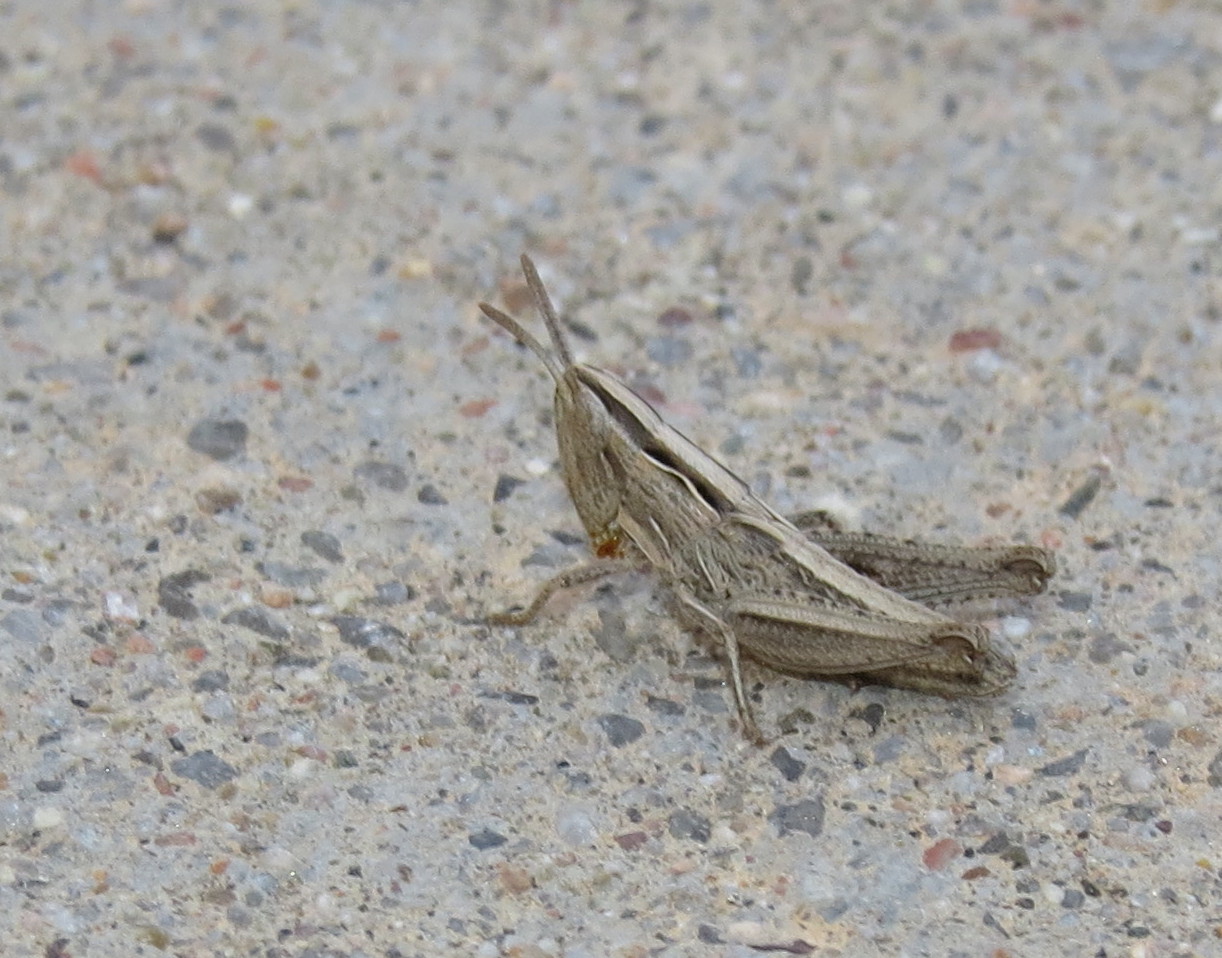
Green-striped Grasshopper nymph

Believe it or not, some grasshoppers overwinter as nymphs (juveniles, immatures), and will poke their heads out of the leaf litter on warm days. The Green-striped Grasshopper, Chortophaga viridifasciata, is one of these.

Smooth springtail, family Isotomidae

Plump springtail, order Poduromorpha

Today, springtails are technically considered “non-insect hexapods” given their primitive physical form, but at one time they were classified as insects. They are generally small enough (under five millimeters) that they escape your attention unless they move. As their name implies, many species jump away when approached. Others do not have the anatomical mechanism to do so, and those are the ones I seem to be encountering now. In some geographic locations you may encounter “snow fleas,” which are actually springtails that can pepper the melting snow at the base of trees and similar situations.

Juvenile long-jawed orbweaver

Juvenile Humpbacked Orbweaver

Spiders can be out and about, too, though they mostly represent juvenile specimens. I managed to spy a young long-jawed orbweaver, Tetragnatha sp., and a “baby” Humpbacked Orbweaver, Eustala anastera, outdoors. I did see a jumping spider on the ceiling of our living room, though, and if I searched thoroughly, I could probably find more arachnid friends.

While I am enjoying the warmth of this winter, so far, I am also concerned about the volatility of our weather from one year to the next. Last year at this time we were buried under snow. The extremes and unpredictability of when the different seasons begin and end does not bode well for the survival of many species. Insects are more adaptable than most, but even they can succumb if they burn their fat reserves ahead of true spring. Take care, friends, let me know what you are finding.

Thursday, July 12, 2018

An Insect "State of the Summer" Report

Here in Colorado Springs, Colorado, and elsewhere in the state, it has been anything but a normal summer. Not that there is any such thing as "usual" in this age of aridification and climate change, of course. What follows are personal, anecdotal observations related to weather, insect diversity, and insect abundance so far this season.

Mammatus clouds signal impending hail
Weather

There are only three words needed to describe the weather this summer: Hot, dry, and stormy. We have had recent stretches of ninety-plus degree days, well above the expected average. The excessive heat has been punctuated by severe thunderstorms. At our home, we have had more hail events this year than in the five-plus previous years that I have lived here....and we were lucky. One major hail storm dumped baseball-sized ice balls on the city of Fountain, just a few miles down the highway from Colorado Springs. Repairs to vehicles and roofs and other damaged property will take months and cost many thousands of dollars.

Accumulated hail in our backyard today!

Beyond the city, at least fifteen wildfires have burned thousands of acres of forest and grassland, rendering wildlife habitat and recreational destinations unfit for man or beast for years to come. That does not even address the human dwellings and other structures that were lost in the blazes. Now, heavy rains like we had at our home today will cause flash flooding over the burn scars, and lead to water damage at the bottom of slopes.

Aristotelia elegantella, a tiny twirler moth new to our yard
Insect Diversity

Insect diversity appears....relatively stable, though it is difficult to assess for reasons that will become clear later in this story. Interestingly, every time I turn on our backyard blacklight I seem to attract some species new to me and new to our growing "home list" of animal organisms that now exceeds 440 taxa (levels of classification from Kingdom to species and every level in between). I have managed to excite even seasoned moth experts with some of the nocturnal Lepidoptera that are turning up. We have even had a pine sawyer (Monochamus clamator) and bark beetles (Dendroctonus sp.) come to the blacklight. I suspect someone brought firewood down out of the mountains and the beetles are emerging from it.

Spotted Pine Sawyer, Monochamus clamator
Insect Abundance

Numbers of individual insects are way down. I have to work hard just to find species normally overwhelmingly present. It is this situation that has made assessing diversity more difficult. It is disturbing to note how few insects there are visiting wildflowers, but wildflowers are fewer and farther in between, too, smaller in size and lower-growing than usual, making it difficult to detect them, let alone any pollinators. Yellow Sweet Clover, Melilotus officinalis, an exotic invasive that is now well-established throughout the U.S., and its relative White Sweet Clover, are overwhelmingly abundant this year. They normally attract plenty of pollinators, but I find almost none.

Overwhelming parasitic mite load on Melanoplus sp. grasshopper

Another worrisome observation is that the few arthropods doing well are mostly parasites of other arthropods. Parasitic mite loads on grasshoppers are in some instances frighteningly high. Bee flies are doing well but their hosts, solitary wasps and bees among others, are not prospering. Cuckoo wasps and cuckoo bees are at about average density and distribution.

Bee flies, like this Poecilanthrax arethusa, seem to be doing fine

Even the European Paper Wasps nesting on our back gate have failed to produce more than about two new workers the entire summer so far. That is shocking since they are among the most successful of social predatory wasps.

The New Normal?

Should this year be the beginning of a trend, it would be devastating. Our drought-stricken landscape needs to be watered with historically normal rain patterns or another Dust Bowl will be upon us, threatening not only wildlife diversity but human sustenance in the form of crops and livestock. The forest wilderness cannot take further fragmentation if wildlife populations are to endure, especially large predators that require vast individual territories for hunting and rearing offspring. We need to start treating our own properties as potential wildlife habitat, planting with native vegetation. It may be that we also need to assume some degree of latitudinal climate change and plan accordingly, adopting drought-resistant cultivars into our landscaping.

Our backyard milkweed garden ravaged by today's hail

What are you observing where you live? Share your stories and concerns and possible solutions. This blog is a community built by all of you, please speak up.

Friday, November 18, 2016

Last Hurrah or New Normal?

Dateline: Colorado Springs, Colorado, USA, November 16, 2016. The temperature today reached a high of 77° F, quite abnormal for this time of year. Walking for a couple of hours along the Rock Island Trail, a concrete bike path through the rural-suburban interface, produced a variety of insects that I might find, on average, no later than say early to mid-October, if that late.

Dainty Sulphur butterfly

Weather trends are not looking good. There might actually be something to the whole global warming, climate change thing. It last rained here twenty-one (21) days ago, and that was but a trace. Last year we had snow by now, and concurrent cold temperatures, obviously. What our local climate now lacks in predictability it makes up for in extremes.

Adult female Red-legged Grasshopper

We are not alone, of course. One of my colleagues, Mathew Brust, in Nebraska, recently posted to Facebook that he has been observing certain grasshopper species that are farther ahead in their metamorphosis than they should be at this time of year. He expressed fears that we might have lower insect diversity and abundance come next spring as a result of the extended summer/fall:

"Wait, latest update, I have seen 13 grasshopper species in two days (8 as adults, 5 as nymphs). What really scares me is that many of the nymphs are already 5th instars (last stage before adulthood), which I have never seen in fall, not even on warm days in January. I am seeing many late butterflies, and I suspect most will be dead-ends as their offspring will not survive. These are likely individuals that should have normally emerged next spring. I have to wonder how many butterfly species are going to see a serious drop in numbers next year because of the messed up weather this fall. Pretty screwed up stuff! Ah, but I guess global warming is just a hoax, so it must be due to something else entirely."

Mathew is obviously being tongue-in-cheek with his last comment, but it is important that each of us document what we are seeing. I, for one, am highly skeptical that the incoming federal administration is going to make major strides, if any at all, toward a better understanding of climate change, so it us up to citizen scientists to contribute what we can.

Velvet-striped Grasshopper nymph

I found three species of grasshoppers as adults (and heard another one species crepitating in a field), and one as a nymph, yesterday.

Western Yellowjacket worker

I even found a worker Western Yellowjacket on the trail that had probably collided with a cyclist a few minutes earlier. It spun around aimlessly on the concrete in a dizzy, disoriented kind of way, but eventually flew off. Vehicular traffic of all kinds takes its toll on insects and spiders, but that can be the subject of a future blog post. What is surprising is that there are any yellowjackets still present. Queens should have entered into hibernation by now, and workers and males should have perished back in October.

Western Pygmy Blue butterfly

I spotted a shockingly fresh-looking Western Pygmy Blue butterfly, too, and perhaps even more surprisingly discovered it was taking nectar from tiny, blooming flowers. What plant in its right mind is blooming now? There are still roadside sunflowers looking as bright and healthy as the majority looked at their peak in August. I even see a few asters still clinging to life, and wild alfalfa flowers, too.

Adult seed bug, Melacoryphus nigrinervis

The other part of this story is that I, myself, am usually hunkered down for the winter, devoting my time and energy to editing images from the spring, summer, and fall, plotting stories to approach editors with, and otherwise confining myself mostly to the indoors. My brain is telling me that is what I should be doing, but my eyes and temperature sensors are kicking me out the door to continue exploring. My own biological compass is spinning wildly out of control.

Elm Leaf Beetle

What are you observing and experiencing right now in your corner of the world? Anecdotal information is critical for a better understanding of trends in climate and weather, so I hope you will consider recording your observations on i-Naturalist, and your "spottings" to Project Noah, and any other relevant databases and resources. I'll be talking about another such resource soon, pertinent to personal and community gardens, and local agriculture. Changes in insect abundance and diversity will, obviously, have a profound impact on how we feed ourselves and each other. Stay tuned.

Wolf spider