Showing posts with label environment. Show all posts

Sunday, October 5, 2025

What Would Jane Do?

If there was ever a person whom I wanted to remain immortal, it would probably be Dr. Jane Goodall. It was therefore devastating to learn of her passing last week. I do not imagine the tributes and anecdotes will subside anytime soon, nor should they. She remains an indelible, near tangible part of everyone who she ever crossed paths with. That is a kind of immortality to treasure.

Wikimedia Commons

Nearly everyone I know has either met Dr. Goodall in person, or heard her speak, or both. She toured more than Taylor Swift, I swear. It would be interesting to learn where she didn’t visit. The list would be a lot shorter than where she did travel to. I know I saw her at least once, probably twice, but it was long before the age of the internet, let alone cell phones and selfies, so I have no record.

I do recall, after her presentation, inquiring about the pack of African wild dogs she followed with her then husband, Hugo van Lawick, that was made into a television documentary called The Story of Solo, after the book Solo: The Story of an African Wild Dog. She told me that an epidemic of distemper wiped out much of the pack, but they were recovering. She thanked me for asking.

It is truly remarkable how far-reaching her persona has become. Chimpanzees became a wonderful vehicle for driving much greater missions. She understood that the meaning of life is joy and reverence (you get “love” when you combine the two). She celebrated curiosity as the best of all qualities in humans, other primates, and indeed all animals. Curiosity crosses gender, politics, religions, languages, all the demographics that are supposed to make us different from each other.

We rightfully mourn her passing, as we do with all friends, but this grief feels different. It is at once both deeper and more liberating than average. Liberating? Yes, she gives us, by example, license to buck standards that no longer serve us well, in the scientific community, and in humanity at large. She is a gift that will always keep on giving, through her disciples, the students of her disciples, ad infinitum.

She also made courage look effortless. I suspect she had more trepidation in facing her critical male colleagues than in approaching wild chimpanzees, but you would never know it. At least she did have one great man in her corner: Louis S. B. Leakey, the world-renowned anthropologist, selected three women, including Goodall, to conduct long-term field research on the other three great apes. Dian Fossey was tasked with learning about gorillas, specifically Mountain Gorilla, while BirutÄ— Galdikas observed orangutans.

I will continue to speak of Dr. Goodall in the present tense, because her legacy is still very much alive, her spirit burning intensely in those inspired by her. I continue to see her everywhere, in the eyes of zookeepers managing great apes, in field biologists who ask themselves “What would Jane do?” when faced with a seemingly intractable quandry, and in the faces of executives of environmental nonprofits who passionately raise funds to protect habitat.

What I personally need to be reminded of right now, is that our human culture wars are meaningless, binary politics a waste of time, and that anger takes more out of me than love. Jane exemplifies peace beyond all else. She has an unexpected elegance for someone who spent so much time in the “jungle,” and treats everyone as an equal. She makes time for everyone who needs her counsel.

Cultivating hope is the undying mission left to us by Goodall. That is how we must honor her. We have it within us to do that, to make the planet safe for all beings, including fellow humans, fellow primates, even “lowly” invertebrates. Our best acts of resistance to the real and existential threats we face now may be to simply turn our backs to them, not in the sense of refusing to bear witness, but so we can create something completely new, just, and equitable for all species.

Tonight, for dinner, my partner and I had leftovers of a vegan dish she prepared earlier in the week. We can strive to do more of that, less of the meat-based recipes. We can do more of a lot of positive things, frankly. I will simply ask myself, “What would Jane do?”

Thursday, June 8, 2023

Guest Post: "Friend or Foe?"

by Caity Judd

Caity Judd is one of those people who I put in the category of “best friends I haven’t met in person yet.” She is curious, adventurous, and a tireless advocate for all things unsung and underappreciated, including fellow humans. The following is a post she made to a Facebook group that we both subscribe to. It is so eloquent and passionate that I asked if I could publish it here as a guest post. I am grateful that she agreed. I will have a brief postscript at the end….

Sphinx moth caterpillars, like this Manduca rustica, consume a LOT of foliage; but they turn into lovely moths which pollinate flowers that bloom at night.

”I want to take a minute to talk about how we think about our exoskeleton-wearing neighbors. People really like to label things and put things in boxes. I get it. I love labeling things and putting things in boxes. That’s part of why I like the ID/taxonomy part of entomology and arachnology so much. But sometimes the boxes we try to put things in are so black and white that they end up missing any nuance about very complicated situations.

‘Friend or foe?’ is one such example. There are very few examples of any kind of animal (including humans) that are all-beneficial or only problematic. Even if we only look at animals who have been dubbed ‘invasive’ in an area, if you look at how that animal exists within its home range ecology, things get complicated again. So, maybe it’s fair to say that spotted lanternflies or emerald ash borers are “foe” outside of their native range. But the vast majority of animals can’t be wrapped up neatly into those labels, even within a certain range.

Did you know that the particular species of ladybugs, mantises, and honey bees that most US gardeners seem to believe are “friends” aren’t from here? They all have negative impacts on local ecologies when introduced to places they don’t come from. Are they ‘friend’ just because they are useful to us? They’re really not even as useful as people seem to largely believe; adult ladybugs and mantises often don’t stick around long enough to serve their utility for the person who introduced them. The idea that honey bees are solely responsible for pollinating food crops is hogwash. Instead, these animals displace their native counterparts, throwing off the balance even further.

’Friend’ and ‘foe’ are labels that artificially limit your understanding of the interactions of plants and animals in a geographic area. There’s nothing wrong with fondly calling something you happen to like ‘friend’; that’s different than trying to smush everything into a one-or-the other category. Instead of asking ‘friend or foe,’ perhaps we should attempt better, more complete understanding, by asking ‘how does this animal interact with the environment around it?’

If you try that route, you may learn that aphids, while they do drink your plants’ juices, are also hosts for tiny little parasitoid wasps who rely on aphids to continue their own life cycles, and act as a natural control for their numbers. You may learn that while we all love ourselves a house centipede, they’re not actually native in the U.S. You may learn that termites play an immensely important role in breaking down wood fiber, and feed all sorts of insectivorous animals. You might learn that dragonfly naiads and mayfly nymphs are good indicators of unpolluted water. You might learn about ants’ incredible seed-dispersing capabilities. The natural world, even the one in your backyard, has so much richness and complexity to be discovered, if only we don’t put limits on our curiosity in the first place.”

------------

As I mentioned previously, Caity is a fierce protector of persecuted human demographics as well, and I think it is important to note that we too frequently extend this “friend or enemy” mindset to fellow Homo sapiens. We are told that immigrants and refugees are “pests” in a manner of speaking because “they take our jobs.” Nonsense. We do not own resources of any kind, we share them. The more we frame our lives that way, the more peacefully we can coexist and solve the larger problems of the day, like climate change and species extinctions.

Thanks again, Caity, for a wonderful summary of how we can approach the natural world in our yards, gardens, and on our doorstep.

Friday, November 18, 2016

Last Hurrah or New Normal?

Dateline: Colorado Springs, Colorado, USA, November 16, 2016. The temperature today reached a high of 77° F, quite abnormal for this time of year. Walking for a couple of hours along the Rock Island Trail, a concrete bike path through the rural-suburban interface, produced a variety of insects that I might find, on average, no later than say early to mid-October, if that late.

Dainty Sulphur butterfly

Weather trends are not looking good. There might actually be something to the whole global warming, climate change thing. It last rained here twenty-one (21) days ago, and that was but a trace. Last year we had snow by now, and concurrent cold temperatures, obviously. What our local climate now lacks in predictability it makes up for in extremes.

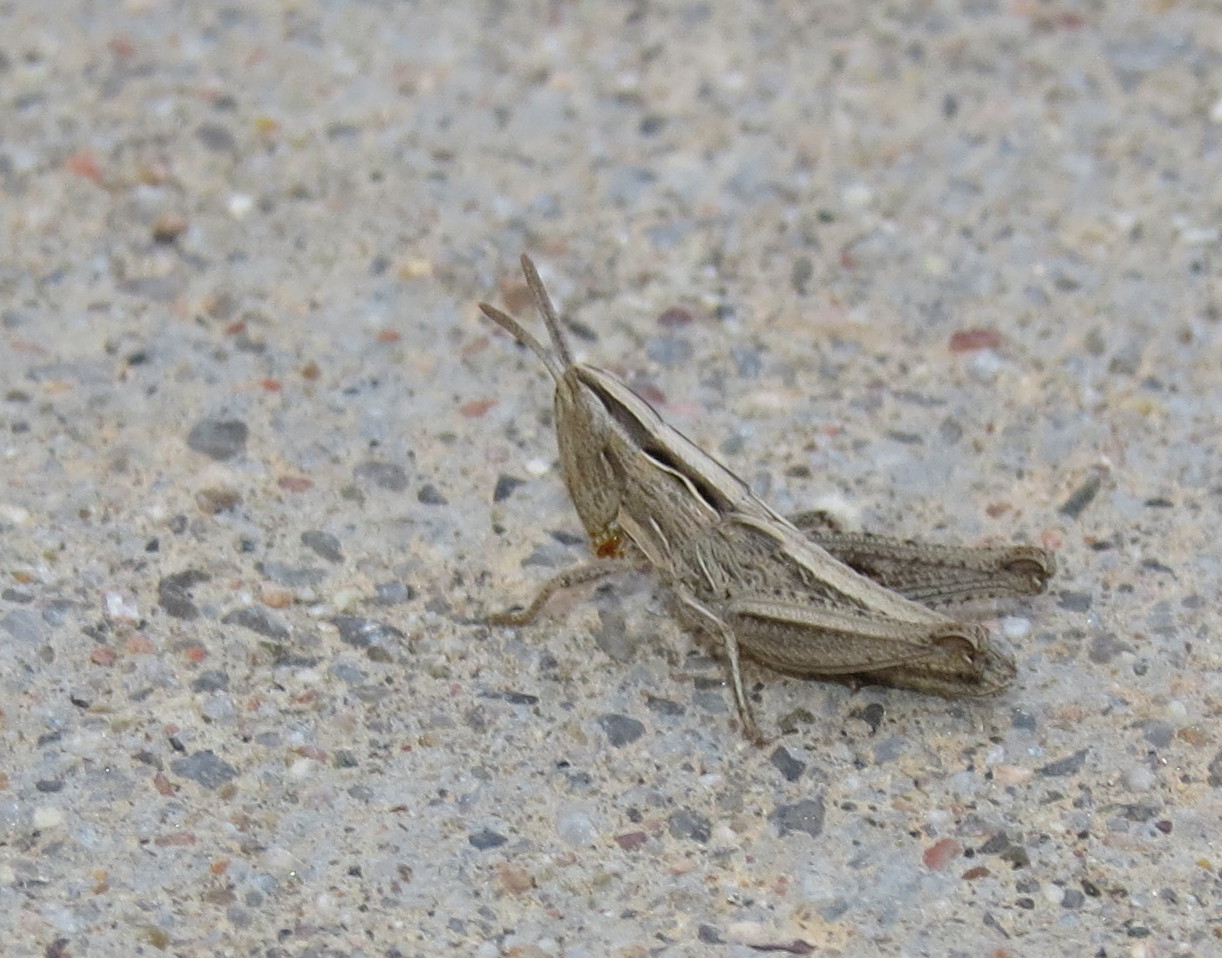
Adult female Red-legged Grasshopper

We are not alone, of course. One of my colleagues, Mathew Brust, in Nebraska, recently posted to Facebook that he has been observing certain grasshopper species that are farther ahead in their metamorphosis than they should be at this time of year. He expressed fears that we might have lower insect diversity and abundance come next spring as a result of the extended summer/fall:

"Wait, latest update, I have seen 13 grasshopper species in two days (8 as adults, 5 as nymphs). What really scares me is that many of the nymphs are already 5th instars (last stage before adulthood), which I have never seen in fall, not even on warm days in January. I am seeing many late butterflies, and I suspect most will be dead-ends as their offspring will not survive. These are likely individuals that should have normally emerged next spring. I have to wonder how many butterfly species are going to see a serious drop in numbers next year because of the messed up weather this fall. Pretty screwed up stuff! Ah, but I guess global warming is just a hoax, so it must be due to something else entirely."

Mathew is obviously being tongue-in-cheek with his last comment, but it is important that each of us document what we are seeing. I, for one, am highly skeptical that the incoming federal administration is going to make major strides, if any at all, toward a better understanding of climate change, so it us up to citizen scientists to contribute what we can.

Velvet-striped Grasshopper nymph

I found three species of grasshoppers as adults (and heard another one species crepitating in a field), and one as a nymph, yesterday.

Western Yellowjacket worker

I even found a worker Western Yellowjacket on the trail that had probably collided with a cyclist a few minutes earlier. It spun around aimlessly on the concrete in a dizzy, disoriented kind of way, but eventually flew off. Vehicular traffic of all kinds takes its toll on insects and spiders, but that can be the subject of a future blog post. What is surprising is that there are any yellowjackets still present. Queens should have entered into hibernation by now, and workers and males should have perished back in October.

Western Pygmy Blue butterfly

I spotted a shockingly fresh-looking Western Pygmy Blue butterfly, too, and perhaps even more surprisingly discovered it was taking nectar from tiny, blooming flowers. What plant in its right mind is blooming now? There are still roadside sunflowers looking as bright and healthy as the majority looked at their peak in August. I even see a few asters still clinging to life, and wild alfalfa flowers, too.

Adult seed bug, Melacoryphus nigrinervis

The other part of this story is that I, myself, am usually hunkered down for the winter, devoting my time and energy to editing images from the spring, summer, and fall, plotting stories to approach editors with, and otherwise confining myself mostly to the indoors. My brain is telling me that is what I should be doing, but my eyes and temperature sensors are kicking me out the door to continue exploring. My own biological compass is spinning wildly out of control.

Elm Leaf Beetle

What are you observing and experiencing right now in your corner of the world? Anecdotal information is critical for a better understanding of trends in climate and weather, so I hope you will consider recording your observations on i-Naturalist, and your "spottings" to Project Noah, and any other relevant databases and resources. I'll be talking about another such resource soon, pertinent to personal and community gardens, and local agriculture. Changes in insect abundance and diversity will, obviously, have a profound impact on how we feed ourselves and each other. Stay tuned.

Wolf spider