Friday, February 14, 2014

Bugs in Love

Happy Valentine’s Day! No matter whether you, or any other person, loves insects, there is no question that they love each other. There are few things arthropods are better at than procreating, so on this day of love why not celebrate their courtship and mating?

True bugs like the Eastern Boxelder Bugs above, often mate “tail-to-tail.” It is one way to differentiate them from beetles, which usually mate stacked up, the male on top. Take the two tiger beetles below, for example.

The video below shows a pair of blister beetles (genus Epicauta) that I found here in Colorado Springs. The male is in the rear, rocking back and forth and literally tickling the fancy of the object of his affection with his antennae. You’ll have to add your own sound track, maybe Barry White or Marvin Gaye. Ooooooh....yeah.

Butterflies, like most insects, rely heavily on pheromones to attract the opposite sex. Pheromones are species-specific volatile chemicals produced mostly by the female, but sometimes the male. The picture below depicts a pair of Heliconius hecale in the “Butterfly Magic” exhibit at Tucson Botanical Gardens. The female is perched on the leaf while the male hovers above.


In this case, he is wafting his own pheromones toward her. Unfortunately for him, the posture of the female is the Lepidoptera equivalent of flipping one’s middle finger. Nice try, guy. Better luck next time.

Some male insects have a “hit-and-run” mentality, literally. Male European Woolcarder Bees, Anthidium manicatum, stake out territories around resources used by the females. They will rout any other males, and any other bee species, from a patch of flowers, for example. When a female lands on a flower and tries to go about the business of harvesting pollen….BAM! The male bee forcibly accosts her, mating with her whether she wants to or not. The session ends after only a few seconds.

Among the more gymnastic of mating rituals occurs in the Odonata: the damselflies and dragonflies. It still may not be much fun for a female, as the male grasps her tightly around the neck with the claspers on the end of his abdomen. Some dragonflies even end up puncturing the eyes of their mates with the prongs and spurs on their claspers.

A compliant female will, however, bend her abdomen up to meet the base of her mate’s abdomen, as his sperm duct is located there. A pair of mating damselflies or dragonflies thus forms a “wheel,” often in the shape of a heart. What a fitting image for Valentine’s Day.

Friday, February 7, 2014

King of the Dung Heap

Some of the most beautiful insects in the world are found under the most disgusting of circumstances. Take, for example, the subject of this week’s “Fly Day Friday.” The Golden Dung Fly, Scathophaga stercoraria, is a common species, especially in early spring and autumn. Unfortunately, it is most abundant around cow and horse manure.

The male fly, about 7-9 millimeters in length, is covered in long, bright yellow or golden hair. The insect positively glows when the sunlight strikes its body at just the right angle. Females are often smaller, and rather dull brown or gray. Males are quick to colonize a fresh heap of dung, many individuals descending on the meadow muffin. The flies are predatory on other, smaller flies that try and compete with their monopoly on the dung.

Females covet fresh scat as food for their offspring, but they first have to endure a mob of bachelors attempting to mate with them. Larger males are usually more successful at copulation than smaller individuals, but in the frenzy they sometimes mistake others of the same gender for females. Males repel such unwanted advances by pushing themselves up on their front and hind legs and kicking the would-be suitor off their back with their middle legs.

Even after mating a female is usually accosted by other males trying to “get in the last word,” so to speak. The kicker is that the female has three, sometimes four, spermathecae, internal storage chambers for sperm within her abdomen. So, not only is there external competition between male flies, but competition among their sperm, inside the female. Still, the last male to mate with a given female will fertilize about 80% of her eggs.

He often guards the female while she deposits her eggs. According to one study it takes her an average of forty-five minutes to complete oviposition. Manure that dries out, forming a crust, is nearly impossible for the flies to penetrate when laying their eggs, so there is a premium on freshness.

There is a surprisingly voluminous amount of information about the mating habits of this species, which any Google or Google Scholar search will reveal. There are even some online videos, and not all of them R-rated. The flies are easy to observe in the field, and easy to propagate in the laboratory, so they make good subjects for students and scientists, no doubt.

When not engaged in sexual behavior, or searching for poop, dung flies can be found peacefully sipping nectar from flowers, especially in early spring. I often see them on willow catkins, where they will also prey on smaller flies (see photo above). There are several generations of these insects throughout the warmer months, but they seem to be most conspicuous in spring and fall.

The Golden Dung Fly has a nearly worldwide distribution, and is not surprisingly most abundant in habitats frequented by livestock and large, wild mammals. So, forest edges, meadows, fields, farms, and ranches are good places to find them in great numbers. Not that you would want to go out looking for feces or anything….

Sources: Preston-Mafham, Rod and Ken. 1993. The Encyclopedia of Land Invertebrate Behaviour. Cambridge, Massachusetts: The MIT Press. 320 pp.
Ward, Paul I. 2000. “Cryptic Female Choice in the Yellow Dung Fly Scathophaga stercoraria,” Evolution 54(5): 1680-1686.

Wednesday, February 5, 2014

Double-banded Scoliid wasp

Black and white insects, especially those that are of good size, never fail to attract attention. One of those conspicuous types is the Double-banded Scoliid, Scolia bicincta. These large, hairy wasps are commonly seen on autumn wildflowers like goldenrod (Solidago spp.), thoroughworts (Eupatorium spp.), and milkweed (Asclepias spp.).

Wasps in the family Scoliidae are easily recognized by their relatively large size, robust hairy bodies, and often blue or violet wings with dense horizontal ridges near the tips. Females have short antennae while males have long antennae. Males also have a “pseudostinger,” sometimes three-pronged, on the last abdominal segment. Females have a true stinger, retracted inside the abdomen when not being deployed.

S. bicincta is named for the two broad, white bands across the front half of the abdomen. The insect is otherwise black with bluish reflections on the wings. Size varies from 15-25 millimeters in body length. The species ranges across the eastern U.S. from southern New England to Nebraska and Kansas, south to Florida and Louisiana.

This wasp is not quite as abundant as its cousin the Blue-winged Wasp, but it is by no means rare. No host records exist for the Double-banded Scoliid, as far as I can fathom, but it is assumed to be parasitic on subterranean scarab beetle grubs.

An adult female wasp somehow divines the presence of a beetle larva underground, digs down to it using her exceptionally spiny legs, and stings the grub into paralysis. She either utilizes the grub’s existing burrow as its tomb, or carries it deeper and fashions a crude cell-like crypt. She then lays a single egg on the grub and abandons it.

The wasp larva that hatches from the egg feeds as an external parasite for roughly two weeks. When finished, the larva spins a cocoon and overwinters inside. Come spring it forms a pupa, completing its metamorphosis into an adult wasp shortly thereafter. Adult wasps are on the wing from July through September or October, their flight period depending on geographic latitude to at least some degree.

Look for the male wasps flying close to the ground in a lazy figure-eight pattern. They emerge before females and are eager to find a virgin of the opposite gender, even if she has not yet surfaced from her pupal chamber. Males roost for the night either individually or in loose groups, curling themselves around stems or twigs.

Scoliid wasps should be considered beneficial to your yard, lawn, garden, or farm, where they help to keep those pesky “white grubs” under control. Meanwhile, the adult wasps are fairly effective pollinators considering they are flower visitors out for nectar only. Their hairy bodies can accrue a coat of pollen that they then carry to the next flower.

Source: Grissell, E.E. 2007. “Scoliid Wasps of Florida, Campsomeris, Scolia, and Trielis spp. (Insecta: Hymenoptera: Scoliidae),” Featured Creatures, DPI Entomology Circulars 179 and 185, University of Florida.

Sunday, February 2, 2014

Spinybacked Orbweaver

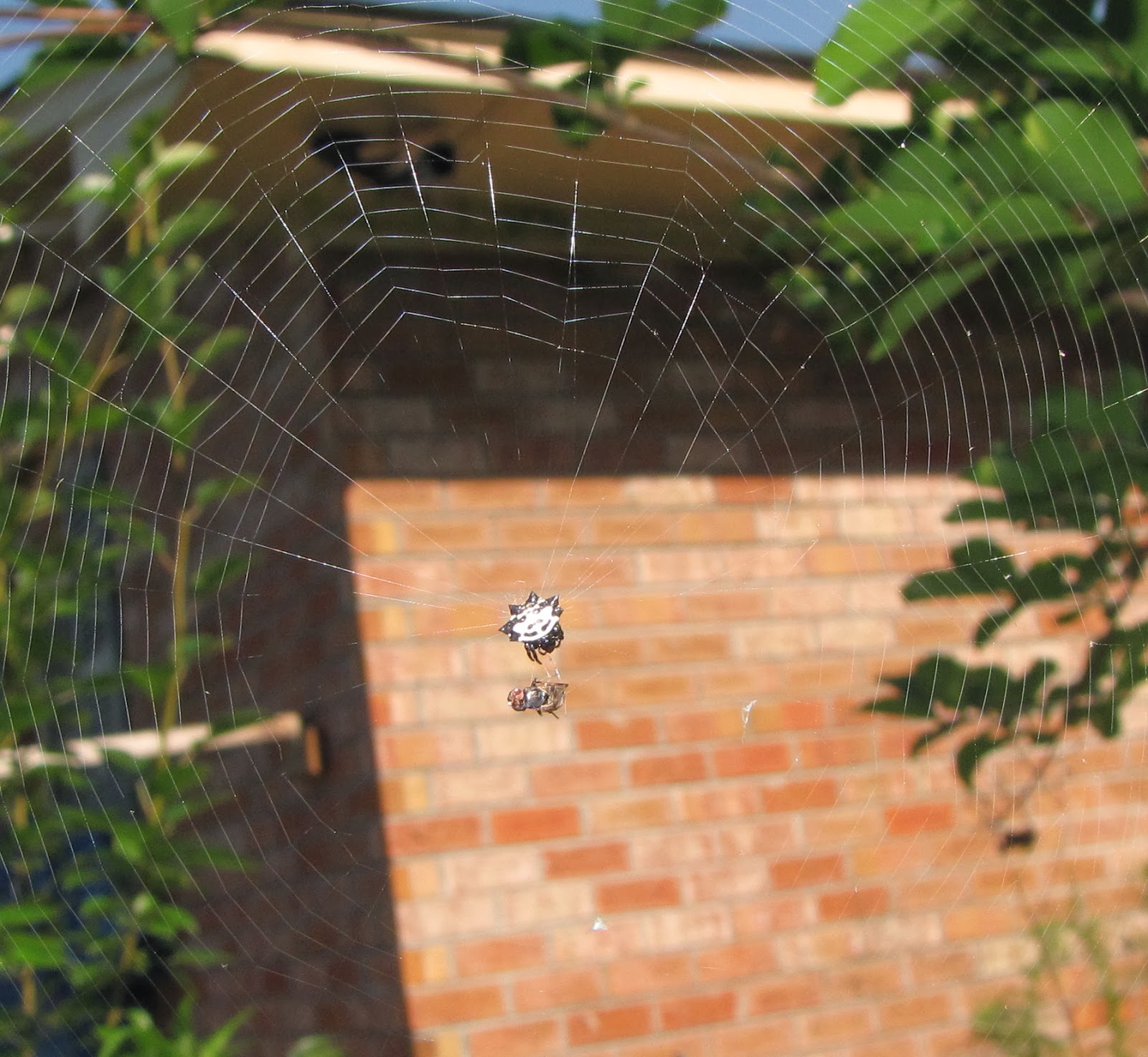
The diversity of shapes in the spider world is amazing. What does the Spinybacked Orbweaver, Gasteracantha cancriformis, remind you of? The genus name translates from the Greek to “belly thorn,” and the species name is Latin for “crab shape.” Indeed, other common names for this species include Crab-like Orbweaver and Crab-like Spiny Orbweaver. It reminds me of one of those medieval mace weapons come to life, or a flesh-and-blood ninja star (shuriken).

This is no soft-bodied arachnid, either. The exoskeleton of the flattened abdomen is thick and hardened, the spikes protruding from it horn-like and stout. A predator would certainly think twice before swallowing something that prickly.

This unique species is unlikely to be confused with any other spider you will encounter, provided you recognize it as a spider and not a piece of windblown debris that happened to be intercepted by a web. They tend to crouch, with their short legs drawn close to their bodies, so no one could fault a person for dismissing the spider as an inanimate object.

The overwhelming majority of specimens you are likely to see are females. The mature spiders are actually wider than they are long, ranging from about 5-9 millimeters in length, but 10-13 millimeters in width. Contrast those dimensions with the tiny males, which are only 2-3 millimeters in body length, and only slightly wider. He is a little rough around the edges but lacks the big spikes of the female.

Male G. cancriformis © Joe Lapp via Bugguide.net

There are several color forms of the females. Most are ivory and black on top, but they can be yellow with black spikes, yellow or white with red spikes, or red with black spikes. The underside is black, mottled with yellow or white spots, and rather wrinkled in appearance. The spinnerets arise from a short turret near the middle of the belly.

The first one of these I ever saw was at the Hemingway House in Key West, Florida in June, 1978. It had spun a web high in a tree and had I not been on a balcony at the time I never would have noticed it. The snare has a large, open hub where the spider sits, and the spiral is not as tight as in species of Micrathena (which also have spiny bodies). The body of the web can span 30-60 centimeters.

The web is often decorated with little tufts of silk along some of the radii near the hub. It is suspected that these knots of silk serve as warning beacons to birds so that the snare is not destroyed by an avian flying through it. Could they also be lures for potential prey? One theory as to the function of a stabilimentum, the band of silk in many Argiope orb weaver webs, is that the ribbon imitates a flower, reflecting ultraviolet light that pollinating insects cue in on.

This can be an abundant spider along woodland edges, citrus groves, even gardens, especially in rural townships from the southern United States to Argentina. Look for it as far north as Maryland, Arkansas, and Oklahoma. I have encountered it regularly in Florida and Texas, but it is known as far west as southern California.

G. cancriformis is most common in late fall and early winter, from October through January, at least in Florida. Mated females deposit eggs in sacs that are attached to the underside of leaves. The egg sac is very distinctive, covered in a rather loose net of coarse yellow silk with a line of green silk down the center of the oval structure.

Egg sac © Kara Tyler-Julian via Bugguide.net

The Spinybacked Orbweaver will always be a species I look forward to seeing anytime I venture into the subtropical southern U.S. Keep a lookout for them in your own travels.

Sources: Bartlett, Troy, et al. 2012. “Species Gasteracantha cancriformis - Spinybacked Orbweaver,” Bugguide.net.
Edwards, G.B. 2000. “Spinybacked Orbweaver,” Featured Creatures, EENY-167, DPI Entomology Circular 308, Florida Department of Agriculture and Consumer Services, Division of Plant Industry.