Showing posts with label Hymenoptera. Show all posts

Wednesday, May 20, 2026

Bees Are Not (Purposeful) Pollinators

Today is World Bee Day, for celebrating our favorite pollinators. I enthusiastically support increasing awareness of bees other than honey bees, but a vague mythology exists. Here is some food for thought, remembering that one out of every three bites of food we eat we owe to the efforts of pollinators.

A tiny sweat bee, genus Lasioglossum, visits a ornamental Amaryllis flower in our Leavenworth, Kansas yard. Bees prefer native plants, though.

There is something of a persistent fairy tale, if only implied, that portrays bees as little agents of plant reproduction, flying flower to flower to effect floral fertilization, like it is their job, or out of the goodness of their tiny little hearts. Nothing could be farther from the truth.

A female mining bee, genus Andrena, pauses to rest and groom between forays for collecting pollen. Colorado Springs, Colorado.

Bees are best described as “pollen harvesters,” or even, perish the thought, “pollen predators.” Female bees actively collect pollen as food provisions for their larval offspring. This definition applies to honey bees, bumble bees, sweat bees, mining bees, mason bees, leafcutter bees, digger bees, all the bees except the kleptoparastic cuckoo bees. Cuckoo bees don’t collect pollen, but lay their eggs in the nests of other bees that do. Cuckoo bee larvae feed on the stolen pollen reserves of their hosts.

Many cuckoo bees, like this one in the genus Nomada, look more like wasps, lacking the "fuzzy" appearance we associate with bees. Colorado Springs, Colorado.

Pollination occurs as a by-product of the bee’s determined, thorough gathering of pollen; and the body form of bees that allows pollen to be shed as frequently as it is foraged. Body plan and behavior therefore make bees effective pollinators.

A male Squash Bee, Peponapis pruinosa, waits in a flower for a potential mate to visit. This bee species visits flowers in the gourd family exclusively. Colorado Springs, Colorado.

Another facet of bee behavior is that some species are oligolectic, meaning they visit only one particular genus, or even species, of flower. This greatly increases the likelihood that pollination will happen. Many bees are generalists, and will visit a variety of flowers, lowering the possibility of compatibility of bee-shed pollen with the flower receiving the bee’s next visit. This is not usually appreciable enough to be negatively significant, but it is still worth noting.

A female sweat bee, genus Halictus, has difficulty reaching pollen and nectar in an ornamental rose flower. Colorado Springs, Colorado.

Flowers and bees have coevolved to take advantage of each other, and it is an ongoing, dynamic relationship. Human interference threatens to upend that in a variety of ways. Some plant cultivars have sterile flowers, and bees therefore waste time and energy trying to “get blood out of a turnip.” Other cultivars, bred for large, complex “double bloom” flowers, result in blossoms too complicated for bees to navigate to find pollen and nectar. Lastly, cultivars may have pollen with a much lower nutritional value than that of the native plant they were derived from.

A worker female honey bee, Apis mellifera, among the first bees active in spring. El Paso County, Colorado.

Honey bees, social bees in the genus Apis that are not native to the Americas or Australia, are the unfortunate poster children for Bee Day, thanks to public familiarity through heavy marketing campaigns by the apiculture (bee keeping) industry. While absolutely vital pollinators for industrial scale agriculture, honey bees in unmanaged, feral colonies have a serious negative impact in natural ecosystems. Honey bees hog floral resources that native bee species, most of which are solitary, need to prosper.

A female Eastern Carpenter Bee, Xylocopa virginica, robs nectar from a hosta flower, throuch a slit she cut at the base of the blossom. Leavenworth, Kansas.

Back to flowers and bees for a moment. There are long- and short-tongued bees. This difference in anatomy means that many bees are restricted to visiting flowers with shallow corollas, such that they can reach the nectar reservoirs. Some larger short-tongued bees, namely large carpenter bees in the genus Xylocopa, are able to cut a slit at the bottom of deep-throated flowers, and “rob” the nectar without dusting themselves with pollen in the process of feeding. Smaller bees follow the carpenter bee, and take advantage of the holes it cuts.

The bumble bee on the left performs proper pollination of a hosta flower, while the longhorned digger bee on the right bypasses the flower's reproductive parts and uses a slit cut by a carpenter bee to rob nectar.

If it seems like the myth of the hard-working bee might be falling apart a little, then what about other pollinators like butterflies, moths, wasps, flies, beetles, hummingbirds, and bats? Well, those organisms are not even coming to flowers for pollen, with a few exceptions. They are “flower visitors” that want nectar as sugary fuel for their high metabolism. Setae (hairs), feathers, and fur will accumulate pollen, and shed it, so again, pollination can be achieved, but it is not some kind of selfless mission of the critter.

A female leafcutter bee, genus Megachile, shears a piece from a redbud leaf to use in fashioning a cell in her nest. She can do quite a bit of cosmetic damage, but the shrub will be fine. Leavenworth, Kansas.

All of this is not to say that bees are not loveable, and in need of conservation. Here are some neat facts, tips for helping bees, and resources to investigate:


  • There are over 4,000 species of bees found north of Mexico. Hotspots include the Mojave Desert, and Colorado.
  • Most native, solitary bees nest in burrows underground, so leave some bare patches of soil in your yard for them.
  • ”Bee hotels,” aka bee condos, bee blocks, are for solitary bees that nest in natural cavities in wood. Avoid commercial products, and make your own; or, better yet, leave stumps and solid wood logs in the yard that have obvious holes from beetle borings. Snip old, hollow twigs and woody stems so bees can use those upright tunnels, too.
  • Consult online gurus like Dr. Kit Prendergast (“The Bee Babette”) of Australia, and Krystle Hickman (“beesip”) of southern California, for friendly presentations on bees, and tips on how to help them.
  • Watch My Garden of a Thousand Bees, a fascinating documentary set in the United Kingdom, but applicable elsewhere in the northern hemisphere.
  • Landscape with native plants whenever and wherever you can. Be tolerant of the damage done by female leafcutter bees making their nests by cutting chunks of foliage.

A female sweat bee, genus Lasioglossum, lives up to her name and sips perspiration from my hand. Leavenworth, Kansas.

Enjoy the rest of National Bee Day, and get ready of National Pollinator Week, coming June 22-28, 2026.

Saturday, April 11, 2026

The Beetle and the Bee

At the end of February, I finally found a beetle I had been looking for here, for years. Perhaps I had not been scouting for it early enough, but we barely had a winter this year, and I suspect that most years it would have been evident in March. The key was finding an aggregation of its host organism.

Tricrania sanguinipennis is a blister beetle in the family Meloidae. The adult insects measure 9-15 millimeters, but are bright enough, and active enough, that they are easily seen. Their wings, hidden under their red, leathery elytra, are almost vestigial, so they are flightless. Instead they crawl, but rather rapidly, over the surface of the soil, periodically digging where they detect the possible presence of a host.

Kansas is about as far west as this beetle is found, though there are records well north into Saskatchewan, Canada. It occurs over the eastern U.S. to extreme northern Florida, and up into adjacent southern Canada.

The limiting factor is that Tricrania sanguinipennis is a parasitoid of solitary bees that nest in dense aggregations, namely cellophane bees in the genus Colletes.

We have the Unequal Cellophane Bee, Colletes inaequalis, nesting in our yard and/or the adjacent neighbor’s lawn, depending on the year, but those locations are apparently blister beetle-free. It took finding a small aggregation of the bees in a forested park to locate the beetles.

An Unequal Cellophane Bee lurks just inside the entrance to her burrow.

The bees nest in burrows, ideally in sandy soil. The vertical, subterranean tunnels branch into several individual cells, each one an “apartment” for a single bee larva. The grub feeds on a nearly liquid loaf of pollen and nectar. The walls of its room are coated in a type of natural plastic manufactured in glands in its mother’s abdomen, which essentially waterproofs the chamber, and retards mold and fungus.

Back to the beetles. What the female beetles lack in mobility, they more than make up for in fecundity. Each lady can produce hundreds of eggs, over a thousand in some documented instances. How, then, do the beetles gain entry into these tunnels? The answer is that they do not. The larvae do.

The larval stage is unusually lengthy, progressing through six instars. An instar is the interval between molts. It is also strange in that it includes hypermetamorphosis. In this case that means the larval form changes radically in both appearance and behavior from one molt to the next.

Several male Unequal Cellophane Bees waiting for females to emerge.

The first instar larva that emerges from the egg is a sleek, streamlined, highly mobile bee-seeking missile called a triungulin. At the time they are active, it is almost exclusively male Colletes bees that are active, buzzing about and frequently landing to investigate a potential site where a female could emerge. It is at these brief moments when a blister beetle triungulin scampers aboard, affixing itself to the hairs on the underside of the bee’s abdomen.

Oops! An overeager male mistakes another male for a female.

When the male bee at last is able to mate, the triungulin transfers to the female bee. In at least a few instances, the triungulin may attach directly to a female bee that it encounters on the ground. She will eventually, and unwittingly, ferry that parasite, and probably several others, to her new nest burrow. Once inside, it disembarks and infiltrates one of the subterranean nest cells.

The beetle larva usually consumes the egg of the host immediately, but not always. The bulk of its diet will be the honey and pollen left by the bee for its offspring in the cell. It may be a frequent occurrence that more than one beetle larva invades a single bee cell. In that event, cannibalism of the competition resolves the conflict.

The meal of the host egg or larva is usually enough nutrition to trigger the beetle larva’s molt to the next instar. This results in a shocking change from that sleek, active larva into the insect equivalent of a couch potato. The second instar is, shall we say….rotund, and boat-shaped. It commences feeding on the pollen and nectar stores in the cell of the now missing bee offspring. The insect retains this form for the remainder of its larval life. The first three instars shuck their old exoskeleton completely, but the fourth and fifth instars retain each molt in its entirety. Think of it as an object inside a balloon (inside another balloon by the fifth instar). Those larvae actually shrink in size to fit inside the shed “skins.” When molting into the pupa stage, the sixth molt is again broken during shedding, and compacted at the rear of the pupa, which is still inside those other exoskeleton balloons.

It takes until late summer or early fall for the life cycle to complete, the adult beetle remaining encased in its final one or two larval exuviae, where it overwinters, still inside the cell in the host’s nest burrow.

You would think that the bee species hosting this diabolical beetle would be decimated by it, but such is not the case. Each spring there are plenty of the adult bees. What is more of a threat is the potential disconnect between the bees and their nectar plants. Colletes inaequalis visits flowering trees almost exclusively, especially Eastern Redbud, and maple trees. As the phenology of the blooming cycles becomes increasingly unpredictable thanks to climate change, the appearance of the flowers may cease to always coincide with the emergence of the bees that pollinate them.

Sources: Messinger Carril, Olivia, and Joseph S. Wilson. 2021. Common Bees of Eastern North America. Princeton, NJ: Princeton University Press. 286 pp.
Parker, J.B. and Adam G. Boving. 1925. “The Blister Beetle Tricrania sanguinipennis - Biology, Descriptions of Different Stages, and Systematic Relationship,” Proc U.S. Nat. Mus. 64(2491): 1-40. This is a wonderfully exhaustive article, with illustrations of all larval instars.

Wednesday, January 21, 2026

Another Micro Mystery

One way that I find insects in winter is by scraping off paper wasp nests that have been abandoned by the past season’s generation of wasps, and placing the nests in a transparent container. What usually happens is that one or more kinds of insects will eventually emerge from these nests. Allow me to share one example.

Dibrachys sp.

I started collecting recent, abandoned paper wasp nests (Polistes metricus is the common species around our home here in Leavenworth, Kansas, USA) when I saw a social media post by Sloan Tomlinson (@thatwaspguy on Instagram). He had reared a type of small parasitoid wasp as a result: the eulophid wasp Elasmus polistis. That species is a parasitoid of the brood (larvae, pupae) of paper wasps. Cool. I could add another species to my home biodiversity list.

So many tiny wasps!

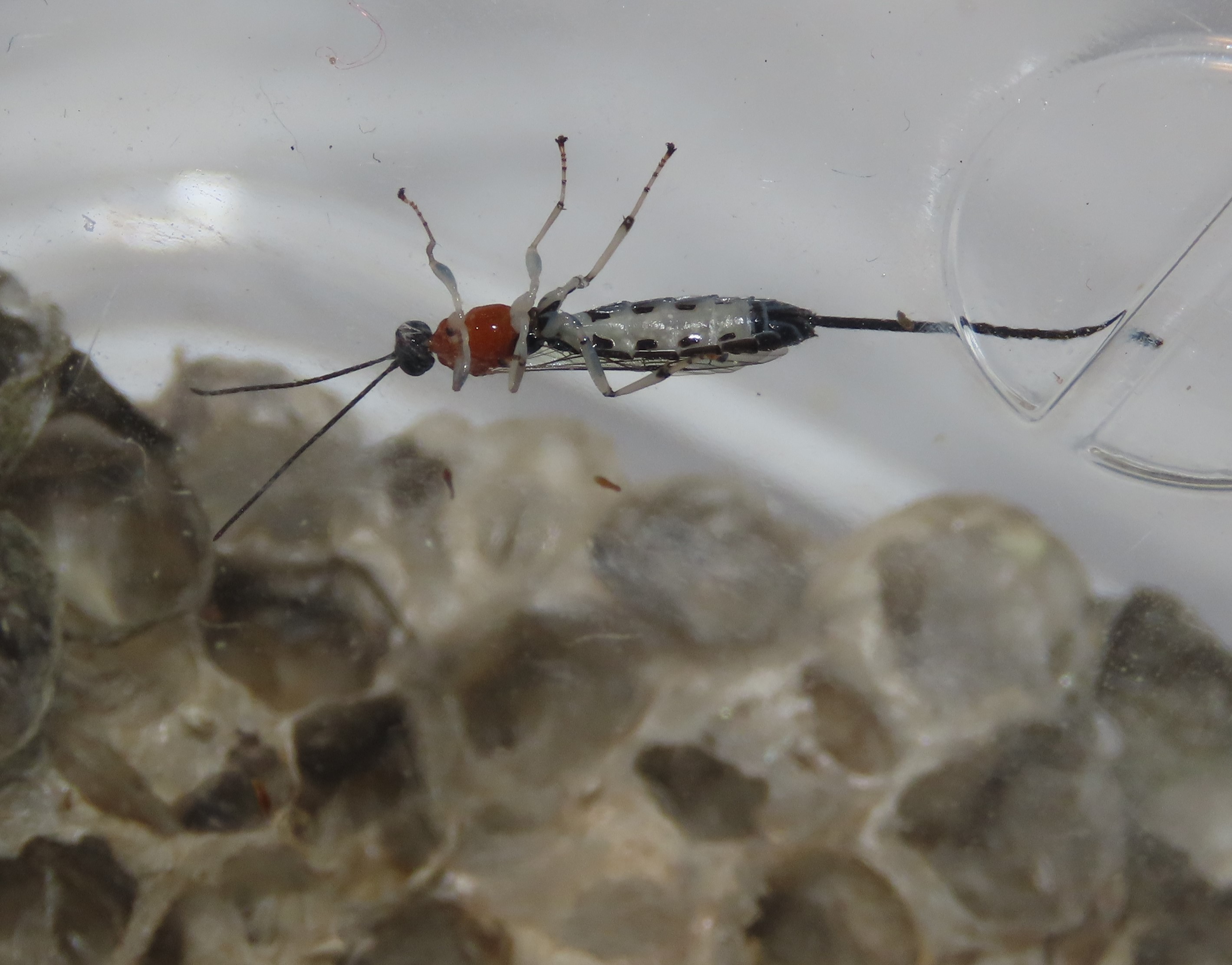
I was excited to find, in January of 2022, that this method had worked, as I saw tiny wasps running around inside the container with the old paper wasp nest. Photographing the little creatures, and then cropping those images, it became apparent that what I had was not what I expected. I was left with a mystery that took me awhile to solve, even though I’m fairly good at researching.

I eventually found a journal article chronicling a study of various parasitoids of paper wasps collected from nests in Missouri, the state immediately adjacent to Kansas. In fact, Leavenworth is right across the Missouri River from Missouri. One of the creatures listed was a wasp in the family Pteromalidae. They had only eighty-seven specimens, though. I was looking at hundreds by the time they finished emerging.

Male wasps attempting to mate with a female.

The species name given was Dibrachys cavus. More recently, it has been revealed to be a “species complex,” and has a new assigned name: Dibrachys microgastri. It represents one of *three* species, any one of which could potentially be my creature. Collectively, they are parasitoids of pretty much any insect with complete metamorphosis. That makes it difficult to determine exactly which one I have. Even placing a specimen under a microscope might not be enough magnification for these two-millimeter wasps.

Dibrachys is unusual for a single genus of wasps in having such a wide range of potential hosts. At least some species, or perhaps most, are hyperparasitoids of tachinid flies and braconid or ichneumon wasps that are themselves parasitoids of moth pupae. This makes me wonder if these minions are part of this puzzle that I documented in 2022.

I find unsolved mysteries intriguing, and delight in them even if I never reach any verifiable conclusion. There will always be *something* that defies explanation in the natural world.

This little cobweb weaver spider may have been making a killing, literally.

Sources:Gibson, Gary A.P., John T. Huber, and James B. Woolley (eds). 1997. Annotated Keys to the Genera of Nearctic Chalcidoidea (Hymenoptera). Ottawa, Ontario: NRC Research Press. 794 pp.
Peters, R.S. & Baur, H. 2011. A revision of the Dibrachys cavus species complex (Hymenoptera: Chalcidoidea: Pteromalidae). Zootaxa, 2937 (1), 1-30.
Whiteman, Noah K. and Brett H.P. Landwer. 2000. Parasitoids Reared From Polistes (Hymenoptera: Vespidae: Polistinae) Nests in Missouri, With a State Record of Elasmus polistis Burk (Hymenoptera: Elasmidae). J Kansas Ent Soc 73(3): 186-188.

Thursday, August 22, 2024

A One Millimeter Mystery

Sometimes a minor disaster turns into something positive, like a fallen tree limb revealing a hidden relationship between a wasp, a fly, and a saw blade. All of this in the front yard of our house in Leavenworth, Kansas, USA.

Yikes!

Upon returning from a week-long road trip in late June that took us into Arkansas, southeast Missouri, and southern Illinois, we pulled up in front of our home to discover that a massive tree limb had broken off the ancient Pin Oak, miraculously landing between our house and the neighbor’s house, with no significant damage to either structure. This makes the third such incident since we moved here in May of 2021.

Ugh, I've got a big job ahead of me.

We do not own a chainsaw, so I started cutting off the smaller branches with a couple of manual saws that we have. The odor emanating from the cuts attracted several wood-boring beetles right away. Close behind them were parasitoid wasps looking to oviposit on the eggs or larvae of their beetle hosts. While this was entertaining, and resulted in adding a new longhorned beetle to our home list of animal life, a more intriguing scenario attracted my attention.

My saws bring all the wood-boring insects to our yard.

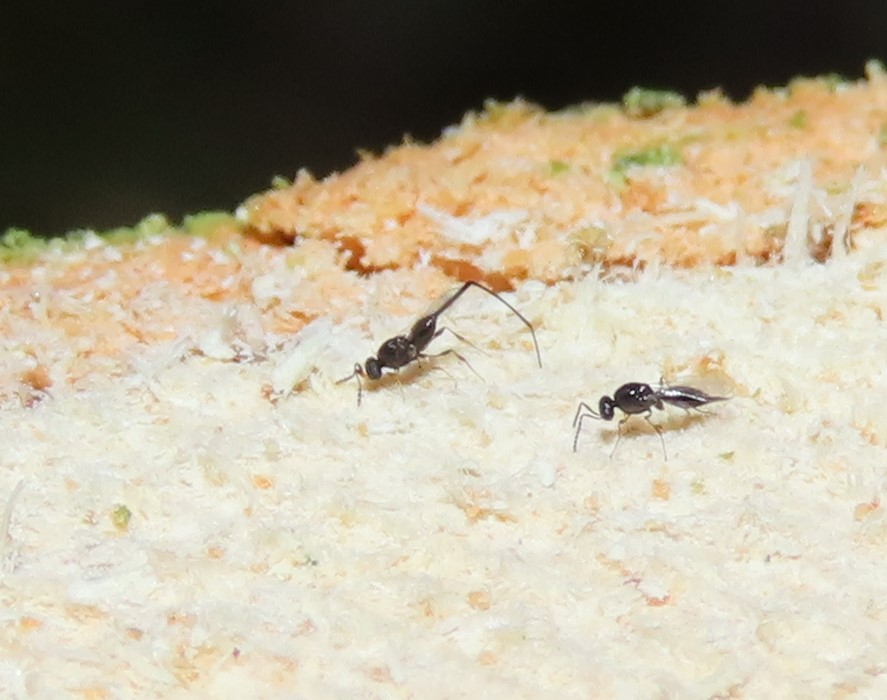
Awhile later, I noticed several minute black specks moving over the surface where I removed the branch. They had to be insects, but I could not tell what kind. I took a few photos, and was shocked to find they were miniscule wasps. Some had greatly elongated abdomens, others did not.

At least the long-bodied wasp is a Synopeas sp. platygastrid wasp.

I submitted a couple of photos to the Hymenopterists Forum, an interest group on Facebook, to solicit an identification from true expert specialists. They did not disappoint.Bob Zuparko suggested they might be in the family Platygastridae, and that was confirmed by Kendrick Fowler. He also suggested a genus, Synopeas, and subgenus Dolichotrypes. He wasn’t sure the wasp with the “normal” abdomen was even a male of the same thing. It might be something else entirely.

Fowler went on to explain that this is a known behavior, the attraction to freshly cut oak, and that the host is presumably some sort of fly in the gall midge family Cecidomyiidae. That floored me because until then I thought all gall midges attacked foliage and/or stems. Also, how did this behavior evolve? There weren’t saws of any kind until recently, in the evolutionary sense. Beavers?

I decided to dig a little deeper and discovered that there is a genus of gall midges that oviposits in this situation: Xylodiplosis. I went back out and looked at some of the branch stumps again. Amazingly, I managed to find a few gall midges laying eggs. They were much more difficult to photograph than the wasps, and not as numerous, either. Why the wasps arrived before their hosts is a mystery to me. Oh, and there is also Ledomyia, another genus of gall midge that lives in freshly cut wood like this. I’m honestly not positive which one I documented.

Female gall midge, probably Xylodiplosis sp., ovipositing.

It turns out that Xylodiplosis gall midges have all kinds of enemies. They are attacked by nematode worms (family Ektaphelenchidae), mites (family Tarsonemidae, tribe Pseudotaesonemoidini), even another kind of gall midge (Lestodiplosis xylodiplosuga). Most of the research on these has come out of Europe, by the way, so it may not apply here in North America.

Back to the wasps. Synopeas larvae do do not begin to develop until after the host gall midge larva leaves its lair in the xylem wood to pupate in the soil. The adult wasp emerges about fourteen days after the unparasitized adult of the host gall midge, according to one source (Rock and Jackson, 1985). In their findings, the rate of parasitism was about five percent, and that included another platygastrid wasp in the genus Leptacis.

In at least one of my photos of the wasps (first photo of them in this post), I can barely make out the short spine on the scutellum (top rear of thorax) that separates Synopeas from similar genera of platygastrids. Identification of species is not possible without examination of a specimen under high magnification. There are currently forty-four known species of Synopeas found in the Nearctic (North America more or less north of Central America). I will leave you to go farther down the research rabbit hole.

Sources: Awad, Jessica N. 2020. “Building a diagnostic framework for the genus Synopeas Forster (Hymenoptera: Platygastridae: Platygastrinae) based on reared specimens from Papua New Guinea.” Master of Science thesis, University of Florida.
Crawford, J.C. and J.C. Bradley. 1911.”A New Pelecinus-like Genus and Species of Platydateridae,” Proc. Ent. Soc. Wash. 13: 124-125.
Gagne, R.J. 1985. “Descriptions of new Nearctic Cecidomyiidae (Diptera) that live in xylem vessels of fresh-cut wood, and a review of Ledomyia (s. str.),” Proc. Ent. Soc. Wash. 87(1): 116-134.
Hooper, D.J. 1995. “Ektaphelenchoides winteri n. sp. (Nematoda: Ektaphelenchidae) from wood fly larvae Xylodiplosis sp. (Diptera: Cecidomyidae),” Fundamental and Applied Nematology 18(5): 465-470.
Khaustov, Alexander A., Arne Fjellberg, and Evert E. Lindquist. 2022. “A new genus and species of Pseudotarsonemoidini (Acari: Heterosstigmata: Tarsonemidae) associated with xylophagous gall midges in Norway,” Systematic and Applied Acarology 27(6): 1020-1034.
Rock, E.A. and D. Jackson. 1985. “The biology of xylophilic Cecidomyiidae (Diptera), Proc. Ent. Soc. Wash. 87(1): 135-141.
Skuhrava, M. and K. Dengler. 2001. “Lestodiplosis xylodiplosuga sp. n., a predator of Xylodiplosis sp. (Diptera: Cecidomyiidae): morphology of developmental stages, biology and behaviour,” Acta Societatis Zoologicae Bohemicae 65(1): 57-68.

Wednesday, December 7, 2022

A Potential New Host Record for Calliephialtes grapholithae (Hymenoptera: Ichneumonidae) from a Paper Wasp nest (Hymenoptera: Vespidae: Polistes metricus)

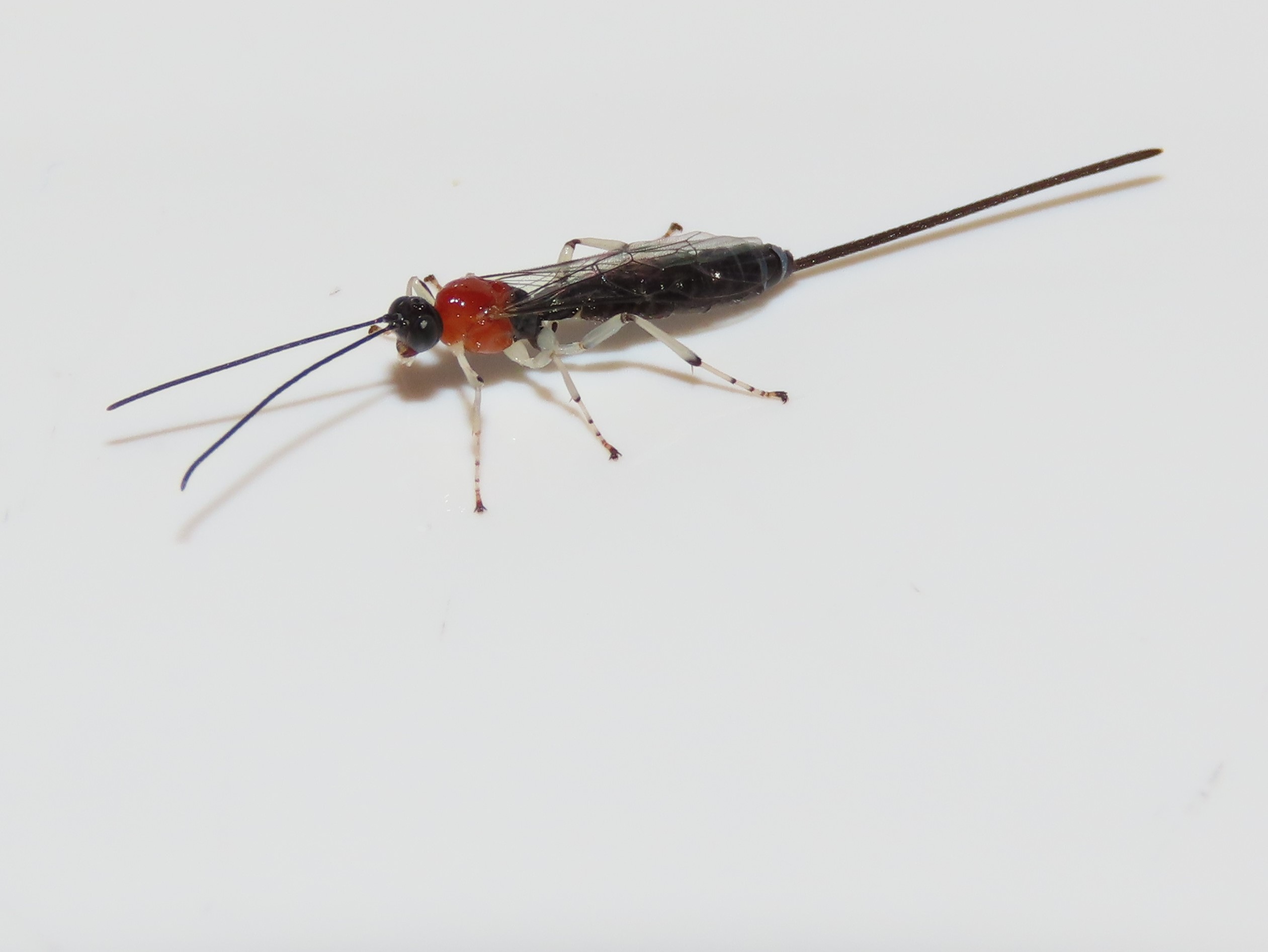
Adult female ichneumon wasp, Calliephialtes grapholithae

It started out innocently enough. Back in 2021, a Facebook post by Sloan Tomlinson (@thatwaspguy on Twitter) caught my attention. He had reared small parasitoid wasps, Elasmus polistis, from an abandoned paper wasp nest that he had contained. I messaged him to learn more, and then followed his suggestion to try this myself.

Nest of Polistes metricus from 2022

We had a nest of the Metric Paper Wasp, Polistes metricus, in a corner of the recessed frame of our back porch doors (French doors) at our home in Leavenworth, Kansas, USA. After the wasps left, I cut down the nest and placed it into a plastic container. Shortly thereafter, in about mid-November, a large number of small parasitoid wasps emerged that were not the same as those that Sloan Tomlinson had reared out. That is a separate mystery from the one I am documenting today.

This year, 2022, we had two Polistes metricus nests, one in each corner of the door frame. One succeeded better than the other by a substantial margin, and I repeated the exercise of cutting down the larger nest and containing it in late autumn. Besides the large number of tiny, metallic parasitoid wasps, I got a shocking surprise.

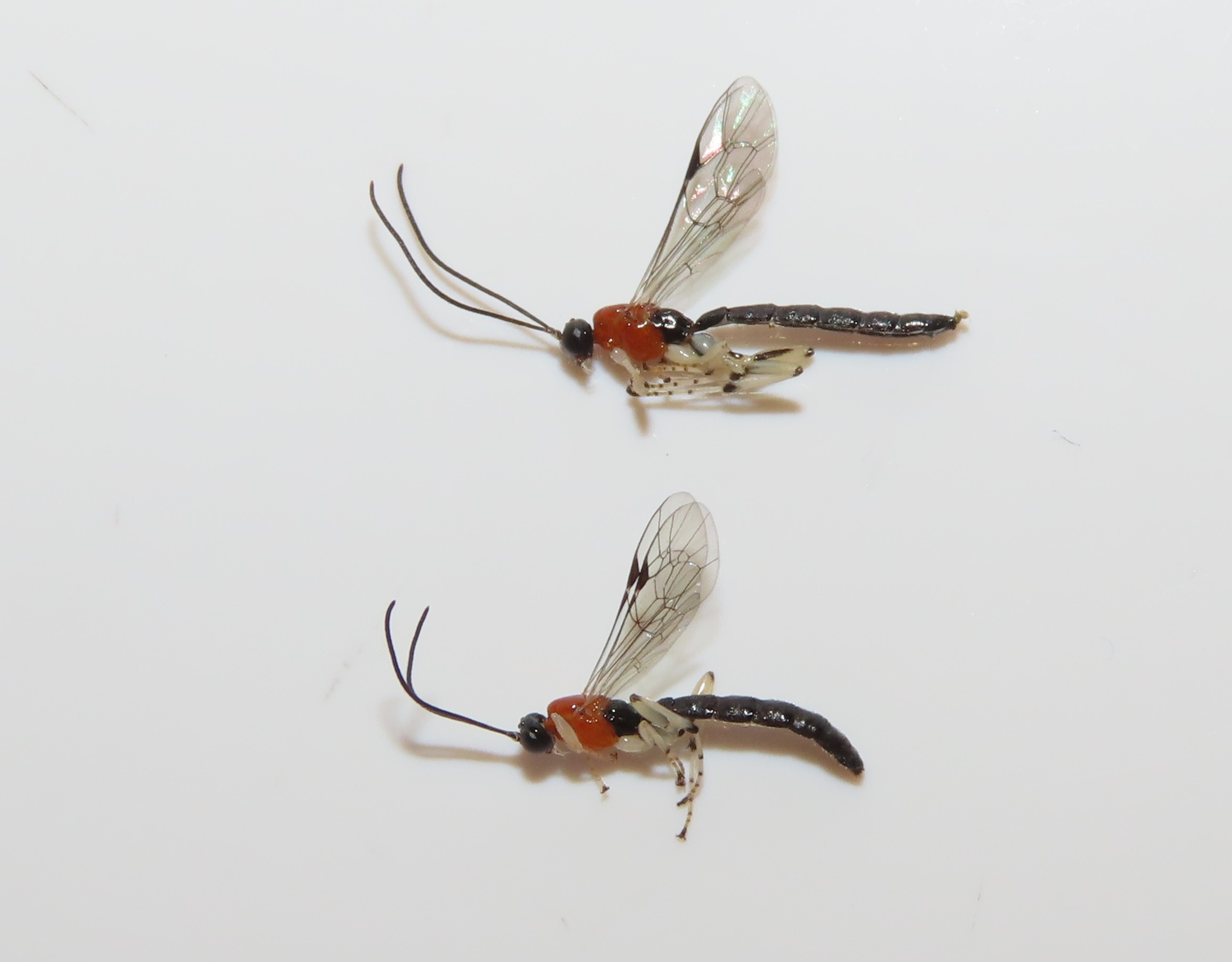
My partner, Heidi, and I went on a vacation in late October. When we returned, I was amazed to find a live female ichneumon wasp, one nearly deceased male, and one deceased male, inside the container with the Polistes nest. The insect was not one of the species that is a known parasitoid of paper wasps. I was able to identify it as Calliephialtes grapholithae, but that made no contextual sense. All of the known hosts for that species are caterpillars of moths.

Adult males of Calliephialtes grapholithae

Previously recorded hosts for C. grapholithae include larvae of the following Lepidoptera: Acrobasis betulella, (formerly A. hebescella), A. juglandis, A. rubrifasciella (recorded as A. nibrifasciella (Pyralidae: Phycitinae); Carmenta texana (Sesiidae: Sesiinae); Cydia caryana (recorded as Laspeyresia caryana, the Hickory Shuckworm, Tortricidae: Olethreutinae); Meskea dyspteraria (Thyrididae: Siculodinae); Periploca ceanothiella (recorded as Stagmatophora ceanothiella, Cosmopterigidae: Chrysopeleiinae); Thyridopteryx ephemeraeformis (Psychidae: Oiketicinae); Megalopyge opercularis, the Evergreen Bagworm (Megalopygidae). Most of these taxa represent a “concealed host,” such as the Evergreen Bagworm and Hickory Shuckworm.

The only way the association of C. grapholithae with paper wasps can be made is if there is a moth larva involved in some fashion. It so happens that there is. The Sooty-winged Chalcoela, Chalcoela iphitalis, is such a moth (Crambidae: Glaphyriinae). The caterpillar stage is predatory on the larvae of Polistes wasps, inside their nests. Webbing spun by the caterpillars is a clue to their presence. Apparently, the adult female moth approaches the nest at night, when the adult wasps are less alert. Still, she may lay her eggs on the back of the nest, and let her tiny larval offspring find their way into a cell.

Caterpillar of Chalcoela iphitalis from paper wasp nest

Sure enough, I happened to notice one of these moth caterpillars, strikingly similar to a paper wasp larva, in the bottom of the container with the nest and its other associates. There is little doubt in my mind that C. iphitalis is a host for the ichneumon wasp Calliephialtes grapholithae. The pattern of this wasp seeking concealed hosts fits, though how the wasp navigates a well-defended nest of paper wasps is beyond my imagination. I am hoping that such an infiltration can be documented, or that someone else will independently rear the ichneumon from a paper wasp nest. Until that time, I cannot assert, unequivocally, the host relationship.

Adult Chalcoela iphitalis moth

I also wonder if the sever drought experienced by eastern Kansas this past summer had anything to do with the proliferation of the moths that plague the paper wasps. I noticed more than usual. One of the two nests almost failed completely, though one of the foundress wasps may have died prematurely, slowing the nest’s rate of growth, eventually halting it.

Much remains to be discovered about even the most common of insects, especially when it comes to ecological relationships to other species. I urge my readers to undertake what observations and experiments they can to further enlighten our understanding of the natural world.

Sources: Carlson, Robert W. “Database of Hymenoptera in America north of Mexico,” Discover Life
Hoskins, Jonathan. 2021. “Species Calliephialtes grapholithae,” Bugguide.net
McCormac, Jim. 2017. “Wasp-eating moth fills rare niche,” Ohio Birds and Biodiversity
Calliephialtes grapholithae,” iNaturalist.org

Wednesday, August 31, 2022

Wasp Wednesday: Another Cricket Hunter, Lyroda subita

Crickets in the family Gryllidae are sufficiently diverse, and abundant enough, to be the target hosts for a variety of parasitoid wasps, especially those in the families Sphecidae and Crabronidae. There are previous posts about the Steel Blue Cricket Hunter, and the genus Liris, but here in eastern Kansas there is another player. Lyroda subita is easily confused with Liris, but the clue is in the "toes."

Like all of the larger cricket-hunting wasps, Lyroda is solitary, each female constructing her own nest, in this case an underground burrow. Whether she digs it herself is the subject of debate. At least some observations indicate the wasps use the abandoned burrows of other solitary wasps rather than excavating a nest themselves. The tunnel of Lyroda subita can be fifteen to thirty centimeters below the surface of the ground. There may be only one cell, or two. Historical records are rather scant.

The female hunts almost exclusively crickets of the family Gryllidae, both adults and immatures (nymphs). She subdues her quarry with a paralyzing sting in a nerve center that renders the victim limp. Transporting such a bulky insect is no problem for the agile wasp. She slings it beneath herself, grasps the cricket's antennae in her mandibles, and away she goes. She can run over the ground with it, but can also glide or even fly with it. Multiple crickets are used to provision a single cell, after which she lays an egg on the last cricket, seals the cell, and then repeats the entire process.

There is at least one record of L. subita using a different host: a pygmy mole cricket of the family Tridactylidae. Since these are mostly subterranean orthopterans, and not that closely related to crickets, the how and why of this anomaly remains unanswered. Other species of Lyroda from other parts of the world are known to use pygmy grasshoppers, family Tetrigidae, as hosts, and those insects occupy similar micro-habitats as pygmy mole crickets. Maybe it is a matter of what is available in a given habitat, then. Pygmy mole crickets and pygmy grasshoppers occur mostly in wet or damp situations along stream banks.

In our Leavenworth, Kansas yard, there are large numbers of Gryllus field crickets, and ground crickets of the subfamily Nemobiinae, offering Lyroda plenty of options.

L. subita is a medium-sized insect. Females range from 10-13 millimeters in body length, males slightly smaller at 6-10 millimeters. Both sexes are slate gray in color with silver highlights, especially on the abdomen. In the right light it can appear the abdomen is banded in dark gray and white. The ocelli, a trio of simple eyes on the crown of the head, between the compound eyes, are present. The most easily observed feature is on each "foot." The last tarsal segment bears a very large pad called an arolium (plural arolia), which differs markedly from the petite feet of the nearly identical Liris genus. Liris also has only a single mid-ocellus, the lateral simple eyes being reduced to longitudinal scars.

This species occurs throughout most of the United States (except for Washington, Oregon and the southwest states), southern Canada, the northern half of Mexico, and also Cuba and Hispaniola. There are twenty-one other species of Lyroda, most of which are found in southeast Asia, plus Africa, Australia, and South America.

Sources: Kurczewski, Frank E., and Margery G. Spofford. 1985. "A New Host Family for Lyroda subita (Hymenoptera: Sphecidae)," The Great Lakes Entomologist 18(3): 113-114.
Bohart, R.M. and A.S. Menke. 1976. Sphecid Wasps of the World: A Generic Revision. Berkeley: University of California Press. 695 pp.
Elliott, Lynette, et al. 2006. "Species Lyroda subita," Bugguide.net
Khvir, Viktor I., and Wojciech J. Pulawski. 2020. "A Revision of New World Lyroda Say, 1837 (Hymenoptera: Crabronidae)," Proceedings of the California Academy of Sciences Series 4, Volume 66, nol 13: 315-330.

Wednesday, August 17, 2022

Wasp Wednesday: Aulacids

Pristaulacus fasciatus female

Sometimes an unfortunate event yields something interesting later. More on that in a minute. Aulacid wasps are seldom seen, but also often overlooked due to their superficial resemblance to ichneumon wasps. They are found in similar situations as ichneumons, and behave similarly. Two genera and 185 species make up the family Aulacidae, and they collectively occur on all continents except Antarctica. There are thirty-two species in North America.

At 3 AM on June 1, 2022, a massive limb broke off of the Pin Oak tree in our front yard in Leavenworth, Kansas, USA. It apparently hit the ground before striking our house, but it did enough damage to require a new roof and gutters. Removal of the limb took place later that day, and I had the service that did the work leave the log sections in a pile around the base of the tree, where they sit currently. The least I could get out of this minor tragedy would be some interesting insects.

A female Chrysobothris sp. jewel beetle. Her larval offspring are potential hosts for aulacids.

Cut, living wood emits aromatic compounds that attract insects eager to exploit the resource. These include wood-boring beetles in the families Cerambycidae (longhorned beetles), and Buprestidae (jewel beetles or metallic wood-boring beetles) that lay their eggs in bark crevices. The beetle larvae that hatch then bore into the wood. In turn, the parasitoids of these beetles arrive. Aulacid wasps are known to be parasitoids of these beetles, especially the larvae of the longhorned beetles, as well as larval wood wasps in the family Xiphydriidae.

Another potential host for aulacids: Graphisurus fasciatus, a longhorned beetle.

I had collected aulacids in Cincinnati, Ohio when I lived there, and those specimens now reside with the rest of my collection at the Denver Museum of Nature and Science. I had not photographed any, except for one specimen of Pristaulacus rufitarsis in Colorado. I had the good fortune of getting permission to look for insects at a slash pile of freshly-cut pine in Black Forest, just north of Colorado Springs.

Pristaulacus rufitarsis female in Colorado, USA

Here in Kansas, on the western-most fringe of the eastern deciduous forest, I was not sure whether these wasps would occur here. I was delighted to finally spot a female of Pristaulacus fasciatus on the pile of logs in our front yard in late July. Since then, through mid-August, I have seen at least three specimens, and finally managed to get respectable images. All have been females. Perhaps mating takes place away from the logs and trees that the females scour for evidence of their intended hosts.

It has been interesting observing these wasps. They walk haltingly across the logs, bobbing their abdomens slightly, and slowly rowing their wings, which is enough to give one cause to think they might be stinging spider wasps. Indeed, Pristaulacus fasciatus may be part of a small mimicry ring, which I’ll address in a future post.
I notice that the female wasp probes every crack and crevice by inserting her antennae deeply into it, perhaps divining the location of a host that way. Once she locates a victim, she commences ovipositing. Grooves on the inner surface of her hind coxae (basal-most segments, connected directly to her thorax, help guide and stabilize her thin ovipositor as she inserts it.

Her ovipositor is entering the wood between her hind leg and middle leg.

Aulacids are identified by the attachment of the abdomen high on the thorax, a short “neck” behind the head, and a somewhat sinuous, not straight, ovipositor. The first two characters reveal the relationship of aulacids to ensign wasps and carrot wasps under the umbrella superfamily Evanoidea. Aulacus is the other genus, with species typically a bit smaller than Pristaulacus. Females of P. fasciatus have a body length averaging around 16 millimeters, while males are slightly smaller at 13 millimeters. They are conspicuous insects, easily spotted but only in these unusual situations.

Look for P. fasciatus from eastern Texas and Nebraska eastward, though it appears absent from most of the southeast U.S. and Canada. There is one record in New Mexico on iNaturalist.

Sources: Eaton, Eric R. 2021. Wasps: The Astonishing Diversity of a Misunderstood Insect. Princeton, NJ: Princeton University Press. 256 pp.
Smith, David R. 1996. “Aulacidae (Hymenoptera) in the Mid-Atlantic States, With a Key to Species of Eastern North America,” Proc. Entomol. Soc. Wash. 98(2): 274-291.