Thursday, June 16, 2022

OrThoptera Thursday: Eastern Ant Cricket

Between allergies to grass pollen, windy and/or stormy weather, and periodic depression, I have not been getting out in the field very often lately. Consequently, I was delighted when an unusual insect came to me. Leaving our bathroom for our bedroom the other night, I caught movement out of the corner of my eye. A small insect was running along the edge of the bathtub. My initial thought was "oh, shoot, a cockroach nymph." Closer examination revealed it to be something much more exciting and not at all a pest.

It was an adult male Eastern Ant Cricket, Myrmecophilus pergandei. How it came to be in our bathroom I have no idea. This species, like others in its genus, is supposed to be found almost exclusively in association with ants. Ironically, ants may consider these diminutive crickets to be pests inside their colonies.

Myrmecophilus have been observed actively "licking" ants, and the walls of underground ant nests, presumably feeding on oily secretions from their hosts' exoskeletons. The ants barely tolerate this unwanted attention, and may attack or even kill and eat the crickets. Still, the cricketes are remarkably agile, able to run away quickly from danger. I was surprised that I managed to successfully usher this one into a vial so I could take better images in the casserole dish that is our "studio" for insect and spider subjects.

Carpenter ant, a potential host species for our ant cricket

Ant crickets vary in size, usually in accordance with the host ant species, but none exceed 4.7 millimeters. The smallest adult specimens recorded measured less than 1.5 millimeters.The one imaged here is a relative giant. I suspect it may have come from a nest of carpenter ants, of which we have several around our home, one satellite nest in the frame of our back door, not terribly far from the exterior wall of the bathroom.

Among their adaptations to life in subterranean ant colonies, ant crickets have no ocelli (simple eyes), and their compound eyes are reduced to a small collection of facets. What they lack in vision they make up for with long, sensitive antennae. They also have oversized cerci, the pair of flared, tail-like appendages at the rear of the abdomen. The cerci are covered in sensory hairs that, as in roaches, other crickets, and related orthopterans, detect otherwise imperceptible air currents generated by approaching predators.

Eastern Ant Cricket is found from Maryland south to Florida, and west to southern Iowa, eastern Kansas, Oklahoma, and Texas, but there are recent records from New York and New England. There may be other species where you live. Oregon Ant Cricket, Myrmecophilus oregonensis, ranges west of the Cascade Mountains from southern British Columbia through Oregon and Washington, and most of California. Mann's Ant Cricket, M. manni, has a similar range, but from southern Washington state through Oregon, California, most of Nevada, and Arizona. Nebraska Ant Cricket, M. nebrascensis, occurs from southern California to Texas, and north through eastern Colorado, and most of Nebraska, Kansas, and Oklahoma.

Sources: Capinera, John L., Ralph D. Scott, and Thomas J. Walker. 2004. Field Guide to Grasshoppers, Katydids, and Crickets of the United States. Ithaca, New York: Cornell University Press. 249 pp.
Bugguide

Wednesday, June 15, 2022

Wasp Wednesday: Walden's Mason Wasp, Ancistrocerus waldenii

Guest post by Heather Holm

The Vespidae subfamily Eumeninae includes primarily solitary wasps that nest aboveground in pre-existing cavities (hollow stems or brambles, holes in wood) or in free-form mud nests. One morphological trait eumenines share with the social wasps also in the family Vespidae, is wings that fold longitudinally. Eumenines (potter and mason wasps) are generally black with white, rusty orange, and/or yellow markings. In the southeastern United States, some species have very prominent red markings and in some instances, these red markings replace the white or yellow markings of northern populations. Generally, eumenines hunt various families of moth larvae (caterpillars) although a minority prey on beetle larvae.

Potter and mason wasps use mud to line, partition, or construct their solitary nests. For those that nest in pre-existing cavities, partitioning the cavity with mud results in individual cells or rooms in which a single larva develops as it feeds on the cache of prey provided by their mother. Free-form mud nests are either single-celled (ex. potter wasps in the genus Eumenes) or contain multiple cells, comprised of multiple cells adjoining one another.

Video 1 caption: A female works the wet mud bolus with her mandibles to add an additional layer of mud to the edge of a partially completed cell.

For those mason or potter wasp species that construct free-form mud nests, a significant amount of time and energy is allocated toward water and soil collection to make mud. Mud is used to make one or multiple cells/enclosures that house a number of caterpillars, and eventually the developing wasp larva. To make mud, the wasp female first finds a water source, imbibes the water storing it in her crop, then searches for the perfect soil type to begin collecting soil particles. Each mason wasp can have their own unique soil preferences, some preferring sand, while others may seek out sandy loam soil. Perching on the ground, she scrapes and gathers a ball of soil particles in her mandibles and simultaneously regurgitates some water to form a mud bolus. When the bolus is sufficiently moistened and large enough, she carries it back to the nest held in her mandibles.

A female spends the night in a newly formed mud cylinder/cell. She’ll complete construction and provisioning of the cell the following day.

This month in my garden, I found a Walden's mason wasp female (Ancistrocerus waldenii) constructing a free-form mud nest on the side of a rock. This wasp species prefers to construct its nest attached to a hard surface such as a rock, concrete, or even on the side of a terra cotta flower pot! The rock in my garden that she selected has multiple concave indentations; these convenient divots helped form the back wall of the mud cells. After selecting the nest site, nest initiation begins with the construction of a single mud cylinder, and each layer of mud that forms the cylinder requires several mud-collection foraging trips. Once the cylinder-shaped cell is large enough to hold several moth caterpillars, the wasp female lays a single egg, suspended from the roof of the cell by a silken thread. Many solitary wasps lay their egg on one of the prey cached in the cell after they have fully provisioned the cell; eumenids, however, typically lay their egg in an empty cell prior to provisioning the cell with prey.

A closeup of an Ancistrocerus waldenii female peering out of an incomplete mud cylinder. This unfinished cell provides a convenient enclosure for her to spend the night, rest, or avoid inclement weather.

Providing food for her future developing larva comes next. She hunts for moth caterpillars on plant foliage, captures one, stings it to cause paralysis, then carries the caterpillar clutched beneath her. She fills the cylinder with multiple immobilized caterpillars, an average of nine, seals off the end of the cylindrical cell with mud, then begins the construction of the next, adjoining mud cylinder. Her egg, safely suspended from the roof of the cell, will hatch in the next few days and the tiny, first instar larva will drop onto the cache of caterpillars and begin feeding. The venom that paralyzed the caterpillars also keeps them alive for several days, long enough for the developing wasp to have a fresh and live supply of food while it develops.

An Ancistrocerus waldenii female returns to her nest with a bolus of mud held clasped in her mandibles. She is adding an additional layer of mud over multiple fully provisioned cells.

An Ancistrocerus waldenii nest can have multiple mud cylinders/cells, constructed adjoining or on top of one another. After all of the cylinders are complete and provisioned with prey, the female adds an additional thick layer of mud over the entire nest to help seal it off from predators and help prevent the nest from breaking down before the wasps inside emerge as adults.

Here are a few tips for identifying Ancistrocerus waldenii females although if you find a similarly-constructed mud nest attached to a hard surface, that will help narrow down your identification to a few species. Wasps in the genus Ancistrocerus have a prominent transverse carina [ridge] on the base of their first abdominal segment (T1, for tergum one, the first visible dorsal plate). Ancistrocerus waldenii has white (less often yellow) markings. The female has a spot on the top of the sixth abdominal segment (T6) and complete apical bands on the first through fifth abdominal segments (T1 to T5). The female also has entirely black antennae (many mason wasps have yellow or white markings on the underside their antennal scape [first long segment of the antenna, nearest face]).

Be sure to visit Pollination Press, LLC, Heather's publisher, and shop for her books. Her book on wasps is a fine complement to my own; and who doesn't need another guide to native bees? Thank you, Heather, for agreeing to do this guest post.

Friday, June 10, 2022

Thoh-Dah Prairie Bioblitz

Last weekend, June 4-5, my wife and I had the opportunity and honor to participate in a bioblitz of a newly-acquired property of the Missouri Prairie Foundation. Thoh-Dah Prairie is located in St. Clair County, Missouri, U.S.A., and is named for the Osage word for “peace” or “peaceful.” Indeed, it is an idyllic landscape.

Copyright Heidi Eaton

According to MPF, colonialism has been positively brutal to prairies in Missouri. Pre-settlement prairie amounted to roughly fifteen million acres. Today, only about 51,000 acres remain, in scattered patches that are at best tiny refuges of native grasslands. Given the scarcity of such a unique ecosystem, Heidi and I were eager to discover what insects live there.

Carol Davit addresses the crowd before the dedication

An enormous tent was set up to accommodate everyone, and several parties also erected their own camping tents to spend the night. Plenty of resources were provided by MPF, and memberships and merchandise were available for sale along with free publications from Missouri Depart of Conservation.

Ready for the ribbon cutting

The event was kicked off with a ribbon-cutting ceremony to dedicate the parcel, now preserved indefinitely thanks to the generosity of the family that managed hayfields there for generations. We immediately took to exploring, and were amazed by the floral diversity alone. Most of the plants we saw would not be found in your average vacant, neglected field. Many are endemic only to this kind of prairie.

Carolina Rose

New Jersey Tea

Sensitive Briar and Tickseed Coreopsis

Painted-cup Paintbrush

Most of the area we covered in our survey of organisms was subjected to a prescribed burn in autumn of last year. You could scarcely tell, as it was lush and green. Dickcissels and Grasshopper Sparrows called from all directions. Swallows frolicked low over the grasses. The skies remained overcast almost the entire time, and there was a brief, late afternoon shower, but we still found plenty of insects.

Clay-colored Leaf Beetle

Following an afternoon of hiking the gentle slopes, we were treated to a potluck. Each party brought a dish, but some of the MPF personnel fried up some fish, and also cooked quail and venison. There were plenty of salads and desserts, including homemade ice cream. Now that is how you do a proper bioblitz.

Bioblitzing makes you hungry....

....and tired
(photo used with permission)

After dark, a sheet and blacklight were set up. Despite the cooling effect of the earlier rain, several interesting species flew in.

Coffee-loving Pyrausta moth

Pyrgotid fly, Pyrgota undata

Firefly, Photuris sp.

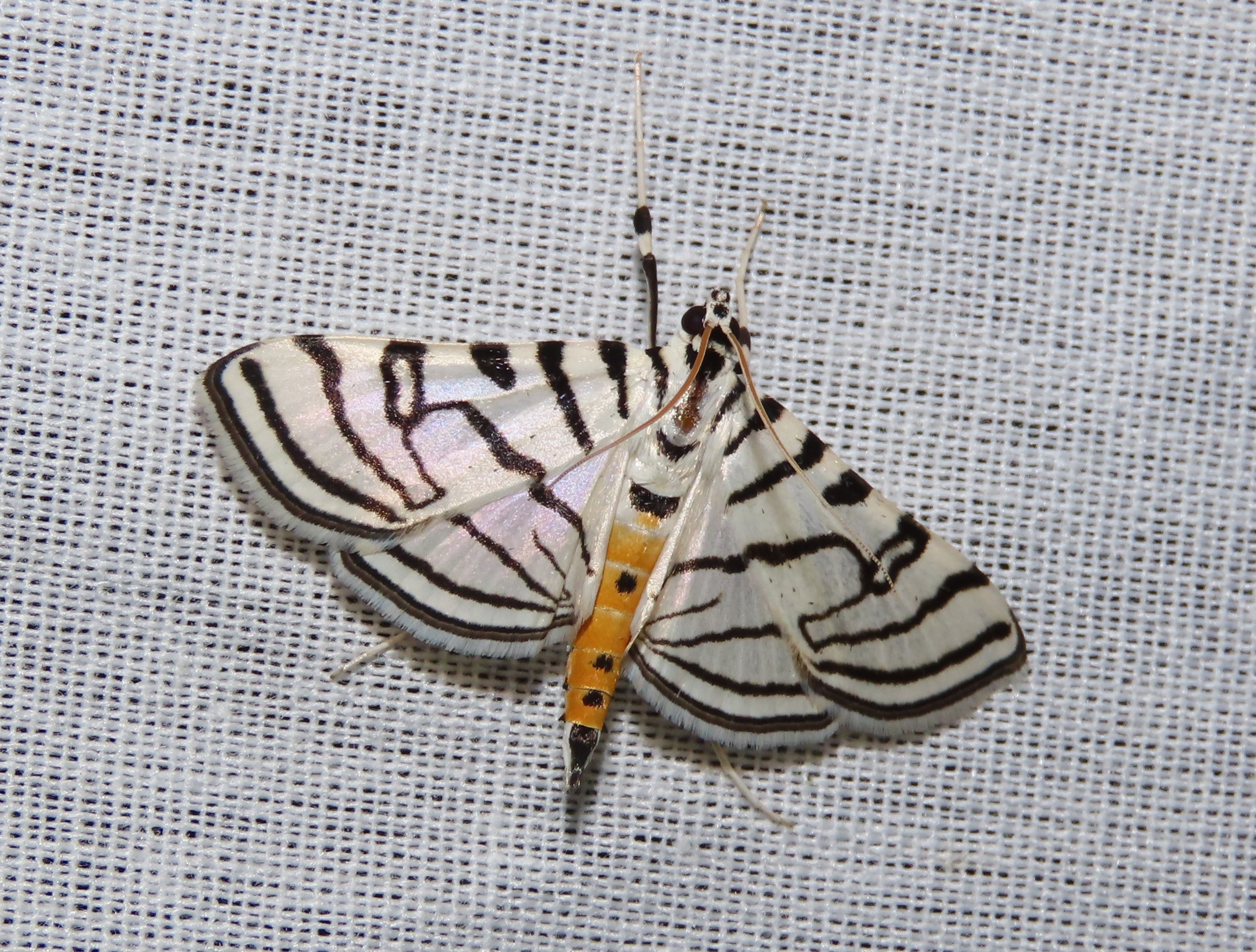
Zebra Conchylodes moth

Sunday, we explored in a different direction, making use of the mown paths that provided avenues for the many, enthusiastic bioblitz participants. Prairies are not all dry and dusty, we learned! There were several wet, boggy areas that proved to be almost entirely different habitats from the surrounding hills that drained into them.

Striped Lynx Spider

A couple of “tree islands,” thick stands of trees and/or shrubs, offered yet another kind of habitat. One larger group of trees surrounded a large pond that we could not comfortably access. The edges of those tree islands were perhaps richer in insect fauna, but such ecotones are well-known for higher diversity.

Azure Bluet damselfly

We got a little carried away, and by the time we returned to “base camp” a little after noon, we found the tent deserted. We are already looking forward to making another trip there to see how the area changes with the seasons, and contribute more data to the MDF for use in education and conservation.

That's all, folks!

Heidi took so many great photos that you can look forward to another blog post of images and captions alone. Meanwhile, please consider membership in the Missouri Prairie Foundation. It has a long, strong record to success stretching over 56 years (since 1966).

Besides identifying, acquiring, and managing remnant prairies such as Thoh-Dah, MDF also encourages rewilding of your own property through the Grow Native! project. This is one of the resources we are using to begin converting our own lawnscape into something much more compatible with the native landscape.

Goat's Rue

Many thanks go to Carol Davit, Executive Director of MPF, Jerod Huebner, Director of Prairie Management, and Erika Van Vranken, Special Projects Coordinator, and Sarah Hinman, board Secretary, for making this event such a success. These are empathetic and appreciative people.

Sunday, June 5, 2022

Wh-a-a-a-t? Another Red Spider?!

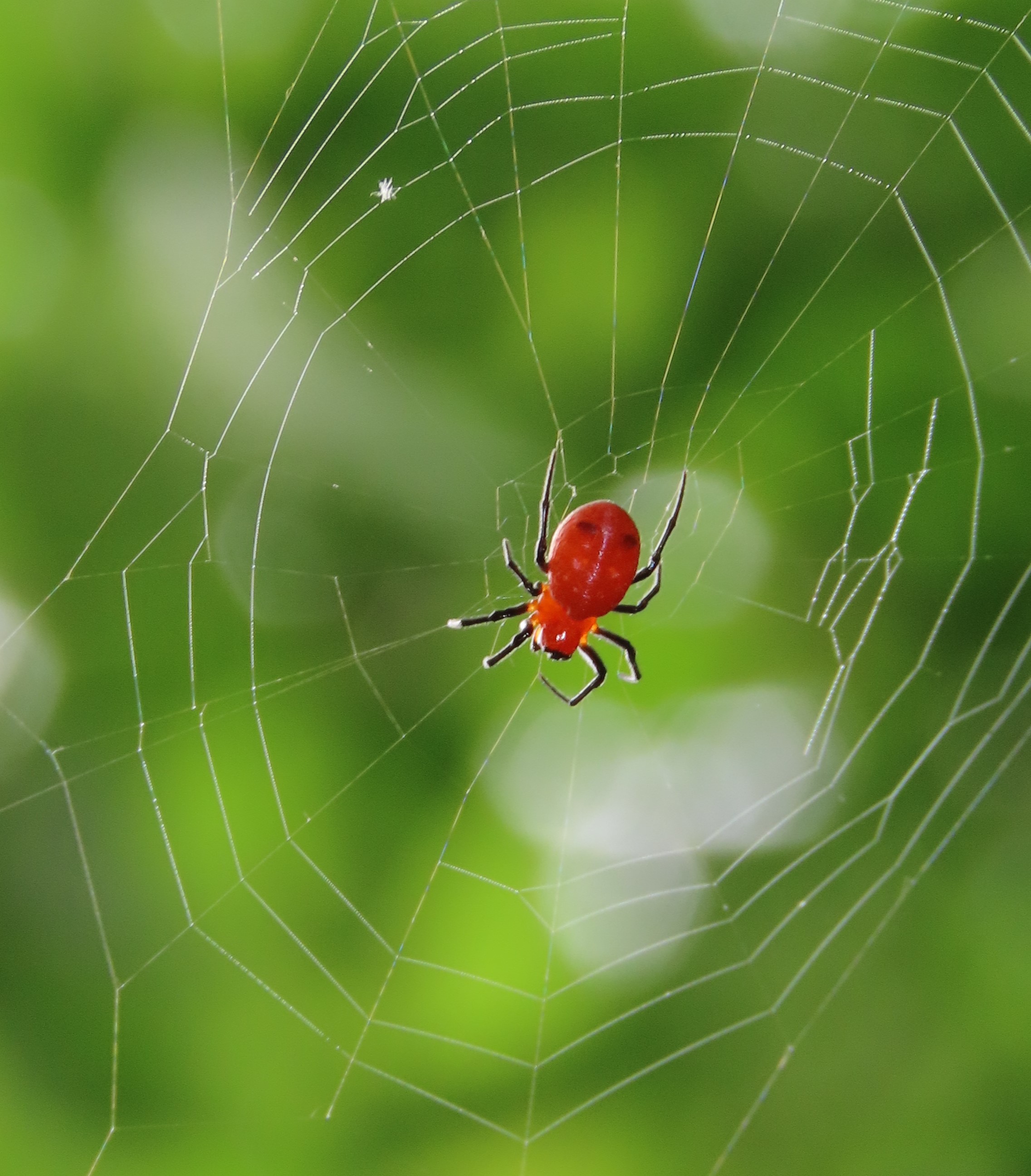
I am seeing a theme developing here. Last week I posted about a lovely little red spider I found in our back yard. Today, I bring you a slightly larger red spider that I spied at Graham Cave State Park in Missouri, USA. This one, Hypsosinga rubens, is an orbweaver, but because it spins its web in a horizontal plane, I initially mistook it for a female of the Scarlet Sheetweb Weaver.

A friend who was with me at the time I saw this diminutive beauty commented that she sees them all the time, and calls them "tomato spiders" because of their bright red color. Well, at only 7.4-8.7 millimeters in body length, maybe *cherry* tomato spider is a better name. The only common name I find is Rubens Orbweaver. Males of this species are smaller still, 6-6.5 millimeters, and they usually have a black abdomen.

There is great variability in color and pattern, or lack thereof, and a typical female from Florida has a white abdomen with small black markings. The Rubens Orbweaver occurs over most of eastern North America, but there are scattered records from the Prairie Provinces in Canada.

Beyond the bright color of this spider, the thing that surprised me was how ridiculously small its web was, stretched between a couple of leaves on a shrub at a little over waist-height. I expected her to drop out of the web if I approached too close or moved suddenly, but she stayed put in the hub of her snare. Information in the literature indicates that they may also shelter under bark on trees, or tuck themselves under leaf litter. I found mine along a forest edge, and forests are their preferred habitat.

Sources: Bradley, Richard A. 2013. Common Spiders of North America. Berkeley: University of California Press. 271 pp.
Hollenbeck, Jeff. 2007. "Species Hypsosinga rubens," Bugguide.net