Showing posts with label Missouri. Show all posts

Wednesday, August 12, 2026

Jewel Beetle Spring

As I write this, Leavenworth, Kansas, USA, is under an (checks notes) “extreme heat warning,” expected to last for another two days at least. It has been an excessively hot summer, and I am recounting memories from spring more than I am making new discoveries. One thing that stands out was the diversity of jewel beetles, family Buprestidae, that I found during the month of May this year.

Blue Spotwood Borer, Agrilus acutipennis

Jewel beetles are also known as metallic woodborers for their often brilliant, iridescent colors; and called flathead borers for the flattened larval stage. The adult beetles are frequently alert, dashing or flying away at the first hint of potential danger, making them a challenge to photograph. Others are exceptionally cryptic, relying on camouflage and stillness to avoid detection in the first place. Some species exhibit all of these characteristics and behaviors.

Emerald Ash Borer from May 30, 2021, Leavenworth, Kansas.

Yes, some species can be pests, namely the Emerald Ash Borer, Agrilus planipennis, but that is a species native to east Asia. It is extremely problematic where it has been introduced. Most jewel beetle species are kept in check by parasitoid wasps, predatory beetles, and other natural controls.

Unidentified Agrilus sp. from Weston Bend State Park, Missouri.

On May 4, Heidi and I went across the river to Weston Bend State Park in Missouri, one of our favorite haunts during spring bird migration. It turned out to be pretty good for insects, too, including some jewel beetles. I spotted one of the many species of the genus Agrilus that can be found in our neck of the woods. These are small, usually well under ten millimeters, very narrow and elongate, and more often than not have muted colors. They are most often seen on foliage in sunny spots in the forest understory, or along forest edges.

Texania campestris, Weston Bend State Park, Missouri.

Heidi, while taking pictures of moss or mushrooms on a stump, suddenly exclaimed that she saw a huge buprestid. Indeed, she found a big specimen of the Hardwood Heartwood Buprestid, Texania campestris. It is very likely the largest species of jewel beetle in our immediate area, ranging from 20-30 millimeters. It can be confused with the pine-boring genus Chalcophora that is found elsewhere in Missouri.

Texania campestris

T. campestris occurs east of the Great Plains, but is more common in the southern U.S. than elsewhere. Known host plants for the larvae include American Beech, American Sycamore, maples, and Black Willow.

Texania campestris

Closer to home, I visited Havens Park here in Leavenworth, on May 13. It is the closest thing to a “wild” park within walking distance. It is a hilly park, at the top of which is something of a plateau. There, at the summit, more or less, is a degraded glade habitat, more xeric than the surrounding forest, dominated by Eastern Redcedar, and some of the hardier oaks.

Blue Spotwood Borer, Leavenworth, Kansas.

I found a handful of jewel beetles flying around, and landing on, some oak saplings in one sunny spot. They turned out to be the Blue Spotwood Borer, Agrilus acutipennis, infrequently to rarely collected, according to one recent source. This is a spectacular species for the genus, at 7-10 millimeters in length, and vivid metallic blue with white scales highlighting the edges of the pronotum (top of thorax), and the sides and venter of the abdomen.

Blue Spotwood Borer

The Blue Spotwood Borer is found east of the Great Plains, well into Canada. Larvae are known to bore in Eastern White Oak, and Overcup Oak, but the adult beetles alight on all kinds of other oaks, hickories, and walnut.

Brachys ovatus, Havens Park, Leavenworth, Kansas.

In contrast to that showy species, I also noticed a Brachys ovatus, doing its best impression of a dried-up leaf edge. At only 4-7 millimeters, it is easily overlooked despite how relatively common it is, throughout eastern North America. Oddly, males of this species are rarely seen, and it may reproduce by parthenogenesis. Larvae bore in Northern Red Oak.

Common Hackberry Agrilus, Havens Park, Leavenworth, Kansas.

I also found an unusually lethargic Common Hackberry Agrilus, Agrilus lecontei, also on an oak leaf. I thought it might even be dead, a victim of a robber fly or other predator. I collected it into a vial, and by the time I got home it was apparent it was very much alive.

Common Hackberry Agrilus alive and well!

This is another small (4-7 mm) species that is supposedly uncommon, despite its widespread distribution east of the Great Plains.

Redbud Borer, Leavenworth, Kansas.

We have several Eastern Redbud trees “volunteering” in our yards, so it was not surprising to discover a Redbud Borer, Ptosima gibbicollis, on one of them on May 18.These little beetles are only 4-7 millimeters, but black with bright yellow markings, so they are easy to see.

Redbud Borer

On May 20, I was surprised and delighted to spot a Two-lined Chestnut Borer, Agrilus bilineatus, on a leaf near our front steps.

Two-lined Chestnut Borer, Leavenworth, Kansas.

Despite the name, this beetle uses a variety of oak species as host trees. It is a widespread and common species east of the Great Plains, but this is the first time I have seen one. It is 4-10 millimeters long.

Two-lined Chestnut Borer

I walk our neighborhood regularly, weather permitting, but on May 22 I took only my phone with me. Naturally, I found a lovely specimen of Anthaxia cyanella on a leaf in a hedge adjacent to an open field.

Anthaxia cyanella, Leavenworth, Kansas.

This brilliant blue beetle is only 4-5 millimeters long, and is apparently infrequently encountered. Larvae are known to bore in Eastern Redbud, Honeylocust, Downy Serviceberry, and River Birch. Adult Anthaxia species in general are usually seen on flowers, especially composites.

Beech Borer, Leavenworth, Kansas.

On May 26, once again with only my phone at hand, I noticed a Beech Borer, Agrilus obsoletoguttatus, in the little butterfly garden along one exterior wall of our local library.

Beech Borer from blacklighting in Leavenworth on June 10, 2021.

This beetle, 4-8 millimeters in length, is quite common east of the Great Plains. Larval host trees include Dwarf Chinkapin Oak, Northern Red Oak, Ohio Buckeye, Eastern Hophornbeam, and Honeylocust, among others.

Heidi and I hiked the VA Trails, another mostly wild park along the Missouri River on the Kansas side here in Leavenworth, on May 27. I didn’t see any jewel beetles until we came back to the parking lot and I noticed a large, recently-downed limb of an oak tree about fifty yards away.

Chrysobothris sp., VA Trails, Leavenworth, Kansas.

Storm damage provides woodboring beetles of all sorts with fresh resources that they quickly locate and oviposit into. Among the more reliable arrivals will be jewel beetles in the genus Chrysobothris. The bad news is that they all look very similar and are extremely challenging to identify.

Sure enough, I found several of these cryptic gems running over the bark of the tree limb. The Chrysobothris femorata species complex is probably what this one falls under. The species is named the Flatheaded Appletree Borer, but there is a wide range of deciduous trees used as hosts. These are probably opportunistic generalists that take advantage of storm damage and logging operations. Chrysobothris are midsize jewel beetles, ranging from 7-16 millimeters in this particular instance.

Chrysobothris sp. Males thump their butts on the log to get the attention of females.

Jewel beetles can be found during most of the warmer months, but spring, even early spring, is perhaps the best time to be looking for them. They are well worth pursuing, and you can help add to our collective scientific knowledge by sharing your observations on iNaturalist, Bugguide, and elsewhere. Happy Hunting!

OK, BYE-E-E-E!

Sources: Paiero, Sten M., et al. 2012. Field Guide to the Jewel Beetles (Coleoptera: Buprestidae) of Northeastern North America. Canadian Food Inspection Agency. 411 pp.
Solomon, J.D. 1995. Guide to Insect Borers of North American Broadleaf Trees and Shrubs. Agriculture Handbook 706. Washington, DC: U.S. Department of Agriculture, Forest Service. 735 pp.

Friday, June 10, 2022

Thoh-Dah Prairie Bioblitz

Last weekend, June 4-5, my wife and I had the opportunity and honor to participate in a bioblitz of a newly-acquired property of the Missouri Prairie Foundation. Thoh-Dah Prairie is located in St. Clair County, Missouri, U.S.A., and is named for the Osage word for “peace” or “peaceful.” Indeed, it is an idyllic landscape.

Copyright Heidi Eaton

According to MPF, colonialism has been positively brutal to prairies in Missouri. Pre-settlement prairie amounted to roughly fifteen million acres. Today, only about 51,000 acres remain, in scattered patches that are at best tiny refuges of native grasslands. Given the scarcity of such a unique ecosystem, Heidi and I were eager to discover what insects live there.

Carol Davit addresses the crowd before the dedication

An enormous tent was set up to accommodate everyone, and several parties also erected their own camping tents to spend the night. Plenty of resources were provided by MPF, and memberships and merchandise were available for sale along with free publications from Missouri Depart of Conservation.

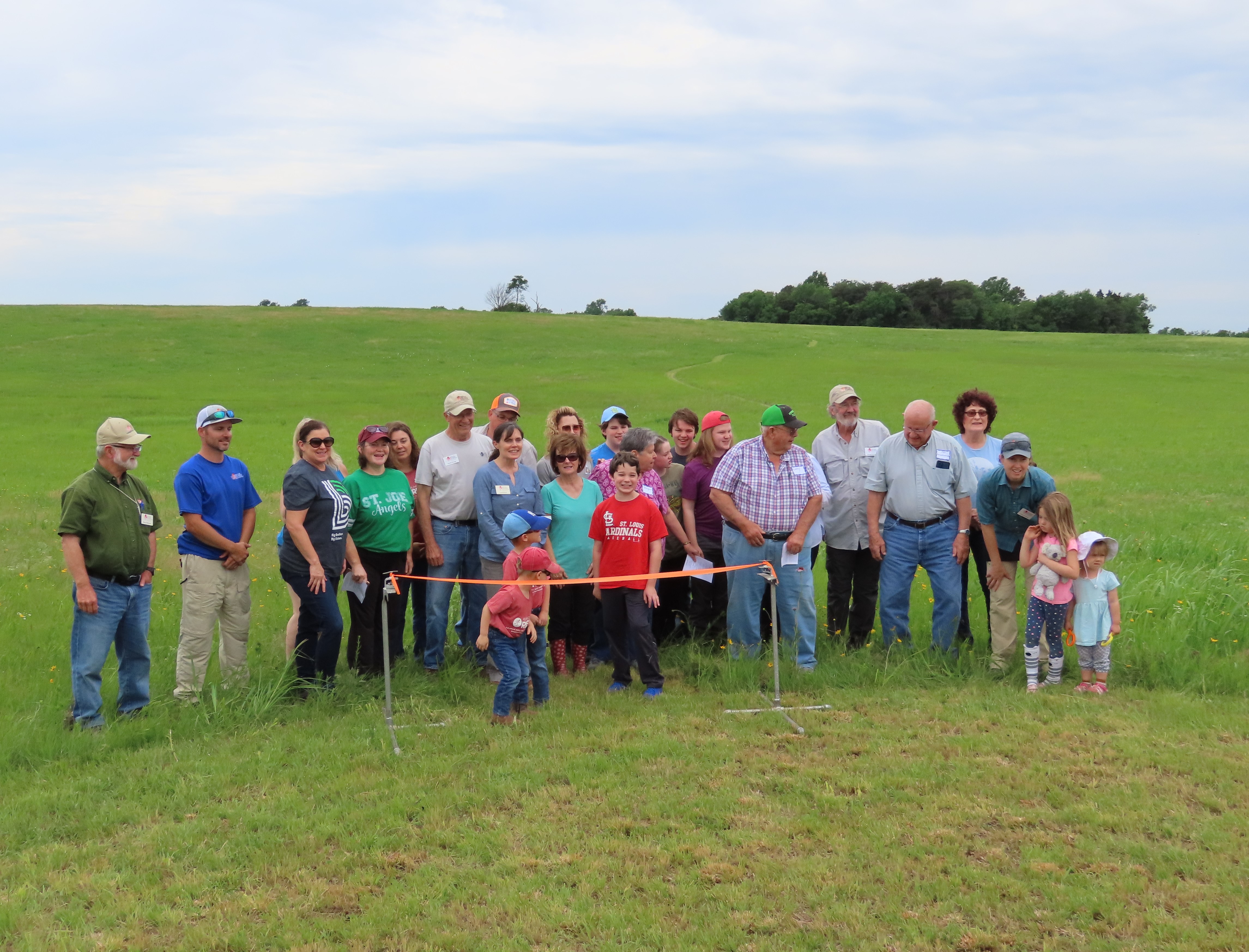
Ready for the ribbon cutting

The event was kicked off with a ribbon-cutting ceremony to dedicate the parcel, now preserved indefinitely thanks to the generosity of the family that managed hayfields there for generations. We immediately took to exploring, and were amazed by the floral diversity alone. Most of the plants we saw would not be found in your average vacant, neglected field. Many are endemic only to this kind of prairie.

Carolina Rose

New Jersey Tea

Sensitive Briar and Tickseed Coreopsis

Painted-cup Paintbrush

Most of the area we covered in our survey of organisms was subjected to a prescribed burn in autumn of last year. You could scarcely tell, as it was lush and green. Dickcissels and Grasshopper Sparrows called from all directions. Swallows frolicked low over the grasses. The skies remained overcast almost the entire time, and there was a brief, late afternoon shower, but we still found plenty of insects.

Clay-colored Leaf Beetle

Following an afternoon of hiking the gentle slopes, we were treated to a potluck. Each party brought a dish, but some of the MPF personnel fried up some fish, and also cooked quail and venison. There were plenty of salads and desserts, including homemade ice cream. Now that is how you do a proper bioblitz.

Bioblitzing makes you hungry....

....and tired
(photo used with permission)

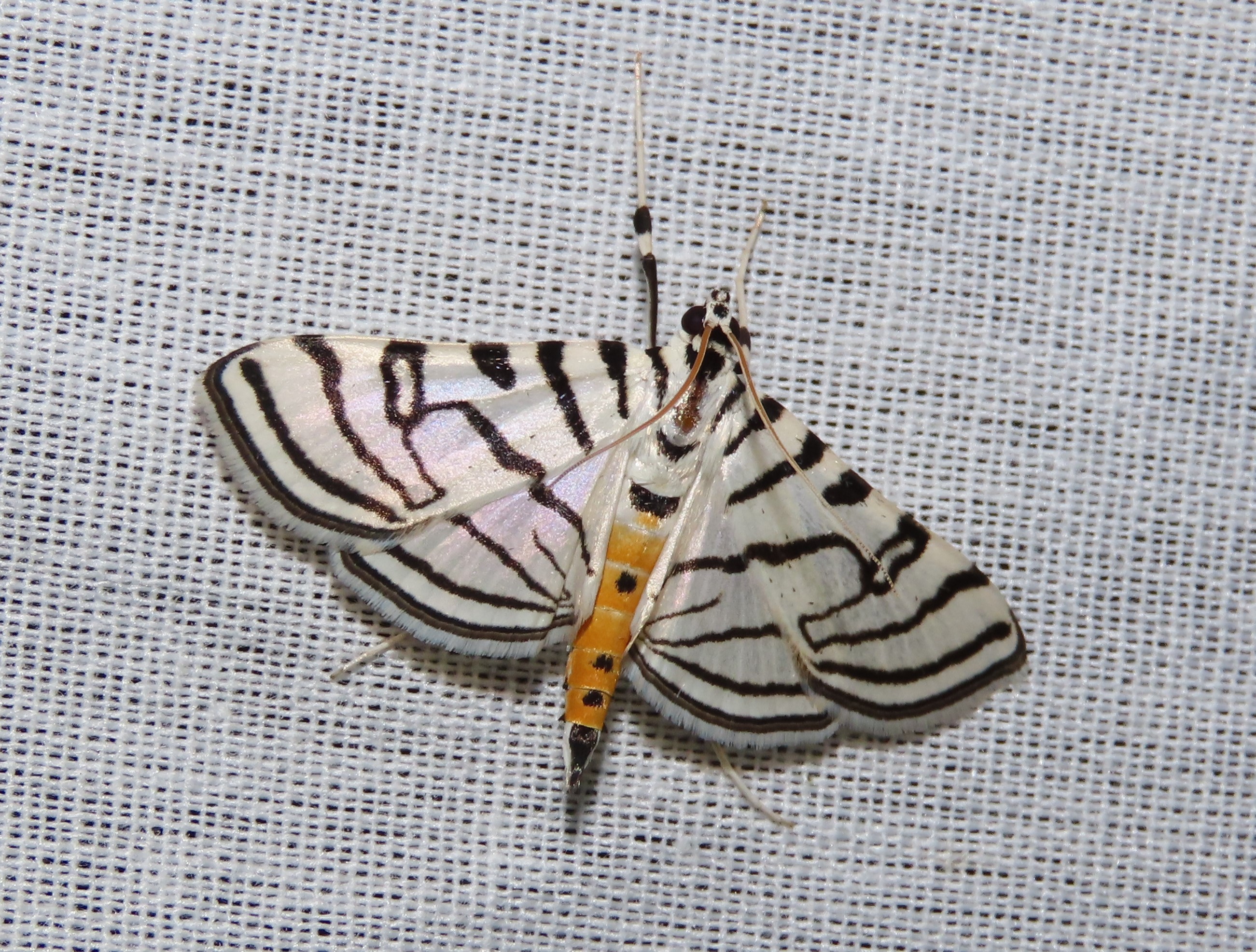
After dark, a sheet and blacklight were set up. Despite the cooling effect of the earlier rain, several interesting species flew in.

Coffee-loving Pyrausta moth

Pyrgotid fly, Pyrgota undata

Firefly, Photuris sp.

Zebra Conchylodes moth

Sunday, we explored in a different direction, making use of the mown paths that provided avenues for the many, enthusiastic bioblitz participants. Prairies are not all dry and dusty, we learned! There were several wet, boggy areas that proved to be almost entirely different habitats from the surrounding hills that drained into them.

Striped Lynx Spider

A couple of “tree islands,” thick stands of trees and/or shrubs, offered yet another kind of habitat. One larger group of trees surrounded a large pond that we could not comfortably access. The edges of those tree islands were perhaps richer in insect fauna, but such ecotones are well-known for higher diversity.

Azure Bluet damselfly

We got a little carried away, and by the time we returned to “base camp” a little after noon, we found the tent deserted. We are already looking forward to making another trip there to see how the area changes with the seasons, and contribute more data to the MDF for use in education and conservation.

That's all, folks!

Heidi took so many great photos that you can look forward to another blog post of images and captions alone. Meanwhile, please consider membership in the Missouri Prairie Foundation. It has a long, strong record to success stretching over 56 years (since 1966).

Besides identifying, acquiring, and managing remnant prairies such as Thoh-Dah, MDF also encourages rewilding of your own property through the Grow Native! project. This is one of the resources we are using to begin converting our own lawnscape into something much more compatible with the native landscape.

Goat's Rue

Many thanks go to Carol Davit, Executive Director of MPF, Jerod Huebner, Director of Prairie Management, and Erika Van Vranken, Special Projects Coordinator, and Sarah Hinman, board Secretary, for making this event such a success. These are empathetic and appreciative people.

Wednesday, May 22, 2013

Polistes metricus

Paper wasps tend to be quite variable in color and pattern, even within one species, so identifying them is not easy, even for experts. Case in point is differentiating the common Northern Paper Wasp, Polistes fuscatus, from the very similar Polistes metricus.

Dark specimens of the Northern Paper Wasp are nearly identical to Polistes metricus, a consistently dark species that I have found to be less abundant than P. fuscatus in areas where their geographic ranges overlap. One fairly reliable, if subtle, clue is the shape of the abdomen. Note that the abdomen of P. metricus is highly convex on the underside, creating a nearly acute angle with the underside of the petiole (stalk-like segment connecting abdomen with thorax). This is usually much less pronounced in P. fuscatus.

Another difference is in the face of the female wasps. Females of P. metricus have an almost completely red face, the black markings confined to the ocellar triangle. Ok, so what is an “ocellar triangle?” Most wasps have a trio of tiny, “simple” eyes at the top of the head, between the large compound eyes. These simple eyes are usually arranged in a triangular pattern. Females of the Northern Paper Wasp have the black marking extended from the ocelli to the base of the antennae. Males of both species have square, yellow faces.


Female P. fuscatus. Note black face; gently curved venter of abdomen

Female P. metricus. Note convex venter of abdomen.

Female P. metricus. Note all-red face.

Polistes metricus ranges from extreme southwestern Ontario and Maine south to Florida, and west to southern Ohio, Nebraska, Kansas, Oklahoma, and eastern Texas. The Northern Paper Wasp has a much larger geographic distribution.

I was fortunate enough to find three embryonic nests of P. metricus on a recent trip to Missouri. Two nests were under the exterior of a recessed door frame in Excelsior Springs. The other was under the roof of a sign and kiosk at Little Dixie Lake Conservation Area west of Kingdom City. These are typical nesting sites, though they can also be built among shrubbery and other more exposed locations.

Both the Northern Paper Wasp and P. metricus prey mostly on caterpillars, chewing up the larvae and feeding them to their own grubs back at the nest. Look for the adult wasps on flowers as they fuel themselves on nectar. They can also be seen around aphid colonies, lapping up the “honeydew” secreted by the aphids as a waste product.

Source: Buck, M., Marshall, S.A. and Cheung D.K.B. 2008. Identification Atlas of the Vespidae (Hymenoptera, Aculeata) of the northeastern Nearctic region. Canadian Journal of Arthropod Identification No. 5: 492 pp. (PDF version).

Wednesday, May 15, 2013

Priocnemis minorata

One of the more conspicuous wasps of springtime in deciduous forests of the eastern United States is the spider wasp Priocnemis minorata. Indeed, it is usually the first member of the family Pompilidae to be seen. You can find them right now, as I did in Missouri last week.

These are medium-sized insects, the length of the front wing varying from 6-12 millimeters, the entire insect a bit longer. Their long legs make them appear even larger overall. They are shiny black in color, with the wings having a smoky and/or iridescent appearance. Note the serrated top surface of the tibia (“shin” segment) on the hind leg. This character immediately sets them apart from other black spider wasps you are likely to encounter. Look for them hunting among leaf litter in places where there is dappled sunlight through the tree canopy. The wasps are active from late March to mid-June, with peak activity in April and May.

While this species is most abundant in the U.S. east of the 100th meridian, it has also been recorded from the Pacific Northwest in southeast British Columbia and western Oregon. Additional Canadian records include Nova Scotia, Quebec, and Ontario.

Priocnemis minorata is a generalist predator of spiders, and probably an opportunist. Known host records include Coras juvenilis, Wadotes calcaratus, Wadotes hybridus (hacklemesh weavers, family Amaurobiidae), Hibana gracilis (ghost spiders, family Anyphaenidae), Clubiona obesa (sac spiders, family Clubionidae), Dolomedes tenebrosus (fishing spiders, family Pisauridae), Trochosa terricola, Gladicosa gulosa, Arctosa rubicunda, and Varacosa avara (wolf spiders, family Lycosidae).

Last week I found the female specimen shown here at The Inn on Crescent Lake in Excelsior Springs, Kansas, that oddly persisted in staying in one place. Eventually, I figured out that she was in the process of carting off a paralyzed, immature nursery web spider, Pisaurina mira (family Pisauridae). It turns out this is not a new host record, as this spider species was discovered as a host for Priocnemis minorata previously (Kurczewski, et al., 1987).

Dick Walton has captured some stunning video of this species in action, including what might be a new host record: a running crab spider in the genus Thanatus (family Philodromidae). He also shows another specimen dispatching a wolf spider.

The female wasp digs a burrow prior to going hunting. The entrance is usually hidden under dead, dry leaves. The tunnel itself is vertical or slightly angled, and may reach a depth of 27.5 centimeters. One cell is constructed at the bottom of the shaft, with as many as six other cells branching off progressively from the bottom up. One spider is apparently stored in each cell, on its side, with an egg laid on the spider’s abdomen. The egg hatches in two days and the larva that hatches matures in about a week. The remainder of the year is spent in the pupa stage, until the adult wasp emerges the following spring.

When I lived in Cincinnati, Ohio, I could always tell when spring had really arrived by when the spider wasps were out. I encourage you to look for this species in your own neck of the woods, among the trilliums, violets, and other wildflowers on the forest floor.

Sources: Evans, Howard E. and Carl M. Yoshimoto. 1962. “The Ecology and Nesting Behavior of the Pompilidae (Hymenoptera) of the Northeastern United States,” Misc. Publ. Entomol. Soc. Am. 3(3): 67-119.
Kurczewski, Frank E. and Edmund J. and Roy A. Norton. 1987. “New Prey Records for Species of Nearctic Pompilidae (Hymenoptera),” J. Kans. Entomol. Soc. 60(3): 467-475.
Townes, Henry. 1957. “Nearctic Wasps of the Subfamilies Pepsinae and Ceropalinae,” US Nat. Mus. Bull. No. 209. 286 pp.