Showing posts with label host. Show all posts

Wednesday, December 7, 2022

A Potential New Host Record for Calliephialtes grapholithae (Hymenoptera: Ichneumonidae) from a Paper Wasp nest (Hymenoptera: Vespidae: Polistes metricus)

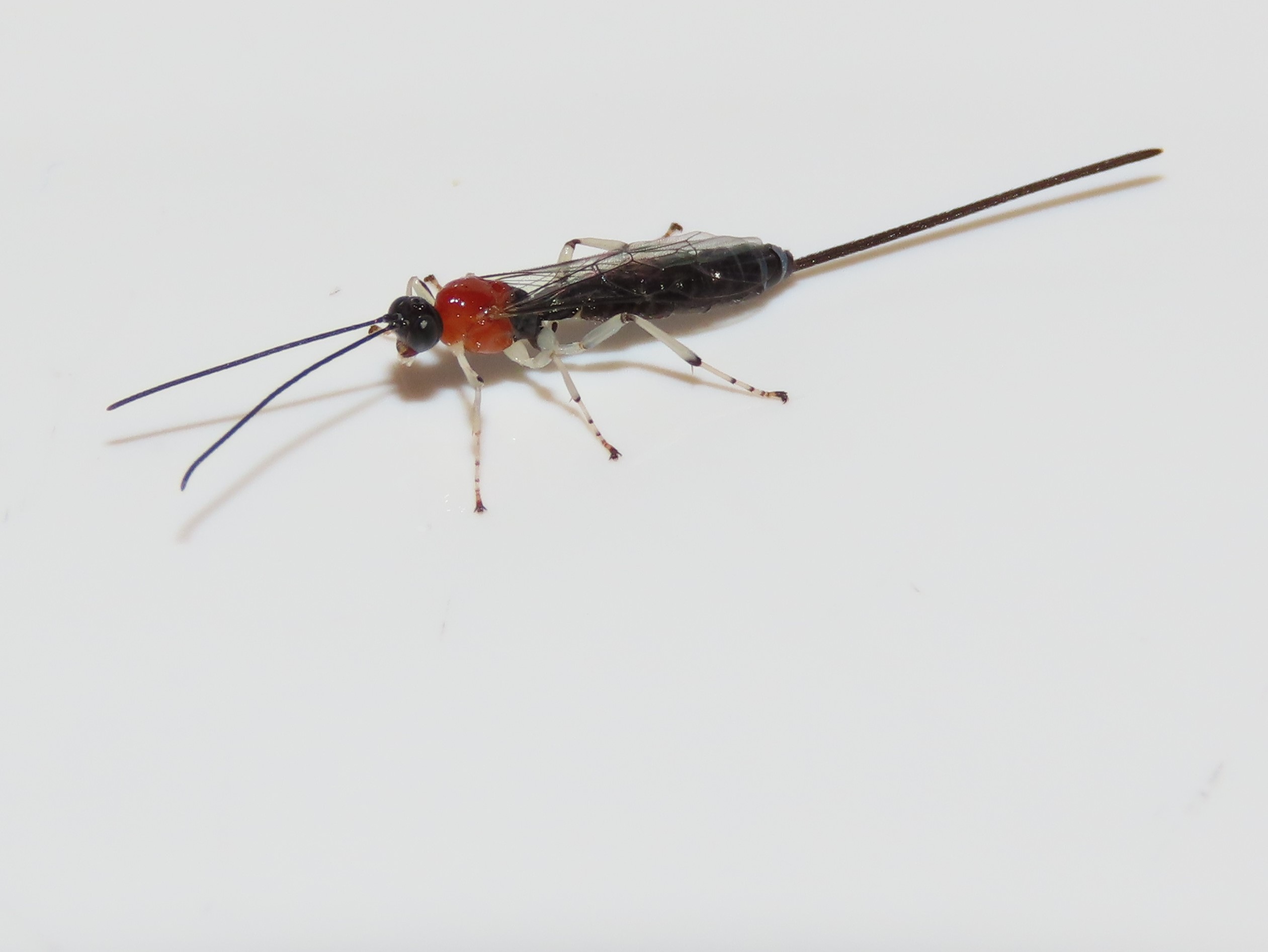
Adult female ichneumon wasp, Calliephialtes grapholithae

It started out innocently enough. Back in 2021, a Facebook post by Sloan Tomlinson (@thatwaspguy on Twitter) caught my attention. He had reared small parasitoid wasps, Elasmus polistis, from an abandoned paper wasp nest that he had contained. I messaged him to learn more, and then followed his suggestion to try this myself.

Nest of Polistes metricus from 2022

We had a nest of the Metric Paper Wasp, Polistes metricus, in a corner of the recessed frame of our back porch doors (French doors) at our home in Leavenworth, Kansas, USA. After the wasps left, I cut down the nest and placed it into a plastic container. Shortly thereafter, in about mid-November, a large number of small parasitoid wasps emerged that were not the same as those that Sloan Tomlinson had reared out. That is a separate mystery from the one I am documenting today.

This year, 2022, we had two Polistes metricus nests, one in each corner of the door frame. One succeeded better than the other by a substantial margin, and I repeated the exercise of cutting down the larger nest and containing it in late autumn. Besides the large number of tiny, metallic parasitoid wasps, I got a shocking surprise.
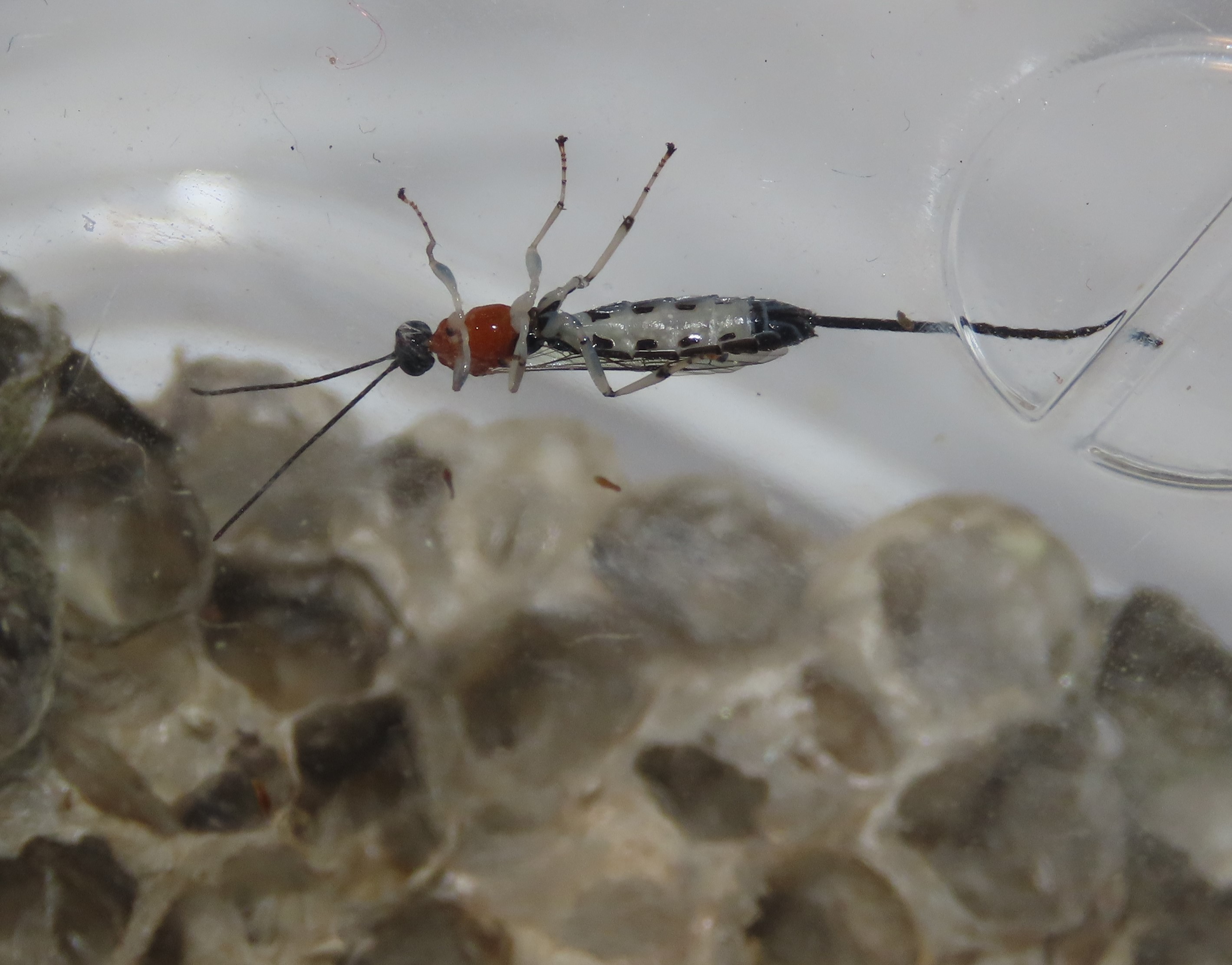
My partner, Heidi, and I went on a vacation in late October. When we returned, I was amazed to find a live female ichneumon wasp, one nearly deceased male, and one deceased male, inside the container with the Polistes nest. The insect was not one of the species that is a known parasitoid of paper wasps. I was able to identify it as Calliephialtes grapholithae, but that made no contextual sense. All of the known hosts for that species are caterpillars of moths.
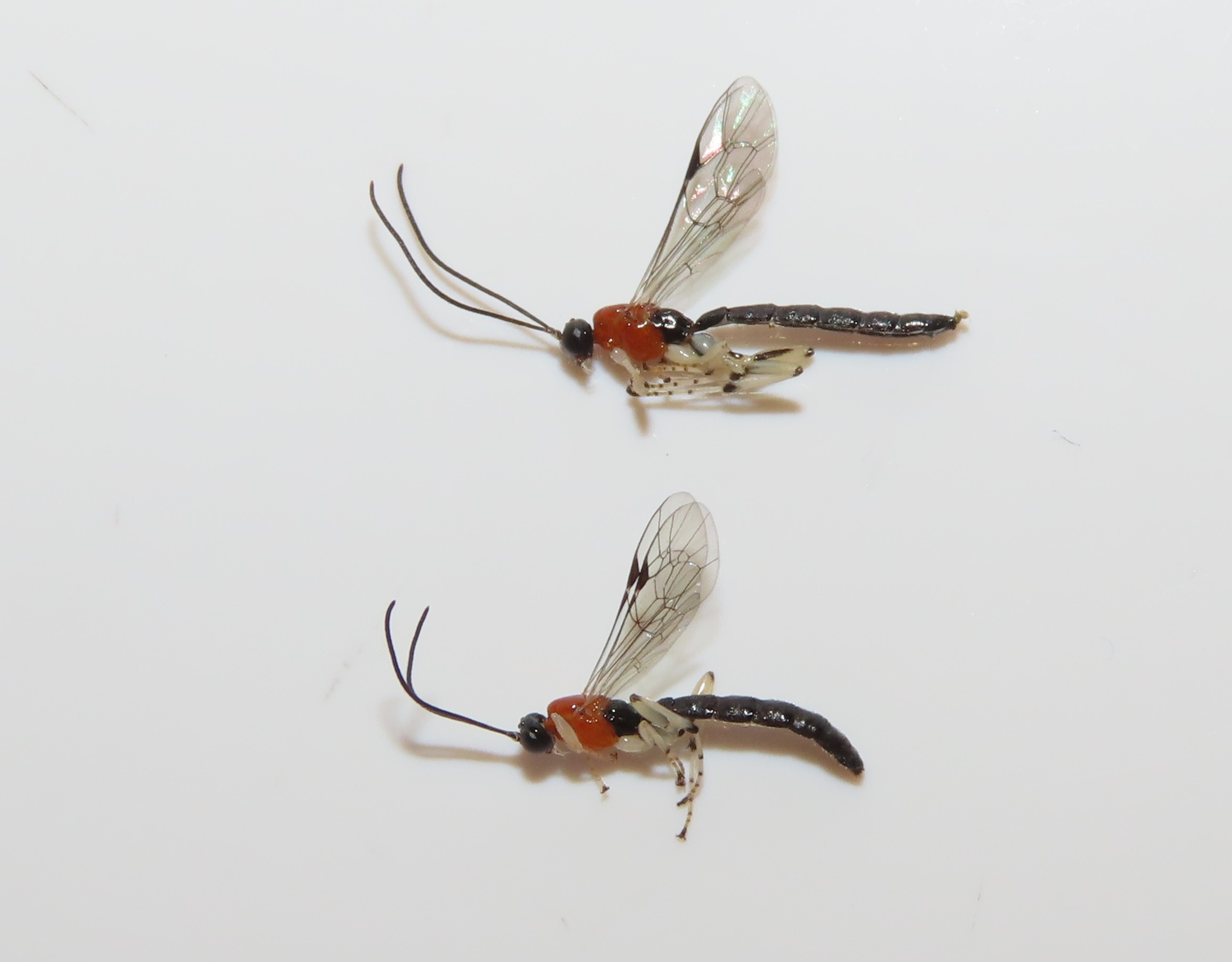
Adult males of Calliephialtes grapholithae

Previously recorded hosts for C. grapholithae include larvae of the following Lepidoptera: Acrobasis betulella, (formerly A. hebescella), A. juglandis, A. rubrifasciella (recorded as A. nibrifasciella (Pyralidae: Phycitinae); Carmenta texana (Sesiidae: Sesiinae); Cydia caryana (recorded as Laspeyresia caryana, the Hickory Shuckworm, Tortricidae: Olethreutinae); Meskea dyspteraria (Thyrididae: Siculodinae); Periploca ceanothiella (recorded as Stagmatophora ceanothiella, Cosmopterigidae: Chrysopeleiinae); Thyridopteryx ephemeraeformis (Psychidae: Oiketicinae); Megalopyge opercularis, the Evergreen Bagworm (Megalopygidae). Most of these taxa represent a “concealed host,” such as the Evergreen Bagworm and Hickory Shuckworm.

The only way the association of C. grapholithae with paper wasps can be made is if there is a moth larva involved in some fashion. It so happens that there is. The Sooty-winged Chalcoela, Chalcoela iphitalis, is such a moth (Crambidae: Glaphyriinae). The caterpillar stage is predatory on the larvae of Polistes wasps, inside their nests. Webbing spun by the caterpillars is a clue to their presence. Apparently, the adult female moth approaches the nest at night, when the adult wasps are less alert. Still, she may lay her eggs on the back of the nest, and let her tiny larval offspring find their way into a cell.

Caterpillar of Chalcoela iphitalis from paper wasp nest

Sure enough, I happened to notice one of these moth caterpillars, strikingly similar to a paper wasp larva, in the bottom of the container with the nest and its other associates. There is little doubt in my mind that C. iphitalis is a host for the ichneumon wasp Calliephialtes grapholithae. The pattern of this wasp seeking concealed hosts fits, though how the wasp navigates a well-defended nest of paper wasps is beyond my imagination. I am hoping that such an infiltration can be documented, or that someone else will independently rear the ichneumon from a paper wasp nest. Until that time, I cannot assert, unequivocally, the host relationship.

Adult Chalcoela iphitalis moth

I also wonder if the sever drought experienced by eastern Kansas this past summer had anything to do with the proliferation of the moths that plague the paper wasps. I noticed more than usual. One of the two nests almost failed completely, though one of the foundress wasps may have died prematurely, slowing the nest’s rate of growth, eventually halting it.

Much remains to be discovered about even the most common of insects, especially when it comes to ecological relationships to other species. I urge my readers to undertake what observations and experiments they can to further enlighten our understanding of the natural world.

Sources: Carlson, Robert W. “Database of Hymenoptera in America north of Mexico,” Discover Life
Hoskins, Jonathan. 2021. “Species Calliephialtes grapholithae,” Bugguide.net
McCormac, Jim. 2017. “Wasp-eating moth fills rare niche,” Ohio Birds and Biodiversity
Calliephialtes grapholithae,” iNaturalist.org

Wednesday, June 5, 2013

Wasp vs. Wasp

My wife and I went down to Fountain Creek Regional Park in Fountain, Colorado recently (the evening of June 2, 2013), and I happened upon an interesting scene. About five or six female mason wasps, Symmorphus sp., were nesting in beetle borings in a cottonwood log by the side of the trail. About four cuckoo wasps, Chrysis sp., were hanging out around the holes the wasps were using as nests. Heidi said I must have spent 45 minutes taking pictures of them all, but it was worth it because I got to observe what was happening.

The above image is one of only two really nice shots I got of the female Symmorphus mason wasps. They would alight near their nest hole, and dive in very quickly. If I approached too quickly with the camera, the wasp would fly off before entering. If I waited too long, I would get a shot of the wasp’s abdomen disappearing, or a seemingly empty hole. Waiting for the wasp to emerge was basically futile, as she would exit much more quickly than was possible to focus.

You have to have an appreciation of the size of the players and the beetle borings to know what I was up against. The borings are probably the exit holes of deathwatch beetles, family Anobiidae, which bore in dead, solid wood as larvae. The diameter of each hole is about the same as the end of a retracted ballpoint pen (about 3 millimeters). Yes, both the mason wasps and cuckoo wasps could fit through those holes.

”Science has strict rules against anthropomorphism, but if you ask me, those chrysidids were cunning and calculating.”

Meanwhile, the bright metallic green cuckoo wasps were not as easily disturbed as the mason wasps. They might run randomly around between holes, but most of the time they sat quietly in the vicinity of a group of holes. Science has strict rules against anthropomorphism, but if you ask me, those chrysidids were cunning and calculating. They were waiting for the wasps to show them which holes were active nests worthy of their attention.

Cuckoo wasps are parasitic in the nests of other solitary wasps. They can’t sting, but the last few segments of the abdomen of the female telescopes into an egg-laying organ that can reach into the bottom of one of those nest tunnels. The cuckoo wasp lays an egg in the nest of its host, and the larva that hatches generally consumes the meal intended for the host offspring.

In the case of Symmorphus, females catch and paralyze leaf beetle larvae that are free-living, or are leaf-miners (living between the layers of a leaf). At least one species of Symmorphus attacks leaf-mining moth caterpillars on occasion. The larval victims are packed into a cell along the length of the beetle boring, and the mother wasp lays her own egg on the last victim. She then creates a partition of mud or chewed wood fibers, and begins a new cell. The process is repeated such that several cells usually occupy one tunnel.

The mason wasps, for their part, were also quite cognizant of the cuckoo wasps. I witnessed at least one altercation whereby a female mason wasp fended off a too-eager chrysidid at the entrance to her nest. Cuckoo wasps, while they can’t sting, have a dense, pitted exoskeleton that effectively repels the bites and stings of their hosts. They can even roll into a ball as a last resort, becoming virtually impregnable.

Without collecting specimens of the wasps, which I did not do, I cannot conclude the species I was observing. Process of elimination narrows the possibilities to Symmorphus cristatus or S. canadensis for the mason wasps. The cuckoo wasps could represent one or more species in the Chrysis coerulans species group. Scientists are still trying to sort out how many species there actually are in that complex.

After getting up from my baseball catcher’s stance, I could feel how my legs had stiffened. The pain was worth the gain, though, and I encourage my readers to endure for the sake of personal and collective knowledge. Field observations are not the scientific priority they once were in the fledgling years of ethology (study of animal behavior). It could easily be you who makes history with a new host record for a predator or parasite, or records some other hitherto unknown association between species.

Sources: Bohart, R.M. and Lynn S. Kimsey. 1982. “A Synopsis of the Chrysididae in America North of Mexico,” Mem. Am. Entomol. Inst. 33: 1-266
Buck, M. Marshall, S.A., and Cheung, D.K.B. 2008. “Identification Atlas of the Vespidae (Hymenoptera: Aculeata) of the Northeastern Nearctic Region,” Canadian Journal of Arthropod Identification No. 5: 492 pp.
Krombein, Karl V. 1967. Trap-nesting Wasps and Bees: Life Histories, Nests, and Associates. Washington, DC: Smithsonian Press. 570 pp.