Showing posts with label Lepidoptera. Show all posts

Sunday, November 2, 2025

Remembering Moth Week 2025

Yes, I am terribly behind in making public my sightings of insects, arachnids, and other wildlife this year. I finally have my observations for National Moth Week 2025 loaded onto iNaturalist, but I will share some of them here in this post.

Zebra Conchylodes Moth, Eddyville, Kentucky.

Heidi was generous enough to secure us tickets to the Coldplay concert in Nashville, Tennessee, USA, so we spent almost the entirety of the week in that area of the country. We began in the Land Between the Lakes National Recreation Area. When we arrived, the weather was rainy and not at all conducive to looking for insects, but it was also the day before the start of National Moth Week.

This Pink-shaded Fern Moth was the first of its kind I'd ever seen.

We stayed at a small rental house near Eddyville, Kentucky, surrounded by deciduous forest. The first night, we simply left the front porch light on, and looked at the few insects that flew in, using the awning over the porch as convenient cover from the showers.

This Lost Owlet moth was also new to me.

The subsequent two nights were better. We put out our blacklight the second night, under the carport by a large metal garage building. The building had its own, motion-activated light, which helped draw more bugs to our sheet. The landscape was still quite wet, however.

Tulip-tree Beauty, a large geometer moth, was common at our lights....
....but harder to see on a tree trunk!

We debated whether to turn on the blacklight for our third and final night in Eddyville, but I decided against it. We did turn on a light over the back porch, though, and that attracted a good number of insects, including moths.

A Posturing Arta moth, posturing.

As we headed south, we entered Tennessee, and stopped at the lovely Cedar Pond Picnic Area. The sun had broken through permanently by now, so there was more insect activity. Around the pond were a couple of overlooks, and at one of those we startled a butterfly off a pile of scat from some mammal’s recent visit. On closer inspection, we noticed there was also a Nessus Sphinx Moth taking advantage of the fresh dung.

Nessus Sphinx moth enjoying(?) fresh dung.

While we were in Nashville, we stayed at a hotel that did not permit us to do any blacklighting. Plus, there was the concert itself. If you have never been to a stadium concert for your favorite band, I recommend the experience. Highly exhilarating, and worth the expense.

Deep Yellow Euchlaena Moth, Giant City State Park, Illinois.

From Nashville we headed west to southern Illinois, an area rich in both biodiversity, and protected natural areas in which to enjoy it. There are wildlife refuges, state parks, and other places that have grassroots support from local friends groups, resulting in excellent maintenance and outstanding sources of firsthand knowledge.

Rosy Maple Moth.

We decided to visit Crab Orchard National Wildlife Refuge on the way to our destination of Giant City State Park. The visitor center was being remodeled, and it was about to close for the day, but we met a couple who volunteer there. They were friendly, and very helpful. Exploring the exterior of the building, I found a beautiful Rosy Maple Moth, still hanging out by a light it had been drawn to the previous night.

Caterpillars, like this one of a tussock moth, count, too, during National Moth Week. Lower Cache River, Illinois.

Jennifer Randolph, the naturalist and nature center manager at Giant City State Park had invited me to give a presentation on moths for her volunteers and anyone else interested, so we stayed at a cabin in the park for three nights.

The "working" part of our vacation, presenting on moths at Giant City State Park.

The first two nights we set up a blacklight on our cabin porch, and were rewarded with a spectacular variety and quantity of insects. The cabins are basically duplexes (front to back) offering comfortable accommodations for guests, and situated far enough apart that you are not disturbing your neighbors with quiet nighttime activities.

The Bad-wing is actually a real beauty.

On our last night, we set up our lights a fair distance away at a picnic shelter elsewhere in the park. There was a pole light by the shelter that complemented our dim white light and portable blacklight. We did not see many species different from what we had at our cabin, but there were some notable exceptions.

A large and lovely Azalea Sphinx.

On our drive back home, we stopped for a rest, rather randomly, at a Casey’s store in New Florence, Missouri. When I glanced up as we pulled into our parking spot, I could hardly believe my eyes. I blurted out an excited “Oooh, oooh!,” and pointed, wide-eyed, at the enormous female Imperial Moth perched on the wall beneath a light.

Imperial Moth, female.

Moth Week could have ended there and I would have been happy, but we got home to Leavenworth, Kansas in time to set up our blacklight in the front yard for the final night, July 27. A few more species were added, and then it was over.

Unidentified dagger moth, genus Acronicta, Leavenworth, Kansas.

All of my observations can be seen at the hyperlink in the first paragraph of this blog post. Meanwhile, Heidi’s observations can be found here. We almost always see different species, even in the same place. Plus, her photos are usually better.

Linden Prominent moth was a new visitor to our Leavenworth, Kansas yard.

While there is an official National Moth Week, almost any time of the year can be its own moth week. There are still moths flying here in Leavenworth, at least until the first hard freeze. Turn on your porch light and see what lives in your own neighborhood.

Basswood Leafroller Moth, Leavenworth, Kansas.

NOTE: In the current, highly-charged political atmosphere, I strongly suggest navigating friends group websites for recreation areas, national parks, wildlife refuges, and other properties operated by the federal government, to avoid being subjected to biased and irrelevant content. Thank you.

Wednesday, July 16, 2025

Accidental Achievement

When we lived in Colorado Springs, I would walk our neighborhood regularly, if not daily, unless the weather was severe. Little did I know that one such constitutional would yield something globally significant.

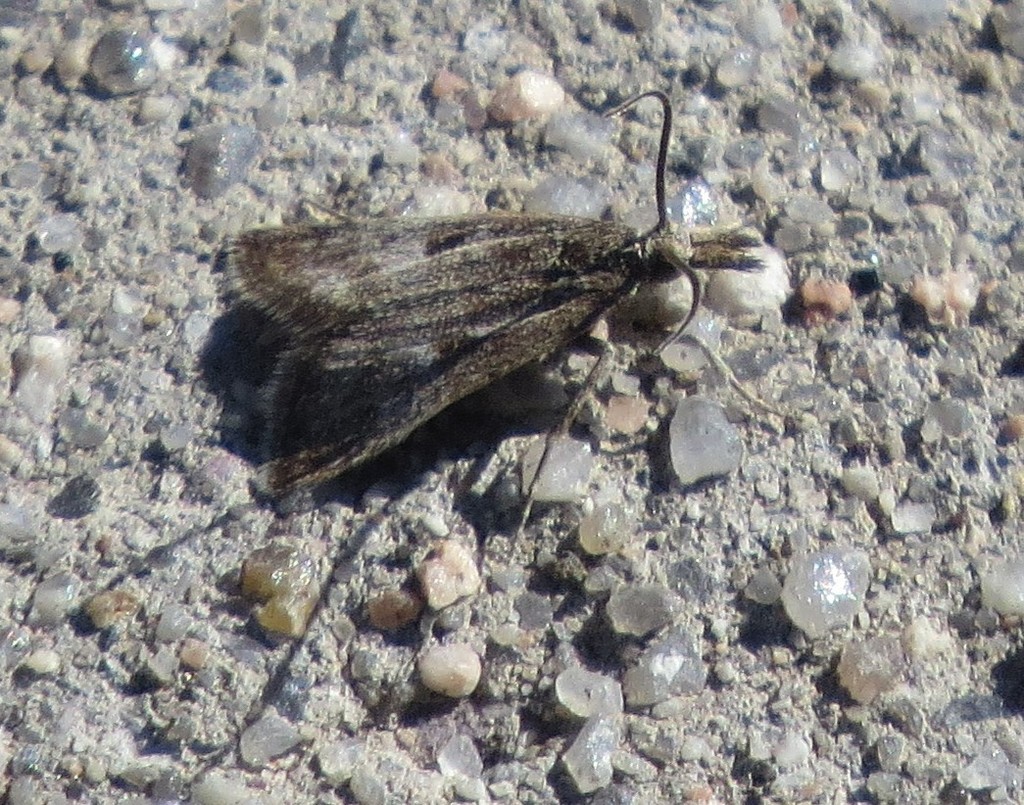
My photo of the male moth.

On the afternoon of November 5, 2020, passing a vacant lot up the street that I had passed by almost daily, I noticed small moths flying around. Many moth species fly late into autumn, so that alone did not intrigue me. Many moths fly during daylight hours, so that was not unusual, either. Curious me wanted to document the thing anyway, but that was easier said than done. The moths were wary, and quickly disappeared into weeds when they landed, camouflaged.

Finally, one of them landed on the sidewalk, and as I recall a bit of a breeze kept it from taking flight again immediately. Not the best of photos, but I put it on iNaturalist anyway. I wasn’t even completely sure of the family, but I figured something so common would be recognized by an expert eventually.

My iNaturalist entry.

Fast forward to November of 2024, and I receive an email from Andrew Warren informing me that not only was this moth a species new to science, but that it also qualified to be in a new genus. I was shocked. How could something that abundant be completely overlooked until now?

It turns out I had the correct family (Crambidae), but obviously could not have put a more specific name to it. It didn’t have one! The paper describing the moth is now published, and anyone can view it here. I was not at liberty to share this story until after the publication, as a common courtesy to the authors.

Better image of a male, photo © Andrew Warren.

Allow me to briefly summarize, if you do not want the long story in the journal article. The moth has so far been collected between October 20 and November 22. Mine is so far the only record for El Paso County, but it is suspected to occur all along the Front Range, possibly into Wyoming in the north and New Mexico in the south. This is based on the host plant for the caterpillar, which is a grass known as Sand Dropseed, Sporobolus cryptandrus.

The larvae probably feed on the roots of the plant, because the moths have only been found in situations where the dropseed was either mowed or trampled. Seriously. Where the plants are upright, no moths. Sure enough, the vacant lot where I found mine was mowed regularly, much to my dismay until I learned this story.

The female moth, photo © Christian Nunes.

The females of the moth, which now bears the name Coloradactria frigida, are flightless, with heavy bodies and short wings. No wonder I never saw those. They certainly must emit a pheromone to attract the males.

Other known localities for the moth are in Douglas County around Castle Rock, and in Weld County, all in Colorado. Late autumn searching elsewhere should certainly turn up new records.

A mating pair of the moths, photo © Christian Nunes.

The lesson I have learned from this is that you can, and should, never assume anything when it comes to entomology. You do not even have to know what you are doing to make an earth-shattering discovery. We collectively know very little. It is your curiosity that counts. That, and your willingness to share what you find with others. Do the documenting with photographs, videos, and sound recordings, and put them out there. Please.

Source: Warren, Andrew D., Clifford D. Ferris, Bernard Landry, Jeremy Authier, Theo Leger, Julia Bilat, and Christian A. Nunes. 2025. “A New Genus and Species of Crambinae (Pyraloidea: Crambidae) With Brachypterous Females From Colorado, U.S.A.,” Journal of the Lepidopterists’ Society 79 (2): 73-84.

Tuesday, August 13, 2024

National Moth Week 2024 Recap from Kansas City

We are in the Greater Kansas City Metro area, anyway, here in Leavenworth, Kansas. National Moth Week ran from July 20-28 this year, which was helpful because the weather was unstable and somewhat volatile, and we were traveling during the end of that time span. Our results were mixed, but they did include some new species for our property.

Chickweed Geometer Moth, Haematopis grataria, is a pretty dependable species for National Moth Week.

This part of the United States has received more rain this year than in the previous three that we have experienced. Oddly, this seems to have driven insect diversity and abundance down. Our plants are doing well. I had no idea that violets could grow that tall and that dense, for example. The goldenrod may be taller than I am by the time it blooms.

Green Cloverworm Moth, Hypena scabra, is common here most of the summer.
Black-bordered Lemon Moth, Marimatha nigrofimbria, has been a "regular" in our yard this year.

I walked our yard in the daytime on the afternoon of July 21, and flushed the above three moth species from our “lawn.”

Clemens' Grass Tubeworm Moth, Acrolophus popeanella.

That night I switched on the light for our covered side porch, which is only about five feet from the neighbor’s house, but only managed to attract a couple of grass tubeworm moths. Returning to the front entrance, I discovered what I believe to be an adult Variegated Cutworm lodged on the inside of the screen door.

Variegated Cutworm Moth, Peridroma saucia, I think.

Ironically, an unidentified tortricid moth appeared on the side porch screen door during the day on July 25.

Unidentified tortricid moth.

On July 26 I hiked over to Havens Park, one of the few forested places in town, in hopes of flushing some underwing moths, as I have had fair luck in the past. Lo and behold, I did get one, an Epione Underwing, Catocala epione, that stuck around just long enough for me to get a couple of images. Breaking through countless spider webs strung across the trail was worth it after all.

Epione Underwing, Catocala epione.

I set up our entolight blacklight twice, once in the back yard on the night of July 23, and again in the front yard on July 26. The difference in the species between the two locations is rather surprising. Frankly, given that the federal prison, lit up like Las Vegas every night, is less than two blocks away, I am mystified as to how we attract anything.

Maple Looper Moth, Parallelia bistriaris.

The back yard yielded a few moths, mostly small and common species, but also delivered a couple of lovely, larger moths. When blacklighting, it helps to remember to look on foliage, tree trunks, fence posts, and other surfaces just beyond the reach of the illumination of your lights. Many moth species are “too shy” to come directly to the sheet.

Banded tussock moth, Halysidota sp., found in the shadows just beyond the reach of the light.

The front yard, like the back yard, had few moths at the light until about eleven PM. Naturally, every time I decided I should turn out the light for the night, something new would show up. I think I eventually went to bed around one AM. Thankfully, the neighbors tolerate our “hobby.”

Spotted Peppergrass Moth, Eustixia pupula.

Among the novel finds in the front yard was one of the crocus geometer moths in the genus Xanthotype. They cannot be identified to species from photos, so we will settle for genus.

Crocus geometer moth, Xanthotype sp.

Another interesting moth was a Yellow-collared Slug Moth, Apoda y-inversum. Their helmet-shaped caterpillars apparently feed only on the leaves of hickory trees.

Yellow-collared Slug Moth, Apoda y-inversum.

All of my moth observations for the week can be found here on iNaturalist.

Packard's Wave, Cyclophora packardi, and a pygmy leafmining moth, Stigmella sp., immediately below it.

Next year I will try and schedule public events, as we did last year on Fort Leavenworth, for both a variety of habitat, and as a way to introduce others to the magic of moths. I hope all of you were able to enjoy this year’s edition of National Moth Week wherever it found you.

Zeller's Macalla, Macalla zelleri, a type of pyralid moth. Wish we had more, as their caterpillars feed on Poison Ivy.

Wednesday, December 7, 2022

A Potential New Host Record for Calliephialtes grapholithae (Hymenoptera: Ichneumonidae) from a Paper Wasp nest (Hymenoptera: Vespidae: Polistes metricus)

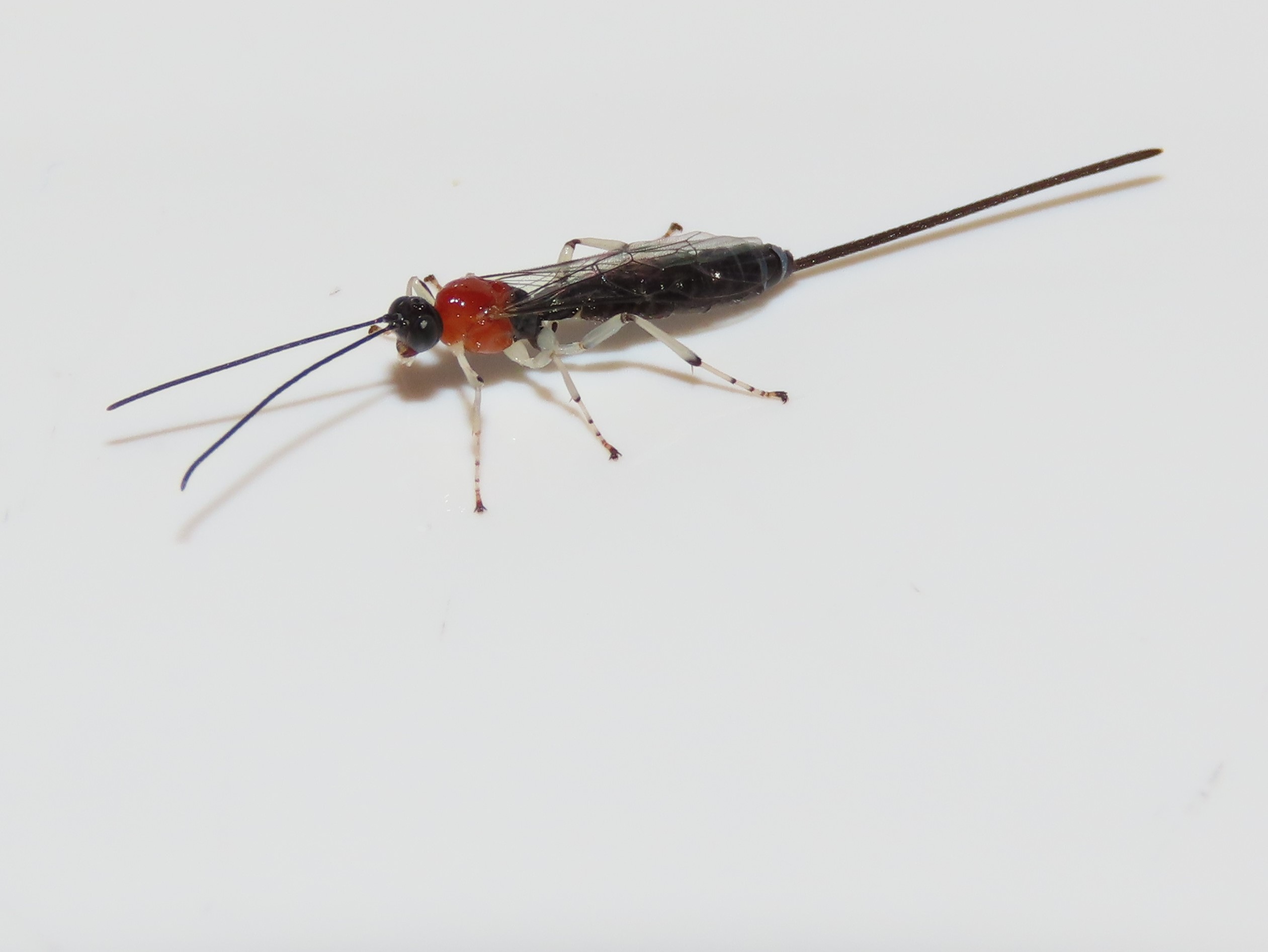
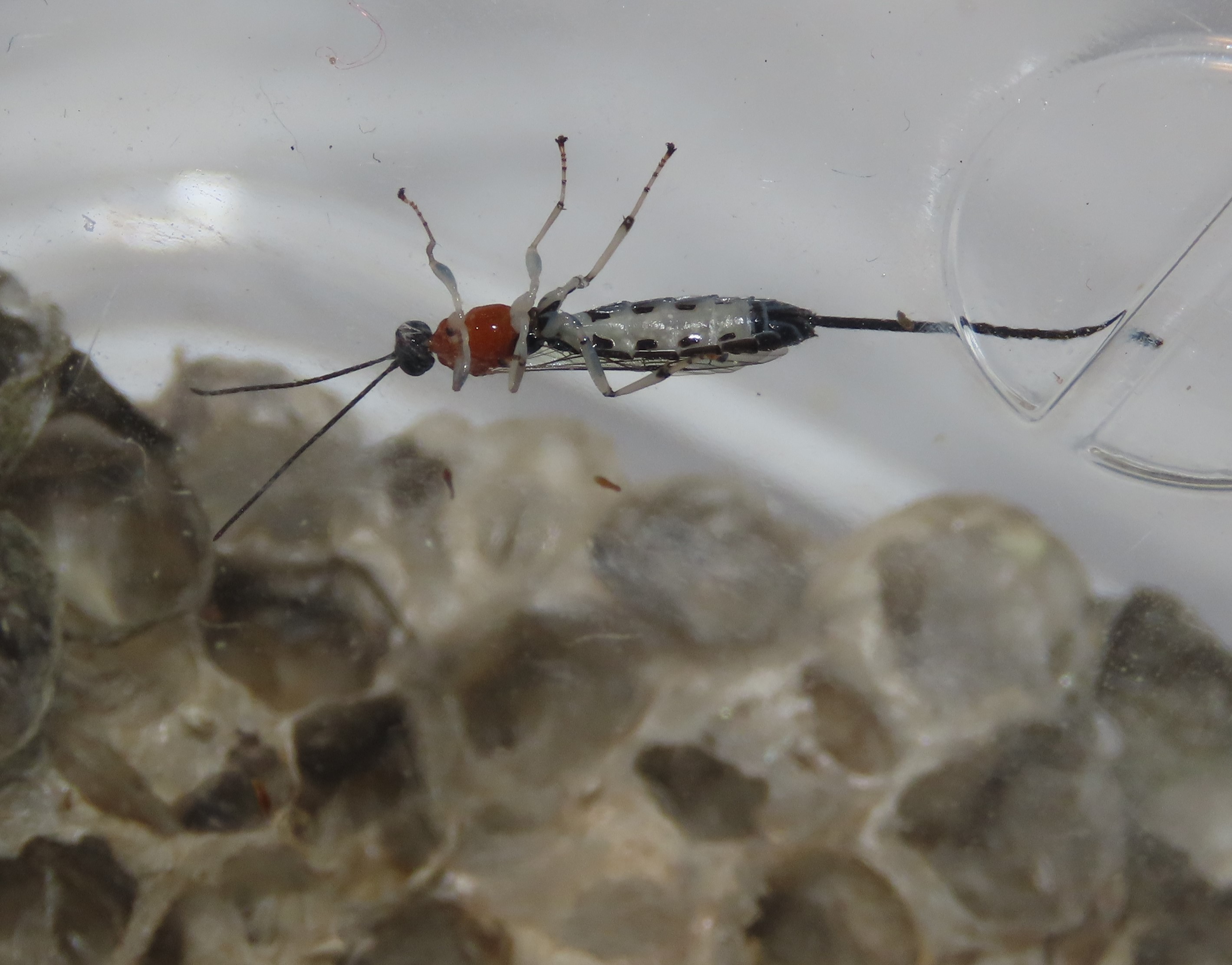
Adult female ichneumon wasp, Calliephialtes grapholithae

It started out innocently enough. Back in 2021, a Facebook post by Sloan Tomlinson (@thatwaspguy on Twitter) caught my attention. He had reared small parasitoid wasps, Elasmus polistis, from an abandoned paper wasp nest that he had contained. I messaged him to learn more, and then followed his suggestion to try this myself.

Nest of Polistes metricus from 2022

We had a nest of the Metric Paper Wasp, Polistes metricus, in a corner of the recessed frame of our back porch doors (French doors) at our home in Leavenworth, Kansas, USA. After the wasps left, I cut down the nest and placed it into a plastic container. Shortly thereafter, in about mid-November, a large number of small parasitoid wasps emerged that were not the same as those that Sloan Tomlinson had reared out. That is a separate mystery from the one I am documenting today.

This year, 2022, we had two Polistes metricus nests, one in each corner of the door frame. One succeeded better than the other by a substantial margin, and I repeated the exercise of cutting down the larger nest and containing it in late autumn. Besides the large number of tiny, metallic parasitoid wasps, I got a shocking surprise.

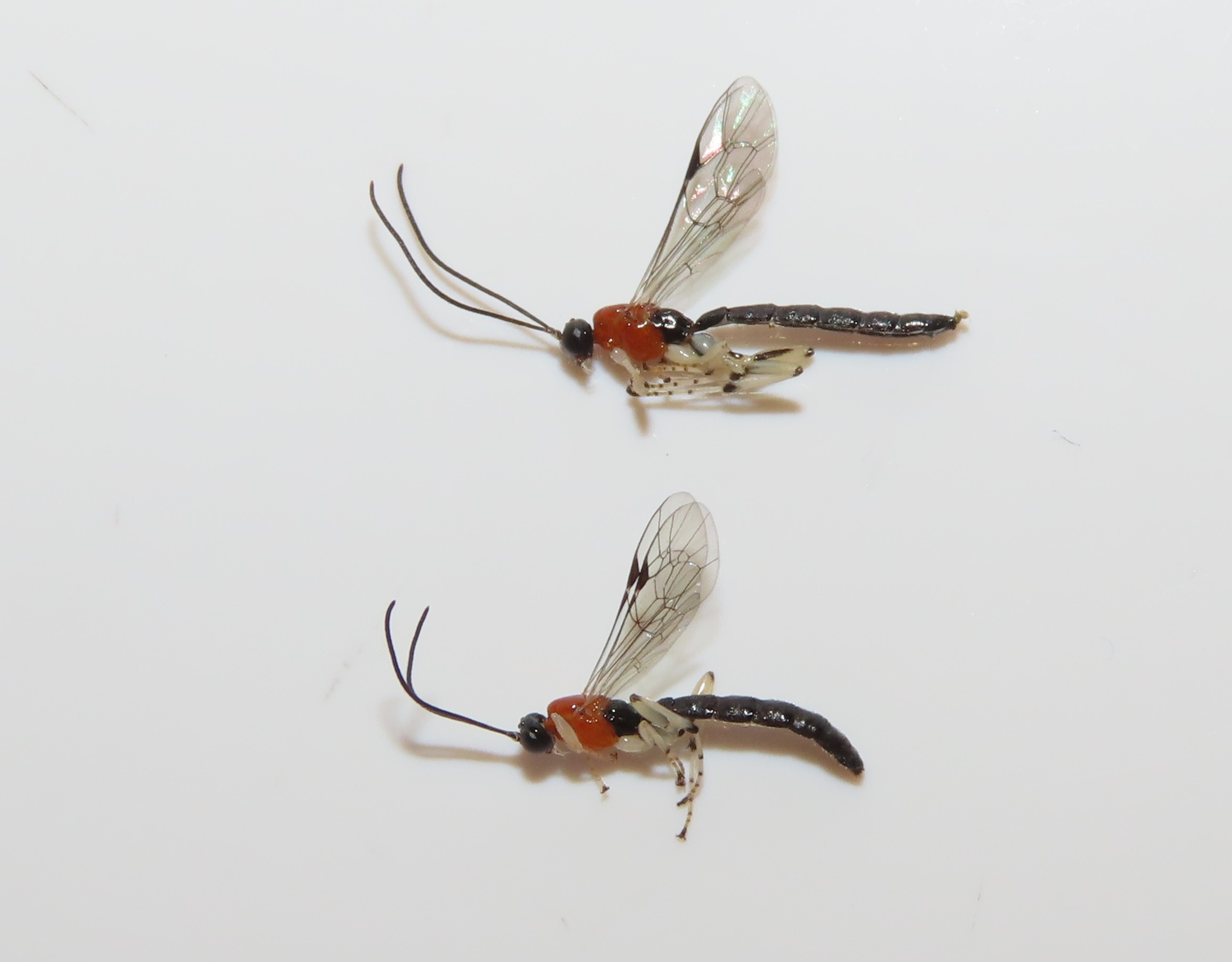
My partner, Heidi, and I went on a vacation in late October. When we returned, I was amazed to find a live female ichneumon wasp, one nearly deceased male, and one deceased male, inside the container with the Polistes nest. The insect was not one of the species that is a known parasitoid of paper wasps. I was able to identify it as Calliephialtes grapholithae, but that made no contextual sense. All of the known hosts for that species are caterpillars of moths.

Adult males of Calliephialtes grapholithae

Previously recorded hosts for C. grapholithae include larvae of the following Lepidoptera: Acrobasis betulella, (formerly A. hebescella), A. juglandis, A. rubrifasciella (recorded as A. nibrifasciella (Pyralidae: Phycitinae); Carmenta texana (Sesiidae: Sesiinae); Cydia caryana (recorded as Laspeyresia caryana, the Hickory Shuckworm, Tortricidae: Olethreutinae); Meskea dyspteraria (Thyrididae: Siculodinae); Periploca ceanothiella (recorded as Stagmatophora ceanothiella, Cosmopterigidae: Chrysopeleiinae); Thyridopteryx ephemeraeformis (Psychidae: Oiketicinae); Megalopyge opercularis, the Evergreen Bagworm (Megalopygidae). Most of these taxa represent a “concealed host,” such as the Evergreen Bagworm and Hickory Shuckworm.

The only way the association of C. grapholithae with paper wasps can be made is if there is a moth larva involved in some fashion. It so happens that there is. The Sooty-winged Chalcoela, Chalcoela iphitalis, is such a moth (Crambidae: Glaphyriinae). The caterpillar stage is predatory on the larvae of Polistes wasps, inside their nests. Webbing spun by the caterpillars is a clue to their presence. Apparently, the adult female moth approaches the nest at night, when the adult wasps are less alert. Still, she may lay her eggs on the back of the nest, and let her tiny larval offspring find their way into a cell.

Caterpillar of Chalcoela iphitalis from paper wasp nest

Sure enough, I happened to notice one of these moth caterpillars, strikingly similar to a paper wasp larva, in the bottom of the container with the nest and its other associates. There is little doubt in my mind that C. iphitalis is a host for the ichneumon wasp Calliephialtes grapholithae. The pattern of this wasp seeking concealed hosts fits, though how the wasp navigates a well-defended nest of paper wasps is beyond my imagination. I am hoping that such an infiltration can be documented, or that someone else will independently rear the ichneumon from a paper wasp nest. Until that time, I cannot assert, unequivocally, the host relationship.

Adult Chalcoela iphitalis moth

I also wonder if the sever drought experienced by eastern Kansas this past summer had anything to do with the proliferation of the moths that plague the paper wasps. I noticed more than usual. One of the two nests almost failed completely, though one of the foundress wasps may have died prematurely, slowing the nest’s rate of growth, eventually halting it.

Much remains to be discovered about even the most common of insects, especially when it comes to ecological relationships to other species. I urge my readers to undertake what observations and experiments they can to further enlighten our understanding of the natural world.

Sources: Carlson, Robert W. “Database of Hymenoptera in America north of Mexico,” Discover Life
Hoskins, Jonathan. 2021. “Species Calliephialtes grapholithae,” Bugguide.net
McCormac, Jim. 2017. “Wasp-eating moth fills rare niche,” Ohio Birds and Biodiversity
Calliephialtes grapholithae,” iNaturalist.org

Sunday, July 24, 2022

It's National Moth Week Already?!

Yes, National Moth Week is once again upon us! This year it happens starting yesterday, July 23, and ends Sunday, July 31. NMW is an annual citizen science event that anyone can participate in. You might start by visiting the National Moth Week website for information about the history of the project, and how to contribute your observations.

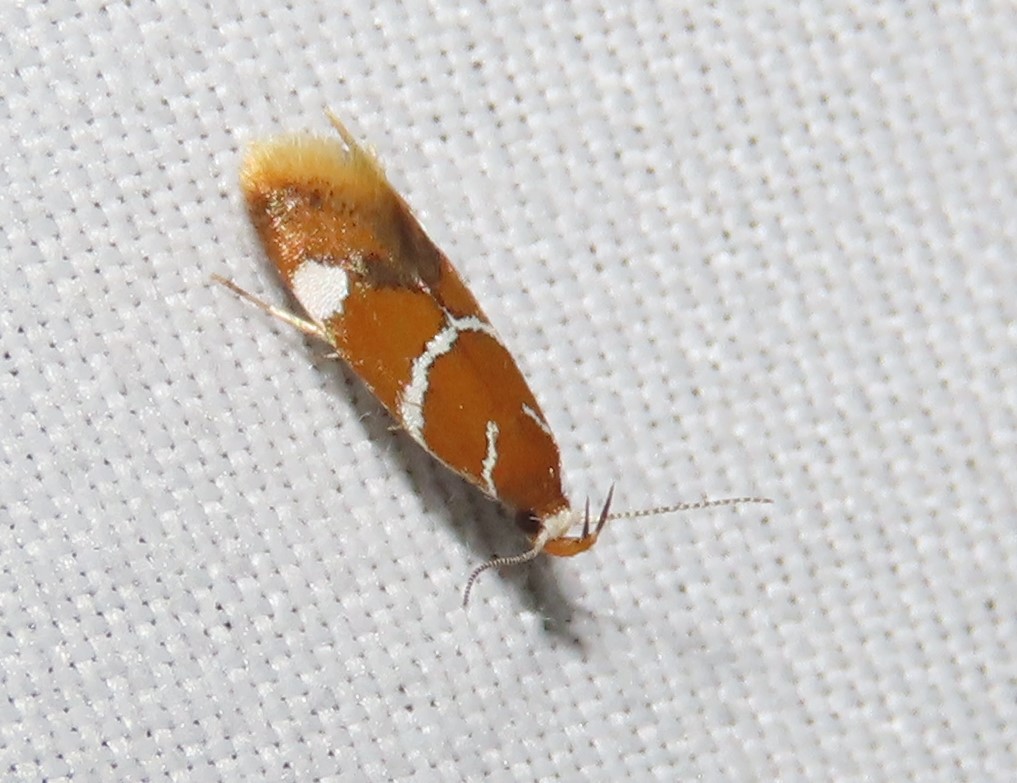
Suzuki's Promalactis Moth, Promalactis suzukiella

Despite a breezy to gusty night last night, we hung a blacklight, with a white sheet backdrop, from our front porch in Leavenworth, Kansas, USA. Our neighborhood is more or less suburban, with modest yards around each home. It has been hot and humid, but with a prolonged dry spell, so I was not expecting much.

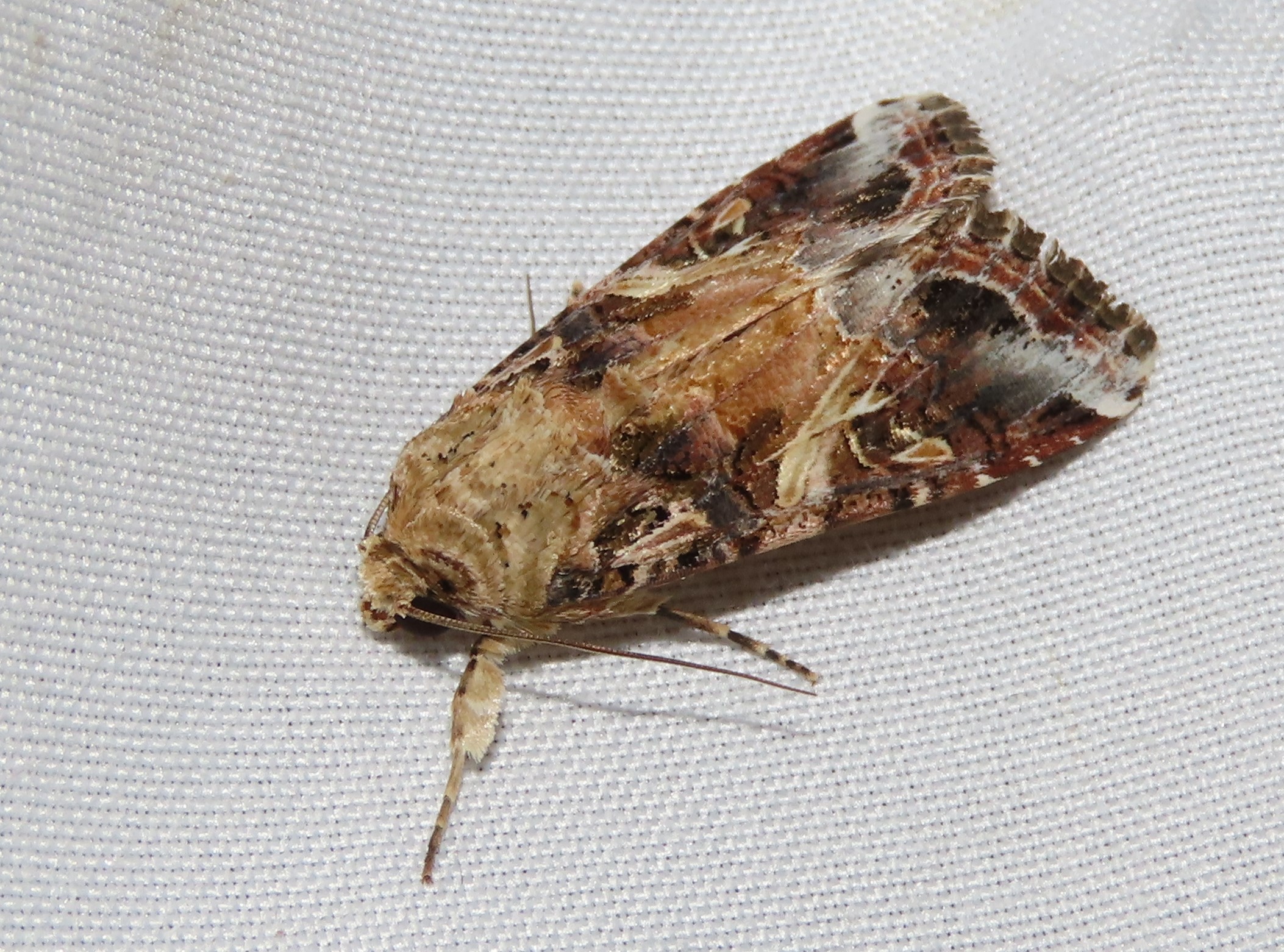
Yellow-striped Armyworm moth, Spodoptera ornithogalli, I think.

Still, we had many moths fly to our ultraviolet beacon. Many were small enough to be overlooked, or easily mistaken for leafhoppers, small caddisflies, or other insects. A few could be dismissed as bits of plant debris, so convincing is their camouflage, even on a white canvas.

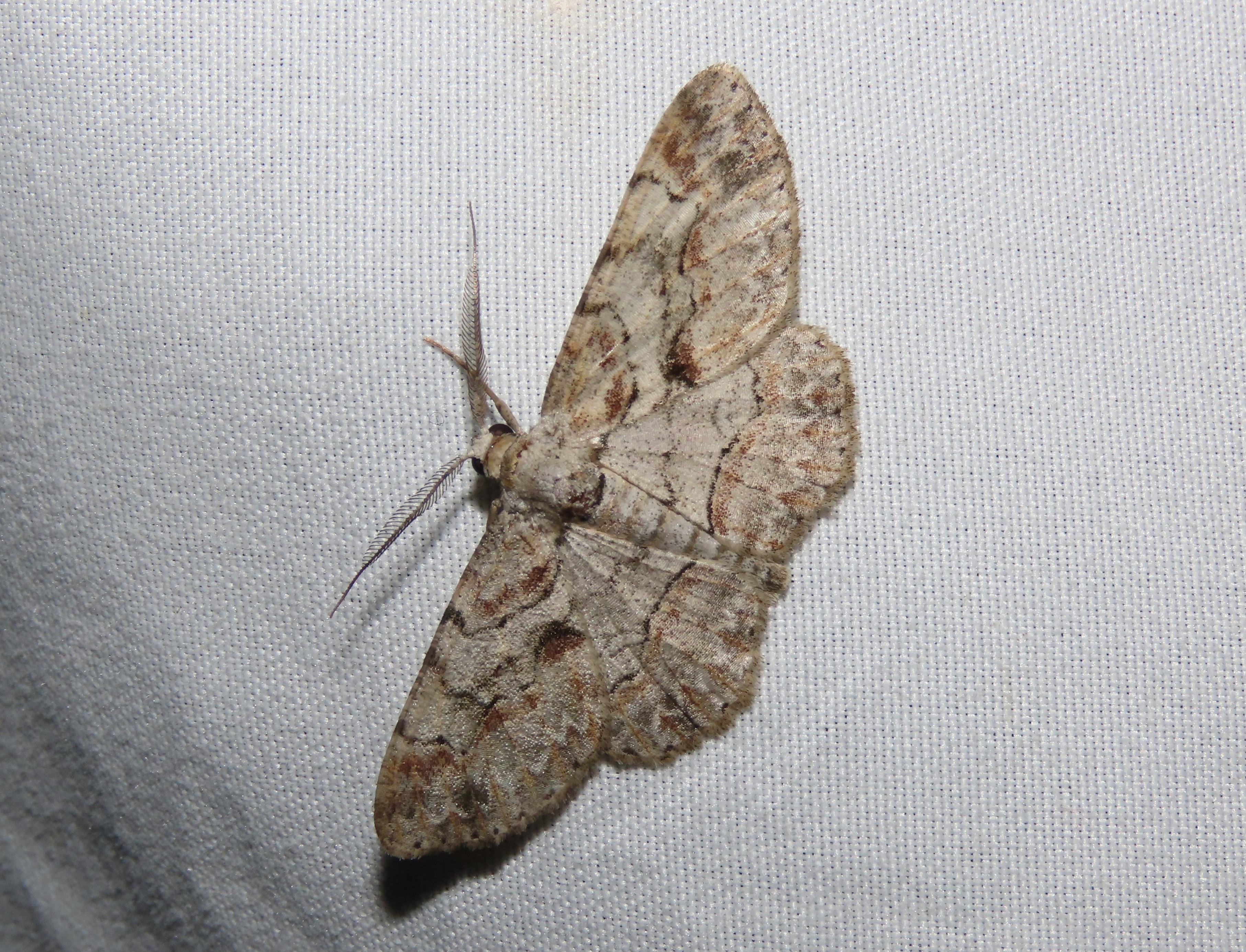
Brown-shaded Gray, Iridoposis defectaria

Here is a small selection of some of the moths that appeared. I do not even know the identities of a few of them myself. Moths are that diverse, with little known about them unless they are of economic importance.

Skiff Moth, Prolimacodes badia

Walnut Caloptilia, Caloptilia blandella

Kermes Scale Moth, Euclemensia bassettella

Tubeworm moth, Acrolophus sp.

Small Baileya, Baileya australis

Stripe-backed Moth, Arogalea cristifasciella

Orange-headed Epicallima, Callima argenticinctella

The Wedgling, Galgula partita

Unidentified crambid moth

What is on your sheet, or at your porch light? Share them with the world. All it takes is a phone or camera, and a connection to the iNaturalist projects for global National Moth Week and United States National Moth Week. It is all free, and before you know it you will be scrolling through the observations of other moth aficionados from elsewhere. Happy Mothing!