Sunday, July 3, 2022

Spider Sunday: Star-bellied Orbweaver, Acanthepeira stellata

NOTE:Today's post is an update of a previous post on November 11, 2012, prompted by a surprising recent find in our own back yard, on June 22, here in Leavenworth, Kansas, USA. I habitually tour our property looking for insects, spiders, and other invertebrates, and almost dismissed a brown, thorn-studded object as a piece of plant debris that had become adhered to our siding. Fortunately, I had seen other individual Star-bellied Orbweavers previously, though none of them nearly as large as this one.The hard, spiked abdomen of this adult female was nearly the size of a dime.

Nothing to see here....Psst, she's facing southeast

There is no shortage of the weird in the spider world, and this animal is a stunning example. One of my friends on the photo-sharing site Flickr asked "Why is it 'star-bellied' when it's star-butted? Is there more star-ness on its belly?" Fair question, to which I have no answer. Maybe the person that first saw one described it from the ventral side. The pointy tubercles certainly show up from all angles. The spikes enhance its camouflage as it passes itself off as a bur, seed pod, or bit of dried vegetation.

She has legs!

Acanthepeira stellata is one of four North American species in the genus, collectively found from southeast Canada south and west to southern California. This species in particular is known from southeast Canada to Florida, and west to Kansas and Arizona.

An immature spider in its web in western Massachusetts

These are not large spiders. Mature females measure 7-15 millimeters in body length, males 5-8 millimeters. Their unique appearance may make them easy to identify, but quite difficult to find, unless they are sitting in the hub of their web, which they don't seem to do with dependable regularity. Couple their cryptic shape with the fact that they tend to build their circular snares less than three feet off the ground in prairies, fields, meadows, and forest openings, and it can be an exercise in futility to hunt them amid tall grasses. Should one degtect your approach, it will drop to the ground, fein death, and disappear in the tangle of vegetation.

Can you spot the spider at Thoh-Dah Prairie in Missouri?

Star-bellied spiderlings emerge from egg sacs in summer, and overwinter as immature or penultimate (one molt removed from adulthood) individuals. Adult females can be found from May to October, at least in Illinois (Moulder, 1992). Mature males can be seen from May to September. I have found near-adults in odd places, probably as a result of "ballooning." Ballooning is a dispersal strategy used by many young spiders to travel afar and stake out their own territories. A spiderling typically climbs up to the summit of a tall object, stands on tiptoe ("tip tarsus??"), and issues long strands of silk from its spinnerets. These threads are caught by the wind, and when the spider lets go it may be blown hundreds of feet, if not a mile or more. One baby A. stellata was captured at 1000 feet in the air over Tallulah, Louisiana, on December 13, 1930 (Fitch, 1963).

This little one has ballooned onto the beach at Cape May, New Jersey

Once settled, these spiders spin the characteristic orb web to snare insects, mostly immature grasshoppers. There is one record of an adult female preaying upon an American Green Tree Frog, Hyla cinerea, but this is certainly not a routine event (Lockley, 1990).

An adult at night in Broken Bow, Oklahoma

Star-bellied Orbweaver is not immune to predators itself. The Black and Yellow Mud Dauber, Sceliphron caementarium, is a parasitoid wasp that stings spiders into paralysis and stockpiles them in mud cells as food for a single larval wasp in each cell. The wasps are undeterred by a hard-bodied spider.

Subadult spider in its web at night in Adams County, Ohio

You may have better luck finding the Star-bellied Orbweaver at night. Many species of orbweavers that are in hiding by day move to the hub (center) of their webs after dark. Taking a night hike reveals another world anyway, nocturnal spiders being among the impressive highlights.

Sources: Guarisco, Hank. 2017. A Pocket Guide to Common Kansas Spiders. Wichita, Kansas: Great Plains Nature Center. 67 pp.
Fitch, Henry S. 1963. Spiders of the University of Kansas Natural History Reservation and Rockefeller Experimental Tract. Lawrence, Kansas: University of Kansas Museum of Natural History, Misc. Publ. nol 33. 202 pp.
Gaddy, L.L. 2009. Spiders of the Carolinas. Duluth, Minnesota: Kollath+Stensaas Publishing. 208 pp.
Lockley, T.C. 1990. "Predation on the green treefrog by the star-bellied orb weaver, Acanthepeira stellata (Araneae: Araneidae)," J. Arachnol. 18(3): 359.
Moulder, Bennett. 1992. A Guide to the Common Spiders of Illinois. Springfield, Illinois: Illinois State Museum Popular Science Series, vol. X. 125 pp.
Weber, Larry. 2003. Spiders of the North Weoods. Duluth, Minnesota: Kollath+Stensaas Publishing. 205 pp.

Wednesday, June 29, 2022

Wasp Wednesday: Blue Mud Dauber, Chalybion californicum

NOTE: This is an update of my original blog post from August of 2010, with some new images.

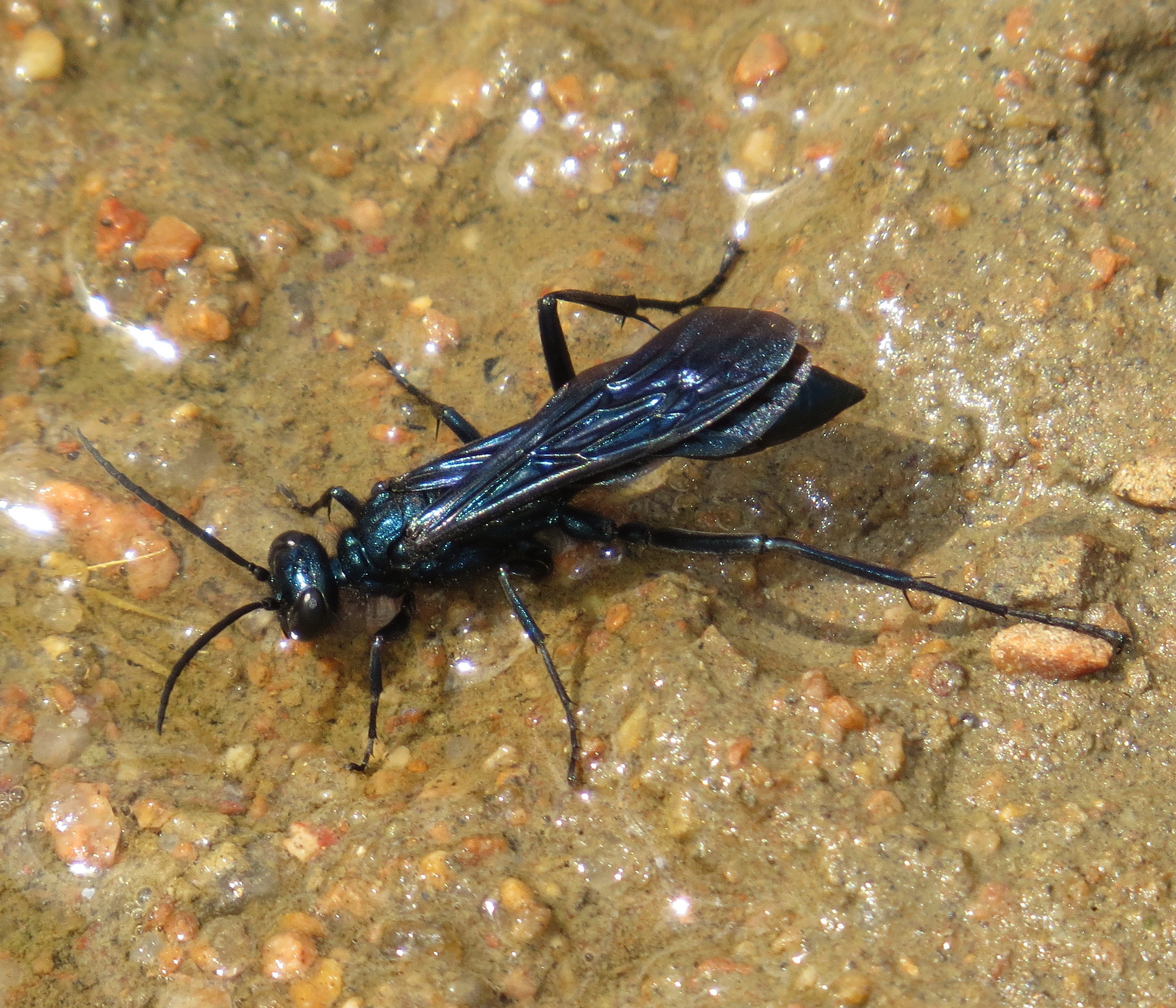
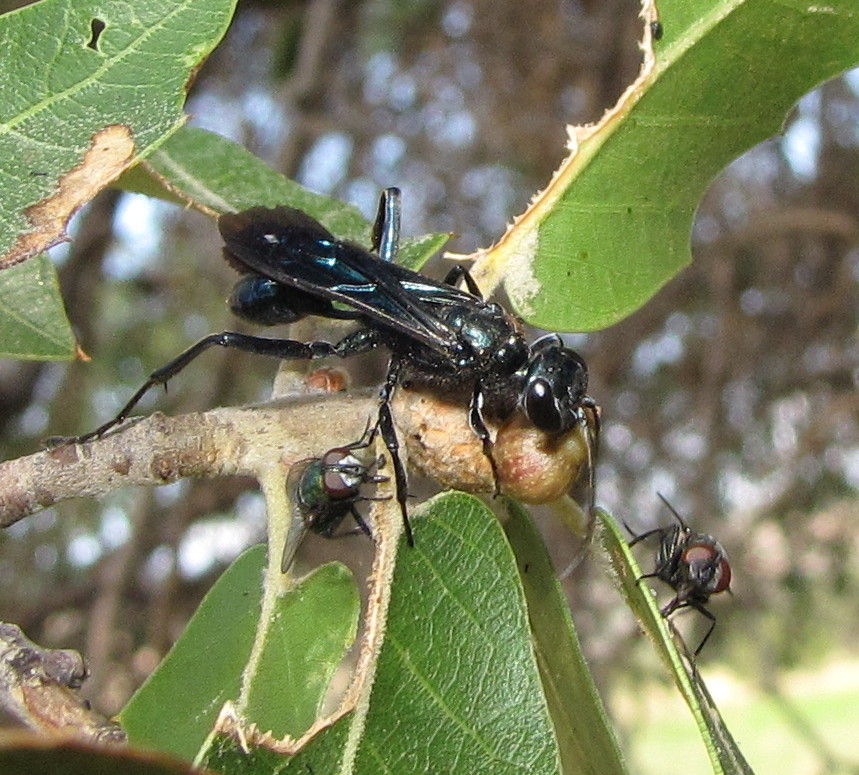
Blue Mud Dauber drinking water in Colorado, USA

Among insect architects, the Blue Mud Dauber, Chalybion californicum, is not Frank Lloyd Wright. What it does have going for it is a remodeling career. Oh, and a reputation as a fierce enemy of black widow spiders.

Female Blue Mud Dauber with paralyzed juvenile Western Black Widow in Colorado, USA

Blue mud daubers are solitary wasps in the family Sphecidae. Females take over abandoned nests of their cousin, the Black and Yellow Mud Dauber, Sceliphron caementarium, or, in many cases, evict the larval tenants and food stores of active mud nests. While Sceliphron gathers mud to make her nest, Chalybion carries water to an old nest to soften it and remold it to her needs. The result is a very lumpy version of the normally smooth Sceliphron nest.

Female Blue Mud Dauber on "renovated" nest of Black & Yellow Mud Dauber in Delaware, USA

Chalybion makes up for any engineering deficiencies with a persistent, clever, and energetic approach to catching prey. The female wasp is able to land on a spider web without getting entangled, then do a convincing impression of an insect that is in distress. She vibrates the web and draws the spider out. The poor arachnid comes dashing down a thread expecting dinner and instead seals its own doom. The blue mud dauber stings the spider into paralysis and flies it off to her nest.

A female Blue Mud Dauber in Kansas, USA begins her hunt by alighting on non-sticky threads of a cobweb weaver's snare....
Fanning her wings, she vibrates the web to simulate a struggling insect....
Now she awaits the spider's response....
Nothing....so one more try at luring the arachnid....
Success! The spider rushed to the wasp so quicly that I missed the shot. The wasp stung the spider in a nerve center and it was immediately paralyzed.
Extricating the spider from its web, she flies away with her prize.

Among the known spider hosts for the blue mud dauber are black widows, specifically the Southern Black Widow, Latrodectus mactans. For a highly entertaining account of this I recommend chapter five (“The Terrible Falcons of the Grassland”) in Hunting Big Game in the City Parks, by Howard G. Smith (New York: Abington Press, 1969). Additional spider hosts include mostly other cobweb weavers, family Theridiidae, small orb weavers (Araneidae), and the odd lynx spider (Oxyopidae), crab spider (Thomisidae), or jumping spider (Salticidae).

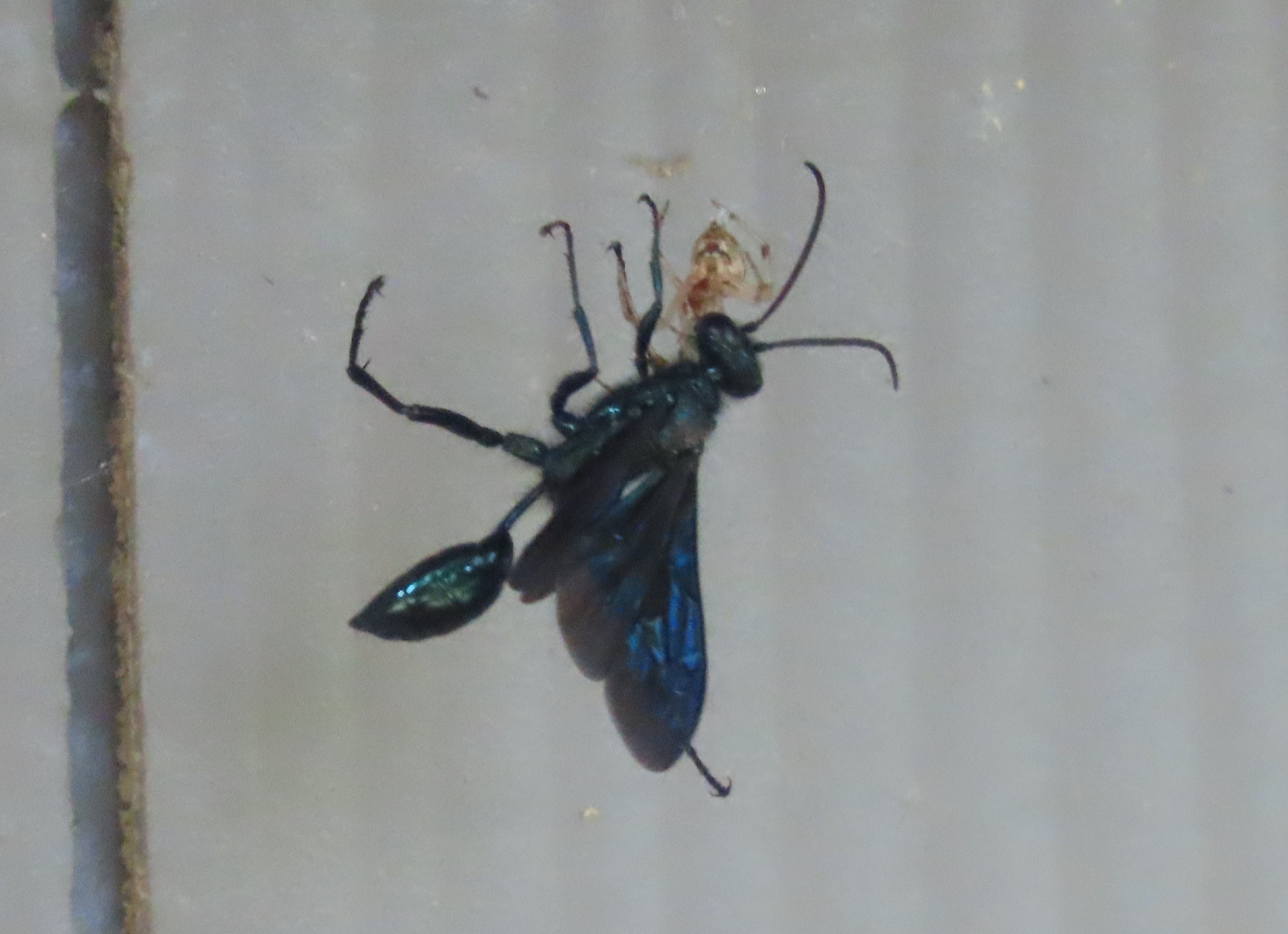
Female Blue Mud Dauber dismembering a spider in order to feed on its hemolymph (blood). I do not know how frequently the wasps do this.
Missouri, USA

Mud daubers in general stuff a multitude of spider victims into each mud cell before finally sealing it with a curtain of mud. A single egg had been laid on the very first spider stored at the bottom of the cell. The wasp larva that hatches then gradually consumes all the spiders, leaving a smattering of legs as the only indication there was ever anything else in there with them. The mature larva then spins a papery silken cocoon inside which it pupates. A few weeks later (or come spring if it was overwintering) an adult wasp chews a round hole in the end of the cell and exits. Holes in any other part of the mud nest indicate that some kind of wasp parasite chewed its way to freedom instead of the mud dauber.

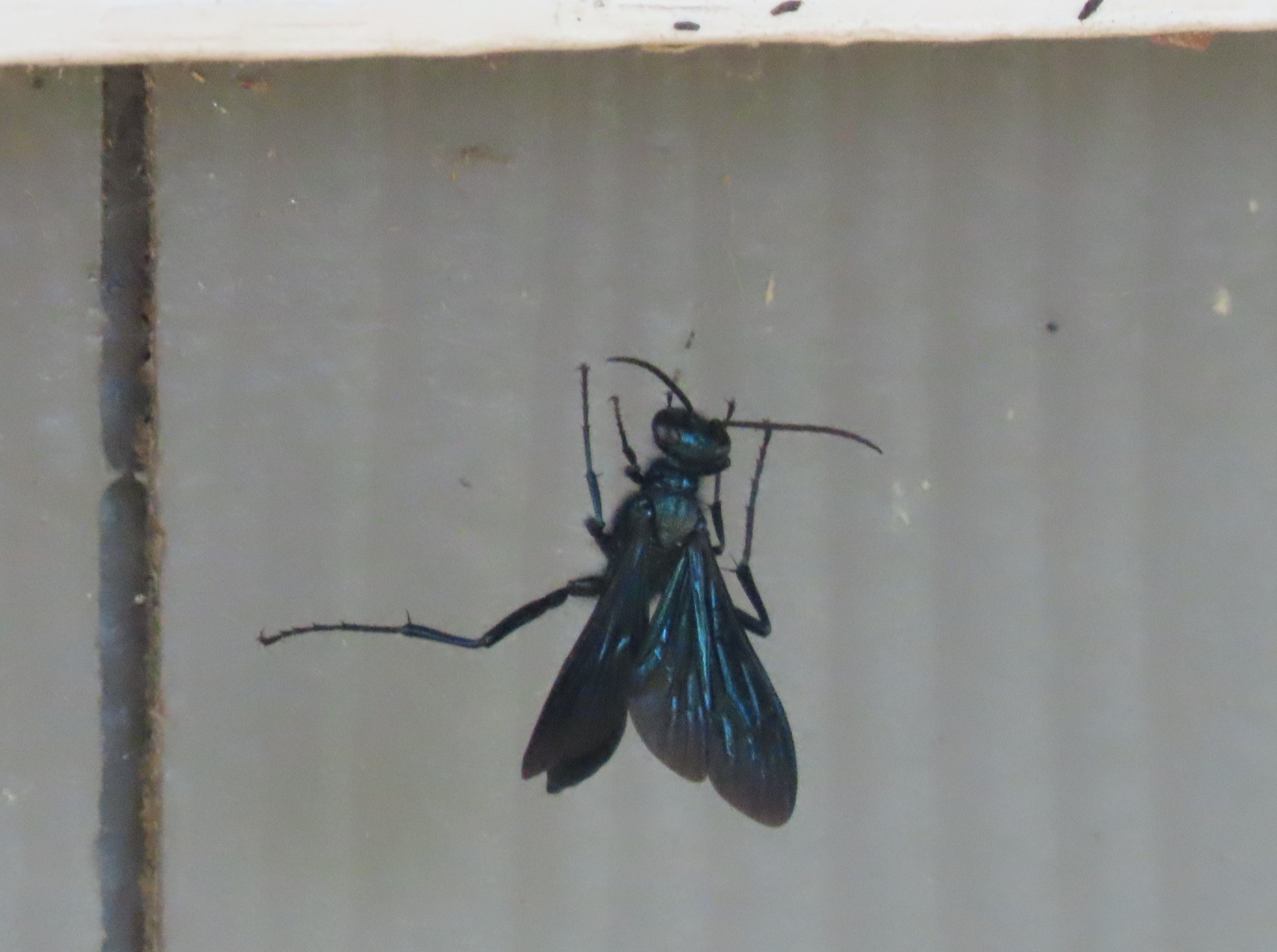
Male Blue Mud Dauber hot-footing it in Colorado, USA

Male mud daubers are far less industrious than their female counterparts. Their sole mission is to father the next generation.

Meanwhile, they are content to sip nectar from flowers or extrafloral nectarines. They also like oozing sap from wounded trees and, perhaps most of all, the “honeydew” secreted by aphids and scale insects. Both genders of mud daubers like this delicacy, which is nothing more than the sugary liquid waste produced by those sap-sucking buggers.

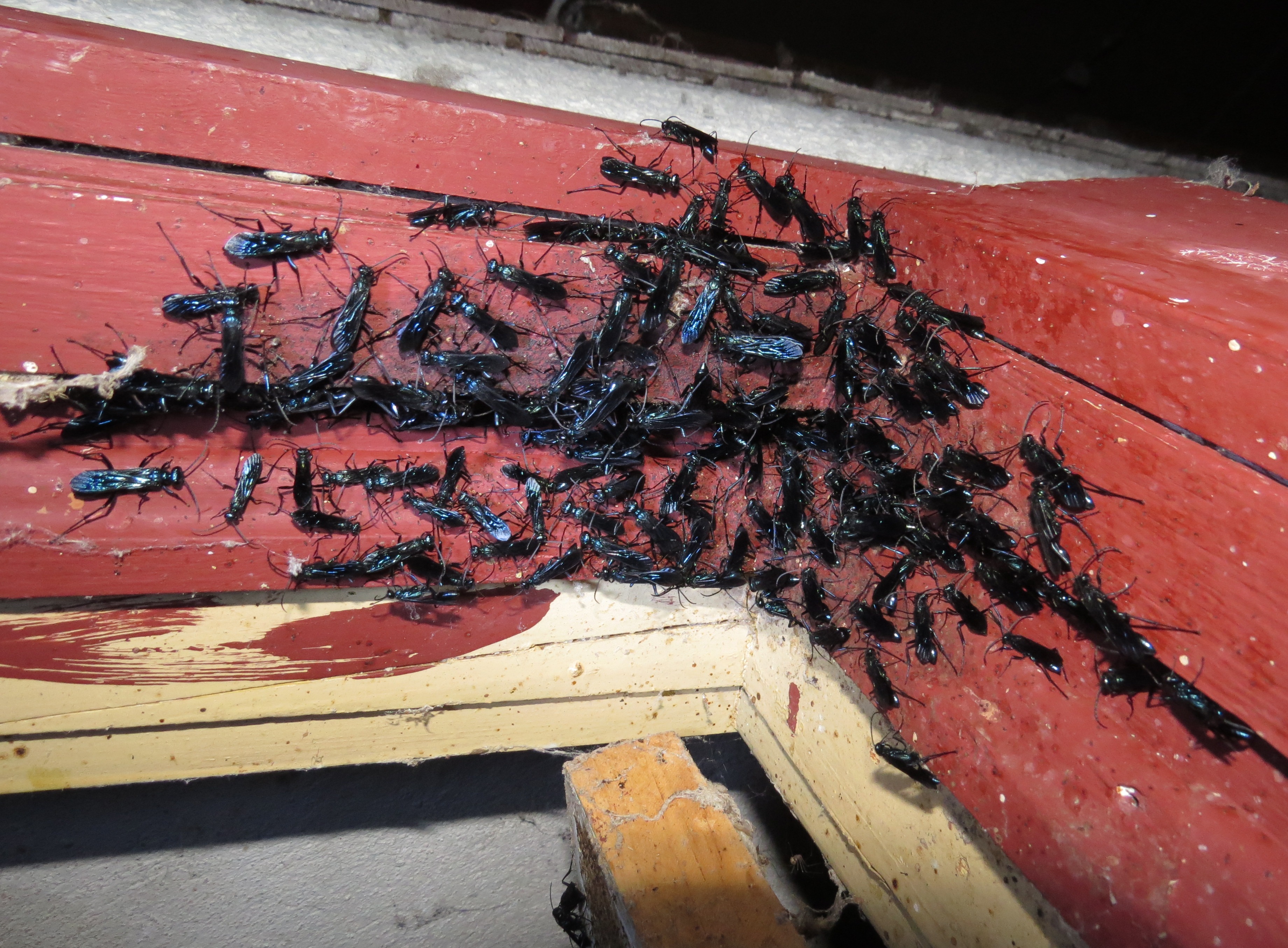
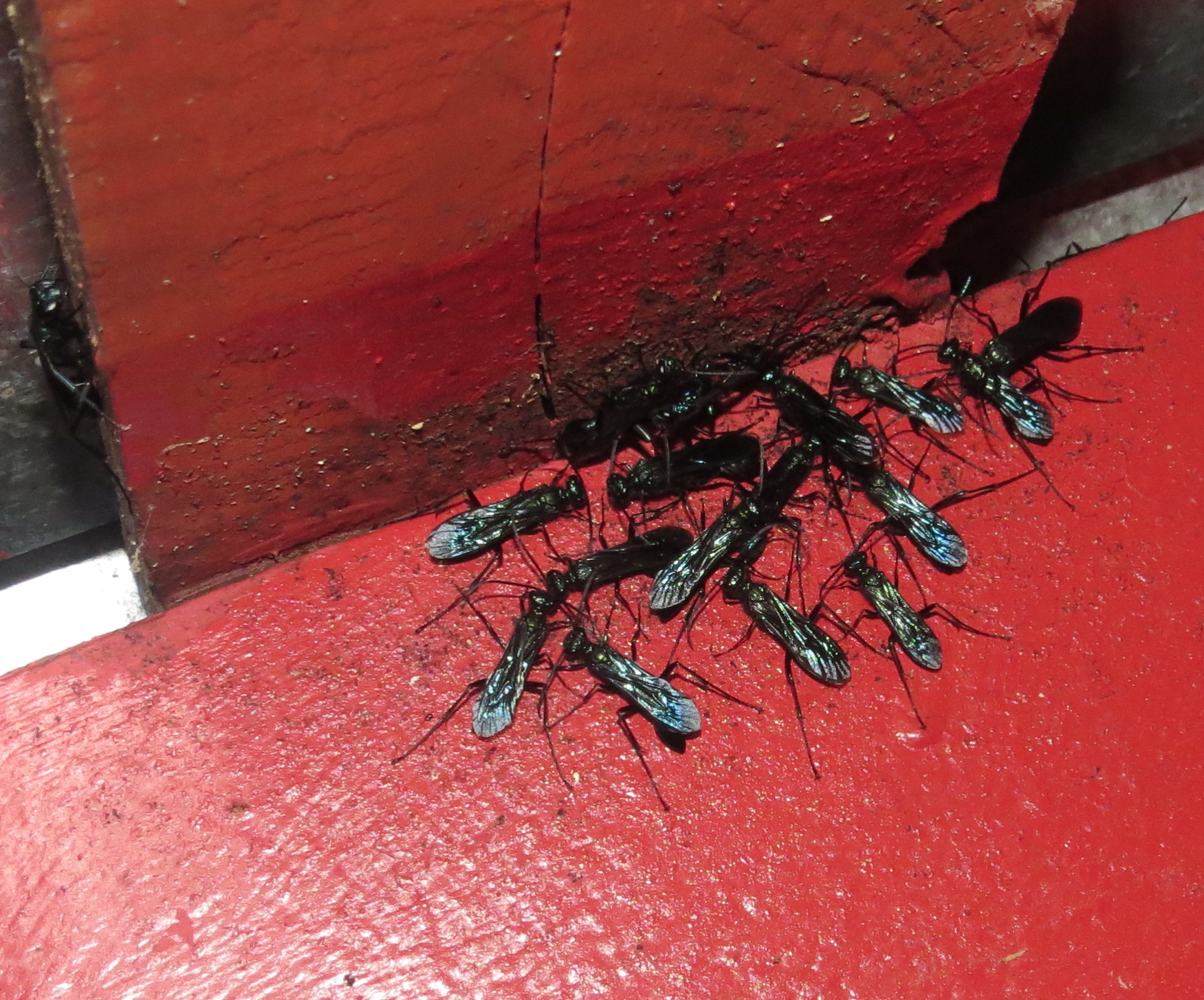
Large nocturnal congregation of male Blue Mud Daubers in a door frame in Colorado, USA

After a heavy day of drinking, males may gather in “bachelor parties” to sleep it off during the night. These congregations of normally solitary wasps can cause a bit of anxiety in people who confront them. Take a look at this image and comment thread for an example.

A smaller group of males in Georgia, USA

It should be noted that there are actually two species of Chalybion found north of Mexico. C. californicum is transcontinental in the U.S. and southern Canada, while C. zimmermanni ranges from Tennessee and North Carolina south to Florida and west to Texas, Arizona, and into Utah. I am curious as to whether these specimens I photographed in southern Arizona are C. zimmermanni given the white, not dark, hairs on the thorax; and the smoky, rather than violaceous, wing coloration (see below).

Probable male Chalybion zimmermani in Arizona, USA

Enjoy making your own observations of these wasps. They are not the least bit aggressive and, because they often nest on the exterior of buildings, are easy to watch.

Probable female Chalybion zimmermani in Arizona, USA

Sources:
Bohart, R. M. and A. S. Menke. 1976. Sphecid Wasps of the World. Berkeley: Universithy of California Press. 695 pp.
Eaton, Eric R. 2021. Wasps: The Astonishing Diversity of a Misunderstood Insect. Princeton, New Jersey: Princeton University Press. 256 pp.
Krombein, Karl V. et al. 1979. Catalog of Hymenoptera in America North of Mexico. Washington, DC: Smithsonian Institution Press. Vol. 2, pp 1199-2209.

Friday, June 24, 2022

Fly Day Friday: Biting Midges, No-See-Ums, Punkies

The list of aliases for the biting midges of the fly family Ceratopogonidae is seemingly endless, but most are apt descriptions of how tiny these insects are. I suppose I could emphasize their diminutive size by not illustrating this post at all, and leaving their appearance to your imagination....These flies certainly stretch the limits of my Canon PowerShot SX50 (and more recently SX70), so I encourage you to visit other photo resources to see the insects' true majesty.

Adult female Culicoides sp.from Colorado, USA.

Were it not for the few species of biting midges in the genus Culicoides that habitually bite humans, we might know little about them at all, aside from those that bite livestock. The majority of ceratopogonids apparently feed mostly on the hemolymph (blood) of other insects, believe it or not.

Biting midges feeding on the hemolymph (blood) of an Arizona Sister butterfly in the Huachucha Mountains of Arizona, USA

Only the females take blood meals, and in some species the females have atrophied mouthparts and do not feed on blood. Both sexes feed on nectar and other sugary liquids as well, to fuel their flights. There are at least 39 genera, with over 600 species, of Ceratopoginidae in North America north of Mexico.

© Judy Semroc

I was prompted to finally do a post about no-see-ums, in part, by an e-mail I received from my friend Judy Semroc, an accomplished wildlife photographer. She sent me images of peculiar "larvae" around the nostrils of a snapping turtle. It wasn't until the final close-up image that I was able to discern that the creatures were actually adult female biting midges, some so engorged with blood that they looked more like mites.

© Judy Semrock

Not all ceratopogonids are that small. They collectively range from one to six millimeters in body length. They are not always easy to tell apart from other families of non-biting midges, but with a little practice one can often discern the "long face" that includes a short proboscis and associated palps.

This biting midge has killed a non-biting midge in Wisconsin, USA

No-see-ums can be more than a mere nuisance. Some are known to transmit disease-causing microbes to humans and livestock. They are a principal vector of bluetongue, a virus which afflicts cattle and sheep.

In this specimen from Colorado, USA, you can see the proboscis and palps.

There is, however, at least one redeeming member of the family. A species in the genus Forcipomyia is the sole pollinator of cacao trees, the plant from which we get chocolate. Unfortunately, when tropical forests are turned into cacao plantations, the tiny flies lose the humid conditions and moist soil needed to complete their life cycle.

The life cycle of ceratopogonids usually revolves around aquatic or semi-aquatic habitats, or excessively moist conditions in otherwise dry habitats. Larvae may live under bark of decaying logs, in mosses, treeholes, sap flows, or soil. There, most feed on floral debris, algae, or fungi. Larvae in fully aquatic habitats are mostly or exclusively predatory on other small organisms.

Male biting midges, like this one from Illinois, USA, often fold down the setae on their antennae, giving them the appearance of having a mustache.

Adult male midges of many species form aerial swarms over a prominent object or landmark, to attract the attention of females. The plumose (feather-like) antennae of males function as "ears," tuned to the wingbeat frequency of approaching females. Mating usually takes place while airborne, though some species alight to copulate.

Clinohelea bimaculata, Leavenworth, Kansas, USA

Another encounter that fueled my curiosity about ceratopogonids happened just yesterday. I spotted what I initially thought was a small, skinny mirid plant bug on the surface of a leaf in our back yard. I had serious difficulty getting an in-focus image with any detail whatsoever. Reviewing the images it became clear it was not even a true bug. On a hunch I explored Bugguide.net for ornate punkies. Lo-and-behold, I found a match: Clinohelea bimaculata. It will be a state record for Kansas for both Bugguide and iNaturalist, provided I have identified it correctly.

Oh, my, I think it has prehensile "toes" (tarsal claws)!

The preceding is at best a snapshot of a highly diverse and complicated family of flies. Much is known, especially about species of economic and public health importance, but there remains much to learn.

Sources: McAlister, Erica. 2017. The Secret Life of Flies. Richmond Hill, Ontario: Firefly Books. 248 pp.
McAlpine, J.F., et al. 1981. Manual of Nearctic Diptera, Volume 1. Ottawa, Ontario: Agriculture Canada. 674 pp.
Bugguide.net
a href=http://campus.belmont.edu/cienews/cie.html>The Ceratopogonid Web Page.

Tuesday, June 21, 2022

Conflicting Advice Is Killing the Rewilding Movement

All the major figures leading the modern conservation movement agree that converting your yard into wildlife-friendly habitat is the most important and impactful thing you can do to turn the tide of bird and insect decline. As for how to do that, there is precious little agreement to be had. The result is analysis paralysis, and the “lawnscape” continues to dominate urban, suburban, and even rural areas.

"No Mow May," or "No, go ahead?"

This happened to myself and my partner. We finally own a modest home in Leavenworth, Kansas, with modest yards in front and back. Our goal is to begin planting native flora, but we were confronted with opposing recommendations on how to begin. “Kill the lawn with a single application of glyphosate” says one authority. “Suffocate it” advised another party. Heck, do we even have a lawn to begin with? Sure, there is some grass, scattered among thick patches of henbit, red deadnettle, violets, dandelions, plantain, wild….garlic?

"Before" we did anything

The result is that after over a year of living here, my wife finally took the initiative to start burying a section of the yard under a layer of carboard covered in mulch. Now we wait four to six weeks….”No, it will likely take four to six months” said someone commenting on our proud social media post. Great. Next, we will hear “till once!” versus “no, don’t till at all!”

We need to stop circulating memes and sound-bite articles in the media….We want the easy fix, but it is rarely the best avenue.

I agree that one has to be patient. Nature generally operates at a snail’s pace, while we are now too eager after having flailed in the turbulent seas of “how-to” recommendations. We should know better, of course. We should learn from our previous experiences, however few.

Here comes the cardboard and mulch!

At our previous home in Colorado Springs, Colorado, where we lived in a townhouse, we had about a 5x10 “yard” in the back, a tiny patio adjacent, and a shed, with a fence enclosing all of it. We planted milkweed in hopes of attracting Monarch butterflies. It was at least three years before the plant flowered. Oh, it proliferated underground, sending up shoots all over the place, but it was at year five before we found Monarch caterpillars. Garden gratification is seldom instant.

Where things stand right now....

We also put up a “bee condo,” a block of unfinished wood with holes of various diameters drilled into it. This effort did yield almost instantaneous results. Leafcutter bees and mason wasps began nesting. We also had sapygid wasps that parasitized the leafcutter bees. Neat fodder for blog posts.

Many experts now claim that bee condos are about the worst thing you can do. They attract parasites, become infested with mites and fungi, and are basically deathtraps for the very insect pollinators we are supposed to be helping. You need to replace the cardboard tubes inside the bored holes, if that is your style of bee block, or at least clean the cavities with a brush and dish soap diluted in water. I’m not sure exactly when you are supposed to do that….

Here in Kansas, bees simply nest in our siding. LOL!

Further, are we not giving bees and wasps enough credit for choosing healthy nest sites? They clean out cavities before they begin nesting anyway. Even in natural situations of old beetle borings in logs and dead, standing trees, there are always cuckoo wasps, leucospids, and others lurking, eager to parasitize the nests of other wasps, and bees. That is the way nature works.

Clover *does* feed the bees, and fixes nitrogen for other plants, but surely someone else will tell you differently....

Oh, I forgot about the dandelion controversy. Leave them, they are necessary resources for early-emerging pollinators. No, dandelion pollen and nectar has very low nutritional value. They do more harm than good. Do away with them….but, but….”No mow May!”

The bottom line is that recommendations will change based on new scientific research, and the collective experience of those gardening for wildlife. However, there is no one solution for every situation, every geographic location, every soil type, nor any other element that varies. We need to stop circulating memes and sound-bite articles in the media that claim otherwise. We most definitely need to stop the implied shaming of anyone who disagrees.

Daisy Fleabane "volunteers" in our yard and we are "weed tolerant."

We want the easy fix. It is in our human nature, but it is rarely the best avenue. Resist the impulse to jump on the latest bandwagon, and consult your state chapter of the Native Plant Society instead. Consult the list of noxious weeds for your state and eliminate any you find. Otherwise, be “weed tolerant” and see if most of those plants volunteering themselves are actually native wildflowers. Never use pesticides, fungicides, herbicides, or even fertilizers. Indeed, the soil is itself an ecosystem of microbes, and symbiotic fungi that enhance the vigor of plants.

Here at Bug Eric blog, I promise to continue sharing my own experiences, good and bad, and recommend dependable resources to further your own pursuit of biodiversity enhancement. Let me know what has worked (or not worked) for you. I will pass that along as well. Above all, please act, with whatever information you have already garnered. The inertia of inaction is the enemy of rewilding.