Wednesday, October 20, 2010

Wasp Wednesday: Odontocolon

When I was in western Massachusetts last fall, the neighbors across the street in South Deerfield had to have a dying maple tree removed. I came home one evening to find the tree in pieces, neatly cut by a chainsaw. Naturally, I wanted to investigate the insect fauna of the new deadfall. Among the creatures to be seen on those early October days were ichneumon wasps of the genus Odontocolon.

Many thanks go to Bob Carlson, an expert on the family Ichneumonidae who recognized the genus from my images. He has almost single-handedly organized the pages and pages of ichneumons over at Bugguide.net.

Odontocolon is one of four genera in the subfamily Xoridinae. All are recognized as parasites of wood-boring beetles and/or Hymenoptera. There are 23 species of Odonotcolon found north of Mexico. Several are “holarctic,” meaning they are native to the entire northern hemisphere. The genus is recognized in part by the teeth on the hind femur. Females have long ovipositors (see image above), while males do not (see below).

Those ovipositors come in handy since the wasp has to drill into the wood to reach her target. Cutting down the maple tree exposed several grubs of longhorned woodborers (Cerambycide) lying on the stump.

Maybe this is what the wasps were after, but they ignored the helpless beetle grubs out in the open. Perhaps the wasps knew those grubs would be bird food any minute, or would die in some other fashion before the larval wasps could make meals out of them. In any event, I was able to witness one female ovipositing in the stump.

An egg is laid on the living beetle grub, and the female then withdraws her ovipositor to go looking for another host. The larva that hatches from her egg lives as an external parasite on its host, taking its time as the host itself matures. Sometimes a female wasp will oviposit on the pupa of the host, rather than the grub. The result is the same: her larval offspring will consume the host and emerge from the host’s pupa.

Many other ichneumon wasps are parasitic on wood-boring insects, the most spectacular being the giant ichneumons in the genus Megarhyssa which I wrote about last year, before I started “Wasp Wednesday.” Autumn is the perfect time to look for ichneumons on dead and dying trees, so go take a look.

Saturday, October 16, 2010

Butterfly Time (Part 1)

The seventh annual installment of “Butterfly Magic” opened last Monday at the Tucson Botanical Gardens. The live, flying butterflies (and a few moths) will be occupying the tropical greenhouse through April, 2011, open daily from 9:30 AM until 3:00 PM, save for the obvious holidays.

This year I find myself in the position of Assistant Butterfly Curator, but Dr. Elizabeth Willott, Curator of Butterflies, is the person responsible for the success of this event. We also owe an enormous debt of gratitude to the many volunteers who actually staff the exhibit day in and day out, and who ensure that the butterflies make it from the Chrysalis Room to the greenhouse. More importantly, they make sure no butterflies escape the confines of the greenhouse. They also interpret the exhibit, sharing their knowledge of the insects with visitors and making sure our human guests have a pleasant experience. The volunteers also protect the butterflies from unintentional harm at the hands of overzealous visitors.

Our first shipment of butterfly chrysalids (pupae) arrived Friday, October 1. Elizabeth and I picked them up from the nearby FedEx store where they arrived via overnight shipment from a butterfly distributor in Denver, Colorado. At some point I hope to document the receiving and handling such shipments and sharing that with all of you. It is a very labor-intensive process. October first’s extraordinarily hot temperatures may have spelled doom for many of the specimens in the shipment. We humans were certainly sweating our way through sorting and pinning them. I finished the day pretty dehydrated and a bit light-headed.

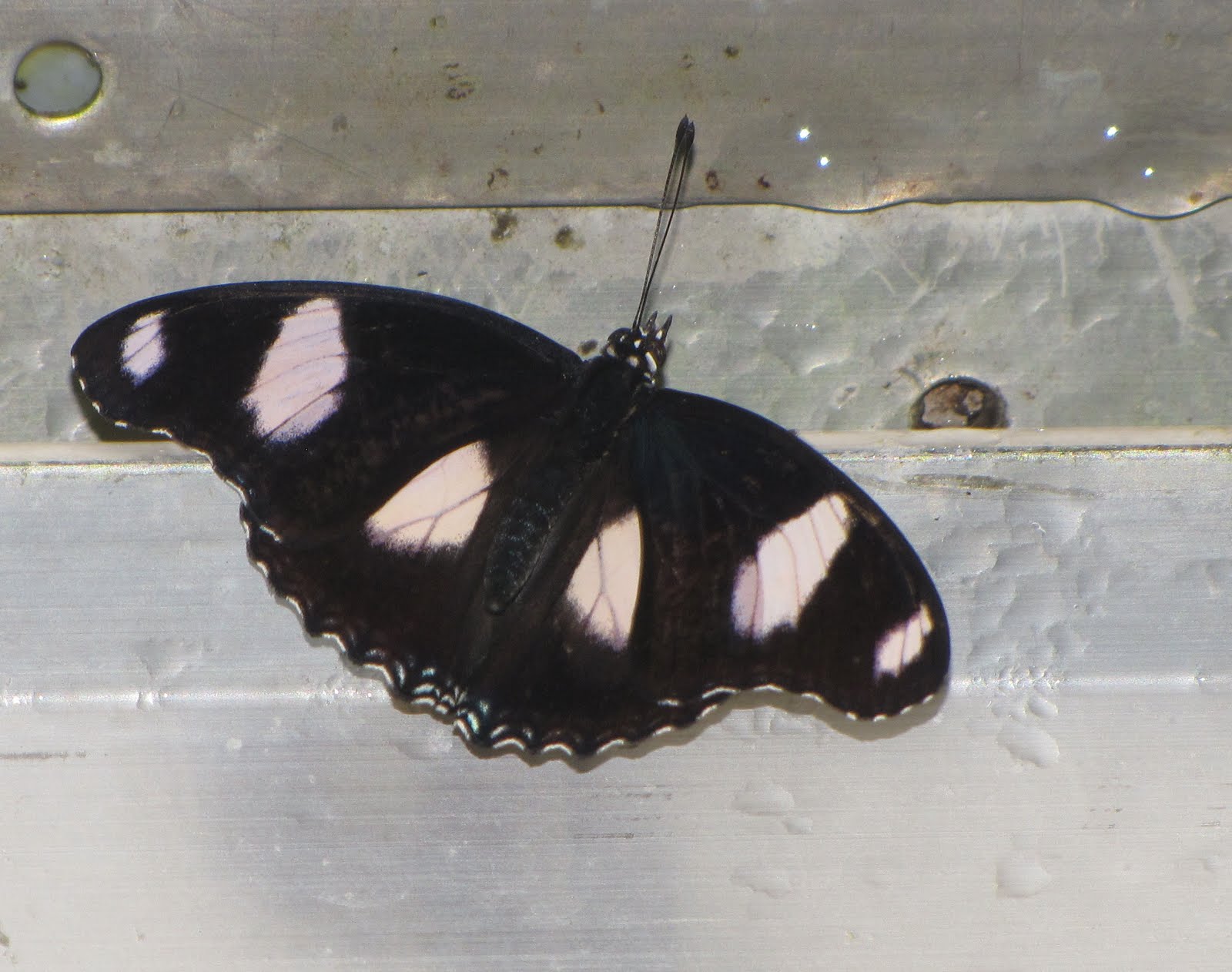
The end result is worth the trouble, though. Among our first crop of butterflies was the Danaid Eggfly or “Mimic,” Hypolimnas misippus. The females (see image above) mimic the African Monarch and other distasteful butterflies. The males, on the other hand, look radically different (image below). Yes, those really are the same species!

Among the most populous of our new arrivals is the Mocker Swallowtail, Papilio dardanus. As you might have guessed from the common name this, too, is a species exhibiting dramatic sexual dimorphism. The females lack tails, looking very much like the milkweed butterflies they are impersonating. Males have the familiar “tails” on the wings and are boldly marked with black and white on the top side of the wings. Here is a mating pair (below).

Enjoy this species while you can, as it was denied on our United States Department of Agriculture (USDA) permit this year. Fortunately, that decision was not retroactive to our current permit with our U.S. distributor. We will be unable to import Papilio dardanus directly from its native Africa from now on, however. The caterpillars feed on citrus and are thus deemed a potential threat to that industry.

Yet another spectacular butterfly on show is the Flame-bordered Charaxes, Charaxes protoclea. It, too, is a native of Africa. This is a powerful flier, its robust body packed with muscles to operate those fiery wings.

Be sure to check out images of some additional species in Part 2 of this article, over at ”Sense of Misplaced”. Thanks, hope to see you pass through the Tucson Botanical Gardens one of these days.

Wednesday, October 13, 2010

Wasp Wednesday: Leucospis

Most members of the superfamily Chalcidoidea are very tiny parasitic wasps. The leucospids, family Leucospidae, are veritable giants by comparison. They are so large they are easily mistaken for mason and potter wasps, right down to their ornate black and yellow markings, and the way the front wings are folded longitudinally when not in use.

The six North American species in the family Leucospidae all belong to the genus Leucospis. They range in length from 3-14 mm, but are easily identified as chalcids by the greatly swollen and toothed hind femora (“thighs”). They are widely regarded as uncommon or even rare wasps, but in my experience they are quite common, just easily overlooked, or dismissed as yet another mason wasp. Look for them sipping nectar from flowers like wild carrot. Females (pictured above) have a slender ovipositor that curls back over the top of the abdomen. Males (see image below), are smaller and lack the egg-laying organ.

Leucospids are external parasites of other solitary wasps, and also solitary bees. That is to say, they are parasites in their larval stage. Adult females lay their eggs in the nests of their hosts. This may mean that the female is drilling through the dead wood of a hollow twig to reach the host’s nest cells inside. The most common and widespread North American species, Leucospis affinis, is primarily a parasite of megachilid bees including leafcutter bees (Megachile), mason bees (Osmia), and resin bees (Dianthidium). These bees all frequently nest in hollow twigs or similar pre-existing cavities that they partition into cells.

The first larval leucospid to hatch in a cell of the host nest has one mission at the outset: eliminate the competition. The larva will seek and destroy any other leucospid larvae or eggs that occupy the same cell. The wasp larva then attaches itself to the bee larva and begins slowly sucking it dry. The bee larva will mature enough to spin a cocoon around itself and its wasp larva parasite, but it will never become an adult bee. The leucospid larva finishes off the bee larva, leaving an empty husk. Observations of the life cycle in situ and in the lab show that development is fast: A leucospid larva matures in about seven to twelve days after hatching from its egg, pupating in another five days inside the cocoon prepared by the now-deceased bee larva. An adult wasp emerges from the pupa in 9-14 days (or overwinters in the case of late-season generations). The size of a given individual adult leucospid varies according to the size of the host larva it was a parasite of.

Much remains to be learned about these wasps, and their impact on native pollinators like the leafcutter bees. Your own personal observations could prove quite insightful and valuable. Meanwhile, check out the amazing life cycle images in the Universal Chalcidoidea Database, and additional images of adults at Bugguide.net.

Sources: Krombein, Karl V. 1967. Trap-nesting Wasps and Bees: Life Histories, Nests, and Associates. Washington, DC: Smithsonian Press. 570 pp.
Goulet, Henri and John T. Huber. Hymemoptera of the World: An Identification Guide to Families. Ottawa, Ontario: Agriculture Canada. 668 pp.