Thursday, April 25, 2013

Speckle-winged Grasshopper

It is “OrThoptera Thursday,” and time to introduce you to a common springtime grasshopper, the Speckle-winged Grasshopper. It goes by Arphia conspersa in scientific circles.

Ordinarily, I would be seeing fair numbers of this insect by now, and indeed they are slowly becoming more abundant as the weather warms from an unseasonably cold early spring here along the Front Range of Colorado. Warmer enclaves have more activity, such as around Pueblo and Cañon City. Last year I saw adults of this species on February 29, but then again we hardly had a winter.

Arphia conspersa is very widespread in its distribution, occurring from the Great Plains westward, north to central Alaska and south to central Mexico. It exploits a variety of habitats, from meadows up to 11,000 feet in elevation to desert canyons. Pastures, open fields, and vacant lots are where one is most apt to encounter it, even in highly urbanized areas.

Identifying the Speckle-winged Grasshopper can be surprisingly difficult because there is so much variation from one individual to the next. The overall color may be brown or grey with varying degrees of darker mottling. Many specimens sport a bright yellow “racing stripe” down the back when the wings are folded at rest. The tibia (“shin”) of the hind leg is often bright yellow (as can be the abdomen of males), but the tibia is usually concealed under the edge of the femur (“thigh”) unless the grasshopper is walking.

This species is one of the “band-winged grasshoppers,” named for the pattern on the hind wing. Unfurled, the hind wing is brightly-colored at the base, with a dark submarginal band across the outer reaches. The hind wing of Arphia conspersa may be colored yellow, orange, red, or even pink, but is only visible during the short flights made by the insect.

Males of the Speckle-winged Grasshopper are more likely to be heard than seen. Part of the courtship involves what are called “appetitive” or “crepitation” flights. The male purposely flies a short distance, making a loud crackling sound at will in the process. This visual and audible display apparently attracts the attention of the female.

A male can detect a female from a distance of at least two feet when both are on the ground. Considering how incredibly well camouflaged these insects are, that is no mean feat. He will approach by running, stopping and stridulating, and then repeating the process until he is next to his prospective mate. Stridulating is accomplished by rubbing the inside of the hind femur against ridges on the folded front wings. A faint chirping noise is generated by stridulating. Once in close proximity, the male orients to the female face-to-face, and they wave their antennae at each other. More complexities then ensue before she decides whether to accept his advances.

Mated females select patches of bare earth in which to lay their eggs. The abdomen of the female is capable of telescoping at least two inches while inserted into the ground. At that depth she deposits a pod of about twenty eggs.


female ovipositing in soil

Nymphs of Arphia conspersa begin hatching from the eggs in about mid-July, and go through a total of five instars (an instar is the period between molts) before reaching adulthood. The nymphs typically get to that fifth instar in late autumn, then overwinter. Exactly how they manage to survive is something of a mystery, but experiments have shown at least some specimens can withstand temperatures of -16°C for short periods.


nymphs

The fact that this is one of the few larger grasshoppers to be found as an adult in early spring makes its identification a bit easier. There are simply fewer similar species to confuse it with. Thankfully, this insect is never abundant enough to be a pest, either, even though it certainly consumes a fair amount of forage in the form of grasses and sedges.

Source: Branson, David, et al. 1994. “Speckle-winged Grasshopper, Arphia conspersa Scudder,” Wyoming Agricultural Experiment Station Bulletin 912.

Wednesday, April 10, 2013

Changing Course

You, dear reader, deserve an explanation for my recent absence. Lately, I find myself increasingly disillusioned about whether to continue this blog. The possibilities for posts are endless, that is not the problem. Whether I am simply “preaching to the choir” is one concern, but continuing to provide these posts for free is a much more pressing issue.

The response has been good, and I continue to get praise for which I am genuinely grateful. Honest, I truly appreciate that you appreciate what I do. However, my life has changed dramatically since I first began this blog. I got married, and with that blessing comes the added responsibility of providing at least a modicum of a financial contribution to the relationship. I do not have a traditional “job” of any kind, and those are becoming harder to come by anyway. My revenue stream is drying up as magazine markets for my writing continue to dwindle, either folding outright or ceasing to use freelancers. Almost nobody with an internet presence is willing to pay for content.

It becomes tiresome and guilt-generating to be begging for donations to this blog. I am not PBS or NPR. It is not my intent to coerce monetary remuneration from anyone who follows this blog. For all I know, most of you are in the same boat I am in, unable to spend much on anything but essentials and the odd splurge of a dinner out.

The other problem I face is purely personal. I am prone to mild depression and anxiety, and my writing suffers periodically because of that. I know that I have also grown weary of providing “virtual” experiences online and would much rather be getting together with my colleagues and “fans” in the field where we can look at actual, living organisms. There is no substitute for sharing in the real world.

I need your help to become the “go-to guy” for entomology at nature festivals, Master Naturalist workshops, ecotours, and other events. I need to be pointed toward hidden markets for my writing, too, from regional and local magazines to book publishers.

For the time being at least, posts here will be sporadic as I concentrate my efforts on finding projects and clients that have at least slight economic potential. You have my apologies, but I hope that I have your understanding. Thank you.

Thursday, March 21, 2013

OrThoptera Thursday: Northern Green-striped Grasshopper

No sooner has the grass sprung up in the early spring than there are insects out to eat it. Walk through an open field or meadow and you may be surprised to find that you are startling grasshoppers into flight already. At least they will be hopping. Several species of grasshoppers (family Acrididae) overwinter as older nymphs and mature quickly once temperatures warm consistently and the days lengthen. One of those early season species is Chortophaga viridifasciata, the Northern Green-striped Grasshopper.


Adult female, Colorado Springs

Last year in Colorado Springs I found nymphs of this species along an urban trail on March 10; and adults in an open field on March 27. This year, which has seen a rollercoaster of temperature extremes, I suspect they will mature later.


Nymph, Colorado Springs

Chortophaga viridifasciata is rather variable in color and pattern, which makes it difficult for the average person to identify. Its early appearance is one clue. A distinguishing physical feature is the pronotal ridge, which is strong, straight, and broken by only a single sulcus midway along its length. The pronotum is the top surface of the thorax, and the ridge runs right down the middle, lengthwise. In profile, the ridge is evenly straight. It is at least somewhat arched in early season Arphia species.

Females of the Northern Green-striped Grasshopper are larger (28-38 millimeters) and heavier-bodied than males, and are usually green with brown markings. Males (23-30 millimeters) are mostly brown with few if any green markings. Below is an image that shows males from the same population can still be brown or green.

When the grasshopper flies, the hind wings are exposed. They are pale yellow in color at their base, with the outer half smoky brown to nearly black. This also contrasts with similar Arphia species that have the hind wings bright yellow, orange, pink, or red. Flight covers a short distance, but may be noisy. Male band-winged grasshoppers in general (subfamily Oedipodinae) are capable of making “crepitation flights” whereby the front and hind wings snap together rapidly to make a crackling noise. This is accomplished at the grasshopper’s will, so other flights can be silent. Crepitation flights are often associated with courtship displays, but not always, and females of some species can crepitate as well.


Male from South Carolina

C. viridifasciata is an abundant grasshopper found east of the Rocky Mountains from southern Canada to northern Central America. It also creeps into Arizona and Idaho, with scattered records in extreme southeast British Columbia. The preferred habitat is wet areas with short grass. While there is only one generation in most of its range, there can be two generations in southern areas, where the adults can overwinter.

Southern populations have been considered a separate species, C. australior, but there is reason to suspect this is an artificial distinction. The “two” certainly overlap as far north as the Ohio River Valley and Nebraska. Where there are two generations of C. viridifasciata, the later generation tends to resemble C. australior. Many authorities still separate the two, with C. australior confined in its range to the southeast from Georgia to Florida and west to east Texas.

The only other species in this genus are C. Mendocino, found in Mendocino County, California; and C. cubensis found in Cuba.


Male from western Massachusetts

Be on the lookout for this grasshopper where you live. Even in New England they are likely to be out by the end of May at the latest, and March or April in most other locations.

Sources: Capinera, John C., Ralph D. Scott, and Thomas J. Walker. 2004. Field Guide to the Grasshoppers, Katydids, and Crickets of the United States. Ithaca, NY: Comstock Publishing Associates (Cornell University Press). 249 pp.

DiTerlizzi, Tony and Dave Ferguson. 2012. “Genus Chortophaga,” Bugguide.net.

Tuesday, March 19, 2013

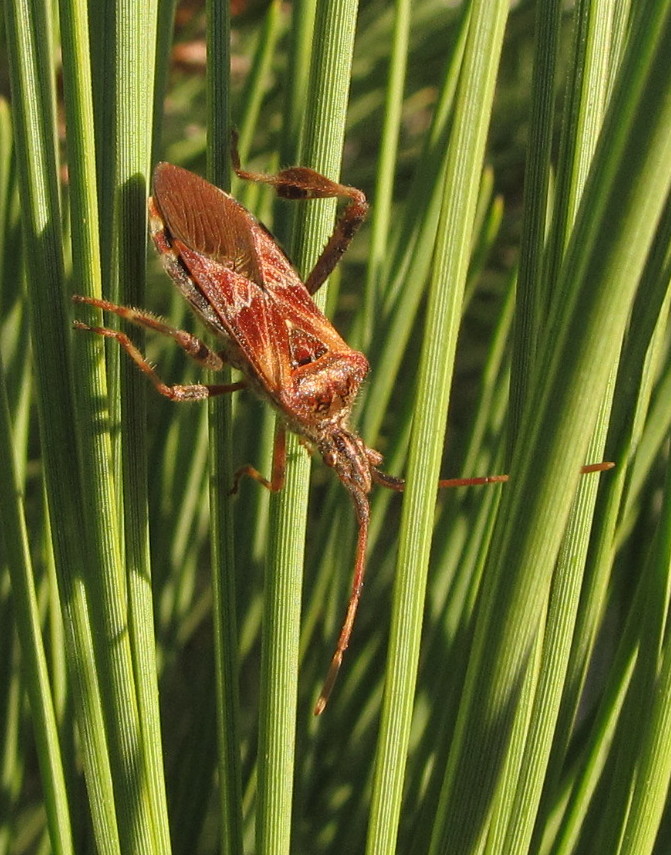
True Bug Tuesday: Exporting the Western Conifer Seed Bug

We spend a great deal of time and energy in the U.S. wringing our hands over invasive species from Europe and Asia, but we forget we sometimes export our own pests in return. Last week, a thread emerged on the Entomo-l listserv from a doctoral student in France who inquired about how to control the Western Conifer Seed Bug, Leptoglossus occidentalis. Seems it was first detected in Europe in northern Italy in 1999, but has since spread through most of the continent. It was first found in the United Kingdom at Weymouth College in Dorset in January, 2007.

This rapid colonization should come as no surprise. Here in its native North America, the WCSB has shown the same propensity for expanding its range. Once confined to the western U.S., it began creeping eastward in the 1950s. By the 1990s it had reached the east coast.

Leptoglossus occidentalis is generally considered at most a nuisance pest that likes to spend the winter inside homes where it emerges at inopportune times, flies with a loud droning noise, and produces a disagreeable (to some people at least) odor when accosted.

The conversation on Entomo-l revealed that the bug is not always so innocuous. It has beak-like mouthparts and it can pierce polyethylene (PEX) tubing used in plumbing and radiant heating. The bugs secrete a protein in their saliva that forms a protective sheath around their mouthparts while they feed, and this sheath is left behind as evidence. Hence, investigators were able to sleuth the culprit in the case of the “weeping” pipes that lose water through the pinhole punctures caused by bugs exploring novel surroundings (Bates, 2005).

Obviously, a much more pressing concern for our friends abroad is the prospect of WCSB becoming a forest pest. They feed on seeds inside the cones of conifers, especially pines but also Douglas Fir and Eastern (Canadian) Hemlock. They rarely cause significant damage in natural stands, but are a potential problem in conifer seed orchards.

Indeed, laboratory studies show that late-season feeding in particular can have adverse effects, reducing the storage reserves of lipids and buffer-insoluble (crystalloid) proteins by up to 78% and 97% respectively in seeds of Douglas Fir (Bates, et al., 2001). WCSB certainly impacts second-year cones in orchards. Seed production can be reduced by 75% in Lodgepole Pine under some circumstances (Bates, et al., 2002).

Our collective desire for “free” trade and global commerce guarantees that we will continue to exchange fauna and flora that could become problematic outside their native regions. Are we properly informed of the risks? One is left to wonder about the consequences.

Sources: Bates, Sarah L., Cameron G. Lait, John H. Borden, and Allison R. Kermode. 2001. “Effect of feeding by the western conifer seed bug, Leptoglossus occidentalis, on the major storage reserves of developing seeds and on seedling vigor of Douglas-fir,” Tree Physiol. 21: 481-487.
Bates, Sarah L., Ward B. Strong, and John H. Borden. 2002. “Abortion and Seed Set in Lodgepole and Western White Pine Conelets Following Feeding by Leptoglossus occidentalis (Heteroptera: Coreidae),” Environ. Entomol. 31(6): 1023-1029.
Bates, S.L. 2005. “Damage to common plumbing materials caused by overwintering Leptoglossus occidentalis (Hemiptera: Coreidae),” Can. Entomol. 137: 492-496.
Taylor, Steven J., Gluseppi Tescari, and Mauro Villa. 2001. “A Nearctic Pest of Pinaceae Accidentally Introduced Into Europe: Leptoglossus occidentalis (Heteroptera: Coreidae) in Northern Italy,” Ent. News 112(2): 101-103.