Showing posts with label pests. Show all posts

Sunday, July 17, 2022

What is, and is NOT, a Japanese Beetle

It is that time of year again in North America when everything is a Japanese Beetle. No matter whether you are a trusted and reliable expert, other people will insist that Green June Beetles, Fig Beetles, Dogbane Leaf Beetles, and various other beetles, are in fact Japanese Beetles. Why is this the case? There is much misinformation online and in the media. Family, friends, coworkers, and others present themselves as experts and make incorrect identifications. Mobile phone "apps" can also be misleading, given the relative infancy of image recognition software and deep learning, which frequently compounds errors instead of correcting them. Here is everything you need to know about how to recognize the Japanese Beetle, Popillia japonica, as well as lookalike species.

L-R: Japanese Beetle, Green June Beetle, Emerald Flower Scarab

The Japanese Beetle, as its name implies, occurs naturally in Japan and northern China. An accidental introduction of this species to New Jersey in 1916 is apparently what launched the beetle's domination of yards and gardens over most of the eastern United States and southeast Canada. It delivers a double whammy to urban and suburban areas by feeding on the roots of turf grasses in its subterranean larval (grub) stage, and on the foliage of more than three hundred (300) species of plants as an adult insect. The beetles are "skeletonizers," leaving a net-like pattern of leaf veins in the wake of their chewing. Grape and rose are among their favorites.
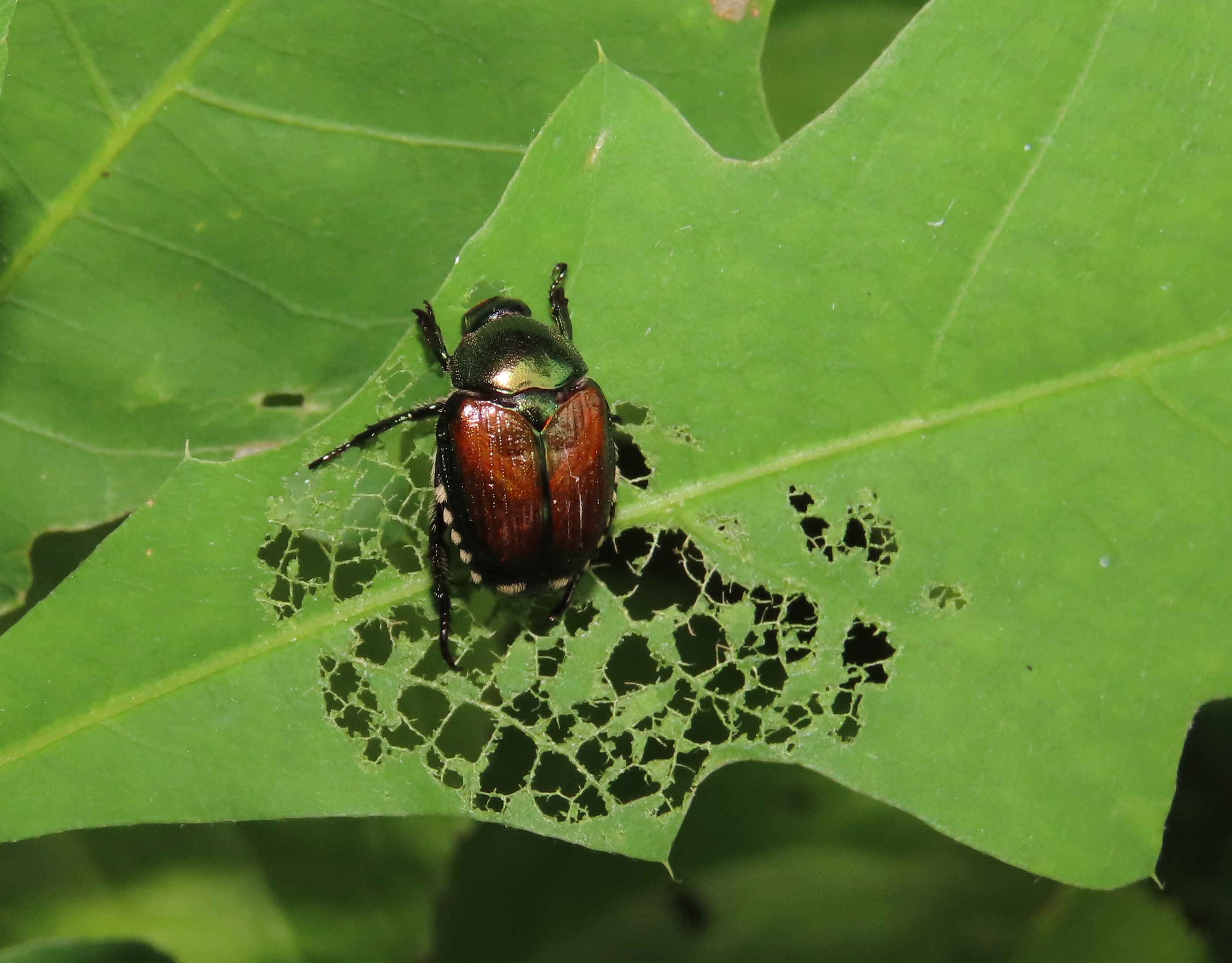
Typical "skeletonizing" damage by Japanese Beetle

Japanese beetles are classified as scarab beetles, in the family Scarabaeidae, subfamily Rutelinae, collectively known as the shining leaf chafers. The adults become suddenly abundant about mid-summer. They fly well, quickly dispersing themselves over the landscape. Their sheer numbers, the telltale pattern of damage they do to foliage, their size, and their behavior help to make them easy to identify with a little practice.

Japanese Beetles congregating and mating

These are smaller insects than you might expect, ranging from 8.9-11.8 millimeters in body length. That is less than half an inch. They vary in color by individual and age, but most are shining metallic green and red. The flanks of the abdomen are adorned with tufts of white hairs, a feature no other lookalike beetle has. The elytra (wing covers) are striated (have grooves), which also helps set them apart from similar beetles. The hind legs are long and stout, with sharp spurs coming from the tip of the tibial segment (think "shin"). When disturbed, Japanese beetles will flare their hind legs out and up, presenting their spiked weaponry. They can give you a good prick should you insist on seizing one.

Japanese Beetle in defensive pose

The antennae of adult Japanese Beetles are short, with a series of leaf-like plates at the tip, typical of all scarab beetles and their allies. The term for this style of antenna is "lamellate" for "plate-like." The plates are covered in receptors that are tuned to species-specific pheromones for locating others of their kind. Pheromone traps, sold commercially, work well if your goal is to draw even more Japanese Beetles to your yard or garden. Hand-picking the insects and drowning them in pails of water, with a dash of dish soap to break the surface tension, may be the best way to control them. Time consuming for certain, but highly specific to the target pest, and otherwise environmentally friendly.

Green June Beetle, Cotinis nitida

The number one victim of mistaken identity in the Japanese Beetle game is far and away the innocuous Green June Beetle, Cotinis nitida, another scarab beetle that is native to the United States. This insect is much larger, at 15-27 millimeters in size. It is mostly matte green with some degree of iridescence in the right light, especially on the insect's underside. It may or may not be marked with ochre trim, and lines on the wing covers. You may hear these beetles before you see them, as they fly loudly. Green June Beetles, and their relative, the Fig Beetle (Cotinis mutabilis), are classified as "flower chafers" in the subfamily Cetoniinae. They have a special hinge on each wing cover that allows the elytra to remain closed while the membranous hind wings are deployed for flight. Consequently, flower chafers bear a great resemblance to large bees while cruising around looking for food or mates. Green June Beetle feeds on flower nectar and pollen, but occasionally damages ripe fruit; and they also feed on fermenting sap from wounds on trees. This makes them a mild pest under circumstances of orchards and nurseries. As grubs, Green June Beetles feed on decomposing organic matter. You will often see females diving headlong into compost and manure heaps to lay their eggs. In nature they look for rich humus.

Emerald Flower Scarab

Another flower chafer sometimes mistaken for a Japanese Beetle is the Emerald Flower Scarab, Euphoria fulgida. This beautiful beetle measures 13.4-19.8 millimeters. It is often highly active and quicker to fly than the other beetles mentioned so far. It varies considerably in color according to both the individual and the geographic locality it lives in. Specimens from the foothills of the Front Range in Colorado, for example, are deep purple and brilliant turquoise.

Dogbane Leaf Beetle

Recently, I had a....disagreement with someone in social media about the identity of yet another beetle, the Dogbane Leaf Beetle, Chrysochus auratus. At 8-13 millimeters, it approximates the size of a Japanese Beetle. It is superficially colored the same, too, being brilliant metallic green, red, blue, bronze, or copper, depending on the angle of light hitting the creature. That is where the similarity ends. The Dogbane Leaf Beetle belongs to a completely different family, the Chrysomelidae. One look at the long, uniformly segmented antennae, tells you it is not a scarab. Its legs are not armed with spines or teeth, and it has cute, wide little feet for gripping plants. Most decisive, however, is the food preference for this species. Dogbane Leaf Beetle feeds only on....surprise....dogbane. You may occasionally encounter an individual that has alighted on some other plant in the course of trying to find a mate or another dogbane plant, but there will never be large numbers of them on anything but dogbane.

Female Tiphia wasp searching for buried scarab grubs

All manner of control strategies have been applied to the Japanese Beetle, yet here it is, still with us, in arguably greater numbers than ever, and steadily expanding its empire. We have imported the Spring Tiphia wasp, Tiphia vernalis, from China in 1925, a natural enemy. The female wasp digs up a beetle grub, stings it into temporary paralysis, lays an egg on it, and abandons it. The larval wasp that hatches feeds on the grub externally, eventually killing it. We also employ Bacillus popilliae, known better as "milky spore disease" to combat the grubs. The bacterium turns the beetle larvae a milky white color in the process of killing them, but it also affects native scarab grubs.

A large robber fly, Laphria lata, has skewered a Japanese Beetle on its proboscis

Be careful in how you control Japanese Beetles, lest you adversely impact garden allies. Assassin bugs, particularly the Wheel Bug, and robber flies, are among the chief predators of Japanese Beetles, but they need as natural a landscape as possible to proliferate and be effective controls. Invasive species are an artifact of global consumerism, and coveting thy (foreign) neighbor's flora. Resist the temptation and help prevent the next pest from gaining a foothold.
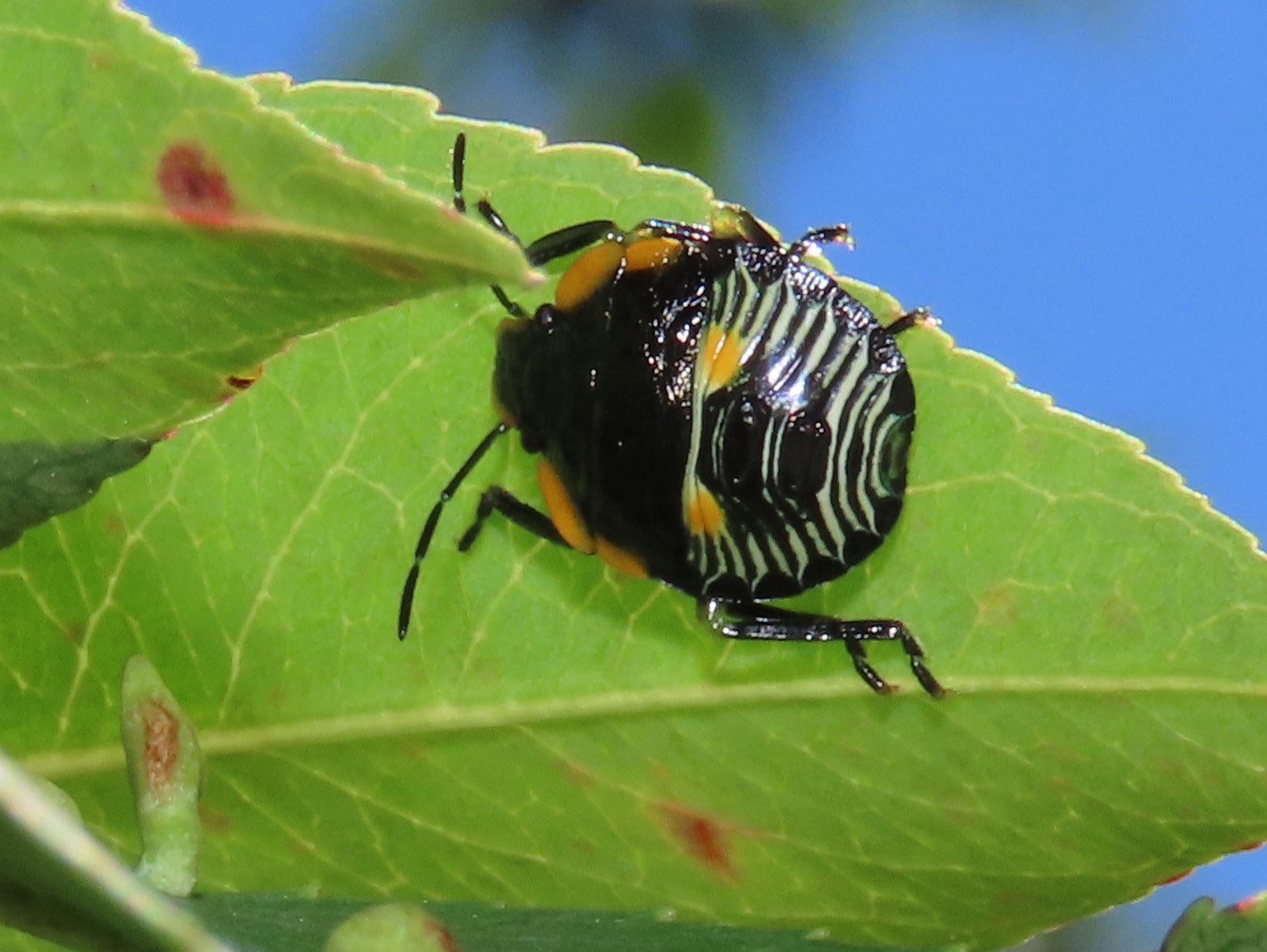
Nope, not a Japanese Beetle. Not even a beetle, but the nymph of a Green Stink Bug.

Sources: Evans, Arthur V. 2014. Beetles of Eastern North America. Princeton, New Jersey: Princeton University Press. 560 pp.
Ratcliffe, Brett C. 1991. The Scarab Beetles of Nebraska. Lincoln: University of Nebraska. Bulletin of the University of Nebraska State Museum, vol. 12. 333 pp.
Berenbaum, May R. 1995. Bugs in the System: Insects and Their Impact on Human Affairs. New York: Addison-Wesley Publishing Company, Inc. 377 pp.
Fahmy, Omar. 2007. "Species Tiphia vernalis - Spring Tiphia," Bugguide.net
Eaton, Eric R. and Kenn Kaufman. 2007. Kaufman Field Guide to Insects of North America. Boston: Houghton Mifflin. 392 pp.

Monday, September 30, 2019

How Humanity Manufactures Its Own Pests

There are only a handful of insects that are associated only with our species, Homo sapiens. The rest of what we call pests are products of our own personal, social, and industrial behaviors, plus media sensationalism. We have become experts at creating adversaries that do not exist naturally.

Yellowjackets are not pests, they are pest control

Human lice of three species, and the bed bug (Cimex lectularius) are the only naturally occurring pests of humanity. They are so closely adapted to our bodies and lifestyles that they cannot exist without us. We are their food and habitat rolled into one. Why, then, do we insist that other insects, and often spiders, scorpions, and other invertebrates, are also pests? At worst we could maybe call each of them a "nuisance," something that interferes periodically with the comfort and progress of our personal lives, disrupts the social order or, more importantly, causes financial hardship.

Carpet beetle larvae eat your woolens, but the adults pollinate flowers (in this case it is the invasive tamarisk tree, though)

As I wrote in the Kaufman Field Guide to Insects of North America, "'Pest" is a label we ascribe to any organism that competes for 'our' resources. It is an artificial concept. Nature recognizes no ownership...." We have only ourselves to blame for most of the creatures we call pests. The worst pests are those that have been introduced from abroad, either intentionally or accidentally, and unleashed in landscapes where they face few, if any, natural predators, parasites, diseases, and other mortality factors. Meanwhile, we grow their favorite host plants as vast monoculture crops and then wonder why they show up in droves to feast on them. Spraying pesticides to suppress one pest often leads to the explosion of another pest that had been previously outcompeted by the one you are now controlling.

The Turkestan Cockroach is one of our "newer" invasive species

Back in the city, nearly all of our domiciliary (structure-dwelling) cockroach species have their origins in tropical Africa. Is this the bad karma we are forced to endure for the slave trade of our ancestors? Since urban slums suffer the most from cockroach infestations, that is apparently not the case. Cockroaches do have another quality to their profile that is independent of race and economic status: they take full advantage of our often sloppy housekeeping habits. Well, we can't possibly take responsibility for that, so we label roaches as pests.

This is less of a conspiracy theory than it is a shrewd business model and marketing strategy.

It is important to note that while cockroaches have been implicated in the mechanical transmission of bacteria and other contaminating pathogens, they have never been proven to do so. Cockroaches, and also "filth flies" like house flies, blow flies, and flesh flies, groom themselves constantly, as they must to prevent themselves from suffering diseases, as well as keep their delicate sensory bristles, hairs, eyes, and antennae sharp enough to detect potential predators. Yes, prolonged exposure to large cockroach populations can trigger asthma, especially in children. That is a fact.

Termites break down dead wood into soil

Let us revisit our own culpability in pest creation. We insist on having cats and dogs live with us, but wage war on fleas and ticks. We build our homes out of wood but won't share them with termites. We plant our gardens and yards with exotic plants that are not acclimated to our region and are therefore more vulnerable to even native insects and fungi and viruses. We covet animals and plants from other countries, creating commercial demand for wildlife that has no place in our captivity, while unintentionally creating invasive species. Yes, I am exaggerating with the first two examples, but my goal is to have you understand how your personal choices have consequences. You can avoid most perceived pest problems by making different choices, like planting native trees, shrubs, and flowers instead of weak, exotic cultivars, for example.

It is terribly ironic that humanity is more tolerant of invasive foreign species than it is of human immigrants and refugees.

Our desire to externalize our problems, and their solutions, falls perfectly into place for those commercial industries that feed off of our laziness and failure to understand how ecosystems function, be they outdoors, or inside the home, office, or tool shed. That alone is not enough to satisfy the desire for profits, so these industries create additional villains that can only be slain through the products and services of said industries. This is less of a conspiracy theory than it is a shrewd business model and marketing strategy. It is no accident that caricatures and CGI effects are employed in advertising to convince us that a given creature is a menace. It is the equivalent of war propaganda and institutional racism.

Female Anopheles mosquito. What good are mosquitoes? Ask a Plasmodium.

One of the tragic consequences of a "pest mentality" is that it can eventually spill over into how we view members of our own species. This is dramatically evident in today's political landscape. It is terribly ironic that humanity is more tolerant of invasive foreign species than it is of human immigrants and refugees. If one defines a pest as a competitor or predator, then it is easy to paint other people that way, especially in economic terms since economies are essentially ecosystems of only one species: us.

The Gypsy Moth was introduced in hopes of starting a silk industry in North America. That worked out well....

We have allowed ourselves to be conditioned by corporations and corporate media into viewing every other organism, every other human being, as either good or evil, an asset or a liability, a boon or a bane, guilty or innocent. The physicians' pledge to "first, do no harm" should perhaps be applied to every profession, including law enforcement, but maybe to the agricultural, nursery, and landscaping industries most of all. It should well be a personal motto, too. Do your homework. Do not blindly accept the so-called truths repeated by industries that profit from ignorance, and shame you for an unkempt house or yard. Promote biodiversity, exterminate instead the predatory practices of the marketplace.

Friday, September 7, 2018

No Exterminator Necessary

Modified from © Pests.org

If this blog is successful at achieving only one thing, let it be a widespread understanding that you almost never need a pest control service. Here is your one stop post for how to tell if you need a service, and what you can do instead.

Just Passing Through

Every household, business, and workplace will have the occasional insect or spider visiting. Arthropods are masters at finding their way through the tiniest crack, crevice, hole, or other access point, which they hope will lead them to greener pastures, not indoors. They are not out to get you and they are not a sign that you are in for more creatures like them. It is usually a one-time event. Do not panic and dial up an exterminator.

One recent scientific study found that the average home is occupied, at one point in time or another, by somewhere between 30 and 200 species of insects, arachnids, and related arthropods. Still no reason for fear. In fact, the greater the biodiversity the better. It is a sign that your home is not sterile, but running on all natural cylinders. Most insects are so small you do not even notice them anyway.

The Pest Control "Racket"

While most pest control enterprises are ethical and fair, here are some points to consider:

  • The technicians that visit your location are usually not entomologists trained to properly identify pests. They are schooled almost exclusively in proper application of insecticides to insure compliance with state and federal regulations.
  • It is in the best interest of a pest control company to identify as a pest any insect that concerns you, regardless of whether it is a pest.
  • Most pest control companies require a contract that guarantees repeated visits to your premises. Think about that. We expect plumbers and electricians to do the job right the first time.
  • When was the last time a "product" or "service" solved anything? In the case of pest species the answer is almost never. The best solution is prevention and attitude adjustment.

You DO Need a Service When....

There are some situations in which you do need professional help. Those are:

  • Bed Bugs are challenging for professionals, let alone do-it-yourselfers, and you will need to find a reputable company to deal with them.
  • Structural pests like termites and carpenter ants. Make sure, however, that you are not mistaking an outdoor swarm event for an indoor infestation. A termite inspection is usually a requirement for home sale and purchase. Find an unbiased agent to conduct that inspection. Request an inspection if you suspect a termite or carpenter ant infestation before employing a pest control company.
  • Social bee or wasp nest in a troublesome location. Always employ a bee removal service if you find a nest in a location that impedes your day-to-day life. Otherwise, note the location of the nest so you can simply avoid it. In most regions of North America, nests of yellowjackets, paper wasps, and the European Hornet are not perpetual, nor re-used the following year. Feral honey bee hives are perennial.
  • Cockroach infestations that have reached extreme population levels. It is important to note that cockroaches have only been implicated in transmission of bacteria, never proven. Prolonged exposure to dense populations of cockroaches, their shed exoskeletons and feces may trigger allergies and asthma in some people, especially children in multi-family dwellings. Insist on a pest control service that uses baits rather than sprays for a longer-lasting, near permanent effect instead of repeated visits to spray insecticides.

The Cure is Prevention

Here are some ways to reduce the potential for pest problems in your home:

  • Repair worn weatherstripping on doors and repair holes in window screens (or replace them).
  • Seal all cracks and crevices, including around places where pipes and electrical conduits enter or leave the home. Pack steel wool into such situations, use caulking elsewhere.
  • Inspect all objects coming indoors from outside, especially plants, firewood, toys, gardening tools....Inspect new plants before you leave the nursery or store.
  • Do not reach your extremities into locations you cannot see into. Be careful moving items out of long-term storage to avoid spider bites, disturbing a wasp or bee nest, etc.
  • Do not leave clothing, gloves, or footwear outdoors overnight, nor in the garage or shed. It never hurts to shake out shoes and clothes anyway.
  • Reduce outdoor lighting or employ motion-sensors or bulbs that are less attractive to nocturnal insects. This will also discourage spiders from stringing their webs across your front and back doors.
  • Never stack firewood against the side of your home, as this will help termites and carpenter ants to become established. Reconsider wood mulch as groundcover.
  • Learn tips for how to avoid bed bugs in your travels and thrift store shopping. Entomologists estimate that soon one out of every four homes will have bed bugs.

Treatment for You!

Nobody wants to hear the suggestion that maybe they are the source of a problem, but sometimes that can be the case. Please seek professional help if you have phobias of insects (entomophobia), spiders (arachnophobia), or related creatures. It will save you a great deal of money and emotional turmoil to go that route. Otherwise, visit an entomologist for a gentle "attitude adjustment." We can cite example after example of the beneficial qualities of insects and the potentially disastrous effects of continued addiction to chemical pest treatments.

Please feel free to share this post widely. I also welcome comments, even dissenting opinions, as long as they are worded in polite language. Everyone deserves to make a living, and we will always need pest control services for situations where every other alternative has been exhausted.

Friday, March 23, 2018

Pinyon Problems? Maybe, Maybe Not

I always seem to be caught off guard by the first insects to emerge in spring, and this year was no exception. The chance finding of a male scale insect prompted me to investigate an ornamental Pinyon Pine in our Colorado Springs townhouse complex, and that revealed yet another insect, or at least signs of one.

Walking in our neighborhood as I do most days, weather permitting, I happened upon what I figured must be a tiny midge or winged aphid, about one millimeter in length, on a wooden fence. Upon closer inspection it turned out to be a male scale insect of some sort. Scale insects generally give the impression of anything but an insect, a small, unmoving, button-like bump on a twig or branch. Mature male scale insects on the other hand often have wings and fly to find females. I was not aware they can appear so early in the season.

Male Pinyon Needle Scale

Back home, I took images of the specimen and tried to match it with something online. Male scale insects are so rarely noticed, let alone imaged, that I was not optimistic. Surprisingly, I found a close match in the genus Matsucoccus, family Matsucoccidae. This is a relatively new family, separated from its previous placement as part of the Margarodidae or "ground pearls." The tiny black and yellowish bug, with white waxy streamers emanating from its posterior, most resembled the Pinyon Needle Scale, Matsucoccus acalyptus, but I was hesitant to jump to conclusions. Our neighborhood is more in the high plains than a forest, though we do have many ornamental conifers.

Sure enough, I noticed a Pinyon Pine between two buildings in our townhouse complex. Now that I knew what I was looking for, I checked for sessile female scales, and managed to find a few. They are barely over one millimeter themselves. It turns out that the life cycle of this species is rather complex, with a lot going on at this time of year.

Adult female Pinyon Needle Scales

Mature females back out of the waxy covering that forms the "bean stage," and render themselves sexually receptive. As near as I can tell, the adult females have this mosaic pattern to them, whereas the "bean" stage does not. Once mated, the female crawls to an appropriate place to lay her oval cluster of yellowish eggs, encased in loose, white, silky webbing. Favored sites for egg laying include the root collar of the tree, in the crotches of large branches, the underside of large branches, or in deep fissures in the bark of the trunk.

"Crawlers" emerge from the eggs roughly five weeks after they are laid. This tiny, orange, first instar immature stage migrates up the tree to begin feeding on needles that grew the previous year. The insects use their piercing-sucking mouthparts to tap fluids inside the foliage. As they feed they begin secreting the wax coating that covers them. That coat turns black shortly after it is produced. The nymphs also molt into their second instar. This is the "bean" stage in which the immobile females pass the winter.

"Bean stage" of Pinyon Needle Scale

Second instar males crawl to the ground in October or November. There they go into a prepupal stage, wrapping themselves in white silken webbing beforehand. Three or four days later the males molt again into the pupa stage, spending the winter there. The female nymphs resume feeding the following spring, molt into adults, mate, and start the cycle anew.

The Pinyon Needle Scale is a native insect, but heavy infestations can severely weaken trees, making them vulnerable to subsequent attack by Pinyon Pine Beetles, Ips confusus, in natural ecosystems. Landscape trees are even more at risk because they are not always planted at appropriate elevations, in proper soils, with proper sun exposure. They are often planted in isolation, too.

Galls of Pinyon Spindle Gall Midge

While looking for the scales, I could not help but notice that many of the needles on the tree on our property were greatly swollen and yellowing. This is the work of an entirely different insect, the Pinyon Spindle Gall Midge, Pinyonia edulicola. It is a tiny fly in the gall midge family Cecidomyiidae. Its life cycle begins when a female lays several eggs in a developing needle in mid-summer. The larvae that hatch crawl to the base of the needle and their feeding activity stimulates the plant to grow needle tissue around them. From five to forty larvae occupy the resulting gall, continuing to feed and grow within it. They pupate in late spring of the following year. The adult flies emerge in mid-June to mid-July.

More Pinyon Spindle Gall Midge galls

Our Pinyon Pine tree seems to be doing ok despite the onslaught, and we tend to underestimate the resilience of plants in the face of insect attack. Our current drought is no doubt undermining the tree's natural defenses, but the insects feeding on it are also not immune to their own predators, parasites, and other enemies. It may be a good idea to keep tabs on the trees in your own yard, but resist the temptation to intervene at the first sight of some insect. Do your homework, ask for expert assistance, and then decide what, if anything, to do.

Sources: Cranshaw, Whitney. 2004. Garden Insects of North America. Princeton, New Jersey: Princeton University Press. 656 pp.
Furniss, R.L. and V.M. Carolin. 1977. Western Forest Insects. Washington, DC: U.S. Department of Agriculture Miscellaneous Publication No. 1339. 654 pp.
Phillips, Gene. 2018. "Pinyon Needle Scales, Matsucoccus acalyptus," Nevada Division of Forestry

Tuesday, September 26, 2017

Grasshopper or Locust?

A person on a Facebook insect identification group recently asked a very good question about the difference between a grasshopper and a locust. You would think it is pretty straightforward, but not so fast.

The American Bird Grasshopper, Schistocerca americana, is related to some grasshopper species in Europe and Africa that can become locusts; and it sometimes migrates beyond its usual geographic range in the U.S.

Most of us think of locusts in the context of Biblical plagues in Africa and parts of Europe, in ancient times. Such plagues still happen, and they are almost apocalyptic in their destructiveness. They even occur in North America on occasion, as well as other parts of the world, so there must be more than one species of locust, right? Yes, and no.

Two-striped Grasshopper, Melanoplus bivittatus, has been overwhelmingly abundant in recent years along the Colorado Front Range

Locusts are not a species of grasshopper, they are the result of overcrowding in the nymph stage of many kinds of grasshoppers. Under favorable conditions, there is an extraordinary survival rate of young grasshoppers, which are called nymphs. When they are literally so abundant and concentrated that they are rubbing elbows (well, "knees" is probably a more appropriate term), this friction causes them to detour from their normal route of metamorphosis.

Instead of maturing into the usual grasshopper, the adult stage features longer wings and other body modifications that permit them to fly greater distances, remain airborne for longer periods, and to undertake these migrations from one food source to the next over long distances. They also may be aided by winds ahead of storm fronts.

The Clear-winged Grasshopper, Camnula pellucida, is prone to population outbreaks in the American West

This is something of a simplification of the physiology of locusts versus normal grasshoppers, but a surprising number of species have the potential to morph into locusts when conditions are right. Then they overwhelm the landscape, defoliating every plant in their path.

Locust swarms will devour plants they would not normally eat. I recall a presentation about a locust epidemic in Oregon where the scientist showed slides of juniper trees (yes, juniper trees) that had been reduced to skeletons by grasshopper swarms. The locusts have even been known to eat garments on clotheslines. Grasshoppers are also omnivores, and will not hesitate to eat dead members of their own species, or gnaw on injured or even healthy ones. It is late in grasshopper season here now in Colorado, and I regularly see grasshoppers with wings reduced to stubs thanks to hungry comrades.

A victim of the grasshopper-killing fungus Entomophaga grylli

Fortunately, for us at least, grasshoppers face many mortality factors. While it has been a banner year for grasshoppers this year along the Colorado Front Range, huge numbers have succumbed to the entomopathic fungus Entomophaga grylli. The insidious fungus grows inside the insect, eventually commandeering its brain and forcing it to behave abnormally. The grasshopper, through no will of its own, climbs to the top of a tall weed, assumes a death grip embracing the stem, and dies. The fungal spores then erupt and rain down on healthy grasshoppers below to begin the cycle again. The spores may even decapitate the dead grasshopper as they exit.

Grasshoppers are the chief grazers of the prairie, even more impactful than livestock, deer, pronghorn, elk, and bison. Natural rangeland can usually withstand their feeding, but ranchers obviously see them as competition and exercise chemical controls when necessary. Since grasshoppers are mostly generalist feeders (a few specialize on only certain broadleaved plants), they pose a threat to agricultural crops, too.

A specimen of the extinct Rocky Mountain Locust
© Bugguide.net

Ironically, the Rocky Mountain Locust, Melanoplus spretus, once the most abundant and devastaging insect pests ever to occur in North America, is now extinct. The book Locust, by Jeffrey A. Lockwood, chronicles the rise and dramatic fall of the species, which ultimately vanished from the U.S. landscape by the early 1900s. I will not spoil the solving of the mystery, as Lockwood's account is far more riveting than anything I could craft if I was even prone to writing historical fiction. Let us just say it is a cautionary tale.

Historical range of the Rocky Mountain Locust

We can certainly be grateful that we seldom experience such traumatic explosions of grasshoppers here on American soil, but we should be empathetic to other nations that do. Entire economies can be on the verge of collapse in the wake of such devastation.

Source: Lockwood, Jeffrey A. 2004. Locust. New York: Basic Books (A member of the Perseus Books Group). 294 pp.

Tuesday, February 28, 2017

The Big Bug Hunt and How You Can Help

Last year in early October, I was approached by Jeremy Dore, founder of the company Growing Interactive, based in the United Kingdom. He was interested in having me collaborate in one of the company's major citizen science projects, "The Big Bug Hunt." He made a convincing enough argument that I signed on last month as one of the U.S. liaisons. What follows is a description of this ingenious endeavor; and how you can help, and benefit from, participating.

The Big Bug Hunt wants your Japanese Beetle sightings!

The aim of The Big Bug Hunt is to build a database that will be used to create a computer application which predicts with great accuracy the emergence of various pest insects in very localized areas. For example, if you have a vegetable garden in Raleigh, North Carolina, you will be able to receive a "reverse 9-1-1" alerting you to the possibility that squash bugs may be descending on your plot within days or weeks. You can then take preventative action now, and avoid using chemical controls later.

The technology that synthesizes this data and turns it into a predictive model is a facet of the discipline called machine learning systems. It means that computers are able to find patterns that humans cannot see. From what I understand, this technology is already applied to large scale agriculture. The goal of Growing Interactive and its subordinate projects like Grow Veg, is to provide the same kind of software tools to individual citizens and community garden personnel to insure their own success in meeting the collective mission of local food security.

The Big Bug Hunt can already predict some aphid emergences with precision

Growing Interactive is a family enterprise for Jeremy, his wife, and their friends; and they take great pride in serving the greater good. Jeremy decided to apply his background in app programming to farming more than ten years ago after his job as a network manager for a group of schools ended. What he has created since then is astonishing in its success. Growing Interactive enjoys the respect and collaboration of academic institutions like the University of York (England), for example.

The Big Bug Hunt is global in scope, but it has gotten off to its best start in the U.S.A. and the U.K. More data is needed, however, to facilitate better accuracy in predicting when common pests like the Japanese Beetle are likely to appear at a given locality. This is where you come in. Simply going to the website, or even clicking on the "Report a Pest" button at the top of my sidebar, will allow you to quickly report any insect, other arthropod, or even a slug or snail that you see in your yard or garden. It is that simple, no registration necessary. Reputational analysis will eventually weigh data according to accuracy, so no observation goes to waste.

Squash bugs are on the "hit list," too

With our ever-changing climate and landscape, a dynamic reporting and recording system like this is vital to every level of agricultural productivity, be it corporate or your own backyard vegetable garden. It will not work, however, without your willingness to contribute. Please consider adding your "two bugs worth," and I promise to keep you abreast of the latest developments here on my blog. Thanks!

Wednesday, August 31, 2016

More Insects From Sunflowers

My last post was devoted to the diversity of insects that find sunflowers (Helianthus spp.) irresistible thanks to the plant's extrafloral nectaries that provide nourishment for a host of wasps, bees, and other insects. Today, let's look at insects that feed on sunflower buds, leaves, stems, and roots. In stands of native sunflowers, these phytophagous (plant-eating) insects are a natural part of the ecosystem; but where commercial sunflower is cultivated for seeds and oil, those species can be pests.

Dectes texanus, 16 mm

Some of the most conspicuous sunflower feeders are beetles. The longhorned beetle Dectes texanus is damaging to sunflower in the larval stage. The female beetle lays her eggs in leaf petioles (the short stalk that attaches the leaf to the stem). The larva that hatches from each egg feeds inside the petiole, then moves down the inside of the main stem, eventually reaching the base of the plant. There, it girdles the inside of the stem and moves below this belt of death to insulate itself for the winter. It packs its own fibrous poop around itself and pupates. An adult beetle emerges the following summer.

Mecas pergrata, 6-12 mm

Mecas pergrata is another longhorned stem- and root-borer that exploits many plants in the sunflower family (Asteraceae).

Sunflower Beetle, 6-12 mm

Sunflower Beetle, Zygogramma exclamationis, is a leaf beetle that feeds on sunflower as an adult and a larva. The adults emerge from hibernation in late spring or early summer, coinciding with the sprouting of sunflower seedlings. The beetles feed on the young leaves. The beetles feed during the day, but their larval offspring feed at night, gathering in small groups among the bracts of flower buds in daylight. There is one generation per year, with adults emerging from the pupa stage in the soil in late summer. They feed briefly before returning to the soil to overwinter.

Pale-striped Flea Beetle, 3-4 mm

The Palestriped Flea Beetle, Systena blanda, is another kind of leaf beetle (family Chrysomelidae), and very small. This species has a wide range of host plants, many of them crops, including sunflower. The adult beetles overwinter, emerging in late spring and doing the most damage to the leaves of young sunflowers. They leave lace-like patterns of injury in their wake. The role of the larval stage in sunflowers is unknown, and perhaps they feed on a different plant.

Sunflower Root Weevil, 6 mm

Weevils, family Curculionidae, are beetles, too, and a whole suite of species is associated with sunflowers. The Sunflower Root Weevil, Baris strenua, feeds on the roots as a larva, and on the leaves as an adult beetle. The adults gnaw holes in the foliage in morning and late afternoon; but they move to the roots near the soil surface to create callous tissue into which the female deposits roughly three eggs at a time. The feeding activity of the larvae that hatch usually results in wilting of the plant due to dehydration. By autumn, each larva has created a soil capsule in which it will pupate. An adult beetle emerges the following year.

Sunflower Stem Weevil, 4-5 mm (generously)

Sunflower Stem Weevil, Cylindrocopturus adspersus, can be seen on the stems of sunflower plants, but they bear a strong resemblance to plant debris and are easily overlooked. Eggs are laid in the stem, and the larvae that hatch bore downward, reaching maturity at about the time they near the base of the plant. They hollow out chambers in the pith in which they will pupate the following year, usually in June.

Red Sunflower Seed Weevil, 2.5-3 mm

The Red Sunflower Seed Weevil, Smicronyx fulvus, is covered in rust-colored scales that rub off as the insect ages. The adults occur in late June and early July, feeding mostly on buds, then pollen once the flowers open. Eggs are laid internally in developing seeds, from the edge of the flower disc inward. Each seed usually feeds one larva, which consumes about one-third of the seed before exiting through a hole it chews, and plummeting to the ground and burrowing beneath the surface. Pupation occurs in the soil the following June or July.

Gray Sunflower Seed Weevil, 3.6 mm

Gray Sunflower Seed Weevil, Smicronyx sordidus, follows a similar life cycle as the Red Sunflower Seed Weevil, except that females deposit eggs externally on developing seeds while the flower is bud is still closed. Feeding by the larva results in an enlarged seed, clearly protruding above surrounding, unaffected seeds.

Sunflower Head-clipping Weevil, 8 mm

The Sunflower Head-clipping Weevil, Haplorhynchites aeneus, belongs to the family Attelabidae rather than Curculionidae. Adults of this species emerge in mid-summer, females feeding on pollen and nectar. Each female prepares for egg-laying by gnawing a perferation around the circumference of the sunflower stem, just below the flower head. She then deposits a single egg in the head. This eventually causes the head to fall off, and her larval offspring feeds in the head, eventually exiting into the soil to pupate.

Black Sunflower Stem Weevil, 3 mm

Black Sunflower Stem Weevil, Apion occidentale, is a member of the family Brentidae, or "primitive weevils." Adult beetles first appear in late spring or early summer, and feed on leaves and stems. Larvae feed internally on the pith of stems and the leaf petioles. Pupation occurs within the plant, adult beetles chewing their way to freedom in late July and August. Again the feed on foliage and stems but eventually move to the flower bracts by the end of summer. From there they enter the soil to overwinter.

Banded Sunflower Moth, 6 mm

Moths are another group of insects with many sunflower specialists. The Banded Sunflower Moth, Cochylis hospes, is a member of the leafroller moth family Tortricidae. The adult moths start showing up in mid-summer, but spend the day mostly away from sunflower plants. Females gravitate to the plants at twilight, laying eggs on the outside of bracts on the sunflower head. The caterpillars that hatch move onto the flower disk where they feed on seeds at all stages of maturity. Each larva eats five to seven seeds before leaving the plant for the soil where they spin a cocoon in which to pupate and overwinter. This moth is a certifiable pest to commercial sunflower growers.

Suleima baracana, 7.5-11 mm

Another tortricid moth is Suleima baracana, the caterpillar of which bores in stems of the Common Sunflower (Helianthus annuus). Look closely for it on the upper surface of leaves, and do not dismiss what you think is a bird turd. This moth looks exactly like the waste of a goldfinch, and appears at about the same time as that avian animal.

Sunflower Moth, 9 mm

Sunflower Moth, Homoeosoma electella, is a pyralid moth (family Pyralidae). The adult females flock to sunflower heads that are just beginning to open, and lay roughly 30 eggs per day on the heads. Young caterpillars feed on pollen and florets, but by the third instar (an instar is the interval between molts) they are tunneling into seeds. They also spin silk webbing over the flower head that becomes littered with caterpillar poop (frass). Mature larvae that have finished feeding then descend the plant to the ground where they spin silk cocoons and spend the winter before pupating in spring.

Several species of cutworms (family Noctuidae) and other moths also affect sunflowers. Even the Painted Lady butterfly may feed on sunflowers as a caterpillar, though they are usually found on thistles.

Sunflower Receptacle Maggot fly, 10 mm

Flies, specifically true fruit flies in the family Tephritidae, make up the last contingent of sunflower consumers. The Sunflower Receptacle Maggot, Gymnocarena diffusa, is a pale, attractive insect with patterned wings. They feed on the extrafloral nectaries. Females begin laying eggs in mid-summer between the second and fourth layers of bracts on the sunflower head. The maggots that hatch bore into the head where they feed. When finished, they usually chew a hole in the head and drop to the ground where they dig more than six inches deep before pupating. Some larvae may pupate within the sunflower head.

Sunflower Seed Maggot fly, 6 mm

The Sunflower Seed Maggot, Neotephritis finalis, first appears around the fourth of July as an adult fly. The female lays her eggs around the corollas of partially-opened florets in the flower disk. The larvae feed within the undeveloped ovaries of the flowers, thereby reducing seed set. Two generations of flies are produced each season. The first generation passes the pupa stage in the flower head; the second generation overwinters in the pupa stage in the soil.

The diversity of insects associated with sunflowers gives you some idea of what most all plants are up against in terms of insect enemies and affiliates. Each part of the plant is a likely target for at least one insect species. We know collectively little about the insects hosted by plants that are of no economic value, so much has yet to be learned. Better get to work, my friends!

Sources: Knodel, Janet J., Laurence D. Charlet, and John Gavloski. 2015. "Integrated Pest Management of Sunflower Insect Pests in the Northern Great Plains," North Dakota State University Extension Service, publication E1457. 20 pp.
"Insects," National Sunflower Association.
"Facts & Information on Sunflower Pests," Kansas State University Department of Entomology.

Friday, January 29, 2016

The Stable Fly

Of all the biting flies we have in North America, one of the most annoying has to be the Stable Fly, Stomoxys calcitrans. They are especially abundant around farms, ranches, zoos, and other places where large mammals are kept. Unfortunately, they will also bite people when livestock is not close at hand.

Like any notorious villain worth their salt, the Stable Fly has it aliases: "beach fly," "dog fly," and "lawn-mower fly" among them. The insect has also fled local jurisdiction. It is apparently native to Eurasia and Africa, with speculation that it probably came to the New World in colonial times, maybe in ship's ballast.

The Stable Fly is easily dismissed as a House Fly under cursory examination. Both flies are in the family Muscidae; and both are about the same size, the Stable Fly measuring 5-7 millimeters. Each species is mostly gray, with black "pinstripes" down the back of the thorax. The Stable Fly differs mostly in having a slender, black, slightly curved beak tucked under its "chin."

Proboscis (painfully) deployed!

While it is only the female mosquito, black fly, deer fly, and horse fly that sucks blood, both genders of the Stable Fly can bite. This is not a painless event, either. An immediate, sharp sensation occurs when the fly plunges its piercing mouthparts into your skin. Shoo it away and it returns instantly, and repeatedly. This persistence is perhaps the main source of our aggravation.

Commencing feeding
Almost full!

The adult fly is only one quarter of the life history of the species of course, with eggs, larvae, and pupae making up the other three stages in its metamorphosis. The female fly deposits her eggs singly, or in clusters of 25-30, in wet, decaying fibrous organic matter. Typical breeding material includes horse manure, silage, rotting hay, grass clippings, and partially composted livestock bedding.

Female full of eggs

The eggs hatch in one to fourteen days. The maggots that emerge take anywhere from 11-30 days on average to mature. The interval is largely determined by temperature, humidity, and food quality and quantity. The hotter and more humid the substrate, the faster the maggots develop. The maggot molts twice after hatching, and may be up to twelve millimeters in length by the time it enters the pupal stage.

The pupa represents the larva's third molt, the shed exoskeleton of which forms a hard, oval, dark brown "capsule" around the pupa itself. The pupal stage typically lasts six to twenty days. The adult fly then bursts out of its capsule by more or less inflating the front of its head.

Stable Flies will also sip flower nectar

The determination of Stable Flies in their feeding behavior naturally induces stress in its victims, and this can take a toll on livestock. A mere twenty flies on a cow can result in decreased milk production. Mild anemia and weight loss can also be a result of high numbers of feeding Stable Flies.

Were it such that general malaise was the only negative effect of Stable Fly populations, it would possibly be tolerable. Unfortunately, Stomoxys calictrans can also carry a variety of diseases. Most of these are of limited effect in the U.S., thankfully, but they cannot be dismissed entirely. Here, the fly can transmit anthrax, which affects livestock, pets, and people. Anthrax exhibits a variety of symptoms, the worst of which include lesions of the lungs or brain.

The next time you visit a local farm, ranch, or zoo, you might want to consider applying that DEET-based insect repellent to help fend-off attacks of Stable Flies. It will make your experience much more enjoyable if it is bite-free.

Sources: Cumming, Jeffrey M. 2006. "Diptera Associated With Livestock Dung," North American Dipterists Society.
Newberry, J. 2003. "Stomoxys calcitrans" (online), Animal Diversity Web.