Showing posts with label Heteroptera. Show all posts

Wednesday, January 31, 2024

Hibiscus Scentless Plant Bug Life Cycle

It is a rare occasion when I am able to document all life stages of an insect species, let alone in the same location, or over a period of a couple of days. That is what happened, though, when I photographed a population of a scentless plant bug, Niesthrea louisianica, sometimes called the Hibiscus Scentless Plant Bug. Indeed, hibiscus and related plants in the family Malvaceae are their hosts. Our saga takes place in Okawville, Illinois, USA, in October of 2023.

While exploring the yard at my sister-in-law's home, I happened to notice adults and nymphs of this insect on buds of what I learned later was the plant known as Rose-of-Sharon, Hibiscus syriacus. Even the adults are not very large, measuring only 6.5-8.5 millimeters in body length. They are noticeable because they are so brilliantly colored in orange and red, with legs annulated (banded) in black and white. Niesthrea louisianica is a mostly southern U.S. species, but ranges from New York to Florida, and west to Iowa, Texas, Arizona, Utah, and California.

Apparently it is not unusual to find all stages in the life cycle at the end of the plant's growing season, and the adult insects overwinter anyway. Females can live about two months, males roughly fifty days. There can be at least three or four generations per year in southern latitudes, fewer farther north. Females deposit eggs in small batches, up to 36 in number, on the underside of leaves, beneath the bracts of the flower buds, or on the seed heads. One female can lay up to seven hundred eggs in her lifetime. I spotted a couple of egg clusters, one being guarded, presumably by the female that laid them.

The first instar nymphs that emerge from the eggs are so tiny! This species goes through five instars, an instar being the interval between molts. Like all true bugs, metamorphosis is "simple," each instar incrementally larger than the last, with the final molt to adulthood resulting, in this case, in a winged, sexually-mature individual. All life stages feed on the flower buds and seeds of the host plant, inserting the stylets of their rostrum to reach the interior fluids and tissues.

The activity period of the Hibiscus Scentless Plant Bug differs with latitude, but the life cycle begins in April or May, when the overwintered females lay eggs. It concludes with the end of the growing season, in October or even later.

One interesting aspect of Niesthrea louisianica is its potential role in controlling a problematic plant called Velvetleaf, Abutilon theophrasti. The bugs can carry pathogenic fungi in the genera Fusarium and Alternaria, which ride on the insects and infect the seeds of the plant, weakened from the feeding activities of the insect.

The "scentless plant bug" moniker may not apply in the case of the Hibiscus Scentless Plant Bug. They possess metathoracic glands, and a single dorsal abdominal gland, that produce copious amounts of exocrine chemicals for self-defense. Not that this deters spiders, one of their chief enemies, nor does it prevent parasitoid tachind flies, genus Leucostoma, from attacking the adult bugs. Scelionid wasps, genus Telenomus, exact a toll as parasitoids of the bug's eggs.

This is one of those species that fits the entomological addage of "Once you see one, you will see them everywhere." They are "locally abundant," like many host-specific phytophagous (plant-feeding) insects. They will not be on every plant because the defensive chemicals of the host plant vary from one individual plant to the next. Be on the lookout for them in Ohio, Indiana, and northern states currently out of their accepted range. Climate change may be driving a northerly range expansion.

A pair of less colorful specimens from Cape May, New Jersey, September, 2017

Sources:Baker, James. 2016. "Hibiscus Scentless Plant Bug," NC State Extension Publications
Kremer, Robert J. 1992. "Integration of a Seed-feeding Insect and Fungi for Management of Velvetleaf (Abutilon theophrasti) Seed Production," Proceedings of the Eighth Annual Symposium on Biological Control of Weeds.
Jones, Walker A., H.E. Walker, P.C. Quimby, and J.D. Ouzts. 1985. "Biology of Niesthrea louisianica (Hemiptera: Rhopalidae) on Selected Plants, and its Potential for Biocontrol of Velvetleaf Abutilon theophrasti (Malvaceae)," Annals of the Entomological Society of America 78(3): 326-330.
Slater, J.A., and R.M. Baranowski.1978. How to Know the True Bugs. Dubuque, Iowa: Wm. C. Brown Company Publishers. 256 pp.
Moorehouse, Angella. 2023. Flower Bugs: A Guide to Flower-associated True Bugs of the Midwest. Minnetonka, Minnesota: Pollination Press, LLC. 360 pp.
Steill, Jennifer, and Jason Meyer. 2003. The Rhopalidae of Florida "Scentless Plant Bugs." Insect Classification Project. 23 pp.

A group of juveniles on an unidentified host plant, New Jersey

Sunday, December 17, 2023

Book Review: Flower Bugs

I must preface this review by stating that the author, Angella Moorehouse, and publisher, Heather Holm, are personal friends. That is not why I am conflicted in my reaction to this book. Neither is it because I view this book as being in competition with any of my own works. We cannot have enough literature devoted to promoting public understanding and appreciation of insects. It boils down in part to my own biases and expectations. With that, you will still receive an honest appraisal.

Pollination Press, LLC produces plant-based books about insects, usually restricted to a particular geographic region. Holm's comfort zone is clearly in botany, though her prior books about bees and wasps, as they relate to flowering plants, demonstrate a command of general entomological knowledge, and dedication to thorough research. There is no question that her books deliver accurate, factual information. From my perspective, as an entomologist with little familiarity or interest in plants, I immediately see what is "missing" in terms of species, even families, because those insects are not associated with forbs.

There is a desperate need for more books that illustrate the ecological networks of different organisms, but Flower Bugs: A Guide to Flower-Associated True Bugs of the Midwest is limited to the flowers of herbaceous flowering plants, and almost exclusively those true bugs that may play a role in pollination, or those species that frequent flowers as a place to ambush other pollinators. The territory covered is eight states (Illinois, Minnesota, Wisconsin, Iowa, Missouri, Michigan, Indian, and Ohio), and adjacent southern Ontario, Canada. The book is in fact based mostly on a detailed survey of locations in western and central Illinois, over a period of seven years.

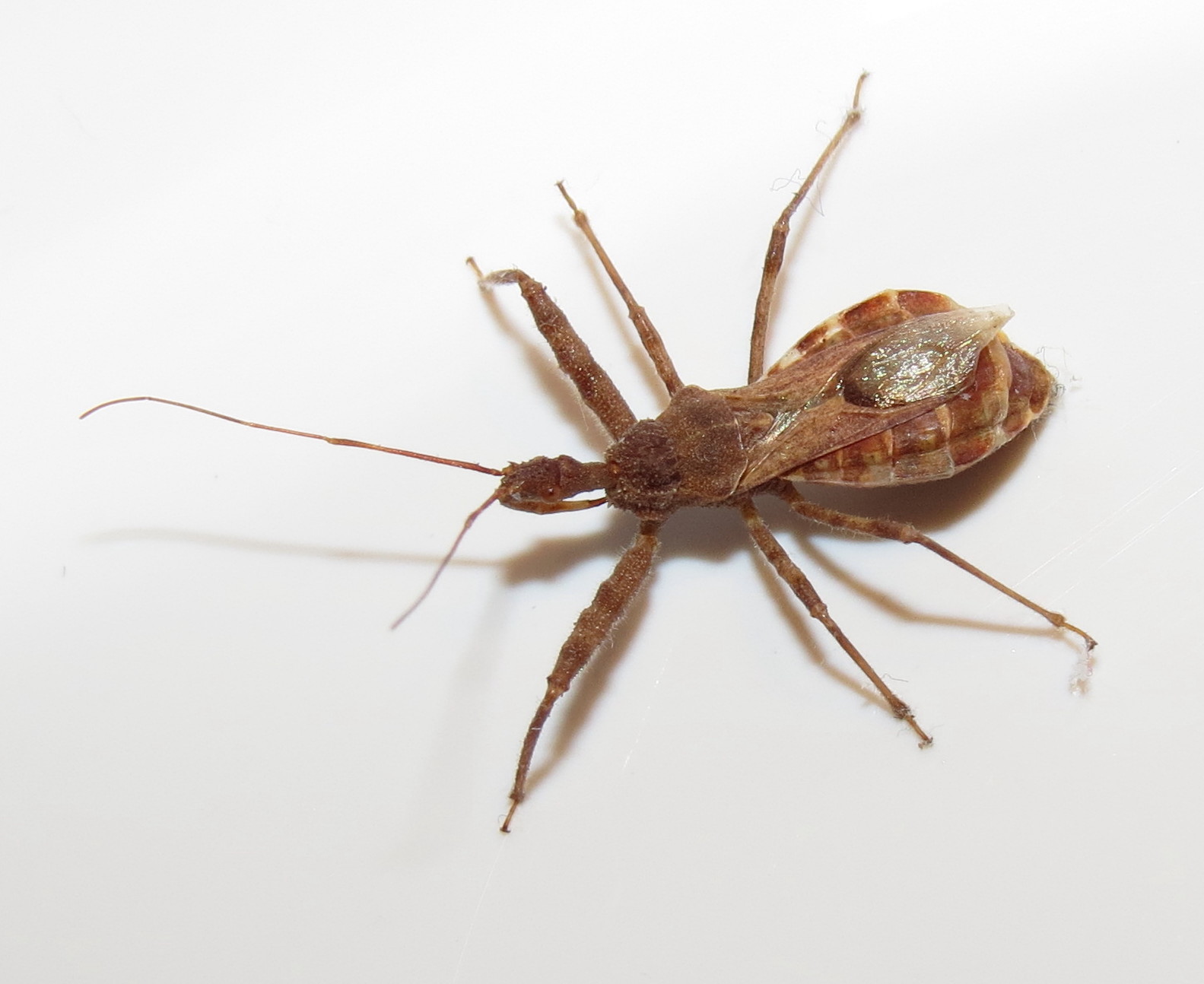
The true bugs treated are further restricted to the suborder Heteroptera, which includes the larger, more obvious examples like stink bugs, assassin bugs, mirid plant bugs, and seed bugs, but leaves out the families of aquatic bugs, plus the other two suborders that include cicadas, leafhoppers, spittlebugs, and aphids. All of these specifics are stated explicitly in the introduction of the book.

The layout of Flower Bugs includes the trademark features of Pollination Press' other books: prolific and quality imagery, geographic range maps, seasonal distribution bars showing what months the adult insect is present, tables of plant species associated with each insect species addressed, diagrams of taxonomic relationships, a glossary, checklists, and a visual index.

The front matter of the book is, as usual for this press, presented to near perfection in degree of detail, and coverage of morphology and ecology. It is an excellent introduction to true bugs as a whole, for the intended audience of native plant gardeners, naturalists, resource management personnel, and others.

The species accounts cover the overall geographic range, variation in physical appearance, life cycle, feeding, habitat, and native plant associations. The images are occasionally redundant, but frequently include photos of the immature stages, which most field guides fail to do. In cases of the mirid plant bugs, assassin bugs, and other families for which there are few flower associates, there are photos of other species for comparison, and to better indicate the full diversity of these groups. Given the lack of any other contemporary guides to true bugs, this gesture is appreciated.

The last book to cover the true bugs for a popular audience was probably Bugs of the World, by George C. McGavin, published in 1993 and 1999 by Blandford, an imprint of Cassell, in London. Back then, the true bugs were classified much differently. In 1978, How to Know the True Bugs, by James A. Slater and Richard M. Baranowski, was published by Wm. C. Brown Company Publishers in Dubuque, Iowa, as part of their "Pictured Key Nature Series." That reference also covered the suborder Heteroptera, but assumed the user had a pinned specimen and a microscope at hand.

The fact that Flower Bugs is the most up-to-date popular reference to North American Heteroptera, no matter how limited the scope, is enough to recommend it. You will no doubt find yourself stalking the true bugs in your own yard, neighborhood park, or other favorite habitat. You can be confident that this book will provide you with an accurate ecological perspective, and interpretation of the behaviors of these insects.

Saturday, April 23, 2016

What's on Dat Scat?

My last post addressed what kinds of insects can be found in dung, but today I want to show you what can be found on animal poop. While blow flies, family Calliphoridae, are often overwhelmingly abundant on fresh manure, you'd be surprised what else comes in for a taste.

Acmon Blue and Reakirt's Blue enjoying some refreshing scat with broad-headed bugs

Would you believe many butterflies will visit scat? Last year I happened upon this scene on a concrete nature trail in a popular park here in Colorado Springs. There were two species of gossamer-winged butterflies imbibing from some kind of predator poo. The ones with the orange bands on both the front wings and hind wings are Melissa Blues. The one with orange on the hind wing only is an Acmon Blue. The other one, without orange bands, is a Reakirt's Blue.

Melissa Blue joins Reakirt's Blue and broad-headed bugs

Males of many butterflies require mineral supplements that they can pass along to females during mating. Dung is one such mineral-rich resource.

Some butterflies feed mostly on dung, or carrion, and hardly ever visit flowers. Among them are the satyrs like this Northern Pearly-eye that was visiting dung on a bike trail in a suburb of Chicago, Illinois.

Northern Pearly-eye butterfly

The Red-spotted Purple is also notorious for preferring dung and corpses for nourishment, though one usually sees the territorial males perching on the ground or up on leaves in the canopy along stream or river corridors, or forest edges.

Red-spotted Purple butterfly

Other surprising visitors to scat are true bugs that normally feed on ripening seeds or other plant material. Finding so many broad-headed bugs, family Alydidae, sharing the poo-pile with the butterflies was quite surprising. There are at least two species here: Megalotomus quinquespinosus is the brown one, known as the "Lupine Bug." The other, smaller and blacker, is a species in the genus Alydus.

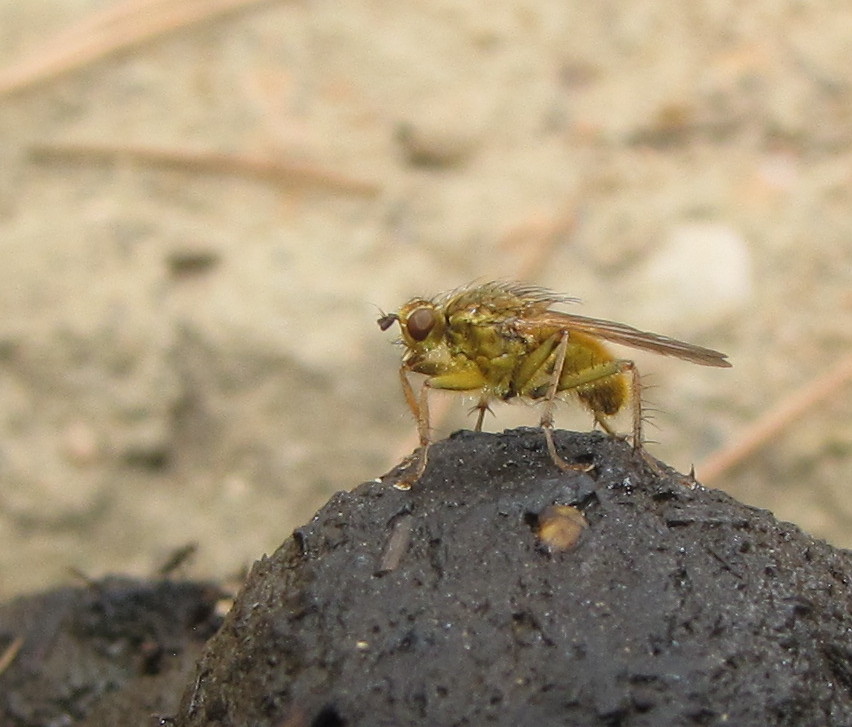
Male Golden Dung Fly

Different kind of excrement seems to attract different kinds of insects, at least to a degree. Fresh cow and horse dung is a favorite breeding ground for dung flies in the family Scathophagidae. The males stake out pats of poo and defend them from other males, while also intercepting females receptive to mating. The female lays her eggs in the manure and the larvae that hatch feed and develop there. You can easily recognize males of the Golden Dung Fly, Scathophaga stercoraria, but their fuzzy, bright golden appearance.

Various blow flies on what is probably bear scat

The blow flies (Calliphoridae) come in two basic varieties: "greenbottles" that are wholly metallic green, mostly in the genus Lucilia, and "bluebottes" that are usually larger, and gray with a metallic blue abdomen. Most of the common bluebottles are in the genus Calliphora. There is also the Black Blow Fly, Phormia regina, that is black or deep metallic blue-black. All can be present at dung.

Black scavenger fly

Tiny and wasp-waisted, black scavenger flies in the family Sepsidae are not easy to see immediately given their size, but their behavior is unmistakable: they walk around "rowing" their wings as if they needed the extra propulsion to get around.

Flesh flies of the family Sarcophagidae are gray with black "pinstripes" on the thorax, and usually red eyes and a red "tail." They are about the size of the blow flies, though some are smaller. The females "larviposit." That is, they lay tiny maggots in dung or carrion, rather than laying eggs. Bypassing the egg stage gives them a head start in exploiting the food resource.

A mating pair of flesh flies

Dung-watching is probably not going to become the next big thing in the world of naturalists, but if you can get over the "yuck factor," you might find some interesting creatures among the clean-up crew. Just make sure you are up wind.

Tuesday, February 2, 2016

Damsels That Cause Distress

Note: The subject for this post was requested by one of my followers. You, too, are welcome to make requests for subjects or topics. Simply e-mail: bugeric247ATgmailDOTcom.

Nabis sp. from Colorado

You would think that insects called "damsel bugs" would be delicate and and otherwise dainty. Well, many members of the true bug family Nabidae are delicate, and certainly small, there is nothing meek about them. They are mostly nocturnal predators that can subdue other insects even larger than themselves.

Hoplistoscelis pallescens, Massachusetts

There are nine genera and 41 species of damsel bugs in North America north of Mexico. None of them are greater than 12 millimeters in length as adults, most of them smaller than that.

Nabis sp. from Colorado

The femur segment of the front leg is usually muscular and swollen, armed with at least one row of small teeth on the underside. This helps the insect to secure prey.

Some nabids are wingless when mature, or have forms with abbreviated and useless wings. Those that fly are often attracted to lights at night, perhaps to prey on other insects drawn there.

While I was in Massachusetts in 2009, I witnessed a specimen of Nabis roseipennis stalk and assassinate a small braconid wasp. The persistence and fearlessness of the little true bug was impressive.

Nabids are easily mistaken for other kinds of true bugs, and it takes a bit of practice to recognize them. Most assassin bugs (Reduviidae) are larger, but they and damsel bugs both have a short rostrum ("beak") compared to most plant-feeding true bugs.

Plant bugs in the family Miridae are perhaps the most similar to damsel bugs, but mirids have a "cuneus," a pronounced wrinkle or notch in the margin of the front wing near where the leathery portion meets the membrane near the tip. Damsel bugs lack this feature.

Here in Colorado, one of our common damsel bugs is a small, dark, ground-dwelling member of the genus Pagasa. They are almost beetle-like in appearance, and I have mistaken more than one for a ground beetle as it ran across the path in front of me. Pagasa can be fully-winged or have wings reduced to non-functional pads.

Pagasa sp., Colorado

The tip of the tibia on the front leg of Pagasafeatures a specialized pad of hairs called the fossa spongiosa that aids them in climbing slick surfaces and grabbing slippery prey.

Pagasa sp., Colorado

So effective are damsel bugs as predators that they are considered economically important as pest control in agricultural systems. Indeed, they are also among the most abundant of small predators.

Nabis capsiformis from south Texas

Sources: Henry, Thomas J., and Richard C. Froeschner. 1988. Catalog of the Heteroptera, or True Bugs, of Canada and the Continental United States. New York: E.J. Brill. 958 pp.
Kerzhner, Izyaslav M., and Thomas J. Henry. 2008. "Three new species, notes and new records of poorly known species, and an updated checklist for the North American Nabidae (Hemiptera: Heteroptera)," Proc. Entomol. Soc. Wash. 110(4): 988-1011.
Slater, J.A. and R.M. Baranowski. 1978. How to Know the True Bugs. Dubuque, Iowa: Wm. C. Brown Company Publishers. 256 pp.

Tuesday, January 26, 2016

That Internet "Killer Bug" Hoax

I could write blog posts about internet hoaxes from here until the end of time. The latest is a "killer bug" that you should not kill with your bare hands because it spreads a lethal virus that also disfigures your skin. What a crock! Thanks to Hoax-Slayer we have the straight scoop.

Well, I can tell you about the insect pictured. Truth may be stranger than fiction in this case. Males of giant water bugs in the genera Belostoma and Abedus care for the eggs of their mates by carrying them on their backs. That's right, these giant water bugs, far from being people-killers, are the poster children for what a caring father looks like.

Male Abedus sp. giant water bug with eggs

The female giant water bug adheres her eggs to the back of the male, and he then guards them. He keeps the ova free of fungus, and well-aerated.

Ok, so what about the horror of that human hand? According to Hoax-Slayer, it is the work of a make-up artist, wrought of putty rather than some horrid disease. The sponge-like texture and pattern simply resembles the hatched eggs on the back of a male giant water bug.

Similar hoaxes have used photo-editing techniques to merge lotus pods or the mouths of lampreys with human body parts, the better to gross-out viewers.

According to an article on Snopes.com, yet another factor comes into play. The meme may be targeting people with "trypophobia," a supposed fear of holes or fear of irregular patterns of holes. No such phobia is documented in scientific literature, however. So, apparently this hoax is a triple-header: fear of insects, fear of disease, and fear of holes, all wrapped up in one whopper of a tale.

There is a slight grain of truth to this over-dramatized viral meme, though. Giant water bugs are predators of other aquatic organisms, and they deliver a venomous bite to paralyze their prey. The venom contains enzymes that aid in extraoral digestion. That is, the saliva begins breaking down tissues of the prey so that it can be withdrawn through the insect's beak and into its digestive system. The bugs will bite in self-defense, too, so handling them should be discouraged for that reason.

Ah, if only truthful information spread as quickly and effectively as fear-inspiring hoaxes like this. Please do your part by investigating the validity of a given meme before sharing it....or share it with a bold disclaimer. Thank you.

Tuesday, October 27, 2015

Autumn Assassins: Acholla spp.

Everyone has their own icon for a harbinger of fall, but mine has to be the assassin bugs in the genus Acholla (Gesundheit!). Adult specimens can actually be found regularly beginning in July, at least in some localities, but are most obvious in autumn, perhaps because foliage is falling and prey insect populations are beginning to decline.

A. multispinosa, Massachusetts

I first encountered these assassins in Massachusetts in 2009. I found one climbing on a signpost at the Mount Sugarloaf State Reserve in South Deerfield on November 1. Acholla multispinosa is our most widespread species, the only one found in eastern North America from New England south along the Appalachia Mountains to Tennessee and North Carolina, west through the Great Lakes, to Kansas, Nebraska, and southeast Iowa.

Male A. ampliata, Colorado

Here in Colorado, our common species is A. ampliata, which also occurs in California, Utah, Arizona, and New Mexico. Last year I found one on September 2, and another on September 8, both apparently males. I found what I assume to be a gravid female just last Friday, October 23, 2015. All the specimens were found beneath a large cottonwood tree in our reasonably urban, residential neighborhood. The bugs had apparently fallen out of the tree and were on a tall, plastic utility box beneath it.

Gravid female A. ampliata, Colorado

Acholla is easily mistaken for the more common Sinea species, but lacks the "thorny" appearance of that genus, and has no prominent spines on the inner surface of the tibia ("shin" segment) on the front leg. Acholla average slightly larger, too, ranging from 12-16 millimeters in body length compared to 12-14 for Sinea.

There is a third species of Acholla, A. tabida, found in California and Mexico.

Another male A. ampliata

What do these assassin bugs feed on? According to one reference, A. multispinosa is an enemy of the Pine Webworm, Pococera robustella, a caterpillar in the moth family Pyralidae. Another source reports the bug to prey on caterpillars of the Codling Moth, Cydia pomonella, family Tortricidae (the "worm" in the apple). Acholla in general are mostly arboreal (tree-dwelling) and thus feed upon insects associated with trees. Indeed, woodlands and orchards seem to be this insect's primary haunts.

A. multispinosa, Massachusetts

Acholla overwinters in the egg stage. The eggs are adhered to a substrate with, and protected by, a hardened secretion from the female's subrectal glands. This material probably insulates the eggs from weather and dessication, but may also repel potential egg predators. Diligent searching has failed to turn up any further information on the life history of Acholla. More appears to be known about its chromosomes, ironically enough.

So, before you put away your field gear for the winter, take one last look for these autumn assassins. You might easily add to our knowledge of their geographic distribution and natural history.

Sources: Drooz, Arnold T. 1985. Insects of Eastern Forests. Washington, DC: U.S. Department of Agriculture Forest Service, Miscellaneous Publication No. 1426. 608 pp.
Hoffman, Richard L. 2006. "Assassin Bugs of Virginia," The Insects of Virginia. No. 15. Martinsville: Virginia Museum of Natural History. 74 pp.
Slater, J.A. and R.M. Baranowski. 1978. How to Know the True Bugs. Dubuque, Iowa: Wm. C. Brown Company Publishers. 256 pp.
Swanson, D.R. 2011. "New State Records and Distributional Notes for Some Assassin Bugs of the Continental United States (Heteroptera: Reduviidae)," Great Lakes Entomologist 44(3-4): 117-138.

Tuesday, January 20, 2015

Rough Stink Bugs

Rough stink bugs in the genus Brochymena, native to North America, have suffered ever since the arrival of the invasive Brown Marmorated Stink Bug from Eurasia. The two are easily confused at first glance, but if you find large numbers of stink bugs in or around your residence, chances are it is the invader, not our natives. Brochymena also overwinters in the adult stage, but usually stays outdoors, tucking itself under loose bark with other members of its kind, or finding some other snug place where conflict with people is minimal.

Last month I had occasion to go to Portland, Oregon, where I encountered the specimen shown above. It is likely Brochymena affinis, but identifying rough stink bugs to species is difficult if not impossible without scrutinizing the (dead) creature under a microscope.

Many times you will find Brochymena out and about on warm, sunny winter days. That does not mean they are easy to spot, however. They resemble both in appearance and texture the lichen-mottled bark on trees. Indeed, their other common name is "tree stink bugs." Adults fly well, and may alight on fences, the sidewalk, or some other similar, contrasting backdrop, and it is then that one usually recognizes them as animate objects.

Brochymena arborea, Manhattan, Kansas

Depending on which authority you consult, there are somewhere between 21 and 23 species of Brochymena found in North America north of Mexico. Adults of our species collectively range from 10-19 millimeters in body length, and are an overall gray color with black and white or ivory speckling. Eggs are laid in small clusters on twigs of trees, and the nymphs that hatch progress through four instars (an instar is the interval between molts) before reaching adulthood. Their development from egg to adult is surprisingly long, so there is but one generation produced annually, at least in temperate climates.

Young Brochymena nymph, Arizona
Fourth instar nymph, Texas

Their ability to withstand cold became abundantly clear to me when I was still collecting and preserving specimens. When I was in Cincinnati I discovered an aggregation of rough stink bugs beneath a shard of bark on a tree. I attempted to kill some of them by placing them in a container inside my freezer. I think I left them there about a week or so, took them out, and found them coming back to life in short order.

Rough stink bugs are not pests in any way, shape, or form, so consequently rather little is known about these insects of non-economic importance. They are suspected of feeding on the sap of host trees and shrubs, though there are persistent rumors that they are occasionally predatory. Since many true bugs (Hemiptera: Heteroptera) are opportunistic predators or scavengers on other insects, this may not be a stretch.

Brochymena sulcata? Colorado

So, how does one tell a harmless Brochymena from a pestiferous Brown Marmorated Stink Bug (BMSB)? First, look at the antennae. The BMSB has white bands on the last two antennal segments. Rough stink bugs have no such contrasting markings on the antennae. Second, look at the leading edge of the pronotum (top surface of thorax), right behind the head. There are fine teeth along that edge in Brochymena, not so in the BMSB.

Brochymena from Colorado: Note dark antennae, teeth on leading edge of thorax
Brown Marmorated Stink Bug: Note banded antennae, no teeth on front edge of thorax

Given their cryptic nature, it amazes me that any other creature could find them and make a meal out of them, but enemies they do have. Rough stink bugs are known to be the prey of the sand wasp Bicyrtes quadrifasciata, for example. The female wasp finds a stink bug, stings it into paralysis, and then flies it back to her nest burrow where she deposits it as food for her larval offspring. Birds, and fence lizards are also recorded as predators of the adult bugs. Feather-legged tachinid flies in the genus Trichopoda glue their eggs to the top of a stink bug's body where the insect cannot reach to groom them off. The fly larva that hatches bores through the exoskeleton of the host and feeds as an internal parasite, usually killing the bug eventually.

Brochymena quadripustulata, New Jersey

The eggs of Brochymena are also parasitized by the tiny platygastrid wasps Trissolcus brochymenae and Telenomus sp.; and the eupelmid wasp Anastatus reduvii.

Look for rough stink bugs in spring and fall when they are emerging from, and entering, hibernation. You'll have to look closely, though, given their camouflage.

Sources: Cuda, J.P. and J.E. McPherson. 1976. "Life History and Laboratory Rearing of Brochymena quadripustulata with Descriptions of Immature Stages and Additional Notes on Brochymena arborea (Hemiptera: Pentatomidae)," Ann. Ent. Soc. Amer. 69(5): 977-983.
McPherson, J.E. 1982. The Pentatomoidea (Hemiptera) of Northeastern North America with emphasis on the fauna of Illinois. Carbondale: Southern Illinois University Press. 240 pp.
Sutherland, Carol, and C. Scott Bundy. 2012. "Real Stinkers in Pecan Production: Stink Bugs, New & Old (plus Leaf-footed Plant Bugs)," Proceedings of the 46th Annual Conference of the Western Pecan Growers Association, pp. 44-55.

Brochymena sp., Colorado

Tuesday, November 11, 2014

Little Bugs with a Big Bite: Minute Pirate Bugs

Sometimes it seems the tiniest of insects is the biggest nuisance. Mosquitoes come to mind, as well as black flies, and "no-see-ums" or "punkies" (biting midges in the family Ceratopogonidae). One other insect often responsible for surprisingly painful bites is the aptly-named "minute pirate bug." There are about 90 species in the family Anthocoridae found in North America, in 22 genera, but only a few cause us grief.

Insidious Flower Bug biting me in Colorado

The Insidious Flower Bug, Orius insidiosus is, appropriately, the species most likely to get under your skin. Well, on your arm, hand, or neck, where it will likely probe you painfully. At only 2-2.5 millimeters, it is possible to overlook it entirely when trying to pinpoint the source of your irritation. In the right light, however, the little bug appears bright white and black.

Despite dispensing unprovoked bites, Orius insidiosus is actually a highly beneficial bug. It is a predator of many crop pests like very young caterpillars of the corn earworm, plus insect eggs, aphids, whiteflies, thrips, and mites. Consequently, this minute pirate bug is reared commercially and sold to farmers as a biocontrol agent.

It takes only twenty days, on average, for O. insidiosus to go from egg to adult. Females lay two eggs per day, and about thirty during their lifetime. Each ovum is deposited in foliage such that the top of the capsule protrudes above the leaf surface. In about four or five days, the first instar nymph emerges from the egg. During the next two or three weeks, the nymph goes through a total of four more instars before transforming into a fully-winged adult bug. The adults live an additional three or four weeks.

Insidious Flower Bug biting me in Kansas

Adult Insidious Flower Bugs overwinter in leaf litter and probably other debris on the ground. Several generations can be produced annually over the insect's wide geographic range. It occurs east of the Rocky Mountains, plus parts of California, and has been introduced to British Columbia. Because it is available commercially, it has likely spread elsewhere, too.

Adult Anthocoris musculus, Colorado

Another species I have found commonly here in Colorado Springs is Anthocoris musculus. It is a real giant by pirate bug standards, measuring 3.4-4.0 millimeters as an adult. I have found it associated with cottonwood trees, and it is well-known from willows and other deciduous trees and shrubs as well as herbaceous plants.

Nymph of Anthocoris musculus, Colorado

It is potentially an important predator in orchards, and has been observed eating red mites and "eye spotted bud moth" in Nova Scotia (Kelton, 1978). This species ranges throughout most of North America including Alaska and northern Canada.

The next time the pirate bug bites, simply utter "Ar-r-r-r!" and remember their beneficial qualities. After all, they are probably keeping your garden free of other tiny pests.

Adult A. musculus feeding on unknown object, Colorado

Sources: "Minute Pirate Bug aka. Orious insidiosus," Evergreen Growers Supply.
Gibb, Tim. 2006. "Have a thick skin when it comes to Insidious Flower Bugs," Purdue Plant & Pest Diagnostic Laboratory, Purdue University Extension
Hull, L.A. and R.L. Horsburgh. "Minute Pirate Bug, Orius insidiosus (Say)," Mid-Atlantic Orchard Monitoring Guide.
Kelton, Leonard K. 1978. The Anthocoridae of Canada and Alaska. Ottawa: Canada Department of Agriculture. Publication 1639. 106 pp. (PDF).
Slater, J.A. and R.M. Baranowski. 1978. How to Know the True Bugs. Dubuque, Iowa: Wm. C. Brown Company Publishers. 256 pp.