Showing posts with label Hemiptera. Show all posts

Wednesday, January 31, 2024

Hibiscus Scentless Plant Bug Life Cycle

It is a rare occasion when I am able to document all life stages of an insect species, let alone in the same location, or over a period of a couple of days. That is what happened, though, when I photographed a population of a scentless plant bug, Niesthrea louisianica, sometimes called the Hibiscus Scentless Plant Bug. Indeed, hibiscus and related plants in the family Malvaceae are their hosts. Our saga takes place in Okawville, Illinois, USA, in October of 2023.

While exploring the yard at my sister-in-law's home, I happened to notice adults and nymphs of this insect on buds of what I learned later was the plant known as Rose-of-Sharon, Hibiscus syriacus. Even the adults are not very large, measuring only 6.5-8.5 millimeters in body length. They are noticeable because they are so brilliantly colored in orange and red, with legs annulated (banded) in black and white. Niesthrea louisianica is a mostly southern U.S. species, but ranges from New York to Florida, and west to Iowa, Texas, Arizona, Utah, and California.

Apparently it is not unusual to find all stages in the life cycle at the end of the plant's growing season, and the adult insects overwinter anyway. Females can live about two months, males roughly fifty days. There can be at least three or four generations per year in southern latitudes, fewer farther north. Females deposit eggs in small batches, up to 36 in number, on the underside of leaves, beneath the bracts of the flower buds, or on the seed heads. One female can lay up to seven hundred eggs in her lifetime. I spotted a couple of egg clusters, one being guarded, presumably by the female that laid them.

The first instar nymphs that emerge from the eggs are so tiny! This species goes through five instars, an instar being the interval between molts. Like all true bugs, metamorphosis is "simple," each instar incrementally larger than the last, with the final molt to adulthood resulting, in this case, in a winged, sexually-mature individual. All life stages feed on the flower buds and seeds of the host plant, inserting the stylets of their rostrum to reach the interior fluids and tissues.

The activity period of the Hibiscus Scentless Plant Bug differs with latitude, but the life cycle begins in April or May, when the overwintered females lay eggs. It concludes with the end of the growing season, in October or even later.

One interesting aspect of Niesthrea louisianica is its potential role in controlling a problematic plant called Velvetleaf, Abutilon theophrasti. The bugs can carry pathogenic fungi in the genera Fusarium and Alternaria, which ride on the insects and infect the seeds of the plant, weakened from the feeding activities of the insect.

The "scentless plant bug" moniker may not apply in the case of the Hibiscus Scentless Plant Bug. They possess metathoracic glands, and a single dorsal abdominal gland, that produce copious amounts of exocrine chemicals for self-defense. Not that this deters spiders, one of their chief enemies, nor does it prevent parasitoid tachind flies, genus Leucostoma, from attacking the adult bugs. Scelionid wasps, genus Telenomus, exact a toll as parasitoids of the bug's eggs.

This is one of those species that fits the entomological addage of "Once you see one, you will see them everywhere." They are "locally abundant," like many host-specific phytophagous (plant-feeding) insects. They will not be on every plant because the defensive chemicals of the host plant vary from one individual plant to the next. Be on the lookout for them in Ohio, Indiana, and northern states currently out of their accepted range. Climate change may be driving a northerly range expansion.

A pair of less colorful specimens from Cape May, New Jersey, September, 2017

Sources:Baker, James. 2016. "Hibiscus Scentless Plant Bug," NC State Extension Publications
Kremer, Robert J. 1992. "Integration of a Seed-feeding Insect and Fungi for Management of Velvetleaf (Abutilon theophrasti) Seed Production," Proceedings of the Eighth Annual Symposium on Biological Control of Weeds.
Jones, Walker A., H.E. Walker, P.C. Quimby, and J.D. Ouzts. 1985. "Biology of Niesthrea louisianica (Hemiptera: Rhopalidae) on Selected Plants, and its Potential for Biocontrol of Velvetleaf Abutilon theophrasti (Malvaceae)," Annals of the Entomological Society of America 78(3): 326-330.
Slater, J.A., and R.M. Baranowski.1978. How to Know the True Bugs. Dubuque, Iowa: Wm. C. Brown Company Publishers. 256 pp.
Moorehouse, Angella. 2023. Flower Bugs: A Guide to Flower-associated True Bugs of the Midwest. Minnetonka, Minnesota: Pollination Press, LLC. 360 pp.
Steill, Jennifer, and Jason Meyer. 2003. The Rhopalidae of Florida "Scentless Plant Bugs." Insect Classification Project. 23 pp.

A group of juveniles on an unidentified host plant, New Jersey

Sunday, December 17, 2023

Book Review: Flower Bugs

I must preface this review by stating that the author, Angella Moorehouse, and publisher, Heather Holm, are personal friends. That is not why I am conflicted in my reaction to this book. Neither is it because I view this book as being in competition with any of my own works. We cannot have enough literature devoted to promoting public understanding and appreciation of insects. It boils down in part to my own biases and expectations. With that, you will still receive an honest appraisal.

Pollination Press, LLC produces plant-based books about insects, usually restricted to a particular geographic region. Holm's comfort zone is clearly in botany, though her prior books about bees and wasps, as they relate to flowering plants, demonstrate a command of general entomological knowledge, and dedication to thorough research. There is no question that her books deliver accurate, factual information. From my perspective, as an entomologist with little familiarity or interest in plants, I immediately see what is "missing" in terms of species, even families, because those insects are not associated with forbs.

There is a desperate need for more books that illustrate the ecological networks of different organisms, but Flower Bugs: A Guide to Flower-Associated True Bugs of the Midwest is limited to the flowers of herbaceous flowering plants, and almost exclusively those true bugs that may play a role in pollination, or those species that frequent flowers as a place to ambush other pollinators. The territory covered is eight states (Illinois, Minnesota, Wisconsin, Iowa, Missouri, Michigan, Indian, and Ohio), and adjacent southern Ontario, Canada. The book is in fact based mostly on a detailed survey of locations in western and central Illinois, over a period of seven years.

The true bugs treated are further restricted to the suborder Heteroptera, which includes the larger, more obvious examples like stink bugs, assassin bugs, mirid plant bugs, and seed bugs, but leaves out the families of aquatic bugs, plus the other two suborders that include cicadas, leafhoppers, spittlebugs, and aphids. All of these specifics are stated explicitly in the introduction of the book.

The layout of Flower Bugs includes the trademark features of Pollination Press' other books: prolific and quality imagery, geographic range maps, seasonal distribution bars showing what months the adult insect is present, tables of plant species associated with each insect species addressed, diagrams of taxonomic relationships, a glossary, checklists, and a visual index.

The front matter of the book is, as usual for this press, presented to near perfection in degree of detail, and coverage of morphology and ecology. It is an excellent introduction to true bugs as a whole, for the intended audience of native plant gardeners, naturalists, resource management personnel, and others.

The species accounts cover the overall geographic range, variation in physical appearance, life cycle, feeding, habitat, and native plant associations. The images are occasionally redundant, but frequently include photos of the immature stages, which most field guides fail to do. In cases of the mirid plant bugs, assassin bugs, and other families for which there are few flower associates, there are photos of other species for comparison, and to better indicate the full diversity of these groups. Given the lack of any other contemporary guides to true bugs, this gesture is appreciated.

The last book to cover the true bugs for a popular audience was probably Bugs of the World, by George C. McGavin, published in 1993 and 1999 by Blandford, an imprint of Cassell, in London. Back then, the true bugs were classified much differently. In 1978, How to Know the True Bugs, by James A. Slater and Richard M. Baranowski, was published by Wm. C. Brown Company Publishers in Dubuque, Iowa, as part of their "Pictured Key Nature Series." That reference also covered the suborder Heteroptera, but assumed the user had a pinned specimen and a microscope at hand.

The fact that Flower Bugs is the most up-to-date popular reference to North American Heteroptera, no matter how limited the scope, is enough to recommend it. You will no doubt find yourself stalking the true bugs in your own yard, neighborhood park, or other favorite habitat. You can be confident that this book will provide you with an accurate ecological perspective, and interpretation of the behaviors of these insects.

Friday, March 23, 2018

Pinyon Problems? Maybe, Maybe Not

I always seem to be caught off guard by the first insects to emerge in spring, and this year was no exception. The chance finding of a male scale insect prompted me to investigate an ornamental Pinyon Pine in our Colorado Springs townhouse complex, and that revealed yet another insect, or at least signs of one.

Walking in our neighborhood as I do most days, weather permitting, I happened upon what I figured must be a tiny midge or winged aphid, about one millimeter in length, on a wooden fence. Upon closer inspection it turned out to be a male scale insect of some sort. Scale insects generally give the impression of anything but an insect, a small, unmoving, button-like bump on a twig or branch. Mature male scale insects on the other hand often have wings and fly to find females. I was not aware they can appear so early in the season.

Male Pinyon Needle Scale

Back home, I took images of the specimen and tried to match it with something online. Male scale insects are so rarely noticed, let alone imaged, that I was not optimistic. Surprisingly, I found a close match in the genus Matsucoccus, family Matsucoccidae. This is a relatively new family, separated from its previous placement as part of the Margarodidae or "ground pearls." The tiny black and yellowish bug, with white waxy streamers emanating from its posterior, most resembled the Pinyon Needle Scale, Matsucoccus acalyptus, but I was hesitant to jump to conclusions. Our neighborhood is more in the high plains than a forest, though we do have many ornamental conifers.

Sure enough, I noticed a Pinyon Pine between two buildings in our townhouse complex. Now that I knew what I was looking for, I checked for sessile female scales, and managed to find a few. They are barely over one millimeter themselves. It turns out that the life cycle of this species is rather complex, with a lot going on at this time of year.

Adult female Pinyon Needle Scales

Mature females back out of the waxy covering that forms the "bean stage," and render themselves sexually receptive. As near as I can tell, the adult females have this mosaic pattern to them, whereas the "bean" stage does not. Once mated, the female crawls to an appropriate place to lay her oval cluster of yellowish eggs, encased in loose, white, silky webbing. Favored sites for egg laying include the root collar of the tree, in the crotches of large branches, the underside of large branches, or in deep fissures in the bark of the trunk.

"Crawlers" emerge from the eggs roughly five weeks after they are laid. This tiny, orange, first instar immature stage migrates up the tree to begin feeding on needles that grew the previous year. The insects use their piercing-sucking mouthparts to tap fluids inside the foliage. As they feed they begin secreting the wax coating that covers them. That coat turns black shortly after it is produced. The nymphs also molt into their second instar. This is the "bean" stage in which the immobile females pass the winter.

"Bean stage" of Pinyon Needle Scale

Second instar males crawl to the ground in October or November. There they go into a prepupal stage, wrapping themselves in white silken webbing beforehand. Three or four days later the males molt again into the pupa stage, spending the winter there. The female nymphs resume feeding the following spring, molt into adults, mate, and start the cycle anew.

The Pinyon Needle Scale is a native insect, but heavy infestations can severely weaken trees, making them vulnerable to subsequent attack by Pinyon Pine Beetles, Ips confusus, in natural ecosystems. Landscape trees are even more at risk because they are not always planted at appropriate elevations, in proper soils, with proper sun exposure. They are often planted in isolation, too.

Galls of Pinyon Spindle Gall Midge

While looking for the scales, I could not help but notice that many of the needles on the tree on our property were greatly swollen and yellowing. This is the work of an entirely different insect, the Pinyon Spindle Gall Midge, Pinyonia edulicola. It is a tiny fly in the gall midge family Cecidomyiidae. Its life cycle begins when a female lays several eggs in a developing needle in mid-summer. The larvae that hatch crawl to the base of the needle and their feeding activity stimulates the plant to grow needle tissue around them. From five to forty larvae occupy the resulting gall, continuing to feed and grow within it. They pupate in late spring of the following year. The adult flies emerge in mid-June to mid-July.

More Pinyon Spindle Gall Midge galls

Our Pinyon Pine tree seems to be doing ok despite the onslaught, and we tend to underestimate the resilience of plants in the face of insect attack. Our current drought is no doubt undermining the tree's natural defenses, but the insects feeding on it are also not immune to their own predators, parasites, and other enemies. It may be a good idea to keep tabs on the trees in your own yard, but resist the temptation to intervene at the first sight of some insect. Do your homework, ask for expert assistance, and then decide what, if anything, to do.

Sources: Cranshaw, Whitney. 2004. Garden Insects of North America. Princeton, New Jersey: Princeton University Press. 656 pp.
Furniss, R.L. and V.M. Carolin. 1977. Western Forest Insects. Washington, DC: U.S. Department of Agriculture Miscellaneous Publication No. 1339. 654 pp.
Phillips, Gene. 2018. "Pinyon Needle Scales, Matsucoccus acalyptus," Nevada Division of Forestry

Tuesday, February 7, 2017

It's Always Something....

To quote the lovely Ms. Rosanne Roseannadanna, "It just goes to show you, it's always something." It may take months, even years, to learn that something you observed and recorded is noteworthy, or potentially so. Such was a recent case in which an image I posted on Bugguide.net was finally identified, more or less, leaving still more questions than answers.

November 27, 2014, Thanksgiving Day in the U.S., I was at the Cheyenne Mountain Zoo where my wife works as a primate keeper. The zoo restaurant staff caters a holiday lunch, and employees bring potluck dishes to supplement. Before and after the feast, I was out looking for insects, as the weather was reasonably conducive to finding late autumn macro-fauna.

On a wooden fence railing I spotted what at first I thought might be an aphid. Upon closer inspection, it was an aphid relative known as a "jumping plant louse" or psyllid. This is a tiny insect. Total body length is only 2.6 millimeters, or 4-4.5 mm if you measure from head to wingtip. It varies from light green to greenish gray.

Psyllids were once lumped into a single family, but research has shown that there are several families. A few species are very abundant and conspicuous, like hackberry psyllids. A few others are economically impactful, especially in orchard crops. The remaining majority are poorly known, keeping a very low profile on native plants.

The image I uploaded to Bugguide understandably floundered in obscurity until February 2 of this year when I received notification that someone had left comments and even moved the image into genus-level classification. I was grateful, but also surprised by the comments left by Chris Mallory:

"Bactericera nr. arbolensis
In nearly every regard it is consistent with this Shepherdia-associated species originally described from Arboles, CO. However, the medial cell of the forewing is much smaller than described and illustrated, and in this aspect it does not agree with any known described species.
There could be several reasons for this. First, the size of the medial cell of B. arbolensis may be more variable than the literature suggests. Alternatively, this may be an undescribed but related species. In either situation it is a very interesting find. I'd love to see more of them."

Wow. Chris Mallory is an expert on the superfamily Psylloidea; and is also one of the individuals behind the comprehensive online guide SoCalFauna.net, a photographic gallery of most of the animals one is likely to encounter in southern California.

Thanks to the in-depth profile page at Chris's Psyllids.info website, I learned that the species he thinks it might be is known from Silver Buffaloberry, Shepherdia argentea and Canadian Buffaloberry, Shepherdia canadensis. Neither of those plants is very common, if found at all, along the Front Range of Colorado. It is, however, conceivable that the zoo landscapes with one or both of them, so I will have to check out that possibility. Meanwhile, there are few literature records of the psyllid itself: MONTANA: Roosevelt County; WYOMING: Sweetwater County: Green River; COLORADO: Montrose County: Cimarron; LaPlata County: Durango; Archuleta County: Arboles. All but the Montana record are from west of the Continental Divide. The type specimens, those from which the insect was described and named, were 3 males and 4 females collected by C.F. Baker in Arboles.

There are 24 known species of Bactericera found in North America north of Mexico, and mine is potentially a twenty-fifth. This just goes to show you, you never know what you might turn up if you point your gaze, and camera or phone, at a yittle, teeny-tiny bug.

Sources: Crawford, D.L. 1914. A Monograph of the Jumping Plant-lice or Psyllidae of the New World. 85: 186 pp. Government Printing Office, Washington, DC.
Tuthill, L.D. 1943. "The Psyllids of America North of Mexico: (Psyllidae: Homoptera)," Iowa State College Journal of Science. 218 pp.

Friday, October 21, 2016

In Praise of Aphids and Scales

When the flowers of autumn are gone, when even the asters are fading fast, where is a wasp or bee or butterfly to go for sustenance? The answer may surprise you, and turn your concept of what is a "pest" on its head.

Highly active, flying insects like bees, wasps, flies, moths, and butterflies rely on high carbohydrate resources like flower nectar to fuel their vigorous lifestyle. When those normal floral resources are no longer available, the insects must travel down other avenues. Fallen, fermenting fruits are one solution. The high sugar content of an apple, pear, or peach beginning to rot does not go overlooked by yellowjackets and paper wasps in particular.

Western Yellowjacket with conifer aphid at center left and Pine Needle Scale at center right

Pomes and other fruits are not, however, the answer to autumn insect nutrition. The overwhelming majority of sweet, sugary carbs are provided by other insects, namely aphids and scales. At this time of year, aphids in particular are feeding on plant sap in earnest, and excreting copious amounts of liquid waste called "honeydew." Infested trees are literally dripping with honeydew, and a great diversity of other insects are drawn to this equivalent of the corner bar.

Conifer aphids and their shocking large eggs

Many aphid species are also transitioning to alternate host plants for the coming winter. This is why you see so many aphids on the wing, landing on your plate at the tailgate party, and otherwise providing a tiny but prolific nuisance to outdoor activities. The aphids thus need their own fuel, and it takes a ridiculous amount of plant sap to yield that result. Xylem and phloem are notorious for being nutrition-poor, so sap-sucking insects cycle those products rapidly through their digestive systems. Liquid honeydew comes out as fast as sap is going in.

Even this Painted Lady butterfly is enjoying aphid honeydew

Social wasps tend to dominate the scene at fall aphid colonies. Because the wasp colonies are winding down, if not finished altogether, their paper palaces have emptied totally and there are now vastly more individual wasps out in the field than there were earlier in the year when many workers were inside the nest feeding the larvae, building new cells in the comb, and engaging in other housekeeping chores. With no purpose left to serve except their own individual survival, worker yellowjackets might qualify as unstable or mentally-ill were they human beings.

A blow fly literally getting its licks in

Meanwhile, flies, the normal prey of many social wasps, are free of worry from the purposeless wasps and fearlessly rub shoulders (humeri?) with them at the aphid honeydew banquet. The aphids themselves are still vulnerable to flower flies (family Syrphidae) that lay their eggs in the colonies. The fly larvae that hatch eagerly feast on the aphids, along with lady beetle larvae and lacewing larvae.

Larva of a syrphid fly that preys on aphids

Here in my Colorado Springs, Colorado neighborhood, ornamental conifers seem to be real aphid magnets. The trees are no doubt at least a little weakened by their circumstances of planting, isolated from other trees in soils that are not always compatible; and maybe (probably?) minus the symbiotic fungi they need to help them get their own complete nutritional requirements.

Striped Pine Scale on ornamental pine

Scale insects, too, afflict these pines, firs, and spruces. Scale insects are relatives of aphids, but are even more sessile, often covered in a hard, waxy shell secreted by the insect. The "lump" is thus a living lid over the insect that created it. Like aphids, scales secrete honeydew as a waste product. If you are unaccustomed to recognizing scale insects, it is easy to be perplexed by the wasp and fly activity. Even butterflies and moths will be flitting around inexplicably.

A tiny ichneumon wasp visits the honeydew saloon

So, the aphid colony is a bustling place at this time of year, the last epicenter of "bug" action before the leaves finally fall and the killing frosts finish off those insects still commanding our attention. They still survive, of course, hidden from view, often in life cycle stages we would not recognize as insects until spring returns them as such.

The yellowjacket trap at bottom right was not nearly as attractive as the "aphid tree" next to it

Enjoy this last hurrah of bugdom. You can easily approach the buzzing horde without fear, so intent are they on feeding. Worry not of stings, though be careful where you reach and step. This is no season to be barefoot to be sure.

Saturday, April 23, 2016

What's on Dat Scat?

My last post addressed what kinds of insects can be found in dung, but today I want to show you what can be found on animal poop. While blow flies, family Calliphoridae, are often overwhelmingly abundant on fresh manure, you'd be surprised what else comes in for a taste.

Acmon Blue and Reakirt's Blue enjoying some refreshing scat with broad-headed bugs

Would you believe many butterflies will visit scat? Last year I happened upon this scene on a concrete nature trail in a popular park here in Colorado Springs. There were two species of gossamer-winged butterflies imbibing from some kind of predator poo. The ones with the orange bands on both the front wings and hind wings are Melissa Blues. The one with orange on the hind wing only is an Acmon Blue. The other one, without orange bands, is a Reakirt's Blue.

Melissa Blue joins Reakirt's Blue and broad-headed bugs

Males of many butterflies require mineral supplements that they can pass along to females during mating. Dung is one such mineral-rich resource.

Some butterflies feed mostly on dung, or carrion, and hardly ever visit flowers. Among them are the satyrs like this Northern Pearly-eye that was visiting dung on a bike trail in a suburb of Chicago, Illinois.

Northern Pearly-eye butterfly

The Red-spotted Purple is also notorious for preferring dung and corpses for nourishment, though one usually sees the territorial males perching on the ground or up on leaves in the canopy along stream or river corridors, or forest edges.

Red-spotted Purple butterfly

Other surprising visitors to scat are true bugs that normally feed on ripening seeds or other plant material. Finding so many broad-headed bugs, family Alydidae, sharing the poo-pile with the butterflies was quite surprising. There are at least two species here: Megalotomus quinquespinosus is the brown one, known as the "Lupine Bug." The other, smaller and blacker, is a species in the genus Alydus.

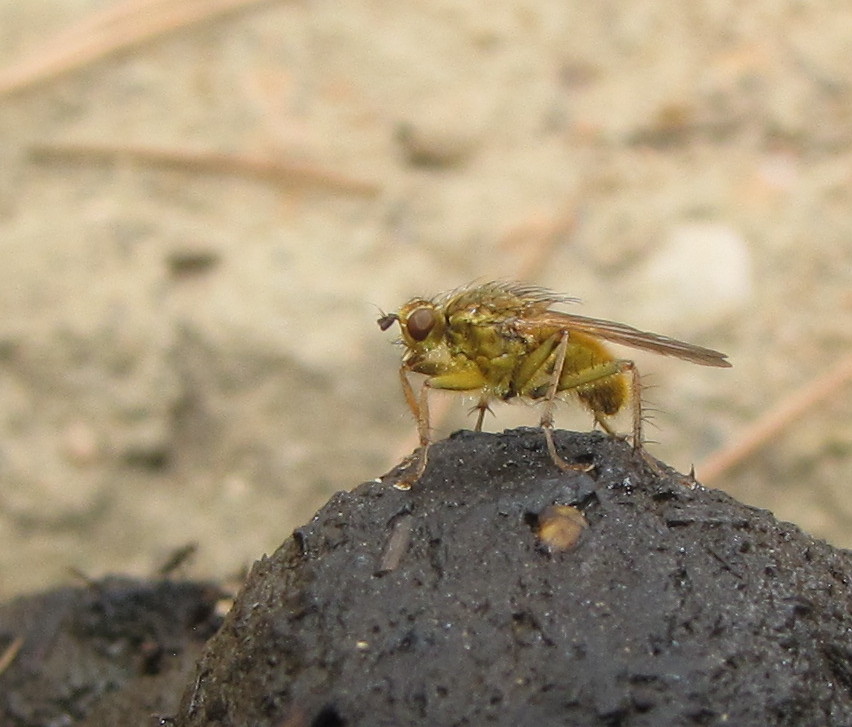
Male Golden Dung Fly

Different kind of excrement seems to attract different kinds of insects, at least to a degree. Fresh cow and horse dung is a favorite breeding ground for dung flies in the family Scathophagidae. The males stake out pats of poo and defend them from other males, while also intercepting females receptive to mating. The female lays her eggs in the manure and the larvae that hatch feed and develop there. You can easily recognize males of the Golden Dung Fly, Scathophaga stercoraria, but their fuzzy, bright golden appearance.

Various blow flies on what is probably bear scat

The blow flies (Calliphoridae) come in two basic varieties: "greenbottles" that are wholly metallic green, mostly in the genus Lucilia, and "bluebottes" that are usually larger, and gray with a metallic blue abdomen. Most of the common bluebottles are in the genus Calliphora. There is also the Black Blow Fly, Phormia regina, that is black or deep metallic blue-black. All can be present at dung.

Black scavenger fly

Tiny and wasp-waisted, black scavenger flies in the family Sepsidae are not easy to see immediately given their size, but their behavior is unmistakable: they walk around "rowing" their wings as if they needed the extra propulsion to get around.

Flesh flies of the family Sarcophagidae are gray with black "pinstripes" on the thorax, and usually red eyes and a red "tail." They are about the size of the blow flies, though some are smaller. The females "larviposit." That is, they lay tiny maggots in dung or carrion, rather than laying eggs. Bypassing the egg stage gives them a head start in exploiting the food resource.

A mating pair of flesh flies

Dung-watching is probably not going to become the next big thing in the world of naturalists, but if you can get over the "yuck factor," you might find some interesting creatures among the clean-up crew. Just make sure you are up wind.

Tuesday, February 2, 2016

Damsels That Cause Distress

Note: The subject for this post was requested by one of my followers. You, too, are welcome to make requests for subjects or topics. Simply e-mail: bugeric247ATgmailDOTcom.

Nabis sp. from Colorado

You would think that insects called "damsel bugs" would be delicate and and otherwise dainty. Well, many members of the true bug family Nabidae are delicate, and certainly small, there is nothing meek about them. They are mostly nocturnal predators that can subdue other insects even larger than themselves.

Hoplistoscelis pallescens, Massachusetts

There are nine genera and 41 species of damsel bugs in North America north of Mexico. None of them are greater than 12 millimeters in length as adults, most of them smaller than that.

Nabis sp. from Colorado

The femur segment of the front leg is usually muscular and swollen, armed with at least one row of small teeth on the underside. This helps the insect to secure prey.

Some nabids are wingless when mature, or have forms with abbreviated and useless wings. Those that fly are often attracted to lights at night, perhaps to prey on other insects drawn there.

While I was in Massachusetts in 2009, I witnessed a specimen of Nabis roseipennis stalk and assassinate a small braconid wasp. The persistence and fearlessness of the little true bug was impressive.

Nabids are easily mistaken for other kinds of true bugs, and it takes a bit of practice to recognize them. Most assassin bugs (Reduviidae) are larger, but they and damsel bugs both have a short rostrum ("beak") compared to most plant-feeding true bugs.

Plant bugs in the family Miridae are perhaps the most similar to damsel bugs, but mirids have a "cuneus," a pronounced wrinkle or notch in the margin of the front wing near where the leathery portion meets the membrane near the tip. Damsel bugs lack this feature.

Here in Colorado, one of our common damsel bugs is a small, dark, ground-dwelling member of the genus Pagasa. They are almost beetle-like in appearance, and I have mistaken more than one for a ground beetle as it ran across the path in front of me. Pagasa can be fully-winged or have wings reduced to non-functional pads.

Pagasa sp., Colorado

The tip of the tibia on the front leg of Pagasafeatures a specialized pad of hairs called the fossa spongiosa that aids them in climbing slick surfaces and grabbing slippery prey.

Pagasa sp., Colorado

So effective are damsel bugs as predators that they are considered economically important as pest control in agricultural systems. Indeed, they are also among the most abundant of small predators.

Nabis capsiformis from south Texas

Sources: Henry, Thomas J., and Richard C. Froeschner. 1988. Catalog of the Heteroptera, or True Bugs, of Canada and the Continental United States. New York: E.J. Brill. 958 pp.
Kerzhner, Izyaslav M., and Thomas J. Henry. 2008. "Three new species, notes and new records of poorly known species, and an updated checklist for the North American Nabidae (Hemiptera: Heteroptera)," Proc. Entomol. Soc. Wash. 110(4): 988-1011.
Slater, J.A. and R.M. Baranowski. 1978. How to Know the True Bugs. Dubuque, Iowa: Wm. C. Brown Company Publishers. 256 pp.

Tuesday, January 26, 2016

That Internet "Killer Bug" Hoax

I could write blog posts about internet hoaxes from here until the end of time. The latest is a "killer bug" that you should not kill with your bare hands because it spreads a lethal virus that also disfigures your skin. What a crock! Thanks to Hoax-Slayer we have the straight scoop.

Well, I can tell you about the insect pictured. Truth may be stranger than fiction in this case. Males of giant water bugs in the genera Belostoma and Abedus care for the eggs of their mates by carrying them on their backs. That's right, these giant water bugs, far from being people-killers, are the poster children for what a caring father looks like.

Male Abedus sp. giant water bug with eggs

The female giant water bug adheres her eggs to the back of the male, and he then guards them. He keeps the ova free of fungus, and well-aerated.

Ok, so what about the horror of that human hand? According to Hoax-Slayer, it is the work of a make-up artist, wrought of putty rather than some horrid disease. The sponge-like texture and pattern simply resembles the hatched eggs on the back of a male giant water bug.

Similar hoaxes have used photo-editing techniques to merge lotus pods or the mouths of lampreys with human body parts, the better to gross-out viewers.

According to an article on Snopes.com, yet another factor comes into play. The meme may be targeting people with "trypophobia," a supposed fear of holes or fear of irregular patterns of holes. No such phobia is documented in scientific literature, however. So, apparently this hoax is a triple-header: fear of insects, fear of disease, and fear of holes, all wrapped up in one whopper of a tale.

There is a slight grain of truth to this over-dramatized viral meme, though. Giant water bugs are predators of other aquatic organisms, and they deliver a venomous bite to paralyze their prey. The venom contains enzymes that aid in extraoral digestion. That is, the saliva begins breaking down tissues of the prey so that it can be withdrawn through the insect's beak and into its digestive system. The bugs will bite in self-defense, too, so handling them should be discouraged for that reason.

Ah, if only truthful information spread as quickly and effectively as fear-inspiring hoaxes like this. Please do your part by investigating the validity of a given meme before sharing it....or share it with a bold disclaimer. Thank you.

Tuesday, October 27, 2015

Autumn Assassins: Acholla spp.

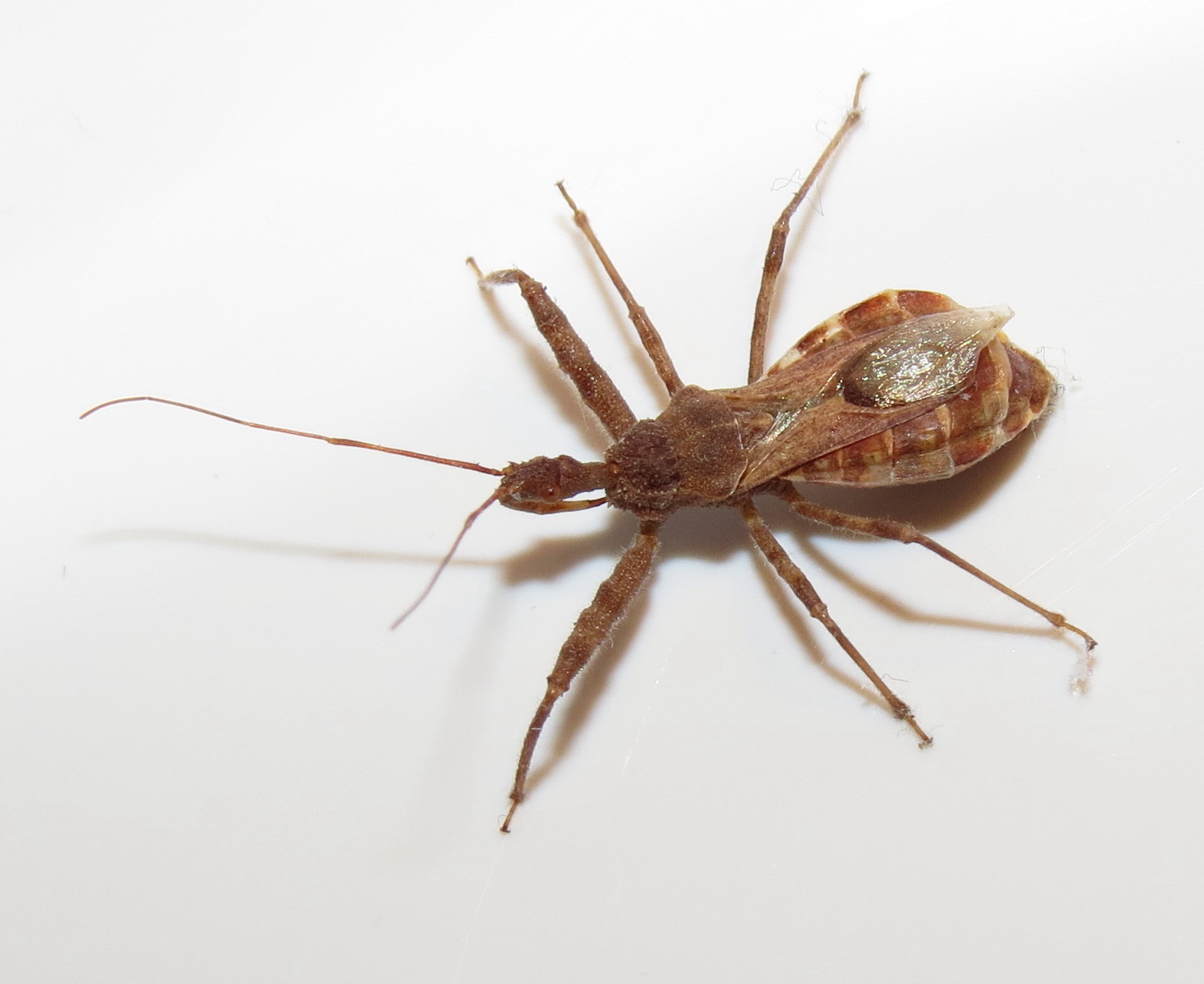
Everyone has their own icon for a harbinger of fall, but mine has to be the assassin bugs in the genus Acholla (Gesundheit!). Adult specimens can actually be found regularly beginning in July, at least in some localities, but are most obvious in autumn, perhaps because foliage is falling and prey insect populations are beginning to decline.

A. multispinosa, Massachusetts

I first encountered these assassins in Massachusetts in 2009. I found one climbing on a signpost at the Mount Sugarloaf State Reserve in South Deerfield on November 1. Acholla multispinosa is our most widespread species, the only one found in eastern North America from New England south along the Appalachia Mountains to Tennessee and North Carolina, west through the Great Lakes, to Kansas, Nebraska, and southeast Iowa.

Male A. ampliata, Colorado

Here in Colorado, our common species is A. ampliata, which also occurs in California, Utah, Arizona, and New Mexico. Last year I found one on September 2, and another on September 8, both apparently males. I found what I assume to be a gravid female just last Friday, October 23, 2015. All the specimens were found beneath a large cottonwood tree in our reasonably urban, residential neighborhood. The bugs had apparently fallen out of the tree and were on a tall, plastic utility box beneath it.

Gravid female A. ampliata, Colorado

Acholla is easily mistaken for the more common Sinea species, but lacks the "thorny" appearance of that genus, and has no prominent spines on the inner surface of the tibia ("shin" segment) on the front leg. Acholla average slightly larger, too, ranging from 12-16 millimeters in body length compared to 12-14 for Sinea.

There is a third species of Acholla, A. tabida, found in California and Mexico.

Another male A. ampliata

What do these assassin bugs feed on? According to one reference, A. multispinosa is an enemy of the Pine Webworm, Pococera robustella, a caterpillar in the moth family Pyralidae. Another source reports the bug to prey on caterpillars of the Codling Moth, Cydia pomonella, family Tortricidae (the "worm" in the apple). Acholla in general are mostly arboreal (tree-dwelling) and thus feed upon insects associated with trees. Indeed, woodlands and orchards seem to be this insect's primary haunts.

A. multispinosa, Massachusetts

Acholla overwinters in the egg stage. The eggs are adhered to a substrate with, and protected by, a hardened secretion from the female's subrectal glands. This material probably insulates the eggs from weather and dessication, but may also repel potential egg predators. Diligent searching has failed to turn up any further information on the life history of Acholla. More appears to be known about its chromosomes, ironically enough.

So, before you put away your field gear for the winter, take one last look for these autumn assassins. You might easily add to our knowledge of their geographic distribution and natural history.

Sources: Drooz, Arnold T. 1985. Insects of Eastern Forests. Washington, DC: U.S. Department of Agriculture Forest Service, Miscellaneous Publication No. 1426. 608 pp.
Hoffman, Richard L. 2006. "Assassin Bugs of Virginia," The Insects of Virginia. No. 15. Martinsville: Virginia Museum of Natural History. 74 pp.
Slater, J.A. and R.M. Baranowski. 1978. How to Know the True Bugs. Dubuque, Iowa: Wm. C. Brown Company Publishers. 256 pp.
Swanson, D.R. 2011. "New State Records and Distributional Notes for Some Assassin Bugs of the Continental United States (Heteroptera: Reduviidae)," Great Lakes Entomologist 44(3-4): 117-138.