Monday, October 24, 2022

Fall (Bug) Colors

October is the heart of autumn in many parts of North Amreica, with intensifying colors of fall foliage. Insects reflect the changing hues of plants, the better to camouflage themselves. As chlorophyll recedes, xanthophyll (yellow) and other carotenoids (orange), begin to manifest. Anthocyanins (reds to purples) become prominent, too. Could it be that insects feeding on those leaves take on the same colors? Perhaps the insects are merely responding the shrinking period of daylight as the leaves are doing.

As leaves begin falling down, alate (winged) citronella ants, Lasius sp., fly up, in hopes of finding mates from nearby colonies.

Greens persisting

This year, here in northeastern Kansas anyway, an exceptionally dry summer has resulted in subdued fall colors. Green leaves persist, even if they are withered from a record-breaking hard freeze last week. Some insects insist on being wholly green, or at least partly so.

A male lesser meadow katydid, Conocephalus sp., basks on a sidewalk.

Green Mantisfly, Zeugomantispa minuta, on the side of our house.

Nymphs of the Pale Green Assassin Bug, Zelus luridus, will overwinter in that stage.

Ah-ha! It is Bristly Roseslug sawfly larvae, Cladius difformis, doing all this damage to our roses.

Straw

Beige is an overwhelmingly common color of fall in pastures and fields, and even lawns thanks to our current drought. Insects of the same color merge seamlessly with grasses and weeds, becoming nearly impossible to detect unless they move. On windy days it is even more of a challenge. Thankfully, for entomologists and bugwatchers, insects frequently alight on, or are blown onto, sidewalks, the sides of buildings, and other surfaces where they stand out.

A Corn Earworm moth, Helicoverpa zea, attracted to a blacklight in our front yard.

This stink bug, Thyanta sp., has highlights of rose and green, too.

A jumping spider, Colonus sp., prowling the exterior of our house.

Yellow and gold

Many insects with warning colors are bright yellow, and black, regardless of the seasons, but in autumn they complement the colors of plants.

A Cloudless Sulphur, Pheobis sennae, pauses in our flower bed.

A Goldenrod Soldier Beetle, Chauliognathus pensylvanicus, in the absence of flowers, looks forlorn on the side of our house.

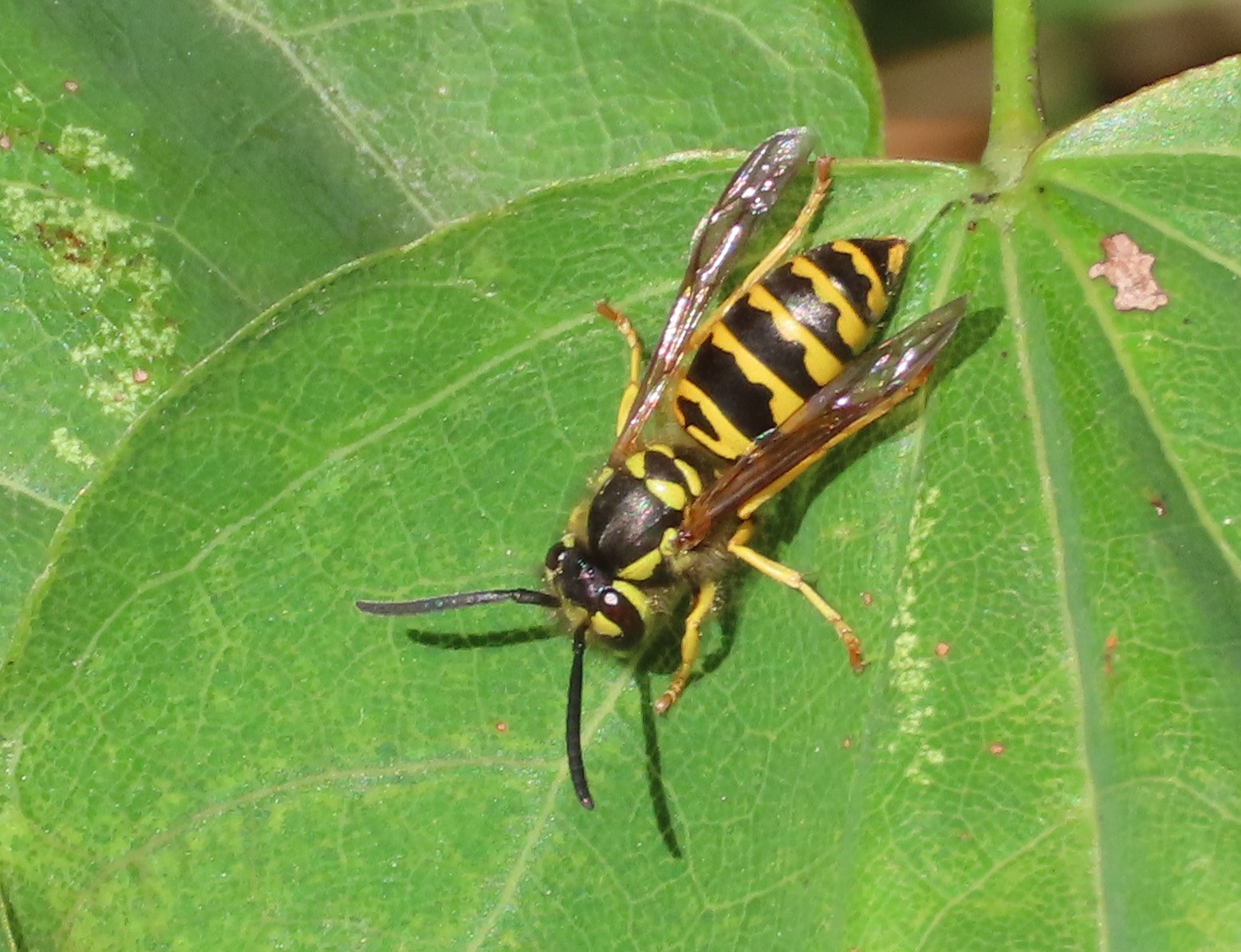
A worker Eastern Yellowjacket, Vespula maculifrons, lingers on a hosta leaf.

One yellowjacket mimic is this syrphid flower fly, Helophilus sp.

Orange and red

Orange and red are less common colors in insects, and often part of the loud wardrobe of aposematism (warning colors), or mimicry of other insects that are well-defended by venom or toxins. Lady beetles defend themselves by autohaemorrhaging, or “reflex bleeding,” from leg and body joints. An alkaloid toxin in the haemolymph is aromatic and sticky, quite repulsive to would-be predators.

Eastern Comma butterfly, Polygonia comma, will overwinter as an adult, hidden in a crevice in a log, or a similar niche.

Some checkered beetles, like this Enoclerus ichneumoneus, are likely mimics of velvet ants (which are wingless female wasps with a potent sting).

Multicolored Asian Lady Beetle, Harmonia axyridis, is also known as the "Halloween Ladybug" for the time of year it is most conspicuous as it seeks winter shelter on or inside buildings.

Worker citronella ants, Lasius sp., are a lovely orange or yellow.

Metallic colors

Many insects are iridescent, often vividly so. Whereas the preceding colors are expressed by pigments that absorb all wavelengths of light except the one we interpret as brown, beige, green, yellow, orange, or red, or black, iridescent colors are produced by a different mechanism. These structural colors are rendered by micro-sculpturing, and/or layering, of the cuticle of the animal’s exoskeleton. Light bounces and reflects, and the color we see varies depending on the angle of the light hitting the organism.

Many longlegged flies, family Dolichopodidae, have bright metallic colors, and run rapidly over the surface of leaves.

Metallic sweat bee, Augochloropsis sp(?), pausing to groom herself.

"Greenbottle" blow flies are brightly metallic green, copper, or bronze.

"Bluebottle" blow flies, Calliphora sp., are weakly iridescent on the abdomen.

White and multi-colored bugs

A few insects are white, or appear so at least. This is especially the case for true bugs that exude waxy secretions to protect themselves from desiccation and make themselves distasteful to predators. Leafhoppers display almost every color combination imaginable in patterns of spots, blotches, stripes, bands, and speckles.

Whiteflies are not flies, but tiny, wax-dusted relatives of aphids.

Drepanaphis sp. aphids are studded with spikes that help hold in place the white wax they secrete.

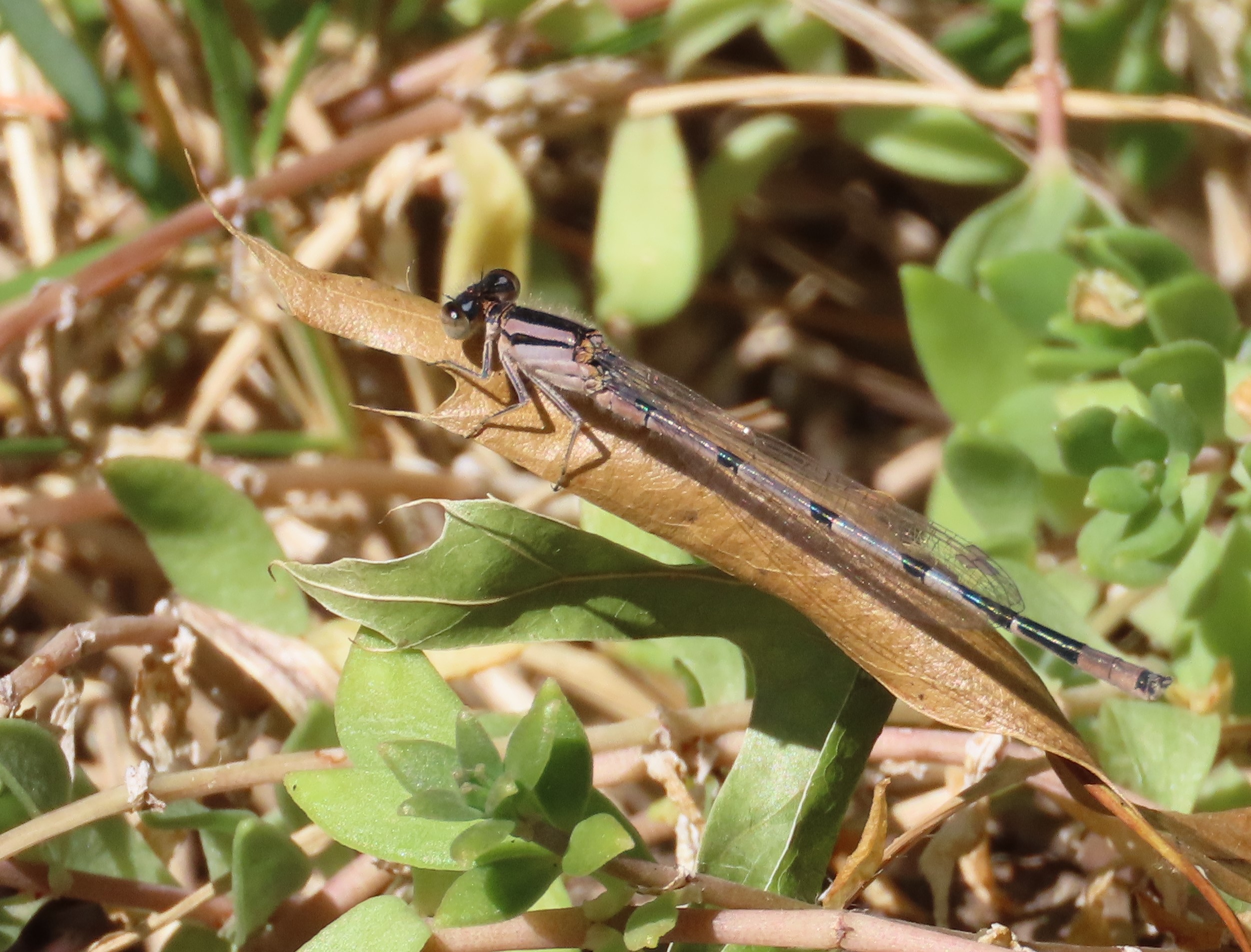
A teneral male Familiar Bluet damselfly, Enallagma civile, has subdued, pastel colors compared to the vivid blue it will have eventually.

Versute Sharpshooter leafhopper, Graphocephala versuta, is a tiny living rainbow.

Until next time

Keep looking for colorful “bugs,” deep into fall. Some will enjoy your rotting Jack-O’-Lantern. Others will find their way indoors, preferring the same comfortable climate you yourself enjoy. Meanwhile, I will do my best to keep cranking out blog posts to help you identify them. Stay warm and dry, friends.

Monday, October 17, 2022

Jim Anderson: My Original Mentor

Last week I learned that my first true mentor, Jim Anderson, passed away on September 22, 2022 at the age of 94. It was my intention to honor him while he was still among the living, but I did not make that enough of a priority. That oversight in no way reflects what a powerful and positive influence he was on my life, and the lives of so many others.

Jim Anderson at 82 years young

I am reasonably certain that my mother was the one who took the initiative in connecting me to Jim. She was a veteran in the television and radio industry, and at the time I first met Jim he was doing a local show on nature for Oregon Public Broadcasting. I seem to recall that our initial meeting was in his studio, in fact.

Concurrently, Jim was employed as an educator with the Oregon Museum of Science and Industry (OMSI). From there, he became director of the Children’s Zoo and conservation and education programs at what was then the Portland Zoo (now the Oregon Zoo in Washington Park).

Jim introduced me to other biologists and naturalists, too, including Mike Houck, who went on to become the Urban Naturalist for the Audubon Society of Portland. Jim and Mike did programs at OMSI field stations and camps, which I had the privilege of visiting periodically on weekends.

The Nature Conservancy hired Jim to manage its Ramsey Canyon Preserve in the Huachuca Mountains of southeast Arizona for three years, but Jim and his wife Sue returned to his beloved Oregon to run the nature center at Sunriver resort south of Bend in the early 1970s. It was there that I caught up with him again. Had my late mother not been so overprotective, I might have spent time with him exploring lava tube caves, or maybe even assisting in banding raptors.

Myself and Jim at Sunriver in August, 1971

Eagles, hawks, and owls were always the center of Jim’s wild universe. He even flew with them, in a manner of speaking. He got a commercial pilot license, and was an accomplished pilot of glider planes. He even instructed student glider pilots.

Among Jim’s enduring menagerie of animals was “Owl,” a Great Horned Owl that had lost an eye. Remarkably, the bird regenerated the eye and, after several years of behavioral rehabilitation, Jim released “Owl” with great fanfare at Sunriver. Owl was immediately harassed by an American Kestrel, such is the drama of nature.

Jim surveyed and banded birds of prey in central Oregon for over fifty years, the last decade or so with the company of his wife, Sue. She wisely insisted that climbing cliffs and trees was too dangerous for someone in his eighties, and Jim begrudgingly retired.

One of the milestones I am most proud of is when I was first published in Ranger Rick magazine, because I had grown up reading Jim’s articles in that publication. He wrote consistently, for many periodicals, and had a column in The Nugget Newspaper of Sisters, Oregon. He also appeared regularly in The Source Weekly of nearby Bend, Oregon. Jim was an outstanding photographer, too, and most of his articles included his images. He compiled his most memorable and hilarious stories in Tales from a Northwest Naturalist, published in 1992.

Everything came full circle for me when Jim agreed to be best man at my wedding to Heidi, on April 29, 2012. A few years later we saw Jim for the last time at his home in Sisters. I had the privilege of introducing another young man, and his then girlfriend (now marital partner), at that time. The couple lived in Bend, and I hope they were able to visit with Jim and Sue again before Jim and Sue moved to Eugene, Oregon to be closer to their children.

Jim, myself, and my mother at my wedding

Being an only child, I had a difficult time socializing with my peers. It was with adults that I felt most comfortable, but Jim nudged me to expand the boundaries of my comfort zone. He was always patient and encouraging, but also insistent, especially when it came to my education. I am glad I still have a few years left, hopefully, to become an even better human being, and a less hesitant one when opportunities present themselves.

Jim's photo of Heidi and I

From what I hear from Sue, I am one of many disciples of Jim. His enthusiasm was contagious, his breadth of knowledge and interests seemingly boundless (did I mention he sang in church choirs?), and his self-reliance admirable. There was no machine he could not repair with bailing wire. He had an old-fashioned wit and sense of humor, and a genuine love and appreciation for all of those he invested his time and counsel in. They do not make men like him very often nowadays. Rest in peace, Jim, you deserve eternal joy and love.

Sunday, September 25, 2022

Book Review: Spiders of North America

It is “Spider Sunday” on this blog, so what better to post than a rave review of the newest spider identification resource, the Princeton Field Guide to Spiders of North America, by Sarah Rose. Yes, I wrote the foreword for this book, but I guarantee that this is an unbiased review. There is far more to recommend this book than my mere two cents at its beginning.

Spiders have faced an uphill battle in the widespread appreciation of these arachnids, in part due to few easily available, and easily affordable, resources for non-scientists. The most reasonably priced books are either outdated, full of errors such as mislabeled images, or both. Until now, the only current guides to spiders have been regional in nature (California and the Pacific coast, for example), or so expensive, and/or scientifically technical, as to discourage their purchase.

Finally, we have a true field guide, organized in a manner that respects the scientific terminology, and understands the limits of macrophotography, and facilitates the identification of many spiders by non-scholars.

One example of Rose’s innovative approaches is her color-coding of spider eyes. The eye arrangement of a given specimen is often key to its identification, but if you do not understand the jargon of “posterior median eyes,” or “anterior lateral eyes,” you are left spinning your wheels, if not throwing the book in the garbage. By associating the different pairs of eyes with different colors, it allows the user to make quick assessments of the creature they have in hand. The only drawback would come if you happen to be colorblind, and that is a consideration few, if any, publishers take into account.

Another way that the author organizes her book is by “guilds,” a term that in this case means the hunting lifestyle of the spider. Some spiders build two-dimensional sheet webs or orb webs, while others are “space web weavers” in three dimensions. Still others are ambush hunters or “ground active hunters.” This works well except maybe for mature male web-weaving spiders that leave their snares to look for mates, but the combinations of characteristics highlighted for each family of spiders overcomes those hurdles.

Each species entry in the book includes a range map, and verified state records. Our collective knowledge of spider distribution is relatively weak, and spiders excel at hitching rides on commerce and vehicles and other belongings, ending up far from their “normal” ranges, but here you have a good reference point for assessing the identity of most spiders you will encounter.

The images in the book are of living individuals, so all the colors and shapes are undistorted. Usually there is more than one image, to illustrate the dorsal (top) and ventral (underside) of the spider, and the color variations that the species might exhibit. Additionally, webs, egg sacs, and young spiders may be depicted, the better to demonstrate the full range of a species’ appearance and lifestyle.

The first part of this field guide provides an excellent overview of spider anatomy and biology, gives a brief and effective lesson in how spiders, and all organisms, are classified, and shares tips for observing spiders safely, ensuring that both you and the arachnid will be unharmed. Need to know the benefits of having spiders around? They’re in there. How do spiders fit into the larger picture of ecosystems? That information is also included. Did I mention there is an illustrated glossary in the back? Additional references are listed in the bibliography.

Before I end, I must offer an apology to all of you. This reference should have been available much sooner. I was the original author contracted to write this guide. It soon became apparent to me that I was not qualified to execute the project. Unfortunately, I procrastinated in disclosing that to the publisher. The least I could do was recommend a replacement, and I could not be more delighted that Sarah Rose agreed. This is a far better book than anything I could have written. If you have even a smidgen of curiosity about spiders, this reference will ignite it into a flame of passion. All the common species are in there, plus ones that you will see and say “Oh, I have got to find one of these!” Happy spider seeking, friends.

Tuesday, September 20, 2022

Fungus Party-y-y!

Sometimes, with luck, you stumble upon a wonderful circumstance of insect abundance. My partner, Heidi, did so this past Saturday afternoon, September 17, along a trail through Wyandotte County Lake Park, Kansas, USA. She happened to notice a thick mass of mushrooms at the base of a tree. It was literally crawling with insects.

Everybody on the dance floor!

The fungus in question may be a species of “oyster mushroom” in the genus Pleurotus, according to Ben Sikes at the University of Kansas, and with the Kansas Biological Survey. He was kind enough to offer an opinion on my photo of it on iNaturalist. At least some species are fit for human consumption, too, but please do not forage without expert guidance, at least initially. Your experiment in wild culinary arts could end abruptly and permanently if you do not know exactly which mycological fruiting bodies to avoid.

"Get down to it....get down to it...."

Insects, on the other hand, do not seem to care, especially the many varieties of beetles that are collectively known as fungus beetles. There are pleasing fungus beetles (family Erotylidae). There are handsome fungus beetles (Endomychidae), hairy fungus beetles (Mycetophagidae), tooth-necked fungus beetles (Derodontidae), silken fungus beetles (Cryptophagidae), polypore fungus beetles (Tetratomidae), cryptic fungus beetles (Archeocrypticidae), minute tree-fungus beetles (Ciidae), and several genera of darkling beetles (Tenebrionidae) that are found almost exclusively on or in fungi, including woody shelf fungi. I may be forgetting some….

Triplax thoracica, but there may have been another species with a dusky or black belly instead of an orange underside.

The most abundant insect on this particular mushroom cluster is probably a pleasing fungus beetle, Triplax thoracica. That genus, certainly, but that species apparently loves oyster mushrooms. It occurs across the eastern half of the U.S. and adjacent Canada. At only 3-5.6 millimeters in length, they are difficult to spot as individuals, but there were dozens flying in, flying out, and running about.

Uh, oh [abrupt, scratched record sound].

In a prehistoric analogy, Triplax are the herd of plant feeders. Sure enough, there were vicious carnivores prowling through the gills and over the caps of the mushrooms.

Sharp dresser, anyway.

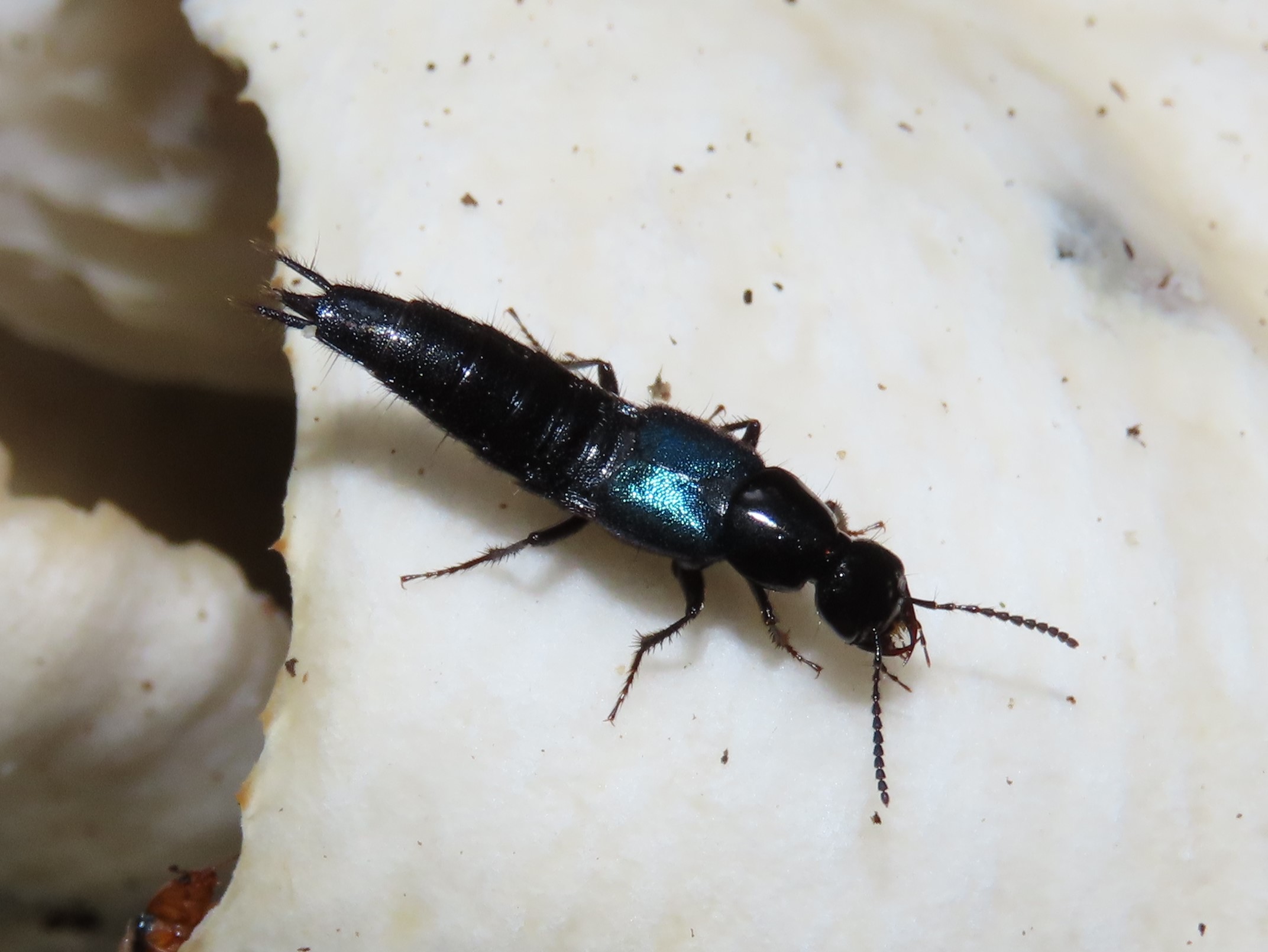
A sleek, serpentine, black rove beetle with metallic blue-green elytra (wing covers) popped into view periodically. Meet Philonthus caeruleipennis, 12-15 millimeters long. Were it a vertebrate, it would no doubt be a weasel, mink, ferret, or other mustelid. It is transcontinental in Canada, but occurs only in the northeast quarter of the U.S. It also occurs in Europe.

Pull the fire alarm! Call 9-1-1!

The equivalent of Tyranosaurus rex in this micro-scenario would be the Brown Rove Beetle, Platydracus maculosus. Measuring 22-35 millimeters, it dwarfs its prey, which in this case was the Triplax fungus beetles.

Serial killer making mincemeat of partygoers.

By now, oblivious to the monsters among them, the Triplax party was becoming something of an orgy, with love trains of males following females. It was quite amusing.

Gettin' busy.

Some of the fungus beetles also had passengers in the form of phoretic mites. The mites, which are probably “mesostigs” in the order Mesostigmata, cause no harm to the beetles. Instead of being parasitic, the mites are hitchhikers, using the beetles as transport to a location where they can feed on insect eggs or other tiny prey.

Mites being a little voyeuristic....

Along with the beetles were pomace flies, family Drosophilidae. These are the “fruit flies” you see in your kitchen around overripe fruit, fermented beverages, and other foods. Drosophilids sare surprisingly diverse, and a good variety can be found around rotting fungi “in the wild.”

Pomace fly disappointed that the mushroom is not spoiling already....

The latecomer to the party was a worker Tennessee Spine-waisted Ant, Aphaenogaster tennesseensis. She was simply looking for dead or injured insects she could take back to her colony to feed her larval sisters.

"Just passing through!

At last, it was time for me to say farewell. Heidi had already progressed down the trail by about fifty yards.

"I'm blowin' this fruit stand!"

Now is a perfect time to go out looking for mushrooms and their associated insects. We left these mushrooms alone, but sometimes it is necessary to tear apart the fungus to find insects. It is best to do so over a white enamel pan, or some other kind of tray so that it catches the insects falling out. Be quick to grab the rove beetles before they take flight. If you do know your mushrooms, then bonus! You can take uninfested specimens to the kitchen instead of the lab. Enjoy your autumn no matter what you do.

Nom-nom-nom-nom....

Sources: Rhine, Lyndzee. 2020. A Pocket Guide to Common Kansas Mushrooms. Wichita: Great Plains Nature Center. 69 pp.
Evans, Arthur V. 2014. Beetles of Eastern North America. Princeton, New Jersey: Princeton University Press. 560 pp.