Showing posts with label identification. Show all posts

Sunday, September 25, 2022

Book Review: Spiders of North America

It is “Spider Sunday” on this blog, so what better to post than a rave review of the newest spider identification resource, the Princeton Field Guide to Spiders of North America, by Sarah Rose. Yes, I wrote the foreword for this book, but I guarantee that this is an unbiased review. There is far more to recommend this book than my mere two cents at its beginning.

Spiders have faced an uphill battle in the widespread appreciation of these arachnids, in part due to few easily available, and easily affordable, resources for non-scientists. The most reasonably priced books are either outdated, full of errors such as mislabeled images, or both. Until now, the only current guides to spiders have been regional in nature (California and the Pacific coast, for example), or so expensive, and/or scientifically technical, as to discourage their purchase.

Finally, we have a true field guide, organized in a manner that respects the scientific terminology, and understands the limits of macrophotography, and facilitates the identification of many spiders by non-scholars.

One example of Rose’s innovative approaches is her color-coding of spider eyes. The eye arrangement of a given specimen is often key to its identification, but if you do not understand the jargon of “posterior median eyes,” or “anterior lateral eyes,” you are left spinning your wheels, if not throwing the book in the garbage. By associating the different pairs of eyes with different colors, it allows the user to make quick assessments of the creature they have in hand. The only drawback would come if you happen to be colorblind, and that is a consideration few, if any, publishers take into account.

Another way that the author organizes her book is by “guilds,” a term that in this case means the hunting lifestyle of the spider. Some spiders build two-dimensional sheet webs or orb webs, while others are “space web weavers” in three dimensions. Still others are ambush hunters or “ground active hunters.” This works well except maybe for mature male web-weaving spiders that leave their snares to look for mates, but the combinations of characteristics highlighted for each family of spiders overcomes those hurdles.

Each species entry in the book includes a range map, and verified state records. Our collective knowledge of spider distribution is relatively weak, and spiders excel at hitching rides on commerce and vehicles and other belongings, ending up far from their “normal” ranges, but here you have a good reference point for assessing the identity of most spiders you will encounter.

The images in the book are of living individuals, so all the colors and shapes are undistorted. Usually there is more than one image, to illustrate the dorsal (top) and ventral (underside) of the spider, and the color variations that the species might exhibit. Additionally, webs, egg sacs, and young spiders may be depicted, the better to demonstrate the full range of a species’ appearance and lifestyle.

The first part of this field guide provides an excellent overview of spider anatomy and biology, gives a brief and effective lesson in how spiders, and all organisms, are classified, and shares tips for observing spiders safely, ensuring that both you and the arachnid will be unharmed. Need to know the benefits of having spiders around? They’re in there. How do spiders fit into the larger picture of ecosystems? That information is also included. Did I mention there is an illustrated glossary in the back? Additional references are listed in the bibliography.

Before I end, I must offer an apology to all of you. This reference should have been available much sooner. I was the original author contracted to write this guide. It soon became apparent to me that I was not qualified to execute the project. Unfortunately, I procrastinated in disclosing that to the publisher. The least I could do was recommend a replacement, and I could not be more delighted that Sarah Rose agreed. This is a far better book than anything I could have written. If you have even a smidgen of curiosity about spiders, this reference will ignite it into a flame of passion. All the common species are in there, plus ones that you will see and say “Oh, I have got to find one of these!” Happy spider seeking, friends.

Sunday, July 17, 2022

What is, and is NOT, a Japanese Beetle

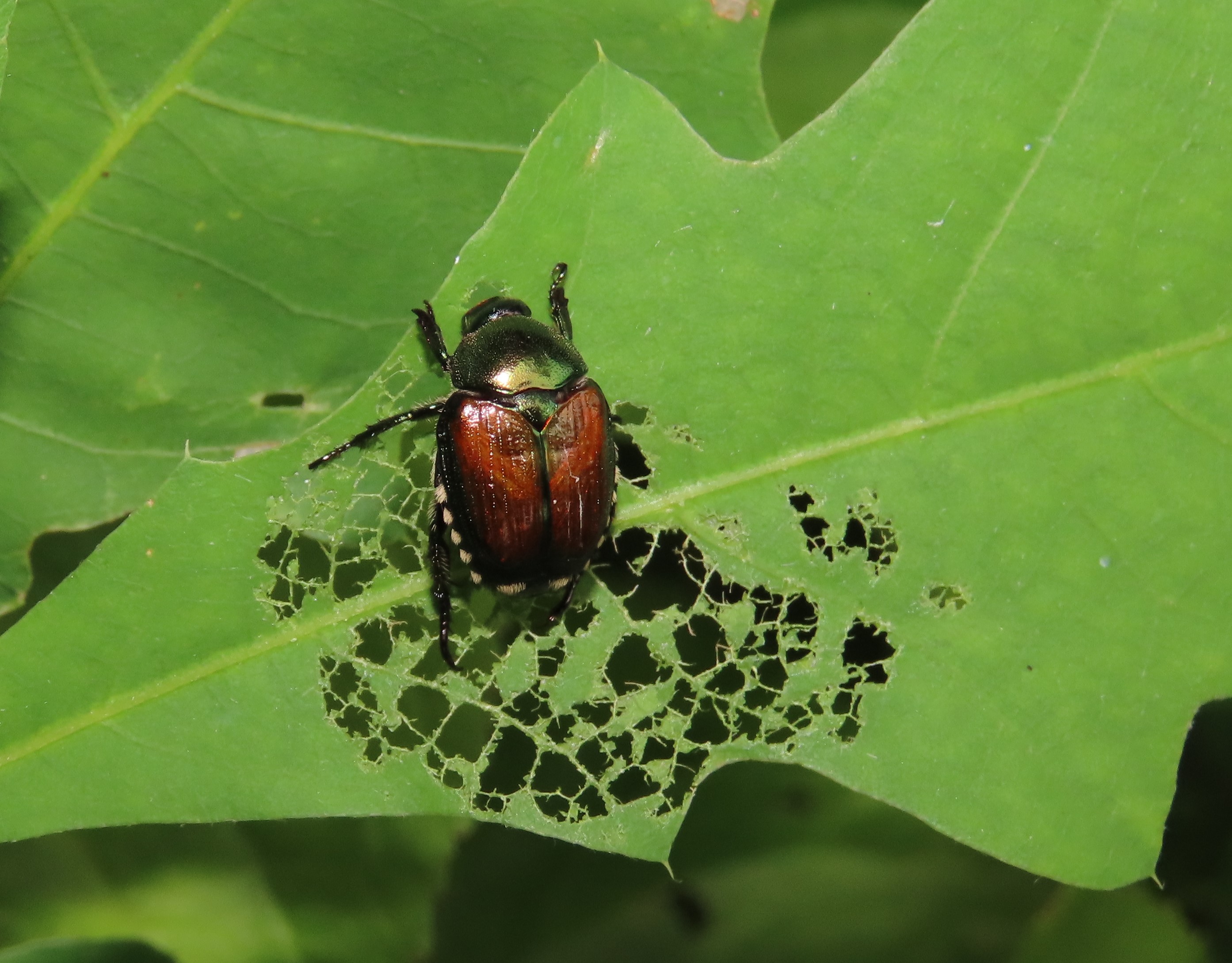
It is that time of year again in North America when everything is a Japanese Beetle. No matter whether you are a trusted and reliable expert, other people will insist that Green June Beetles, Fig Beetles, Dogbane Leaf Beetles, and various other beetles, are in fact Japanese Beetles. Why is this the case? There is much misinformation online and in the media. Family, friends, coworkers, and others present themselves as experts and make incorrect identifications. Mobile phone "apps" can also be misleading, given the relative infancy of image recognition software and deep learning, which frequently compounds errors instead of correcting them. Here is everything you need to know about how to recognize the Japanese Beetle, Popillia japonica, as well as lookalike species.

L-R: Japanese Beetle, Green June Beetle, Emerald Flower Scarab

The Japanese Beetle, as its name implies, occurs naturally in Japan and northern China. An accidental introduction of this species to New Jersey in 1916 is apparently what launched the beetle's domination of yards and gardens over most of the eastern United States and southeast Canada. It delivers a double whammy to urban and suburban areas by feeding on the roots of turf grasses in its subterranean larval (grub) stage, and on the foliage of more than three hundred (300) species of plants as an adult insect. The beetles are "skeletonizers," leaving a net-like pattern of leaf veins in the wake of their chewing. Grape and rose are among their favorites.

Typical "skeletonizing" damage by Japanese Beetle

Japanese beetles are classified as scarab beetles, in the family Scarabaeidae, subfamily Rutelinae, collectively known as the shining leaf chafers. The adults become suddenly abundant about mid-summer. They fly well, quickly dispersing themselves over the landscape. Their sheer numbers, the telltale pattern of damage they do to foliage, their size, and their behavior help to make them easy to identify with a little practice.

Japanese Beetles congregating and mating

These are smaller insects than you might expect, ranging from 8.9-11.8 millimeters in body length. That is less than half an inch. They vary in color by individual and age, but most are shining metallic green and red. The flanks of the abdomen are adorned with tufts of white hairs, a feature no other lookalike beetle has. The elytra (wing covers) are striated (have grooves), which also helps set them apart from similar beetles. The hind legs are long and stout, with sharp spurs coming from the tip of the tibial segment (think "shin"). When disturbed, Japanese beetles will flare their hind legs out and up, presenting their spiked weaponry. They can give you a good prick should you insist on seizing one.

Japanese Beetle in defensive pose

The antennae of adult Japanese Beetles are short, with a series of leaf-like plates at the tip, typical of all scarab beetles and their allies. The term for this style of antenna is "lamellate" for "plate-like." The plates are covered in receptors that are tuned to species-specific pheromones for locating others of their kind. Pheromone traps, sold commercially, work well if your goal is to draw even more Japanese Beetles to your yard or garden. Hand-picking the insects and drowning them in pails of water, with a dash of dish soap to break the surface tension, may be the best way to control them. Time consuming for certain, but highly specific to the target pest, and otherwise environmentally friendly.

Green June Beetle, Cotinis nitida

The number one victim of mistaken identity in the Japanese Beetle game is far and away the innocuous Green June Beetle, Cotinis nitida, another scarab beetle that is native to the United States. This insect is much larger, at 15-27 millimeters in size. It is mostly matte green with some degree of iridescence in the right light, especially on the insect's underside. It may or may not be marked with ochre trim, and lines on the wing covers. You may hear these beetles before you see them, as they fly loudly. Green June Beetles, and their relative, the Fig Beetle (Cotinis mutabilis), are classified as "flower chafers" in the subfamily Cetoniinae. They have a special hinge on each wing cover that allows the elytra to remain closed while the membranous hind wings are deployed for flight. Consequently, flower chafers bear a great resemblance to large bees while cruising around looking for food or mates. Green June Beetle feeds on flower nectar and pollen, but occasionally damages ripe fruit; and they also feed on fermenting sap from wounds on trees. This makes them a mild pest under circumstances of orchards and nurseries. As grubs, Green June Beetles feed on decomposing organic matter. You will often see females diving headlong into compost and manure heaps to lay their eggs. In nature they look for rich humus.

Emerald Flower Scarab

Another flower chafer sometimes mistaken for a Japanese Beetle is the Emerald Flower Scarab, Euphoria fulgida. This beautiful beetle measures 13.4-19.8 millimeters. It is often highly active and quicker to fly than the other beetles mentioned so far. It varies considerably in color according to both the individual and the geographic locality it lives in. Specimens from the foothills of the Front Range in Colorado, for example, are deep purple and brilliant turquoise.

Dogbane Leaf Beetle

Recently, I had a....disagreement with someone in social media about the identity of yet another beetle, the Dogbane Leaf Beetle, Chrysochus auratus. At 8-13 millimeters, it approximates the size of a Japanese Beetle. It is superficially colored the same, too, being brilliant metallic green, red, blue, bronze, or copper, depending on the angle of light hitting the creature. That is where the similarity ends. The Dogbane Leaf Beetle belongs to a completely different family, the Chrysomelidae. One look at the long, uniformly segmented antennae, tells you it is not a scarab. Its legs are not armed with spines or teeth, and it has cute, wide little feet for gripping plants. Most decisive, however, is the food preference for this species. Dogbane Leaf Beetle feeds only on....surprise....dogbane. You may occasionally encounter an individual that has alighted on some other plant in the course of trying to find a mate or another dogbane plant, but there will never be large numbers of them on anything but dogbane.

Female Tiphia wasp searching for buried scarab grubs

All manner of control strategies have been applied to the Japanese Beetle, yet here it is, still with us, in arguably greater numbers than ever, and steadily expanding its empire. We have imported the Spring Tiphia wasp, Tiphia vernalis, from China in 1925, a natural enemy. The female wasp digs up a beetle grub, stings it into temporary paralysis, lays an egg on it, and abandons it. The larval wasp that hatches feeds on the grub externally, eventually killing it. We also employ Bacillus popilliae, known better as "milky spore disease" to combat the grubs. The bacterium turns the beetle larvae a milky white color in the process of killing them, but it also affects native scarab grubs.

A large robber fly, Laphria lata, has skewered a Japanese Beetle on its proboscis

Be careful in how you control Japanese Beetles, lest you adversely impact garden allies. Assassin bugs, particularly the Wheel Bug, and robber flies, are among the chief predators of Japanese Beetles, but they need as natural a landscape as possible to proliferate and be effective controls. Invasive species are an artifact of global consumerism, and coveting thy (foreign) neighbor's flora. Resist the temptation and help prevent the next pest from gaining a foothold.

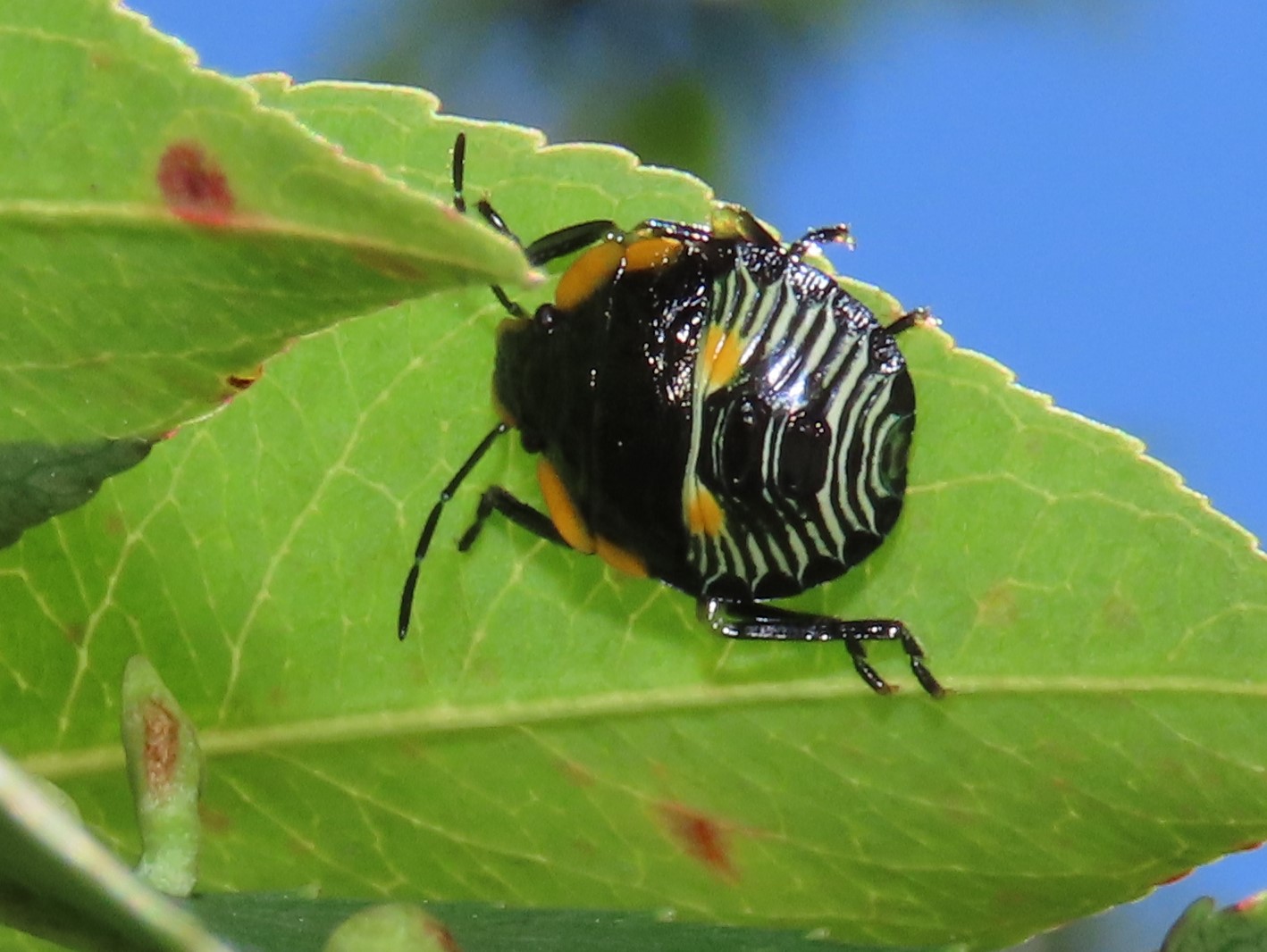
Nope, not a Japanese Beetle. Not even a beetle, but the nymph of a Green Stink Bug.

Sources: Evans, Arthur V. 2014. Beetles of Eastern North America. Princeton, New Jersey: Princeton University Press. 560 pp.
Ratcliffe, Brett C. 1991. The Scarab Beetles of Nebraska. Lincoln: University of Nebraska. Bulletin of the University of Nebraska State Museum, vol. 12. 333 pp.
Berenbaum, May R. 1995. Bugs in the System: Insects and Their Impact on Human Affairs. New York: Addison-Wesley Publishing Company, Inc. 377 pp.
Fahmy, Omar. 2007. "Species Tiphia vernalis - Spring Tiphia," Bugguide.net
Eaton, Eric R. and Kenn Kaufman. 2007. Kaufman Field Guide to Insects of North America. Boston: Houghton Mifflin. 392 pp.

Wednesday, December 22, 2021

Looking Ahead to 2022

The end of this year has brought a clearer focus for the new year ahead. I have projects to complete, and travel plans already. What else materializes will be dependent on my health, my initiative, what my wife has planned, and how the ongoing pandemic plays out.

My office

In November I received forty-five (45) boxes of pinned insect specimens from Colorado that I am under contract to identify to the best of my ability. They are currently stacked around my office in the spare bedroom of our house. I am grateful for the work, and always find it exciting and challenging. Nearly every insect order is represented in this particular project, save butterflies, moths, and aquatic insects.

Daunting, but thrilling, too

An assortment of flies in this box

I am beginning with the flies, which is one of the orders I struggle with. One of the first specimens I looked at was the male dance fly, family Empididae, shown below. I am working with a dichotomous key, the usual method for identifying specimens. Each couplet in the key describes contrasting conditions in one or more physical characters. You follow the option that matches to get to the next couplet and repeat the process until it dumps out a genus name in this case. It is easy to get this wrong, and sure enough I kind of bogged down at one of the couplets.

Mr. Empis dance fly

I did happen to notice that this specimen had a highly obvious character that was not in the key: an opposing pair of huge teeth on each side of the "knee" joint on the hind leg. You'd think the authors of the key could maybe lead with that? I went to an online resource to look at various images of relevant genera and quickly deduced that I had a male Empis, in the subgenus Enolempis no less. The female fly does not have those impressive leg modifications. There are over fifty species in this subgenus, so I am not taking these any farther, even if I could find a key.

Mrs. Empis

The insect identification project is going to take much time, but I have additional work. I am enrolled in a virtual course, Wildlife Conservation Photography 101, from the Conservation Visual Storytellers Academy. Our instructor is the acclaimed wildlife photographer, and academy founder, Jaymi Heimbuch. This has been surprisingly challenging because it requires me to think visually when my mind thinks in words first. I am behind, but Jaymi, her colleagues, and other students, are owverwhelmingly supportive and empathetic. It is a multigenerational cohort, and I love that. Brainstorming potential stories alone has led me to possibly another book idea.

Immediately after the new year I start attending a wasp identification course, also virtual, sponsored in part by Pennsylvania State University. This will at least dovetail perfectly with the Colorado specimen project I have to work on. If wasps interest you, too, consider entrolling.

Ringed Paper Wasp, Polistes annularis, from Sequoyah National Wildlife Refuge, Oklahoma, on our way back from Texas in November

A friend from social media land invited my wife and I to meet them in southeast Texas this spring, so hoping I can finally find certain insects, spiders, and reptiles that only occur along the gulf coast. We went to the annual Rio Grande Valley Birding Festival in November, but Harlingen, Mission, and Brownsville are in an entirely different ecosystem. We did get some "lifer" birds on that trip, though, as did a third person in our party. Where else will we go in 2022? Who knows. We are unlikely to fly, due to both pandemic and carbon footprint considerations.

I am available for virtual group and individual consultations, conversations, or presentations, so please feel free to reach out to me via e-mail. I will post links to archived podcasts and meetings when I have permission from the individual or organization hosting the event.

Lastly, I do plan to continue posting here, and working harder to recruit diverse voices for guest blog posts or interviews. Have a non-profit initiative or organization you would like to advertise here? Please let me know. Keep up your own great work, and thank you as always for following this blog.

Friday, July 2, 2021

The Entomologist on the Internet

Interviewing with Alie Ward on her wildly popular Ologies podcast got me thinking about the internet from the perspective of entomologists, both professional and aspiring amateur. You simply cannot take anything too seriously. You must laugh at yourself when you do. Here are some broad categories of fun and frustration for your entertainment.

Memes

One enduring complaint of professional entomologists is memes. They are nearly always an oversimplification, if not outright misinformation, intended to be the last word on the subject. Memes are sometimes insulting, insinuating that anyone holding a different view is illiterate or worthy only of ridicule. Mostly, memes reveal more about their creator or re-tweeter than they do about the audience, let alone the subject. Those memes that are obviously humorous are the ones I like best. I have even created a few of my own.


(Object) for Scale

One of my favorite scenarios is when someone who wants a particularly large insect or arachnid identified places some object next to it “for scale.” The object is frequently monetary currency, a coin for smaller creatures, and some paper denomination for larger organisms. I cannot resist retorts like “This just in, spiders begging for money, film at eleven,” or “Please do not give them money, they will only use it to buy pheromones.”

Other objects include pocket knives, car keys or fobs, disposable cigarette lighters….Terrific. The insect isn’t scary enough, we have to give it a weapon, too? “That one looks like it is going to kill you with fire!” “What you have there is a nymph, it’s not old enough to drive!” I try to provide legitimate identifications for people making those requests, but I enjoy having a little fun, too.

Fishfly, © WhatsThatBug.com

At least this giant water bug got some lip balm out of the deal (© WhatsThatBug.com)
Wasted Appreciation?

A truly agonizing situation is when some random individual posts images of an insect or arachnid I have been dying to see myself and never found. Why? Why?! (grimaces skyward, shakes fists in air). In fairness, the person posting had to have some degree of curiosity to bother photographing the thing, but too often I still convince myself that true appreciation of the animal has been wasted on this dude at his barbecue.Someday I’ll see a living Rainbow Scarab beetle, or a California Horntail wasp. Right?

My only glimpse so far of a Cottonwood Borer, Plectrodera scalator, in Salina, Kansas

Friday, December 9, 2016

ID Tip: Seven-spotted or Nine-spotted Lady Beetle?

Today's identification tip involves separating two nearly identical lady beetles: the Seven-spotted Lady Beetle, Coccinella septempuncta, introduced from Europe, and the native Nine-spotted Lady Beetle, Coccinella novemnotata. There is widespread speculation that the exotic Seven-spotted ("C-7") has displaced the native Nine-spotted ("C-9"), and indeed the latter species has become noticeably scarce over most of its former range, especially in the eastern U.S., over the last 35 years or so. That is why it is critical to be able to identify C-9 and report sightings to the Lost Ladybug Project.

Typical specimen of Seven-spotted Lady Beetle ("C-7")

Physical Features

The most dependable, though subtle, difference between these two species is found on the front edge of the pronotum (top of thorax). In the Seven-spotted Lady Beetle, only the corners, or "lapels" if you will, are white. The remainder of the pronotum is black. In the Nine-spotted Lady Beetle, the entire pronotal "collar" is white, so the front edge of the pronotum is white, from corner to corner.

Specimen of the Nine-spotted Lady Beetle ("C-9")

Meanwhile, the wing cover (elytron) of the Nine-spotted Lady beetle does bear an extra black spot, located near the "shoulder." This spot can, however, be vague or even obsolete. The markings on the pronotum are much more consistent.

The Nine-spotted Lady Beetle is usually slightly smaller than the Seven-spotted, and is more often a creamy orange in contrast to the brighter orange, or red, of C-7. Both species are polished (shiny) in texture, and highly convex or nearly hemispherical in shape.

Heavier spots on this C-9
Behavior

There is little difference in behavior between these two species. Both are predators of aphids and can be found on plants hosting aphid colonies.

Another example of the Nine-spotted Lady Beetle
Habitat

Habitat is not a good way to distinguish these two lady beetles, either. Both occur in a variety of ecosystems, from vacant lots, yards, gardens, parks, and forest edges to orchards and agricultural fields.

Complicating Factors

A nearly spotless form of the Multicolored Asian Lady Beetle

There are a surprising number of nearly identical lady beetle species, and simply counting the spots is a very unreliable way of making an identification. There is extreme variability in many species, especially the abundant Multicolored Asian Lady Beetle, Harmonia axyridis, which is yet another non-native ladybug. Not only does the number of spots on the elytra vary, but so do the markings on the pronotum. This species needs to be ruled out before you try and conclude whether your specimen is a C-7 or C-9.

Transverse Lady Beetle

Here in the western U.S., we also have the Transverse Lady Beetle, Coccinella transversoguttata, which resembles C-7 except that the spots on the elytra near the pronotum are connected to form a horizontal black bar between the "shoulders." The Transverse Lady Beetle also appears to be suffering in the wake of C-7's arrival.

Quiz Photo: Which species is this one?

Please keep a lookout for the Nine-spotted Lady Beetle where you live and during your travels. The more eyes in the field, the better will be our understanding of the status of this species, which has been the state insect of New York since 1989. Thank you.

Saturday, November 12, 2016

ID Tip: Ground Beetle or Darkling Beetle?

I have decided to begin a new, recurring feature here called "ID Tips" that will be designed to help naturalists, amateur and student entomologists, and others solve common and basic problems in insect and spider identification. Our first installment will explain differences between ground beetles (family Carabidae) and darkling beetles (family Tenebrionidae). The two are easily confused, but generally straightforward once you know what to look for.

Ground beetle, Dicaelus sp.; note antennae, exposed jaws

Darkling beetle, Embaphion sp.; note antennae, hidden jaws

Physical Features

One glaring difference between carabids and tenebrionids is the structure of the antennae. In ground beetles, the segments of the antennae are usually longer than wide, giving the antenna the appearance of a near single filament. Darkling beetles have mostly bead-like segments, such that the antenna resembles one of those keychains that closes by pushing the filament between the beads into a clasp. This is not a foolproof character, but works enough of the time that it will help you make a quick determination.

Ground beetle, Calosoma sp.; note antennae, exposed jaws

Darkling beetle, Eleodes sp.; note antennae, concealed jaws

Look also at the front of the head. Are the mandibles (jaws) exposed and directed forward? If so, then you have a ground beetle or another kind of predatory beetle. Conversely, if the mandibles are concealed beneath the clypeus ("upper lip" if you will), then it is likely your specimen is a darkling beetle or another beetle that feeds on vegetation or detritus.

Behavior

Does your beetle move very rapidly by running? This is another characteristic of ground beetles. Many species are so fast that it is a real challenge to catch them for closer examination. Does your beetle lumber along slowly or only run fast when prodded? Chances are you have a darkling beetle then. Many darkling beetles rely on a very dense exoskeleton to repel attacks by predators, and consequently don't feel the need to flee in haste. Desert and prairie species may even have the wing covers fused to help limit water loss.

Ground beetle, Chlaenius sp., that has a stink defense

Does your beetle stand on its head when disturbed? This head-standing behavior is characteristic of the darkling beetle genus Eleodes, and some other closely-related genera. Both darkling beetles and ground beetles can have extremely effective chemical defenses that include pungent, permeating aromatic compounds released from abdominal glands, so smelling your beetle to make an identification is not only a potential exercise in futility, it can be highly unpleasant if not injury-inducing.

Darkling beetle, Helops pernitens, with antennae like a ground beetle (but concealed jaws)

Habitat

Habitat is not a good way to distinguish ground beetles from darkling beetles. Both can be found in a variety of habitats, and are especially abundant and diverse in aridland ecosystems.

Complicating Factors

Because both carabids and tenebrionids are well-defended insects, they are mimicked by a variety of unrelated insects. One prime example is the longhorned beetle genus Moneilema, which mimics Eleodes darkling beetles not only in appearance, but behavior. The longhorned beetles, which feed mostly at night, on cactus pads, move slowly and even stand on their heads like Eleodes. They have no chemical defense to back-up their warning posture, but the bluff works fine on all but the most desperate of insectivores.

Darkling beetle (Eleodes sp.) head-standing

Cactus longhorned beetle (Moneilema sp.) mimicking Eleodes spp.

Another complication is the relatively recent assimilation of two former beetle families into the Tenebrionidae, many of which do not resemble "classic" darkling beetles. These are the comb-clawed beetles (subfamily Alleculinae) and long-jointed beetles (Lagriinae).

Comb-clawed beetle, Hymenorus sp., a type of darkling beetle

Long-jointed beetle, Statira sp., an aberrant darkling beetle

In contrast, the "ironclad beetles" in the family Zopheridae were once members of the Tenebrionidae. They include beetles so well-armored that entomologists have extreme difficulty in pinning specimens that they collect.

Ironclad beetle, Zopherus tristis

No single character is probably reliable by itself, and it is recommended that one use a dichotomous key, in a technical book or online, to reach a firm conclusion on the identity of your beetle. It is also a great idea to invest in a good dissecting (binocular) microscope. Good luck!

Saturday, October 24, 2015

That Viral Video of the Giant Moth

There is currently a video of a giant moth that has gone viral, with a complement of completely incorrect identifications. This blog post will help sort fact from fiction and address the problems that stem from "oversharing" of such posts.

Here is the video, which elicits the full spectrum of human reactions from horror to beauty to fascination.

Giant moth

A truly horrible – and GIANT – moth.

Posted by The Daily Star on Tuesday, September 15, 2015

At first glance, the creature strongly resembles a sphinx moth. Indeed, given the location of Australia, many have identified it as the Privet Hawk Moth, Psilogramma menephron. The moth in the video is even larger, though, and the head and legs look a bit different.

It took a little bit of "Googling" myself to find the real answer. Turns out this is a "Giant Wood Moth," Endoxyla cinereus. Most people are not familiar with the carpenter moths of the family Cossidae, to which this herculean lepidopteran belongs, so it is no surprise that the moth in the video has been repeatedly misidentified.

This moth was formerly known as Xyleutes cinereus, which might add to the confusion. The caterpillars are grubs that bore in solid wood of eucalyptus trees. The adult female moth can have a wingspan of up to 23 centimeters; and it is the world's heaviest moth, weighing in at up to 30 grams.

Videos tend to command our attention, and we often forget to read the introductory material to learn where the subject was recorded, and other relevant information. Sometimes, the person posting the video fails to include those important details, too. Consequently, viewers may post comments that are not applicable. Before you know it, not only is the video going viral, but so is all the misinformation.

The speed with which erroneous "facts" are broadcast, often unwittingly, is at an all-time high thanks to the internet, so it is up to us as scientists and journalists to do the best we can to correct them, as quickly as we can. I urge you to use your own blogs, Facebook posts, Twitter, and other social media to do just that.

Friday, June 19, 2015

How to Respond to an Identification Request Online

Last week I posted a "how to" article on making identification requests online. I think it is only fair to suggest how to appropriately respond to identification requests. There is much needless redundancy on threads aimed at helping someone identify a given organism. Here are some ways to avoid that, as well as saving yourself time, embarrassment and/or criticism. Actually, the best default option is often to not respond at all. So, let's start there:

Do not respond to an identification request unless....

  • You know what you are talking about. There are plenty of knowledgeable amateur naturalists, Master Naturalists, and citizen scientists, as well as professional scientists, online who can help make identifications. If you do not consider yourself in one of those categories, it may be best to refrain from commenting. That way, there is no need for someone else to correct you down the line. That said, you can be a professional and still be incorrect, but at least you'll be in the ballpark.
  • You have read all of the previous comments! Most redundancy in threads comes from people eager to comment who do not realize the correct answer has already been given. Facebook does not make that easy, because a long thread leads to hidden comments and generates a header that reads something like "view previous [insert random number here] comments."
  • You have something truly worthwhile to add to the conversation. Anecdotal observations can be genuinely helpful, and also create a sense of community in an online group. Post away. Comments like "Burn it with fire!" or "Eew, gross!" only reveal ignorance and intolerance. Use good judgment, and understand when to deploy a filter for your "hostile voice."

Ok, what else can we do, or not do, to make an identification request more efficient and productive? Here are some ideas....

  • Do *not* post another image *within* an existing thread. The addition of more images within a thread, unless the images are of the same specimen, by the same person who started the thread, creates great confusion. The internet as a whole is not always the best source of anything, let alone correctly-labeled images, even if the Google search results say so. If you want to post your own images, start a new thread.
  • Include links to resources that back up your answer. There is no such thing as too much information, and most people asking for the identification of an organism know nothing about it. So, providing a link that sheds light on the life cycle, biology, and ecology of the creature is usually received warmly.
  • Learn who the other players are. If you doubt the credentials of someone else making comments, look them up and see whether your (low) opinion has any basis in fact. You might find that the person is a college professor, curator at a museum, author of a book, or otherwise has vast knowledge of the subject at hand.
  • Do NOT argue with others. This is why I just suggested you get to know the other players, and find out who you can trust. Word your different opinion gently ("I think it is this rather than that, because of this characteristic, behavior, etc"). That way you are being respectful, and giving more insight, too.

I may or may not have covered everything here, so please comment with your own suggestions, including what I should have omitted. I may well revise this post accordingly.

Wednesday, June 10, 2015

How to Request an Identification Online

I am arguably a member of way too many groups on Facebook, but it appears that social media groups are now the place to go if you want an identification of that "thing" crawling across the kitchen floor, eating your tomatoes, biting your child, or otherwise causing consternation or curiosity. Here, then, is how to make a post and get an accurate answer. This primer also applies to any other online outlet for getting identifications.

  • Include an image.
  • You don't have to be a professional photographer. These days you can snap a quick pic with your smartphone and upload it instantly. It doesn't even have to be perfectly focused. Crop it if you can, so that there is as much detail as possible, before posting it.

  • Choose an appropriate group to post to.
  • So you are pretty sure it is a spider. Find a group that specializes on those arachnids. There are also lots of "bugs" groups that encompass just about anything without a backbone. There are garden groups where people often post images of suspected pests, but often it is the blind leading the blind and you may not get anywhere near the truth despite other members' good intentions.

  • ALWAYS INCLUDE GEOGRAPHIC LOCATION.
  • I have seen many times someone from another country post an image and everyone responding assumes it is a species from the U.S. It works the other direction, too. Save responding parties time, energy, and embarrassment by posting the location where your image was taken or the creature was seen. Be as specific as you are comfortable with, but at minimum include nation, state or province, and county or district.

  • Include a size estimate.
  • Use coins or currency, keys, or cigarette lighters in an image to demonstrate scale, it often helps; or estimate, preferably in millimeters. Disregard sarcastic remarks about spiders making off with your cash, stealing your car keys, or setting fires with those lighters. A detailed description in general can also suffice in the absence of an image.

  • Be polite, not demanding.
  • Common courtesy goes a long way to endearing you to experts. Say "please" and "thank you." Be understanding that the people responding may be volunteering their time to assist you. Many professional entomologists in fact face reprimands from superiors for "wasting their time" on "trivial matters," despite the fact that job descriptions often cite "public outreach" as a priority.

  • Do not assume the *first* answer is the *right* answer.
  • Many members of various online groups are amateurs themselves, and the learning curve is steep in making identifications. Most real experts are also specialists, so they may not be able to identify every post in a given group. Their expertise may be limited to bees, for example. Wait for several replies, and do a little homework on each answer to see whether it fits or not. Remember that everyone could still be wrong!

Do share your "mystery bugs" with us through social media, photo-sharing websites, and other online outlets like Project Noah or i-Naturalist. We enjoy seeing your discoveries, and often enough they are valuable sightings. Take care and good luck!

Thursday, November 20, 2014

Lakin Grasshopper

Grasshopper species diversity in the southwest U.S. presents enough of a challenge for the amateur naturalist, but then you have the Lakin Grasshopper, Melanoplus lakinus, that can apparently pass for several hundred species all by itself. That's an exaggeration, of course, but there is such great variability in the color, pattern, and wing length of this species that it is mind-boggling.

Lakin Grasshopper male

Lakin Grasshopper is often overwhelmingly abundant in disturbed habitats such as vacant lots and weedy fields and rangeland filled with its favorite host plants, members of the goosefoot family Chenopodiaceae. This includes Russianthistle ("tumbleweed"), kochia, and native saltbush (Atriplex spp.). It will also feed on various forbs and grasses such as lambsquarters, western wheatgrass, and downy brome. Despite high population densities in some years, it is seldom a crop pest.

Lakin Grasshopper female

This is a grasshopper of the Rockies and Great Plains, ranging from South Dakota and southern Minnesota south through western Iowa, most of Kansas, western Oklahoma, the west half of Texas, plus Nebraska, Colorado, New Mexico, and the eastern two-thirds of Wyoming, Utah, and Arizona. It also occurs deep into central Mexico.

Red form female from New Mexico

Melanoplus lakinus is a pretty "average" grasshopper. Adult males measure about 22 millimeters in body length, females 30 millimeters. Most specimens are short-winged as adults, but some are fully-winged. The overall color varies greatly from brownish or gray to green or even red. The tibia ("shin") segment of the hind leg is usually blue, armed with spines that are black or at least black-tipped. The inner surface of the hind femur ("thigh") is often reddish in part, especially along the bottom edge where the tibia folds into it. The top surface of the femur is most often marked with pronounced dark bands.

Green form female from Colorado

Dark bands on the abdomen, especially near the base, are helpful in recognizing the species in the field, but ultimately one has to examine the external genitalia of the male to confirm identification.

Ok, so how do you even tell apart the different genders? Below is an image that shows the male and female side-by-side, from the rear. The male is on the right. The female is on the left, but her abdomen is twisted to repel his advances, or accept his overtures, I'm honestly not sure which because I did not stick around long enough to see the outcome.

Male on right, female on left, rear view

The male's parts are pretty complicated, but you want to look at the shape of each "cercus," paired tail-like appendages. In the example below, we see that the cercus of M. lakinus is shaped something like a Hershey's candy kiss: broad at the base and tapered toward the tip. Next, take a look at the shape of the subgenital plate. It is best to view it directly from the rear, like in the image above. We can see it has a low, blunt tooth right in the middle. The supra-anal plate also offers species-specific details, but they are more difficult to discern, especially in images.

Anatomy of male M. lakinus

When two grasshoppers do get together, it looks like this:

Mating pair, male on top

Pretty kinky, almost literally! Mated females deposit clusters of eggs ("pods") in the soil by telescoping their abdomen as deep as it can reach. The eggs are held together by a kind of foamy secretion that hardens to protect the mass from environmental extremes. The eggs hatch in late May or early June, on average, the following year. In Arizona, where summer monsoons trigger hatching, emergence is usually in early July. The nymphs pass through five instars (an instar is the interval between molts), reaching adulthood in about a month.

Long-winged female from New Mexico

This year was a good one for the Lakin Grasshopper here in Colorado, and also in New Mexico, as heavy spring rains provided the nymphs with plenty of food after years of draught. The adults have hung around a long time, too. Just yesterday I spotted one basking on the sunny side of a building in our townhouse complex.

Sources: Capinera, John L. , Ralph D. Scott, and Thomas J. Walker. 2004. Field Guide to Grasshoppers, Katydids, and Crickets of the United States. Ithaca, NY: Comstock Publishing Associates (Cornell University Press). 249 pp.
Branson, David H. and Bethany Redlin (eds.). 2004. Grasshoppers: Their Biology, Identification and Management. 2nd Edition. US Department of Agriculture, Agricultural Research Service.
Grasshoppers of Colorado

Tuesday, June 24, 2014

Backswimmer or Water Boatman?

Just a short post for “True Bug Tuesday,” addressing an identification problem that many people admit having. I am not an expert on aquatic insects by any means, but differentiating backswimmers (family Notonectidae) from water boatmen (family Corixidae) is fairly straightforward.

Backswimmer swimming upside down

My own experience has shown that backswimmers are generally far more commonly seen by the casual observer than are water boatmen. Backswimmers can even turn up in the fountains, swimming pools, and other artificial water environments water boatmen rarely frequent. Now, if you bother dragging a net through the water, especially over the bottom of a pond or slow-moving stream, then you may see water boatmen at least as frequently as backswimmers, if not more so.

Turn on lights at night anywhere near water and you may bet large numbers of water boatmen showing up, flailing about on the ground. Both water boatmen and backswimmers can fly as adults, but backswimmers seem to be mostly diurnal and will rarely if ever be attracted to lights at night.

Water boatman attracted to light at night

Physically, both kinds of insects do superficially resemble each other. Both are more or less oval or bullet-shaped, and the hind legs are very long, modified for rowing through the water. That is pretty much where the similarities end, however.

Adult backswimmers, at least those of the common genus Notonecta, are much larger than the average water boatman. Backswimmers, in cross section from front to back, have distinctly triangular bodies. They are shaped more like a boat than a water boatman. The top of a backswimmer is keel-like, affording it the ability to swim very rapidly upside down. Water boatmen are more flattened top to bottom.

Water boatman

The front legs of backswimmers are short, but shaped normally, with no obvious modifications. The front legs of water boatmen have spoon-shaped tarsal segments for scooping organic matter into the mouth of the bug. While backswimmers have a four-segmented rostrum (“beak”) they use to bite prey, water boatmen have the beak fused to the head. The face of a water boatman reminds one of an imperial storm trooper from Star Wars.

Water boatman. Note scoop-like front "feet"

Most water boatmen are brown on top, marked with fine, transverse black lines, giving them a slightly corrugated appearance. Backswimmers, by contrast, are usually boldly marked with patches of black, yellowish-brown, red, or white.

Top of backswimmer, © Lynette Schimming

Backswimmers frequent open water where they actively pursue mosquito larvae and other small aquatic insects. Water boatmen normally cruise the bottom, stirring up muck and microscopic organisms that they feed on. Consequently, water boatmen are often difficult to see when you are looking into the water. They are camouflaged, and/or they hide under leaf litter and other bottom debris.

Backswimmer, © Margarethe Brummermann

Look for backswimmers surfacing to take in air with those hydrophobic hairs around their rear end. The hairs also go down the middle of the underside of the abdomen, helping to trap air for their underwater lifestyle.

Source: Lehmkuhl, Dennis M. 1979. How to Know the Aquatic Insects. Dubuque, Iowa: Wm. C. Brown Company Publishers. 168 pp.