Tuesday, March 28, 2023

Strange Flies on a Fish Carcass

Spring has been dragging her heels here in northeast Kansas, USA, but my partner and I managed a brief outing to take advantage of a certifiably warm and sunny day this past Saturday. Finally, there were a few insects to be seen, even if they were mostly non-biting midges, a few other flies, one butterfly, and several Eastern Boxelder Bugs. Heidi spotted the remains of a large fish just off the trail, and I noticed some small, unusual flies dashing over the head of the dead piscine. I managed a few images, and saw that I had something unfamiliar and pretty interesting.

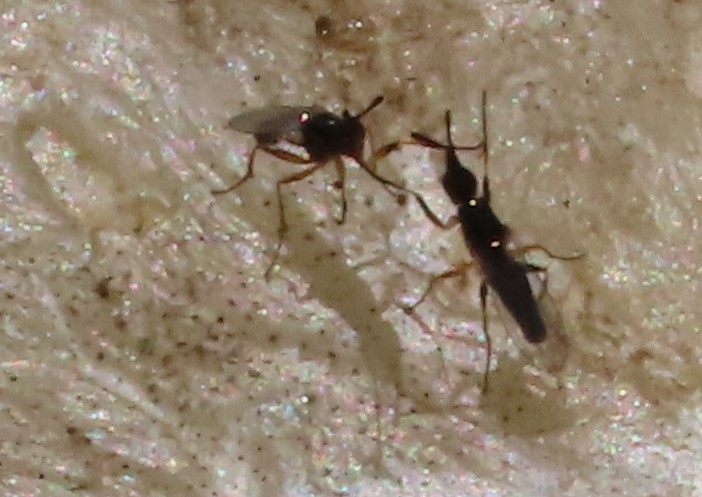
One female (top, left) and two male waltzing flies

The location of our short hike was the Mill Creek Streamway Park in Johnson County, Kansas, north of Shawnee Mission Park. We were on Nelson Island in the Kansas River for most of the time, and that is where we found the fish remains. The overstory was mostly cottonwood trees, the understory just beginning to green up.

A blow fly and at least two waltzing flies

There were the obligatory blow flies on the fish, too. I suspect the deep metallic blue insects were either Phormia or Protophormia. Without collecting specimens, fly identification is problematic. It comes down to patterns of setae, the color of thoracid spiracles, and other miniscule characters that are not usually visible in mere photographs of wild, mostly moving targets.

The smaller flies were another matter. They were so unique that once I returned home I was immediately able to identify them to species. More importantly, I learned about their bizarre behavior. About twice the size of your average kitchen-inhabiting "fruit fly," Drosophila sp., these flies were slender and long-legged, the better for running around and chasing each other, as was apparent in the field.

Male waltzing fly

Surprisingly, my hunch that they were members of the "skipper flies" family Piophilidae was correct. The most famous members of the family are the cheese skippers, named for the "jumping" maggots that infest rancid cheese, "skipping" away from danger by grasping their rear end in their mouths and suddenly releasing it, catapulting themselves vertically and horizontally. As a whole, the larvae of most species feed on decomposing fatty tissues in carrion, often after the corpse begins drying out.
Female (top) and male waltzing flies

The flies I had been observing were "waltzing flies" of the species Prochyliza xanthostoma. Their most distinguishing aspect is the sexual dimorphism between males and females. Males have greatly elongated heads, with a torpedo-shaped face and remarkably long atennae originating from the tip of the cone. Females are more....demure, or at least less comical in appareance, with a head of more normal dimensions.

Why the long face on the males? Stephen A. Marshall, in his epic tome Flies: The Natural History and Diversity of Diptera, explains:

"One of my favorite piophilines is Prochyliza xanthostoma, a Nearctic species that appears in abundance in early spring when melting snow exposes the carcasses of winter-killed animals. Males of P. xanthostoma have long antennae and a greatly elongated head that is used in ritual male-male battles for territory, during which these striking insects stand on their hind legs and engage in vigorous head-butting contests."
Dr. Erica McAlister, in her fascinating book The Secret Life of Flies, also notes the ferocity of these sparring matches:

"The males in another of the group, the waltzing fly, Prochyliza xanthostoma, have quite wonderful heads - almost conical in shape with very large and thick antennae - and they feed on animal carcasses. As their name suggests the males dance to woo the females. But they also have to defend their territories (carcasses) from other males and can have the most amazing fist fights - they really reign down punches on each other.

A female ignoring two competing males

I am now regretting not to have taken a video or two while I was there, though Heidi had long since made her way far ahead of me on the trail. Should I encounter waltzing flies again, I won't make that error of omission. Meanwhile, you might want to search for them. The species occurs over most of North America, especially the eastern half of the continent. If you are sufficiently intrigued, this Wikipedia article goes into extraordinary detail about the behavior and biology of the species.

Thursday, January 12, 2023

Wasp Webinar Presentation to Athol Bird & Nature Club

Last night I presented a webinar on "Wasps: The Astonishing Diversity of a Misunderstood Insect" to the Athol Bird & Nature Club. Here is the embedded recording from Youtube if you would like to view it. I cannot guarantee an indefinite duration for the link. Thank you.

Wednesday, December 7, 2022

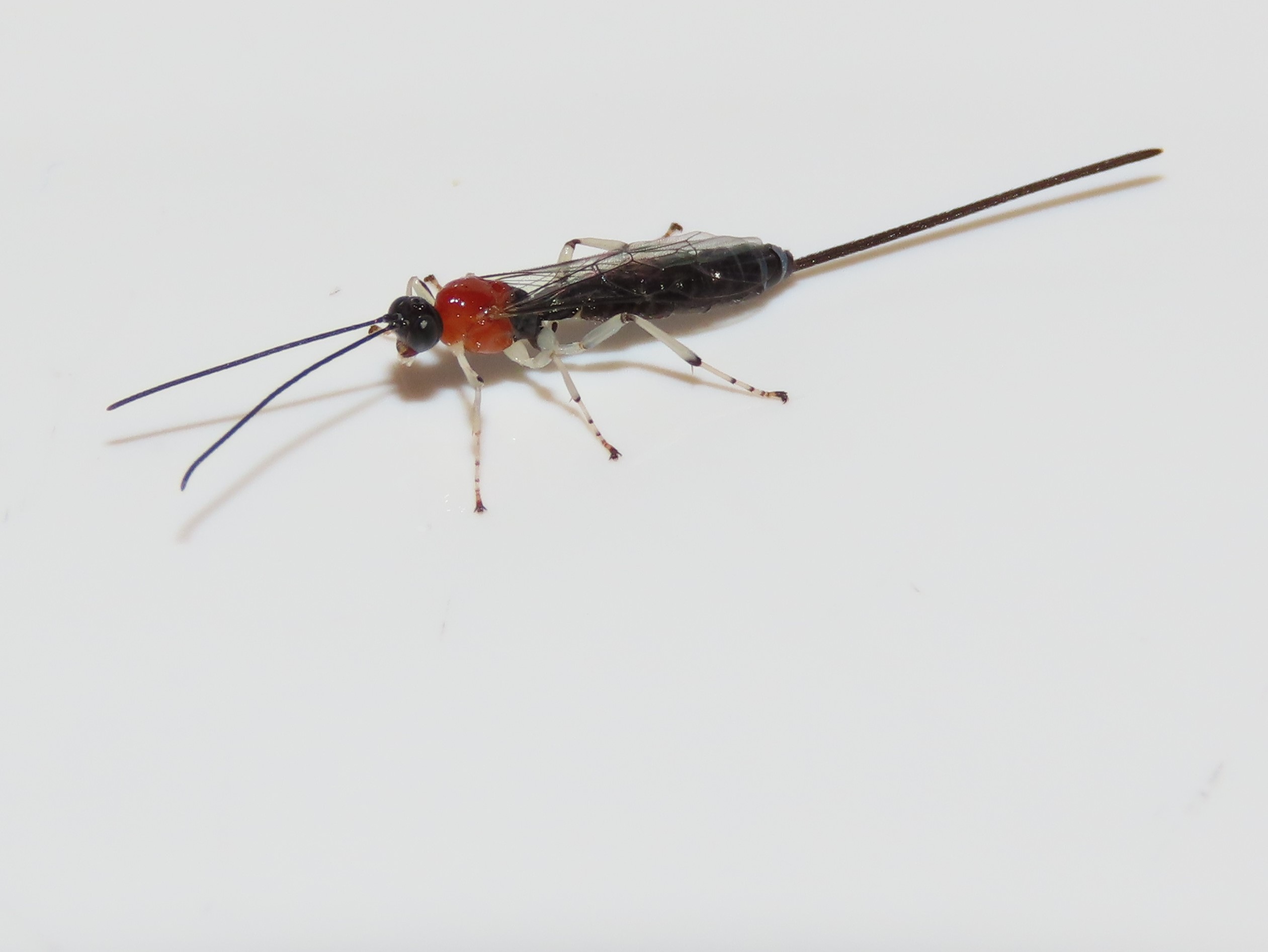
A Potential New Host Record for Calliephialtes grapholithae (Hymenoptera: Ichneumonidae) from a Paper Wasp nest (Hymenoptera: Vespidae: Polistes metricus)

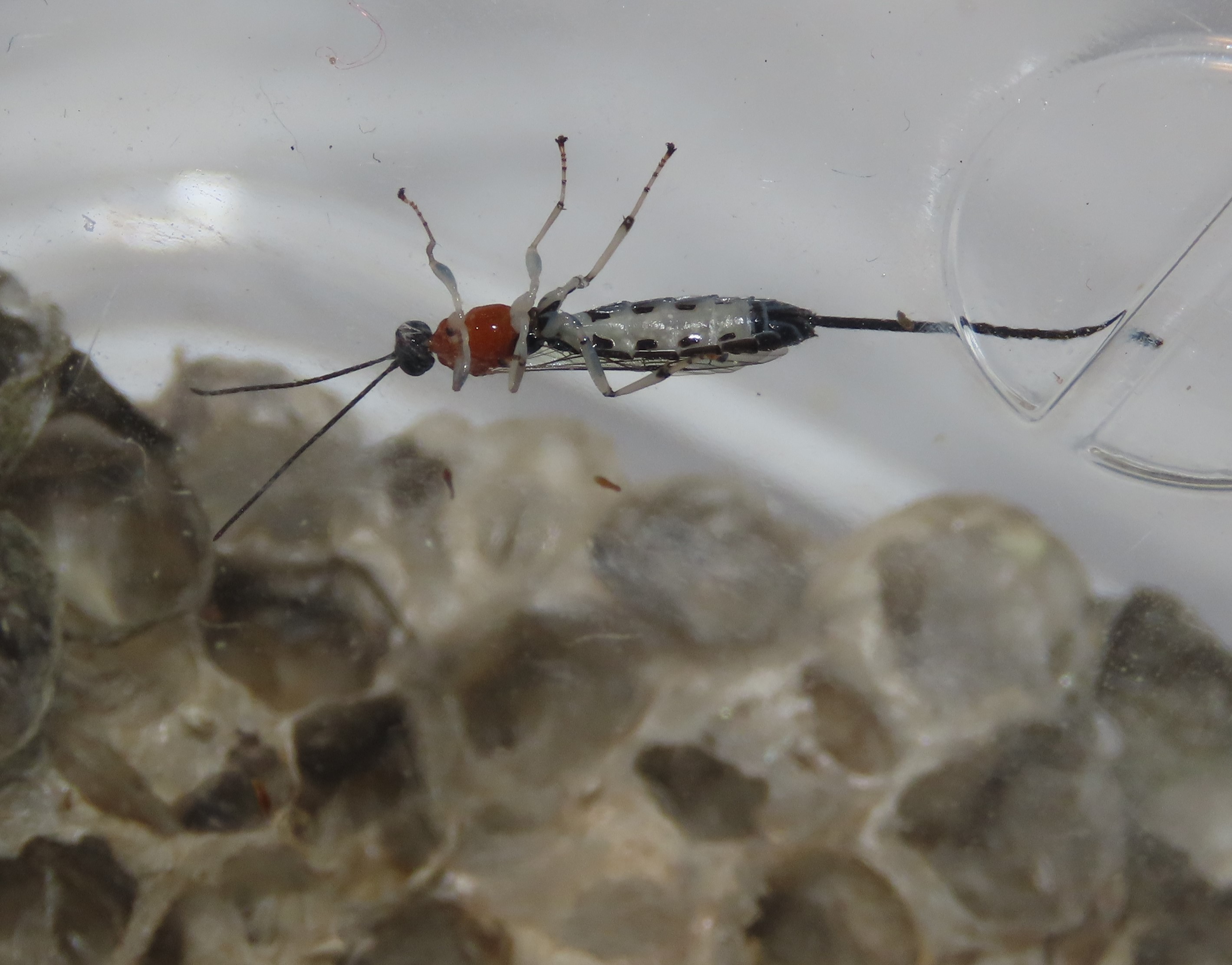
Adult female ichneumon wasp, Calliephialtes grapholithae

It started out innocently enough. Back in 2021, a Facebook post by Sloan Tomlinson (@thatwaspguy on Twitter) caught my attention. He had reared small parasitoid wasps, Elasmus polistis, from an abandoned paper wasp nest that he had contained. I messaged him to learn more, and then followed his suggestion to try this myself.

Nest of Polistes metricus from 2022

We had a nest of the Metric Paper Wasp, Polistes metricus, in a corner of the recessed frame of our back porch doors (French doors) at our home in Leavenworth, Kansas, USA. After the wasps left, I cut down the nest and placed it into a plastic container. Shortly thereafter, in about mid-November, a large number of small parasitoid wasps emerged that were not the same as those that Sloan Tomlinson had reared out. That is a separate mystery from the one I am documenting today.

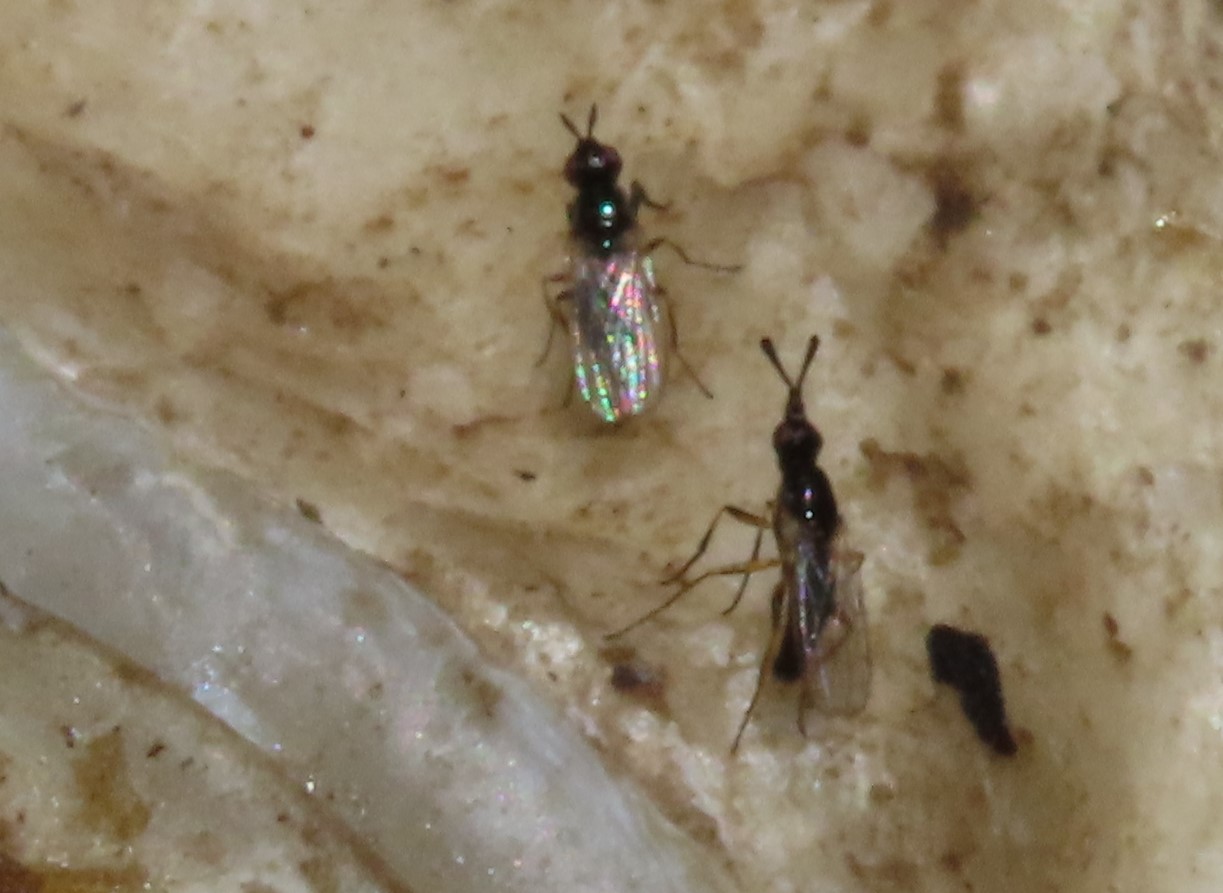
This year, 2022, we had two Polistes metricus nests, one in each corner of the door frame. One succeeded better than the other by a substantial margin, and I repeated the exercise of cutting down the larger nest and containing it in late autumn. Besides the large number of tiny, metallic parasitoid wasps, I got a shocking surprise.

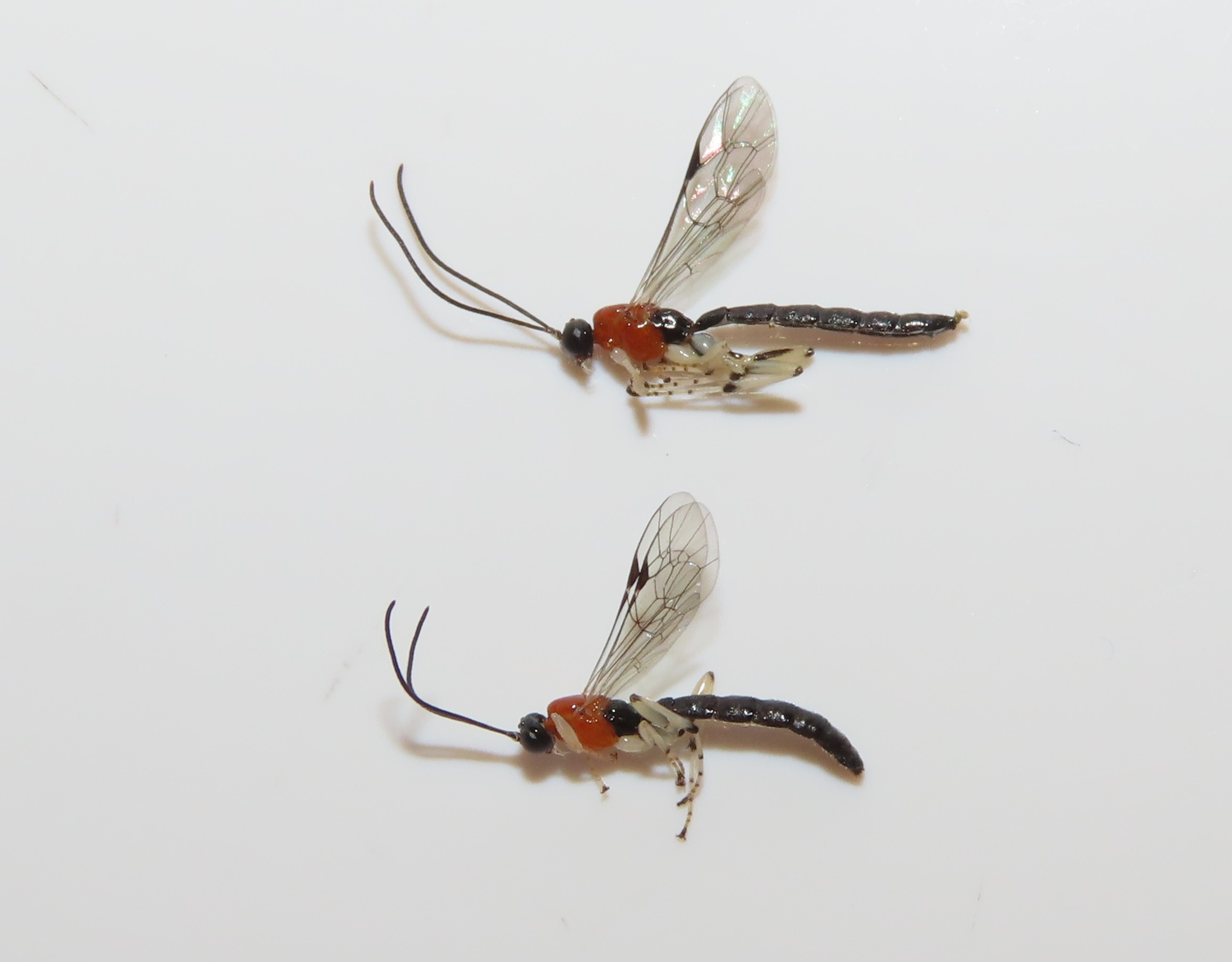
My partner, Heidi, and I went on a vacation in late October. When we returned, I was amazed to find a live female ichneumon wasp, one nearly deceased male, and one deceased male, inside the container with the Polistes nest. The insect was not one of the species that is a known parasitoid of paper wasps. I was able to identify it as Calliephialtes grapholithae, but that made no contextual sense. All of the known hosts for that species are caterpillars of moths.

Adult males of Calliephialtes grapholithae

Previously recorded hosts for C. grapholithae include larvae of the following Lepidoptera: Acrobasis betulella, (formerly A. hebescella), A. juglandis, A. rubrifasciella (recorded as A. nibrifasciella (Pyralidae: Phycitinae); Carmenta texana (Sesiidae: Sesiinae); Cydia caryana (recorded as Laspeyresia caryana, the Hickory Shuckworm, Tortricidae: Olethreutinae); Meskea dyspteraria (Thyrididae: Siculodinae); Periploca ceanothiella (recorded as Stagmatophora ceanothiella, Cosmopterigidae: Chrysopeleiinae); Thyridopteryx ephemeraeformis (Psychidae: Oiketicinae); Megalopyge opercularis, the Evergreen Bagworm (Megalopygidae). Most of these taxa represent a “concealed host,” such as the Evergreen Bagworm and Hickory Shuckworm.

The only way the association of C. grapholithae with paper wasps can be made is if there is a moth larva involved in some fashion. It so happens that there is. The Sooty-winged Chalcoela, Chalcoela iphitalis, is such a moth (Crambidae: Glaphyriinae). The caterpillar stage is predatory on the larvae of Polistes wasps, inside their nests. Webbing spun by the caterpillars is a clue to their presence. Apparently, the adult female moth approaches the nest at night, when the adult wasps are less alert. Still, she may lay her eggs on the back of the nest, and let her tiny larval offspring find their way into a cell.

Caterpillar of Chalcoela iphitalis from paper wasp nest

Sure enough, I happened to notice one of these moth caterpillars, strikingly similar to a paper wasp larva, in the bottom of the container with the nest and its other associates. There is little doubt in my mind that C. iphitalis is a host for the ichneumon wasp Calliephialtes grapholithae. The pattern of this wasp seeking concealed hosts fits, though how the wasp navigates a well-defended nest of paper wasps is beyond my imagination. I am hoping that such an infiltration can be documented, or that someone else will independently rear the ichneumon from a paper wasp nest. Until that time, I cannot assert, unequivocally, the host relationship.

Adult Chalcoela iphitalis moth

I also wonder if the sever drought experienced by eastern Kansas this past summer had anything to do with the proliferation of the moths that plague the paper wasps. I noticed more than usual. One of the two nests almost failed completely, though one of the foundress wasps may have died prematurely, slowing the nest’s rate of growth, eventually halting it.

Much remains to be discovered about even the most common of insects, especially when it comes to ecological relationships to other species. I urge my readers to undertake what observations and experiments they can to further enlighten our understanding of the natural world.

Sources: Carlson, Robert W. “Database of Hymenoptera in America north of Mexico,” Discover Life
Hoskins, Jonathan. 2021. “Species Calliephialtes grapholithae,” Bugguide.net
McCormac, Jim. 2017. “Wasp-eating moth fills rare niche,” Ohio Birds and Biodiversity
Calliephialtes grapholithae,” iNaturalist.org

Sunday, November 6, 2022

The Changing Conversation Around Invasive Species

Recently, the debate about invasive species has become more polarized than ever, with a degree of defensiveness and anger not seen previously. The reasons for this are many, some difficult to admit to.

Chinese Clematis may be invasive, but it deserves a less bigoted name.

I attended a webinar a few weeks ago in which the presenter asserted that “invasive species” is a “militarized term.” My instinctive reaction was that this was accusatory, bordering on defamation of science, when there is clear evidence that the introduction of a species to a new ecosystem can have devastating consequences.

Spongy Moth is still a bonafide forest pest, but now has a more appropriate moniker.

Pondering his comment further, it occurred to me that most of the animals, and plants, we label as invasive have some sort of obvious and negative economic impact. We have, as a consumer culture, become conditioned to frame everything in terms of business and monetary interests rather than ecological concerns. This has become more complicated by angst over climate change, and the resulting vulnerability of humanity to emerging threats, be they viruses or “murder hornets.”

20200512-P1090983 Vespa mandarinia japonica
© Yasunori Koide and Wikimedia Commons. Asian Giant Hornet only "murders" in the beehive, but is a serious threat to apiculture because of that proclivity.

The sudden, and/or overwhelming appearance of a novel organism is going to cause alarm, and the public seldom has comprehensive, appropriate knowledge for interpretation of potential impacts. We are at the mercy of what news outlets tell us. Because traditional print, radio, and television media now compete with social media, sensationalism is the order of the day. “Click bait” banners prevail over more accurate but less provocative headlines.

© Kim Fleming and Bugguide.net. Joro Spider, Trichonephila clavata, is not currently considered invasive.

Initial forecasts can also be premature. The jury is still out on whether some recently-introduced species will become problematic. They may not. The Joro Spider is a case in point. It is locally abundant in some parts of the southeast U.S., but whether this translates to a displacement of native spiders remains an unanswered question.

We collectively have a fascination with heroes and villains, too, and there are no more menacing villains than alien-looking insects, spiders, and other arthropods. Fantasy melds with reality and it becomes difficult to separate the two if you are not scientifically literate, or have a business model that demands public hatred of a particular creature.

© USDA ARS, public domain. Spotted Lanternfly, Lycorma delicatula, adult and nymphs. This species is a potential agricultural pest of serious magnitude.

In opposition to nativism is the idea that there is no such thing as invasive species. After all, man is part of nature, and therefore our actions are natural processes. The outcomes of those activities are circumstances to which we, and other species, will adapt.

It may be no coincidence that a backlash against the idea of invasive species is more evident now that we are recognizing, and attempting to mitigate, a history of colonialism. A convincing argument could be made that White settlers are the original invasive species. Here, in North America, we annihilated and displaced Indigenous members of our own species. We enslaved others. To this day we continue missionary work and other forms of colonialism. Therefore, the idea of invasive species becomes one of self-loathing, certainly an eventual threat to White supremacy and privilege. White people do not want to see themselves as villains.

Meanwhile, we demonize human immigrants and refugees as criminals and threats to domestic labor pools. We clamor for the closure of borders to our fellow humans, but allow our boundaries to be permeated by everything else. Not that human-imposed boundaries reflect natural ones.

The Cross Orbweaver, Araneus diadematus, is an example of a naturalized arachnid in North America.

Scientists have an uphill battle in resolving these opposing perspectives and initiating constructive dialogue. Looking to the past we see how some species from foreign lands have become “naturalized” over time, becoming innocuous additions to our flora and fauna. The average citizen may be shocked to learn that dandelions are not native to the U.S. They have become a fixture in our lawnscapes, even if we are instructed to use weed-killers against them.

Myrtle Spurge, aka "Donkeytail," Euphorbia myrsinites, is classified as a noxious weed in some jurisdictions, but not everywhere.

What is lost in all of this is attribution of the modern problem of invasive species to global consumer culture. Historically, human colonists brought other species with them as a guarantee of food and other necessary resources when venturing into unknown territory. Soon after, those species and their products became valuable in trade, a way to establish meaningful and positive relationships with Indigenous peoples, or other settlers. The pace of travel was slow, and the scale of enterprise miniscule compared to twenty-first century business.

Today, we mostly covet plants and animals of far-off lands. Plants, especially, can harbor potential insect pests. The containers used to transport international commerce are frequently occupied by insects, rodents, and other organisms. We seldom make that connection between our consumer habits and the state of ecosystems around the world.

Captive Reticulated Python. Release of unwanted Burmese Pythons into the Everglades by irresponsible pet owners has been....problematic.

We cannot turn the clock back, but we should make more informed and conscientious individual choices in the marketplace. We should promote the welfare of Indigenous peoples, and actively seek their counsel and leadership in crafting a world better able to withstand climate change. A permanent end to colonialism would not be a bad thing, either.